
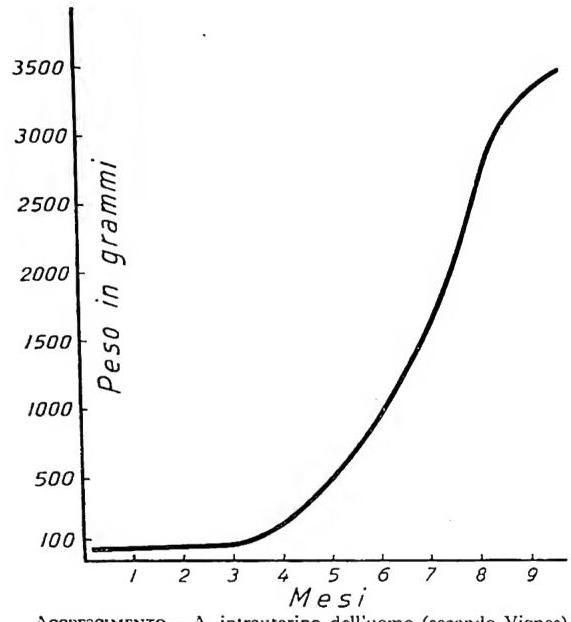
ACCUCRISCIENTO — A. intrauterine of man (according to Vignes)
The increase in size of the human embryo is due both to the formation of internal cavities and, above all, to the fact that the cells deriving from the division of a cell grow until they reach the dimensions of the mother cell; moreover, the formation of embryonic tissues with a notable quantity of intercellular substance (mesenchyme) is another cause of such growth. From the mesenchyme will derive the connective tissues in which the interstitial part, between the cells, the part produced by the cells but not living, acquires a notable prevalence over the cellular part.
Cellular reproduction does not maintain a uniform rhythm in all the tissues of the embryo: fundamental in this regard are the studies of Bizzozzero and his classification of tissues into tissues with permanent elements (which cease early reproduction, such as nervous tissue, and no longer have the ability to reproduce), tissues with stable elements (which cease their reproductive activity with the end of bodily growth, such as, for example, the liver and other glands), and tissues with labile elements (which continue to reproduce even after the phase of bodily growth throughout life, to compensate for their continuous functional wear, such as, for example, the epidermis and blood).
Accretion is studied by relating weight or volume to age. Each organism has its own rhythm of growth, and in general, well-defined periods of slowing and acceleration are noted in relation to the activity of particular endocrine glands (hypophysis, thyroid, thymus, gonads). According to Quetelet, in man there is a maximum of growth from the 6th to the 8th month of intrauterine life and postnatal maxima around the fifth and a half year and around the 15th–16th year, the time of puberty.
If one represents the growth curve of the most varied organisms, or of organs or parts of them, one observes how it has the form of an S. This curve has been compared to those of auto-catalytic monomolecular reactions (Robertson, Ostwald). D'Ancona highlights the similarity of the curves of all those phenomena that are self-limited by the state they themselves provoke; just as in auto-catalytic reactions there is self-limitation due to the production of the substance itself, in organisms the limitation is given by the differentiation of tissues.
In the growth of organisms, each phase of differentiation is characterized by a slowing: sexual maturity causes the most conspicuous slowing or the cessation of growth. In some cases, such as in lampreys (Cotronei), there may even be a reduction in body size. In addition to hormonal factors and other internal factors, external and environmental factors act on growth: the quantity of food, temperature, the quantity of oxygen, and space are those most directly connected.