TRIPOLITANIA. - North-western region of Libya (v.), facing the Mediterranean between Tunisia and the Syrtis.
When the Christian faith began to spread in the region now called T., which corresponds only in part to the "provincia Tripolitana" of the Diocletianic organization, cannot be stated with certainty.
The designation "apostolic" given to certain mosques of the Gebel Nefusa, evidently derived from an identical designation borne by certain Christian churches pre-existing the mosques, already led to doubt whether the first Christian preaching in the region should be traced back to apostolic times, or to those immediately following; and the same hypothesis would seem to be supported by the expression used by Bishop Archeus of Leptis in speaking of himself: "qui post discipulos Domini episcopus fuit Leptitanae urbis": except that, while the first designation must certainly be explained in the sense that those churches were dedicated to the Apostles (of the frequency in Africa of the cult of Sts. Peter and Paul there are manifold testimonies) and not founded by them, the second expression may also have had a vaguely generic meaning. So that, while not excluding — indeed, considering it very probable — that the Good News reached T. quite early, especially in view of the close relations between it and neighbouring Cyrenaica, and that it reached it both directly from the East and from Rome, it does not seem plausible to admit that genuine Christian communities were formed in it before the 2nd century: and the first of such communities could only have been that of Leptis, a maritime city in active commercial and cultural relations from the age of Augustus, and perhaps even earlier, with Greece and Egypt no less than with Rome: for Leptis we have the first certain mention of a bishop in the already-mentioned Archeus, author of a treatise on the date of Easter, who lived in all probability in the time of Pope Victor. Centres for the reception and diffusion of the new faith must have been the many Jewish colonies of the coast and the interior, to which the destruction of Jerusalem first, and then the Cyrenaic revolt of Trajan's time, certainly gave a large increase.
In the middle of the 3rd century, at the Council of Carthage of 256, the Tripolitanian bishops are four: two present in person, Natalis of Oea and Monnulus of Girba (on the island of Gerba in the Lesser Syrtis, today part of Tunisia), and two represented by their colleagues: Dioga of Leptis Magna and Pompeius of Sabrata: episcopal sees are therefore the three cities of the coast, which give their name to the region, plus the island of Gerba. Already at this point there becomes evident what would remain also in later centuries the characteristic of T. as compared with the other regions of Roman Africa, namely the scarcity in it of episcopal sees, all the more singular in that they appear instead more numerous and dense in the rest of Africa; a scarcity that evidently must be related to the equal rarity of urban centres regularly constituted as city communities. To the four sees already mentioned another is added later, that of Tacape (today Gabès in Tunisia), and five such sees would thereafter always remain, as is expressly noted from the Acts of the Councils. The five sees are all on the coast; for the interior, where, as will be said further on, the remains of Christian monuments are anything but rare, the testimonies are less clear, but it does not seem possible to doubt that at least some of the stations of the limes Tripolitanus also had this dignity: certainly Turris Tamalleni had it, where indeed the existence of an urban centre is known, which became a municipium under Hadrian; so perhaps, judging from the analogy of the name of certain of these stations with that of certain sees mentioned in the Acts of the Councils, Thenteos also had it, today identified at Gasr Duib, south-east of Qintan (Journ. of Rom. Stud., 1949, p. 88 ff.), Augemmi and others: except that, since the Acts of the Councils just mentioned explicitly attribute five bishoprics to T., it is to be believed that these sees of the interior were included in a different ecclesiastical region, namely in that denominated Arzugitana or Arzugis, united with and dependent not on T. but on Byzacena, perhaps because from them it was easier to communicate, under cover of the defences of the limes, with the latter than with the former (v. also W. Goodhild, in Journ. of Rom. Stud., 1950, p. 30 ff.). Moreover the remoteness, almost the detachment of the lands between the two Syrtes from the rest of Roman Africa, the difficulty of communications and relations between the latter and T., are characteristic traits of the Christianity of this region, which very often surface or are emphasized in the texts and in the Acts of the Councils.
This did not prevent the Donatist schism from having also in T. its followers and its struggles, of which distant and vague reflections are caught: at the Maximianist Council of Cabarsussi in 393 three Tripolitanian bishops took part, and two others were represented; at the great Carthaginian assembly of 411 some of the Tripolitanian sees appear with two bishops each: one Catholic and one Donatist, others with only one, either Catholic or Donatist. However, of Tripolitanian Donatism the epigraphic testimonies are so far limited to a few inscriptions found at Henscir Taglissi south of Garian (Inscript. Rom. Trip. [v. bibl.], 803).
Having come after 455 into the possession of the Vandals, T. also suffered the harshness of the Arian persecution: Victor of Vita recalls two Tripolitanian bishops, Vincent of Sabrata and Cresconius of Oea, sent into exile by Genseric, but the second appears in 484 again at the head of his Church; at the Council of that year the region still sends all its five bishops: it is the last time that it appears with its representation complete. At the subsequent councils such representation will be far more limited, if not sometimes altogether absent: undoubted proof, perhaps not so much of poverty as of the difficulties in which Christian life was carried on in the region.
A recovery it had with the Byzantine reconquest, and not only in the cities that Justinian enriched with new churches, but even in the furthest interior, where, according to the testimony of Procopius (De aedif. VI, 4), the inhabitants of Cydamus (Gadames) and the Garamantes of Fezzan were converted to the faith of Christ. The episcopal sees must have remained the same, judging at least from the list of African bishoprics appended to the so-called Θρόνος ἀλεξανδρίνος, a list that seems derived from a document of the first half of the 7th century, immediately preceding the first Arab invasions: in it the Tripolitanian bishoprics are four; Leptis, Oea and Sabrata are read correctly, the fourth, Τερέπτον, is certainly corrupt and could be restored either with the name of Gerba or with that of Tacape. It is the last mention we have on the matter.
It is moreover to be believed that the first Arab invasion of the 7th century, just as it did not substantially change the physiognomy of Africa, as regards what still remained in it of its Roman character, so did not extinguish in it what still remained of Christian life: Christian nuclei continued to live first in the cities, at Leptis and at Oea, then on their margins, like that whose burial ground has been found at En Ngila, and in the interior, among the Berbers. Whether these Christian nuclei still elected bishops, and how many, is not known: in any case it was only the Hilalian invasion of the 11th century that annulled and definitively dispersed every Christian remnant.
Against the notices, certainly not copious, that are gathered from the written sources, stand to shed light on Tripolitanian Christianity the numerous monumental testimonies that archaeological explorations have brought to light, which testimonies extend equally to the cities of the coast, sees, as has been seen, of episcopal thrones, and to the interior of the region. As regards the cities, v. LEPTIS MAGNA.
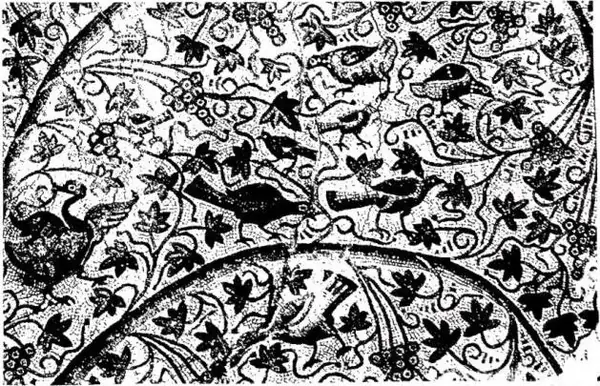
At Sabrata two large churches stood to the south and north of the Forum: the first had been adapted in the early years of the 5th century into the pre-existing judicial basilica; it is a very complex building, with a double apse, a baptistery and many tombs with inscriptions; the second, certainly to be identified with the one of which Procopius speaks (op. cit.), was adorned with mosaics, among which particularly precious is that of the central nave. Two other smaller churches, forming with their respective baptisteries and many tombs within a single complex, are to the north of the theatre. Finally a catacomb, with loculi, graves, earthen burials and arcosolia, inscriptions and symbols painted or in mosaic, was found to the north of the great quarry that precedes the amphitheatre: the oldest core of it is perhaps to be traced back to the end of the 4th century.
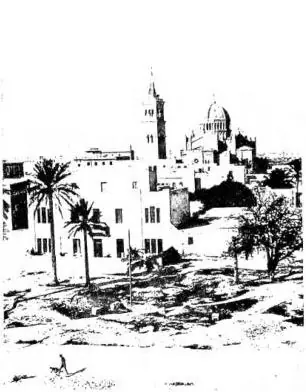
Of Oea, present-day Tripoli, no building survives, but only scattered architectural remains, among which a column with an invocation to Mary and the archangel Gabriel scratched upon it; a small Jewish hypogeum with inscriptions, consisting of a short gallery cut into the sandstone, was discovered near the beach of Sciara Sciat, but it has been almost entirely lost during the Second World War. But in the region immediately adjacent to the city there are the two large and important cemetery areas of Ain Zara and En Ngila. Both in zones of shifting dunes present the same type of tombs, consisting of a rough masonry mound of elongated shape and rounded at the top: on the plaster covering the masonry, inscriptions and symbols are scratched: the date of the two burial grounds is, however, quite different. In the first, 121 tombs were recognized, but there were certainly more: the inscriptions give the name of the deceased, his praises, the date of death, always expressed with the mention of the indiction, and some phrases of good omen and blessing: of interest are certain Virgilian reminiscences. The symbols are crosses, fish, doves, etc. The recurrence of the trisagion sung at the Council of Chalcedon (451) and the emphasis that seems to be recognized in an epitaph on a violent death by persecution, besides other elements, led Aurigemma to date the burial ground to the Vandal period, that is, between the 5th and 6th centuries.
Much later, on the other hand, appears the cemetery of En Ngila, whose inscriptions, which have a more complex phraseology than those of Ain Zara and many references to the sacred texts, sometimes bear a date counted from the creation of the world: on the basis of the Constantinopolitan era, the dates given lead back to the second half of the 10th century and the beginning of the 11th, therefore precisely on the eve of the Hilalian invasion: it is known in fact from el Bekri that at that time groups of Christians lived in the countryside around Tripoli.
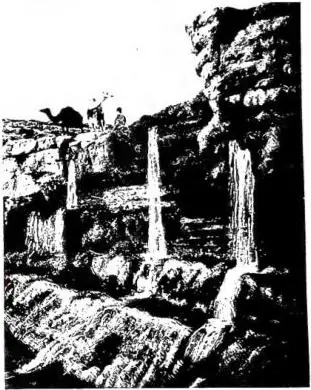
Of an entirely different type is the Christian cemetery of Sirte. It is a catacomb cut into the sandstone and consisting of a gallery 4 m. wide and 31.65 m. long, with a flat vault supported by three pillars hewn from the rock itself. The dead were at first deposited in loculi opened in the walls, then also in earthen graves and in tombs leaning against the walls themselves; the inscriptions, in the great majority in Latin, a few in Greek (47 and 6 respectively), are very simple, bearing only the name and age of the deceased; often they are accompanied by the crimon, of a form that can be dated to the end of the 4th century; and this is probably the age of the hypogeum; in it were collected more than two hundred lamps, in one of which is the image of St. Peter.
In the inland regions two churches were explored at el-Asabaa on the Gebel Garian, and near the village of Breviglieri at Tarhuna. The first, perfectly oriented with its front to the east, has a deep narthex, three naves divided by columns, an altar at the end of the central nave, a raised apse; in this is the tomb of a predytter Turrentius and other burials; behind the apse the baptistery. Numerous stone corbels, adorned with crosses, rosettes, Solomon's knots, supported the roof beams: from the style of these and from the coins found in the excavation the building can be dated to the beginning of the 6th century, before the Byzantine reconquest.
Of the church in the region of Tarhuna only summary notices are so far available: it was a building not large (about 17.60 × 11.75 m.) but of good construction, it had three naves, the side ones narrower and shorter than the central one, divided by columns, and all ending in an apse: the central apse was raised; corbels supporting the roof and capitals bear signs and figures of Christian meaning; annexed was the baptistery with a lobed-cross basin and a circular font; the probable date is the 6th century. The church was part of a larger complex, perhaps a fortified monastery. A third church has been recognized at Gasr Chafagi Aamer in the region of Soffegin: it too has three naves with the central one longer and closed by an apse, the side ones ending in small rooms communicating with one another through a crypt beneath the apse. At the rear of the church a vaulted gallery, and nearby the baptistery and another building with small cells (I. Gentilucci, in Africa Italiana, 5 [1933], p. 172 ff.; D. E. L. Haynes, Ancient T., p. 112 ff., pl. 30). Other Christian buildings finally have been reported at Tebadut, not far from el-Asabaa, at Rumi bis-el-Cur, east of Garian, at Ain Wif, south of the Tarhuna-Garian road (Journ. of Rom. Stud., 1929, p. 84) and perhaps at Giamat near Chicla; architectural or inscribed fragments in the Gebel Nefusa, at Gadames, etc.; hypogea at Tarhuna and Gasr Doga, also in the Tarhuna area (Papers of British School of Rome, 1951, p. 64 ff.). - See pls. LV-VI.