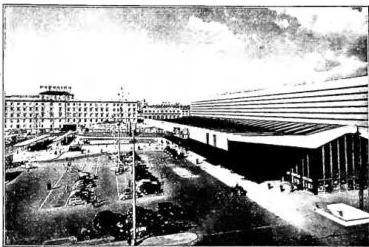
ROMA. - Metropolis of the Roman world, capital of the Papal State and then, from Feb. 3, 1871, of the Italian State (law no. 33, art. 1), it is the center of Catholicism as the episcopal see of the Roman Pontiff:
A) ANCIENT AND IMPERIAL ROME.
I. NAME AND GEOGRAPHICAL SITUATION.
I. NAME
It certainly derives from the Etruscan word rumon = river (W. Corssen, I. Guidi, G. De Sanctis, Fr. Altheim) given to the Palatine settlement because of its proximity to the Tiber, almost identifying it as the "city of the river."In the south-west area of the Palatine, which is the closest to the Tiber through the marshy Velabrum, are gathered the oldest memories of the city associated with that word: the Porta Romana or Romanula (Varro, De lingua lat., V, 164; Festus, s. v.), located in the R. quadrata, at the exit of what was later called the Clivus Victoriae, which is also found in the name of the Porta Flumentana in the corresponding place of the later wall known as the Servian wall; the ficus ruminalis, which stood near the Lupercal and was transferred for magical prestige by the augur Attus Navius to the Comitium; Diva Rumina, who had her own sanctuary on the Palatine Hill. Etymologies from the Greek ῥώμη = strength; from the Latin ruma = breast, for the two highest peaks of the Palatine, the Germalus and the Palatium; or from the Etruscan gens of the Ruma (W. Schulze, G. Herbig) are to be dismissed. In Roman tradition, R. also had a name kept secret for fear that it might be known and magically invoked by the enemy to the detriment of the city. The secret concerned either the name of the city (Pliny, Hist. nat., III, 65; Servius, Aen., I, 277; Macrobius, Sat., III, 8; John Lydus, De mens., IV, 73), or its protecting deity (Pliny, Hist. nat., XXVIII, 28; Plutarch, Quaest. Rom., 65; Servius, Aen., II, 351; Macrobius, Sat., III, 8).
Valerius Soranus, who made public the true name of R. (Pliny, Hist. nat., III, 65) or, according to Plutarch (Quaest. Rom., 61), that of the protecting deity, was punished with death for II. According to John Lydus (De mensibus, IV, 73), the secret name of R. was Flora, deity of fertile nature (Flora mater), served by her own flamen (flamen Floralis), venerated in her own temple on the Quirinal; in myth she was considered a courtesan who left the Roman people heir to her wealth. According to A. Brelich, Flora and other similar deities (Acca Larentia, Pales, Ops Consiva, Diva Angerona), despite the differences in their figures, played the role of secret protecting deities of R. by virtue of their original meaning of fertility, from which the city had to draw, as from an inexhaustible spring, the reasons for its existence.
II. GEOGRAPHICAL SITUATION
Located at 41° 54' N lat. and 12° 29' E long. (Greenwich), with coordinates calculated at the Observatory of the Collegio Romano, the city, center of Mediterranean civilization, occupies a privileged position in the peninsula and in the Mediterranean Sea.Set in an alluvial plain through which meander the curves of the Tiber and the volcanic offshoots of the Sabatini and Alban Hills which, together with the Prenestini Mountains and the Tyrrhenian coast, enclose it within its
(fot. Albani)
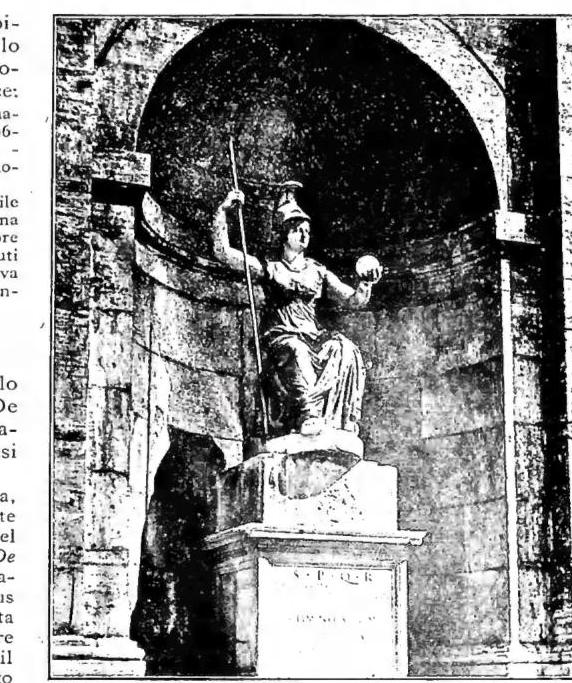
ROMA - La des R. Status marmorea di arte imperiale - Roma, Palazzo Senatorio Campidoglio.
external lines, R. records at various points altitudes ranging from 15 to 80 meters a.s.l. From the primitive city on the Palatine to the current urban complex, the growth it underwent over the centuries was enormous. While the great communication routes belong to the Republican era, the city's development was more rapid during the Empire; the 16th century was the period that saw the beginning of the great constructions of papal R., while only at the end of the 19th and the beginning of the 20th century did the great transformation begin that has almost totally modified the appearance of R. From 210,000 inhabitants in 1870, the population rose to 400,000 in 1900 and to over a million and a half in 1950 (1,599,894 in 1951). This enormous increase, which exceeds that of all Italian cities, is due, in addition to high birth rates, to considerable immigration from every region of Italy. Ecclesiastically, the population of R. is divided into 136 parishes, grouped into 16 prefectures. The climate, very pleasant, presents an average of 7° in the coldest month (Jan.) and 25° in the warmest (July). Within its territory is the seat of Vatican City State; moreover, all the departments of state administration, government and ecclesiastical universities, major banks, bodies, institutes, etc. are located here. Among the few industries, building and printing are fundamental. In recent decades, the movement of its port (the river port of S. Paolo and the canal port of Fiumicino) has registered notable progress. Gastone Imbrighi
II. ARCHEOLOGIA.
SUMMARY:
I. Origins and Regal Age
II. Republican Age
III. Augustan Age
IV. Imperial Age.I. ORIGINS AND REGAL PERIOD
Its foundation was fixed by Varro on April 21 of the year 753 B.C.; this traditional date must be attributed a relative and approximate value, certainly somewhat later than reality.In Latium, formerly a marine gulf filled in during the Tertiary era by the volcanic eruptions of the Alban and Ciminian Mountains and by the alluvial deposits of the Tiber, man appeared in the Quaternary age when, having already emerged from the primitive stage of Paleolithic civilization, he had progressed into the Neolithic. The earliest inhabitants of the Latium region were the Mediterranean Ligurians, who practiced the rite of inhumation (2nd millennium B.C.). In the
transition from the Bronze Age to the Iron Age, as life in Latium became less fearful due to the cessation of the volcanic activity of the Alban Mountains, between the 10th and 9th centuries B.C., there occurred an incursion of peoples of northern origin, akin to the terramaricoli of the Po Valley, of Aryan race, speaking an Indo-European language and observing the funeral rite of cremation, who, attracted by the fertile and rewarding soil, settled there, giving rise to the Latin people. This people, produced by the mingling of Mediterranean autochthons with the new Aryan population—with the latter, being more evolved, predominating—assumed a stable character in Latium. At the end of the 8th and the beginning of the 7th century B.C., a more advanced phase of the Latian Iron Age civilization began, with overseas influences and contributions, in the period known as Orientalizing. Meanwhile, a league of the various population centers inhabited by the Latins had been formed, the Alban League, headed by Alba Longa. The confederated villages, which rose in elevated places for the defense of flocks and herds from raiders, numbered 31 according to Pliny (Nat. hist., III, 69, 70). Meanwhile, Rome was being born. Near the wide loop formed by the Tiber, a short way downstream from the confluence of the Aniene, a short distance from the sea, villages arose on tufa hills, cut by water erosion, rising above the surrounding marshy plain, isolated and easily defensible, almost inaccessible, and covered with dense oak woods (mons Querquetulanus), beechwoods (Fagutal), and osier beds (Viminalis). The site, eminently strategic and suited to commercial traffic, attracted both the Latins of the Alban hills and the Sabines of pre-Aryan Mediterranean stock; the latter, descending from their mountains, traded by river with the Umbrians and, via the Via Salaria laid out by them, pushed as far as the mouth of the Tiber to supply themselves with salt. Archaeological findings with the discovery of burial grounds and dwelling wrecks demonstrate that between the 10th and 8th centuries B.C. hut villages (pagi or oppida) stood on the hills of Rome; Latin stations on the Palatine (Germulus, Palatual, Velia), the Esquiline (Fagutal, Cispius, Oppius) and part of the Caelian (Querquetual or Sucusa); Sabine ones on the Capitoline, Quirinal, and Viminal. The Aventine perhaps continued to be inhabited by Mediterranean Ligurians. On the village of Germulus (Palatine), the square Rome of the mythical founder Romulus, 8th-century B.C. pottery furniture has been identified. In the necropolis of the Forum, extending from the foot of the Esquiline toward the Capitoline, the most ancient tombs date back to the 9th century with the presence of habitation-shaped ossuaries (hut urns); its expansion descends as far as the 7th century. The Esquiline necropolis is more recent, not going beyond the 7th century; it has more rudimentary objects and reveals no trace of Oriental or Hellenic trade. After a first union into a single political center of the pagi of the Palatine and the Esquiline, the seven villages constituted over time their own federation (lega septimontialis) with a religious and political background and for the protection of common interests. It flourished in the middle of the 8th century, in which legend places the reigns of the Latin Romulus (753-717 B.C.) and the Sabine Numa Pompilius (717-673 B.C.). The myth of Romulus was formed in Rome by deriving the name Romulus from Rome itself; the legends of Aeneas, of the 12 Alban kings, of Rhea Silvia, and of the Twins were imported to Rome by Greek erudite historians of the 4th century B.C., after the conquest of Campania, applying analogous Hellenic myths to Roman myths, among which was that of Tyro, daughter of Salmoneus violated by Neptune on the banks of the Enipeus, whose abandoned twins were given to be suckled by a goat. To the first two kings of Rome are attributed the institution of the Senate, of the three tribus, and of the 30 curiae into which the new city was said to have been divided, the promulgation of laws, and the institution of cults and priesthoods. The latent dissension between the Septimontium union and Alba Longa ended with the submission and destruction of the latter and the transport of its inhabitants to the Caelian hill; this is said to have happened during the reign of the third king of Rome, Tullus Hostilius (672-641), who gave his name to the meeting place of the Senate, the Curia Hostilia, in the Forum. The Septimontium federation, having become by virtue of its position, its industries, and its commerce the most important state of the Latin League, took the place of Alba Longa as capital and began the unifying conquest of the nearest inhabited centers. To the fourth king Ancus Marcius, grandson of Numa Pompilius (639-616 B.C.), is attributed the regulation of the declaration of war with the institution of the Fetiales and the foundation of Rome's first colony at the mouth of the Tiber (Ostia).
With the end of the 7th century and the beginning of the 6th, one enters a more certain and documented period in the history of R., a period of subjection and at the same time of significant progress. The Etruscans, at the peak of their power, already commercially connected with R. through the Tiber and the wooden pons Sublicius downstream from the Tiber Island, invade and submit the Roman territory and Latium, pushing as far as Campania. Their domination lasted until the end of the 6th century. Great founders of cities, R. owes to them its transformation from a federation of pagi to the unity of the urbs (an Etruscan word). National tradition proudly refused to recognize foreigners as the true founders of the city. The names of the Latin and Sabine kings appear only in the tale of legendary tradition, while those of the Etruscan kings are documented by historical monuments; the names of Tarchia (Tarquinius) and Mastarna (Servius Tullius) appear in the paintings of the François tomb at Vulci from the 4th century. The very name of R. is derived from rumon, an Etruscan word indicating a watercourse, that is, the city of the river. Furthermore, the rites of the foundation of the city are taken from Etruscan discipline. Tarquinius Priscus (616-579), an Etruscan of Greek origin who combined Etruscan practicality with Greek genius, is the great transformer of the city. He reclaimed the marshy valleys among the seven hills with the construction of sewers channeling the waters to the Tiber, and decreed the construction of defensive walls for the entire inhabited area, in stone, in the parts not naturally defended. Once the swampy grounds between the Palatine, the Capitoline, and the Quirinal were reclaimed, the construction of buildings and houses became possible, as well as the creation of the Roman Forum and the Forum Boarium for assemblies and markets. By a vow made in war against the Sabines, Tarquinius Priscus began the construction of the temple of Jupiter on the sacred Capitoline hill and created in the Murcia valley, between the Palatine and the Aventine, the Circus Maximus, to celebrate the Ludi magni of the Roman people. Stripping the patres of the Senate of their authority, a radical constitutional change was introduced tending toward the absolute rule of the king, according to the Etruscan tradition regarding the head of state. The twelve lictors carrying the fasces who accompanied the king were perhaps a symbol of the twelve Etruscan lucumonies. R., under Etruscan rule, in addition to being an increasingly important trade center, became an industrial city; under the guidance of Etruscan artisans and workers, it began craft activities in the fields of metallurgy and coroplastics. Servius Tullius (575-535 B.C.), who succeeded Tarquinius Priscus, favored by the latter's wife, Tanaquil, proceeded to divide the classes of citizens, creating a plutocratic organization and regulating the collection of taxes and draft operations. To this end, Servius Tullius allegedly modified the system of dividing citizens into tribes and gentes by introducing a system of partitioning on a topographical basis. R. was divided into 4 regions: Palatina (Palatine), Suburana (Caelian), Collina (Quirinal and Viminal), and Esquilina (Esquiline); they were called urban tribes to distinguish them from the rustic ones, established later in the suburbs. At the base of this division were, according to Varro, the 24 shrines of the ancient and mysterious cult of the Argei, 6 per region, centers of the compitalician cult, preserved in the republican and imperial age, transformed into sanctuaries dedicated to the cult of the Lares, guardians and protectors of the vici. With the new system, the population was distinguished according to domicile, no longer on the basis of birth: a first step toward the rise of the plebeians. Continuing the work of his predecessor, Servius Tullius completed the defense of the city with ditches, walls, and an earthwork (agger). To this primitive circuit of the regal age are attributed the remains of the existing Servian walls, formed of small squared blocks of tuff cappellaccio; the remains in larger blocks of compact lithoid tuff would instead belong to the reconstruction of the walls in the 4th century, after the Gallic invasion. The Servian city included only the inhabited land of private quiritary ownership, with the exclusion of publicly owned land; therefore the Capitoline and the Aventine were excluded from II. The Capitoline was included in the primitive defensive circuit, the Aventine only in the 4th century.
The last of the kings of R., Tarquinius Superbus (532-509?), despite the efforts of historians to represent him as a model tyrant, appears as a noble promoter of grandiose public works in R., such as the definitive erection of the temple of Jupiter Optimus Maximus on the Capitol, the arrangement of the Circus Maximus with fixed tiers for spectators, and the perfection of the drainage system for the city's lowlands by means of large channels conveying to the Tiber the spring waters and those descending from the hills which, invading and stagnating on the plain, hindered communications and became unhealthy. They formed three hydrographic basins: the first, northern (Petronia amnis), gathered the waters of the Pincio and the Quirinal; the middle one (Spinon), those of the Esquiline and the Viminal; the southern one (Nodinus), between the Palatine, the Caelian, and the Esquiline, which stagnated in the Velabrum maius. The most voluminous of these channels or sewers was that of the middle basin, hence called Cloaca maxima, which, flowing under the depressions of the Subura, under the Argiletum, the Forum, the vicus Tuscus, and the Forum Boarium, emptied into the Tiber. Its remains belong to the reconstruction that took place between the 5th and 4th centuries B.C., in which the primitive Etruscan vault was replaced by the elliptical vault in opus quadratum.
The expulsion of Tarquinius Superbus (509 B.C.?) was the revolt of R. against the attempt to make the monarchy absolute and hereditary; at the same time R. shook off the yoke of Etruscan domination, which was already in decline in Campania and Latium at the end of the 6th century B.C. With the defeat of Aricia (505 B.C.), Porsenna's attempt to consolidate that domination failed; with the Roman victory at Lake Regillus (497 B.C.), the other attempt by Tarquinius Superbus and his allied cities of the Latin League to restore the monarchy and crush, in its infancy, R.'s predominance over Latium failed. R., with the subjugation of neighboring cities, set out to accomplish its mission as the unifier of the Italic peoples.
II. REPUBLICAN AGE
1. 6th-5th Centuries BC. - At the fall of the monarchy and the rise of the republic, at the end of the 6th and the beginning of the 5th century BC, R. already constitutes an homogeneous entity both from an ethnic and an architectural point of view. Its principal monument was the temple of Jupiter, an ancient Latin divinity, on the southern peak of the Capitol, of hellenized Etruscan art, partly of wood with a fictile revetment, with a triple cella, dedicated to the triad Jupiter, Juno, and Minerva. The statue of Jupiter was, according to Pliny, a renowned work of the coroplast Vulca of Veii. The temple, just completed by Tarquinio il Superbo, according to tradition was dedicated by the suffect consul M. Horatius Pulvillus, in the very year of the foundation of the republic (509 BC).On the Capitol was also the sacellum dedicated to Iuppiter Feretrius, to which the mythical founder of the city, Romulus, was said to have dedicated the spolia opima taken from the leader of the defeated Ceninenses; on the northern peak of the hill was the arx with the auguraculum. From the sacred summit, down the clivus Capitolinus, one descended to the Forum, a common center of life and market, crossed from north to south by the Via Sacra, as far as the opposite height of the Velia (summa Sacra Via). To the left of another slope descending from the arx was the great cistern or water reservoir called the Tullianum, of conical shape with a round plan and an Etruscan vault, later adapted as a public prison. To the right stood the primitive temple of Saturn, attributed to Tullus Hostilius, restored by Tarquinio il Superbo, dedicated again in 501 BC by the dictator L. Laerzio; in the middle was the Vulcanale. Proceeding, to the left opened the open space of the Comitium and the Curia Hostilia, seat of the Senate. In the esplanade of the Comitium, in front of the Curia, was the tomb or heroon of Romulus, discovered in 1899 by Giacomo Boni, sealed later with the lapis niger, which originally formed part of the great burial ground of the Forum. The entrance to the heroon was guarded by the statues of two couchant lions; there was the very famous inscribed stele containing ritual norms. The curving silhouettes
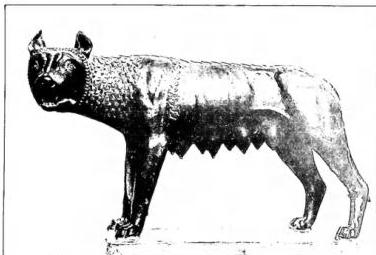
On the Palatine, in the center at the intersection of the cardo and the decumanus, was the mundus, a circular pit into which, at the foundation of that settlement, clods and first-fruits of the mother earth had been cast; on its edge was the votive arx of Roma Quadrata. High up on the Germalus was the tugurium Faustuli or casa Romuli, and on the slopes of the hill toward the Velabrum opened the Lupercal, the grotto of Faunus Lupercus, seat of the ancient rite of the Lupercalia. Placed there perhaps was the famous bronze statue of the Wolf, known as the Capitoline Wolf, a totemic symbol, a masterpiece of the late 6th century B.C. of full Etruscan realism. Also on the Palatine were the arx of Evander or of Victory, and the temple of Iuppiter Stator, vowed, according to tradition, during the war against the Sabines. In the plain between the Palatine and the Aventine (vallis Murcia) extended the Circus Maximus (600 × 150 m); from its far end departed the route to Ostia (Via Ostiensis) and that to the Alban hills and Latium (Via Latina). Near the carceres of the Circus (S. Maria in Cosmedin), Aulus Postumius, the victor of the Battle of Lake Regillus (497 B.C.), erected a triple-cella temple dedicated to the infernal-terrestrial triad: Ceres, Liber (Bacchus), and Libera (Proserpina). Between the Aventine and the Forum Boarium stood the temples of Hercules Invictus, Mater Matuta, and Fortuna Virile, erected in the regal period.
The Esquiline, formed by the distinct heights of the
Cispius and the Oppius, was only partially inhabited. There extended the vast necropolis of the city, which expanded when that of the Forum ceased to be active. It consisted of hypogea carved into the rock and large common pits (puticuli). To avert the dangers of the miasmas spreading there, a shrine to the goddess Mefitis had been dedicated on the Cispius. Between the Esquiline and the Viminalis ran the vicus Patricius (Via Urbana), inhabited by the ancient patrician families, followed by the Subura descending to the Forum.
The Quirinal was then divided into several heights by deep gorges. To the north was the collis Quirinalis proper (near Via delle Quattro Fontane), on which stood the Capitolium vetus, the seat, as on the Capitoline, of the threefold cult of Jupiter, Juno, and Minerva, and the sanctuary of Quirinus, deity of the Sabines of Cures. To the south followed the collis Salutaris (Piazza del Quirinale), where the templum Salutis was later dedicated (302 B.C.), and further south the collis Sanqualis, which took its name from the very ancient temple of Sancus or Dius Fidius (near the church of S. Silvestro). The hill was crossed from southeast to northwest at a high level by a road (Alta Semita) that joined the Via Nomentana leading to Sabina.
Part of the vast plain extending north of the hills (Campus Tiberinus) on the left bank of the Tiber, owned by the State and consecrated to Mars (Campus Martius), was destined for gymnastic exercises and military drills. In the part near the Capitoline were the Saepta, large enclosures destined for the comitia curiata, tributa, and centuriata and for voting in the election of magistrates. The area on the right bank of the Tiber, at the foot of the Janiculum mount, linked to the city by means of the pons Sublicius, was marshy and unhealthy; on the mount was a pagus with an arx and fortifications. At the first milestone of the Via Portuensis, which led to the salt pans near the mouth of the Tiber, the ancient temple of Fors Fortuna perhaps already existed. In the mons Vaticanus, north of the Janiculum, extended vast beds of marl, excellent clay much used in the brickmaking industry and in terracotta art. River trade on the Tiber, both upstream and downstream from Rome, must have been active since those remote times. The sacred river was still only partially embanked and with rudimentary systems.
2. 4th-3rd Centuries B.C. - From the early years of the 4th century B.C., the monumental and architectural development of R. is identified with its history. Camillus, giving thanks for the capture of Veii, dedicated the temple of Juno Regina on the Aventine (369 B.C.) and, to celebrate peace between patricians and plebeians, erected the temple of Concordia at the foot of the Capitoline on the Forum (366 B.C.); to him is also attributed the erection of the temple of Juno Moneta on the Capitoline citadel (345 B.C.). Meanwhile R. had suffered the disaster of the Gallic invasion (390 B.C.), followed by pillage and destructive fire. The date of the Gallic fire closes the first period of the city's building history. The disaster was due to R. being defenseless; the harsh lesson led to the reconstruction of the defensive perimeter of the regal age, which had become ineffective. The new walls, of which conspicuous remains are preserved, also go by the name of the Servian walls. They started from the Tiber near the Forum Boarium (Porta Flumentana), encircled the Capitoline hill, and crossed the narrow gorge between it and the Quirinal (Porta Ratumena or Fontinalis), where communication with the Campus Martius was located. They then climbed to the Quirinal and encircled it (portae Sanqualis, Salutaris, Quirinalis) up to the intersection with the Via Salaria (Palazzo delle Finanze), where the earthen rampart (agger) began, whose retaining walls have impressive remains near the Termini station (Porta Viminalis). The agger defended the Viminalis and the Esquiline and ended at the Porta Esquilina (Arch of Gallienus). Here the wall system resumed; the circuit descended to the gorge between the Esquiline and the Caelian (Porta Caelimontana, Via SS. Quattro) and ran through the valley between the Caelian and the Aventine (Porta Capena); it protected, encircling it, this latter hill (portae Naevia and Raudusculana) to reach the Tiber a short distance from its start at the Porta Flumentana. Of this last stretch, grandiose remains survive near the clivus of S. Balbina and in Via di Porta S. Paolo (13 m in height with 25 layers of squared tuff blocks). R. was rebuilt in a short
time, but irregularly. Private individuals were permitted to build wherever and however they could; public areas were occupied without regard for the rules. The domus of the wealthier citizens were rebuilt in imperfect brickwork (opus latericium), those of the less well-off in sun-dried bricks and mortar. Until the 1st century B.C. the expansion of the city was unregulated; with the growth of the population, buildings and houses increased proportionally, and the perimeter of the city extended even beyond the circle of defensive walls. During the Second Samnite War (326–304 B.C.), in 312 B.C., the first aqueduct (Aqua Appia) was brought to the city by the censors Appius Claudius and C. Plautius, from the Via Collatina (Casale della Rustica). Until then the Romans had drawn water from the Tiber, from scarce springs, and from wells. The same censors began the construction of the Via Appia, following the route of the path that, exiting from the Porta Capena, headed toward Capua. During the Third Samnite War, R. saw the erection of the temple of Bellona in the Campus Martius, vowed by Appius Claudius during a battle against the Etruscans (296 B.C.), and the rebuilding of the ancient temple of Jupiter, vowed by M. Atilius Regulus in combat against the Samnites (295 B.C.). Dating from this period are the peperino sarcophagus of L. Cornelius Scipio Barbatus, victor over the Samnites at Sentinum (298 B.C.), and the funeral eulogy of his son L. Cornelius Scipio, conqueror of Corsica, with mention of the dedication made by him of the temple of the Tempestatum, outside the Porta Capena (295 B.C.). The two monuments formed part of the tomb of the Scipiones between the Via Appia and the Via Latina, on the ancestral estate of the illustrious gens Cornelia. Largely with the rich spoils of the war against Pyrrhus (280–275 B.C.), the censors Manius Curius Dentatus and L. Papirius Cursor (272 B.C.) brought a second aqueduct to R., the Anio Vetus, deriving its waters from the Anio on the Via Valeria (S. Cosimato).
As a celebratory monument of the First Punic War (263–241 B.C.), there were the rostrate column of C. Duilius in the Forum and the temple of Spes in the Forum Boarium (Forum Olitorium), vowed by M. Atilius Calatinus. In the year 242 B.C. the censor C. Aurelius Cotta built, along the route of a pre-existing path, the Via Aurelia as far as the Marta river, and the aediles M. Aemilius Lepidus and L. Aemilius Paulus supervised the construction of the Emporium, a warehouse for foodstuffs on the Tiber at the foot of the Aventine. In the year 233 B.C., the censor C. Flaminius, formerly victor over the Cisalpine Gauls, laid out the Via Flaminia from R. to Ariminum. Shortly after (221 B.C.) C. Flaminius built a second large circus in the Campus Martius (Circus Flaminius), intended for the ludi plebei. A memorial of the Second Punic War (218–202 B.C.) was the temple of Venus Erycina on the Capitoline, vowed by Q. Fabius Maximus after the battle of Lake Trasimene.
3. 3rd and 2nd Centuries B.C. - At the end of the 3rd century B.C., R., now the mistress of Italy, was preparing for the conquest of the world. During the Macedonian Wars (214–168 B.C.), with the increase in wealth, building activity intensified in R. with better and more comfortable edifices. The old temples, largely made of wood with terracotta decorations, gave way to stone temples of a mixed Etruscan-Hellenistic type, mostly pseudo-peripteral: typical examples of these are the Ionic temple of Fortuna Virilis, the temples in the Forum Olitorium of Juno (197 B.C.), and that of Pietas, vowed by Manius Acilius Glabrio at the battle of Thermopylae (182 B.C.). Alongside this type of sacred building, the Italic round form was preserved, as in the temple group of Largo Argentina. It was precisely in the Campus Martius, near the Circus Flaminius, that numerous temples were erected during this historical period; among others, the temple of the Lares Permarini, vowed by L. Aemilius Regillus in a naval battle against the prefects of Antiochus (190 B.C.), and the temple of Hercules Musarum, in memory of the victory of M. Fulvius Nobilior over the Aetolians (189 B.C.). Meanwhile, a new large temple arose on the Palatine to venerate the sacred dark stone of the Magna Mater or Cybele, brought from Pessinus (191 B.C.). It was the first temple in R. with large peperino columns and a wide access stairway. To the censors M. Fulvius Nobilior and M. Aemilius Lepidus (179 B.C.) is owed the construction of a bridge over the Tiber (pons Aemilius), not far from the ancient bridge Sublicius, as well as that of the Navalia, a station for ships on the left bank of the Tiber between the Forum Boarium and the Porta Trigemina. The same censors founded the Basilica Fulvia Aemilia in the Forum in imitation of the Hellenistic basilica, a three-aisled building with apses, a covered meeting place for commercial negotiations, which was also to serve as a law court. Already in 184 B.C. M. Porcius Cato had erected the Basilica Porcia to the west of the Curia Hostilia. Q. Caecilius Metellus, after his Macedonian triumph (148 B.C.), entrusted the architect Hermodorus of Salamis with the construction of a temple in the Campus Martius dedicated to Jupiter—according to Velleius Paterculus, the first marble temple seen in R.—and it was surrounded by porticoes which enclosed the temple of Juno (S. Maria in Portico), already dedicated in the year 175 B.C. by M. Aemilius Lepidus.
After the capture and destruction of Corinth (146 B.C.), a true embellishment of the city began. Architecture took on that direction which, according to Strabo, made R. superior even then to the Hellenistic cities. New districts arose outside the defensive circuit, rendering the latter of no value. Building growth took place especially in the Campus Martius toward the Tiber, where commercial activity was greatest, outside the Porta Capena, and in Trastevere. In the year 144 B.C. the Senate decided to repair the Aqua Appia and Anio Vetus aqueducts and to construct a new one. The execution was entrusted to the urban praetor Q. Marcius (Aqua Marcia), with new waters derived from the springs of Monte Autore, near Agosta. In the year 125 B.C. the Aqua Tepula was brought to R. from the springs near Casal Morena, to the west of the Via Latina. The end of the 2nd century B.C. saw the restoration of the temple of the Castors in the Forum by L. Caecilius Metellus (117 B.C.), the construction of the pons Fabricius, for access to the Tiber Island, begun by the curator viarum L. Fabricius, the rebuilding of the temple of Quirinus on the Quirinal by Papirius Cursor (113 B.C.), the erection of the porticus Minucia near the Forum Olitorium for the sale of grain (112 B.C.); in the year 101 B.C. works of expansion and restoration of the Tabularium were undertaken by decree of the Senate, directed by Q. Lutatius Catulus on the slope of the Capitoline facing the Forum, a building intended for the city archives.
4. 1st Century B.C. - The disastrous competitions between Marius and Sulla brought armed legions within the sacred boundaries of R.; the city was given over to pillage and fire, and the Capitoline burned with its venerable temples (82 B.C.); Sulla himself began the restoration of the temple of Jupiter Optimus Maximus, having some columns of the temple of Olympian Zeus transported from Athens. Reconstruction work was continued under Q. Lutatius Catulus, who was given the extraordinary title of curator restituendi Capitoli. During the First Triumvirate a new bridge over the Tiber was built by the urban prefect L. Cestius (pons Cestius). In the year 56 B.C., through the munificence of the great Pompey, R. acquired its first permanent stone theater (lapideum marmoreum) in the Campus Martius; the curve of its cavea is still indicated by the semicircular shape of the former Palazzo Righetti, founded on the masonry of the theater in Via di Grotta Pinta. The steps of the cavea formed two wide stairways ascending to the temple of Venus Genetrix. Behind the stage of the theater extended vast porticoes enclosing gardens and walkways (between Via di Torre Argentina and Via del Monte della Farina). Large apsed halls opened off the porticoes, in one of which, the Curia Pompeii, Julius Caesar was killed (44 B.C.).
It was Julius Caesar who first conceived of a great development for the old city; in the year 43 BC he promulgated the decree de urbe augenda, with the intention of building in the Campus Martius, but death prevented his noble design. Nevertheless, large residences and suburban villas began to be adorned with sculptures and decorative paintings by freedmen, as well as Greco-Eastern and oriental artists. A new center of civic life was created, the Forum of Caesar, which was added to the Forum properly so-called, occupying part of the Comitium, with at its center the temple of Venus Genetrix, vowed by Caesar at the battle of Pharsalus and dedicated after his triumph in the year 46 BC. To the great statesman we also owe the beginning of the construction of the Basilica Iulia in the Forum and the rebuilding of the Curia, completed by Augustus, as well as the restoration of the Circus Maximus and the creation of the horti Caesaris, which he left by will to the Roman people. At that time, in the western part of the Campus Martius, closer to the Tiber and still uninhabited, tombs were being erected; Sulla was buried there, and in 44 BC the burials of the consuls Hirtius and Pansa, who died following the battle of Mutina, were erected there; the tomb of Hirtius was partly brought to light in 1937, during consolidation work on the Palazzo della Cancelleria. In the year 29 BC, after celebrating the triumph of Actium, Octavius dedicated in the Forum the temple of Divus Iulius on the site where Caesar had erected the new rostra for orators, adorned with the prows of ships taken in the battle of Actium (rostra Divi Iulii), oriented differently compared to the pre-existing rostra in the Comitium adorned with the prows of ships taken from the Anziati in 338 BC.
The grandiose idea of J. Caesar to make R. the worthy metropolis of the Empire was taken up by Octavius, his heir. By establishing his dwelling on the Palatine, then inhabited by patricians and illustrious men, he began the transformation of that hill into an imperial palace. The group of Augustan buildings also included the temple of Apollo Palatinus, vowed by Octavius before the battle of Actium, and the Greek and Latin Palatine Libraries. The transformation of R. began to be implemented with the aedileship of M. Vipsanius Agrippa, the loyal friend and intelligent collaborator of the young prince (33 BC). In that year, the massive reclamation works of the Campus Martius were begun, which lasted until the year 27 BC, when Agrippa was able to lay the foundations of the Pantheon, consecrated to the gens Iulia and its deities Mars and Venus, and of his Baths, the first example in R. of a sumptuous center of sporting, intellectual, and hygienic life; to supply them, he brought to R. in the year 19 BC the new aqua Virgo, whose springs were at the eighth milestone of the Via Collatina (Salone). Agrippa's care during his aedileship was particularly directed towards the restoration of the aqueducts and the overhaul and expansion of the sewers; to him we also owe the construction of a new bridge over the Tiber, upstream from modern-day Ponte Sisto (pons Agrippae). The reclamation was extended to the unhealthy region of the Esquiline, whose vast necropolis was covered by a thick layer of earth and materials; an elegant neighborhood soon arose there. Maecenas was among the first to lay out his famous horti there and live in them. Imposing was the monumental and building development of the Campus Martius, which was soon overrun by new constructions with the exception of an area that was left clear to perpetuate the memory of the ancient military camp; for this purpose it was delimited by boundary stones (cippi), one of which was recovered in Via del Seminario.
On the right of the Via Flaminia (Via delle Muratte, Via S. Claudio) a vast field made for public use was embellished with porticoes that took their names from Agrippa (porticus Vipsania) and from his sister Vipsania Pola (porticus Polae); in this, after the census of the year 8 BC (descriptio orbis), the great cosmographic map totius orbis was exhibited. To the left of the Via Flaminia, Agrippa erected the temple of Neptune (Poseidonion), at the center of a portico called the Argonauts'; of the temple, the 11 Corinthian columns in Piazza di Pietra remain visible. Not far away, further north, Augustus had a solar clock built under the care of the mathematician Novius (Piazza S. Lorenzo in Lucina), which had as its gnomon the Egyptian obelisk brought from the sanctuary of Hierapolis, which now stands reconstructed in Piazza Montecitorio.
III. AUGUSTAN AGE
In the final stretch of the 1st century B.C. the works of transformation and embellishment of the city followed one another at an accelerated pace.The portico of Metellus was restored and embellished, by the work of the Lacedaemonian architects Batrachus and Saurus, and dedicated to Octavian's sister, Octavia (porticus Octaviae). Concurrently (31 B.C.) the Circus Maximus, damaged by a fire, was restored; on its spina was erected the Egyptian obelisk brought from Heliopolis, which now stands in Piazza del Popolo. Followed the important construction of the mausoleum, on the left of the Via Flaminia,
begun in the very year in which Octavian received the title of Augustus (27 B.C.), and intended as a tomb for himself and for the members of the gens Iulia; with its circular tumulus shape it continued the great Etruscan tradition. Near the mausoleum, to celebrate Augustus's happy return from Spain and Gaul and world peace, the ara Pacis Augustae was raised, a distinguished monument of Augustan Roman art characterized by a composed verism (23 B.C.) dedicated in the year 9 B.C. In the year 13 B.C. the construction of the Theater of Marcellus was begun, dedicated in the year 11 B.C., and the other theater erected by L. Cornelius Balbus, the friend of Augustus (Palazzo Cenci), was inaugurated.
Division of R. into 14 regions. - In the year 8 B.C., following the general census, Augustus proceeded to organize R. by dividing it into 14 regions.
The numerical subdivision began south of the city and proceeded in a circle from south to east and then turned to the northwest and west.
The I region (porta Capena) extended south of the wall section, from the porta Navia to the porta Querquetutiana along the urban route of the Appian and Latin
Ways; the II (Coelimonium) included the Caelian Hill; the III (Isis et Serapis) part of the Oppian, the Carinae and the Subura; the IV (Templum Pacis) the Velia and the remaining parts of the Subura and the Carinae; the V (Esquilino) the Esquiline proper and the urban territory beyond the Servian agger; the VI (Alta Semita), the Quirinal and the Viminal; the VII (Via Lata), took its name from a wider section of the Via Flaminia and extended to the right of it up to the Quirinal; the VIII (Forum Romanum) included the Fora, the Capitol and part of the Velabrum; the IX (Campus Martius) the part of the ancient Campus Martius extending to the left of the Via Flaminia to the Tiber. The X region (Palatium) included the Palatine; the XI (Circus Maximus), the smallest of the Augustan regions, was formed by the surroundings of the Circus Maximus and part of the Velabrum. The XII (Piscina publica) included the pseudo-Aventine and the area between the Appian Way and today's Via di Porta S. Paolo; the XIII (Aventinus) the Aventine and the XIV (Transtiberum) the plain to the right of the Tiber up to the Janiculum and Vatican hills. The names of the aforementioned regions do not all belong to the Augustan age; some, like those of the III and IV regions (Isis et Serapis and Templum Pacis), take their name from buildings constructed later; their original name is unknown. Each region was administered by a curator drawn by lot annually from among the praetors, aediles and tribunes of the plebs and was subdivided into compita and vici. The individual vici were presided over by vicomagistri, who were entrusted with the task of performing sacrifices in May and October on the compital altars in honor of the Genius of Augustus and the Lares.
The renewal of R. also led to an architectural transformation. Alongside the Hellenistic-Pompeian style domus, a new type of very high tenement houses (insulae) became widespread, with external balconies and windows closed by sheets of mica and selenite and by shutters; a form of dwelling that anticipates modern ones. In the absence of precise data it is difficult to calculate the population of R., capital of the Empire; it can be assumed that in the period of
maximum splendor it rose to over 1,000,000 inhabitants. The great reorganization of R. was completed with the restitution of as many as 82 temples carried out by Augustus, with the restoration of the aqueducts and with a revised delimitation of the buffer zones of the banks of the Tiber and the waters. Augustus also provided for a further expansion of the Forum, made necessary by new needs; through expropriations and demolitions of old hovels, the Forum of Augustus was created, enclosed by a high wall designed to hide the humble houses on the slope of the
Quirinal; within it arose the temple of Mars Ultor, already vowed in the year 43 B.C. at the battle of Philippi and dedicated in the year 2 B.C.
IV. IMPERIAL AGE
1. 1st Century of the Empire. - To Tiberius (14-37) are owed, in addition to the reconstruction of the temple of Concord, which was named templum Concordiae Augustae and begun while Augustus was still alive, the expansion of the imperial palace on the Palatine (domus Tiberiana), connected by a cryptoporticus to the house called of Livia, which was also believed to be his paternal home. Furthermore, Tiberius had the Castra Praetoria built, the permanent quarters of the Praetorian cohorts. His successor Caligula (37-41) further enlarged the imperial palace upon imposing arched substructures, beneath which passes the clivus Victoriae. He also dedicated the temple of Augustus beneath the Palatine and began the construction of a circus (Gaianum) beyond the Tiber, near the Via Cornelia, which was finished by Nero and to decorate the spina of which he assigned the great obelisk that today forms the center of Piazza di S. Pietro in Vatican. He had also planned the erection of a bridge between the Palatine and the Capitol. During the reign of Claudius (41-54), following the census of the year 46, the pomerium of the city was extended as a reflection of the expansion of the Empire's borders, remaining nonetheless far from the extreme limits of the built-up area. Claudius oversaw the restoration of the arcades of the aqua Virgo and completed the restoration of the theater of Pompey, begun by Tiberius following damage from a fire. A temple dedicated to his memory (templum Divi Claudii) was erected by Agrippina on the spur of the Caelian Hill overlooking the Flavian Amphitheater; it was destroyed by Nero and rebuilt with magnificence by Vespasian.The reign of Nero (54-68) marks another milestone in the building history of R. The fickle Emperor, who was also a refined aesthete, first conceived the construction of a vast imperial residence that, from the northern slopes of the Palatine, encompassing the Velia, would extend as far as the slopes of the Oppian Hill; it was therefore called domus transitoria, connecting the Palatine to the Esquiline. The famous fire, described by Tacitus (Ann., XV, 38 [83]), which broke out on the night of July 18–19 of the year 64 [65], devastated three regions of R. and damaged others, leaving only four unscathed; it did not spare the new Neronian construction, which was not yet entirely completed. When work resumed, the grandiose idea was scaled down and limited to a complex no longer joined to the Palatine, but extending from the Velia to the Esquiline. The work was directed by the architects Severus and Celer, and the decoration was entrusted to the painter Fabullus. This new imperial residence, due to the profusion of luxury, was called the domus aurea, but it had a short life. The large bronze statue of Nero with his head radiating rays,
2. 2nd Century of the Empire. - We thus arrive at the building activity of Trajan (98-117), the great Emperor whose reign marks the apogee of Roman power and the unification of the Empire. Nerva's Forum Transitorium gives access to the imposing new Forum Traianum, which completes the extent of the Fora, dominated by the column of Trajan (112-14), an illustrious example of historical sculpture in which the episodes of the conquest of Dacia are handed down with effectively narrative art. Trajan built his Baths near those of Titus (S. Martino ai Monti) and had the aqua Traiana brought from Lake Bracciano to Rome to supply Trastevere. His successor Hadrian (117-38), a refined patron of art, had the Pantheon rebuilt, giving that illustrious monument its round shape. His architect Apollodorus of Damascus erected the temple of Venus and Rome on the Velia with two opposite apses. The templum Divi Traiani was erected as a backdrop to Trajan's Forum, the Poseidonion (Piazza di Pietra) was rebuilt, taking the name of Hadrianum, and the powerful bulk of Hadrian's Mausoleum (130) was raised, accessed by the pons Aelius (Ponte S. Angelo). With Antoninus Pius (138-61), political stagnation was mirrored by stagnation in construction activity; the only noteworthy monument is the templum Faustinae in the Forum (141), which was later (161) dedicated also to the memory of the pious Emperor by Marcus Aurelius. In honor of this Emperor (161-80), the Antonine column was erected to chronicle his campaigns against the Quadi and the Marcomanni, in which the attempt to imitate Trajanic models is evident. Despite the accentuation of artistic decline, the technical skill of Roman portraiture still stands out in the equestrian statue of Marcus Aurelius, which was erected and remained—until its transfer to the Campidoglio—on the Caelian Hill, near the birthplace of the Emperor, close to the domus of the Laterani. Marcus Aurelius and his son and colleague in the Empire Commodus (180-92) oversaw the revision and extension of the tax data of Rome based on the ever-increasing size of the built-up area. Rome suffered another fire under Commodus (191), with damage to the buildings of the Forum and the Palatine.
3. 3rd Century of the Empire. - The reign of Septimius Severus (192-211), which marked the beginning of the decline and the assumption by the Emperor of full legislative and administrative power, was beneficial for Rome. The city was compensated for the damage of the Commodian fire and beautified with the reconstruction and restoration of numerous sacred and profane buildings. A law was enacted for the restoration and ornamentation of the insulae and aqueducts, and a new edition of the forma Urbis was produced, replacing the one made under Vespasian, which was posted on the rear side of the templum S. Urbis. Noteworthy is the construction of a new imperial residence on the eastern side of the Palatine, which had as its facade facing the Appian Way the multi-story structure called the Septizonium, the restoration of the Pantheon (202), the reconstruction of the atrium Vestae and the House of the Vestals in the Forum, and the erection of the Arch of the Argentarii (near S. Giorgio in Velabro [204]). In honor of Septimius Severus and his son Caracalla, associated in the Empire, a three-way triumphal arch commemorating the victories over the Parthians (203) was erected in the Forum by the Senate and the Roman people. Rome received the appellation of urbs sacra dominorum nostrorum. The construction of the magnificent Antonine Baths in region XII was begun under Septimius Severus (206), but it is especially due to Caracalla, who gave them his name; Elagabalus and Alexander Severus oversaw their completion (235). In the year 212 Caracalla supplied the Marcian aqueduct with new water; by means of a separate conduit, it reached and fed the various services of the new Baths. To Alexander Severus (222-35) we owe the expansion of the Neronian Baths in the IX region, which took the title of Thermae Alexandrinae, and the bringing of the aqua Alexandrina to Rome to feed them. The valiant Emperor Aurelian (270-75) had a temple to the Sun erected on the Quirinal, to whose protection he attributed his victories in the East. But the Alemanni, the vanguard of the barbarian invasions, had pushed as far as Fano. Rome was threatened and invaded; a large part of its built-up area extended outside the venerable, but by now useless, walls of the Republic. Aurelian decided to surround the city with a strong defensive perimeter that would meet strategic needs. Urgency required speed of construction and the incorporation of already existing buildings (e.g., the horti Aciliani on the Pincio, the great wall of the Castra Praetoria, aqueduct arches, the Amphitrenses/Amphitheatrum Castrense, tombs, etc.), all for an extent of about 12 miles. A separate stretch of wall ran along the Tiber from the Via Flaminia to the Janiculan bridge; a part of Trastevere was enclosed in a triangle of walls with its apex on the Janiculum (Porta S. Pancrazio). The main gates of the new line of walls were named after the consular roads issuing from them. The imposing undertaking, begun by Aurelian in 271, was completed by Probus (276-82). During the brief reign of Carinus, a fire damaged a large part of the center of Rome (284).
4. 4th Century of the Empire. - With Diocletian (284-305) the Emperor is no longer merely the general of the armies, but the new sovereign of the Roman world and the diademed dominus of his subjects. R. feels the powerful breath of life imparted to the Empire by the Diocletianic reform and, although with a decadent character, regains grandeur and boldness in art, particularly in architecture. Maximian had the grandiose Baths of Diocletian (302) built in honor of his colleague in the Empire, naming them after him; they were dedicated by Constantius Chlorus in the year 305. In those years, the Theater of Pompey and the Iseum underwent extensive restorations. Maxentius (306-12), while R. was no longer the center of the Empire, still understood its greatness and wished to endow it with another monument by initiating the construction of a new Basilica in the Forum, later called the Basilica of Constantine, as this Emperor brought it to completion. Also dating from Maxentius are the large Circus on the Via Appia and the small heroon or temple dedicated to the memory of his very young son Romulus (vestibule of the church of SS. Cosma e Damiano). To Constantine, the victor over Maxentius, was erected in the year 312 the triumphal arch near the Colosseum, whose sculptures—partly taken from a similar monument of classical Trajanic art and partly of contemporary decadent art—seem to summarize and con-
clude the glorious cycle of Roman art and give a start to Christian art. Constantine had his baths erected on the Quirinal and the Arch of Janus Quadrifrons at the entrance to the Forum Boarium. The emperor Constantius visited R. with the Persian prince Hormisdas (356) and granted the city the obelisk that Constantine had destined for Constantinople and which had remained in Alexandria; it was raised, near the one placed there by Augustus, on the spina of the Circus Maximus (Lateran Obelisk). Among the final flickers of life of paganism, mention must be made of the erection near the Forum of the portico of the Dii Consentes,
with chambers dedicated to the 12 major divinities of the pagan Olympus, by order of the City Prefect Vettius Agorius Praetextatus. Notable in this period is the reconstruction of the Pons Aurelius, previously built by Caracalla, under the emperors Valentinian, Valens, and Gratian (370). Between the years 379 and 383, porticoes were extended across the Cistiberine region (porticus maximus) ending near the Pons Aelius (Ponte S. Angelo) where a triumphal arch was erected in honor of the emperors Gratian, Valentinian, and Theodosius.
5. 5th Century of the Empire. - In the year 403, because of the looming threat of barbarian invasions, the emperors Arcadius and Honorius had the walls of Aurelian restored and strengthened. R. was no longer the imperial residence, which was fixed at Ravenna, a heavily fortified city. An ephemeral jubilation for R. was the celebration of Honorius's triumph over the Goths (405); it witnessed for the last time bloody games in the Colosseum with the sacrifice of the monk Telemachus. Grim days were those of the entry of Alaric's army, of the pillage and the Gothic fire (410). Honorius (423) and his wife Maria had their mausoleum near the Vatican Basilica, which also received the remains of Valentinian III. Further damage was inflicted on the city by the pillage of Genseric's Vandals (455). This brings us to the fall of the Western Empire with the deposition of Romulus Augustulus by Odoacer (476). The last ray of R.'s fading glory was the stay in the Urbe, lasting six months, of the King of the Ostrogoths, Theodoric (500), an Arian who, conscious of the greatness of the eternal city, ordered the repair of the crumbling monuments and instituted officials for the protection of the works of art spared by the rapine and devastations of the barbarian hordes. A new force succeeded the preceding one: the young and vigorous Church, amidst the ruins of classicism, gathered its useful seeds which, blossoming and bearing fruit, were to produce the new Christian civilization.
und Topogr. der Stadt Rom im Altertum, 3 vols., Lipsia 1883-90; R. Lanciani, Ancient Rome in the light of recent discoveries, Londra 1888; id., Pagan and christian R., ibidem 1892; id., Forma Urbis Romae ad modulum 1: 1000 delineata, plate 46, Milano 1893-1901; id., The ruins and excavations of ancient R., Londra 1897; L. Borsari, Topogr. di R. antica, Milano 1897; G. Richter, Topogr. der Stadt Rom., 2nd ed., Monaco 1901; R. Lanciani, Stor. degli scavi di R., 3 vols., Roma 1902; A. Merlin, L'Aventin dans l'antiquité, Parigi 1906; H. Kiepert - Ch. Hülsen, Formae Urbis Romae antiquae, accedit nomenclator topographicus, 2nd ed., Berlino 1912; W. M. Davis, The seven hills of R., in Bull. Amer.
Georg. Society, Nuova York 1912; A. Piganiol, Essai sur les origines de R., Parigi 1917; T. Frank, Roman buildings of the Republic, in Papers of the Amer. Acad., III, Roma 1924; P. Fraccaro, I fattori geografici della grandezza di R., in La geografia, 1926, p. 84 ff.; L. Du Jardin, Mundus, R. quadrata e Lapis niger, in Rendic. della Pont. Accad. Rom. di Arch., 6 (1927-29), p. 47 ff.; V. Lundström, Undersökningar i Roms topographie, in Svenskt Arkiv för humanistiska avhandlingar, II, 1929, p. 138 ff.; G. B. Platner - Th. Ashby, A topographical dictionary of ancient R. (completed and revised by Th. Ashby), Oxford 1929; L. Schudt, Materialien zu einer Gesch. der röm.
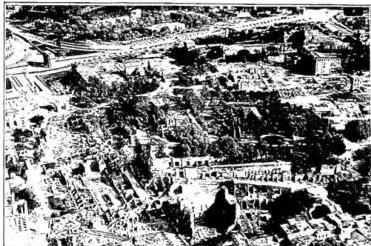
(Int. Knit)
Gioacchino Mancini
### III. POLITICAL AND CONSTITUTIONAL HISTORY.
SUMMARY:
I. The Monarchy
II. From the Monarchy to the Republic
III. Expansion in Latium and Italy
IV. The Struggle for Mediterranean Domination
V. The Republican Constitution and its Crisis
VI. From the Gracchi to Caesar
VII. Octavian and the Genesis of the Principate
VIII. From Augustus to the Severans
IX. The Absolute Empire.I. THE MONARCHICAL ERA
In the first centuries of its history, R. was certainly governed by a monarchical regime. Around a lifelong leader (rex) — whose existence is attested, in addition to constant tradition, by archaeological finds (the stele in the Forum) and by the persistence in the republican period of offices (rex sacrorum) and institutions (interregnum) connected to it — are the assembly of the patres, leaders of the political groups (gentes) pre-existing the formation of the State, and that of the people (comitium). This latter assembly, composed of 30 curiae, subdivisions of the three tribus of the Ramnes, Tities and Luceres, had limited competence, essentially restricted to the field of private law.To a first phase, called the Latin monarchy, another succeeds, that of the last three kings, which, even from the names of the sovereigns, proves to be Etruscan; and which coincides precisely with the moment of maximum Etruscan expansion toward the south. This regime of conquerors would have ended following a revolutionary movement in 509 B.C. However, Etruscan domination was not without advantage for R.; from the invaders the Romans learned the interpretation of signs offered by the divinity (aruspicine), the art of construction (the arch) and, above all, military organization, which constituted the basis of the exercitus centuriatus, whose institution Roman annalistic tradition traced precisely back to Servius Tullius. The period of the Etruscan monarchy was therefore an age of splendor for the city of the Tiber and made it "the great R. of the Tarquins" (Pasquali).
The primitive rex, surrounded by certain priestly colleges (v. AUGURI; FIZIALI; PONTEFICE MASSIMO), had assistants by his side: the duoviri perduellionis and the quaestores parricidii, who aided him in the exercise of criminal jurisdiction, and the magister populi, who commanded the army.
II. FROM THE MONARCHY TO THE REPUBLIC
It was in all probability through this assistant of the rex that the transition from monarchy to republic was brought about. That this occurred gradually and not as the result of a revolution, half popular and half palace-driven, is now unanimously agreed. There is less agreement on the manner in which the transition was made from a single, lifelong head to a collegial magistracy. Some hold (De Sanctis) that three magistrates (praetores, from prae-ire, the function of the one who leads the army in battle), heads of the three tribus, replaced the rex: in 367 B.C., two of these would have become the supreme magistrates, heads of the civitas, while the exercise of civil jurisdiction remained with the third. Others (Arangio-Ruiz) think that from the very beginning—and in conformity with what is found among other Italic populations (e.g., the Oscans)—there was a pair with unequal power, which was subsequently transformed into a collegial pair. Still others (de Francisci) believe that the rex was stripped of his military powers by the magister populi, who commanded the army by his delegation; they also think that the magister populi was for some time a sole magistrate, normally assisted by a magister equitum, and that he later formed a collegial pair with the latter when, in the first half of the 5th century B.C., due to increased military needs, the duplication of army cadres took place with the constitution of two legions.Alongside the two praetores, who from a certain moment assume the name of consules (colleagues), we find the quaestores as assistants. The supreme ordinary magistracy is replaced, in cases of grave necessity (rei gerundae causa and seditionis sedandae causa), by an extraordinary magistrate (dictator), to whom all other magistrates are subordinated; in this figure the ancient magister populi lives on, with his unlimited power, against which neither intercessio (v.) nor provocatio can be opposed.
The new community, in which other groups had been added to the primitive gentes (immigrants, clients who had broken the bond of dependency with their gentiles, perhaps former slaves) together forming the plebs, was tormented, starting from the decades immediately following the establishment of the republic, by the struggle between the two orders of the population: the plebeians claimed, in fact, the right to contract marriage (conubium) with the patricians, access to magistracies (ius honorum), the easing of tax and debt pressure, and perhaps a distribution of land or the limitation of landed property.
A first result of this struggle between patriciate and plebs, characterized by secessions or threats of secessions (Aventine, Mons Sacer) by the plebs under the leadership of its chiefs (tribuni), was the constitution, for the years 451 and 450, of two colleges of decemviri legibus scribendis who drafted Twelve Tables (v.). Only in 445 B.C., however, with the rogatio Canuleia, was conubium granted to the plebeians: a path opened for further demands. In the years following the legislative decemvirate, the Fasti record by turns consular pairs and colleges of tribuni militum consulari potestate, in varying numbers. To this latter magistracy, constituted by the superior officers of the legions and which was in all probability resorted to for the increased military needs caused by the struggles for expansion, plebeians were also admitted. And finally, in 367 B.C., with one of the Liciniae-Sextiae laws, it was established that one of the consul posts should belong to the plebs (in practice this happened regularly only after 320), while a new magistracy was instituted (praetor urbanus), entrusted with the exercise of civil jurisdiction.
III. EXPANSION IN LATIUM AND IN ITALY
Immediately after its constitution, the new State found itself having to face a series of struggles with neighboring populations; Roman annalists insist on these wars against the adiidui et anniversarii hostes. First it was the Etruscans who, attempting an offensive comeback, must have gained successes over the Romans, as can be inferred from the traditional account concerning Porsenna, lord of Chiusi, who is said to have besieged R. for a long time. Then the work of expansion into Latium began. Around 493 B. C., R. joined the Latins in an alliance (foedus Cassianum) which the Hernici, inhabitants of the Sacco (Tolerus) valley southeast of R., soon joined; this alliance was primarily directed against the threat of the Aequi, stationed between Rieti and the Fucino basin, and of the Volsci, who had advanced from the upper Liri valley onto the Lepini mountains to the point of threatening southern Latium between Terracina (Anxur) and Antium. Toward the end of the 5th century these adversaries had been partly forced to retreat, partly contained. In the north too, after a hard struggle (which included the not entirely legendary episode of the Fabii at the Cremera), the powerful Etruscan city of Veii was taken and destroyed (396 B. C.).Scarcely had this severe ordeal been overcome when, in 390, R. suffered the Celtic invasion which ended with its conquest and near-total destruction. The consequences were serious, especially from a political point of view, as they nullified the activity of conquest deployed up to the taking of Veii; only in 338 did R. succeed in reuniting the Latins and Hernici in alliance with itself, in order to turn and face the Volsci and, subsequently, Tarquinii, Caere, and Falerii. Having consolidated its position, R. concluded two treaties: the first with the Samnites (354) and the second with Carthage (348); but its position of growing power and predominance caused the Latins (340), aided by the Campanians, to rise up against II. The victorious Romans came into conflict a little later with the Samnites, who saw their path to the plain and the sea cut off by R. In 326 B. C. Naples surrendered to the Romans; but when the latter, in 321, attempted to penetrate from Campania into Samnium, their army was forced to surrender in the Caudine Forks. The war resumed in 316, with a great initial success for the Samnites, followed two years later by a Roman defeat at Terracina. After a phase of Roman successes in the Liri valley and in Apulia, in 310 R. found itself threatened simultaneously by the Samnites, by Etruscan cities, by the Aequi, and by the Hernici; after a peace concluded in 304, the struggle resumed in 298, against the Italic coalition stirred up by the Samnites. The Romans were victorious at Sentinum in Umbria, and, following this and the blockade of Samnium, a definitive peace was reached in 290.
Subsequently R. turned to subdue the populations stationed in the north; victories over the Gallic and Etruscan populations allowed the foundation of colonies on the Adriatic coast. However, almost simultaneously, the struggle resumed in the south. Some Greek cities in southern Italy had watched the rise of Roman power with sympathy: in 282 B. C., Thurii, threatened by the Lucanians, requested the help of R. The liberated city welcomed a Roman garrison, to the grave concern of Tarentum; an incident led to war with the latter, which had assumed a directive position over the cities of Calabria and could count on the military assistance of Pyrrhus, king of Epirus, who was eager to found a Hellenistic kingdom in southern Italy. The Romans were defeated at Heraclea in 280, and at Asculum in Apulia in 279; but, after a fruitless campaign in Sicily and an indecisive battle near Benevento, Pyrrhus abandoned Italy. The effect of the war was the extension of Roman dominion into Magna Graecia: Tarentum surrendered, and in 270 Rhegium received a Roman garrison. Almost simultaneously, in the north, the Latin colony of Ariminum (Rimini) was founded (268).
IV. THE STRUGGLE FOR THE DOMINION OF THE MEDITERRANEAN
R. now found itself facing the power of Carthage; the latter had long established a commercial monopoly in the western Mediterranean, and had seen its supremacy over Sicily reaffirmed following the failures of Pyrrhus. The clash between the two powers was provoked by the request of the Mamertines, mercenaries who had occupied Messina, to be admitted into the Italic League. In 264 a Roman army crossed into Sicily and forced the Carthaginians to abandon Messina; this led to an alliance between Hiero of Syracuse and Carthage, which, in turn, sent further military forces to Sicily. After the formal declaration of war, once the Roman advance on Syracuse had begun, Hiero abandoned the Carthaginians, who in 262 lost Agrigentum, their main stronghold on the Island. The Carthaginians were defeated at sea for the first time near Mylae in 260 and a second time in 257; following this, the Romans decided to carry the fight to Africa, where initial successes were followed by a severe defeat. After a great Roman naval victory at the Aegates Islands in 241 B.C., the peace treaty established, among other things, that Carthage evacuate Sicily. Thus, in 227, the latter became the first Roman province, almost simultaneously with the erection of Sardinia and Corsica into a province.R. immediately afterward consolidated its position in northern Italy and the Adriatic. In 225 B.C. large Celtic tribes infiltrated Etruria, but were defeated at Telamon; in 223 a Roman army crossed the Po; the Latin colonies of Piacenza and Cremona were founded, and the Flaminia military road from R. to Rimini was built. Simultaneously, between 229 and 219, R. swept Illyrian pirates from the Adriatic.
Carthage meanwhile sought to compensate for the loss of power and prestige suffered in Sicily through conquests in Spain. Faced with this expansion, R. deemed it appropriate to establish, in agreement with Carthage, a limit to their respective spheres of influence: in 226 this limit was set at the Ebro. But south of this river lay Saguntum, a city allied with R. since ca. 230. The internal affairs of this city required Roman intervention in 220; the following year Hannibal Barca besieged Saguntum. This gave rise to the Second Punic War. Hannibal began his march toward Italy, encountering only slight resistance before crossing the Alps. The Roman armies were successively defeated west of the Ticino, on the Trebbia (218), and at Lake Trasimene (217); Hannibal, having crossed into southern Italy, pitched his winter quarters in Apulia. The consuls for the year 216 engaged him
with a large army on the Ofanto near Cannae, but once again the Carthaginians prevailed.
At the same time, Macedonia and Syracuse joined the Carthaginians; Philip V of Macedonia desired to conquer Roman possessions in Illyria. R. succeeded first in containing him in Macedonia, and then (210) pitted the Aetolian League against him.
The war in Spain received a new impetus through the work of Publius Cornelius Scipio the Younger, who in 206 forced the Carthaginians to abandon the Iberian Peninsula.
In Italy too, the fortune of arms was changing: Capua in 211 and Tarentum in 209 fell into the hands of the Romans. In 207 the Carthaginian army led by Hasdrubal to the aid of his brother Hannibal was defeated at the Metaurus, and in 205 Hannibal left Italy to return to Africa, where Scipio brought the war (204). Having established himself firmly at Utica, the Roman general, who had secured the alliance of Massinissa, conducted a successful campaign, which concluded with the victory over Hannibal at Zama (202). For
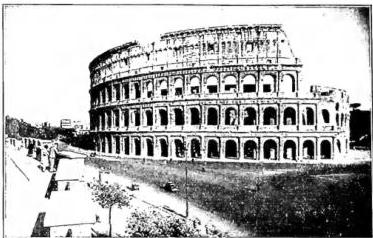
There now remained the task of consolidating the results. With the Celts defeated, northern Italy was fully organized, with the founding of new colonies and with the construction of the Via Emilia, from Rimini to Piacenza, while Liguria was conquered and the eastern frontier secured with the founding of the Latin colony of Aquileia (181) and, subsequently, with the conquest of Istria.
The long struggle in Spain ended only much later, with the taking of Numanzia (133 B.C.). At the same time, the Third Punic War definitively broke Carthaginian power. Cartagine (146) was destroyed and its territory (a large part of modern Tunisia) constituted the province of Africa.
Dominion over the entire Mediterranean basin was achieved by R. through a patient policy, the first phase of which, begun in 201 B.C. with the aid given to Pergamo and Rodi, and continued with the struggle against Filippo (200), concluded with the Roman victory at Cinocofale (197) and the proclamation of the independence of the Greek states (Corinto, 196). This phase was followed by that of the war against Antioco of Syria, defeated first in 191 at Termopili and a second time the following year at Magnesia near Sipilo, and forced to accept the Peace of Apamea (188). The Third Macedonian War, against Persee son of Filippo, ended, after varied fortunes, also with the Roman victory at Pidna (168).
From this moment R., which had limited itself to making its influence felt in the East, changed its policy: Macedonia became a province and Greece too was subjected to Roman rule, after the destruction of Corinto, which occurred in the same year (146) as that of Cartagine.
V. THE REPUBLICAN CONSTITUTION AND ITS CRISIS
The constitution of the city that had extended its conquests to the entire Mediterranean basin was based, at the height of the Republic, upon three organs: the magistracy, the senate, and the comitia. The magistracies had grown in number: alongside the consules there were, in fact, not only the praetor urbanus instituted in 367, but the censores (probably instituted by a lex Aemilia in 434 to draw up the census and later elevated to the very high office of controllers of public morality), the quaestores, the aediles curules, and another praetor, instituted in 242 to administer justice between Romans and foreigners and between foreigners, and therefore called peregrinus. Alongside these patrician magistracies — being of the entire State — (whose characteristic is that they were collegial, unpaid, and temporary), there were others, called plebeian: the tribunate and the aedileship of the plebs. The task of the tribuni was to defend the interests of the plebs; and to this end, they were endowed with the intercessio (v.), by which they could impede the acts of any magistrate, and with prensio, the power to arrest anyone who opposed their will, while enjoying personal inviolability (sacrosanctitas).The principal magistrates of the Republic, those called upon to exercise military and governmental activities, were, after the likeness of the ancient rex, endowed with imperium, a general capacity for command, to which was connected the auspicium, the faculty to interpret the will of the gods.
In the advanced republican era, the Senate was composed of patricians (patres) and plebeians (conscripti), through a selection carried out first by the consuls, later by the censors. It was this assembly, which one entered after having held the magistracies, that constituted the true command center of the Republic, also because of the continuity of policy that it could better ensure in relation to the annual magistrates. To it belonged the direction of foreign and financial policy; to it pertained the assumption of power (interregnum) when the higher magistrates were lacking; finally, it exercised a power of ratification (auctoritas) with regard to the deliberations of the popular assemblies.
These latter had also grown in number: alongside the ancient comitia curiata, there arose, around the middle of the 5th century, the comitia centuriata, an assembly of military origin on a timocratic basis, composed, in its completed phase, of 193 centuries, divided into five classes according to census and ordered so as to ensure the prevalence in voting to the wealthier classes.
Equally very ancient were the comitia tributa, in which the people were organized by tribes. In time, both of these comitia assumed a threefold competence: electoral (for the appointment of magistrates, maiores in the centuriata, minores in the tributa), legislative, and judicial.
In contrast to these assemblies, which gathered the entire people, there was one exclusive to the plebs (concilia plebis tributa), which met under the presidency of the tribunes and whose deliberations (plebiscita) had validity for the plebs alone, until a lex Hortensia (286 B.C.) equalized them with the comitial laws (v. PLEBISCITO).
This constitutional structure, in which the people were called upon to exercise political rights (albeit limited: R. was never a democracy in the modern sense) directly and not through representatives, was nonetheless suited to a community restricted, at most, to the limits of the Italian Peninsula. The conquest of the great world empire not only posed the need to organize the new territories according to different schemes from those employed in Italy (federation, municipia, colonies), but also created the requirement for a strong central power capable of controlling not only the territories, but also the magistrates assigned to them.
The form of organization employed in the territories outside peninsular Italy was the provincia. To the incorporated territory that had become the property of the Roman people was assigned a magistrate (who bore first the title of praetor, then of proconsul or propraetor, depending on the office previously held in the city), assisted by ten legates of the Senate and a quaestor.
Roman dominion had undergone enormous expansion;
sion; but precisely in this expansion, and in the profound modification that it produced in the economy and in Roman life in general, is to be seen the primary cause of that complex series of phenomena that go under the name of the crisis of the Republic. The large influx of capital, goods, and slaves had profoundly altered the economic physiognomy of Italy. The abandonment of the fields, at first a consequence of military operations taking place on the Peninsula, had then continued because certain crops had become uneconomic and certain products (e.g., grain) reached Italian ports at a much more advantageous price than domestic ones. There then formed a series of large landed estates, concentrated in the hands of the senatorial class, which had to invest the wealth accumulated during the wars in this way, since it was prohibited from engaging in commerce. This was instead dedicated to, practically under a monopoly regime, the class of the knights (ordo equester), which had progressively asserted itself and which stood, also as a political force, in contrast with senatorial nobilitas. Below these privileged classes there scarcely existed any longer the people who had formerly exercised their political rights in the comitia and who were ready to rush to defend the Republic on the battlefield. The citizen-soldier having disappeared, the ancient army was replaced by a professional one, composed of soldiers who enlisted for long periods, eager to participate in large distributions of booty and bound, by the long habit of service, more to their direct commander than to the abstract and distant authority of the magistrates and the Senate. In R., in the comitia, there remained only a mob of propertyless individuals, ready to follow the leaders of the various feuding factions who, according to their momentary ability, knew how to appeal to their instincts and satisfy their interests with distributions of food and money.
Around R., furthermore, began to gather the discontent of the Italian allies, harshly tried by the war and too meagerly rewarded, who had in vain requested the grant of the right of Roman citizenship.
VI. FROM THE GRACCHI TO CAESAR
The first evident manifestation of the crisis of the Republic occurred in 133 BC, with the tribunate of Tiberius Gracchus. More than his individual proposals, it is important to note here that, for the first time, we witness an attempt to assert the principle of popular sovereignty, understood not only in the sense that the will of the people must prevail over that of the organs of the civitas, but also in the sense that the people confer upon the magistrates a binding mandate and can therefore revoke it when they depart from the instructions received. To these principles of a revolutionary nature, the Senate opposed others, equally contrary to the republican constitution; by attempting to resort to the senatusconsultum ultimum, by ratifying the assassination of Tiberius Gracchus declared hostis reipublicae, and above all by granting exceptional powers to the magistrates, it anticipated the extraordinary magistracies through which the transition from the republic to the principate was to be effected.The work of Tiberius was continued by his brother Gaius Gracchus, tribune for the years 123 and 122; but even this tribunate, which ended with the death of Gaius, did nothing but aggravate what had been the situation following the death of Tiberius.
Immediately afterwards R. found itself having to face, in Africa, the threat of Jugurtha, heir, along with two other princes, to the throne of Numidia. Jugurtha succeeded in excluding his co-heirs, one of whom, Adherbal, had obtained the protection of the Romans; the latter, in 111 BC, initiated the war, which dragged on, with alternating fortunes, until 106, the year in which Gaius Marius, having defeated Jugurtha, succeeded in having him handed over by the King of Mauritania, near whom the Numidian Sovereign had sought refuge.
Marius then turned to face the threat of the Cimbri and Teutones, who in 105 had defeated the Romans at Arausium (Orange). Having established himself in 104 in southern Gaul, he set about reforming the army and teaching it a new tactic; in 102 the Teutones were
defeated near Aquae Sextiae (Aix-en-Provence) and the following year the Cimbri near Vercelli.
Marius had held the consulship uninterruptedly from 104 to 100 BC, and was by then the recognized leader of the popular party. Two exponents of the latter, L. Appuleius Saturninus and G. Servilius Glaucia, attempted, in the years 100 and 99, to establish the predominance of the democratic party; but the disorders caused by them gave the Senate the opportunity for an energetic repression; with the end of their attempt, the political position of Marius declined, as did that of the equestrian class, which had allied itself with the populares.
But the need for reforms was also present to the most enlightened members of the nobilitas: one of these, M. Livius Drusus, tribune for the year 91, prepared a series of laws, which however met with great opposition. Drusus, who had also presented himself as a defender of the interests of the Italian allies,
was mysteriously murdered. His death was the signal for rebellion in Italy: the allies constituted a veritable State against R., with magistracies and a senate, having its capital at Corfinium and called Italia, and with various armies prepared to march on R. After a year of struggle, in 90, a
Lex Julia granted Roman citizenship to the Italian allies who had remained faithful or who had laid down their arms; in 89, a Lex Plantia Papiria extended it to all residents in Italy who within 60 days submitted a request to the praetor.
Shortly afterwards, conflict broke out between Marius and Sulla, who had become consul and was designated for the command of the war against Mithridates, king of Pontus. Faced with the attempt by the Marian party to strip him of this command following a plebiscite, Sulla marched on R. and occupied II. But, forced to depart to conduct the war, he left the city at the mercy of his adversaries: in the year 86 Marius and L. Cornelius Cinna were appointed consuls without popular election.
Sulla, meanwhile, was conducting fortunate military operations in the East: having conquered Athens in 86, he won two victories, at Chaeronea and near Chalcis; and, following negotiations with Mithridates, quickly concluded peace with him. Having reorganized Asia, in the spring of 83 Sulla landed at Brindisi and, having successively defeated the consular armies and that of the Italians—who intended to take advantage of the situation to assert their independence from R.—re-entered the capital. The repression against the democratic party was ruthless: the proscriptions cleared the political scene of Sulla's adversaries, the property of the proscribed was auctioned off, and their slaves, manumitted by the victor, became, under the name of Cornelii, his strongest supporters. Sulla was appointed dictator legibus scribundis et reipublicae constituendae, having a title and powers conferred upon him that were already completely outside the republican constitution. The regime he established, defined as regnum by the ancients and monarchia mancata by moderns (Carcopino), intended to erase any political relevance of the popular party and the equestrian class. The Senate was brought to 600 members, the number of quaestors to 20, that of praetors to 8. The career path of magistrates and the manner of designating provincial governors were established. The fact of having held the office of tribune of the plebs excluded one from further progress in a political career. The number of permanent criminal courts (quaestiones perpetuae) was increased, the members of which were to be chosen from the senatorial order.
Having completed this work, Sulla in 79 laid down the dictatorship and retired to Pozzuoli, where he died the following year. The construction he had laboriously erected was to suffer its first blows, harbingers of its definitive decline, precisely at the hands of a figure who had been one
of his lieutenants, that Gnaeus Pompey who, at a very young age, had raised at his own expense and led two legions to Sulla and had obtained from him, without being a magistrate, a triumph and the epithet magnus. Pompey's military abilities were immediately utilized in 77, when he was commissioned as a private citizen to conduct the war alongside the consul Q. Lutatius Catulus against the rebellion that had broken out in Etruria, in the places where Sulla had made large distributions of land to his veterans. Immediately afterwards he was sent to Spain with imperium proconsulare to confront Q. Sertorius, an exponent of the democratic party, who, having become governor of northern Spain in 83, and subsequently putting himself at the head of Marius's partisans and the Lusitanian rebels, was, in 77, master of Hispania Citerior. After a long campaign, Sertorius and his lieutenant Perperna were defeated (72 BC).
Pompey returned to Italy at a delicate moment; in 74 the war against Mithridates had restarted and, shortly thereafter, a great slave revolt, led by Spartacus, had broken out in Italy. This uprising of over 40,000 men was subdued with great difficulty; the last slave army was defeated precisely by Pompey.
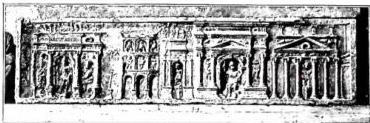
Another blow to constitutional norms was to be dealt by Pompey a few years later. In fact, in 67, to clear the Mediterranean of pirates, a Lex Gabinia established that he should be given command of the war as privatus cum imperio, with the right to appoint lieutenants (legati), levy troops, command the fleet, and dispose of the treasury. Thus was created the figure of a commander with practically unlimited powers. And the success achieved by Pompey in the struggle against the pirates meant that by a Lex Manilia he was entrusted with the command of the war against Mithridates and Tigranes: to the powers already granted to him by the Lex Gabinia, he thus added the government of the provinciae of Cilicia, Bithynia, and Asia. Between 66 and 62 B.C., he not only defeated Mithridates and made Tigranes a vassal of R., but completely reorganized the entire East: he rearranged the provinces, founded various cities, and created a series of vassal principalities. Syria was erected into a province, Palestine became a tributary state of R., and the Greek cities in all these territories had their autonomy recognized and entered into direct relations with R.
The work accomplished by Pompey was to secure the eastern borders for a long time; and it demonstrates, despite the oblivion that fell upon this figure after his defeat in the conflict with Caesar, his high capabilities as a military commander and organizer.
Another figure, in fact, was emerging in the Roman political world: C. Julius Caesar. Of patrician origin, he pursued his activity in accordance with the thought of the popular party; he was driven to this partly by a broader vision of the situation that had come about in R., and partly by the more immediate objective of counterbalancing the growing authority of Pompey.
Having reached an agreement with Crassus, Caesar probably favored the revolutionary machinations of L. Sergius Catiline in 66. The conspiracy failed the first time in 65, but was reorganized in 63, the year of the consulship of M. Tullius Cicero. The latter forced Catiline to unmask himself and to
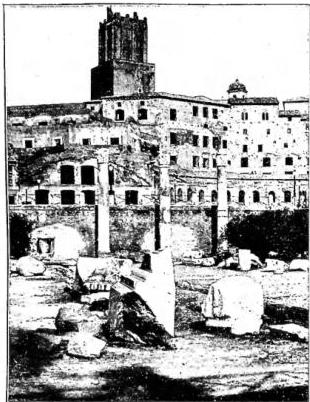
This was the situation when, towards the end of 62, Pompey landed at Brindisi: the following year he celebrated a triumph, but failed to obtain the distribution of lands for his veterans or even the ratification of his organization of the East. Consequently, he found himself in conflict with the Senate, as Caesar had clearly foreseen. The latter, who had been proprietor in Spain where he had proven his good abilities and replenished his fortune, was elected consul for the year 59, together with M. Calpurnio Bibulo.
He reached an agreement with Pompey and Crasso to exercise authority over the State for his own profit and that of his allies in the coming years. He proposed a series of laws and had the comitia approve, against senatorial opposition, Pompey's settlement of the East, while granting financial facilities to the public contractors who supported Crasso.
As a consequence of the agreements, the proconsul Caesar was entrusted for five years with the government of Cisalpine Gaul and Illyricum, to which that of Gallia Narbonensis was subsequently added. This allowed the ambitious commander to form a solid base for his political influence, binding to himself the armies under his command: he extended the dominion of R. from the Pyrenees and the Ocean up to the Ardennes and the Vosges, repulsed the Helvetii, and defeated Ariovistus on the Rhine, thus removing the Germanic threat from Gallic territory.
In a meeting with Pompey and Crasso in Lucca (56) it was established that they would assume the consulship for the year 55: for the following five-year period the government of Spain was assigned to Pompey, that of Syria to Crasso, while Caesar's command in Gaul was confirmed. During this time, Caesar definitively settled Gaul after his victory over Vercingetorix. But following the death of Crasso (year 53), Pompey deemed the moment had arrived to assume a more prominent role in the State: consul sine collega for the year 52, he held himself ready to support senatorial policy militarily. Faced with this attitude, Caesar sought to negotiate with the Senate for his own appointment as consul for the following year (49), upon the cessation of his provincial government. This went against a constitutional rule, but Caesar demanded it above all to avoid a trial regarding his activity as governor. The Senate not only refused the appointment, but recalled Caesar. The latter crossed into Italy and crossed the Rubicon (Jan. of 49), which marked the boundary of the territory subject to his government. Pompey, along with the magistrates and the Senate, abandoned R. and Italy to prepare the army in the East for the decisive battle. Caesar, having occupied R., went to Spain where he defeated Pompey's lieutenants; and after returning for a few short days to the capital, he went to Macedonia to confront his rival, whom he defeated at Pharsalus (year 48). Having passed into Egypt, where Pompey, believing he would find refuge with the King, had instead met his death, Caesar found himself involved in the dynastic struggle of the Ptolemaic family. Returning to R. in the autumn of 47, he was appointed dictator, but, even before he could devote himself to government activity, he was forced to confront the last remnants of the Pompeian party, which had reorganized in Africa, securing the alliance of Juba, king of Numidia. Having defeated his opponents at Thapsus and reduced Numidia to a province (year 46), Caesar was now the master of the State. Dictator perpetuum, invested with the hereditary title of imperator, holder of the praefectura morum and invested with tribunician inviolability, he behaved like a monarch in his acts of government. This was not the way, at that time, to secure dominion over R. and its Empire: and because of this political error Caesar fell in 44, the victim of a conspiracy.
VII. OCTAVIAN AND THE GENESIS OF THE PRINCIPATE
Octavian, the nineteen-year-old nephew of Caesar, initially seemed to adhere to the party of his uncle's assassins, concerned above all with consolidating his own position: he had the comitia confirm his adoption by Caesar, obtained the consulship in August 43, and succeeded in having conferred upon him an imperium prevailing over the consular one, the right to levy troops, and the commission to defend the State against his rivals Antony and Lepidus.These men saw the opportunity to come to terms, and towards the end of October 43, they met at Bologna with Octavian. The fruit of this meeting was an agreement that shortly after received its official sanction in a lex Titia, proposed on November 27, 43, which appointed Octavian, Antony, and Lepidus as tresviri reipublicae constituendae with unlimited power.
Having definitively defeated the senatorial party in the final battle of Philippi (November 42), Octavian and Antony agreed that Cisalpine Gaul should be reunited with Italy and administered by R.; Transalpine Gaul was entrusted to Antony along with the eastern provinces; the Spains were assigned to Octavian and he was granted freedom of initiative in Italy and the Mediterranean; the African provinces were entrusted to Lepidus. In a subsequent distribution, Lepidus kept Africa, Octavian was given the West, while the East was entrusted to Antony, who was to conduct the struggle against the Parthians while Octavian fought Sextus Pompey.
The powers of the triumvirs were supposed to expire, according to the lex Titia, on December 31, 38. Despite this, they continued to exercise exceptional power and only in September or October 37 did Octavian and Antony meet at Taranto to decide on the extension of the triumvirate and set the new expiration date for December 31, 32. In 36 Octavian forced Lepidus to resign his office, while obtaining, by plebiscite, the right to sit on the subsellia tribunicia with the accompanying inviolability.
Public opinion, meanwhile, followed Antony's behavior in Egypt with concern, and popular indignation reached its peak when the will that Antony had entrusted to the Vestal Virgins was published by Octavian, revealing his intention to transfer the capital from R. to Alexandria. Antony was deposed from the triumvirate, albeit illegally, while war was declared against Cleopatra.
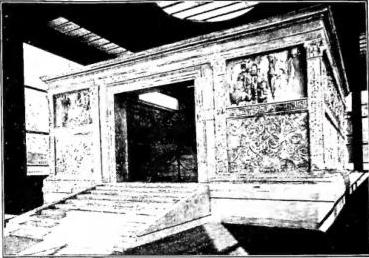
He set about a work that was not merely reconstruction, but, through successive stages, the foundation of a new regime. In 28 Octavian held the consulship. But his personal position was far more significant than that of his colleague in the supreme republican magistracy. He carried indeed, as a praenomen, the title of imperator, which belonged to him as Caesar's heir and which had been confirmed to him by the Senate in 29 B.C.
He also obtained the title of princeps Senatus, while, through various concessions, he had come into possession of almost all the powers and prerogatives of the tribunes of the plebs, even if, as appears most probable, the tribunicia potestas was granted to him in full only in 23.
Finally, he was still invested with the extraordinary constituent power that had had its primary source in the lex Titia, as appears, apart from his acts, from the terms used in the sources to indicate the renunciation he made in the Senate session of January 13, 27 B.C.
He himself states (Mon. Ancyr. lat., VI, 13-16) that through consensus universorum potitus rerum omnium, he transferred the State (and therefore the powers of the State) from his potestas "into the arbitration of the Senate and the Roman People" (in Senatus Populique Romani arbitrium). He therefore abandoned (as other sources also confirm) the constituent power and general command over the troops, retaining instead all other powers, titles, and prerogatives.
In exchange for this renunciation, he was conferred the title of Augustus (he who is sacred by divine designation), while a whole series of honors was paid to him. For the exact understanding of his position, it is important to bear in mind what he himself says regarding the period following the renunciation of 27. He states (Mon. Ancyr. lat., VI, 31 ff.) that he was superior to all in auctoritas, without however having had greater potestas than those who were his colleagues in the consulship between 27 and 23. Now, the term auctoritas is widely used in Roman law, both public and private; the specific meaning it assumes in the case of Augustus "designates... the juridically preeminent position of the man in whose person public power is connate, in a completely different way from that in which it is attributed to republican magistrates: and it connects with the new concept of the maiestas of the emperors, in which the religious element is accentuated" (De Francisci).
This auctoritas is concretized on the other hand in the concession of powers. In fact, Augustus is invested with a decennial proconsular imperium, with the government of the provinces not yet pacified and the relative command of the troops; and he obtains the cura et tutela rei publicae universa, that is, essentially, the faculty to perform all those acts and take those measures deemed by him useful for the good of the State.
Already in the face of these concessions it is difficult to speak, as some historians do, of a republican restoration implemented by Augustus. But his constitutional construction was completed in 23, when he renounced the consulship (never again to assume any republican title afterwards): in that year, in fact, he was conferred the tribunicia potestas (in its fullness) for life and a proconsular imperium (infinitum, that is, not subject to the limit of the pomerium, and maius, inasmuch as it was superior to that of any magistrate). But both powers
ROMA - L'Ara Pacis Augustae, nella ricomposizione definitiva - Roma.
(fot. Anderson)
was conferred upon him separately from the respective republican offices.
With the foundation of the principate, we witness the creation of a bureaucracy, of a series of officials, who slowly absorb the functions proper to the ancient magistracies. To some of these, which were preserved, new functions are assigned within the framework of the new constitutional structure, but any directive force in the government of the State is lacking; the comitia were called upon by Augustus to legislate and voted on numerous and important laws (de ambitu, de vi publica et privata, iudiciorum publicorum et privatorum, de maritandis ordinibus, etc.); but their function was destined to dry up with the increase of the authority of the princeps. The organ that instead increased its functions was the Senate (and this may explain Mommsen's opinion, who defined the Augustan regime as a diarchy formed by the princeps and the Senate); it acquires wide jurisdiction in criminal matters and becomes capable of issuing legal norms: the senatus-consulta indeed become sources of law. Even in this case, however, such increased competence is more apparent than real, since very often the senatus-consultum is nothing more than the text of a proposal (oratio) by the emperor adopted by the assembly.
By virtue of his powers, the princeps then influences justice, both civil and criminal, either by judging on appeal or by entrusting his own officials with the right to judge without observing the rules of ordinary procedure (cognitio extra ordinem). Finally, he makes his authority felt also over jurisprudence, conferring upon certain jurisconsults the ius respondendi ex auctoritate principis. Moreover, he can express his own will, even directly, in the normative field through imperial constitutions, which in time will cause every other source of law to dry up.
It can therefore easily be concluded that, at the end of this complex legalitarian revolution, one finds oneself faced with a new organ, superimposed upon the republican constitution, which was formally preserved but destined to atrophy.
VIII. FROM AUGUSTUS TO THE SEVERI
The successor of Augustus was Tiberius (v.), who had been adopted by his predecessor and who had already obtained, during the latter's lifetime, a portion of his powers (imperium proconsulare maius) to facilitate the transfer of authority. The principate in fact lacked a pre-established system to ensure succession; and this lack, which persisted through the centuries and which was variously sought to be remedied by means of various expedients, was one of the causes of the crisis that culminated in the transition from the principate to the absolute empire.Referring the reader to the respective separate entries for this and the other emperors, it will suffice here to recall the
essential lines of the policy of R. Under Tiberius the Germanic territory facing Mainz was occupied; CLAUDIUS, MATTHIAS (v.) expansion into Germany was further extended, while Mauretania, Thrace, southern Britannia, and Raetia and Noricum were reduced to provinciae. Under Nero (v.) the Kingdom of Pontus was transformed into a provincia and Armenia once again became a tributary state of R. The revolt of Judea was suppressed in blood and ended with the destruction of Jerusalem under Vespasian (v.), to whom the definitive conquest of Britannia is also due.
A decisive assertion of the power of the princeps occurs, after the brief rule of Titus (v.), with Domitian (v.). Having set out on the path of Caesarism in internal policy, in foreign policy this Emperor passed to the offensive along the entire Rhine and Danube line, until reaching the Main. Domitian ended his reign tragically and had as his successor Nerva (v.), a mild and prudent politician who governed the Empire with liberal criteria. Under him, laws were submitted to the comitia for the last time.
With Trajan (v.) the Empire reached its maximum territorial expansion. Under this emperor, the first provincial to ascend the throne, the political and economic balance of the Empire definitively shifted from R. to the provinces. And that this is true is Hadrian (v.), when, under simultaneous pressure on the eastern and western borders, the most recent conquests were abandoned and a return was made to the substantially defensive policy of Augustus, with the creation of a fortified limes.
Nonetheless, this Emperor stands as a figure of great prominence in the history of the principate. Sensing precisely the importance that the Empire possessed in contrast to R., he traveled throughout its entire territory, lingering only briefly in the capital. To him, an apparently staunch traditionalist, is owed a series of innovations that definitively consolidated the structure of the principate, organized the army and the imperial bureaucracy, and regulated the sources of law. With Augustus, in fact, the creation of new bodies and offices had begun alongside the republican ones. The princeps had established his own chancery, divided into various sections according to the business handled (a memoria, a libellis, ab epistolis, a cognitionibus); he had placed his own officials in charge of the provinces directly dependent upon him and in direction of particularly delicate services. Thus various categories of officials arose: besides the legati (v. LEGATO), the praefecti (with military assignments, such as the praefectus praetorio, administrative and jurisdictional ones like the praefectus urbi, and, with more limited competence, those of the vigilum and annonae; the government of Egypt was then entrusted to a special praefectus), the curatores, and the procuratores (v. PROCURA). Hadrian reorganized the entire career of these officials, generally drawn from the equestrian order, and fixed their financial remuneration. In the legal field, Hadrian regulated the ius respondendi and, with the intent of increasingly asserting the influence of the princeps, commissioned the jurist Salvius Julianus with the Edict (v.), thereby also arresting the residual creative activity of the praetor.
However, Hadrian too had failed to create a system capable of automatically ensuring succession. He had named Caesar and invested with the tribunicia potestas Antoninus Pius (v.), who in 138 ascended the throne and during whose long reign a new expansion of the Empire took place. An interesting phenomenon from a constitutional standpoint occurred with his successors, Marcus Aurelius (v.) and Lucius Verus, who reigned together in the years 161–69. Beginning with the death of Antoninus Pius, R. found itself having to face a twofold threat, to the west and to the east. The pressure of the Germanic populations was practically never to stop again; and even all the activity of his successor Commodus (v.) had to be limited to perfecting and reinforcing the system of the Hadrianic limes. With this Emperor closes what may be called the "dynasty" of the Antonines. It is characterized by a government aimed solely at preserving the situation inherited from previous emperors, a government inspired by mildness, even though precisely in this era a hardening in the policy toward Christians was recorded.
The death of Commodus was followed by a severe crisis, which concluded with the accession Severus (v.). He concluded that process of equalizing the eastern regions with the other parts of the Empire which had already begun in the time of Hadrian and which resulted in the grant of citizenship to all those in the orbe romano, Caracalla (v.) in 212.
The age of the Severi, which Severus (v.), is the one that sees the prevalence of the army over every other force of the State assert itself, including for the designation of the emperors. But it also witnesses the last great flowering of jurisprudence, with Papinian (v.), Paul (v.), and Ulpian (v.).
IX. THE ABSOLUTE EMPIRE
After 235, the date of the death of Alexander Severus, a period of severe crisis begins. It is also in this era that some of the most serious persecutions against Christians take place. To save the State from a ruin that seemed imminent, a strong personality was required: this was represented by Diocletian (v.). The energetic work carried out by him seemed to restore order in the Empire; but a large part of his reforms could not last, due to the objective conditions of the moment. Even the tetrarchy was unable to ensure the succession and the Empire once again had a single sovereign with his successor Constantine. Referring the reader to the respective entries and to ORIENTE, IMPERO DI for historical events, it will suffice to recall here that the new organization of the Empire, both territorial (into prefectures, dioceses, and provinces) and bureaucratic, is owed to Diocletian and Constantine. The State, in fact, is henceforth governed by a pyramidal system, at the apex of which is the emperor, flanked by four great central officials: the magister officiorum (v.), the quaestor sacri palatii (v.), and, for financial functions, the comes sacrarum largitiorum and the comes rerum privatorum.In the new constitutional structure, the emperor is no longer the princeps, but is the absolute dominus; and since his power is of divine origin and linked to divinity, he is also deus. Eastern systems (especially Persian ones) in all probability influenced this conception of imperial power. But it is interesting to note how this conception—aimed above all at repelling the increasingly dangerous influence and counterbalancing the weight of barbarian troops and their leaders—was characteristic of Diocletian as well as of the Christian or Christianized emperors, while of course having a different basis, given the change in the cult of the Empire.
The affirmation of the absolute power of the emperor opens the final period of the constitutional history of R. This period, which saw the definitive political decline of Italy and R., and the capital itself transferred to the East, is commonly considered a period of crisis. However, whoever considers how this era witnessed the implementation of Romano-Christian unity and the constitution of a State that is the first example of a bureaucratic-political organization of a modern type, will have to speak not of a crisis but of a colossal transformation, through which not so much a concrete political arrangement was perpetuated, as—and even more so—the idea of the Empire, which was later to continue in that of the "Holy" Roman Empire.
For legal history: Th. Mommsen, Römisches Staatsrecht, 5 vols. in 4 tomes, 3rd ed., Leipzig 1887 ff.; P. Bonfante, Stor. del dir. rom., 2 vols., Rome 1934; P. de Francisci, Stor. del dir. rom., I, Milan 1939; II, 1, ibidem 1938; III, 1, ibidem 1936; id., Arcana imperii, vol. III, 1 and 2, ibidem 1948; V. Arangio-Ruiz, Storia del dir. rom., Naples 1950; G. Scherillo-A. Dell'Oro, Man. di stor. del dir. rom., Milan 1950; F. De Martino, Stor. della costituzione rom., I, Naples 1951. Mention should also be made of some very recent studies on particular points: G. I. Luzzatto, Le organizzaz. preeviche e lo Stato, in Publicaz. della Facoltà di Giurisprudenza dell'Univ. di Modena, Bologna 1948; C. W. Westrup, Quelques recherches sur le problème des origines de Rome, in Revue intern. des droits de l'antiquité, 3 (1949), p. 551 ff.; P. de Francisci, La formazione della comunità politica romana primitiva, excerpt from Ann. Triestini, 21 (1951), sect. 1st; U. Coli, Regnum, Rome 1951. Rodolfo Danieli
#### IV. THE RELIGION OF THE ROMANS.
SUMMARY:
I. Sources and studies
II. Historical antecedents
III. Foundation of R. and the first phase of Roman religion. -IV. From the foundation of the Capitoline cult to the beginning of Hellenistic culture
V. From the first Hellenistic influences to the Augustan age
VI. The Empire
VII. Private cult.I. SOURCES AND STUDIES
The historical study of Roman religion faces a fundamental and permanent difficulty: Roman literary culture was formed only through contact with and on the model of Hellenistic culture, beginning from the 3rd century B.C. onward; except for relatively few archaeological documents, all data on Roman religion therefore come from an era in which the Roman educated classes who transmit them thought in Hellenistic categories alien to the mental frameworks that created the most ancient Roman civilization. In the religious field, almost all divinities were considered identical to analogous Greek deities; the myths, iconographic types, and theological conceptions of the latter were unhesitatingly applied to the former. Only facts, mostly of a cultic nature, recorded by historians and antiquarians, can serve as a secure basis for that work of reconstruction which is essentially the task of the student of Roman religion.Literary sources must therefore undergo a rigorous critical screening. Furthermore, the great shipwreck of classical civilization swept away most of the literature that could have been useful for these purposes: the great classical poets and school texts—late compilations—survived much more easily than the relatively reliable antiquarian writings which, like the works of Varro or Verrius Flaccus, were still based, at least in part, on priestly writings and direct observation of facts. Inscriptions, coins, and artistic monuments likewise derive from the Hellenized age and circles, barely allowing some genuine element of Roman religion to peek through here and there.
After a few predecessors, M. Terentius Varro (1st century B.C.) carried out a colossal activity in the field of Roman religious antiquities: his works, about 500 books, of which only a minimal part survives, were exploited throughout the duration of Roman civilization. Later scholars, Gellius, Macrobius, the scholiasts, and the Church Fathers (St. Augustine left a summary of Varro's lost Antiquitates rerum humanarum et divinarum) drew largely from him and from a few other older scholars (such as the aforementioned Verrius Flaccus, whose scholarship survives, reduced, in the glossary of Festus, in turn abridged by Paul the Deacon). Poets as well, such as Ovid in the Fasti (a poetic commentary on the Roman festive calendar), drew upon this grammatico-antiquarian tradition, which, moreover, also saved some fragments of ancient ritual formulas (e.g., of the carmen saliare), cultic regulations, annalistic notations, etc. The information provided by Greek authors (Plutarch, Dionysius of Halicarnassus), who gladly highlighted the specifically Roman elements of religion, is also precious.
Epigraphic sources—inscriptions scattered throughout the Roman Empire—are published in the CIL by Th. Mommsen, supplemented by various epigraphic periodicals (Ephemeris epigraphica; Année épigraphique, etc.). Aside from the count-
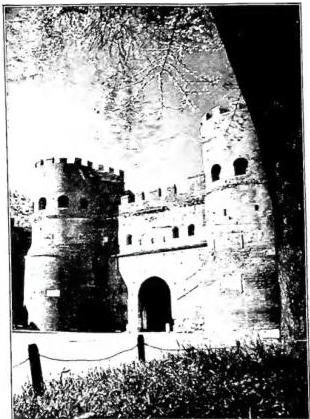
Coins are collected and classified in works by Cohen, Babelon, Mattingly and others, and shed light on aspects of the religious policy of the era to which they belong.
It is difficult to mention in a few words the contributions of archaeology and particularly of excavations, but everyone understands that starting from the architectural layout of a temple down to a stamped brick that allows for its chronological dating, from a symbolic bas-relief of a sarcophagus to the minute furnishings of a tomb or the remains of a funeral sacrifice, everything can have importance for the study of religion.
Studies on Roman religion therefore begin as early as Roman antiquity itself, but immediately under the sign of substantial identification with Greek religion. To find the first conscious distinctions between the two great religions of paganism—which throughout the Middle Ages and even Humanism remained an undifferentiated concept—one must arrive right at the beginning of the last century; but precisely then, especially under the influence of German Romanticism, a clear preference of the classics for Greek civilization and religion emerged, being older and more artistically and philosophically developed than Roman religion which, upon examination of the data, appeared as a poor imitation. Niebuhr's energetically critical position was necessary to give impetus to a scientific direction in the entire field of Roman studies. After the early attempts at synthesis by Hartung and Klausen, or the detailed works of Ambrosch and Preuner, Roman religion finally obtained its place alongside the Greek one, e.g., in the diligent activity, although compromised by a simplistic naturism, of L. Preller. But a new phase, more rigorously scientific, was opened
only under the influence and stimuli of Th. Mommsen, which determined the birth of the so-called philological-historical school. Alfred von Domaszewski and Georg Wissowa, the latter of whom would later be the author of the still fundamental handbook on Roman religion as well as the re-editor of J. Marquardt's important volume on Roman religious antiquities, are direct pupils of Mommsen. The philological-historical school laid the scientific foundations for the study of Roman religion by meticulously ascertaining the consistency of the data and drawing all philologically possible deductions from them; it is impaired, however, by its strictly philological limitation and lack of historical-religious perspectives. A certain corrective came to it from the development of folkloric studies (initiated in Germany by the Grimm brothers and exploited for the classical field by Mannhardt), from the nascent ethnological interest (in England: W. Warde Fowler) and universal historical-religious interest (in France: S. Reinach's school). Thus Roman religion became part of the study material of comparative religions (and left the limited horizon of Greco-Roman comparison, represented by Preuner or, later, by Roscher), which however led to an accentuation of the general and abstract schemes of evolutionism (Deubner) and to a departure from specific classical spirituality. Meanwhile, with the progress of historical studies, the horizon of classical civilization broadened: Roman religion could no longer be treated in isolation nor even within the framework of a generic comparison. The concrete historical unity in which it must be framed is ancient Mediterranean civilization—from Asia Minor, through Greece, to Spain—and within this one must reckon with the cultural heritage of the Indo-European-speaking peoples of whom the Italics are a part. Currently, the entire study of Roman religion finds itself thrown back into question, partly thanks to the criticisms of F. Altheim's school against the philological-historical synthesis, and partly due to the new developments in "Indo-European" (G. Dumézil) and ethnological (H. J. Rose) comparison.
The first scientific work on Roman religion is J. A. Hartung's volume, Die Religion der Römer (Erlangen 1836). The two volumes by R. H. Klausen, Aeneos und die Penaten (Hamburg 1839-40) represent an encounter between the new scientific demands and the still living romantic sensibility, even if with a notable lack of critical sense. Of J. Ambrosch's works, Studien und Andeutungen im Gebiete der altrömischen Bodens und Cultus (Breslau 1839) and Über die Religionsbücher der Römer (Bonn 1843) still deserve to be read. At this point a stricter scientific criterion intervenes in the study of Roman religion, accompanied unfortunately by a growing spiritual aridity. L. Preller's Römische Mythologie (3rd ed. edited by H. Jordan, Berlin 1881-83) is an example more of the second than of the first factor. The school of Th. Mommsen (who in his works on Roman history, law, inscriptions and chronology also personally had to deal with religious subjects) reveals its characteristics in the work of J. Marquardt, which constitutes vol. III of Mommsen's Römische Staatsverwaltung (vol. III in 2nd ed. edited by G. Wissowa, Leipzig 1885). The works in which W. Mannhardt developed his folkloric theses are Antike Wald- und Feldkulte (Berlin 1877) and the (posthumous) Mythologische Forschungen (Strasbourg 1884). For more recent general literature V. BIBLICA.
II. HISTORICAL ANTECEDENTS
Roman religion, like any other cultural product, is determined essentially by three basic factors: the cultural heritage of the people who created it, the influences of the environment in which it arose, and the specific creative historical moment thanks to which it was constituted as an unmistakable and organic unit. One can speak of a Roman religion only from the moment R. exists: and this not for a logical quibble, but because R., having constituted itself into a political unit, will immediately distinguish itself from its environment by its spiritual orientation, no earlier than the 8th century BC through the work of various Italic populations (Latin and Sabine). The cultural heritage of these populations has its roots in a high archaic civilization: Latin words concerning social organization (e.g., rex), priestly organization (e.g., flamen), and certain divinities (e.g., Iuppiter) recur in other forms among various Indo-European-speaking peoples, from India to the western Celts, demonstrating the existence of a common original civilization. This does not mean that the cultural level of those populations—who spent long centuries in migrations and in a presumably hard struggle for existence—was always maintained at a height comparable, for example, to that of Vedic India, but the structural forms of civilization were, in part, preserved. The new environment was saturated with the radiations of other high civilizations, the Mediterranean civilizations: in central Italy there were, from the beginning of the 1st millennium BC, the Etruscans, presumably coming from Asia Minor. The trade routes of the eastern Mediterranean also enetrated the West in their network: the Greek colonizers, who appeared in Italy in the 8th century BC, traveled roads already trodden by eastern, e.g., Cretan, commerce. At the time of the foundation of R., the richer culture of the East must have had the effect of a revelation upon the necessarily rough Italic populations, although they were anything but barbarous and "primitive." In this extremely complex cultural constellation matures the moment in which the various population groups living in the territory of future R. will feel the need to constitute themselves into a political and sacral unit, founding a city-state on the model and level of the cities of their environment.III. FOUNDATION OF R. AND FIRST PHASE OF ROMAN RELIGION. - To approach the earliest phase of Roman religion there are few starting points, but fortunately some fundamental ones: first of all, the calendar which, preserved unaltered—that is, with clearly distinct additions in the calendars of later ages—demonstrably dates back to an epoch prior to the foundation of the Capitoline cult (509 B.C.). It is like the charter of the religious union of the communities living in R., now also politically united, insofar as it includes cults of both the Palatine and the Quirinal; in the divine names and the names of the months, a significant Etruscan influence is noticeable. It is a lunisolar calendar of twelve months (plus an intercalary period) with 45 fixed festivals on odd days (with two exceptions). The days of the new moon (kalendae) and full moon (idus), as well as the ninth day preceding the idus (nonae), have a special name: furthermore, each day bears an abbreviation defining its sacred character. The idus are sacred to Jupiter, the kalendae to Juno. From the names of the festivals, other divine names appear: Vesta, Vulcan, Saturn, Consus, Ops, Pales, Portunus, Angerona, Larentia, etc.
Other festivals have a name deriving from the ritual action (e.g., Armilustrium) or from the central object of the festival (e.g., Vinalia), but more recent data consistently inform us of the deities involved: thus, for example, the great importance of Mars emerges.
One is therefore confronted with a sacred life regulated by the cosmic order (and also by the value attributed to numbers) and with a developed polytheistic system. Such a system already presupposes a perfect and mature fusion of elements and influences of various origins; through the Etruscan influence, the Greek one also operates (in fact, the neuter plural of festival names corresponds exactly to the usage of Greek calendars). The major spheres of religious interest are, much as in all great archaic polytheisms: agrarian life, war, death, i
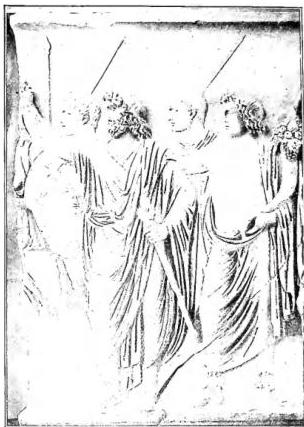
Since in Roman literature—which, as has been said, arose much later—many deities of the calendar recede into the background and indeed almost disappear (e.g., Portunus, Volturnus, Furrina), and on the other hand it is precisely these deities that antiquarian data show as having their own flamen, it can be inferred that the original priestly organization also dates back, at least in part, to the period of the calendar: not least because the number 12 (12 flamines, 12 salii), which is that of the months, dominates II.
The priestly organization can be briefly summarized as follows. There are four priestly collegia: that of the pontiffs, which includes the rex sacrorum, the flamines, the vestals, and the pontiffs properly speaking; that of the augurs; that (certainly later than the calendar) of the duoviri (later increased to become quindecemviri), in charge of consulting the Sibylline books; and that of the triumviri epulonum. In addition, there are priestly sodalities that are distinguished from the collegia perhaps by an activity linked to single occasions or recurrences. These are: the Fetiales, the Salii, the Luperci, the Arvales, the Titii. The spheres of competence of the individual priesthoods are well defined. The rex sacrorum has specific functions, probably those that still in the time of the calendar were reserved for the king (cult of Janus). The pontiffs are the expert regulators of the sacral life of the State, the superintendents of every cult, without specific relationships with determined divinities or determined types of religious function. The flamines, on the other hand, are specific priests of individual divinities—the three flamines maiores are those of Jupiter, Mars, and Quirinus—which does not exclude their participation in the cults of other well-determined divinities; the same applies to the vestals. The augurs have the exclusive task of ascertaining divine favor for the enterprises of the State and of ensuring the ritual conditions necessary for any act that requires them. The priests in charge of the Sibylline books had to deduce from them the exceptional sacral measures to be adopted in the various situations that arose in the life of the State.
On the basis of the names of festivals, the priestly specialties, and with the aid of more recent data, the great variety of rites can also be partially reconstructed. The sacrifices themselves, which could be bloody or bloodless, were very varied: male victims were due to the gods, female victims to the goddesses; the color of the victim also depended on the character of the divinity (black victims to the Underworld); to Jupiter, on the idus, a sheep was due, to Janus a ram, to Mars a horse or the suovetavilia (sacrifice of a pig, a sheep, and a bull), etc. Besides sacrifices, there are lustrations, purifying rites. Some rites are connected with processions, others with dances (of the Salii), others with races of men (Luperci) or horses (equus october), etc. The antiquity of other ritual forms, such as the votum, the auspicium, the evocatio, etc., is unquestionable.
Sacred places are well defined: some divinities must have their sanctuaries outside the pomerium, others within the city. In this early phase, stone-built temples seem to have been lacking: instead, there were altars placed in sacred enclosures or in caves.
IV. FROM THE FOUNDATION OF THE CAPITOLINE CULT TO THE BEGINNING OF HELLENISTIC CULTURE
The features of Roman religion characterized above were thus fixed in the period between the foundation of the city and the beginning of the 5th century B.C. They represent the permanent basis of what may be called Roman religion, not in the sense that it was created ex nihilo by the Romans, but inasmuch as its various elements reached an organic and autonomous form at R., clearly distinct from all other religions of the surrounding environment and, a fortiori, of the world. This basis would remain faithfully preserved in public cult throughout the entire duration of Roman civilization. However, it is not a rigidly closed system, but only a basis, susceptible to organic expansions dictated by the needs that arose in the course of history.The autonomy of Roman civilization manifests itself in the political field, for the first time, with the expulsion of a ruling Etruscan dynasty and the proclamation of the Republic. The State as such, administered by magistrates rather than embodied in a monarch, no longer recognizes above itself anything other than the will of the gods: to Jupiter—liberated from any predominant naturistic element and conceived purely as optimus maximus, also untied from his polarity with Juno—royal attributes are conferred (yet without the odious title of rex); the colossal Capitoline temple, built by the last kings, is dedicated to him in 509 B.C., which tradition considers as the first year of the Republic; alongside the supreme god, in a subordinate position and equal to one another, stand Juno Regina and Minerva.
Its political revolution places R. in sharp contrast with its environment, forcing it into a tenacious struggle destined to end with Roman hegemony in Italy; on the other hand, it initiates a development of democratic policy, in the course of which the non-patrician classes gradually succeed in asserting their demands. These two fundamental motives, plus an extraordinary cultural development due both to a greater consciousness and to close contact with surrounding peoples and the broadening of historical horizons, determine the evolution of Roman religion between the 5th and 3rd centuries B.C. The new cults, which now find a home in well-built temples, rise to the level of classical Greek spirituality: the plastic divine figures of the Hellenic Olympus appear at R. Apollo, whose veneration is already a prerequisite for the use of the Sibylline books (introduced at R. perhaps as early as the monarchic period and kept in the Capitoline temple), obtains a temple in 431; Mercury as early as 495. In the lectisternium of 399 B.C., the "twelve deities" of the Greek cult appear. Meanwhile, the plebs outlines its own religious physiognomy: the first step in this sense is the introduction of the cult of the triad Ceres-Liber-Libera (corresponding to the Greek deities Demeter, Dionysus, Persephone), as early as 494 B.C. The cult of Diana on the Aventine also possesses a plebeian character, in addition to its aspect of "foreign" policy (it is a Latin federal cult under the sign of Roman hegemony). The struggle of the plebs in the religious field would culminate with the conquest of the right to enter the public priesthoods, sanctioned by the lex Ogulnia (300 B.C.). By extending its dominion, R. naturally extends its religion as well: it welcomes, transforming them according to its own spirit, the cults of subjugated peoples (Diana, at R., loses her slave-priest that she has in the Arician valley; Juno Sospita the serpent cult connected to her at Lanuvium; Fortuna Primigenia the oracle that is her specialty at Palestrina, etc.). Furthermore, great development is taken by the cults that consecrate the fundamental ideals destined to guide R. in this period of its rise: just as in the archaic era the cult of Fides (whose great antiquity is demonstrated, besides by tradition, by the participation of the three major flamens), now that of Spes (477?), Salus (302), Concordia (367), with reference to the disputes between patriciate and plebs, and Victoria (294), express the sacral meaning that R. confers upon the cornerstones of its own conduct.
V. FROM THE FIRST HELLENISTIC INFLUENCES TO THE AUGUSTAN AGE
In few national histories is there observed such an abrupt break in cultural development as the one that occurs at R. upon its first direct contact with the Hellenic world. And this is understandable: the Greeks in that period have already passed the peak of their maturity and reveal tendencies toward cultural and intellectual refinements; R., substantially archaic, but with aspirations to superiority, seeks to assimilate that superior cultural level which strikes it in its adversaries. From one moment to the next (in the 3rd century B.C.: from the first wars with Magna Graecia), Roman intellectual, literary, and artistic culture arises.In the religious field, the State controls permitted cults. Aesculapius is the first Greek deity accepted from Greece itself (295 B.C.). But by now Greece is no longer just Greece: it is the Hellenistic world, saturated with Oriental influences. From this world there arrives at R., in 205 B.C., the cult of the Phrygian goddess Cybele, called at R. Magna Mater Deum Idaea (with an allusion to the Trojan origins of the Romans): characteristically, Roman religion accepts it only on condition of transforming it in accordance with its own ritual forms and isolating the elements not compatible with these, entrusting them to Phrygian priests who do not figure in the public cult.
In the 3rd century, and even during the Hannibalic Wars, the continuity of the public cult is demonstrated by a series of foundations of temples dedicated to the most ancient divinities: Consus, Pales, Tellus, Janus, Juturna, etc. But among the private masses, and precisely both in the intellectual class now devoted, body and soul, to Hellenistic culture, and in the people who had become extraordinarily mixed during the vertiginous growth that turned a small city into a world power, a notable distancing from the archaic religion takes place. The State, on the alert, combats the cults incompatible with its religious line: the bloody repression of the Bacchanalia (186 B.C.) constitutes an energetic opening blow in that series of measures that the State will take with regard to any religious orientation which, under the banner of individual salvation, leads to the neglect of the supreme public interest: thus it will arrive, through hostilities against Oriental cults,
such as astrology, the Jews, right up to the persecutions of the Christians.
In the 1st century B.C. the ruling classes themselves with difficulty separate their public duties from their Hellenistic cultural formation. One aspect of the Hellenistic-Oriental religious world is the sacredly conceived monarchy: precisely what R. had to eradicate in order to create its own spiritual line. The first great Roman leaders who operate on a world scale, such as Scipio Africanus, already show themselves sensitive to the forms of the Hellenistic monarchy and their pretensions find full consent from the composite mass. But this situation matures above all in the times of Sulla, Caesar, Antony. Octavian's victory over the latter presents itself at first as a backlash of the Roman spirit against Hellenistic orientations. And in fact Augustus, who claims to be only the first magistrate of the State and rejects (permitting it only in the provinces) the cult dedicated to his person, makes notable efforts to restore even the Roman religion in its ancient forms. The neglect of these had reached extreme points: from 87 to 1 B.C., R. was without a flamen Dialis; of many divinities the erudite knew only the name (Furrina, Angerona, etc.). Augustus has 82 temples restored. But by now neither his sensitivity nor that of the people is that of the ancient Roman. As pontifex maximus, Augustus also introduces audacious reforms: he imposes his own personal orientations on the public religion (to the new cult of Mars Ultor he transfers the privileges of the Capitoline temple; he intensifies the cult of Apollo; he confuses his own private cults of Vesta and the Penates with those of the State, etc.). And around his figure there revives the ideology of the Hellenistic monarchy which with his successors will culminate in the imperial cult.
VI. THE EMPIRE
The imperial age brings to completion the process that began during the late Republic: a process in the course of which Roman religion properly so called is transformed into the religion of the Hellenistic world dominated by R. Not that the fundamental elements of Roman culture disappear: through its administrative and military organs R. imposes respect for its gods upon the world and particularly the Capitoline cult; on the other hand, the Italic people faithfully preserve the rites of domestic worship. But the general religious consciousness definitively undergoes the ascendancy of two new factors of religion: the imperial cult and the oriental cults.In any case, in order to correctly evaluate the importance and measure the novelty of these factors, certain facts must be kept in mind. The imperial cult has roots not only in the late Republic, but also deeper roots in the distant Mediterranean protohistory, into which the nascent R. was once also framed. It signifies an identification between the State and the sovereign, and, through this indirect formula, ensures continuity for that central position of the State which has always been the principal characteristic of Roman religion.
The oriental cults (Isis, Dea Syria, Jupiter Dolichenus and Heliopolitanus, Attis, Mithras: V. voci singole) increasingly conquer the mixed masses of the Empire. But different nuances must be distinguished within them. Exotic divinities could appear to the Romans as identical or similar to the divinities of their polytheism (Isis and Fortuna; the Ba'al of Doliche and Jupiter, etc.) and assimilate syncretistically to them: in this case they do not represent a substantial novelty in Roman religious life. Their fashion among intellectuals can be deceptive regarding their actual religious value, which in this case is practically nil. Practiced in an authentic form by the exotic faithful themselves, these cults have no significance for Roman religion. Their most important form is the mystery form, long opposed by the State: but when the Roman ruling classes have themselves initiated into all the oriental mysteries, this signifies two things: first, that the mysteries have already lost their original form and
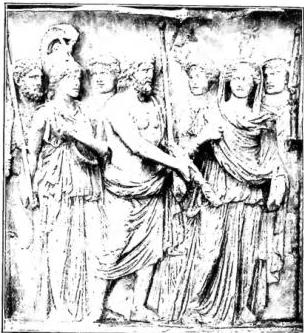
VII. PRIVATE CULT
It does not have a history in the proper sense of the word. The difference between public cult and private cult is that the latter, rather than by the State as such and by its constituent elements, is practiced by individuals and their private groupings (family, gens, associations), and practiced directly, that is, without priestly mediation. Among the deities of Roman polytheism, there are several that concern the State more (Janus, Vesta, Quirinus, etc.) than the individual, and vice versa (Silvanus); others have a reason for being only in the private sphere (deities of domestic cult: individual Genius, Lares, Penates of the family, etc.: V. related entries). Domestic and rural cults, in particular, preserve their archaic forms throughout the duration of Roman paganism.V. LETTERATURA ROMANA ANTICA.
SUMMARY:
I. Archaic Age
II. Republican Age
III. Imperial Age.In the aftermath of the foundation of R., around the 8th-7th century B.C., the various Italic tribes in their different dialects had not left any literary document in the true meaning of the term. The numerous Faliscan-Oscan-Umbrian, Pelignian, Sabellian, etc., inscriptions that have survived until now mostly contain sacred laws, dedicatory and legal expressions, and cult formulas
(e.g., the Eugubine Tables, Umbrian; the Tabula Bantina, of Agnone, of Capua, Oscan, etc.). Nor can the Faliscan inscription engraved on a cup be considered the result of a literary endeavor: - foied. uino. pipafo. cra. carefo - (today I will drink wine, tomorrow I shall be without it: Corpus inscrip. Etruscarum, 8179, 80), even if such a precept springs from an easy and contingent frame of mind.
The Italic peoples, apart from myths, prayers, carmina, and mimetic forms handed down orally and in tradition, have left a substratum that is always found enduring at the foundation of the Roman mentality: clarity of thought, severe religiosity, concrete expression of human feelings. Scrolling through the most ancient Latin inscriptions, one is struck by this reserve, by the solemn pietas that permeates the sacred epigraphs, the laws, the consular praises, and the funerary stones. Especially from the latter, voices of wives, mothers, children, and slaves speak almost conscious of the great mystery they have faced and serenely recount to the passerby the virtues they had in life; and they have phrases that denote a conscious acceptance rather than a resigned abandonment. Equally, ritual precepts, sacred laws, etc., obey this intimate sense of balance and practicality, to the significance of one's own individuality which, with the passing of years, even while becoming spiritually refined, constitutes no small part of Latin literary expression.
I. ARCHAIC AGE
Traditionally, Roman literature is considered to begin with the Odysia of Livius Andronicus (3rd century B.C.); however, this beginning is not to be understood merely under the sign of the translation of the Homeric poem, but rather with the memory of the hymn that Andronicus composed in honor of Iuno Regina, to be sung by twenty-seven maidens in expiation of certain prodigies that had then occurred. It is precisely the carmen of this semigraecus, which Livy (XXVII, 37, 7) criticizes for its crude composition, that worthily inaugurates the archaic age, entirely pervaded by a heroic spirit and a reverent fear of the divine. The arduous labor of conquest to amalgamate the proud Italic populations and the great epic of the Punic wars constitute material of noble song and worthy memory for the Roman, if Cn. Naevius makes himself their interpreter. Naevius, who had already honorably fought during the First Punic War, was the creator of a national drama with the fabula praetexta, and his Bellum Poenicum, which takes its cue from the adventurous arrival of Aeneas in Latium, ideally links contemporary events to the carmina convicialia, to the naeniae in honor of ancestors, and to the most ancient heroic and religious legends. The carmina convicialia, by their very genre of poetry, constitute the precursors of the Roman epic and were sung in turn at banquets by the guests and by well-born youths to commemorate the praises and deeds of the great departed.The archaic age possesses to a large degree this devotion to history, another fundamental element of Latin spirituality. Naevius composed his poem in saturnians, an ancient meter probably of a recitative nature (cf. G. Pasquali, Preistoria della poesia romana, Firenze 1936) which Ennius, the pater of Latin poetry, replaced with the hexameter in weaving the great fabric of his Annales.
Some aspects of Ennius's work bear witness to contact with Greco-Hellenistic culture. Much has been written and discussed regarding this encounter between the Latin and Greek mentalities, especially in the last century. Today, anyone can more calmly conclude that while the Greek world undoubtedly revealed broader forms of culture to Latin literary experience, facilitating a more advanced technique, often the two spiritual strata, while completing each other, remain distinguishable, and frequently the Greek one may have little or no hold on the Latin mentality. Plautus boldly contaminates Greek comedies and latinizes their meters, but scenes and situations are stamped by the Roman environment, even if his characters bear Greek names and the theatrical action takes place in Greek cities. His numeri innumeri in some of his comedies (e.g., the Casina) are influenced by that repertoire of typically Italic burlesque genre which is born and draws nourishment from the rural environment: from Fescennines, from atellanae, from all the anonymous Oscan farces, etc. (cf. E. Fraenkel, Plautinisches im Plautus, Berlino 1922; G. Pasquali, Plauto, in Pagine stravaganti e supreme, Venezia 1951; G. E. Duckworth, The nature of roman comedy, Oxford 1952). Roman common sense always regained the upper hand against any infatuation for things Greek, considering it akin to a foreign fashion. Lucilius in his Saturae smiled at it by taking aim at the Hellenizing praetor Albucius (Baehrens, 59); literary criticism, in agreement with the public's taste, revolted against Terence's theater, detecting in his comedies a too-obvious derivation from those of Menander (cf. G. Coppola, Teatro di Terenzio, Bologna 1942). The conservative attitude of the small landowners, represented by the prudently enlightened work of Cato the Elder (cf. bibliographical review of studies in Paideia, 7 [1952], pp. 213-217), hindered the activity of the Scipionic circle, which was uninhibited in its ways and a proponent of the new currents.
II. REPUBLICAN AGE
The republican age finds its significant exponents in the prose of Sallust and the poetry of Catullus. The historian recounts the experiences and dark sides of a society of whose events he was a protagonist, and it is uncertain whether his pages still vibrate with indignation or regret. Catullus expresses pure love with all its irrationalities, raptures, and melancholies. Lucretius's De rerum natura, composed patriai tempore iniquo (v. 41), while seeking to clear minds of the fear of gods while simultaneously providing an explanation of natural phenomena, is thoroughly imbued with the religious awe of one who has attempted to lift the veils of the divine. Amidst such fervor, voices calling back to tradition arise here and there, in the mimes of Decimus Laberius, in the maxims of Publilius Syrus, in the honest biographies of Cornelius Nepos.Varro retreats into the otium of his prodigious philological activity, while his Saturae Menippeae show him to be an acute and caustic observer of the flaws of contemporary society.
At the conclusion of this age, Cicero examines how much of the new political and literary experiences can be integrated into the continuity of the Roman tradition or, if departing from it, rejected as ephemeral. In the De natura deorum, doubts and needs regarding the divine are contested to conclude that there exists aliquot numen (II, 2) which, in its harmonious ordering intelligence, rules and governs the universe. The pages concerning morality indicate that the summum bonum does not reside in voluptas temporanea and bodily pleasure, but the spiritual end is another: ad altiora nati sumus (De fin., II, 34). Ideas on the State seek to balance the rights of the people and the powers of the ruling class; the vetus respublica thus ordered formed the object of his regret and his hope for the future (Ch. Wirzubski, Libertas as a political ideal at Rome, Cambridge 1950, pp. 79-97).
This ideal, perhaps too cautiously conservative, failed him as a lifeline to survive in the whirlpool of the new times. The style of Caesar's Commentarii, cold and detached notes of a great military leader and consummate politician, marks the transition to the sparse and essential phrases of the Monumentum Ancyranum. Nevertheless, the culture of the Augustan age, while approving, consciously or not, the new transformations that the skillful and careful work of the princeps was creating in Roman society, seems to suffer from a thinly veiled anxiety. Upon closer inspection, these poets and prose writers, beyond what is a formal echoing of external reality, all express a sentiment of indefinable regret. It is the subtle melancholy that shines through some of Horace's odes—more than a mere callback to his favorite Greek lyric poets—when the poet introduces the inevitability of death in contrast to the joyful course of earthly days; in the ode to Leuconoe, e.g. (I, 11). It is that fragility which Tibullus invokes to support his frailty and his restless love: tam possim contentus vivere parvo (I, 1, 25). Propertius enriches the elegy with a romantic tone by evoking the ancient ages of R. and the desolate squalor of a ruined city. Livy's prose imparts an epic tone to the deeds of R., exalting the poetic fabulae that lie at the origin of its history. Ovid's poetry represents a splash of color with softly blurred outlines within the Augustan age; with the voluptuous mythological interpretation of the Metamorphoses, with the elegant and precious complacencies of the Amores and the Ars amandi. The Fasti describe the religious festivals of R. in vivid vignettes (on Virgil, V. the relative entry).
III. IMPERIAL AGE
In the imperial age, writers originating from various parts of the Latin world interpreted the heightened demands of the human spirit and reflected reality in its various aspects. Seneca (v.) bear witness to this inspiration, seeking a justification for life's problems not in metaphysical heights, but by examining and weighing earthly anxieties. It is a rich and interesting experience, even if many pages of this moralist sometimes resemble the advice of a man of letters careful not to commit himself too far. The De brevitate vitae, on the other hand, possesses a sincere tone and color. The Satiricon of Petronius - if this author belongs to the 2nd or 3rd century AD rather than the Neronian age (cf. E. V. Marmorale, La questione petroniana, Bari 1948) - poses no problems; it is a tale between picaresque and refined, unsettling and coarse. The satire of Juvenal perhaps overcharges the colors, but it is the straightforward opinion of an embittered and honest spirit. The poetry of Persius remains too much under Stoic influence to rise to true poetry.More affable, more insinuating, more stylistically refined are the epigrams of Martial; elegant and rhetorical is the poetry of Statius. The events narrated by Tacitus (v.) are not intended so much as a critique, but rather as the incorporation into history of a reality no less painful. The burning lust for dominion of Roman commanders, which forms the background of Sallust's Jugurtha, the firm and dignified fighting of the Roman legions described by Livy, are replaced in the Historiae and Annales of Tacitus by the atrocious and pitiful spectacle of civil wars and by figures of emperors, sinister in their greatness. Tacitus accepts the principate as an inevitable political evolution, even if men have embraced its most wretched teaching and ruere in servitium (Ann., I, 7, 1). In Quintilian the laws of civic and literary education, supported by morality and common sense, assume an honest and enduring vision. At the end of the Trajanic age, taste and culture fall back upon erudite activities (think of Fronto), upon brief notes and philological and grammatical skirmishes; law is codified, and in history one takes pleasure in anecdote and spicy gossip. This system was inaugurated by Suetonio and continued with no great success by the Scriptores historiae augustae. The Christians have already appeared, bearers of an exiliabilis superstitio (Tacitus, Ann., XV, 44) that could not be suppressed, confused by Suetonius with the Jews assidue tumultuantes (Claud., 25), casting a shadow of perplexity upon the delightfully impressionistic yet somewhat superficial correspondence of Pliny the Younger (X, 66). Almost all authors of the 2nd and 3rd century AD are examined with erudite curiosity, but few are read with true delight. These are precisely the ones who start from the observation of daily custom, as Apuleius does with a skeptical eye in his Metamorphoses.
Some minor voices are fresher and more sincere; the anonymous Celeuma or sailors' chant and the Pervigilium Veneris. There is a return to the practical observation of the cultivation of fields with the De re rustica of Palladius; a thread that was never interrupted in the Latin literary tradition and which, departing, one might say, from the priscus Carmen Arvale, up to Virgil, is never divorced from a moral and religious concern. A short poem in which one truly feels the laughter of the fresh landscape described is the Morella of Decimus Magnus Ausonius; bloated and agitated is the poetry of Claudian. Thus we have reached the threshold of the 4th century AD, and from then on it is very difficult to discern how much that is Roman still remains in the literary forms. The final authors expressed by dying paganism are Aurelius Symmachus, nobly anchored to the past with his ora-
The Ground Truth image displays a single, solid horizontal line. According to Rule 2 (UNDERSCORE & LINE RULES), this is a stylistic or background line, not a placeholder underscore. Therefore, the OCR result must ignore II. The provided OCR content is "____", which consists of four underscores. This is an incorrect interpretation of the line as a placeholder, violating the rule that stylistic lines must be ignored. The OCR has hallucinated text (underscores) where none should exist, violating the rule to ignore such lines. Hence, the OCR result is inconsistent with the Ground Truth.
The Ground Truth image displays a single, solid horizontal line. According to Rule 2 (UNDERSCORE & LINE RULES), this is a stylistic or background line, not a placeholder underscore. Therefore, the OCR result must ignore II. The provided OCR content is "____", which consists of four underscores. This is an incorrect interpretation of the line as a placeholder, violating the rule that stylistic lines must be ignored. The OCR has hallucinated text (underscores) where none should exist, violating the rule to ignore such lines. Hence, the OCR result is inconsistent with the Ground Truth.
The Ground Truth image displays a single, solid horizontal line. According to Rule 2 (UNDERSCORE & LINE RULES), this is a stylistic or background line, not a placeholder underscore. Therefore, the OCR result must ignore II. The provided OCR content is "____", which consists of four underscores. This is an incorrect interpretation of the line as a placeholder, violating the rule that stylistic lines must be ignored. The OCR has hallucinated text (underscores) where none should exist, violating the rule to ignore such lines. Hence, the OCR result is inconsistent with the Ground Truth.
tion for the altar of Victory, and Rutilio Namaziano who in his De reditu suo expresses hostility towards the hermit monks living on Capraia (I, V. 439 ff.) and pities a friend who led a monastic life on Gorgona (ibid., 517 ff.). In the mists of the island as in the ruins of Populonia (ibid., 401) the writer saw the twilight of those ideals, which had long since disappeared, that had animated ancient literature.
B) CHRISTIAN ROME DOWN TO THE PRESENT DAY.
### I. CIVIL AND ECCLESIASTICAL HISTORY.
SUMMARY:
I. Rome in Holy Scripture
II. Ancient History
III. From Gregory the Great to Stephen III
IV. The 8th-12th Centuries
V. The 13th-15th Centuries
VI. From the 16th Century to the French Revolution
VII. The Roman Republic (1798-99)
VIII. From the late 18th Century to 1849
IX. From the Roman Republic (1849) to the Present Day.I. R. IN SACRED SCRIPTURE. - The Romans are perhaps mentioned in Dan. 11, 30; Rome or the Romans indirectly in I Macc. 1, 11; 7, 1, and directly in the account of the alliance requested (161 B.C.) by Judas Maccabeus to defend against Syrian aggression (I Macc. 8, 1-32; II Macc. 4, 11), later renewed (in 144 B.C.) by his brother Jonathan (I Macc. 12, 1-4.16). Rome joined in the mourning of the Jews for the death of Jonathan and reconfirmed friendship with his brother Simon (I Macc. 14, 16-19.24.40; 15; 15-24). But through its interventions in Palestine, Rome was slowly preparing its conquest, which took place by the hand of Pompey in 63 B.C.
At the time of Jesus, after the death of Herod and his son Archelaus, who had reigned over the entire land of Israel, part of the country was entrusted to tetrarchs and Judea was placed under the rule of a Roman procurator (v. I). Rome is not named in the Gospels, but its emperors are repeatedly mentioned (Lk. 2, 1; 3, 1; Mt. 22, 17-21; Mk. 12, 14-17; Lk. 20, 22-25; 23, 3; Jn. 19, 12.15; etc.) and their representatives: the legate of Syria (Lk. 2, 2), the procurator of Judea Pilate (Lk. 3, 1; etc.). The danger of a harsher servitude under Rome provided the Sanhedrin with the pretext for the death of Jesus (Jn. 11, 48), as an instigator of one of those
pseudo-Messianic movements that periodically shook Palestine; whereas the fear of losing the favor of Caesar led Pilate to condemn Jesus, and only by asserting the exclusive sovereignty of Caesar did the Jews overcome the procurator's hesitation (Jn. 19, 12-15).
Acts 18, 2 CLAUDIUS, MATTHIAS (v.) which ordered all Jews to leave Rome (A.D. 49), and on this occasion the two Jews, Aquila (v.) and Priscilla, having left Rome, met Paul in Corinth. A journey to Rome was a constant aspiration of Paul for many years (Rom. 1, 13; 15, 23), becoming more ardent at the end of his third missionary journey (Rom. 15, 19 ff.). The night following his arrest in Jerusalem, Jesus appeared to Paul, assuring him that he must bear witness to him in Rome as he had borne it in Jerusalem (Acts 23, 11). St. Luke highlights the humane treatment accorded by the Roman authorities to Paul as a prisoner in Jerusalem (the tribune Lysias), in Caesarea (the procurators Felix and Festus), on the journey to Rome (the centurion Julius), and during his stay in Rome, when Paul lived in a rented house, with the freedom to receive anyone who came to visit him and to preach (Acts 28, 30 f.). The treatment given to St. Paul during his second imprisonment must have been different, however, Onesiphorus (v.) had to overcome great difficulty to track down the Apostle (II Tim. 1, 17), who found himself in abandonment (cf. II Tim. 4, 9-15) and awaited death (II Tim. 4, 6 ff.; V. PAOLO, APOSTOLO., I). It is generally believed that the Babylon of I Pet. 5, 13 is Rome, according to a metaphor not infrequent in rabbinic usage (texts in H. L. Strack-P. Billerbeck, Commentar zum N. T. aus Midrasch und Talmud, III, Munich 1926, p. 816); hence the letter would have been written from Rome. Also in the "great Babylon," whose pomp, corruption, cruel impiety toward the faithful of Jesus, and ruin are described in the Apocalypse (chaps. 17-19), traditional exegesis holds that Rome is depicted.
II. ANCIENT HISTORY
Christian preaching must have reached R. very early; however, there is a lack of any precise information regarding the time and how it began there. Converted Jews, Eastern neophytes, and Greeks, brought by the most diverse circumstances and from different countries, must have contributed to creating groups of the faithful in R. who around the year 58 drew praise and concern from s. Paolo, as is evident from the letter he sent them then.Later, when Paul was approaching R. in 61 as a prisoner, the faithful went out to meet him at Forum Appii and Ad tres tabernas (Act. 28, 15), but the sacred author does not dwell on anything regarding his relations with them during that first stay. Unknown, on the other hand, are the circumstances that brought the Apostle s. Pietro (v.) to R., where he took over the leadership of the community, perpetuating that primacy over all the Churches that had been conferred upon him by the divine Founder in his final appearances in Galilee (v. PRIMA).
R. was immediately a center of Christian radiation and hierarchical organization, first in the surrounding regions, then throughout Italy and neighboring countries, in Africa, and in the valleys of the Rhine and the Danube; this was firmly believed by the beginning of the 5th century, when Pope Innocent I wrote to Bishop Decentius of Gubbio, appealing to constant tradition. The different phases of this evangelization have remained unknown, even though local legends have attempted to dispel the obscurity. It is understood, however, that in the intervals, sometimes quite long, between successive persecutions, the resurgences must have been rapid and increasingly widespread. Yet we are also poorly informed about the internal affairs and direct external interventions of the Roman Church during the first two centuries of its existence. CLEMENTE X (v.), toward the end of the 1st century,
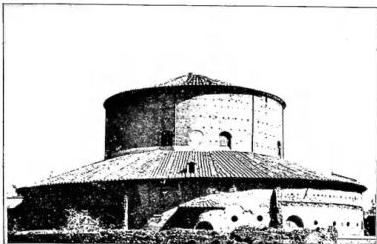
Even the pagan reaction in R. was at times particularly fierce, because the imperial police had to be very careful in the execution of the edicts, and thus the community received a particularly bloody consecration of its privilege of being at the head of the new spiritual empire (v. PERSECUZIONI); however, the number and personality of the martyrs become clearer with the progress of the cult upon their tombs, even if it is not always possible to establish the time and manner of their execution and if the memory of only some could be perpetuated, especially in the first moments of Christian propaganda. Numerous, too, must have been those who, without shedding blood, sacrificed everything for the exercise of their faith.
An important testimony on the efficiency of Christianity in R. in the aftermath of the Decian persecution is found when, in 251, Pope Cornelius gathered around him a Synod of 60 bishops and, in a letter to Fabius, bishop of Antioch, speaks of a numerous clergy and opportunely organized charity (Eusebius, Hist. eccl., VI, 43). From the time of his predecessor Callistus, the burial regime (v. CIMITERI CRISTIANI ANTICHI) and perhaps ecclesiastical ownership had also been organized. The Roman community passed through particularly critical moments after the martyrdom of Pope Zephyrinus, when the secession of Hippolytus (v.) occurred; after that of Pope Fabian (v.), when Novatian (v.) arose as antipope; and of Sixtus II, due to the confiscation of the cemeteries and the prohibition of meetings. The persecution of Diocletian-Maximian was bloody for only two years, but it yielded numerous martyrs and left a trail of internal dissensions whereby, after the death of Pope Marcellinus (v.), his successors Marcellus and Eusebius were sent into exile by the Emperor Maxentius, and peace returned to the Roman Church only with the election of Pope Miltiades (311). Under him Constantine entered R. triumphantly, definitively secured the triumph of Christianity (313), and assigned to the Roman Church the domus Faustae in Lateranis, which became the stable residence of the Pontiff until the end of the 13th century. Indeed, it was here that the Council of bishops, assembled to settle the questions that arose in the Church of Carthage concerning Bishop Caecilian, was held in 313. The turbulence of Egypt regarding Meletius and the agitated controversies caused by the Arian propaganda, resolved at the Council of Nicaea (325), did not at first have serious repercussions in R. during the pontificate of Pope Sylvester, when the Roman Church, thanks to constant imperial favor, was embellished with grandiose constructions, such as the basilicas on the tombs of the Apostles and martyrs outside the walls and the titular churches within, and intensified propaganda for the conversion of pagans.
The Arian party, emboldened by the growing favor of the Emperor Constantius, went so far Julius (v.) the disavowal of St. Athanasius (340); the Pope resisted and sent his legates to the Council of Sardica (345) to make peace between the opposing factions. When Constantius, having returned as sole emperor after the divisions of Constantine's sons, sought to pressure the West in favor of Arian conceptions, in the vain hope of thereby restoring spiritual unity to the Empire, he encountered tenacious opposition from Pope Liberius (v.), who was sent into exile by him and replaced by the antipope Felix II. The latter could not last, and Liberius returned; but upon his death (366) bitter discords arose in R. when the antipope Ursinus was set up by a part of the clergy against the new Pope Damasus, giving rise to violent scenes, and Damasus's life was made hard by repeated appeals to the imperial court. This did not sap Damasus's industriousness in convening councils, erecting titular churches, and reorganizing cemeteries. Under him St. Jerome succeeded in spreading among aristocratic women an ardor for the spiritual life that was never again extinguished. Moreover, monastic life (v. MONACHISMO), which St. Athanasius had made known toward the middle of the 4th century, had found followers also in R., where monasteries began to arise, particularly in the vicinity of the Vatican Basilica and the most venerated sanctuaries.
It is not to be believed, however, that paganism in R. was entirely eradicated. Although the Emperor Constantius had prohibited its public worship and ordered the closure of the temples, in R. it was necessary to proceed with great caution in this regard. After the brief parenthesis of Julian the Apostate (v.), Gratian renewed the decrees of Constantius, confiscated the property of the temples and prohibited public largesses, refused the title of pontifex maximus which the emperor had borne since the time of Augustus, and in 382 ordered that the altar and statue of Victory be removed from the Senate hall. A delegation of pagan senators led by Symmachus failed to obtain the revocation of this order and the preservation of the ancient privileges. A literary polemic between Symmachus and St. Ambrose (later also Prudentius) made this episode famous. But the pagan senators tried to make a comeback on the occasion of the rebellion of 392 by replacing the statue of Victory in the hall, celebrating the ancient cults anew, and imposing a solemn lustratio on the city, almost to purify it from Christian contamination. The victory of Theodosius in 394 put an end to this last effort of paganism to survive; the temples were closed, the college of the Vestals was dispersed, and a few years later the Circus games also ceased; the accusation that Christianity was the cause of the ruin of the Empire did not yet cease, however; St. Augustine had to polemicize against this prejudice, which was tenacious in a part of the aristocracy and in the literary tradition.
With the death of Maxentius, R. had ceased to be de facto the capital of the Empire. Not only had Constantine caused Constantinople to rise as the metropolis of the—
the East, but for the West Trier (later Arles) and Milan had risen to compete with R. With the Visigothic invasion, Ravenna became the true capital of what remained of the Western Empire. In 410 Alaric and his Visigoths seized R. and sacked it; Pope Innocent had striven in vain with the Emperor Honorius to avert the disaster. Pope St. Leo (v.) witnessed the tragic end of the Theodosian dynasty, and although in 452 he succeeded in turning Attila and his Huns away from Italy, in 453 he saw Genseric and his Vandals, setting out from Africa, seize R. and depart laden with booty. The following decades marked the agony of the Empire, until a leader of the barbarian auxiliaries, Odoacer, having proclaimed himself king (476), brought it to an end, even without destroying its internal institutions. Odoacer in turn succumbed (489-91) beneath the blows of a new barbarian, Theodoric, king of the Ostrogoths, who made himself master of Italy. Meanwhile R. continued to govern itself through its Senate and the praefectus Urbi, but it was no longer the arbiter of the world's fortunes, though it always preserved the memories and majesty of its past. In the East they would gladly have dispensed even with its spiritual primacy, which could not be taken from it, under the presumption that the authority of the Empire was a sufficient safeguard of religious unity. Instead, the schisms provoked by the great Christological questions—Nestorian and Monophysite—had indeed superseded Arianism, still professed by the invading barbarians, but only to perpetuate deeper divisions. Byzantine dogmatism had not taken hold in R.; however, a keen sense of legitimism toward the Empire, considered as the continuation of Romanness, had become lively against barbarian domination; and this, albeit with different phases, dominated the events of the following age. An expression of this were the turbulences stirred up regarding the election of Pope Symmachus (v.) by the antipope Lawrence, a few years after the distrust of King Theodoric that cost I (v.) and some members of the Roman aristocracy (v. BOEZIO), until it came to the Gothic wars, which were desolating for all of Italy, but particularly for R. Besieged by the Gothic king Witigis for more than a year and subjected to the harshest trials, the city was able to hold out only through the skill and valor of Belisarius, the Byzantine general who had managed to occupy II. In the meantime Pope Silverius (v.) was removed from R. and deprived of the see, which was given to Vigilius (537). The fortunes of the Goths having revived, R. was besieged a second time by the Goths, and this time it was Pope Vigilius who had to leave R., because Justinian wanted him in Constantinople. The city fell into the hands of Totila through betrayal on Dec. 17, 546, and the deacon Pelagius, having gone to meet him, barely succeeded in moving the King to clemency; but the population was forced to leave the city, while its walls were partially destroyed. R. remained in the power of the Goths until Narses restored it to the Byzantines in 552, after new battles and new slaughters. This was one of the most critical moments of its history; it had also remained deprived of the Pope, who died in Sicily in July 555; the following year Justinian sent as pontiff Pelagius (v.) who, welcomed with much mistrust at first, finally succeeded in restoring order and confidence to the troubled city.
The Lombard invasion of 568, which threw Byzantine Italy into turmoil, stopped at the outskirts of R., where the sinister echoes of the misfortunes caused by the new barbarians reached; from Tuscia and Sabina they aimed to hurl themselves upon the city, which however was not reached by them, thanks above all to the activity of Pope Gregory I. From here, with the steady decline of imperial authority, began the history of R. in the Middle Ages.
tholicisme, ib. 1929; id., Le Siège apostolique (559-451), ib. 1924; id., Cathedra Petri, ib. 1938; E. Caspar, Die älteste röm. Bischofsliste, Berlin 1926; H. Lietzmann, Petrus und Paulus in Rom, ib. 1927; G. Bardy, L'Eglise rom. sous le pontificat de saint Anicet, in Recherches de science religieuse, 17 (1927), pp. 481-511; J. Chapman, Studies on the early papacy, Oxford 1928; H. Grisar, Roma alla fine del mondo antico, 2 vols., Rome 1930; E. Caspar, Gesch. des Papsttums, 2 vols., Tübingen 1930-33; A. S. Barnes, The Martyrdom of st. Peter and st. Paul, Oxford 1933; G. Romano - A. Solmi, Le dominaz. barbariche in Italia, Milan 1940; O. Bertolini, R. di fronte a Bisanzio e ai Longobardi, Bologna 1941; R. Valentini - G. Zucchetti, Codice topogr. della città di R., II, Rome 1942.
III. FROM GREGORY THE GREAT TO STEPHEN III (590-772)
The Lombard invasion had profoundly affected, between 569 and 589, the neighboring provinces of "Tuscia et Umbria" and "Campania"; R. itself had been repeatedly in danger, and became so again at the beginning of the pontificate of Gregory the Great (590-604). It was saved, together with the surrounding territory, thanks to the initiatives, as bold as they were appropriate and timely, of the great Pontiff also in the military and politico-diplomatic field in his dealings with Agilulf and with the Duke of Spoleto Ariulf. Thanks to him, the popes of the 7th century no longer had to face the same trials; but the work of Gregory the Great had marked a decisive moment in relations not only with the Lombards, but also with the Empire.Still around the middle of the 7th century, the official announcement to the Exarch of Italy of the election of a new pope solemnly declared that the virtue not of imperial arms but of God and of St. Peter, in the person of the Pontiff, his vicar, kept in check and placated, upon its approach, the ferocity of the barbarians. Gregory the Great, moreover, had always acted in his diplomatic initiatives as a loyal subject and according to his personal assessment of the interests of the Empire in Italy; but without hesitating to place himself
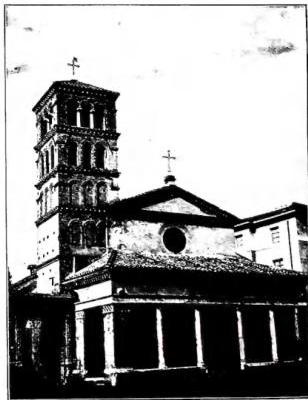
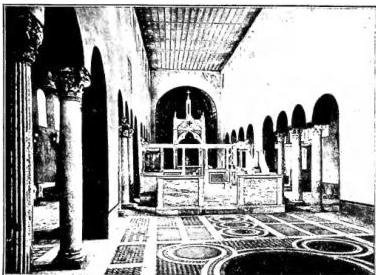
The exarch of Italy Isaac therefore appealed solely to motives of a material order. The Byzantine treasury was accustomed to send the funds for the pay of the troops of R. to the Pope, who kept them on deposit at the Church Treasury in the Lateran Palace, from which the paymasters withdrew the necessary sums. Such operations often took place with great delay, provoking lively discontent among the troops. The Exarch thought to exploit this and gave secret instructions to the highest-ranking officer of the exercitus Romanus, the chartularius Maurice, to accuse the recently deceased Pope, Honorius I, before the soldiers of having improperly retained in the Church Treasury the funds regularly sent by Heraclius. The soldiers assaulted the Lateran, where Severus, successor of Honorius I, had been installed, and after three days of resistance occupied the Palace. The chartularius had seals affixed to everything kept in the Treasury (late 639 - early 640); the Exarch, having arrived from Ravenna, sent the notables of the clergy into confinement as guilty of resistance to constituted authorities, proceeded to inventory the Treasury, recovered what could be claimed for the imperial treasury, and sent it back to Byzantium. The true purpose of this violence masked by legal fiction was to intimidate the Church of R. to make it more malleable to the Ἔκθεσις; but such a maneuver proved
that the Exarch knew he could not count on the unconditional obedience of the Roman troops if it were a matter of religious subjects. Two years later the chartularius Maurice incited the troops under his command to revolt against the exarch Isaac himself. He paid for the rebellion with his life and his was an ephemeral movement, due solely to personal ambitions, to which the Church of R. remained completely extraneous; but it results from this that even in the Roman territory, as an effect of the reforms introduced into Byzantine institutions starting from 584, with the establishment of the office of exarch of Italy, the ancient civil provinces were being replaced by new military territorial districts, which would soon be placed under the command of duces, and would therefore be called duchies.
The condemnation of monothelitism at the Lateran Council, under Pope Martin I (Oct. 649), brought the religious conflict between the Church of R. and Byzantium to an acute phase. The spiritual solidarity with the Pope even of the armed forces proved so firm, that even the exarch of Italy Olympius, to whom the emperor Constans II had entrusted the task of overcoming, by every expedient including violence, the opposition to
his τύπος περὶ πίστειος, was induced by it to rebel himself against the Empire. For three years Olympius ruled the Italian domains of Byzantium as a master, until he died however of illness in 652 in Sicily, where he had led the army to parry the first Arab incursion on the island. For the first time in the history of Byzantine Italy, a religious conflict had repercussions on the political situation. The fact for the moment had no consequences; but in June 653 the exarch Theodore Calliopa was able to arrest Martin I in the Lateran Basilica as a rebel, proclaim him, in the name of the Sovereign, usurper of the papal chair, and have him taken prisoner to Byzantium; and Constans II was able to have the Pope tried and condemned for what had happened, as a purely political crime, that is, of high treason. In July 663 Pope Vitalian (657-72), the clergy, and the population of R. welcomed the Emperor, who had come to visit the city, with the honors of a legitimate sovereign. In 668 Vitalian gave the moral and material support of the Church to Constantine IV, son of Constans II, after the latter had been assassinated in Syracuse, and the guilty officer had had himself proclaimed emperor.
Religious peace was re-established with the 6th Ecumenical Council of 680-81, which condemned monothelitism and its promoters and abettors in Constantinople; but whenever it seemed that Byzantium was attempting against this peace, in the imperial domains of the Italian peninsula the reactions were immediate, especially in R., assuming such a character that only the moderating action of the Popes could prevent them from passing straightaway into the political sphere. Thus twice high dignitaries were sent to R. by emperors with orders hostile to the Church; and the revolting troops, rushed to its defense even from other parts of the imperial domains in the peninsula and from Ravenna itself, wanted to put them to death, and they owed their lives to the personal intervention of the popes; around 695, at the time of the emperor Justinian II, the protospatharios Zacharias was saved by Sergius I; and around 701 the exarch Theophylact, by John VI. Meanwhile, the reforms in Byzantine institutions had led to the organization into a duchy also in the Roman territory, with the seat of command on the Palatine; and the exercitus Romanus had organized itself into a corpus capable of administrative and political functions as well, inasmuch as the military class was by then absorbing and replacing the ancient civil aristocracy into a new military aristocracy. The first mention of a duke occurs for R. only around 712-13. But certainly the Roman Duchy had an origin roughly contemporary with that of the Duchy of Naples, and the first duke of Naples was appointed by Constans II in 661. The exercitus Romanus already around the
middle of the 7th century appeared as a class of its own, alongside the clergy and the civil laity, in official documents concerning papal elections. Its new position in public life is already evident towards the end of the 7th century by the fact that during the pontificate of Benedict II (684-85) the emperor Constantine IV sent locks of hair of his sons Justinian and Heraclius to R., with a message addressed to the Pope, the clergy, and the exercitus Romanus.
The act, according to the customs of the time, symbolically conferred upon the two imperial princes the status of adoptive sons of R., represented by its bishop, its clergy, and its armed forces. The weight of this military class made itself felt in the conflicts over the election of the successor to Pope John V (d. Aug. 2, 686). The exercitus Romanus opposed the candidacy of the priest Theodore to that of the archdeacon Peter, which was supported by the clergy, and did not hesitate to bar the approaches to the Lateran Basilica with armed men; it acceded to the election of a third candidate, the priest Conon, probably also because he was the son of an officer in the imperial army. Upon the death of Conon (Sept. 21, 687), the military class participated once again in the conflicting factions, this time dividing itself between the supporters of Theodore, who in the meantime had become archpriest, and the supporters of the archdeacon Paschal; and its leaders contributed effectively to the victory of the third candidacy, that of the priest Sergius, consecrated on Dec. 15, 687, after the Exarch of Italy, John Platyn, having come in person to R., had recognized the regularity of his election. However, more than the virtus armarum, once again the virtus S. Petri proved beneficial to R. when the Lombard threat loomed over the city once more, after a century. Pope John VI (701-705) obtained that the Duke of Benevento, Gisulf I, after running rampant and devastating Campania as far as the fifth milestone from R. on the Via Latina, should halt hostilities and withdraw. The Roman Duchy, however, lost at that time, beyond the Liri, Arpino and Arce, and on the Liri, Sora, which Gisulf I annexed to his domains. Nor was it long before the problem of religious relations with Byzantium, and their repercussions on the political situation, reopened as well.
In 712, if Pope Constantine I (708-15) reacted on the religious plane to the attempt by Philippicus Bardanes to reaffirm Monothelitism, the laity reacted on the political plane as well. For the first time since it had been under Byzantine rule, the populus Romanus set itself up as a judge of the legitimacy of an emperor, refusing to receive the icon of Philippicus Bardanes, to recognize as valid or to allow the drafting of acts in his name, to accept coins with his effigy, or to allow the liturgical prayer for the reigning sovereign to be recited for him during Mass. These decisions were the subject of a decree, which must be presumed to have been issued by the only assembly whose persistence is attested by the sources at least still in the time of Gregory the Great, in 603: the Senate. But the decisions had also had the backing of the exercitus Romanus. Its commander, Christopher, the first duke of R. whose name is known, was the champion of the great majority of the laity when this, in 713, had it established by virtue of another decree, a logical consequence of the preceding one, not to recognize as duke of R. Peter, who had been promoted in place of Christopher by Philippicus Bardanes.
The supporters of the new duke were confronted with arms when they attempted to force access from the Via Sacra to the command headquarters on the Palatine, and they escaped slaughter only thanks to the timely arrival at the combat site of the priests, bearing the Gospels and the Cross, sent by the Pope to make peace. A significant fact: the promotion made ad nomen heretici had not been recognized zelo fidei; defensores heretici Petri were those called who wished to impose it, and pars Christianus was the name given to Christopher's party. And the Romans agreed to receive Peter as duke only after Philippicus Bardanes had been overthrown (June 713) and his successor, Anastasius II, had transmitted to the Pope in R., through the exarch Scholasticus, a solemn profession of faith conforming to the Sixth Ecumenical Council. Constantine I, no differently from Sergius I and John—
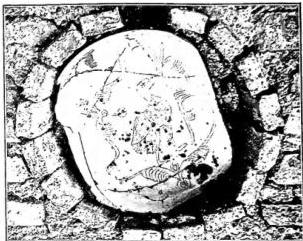
But what had happened boded well for the developments that political events in R. could take when the popes changed their course of action. The conflict that Gregory II (715-31), of a Roman family perhaps among the few survivors of the ancient Roman senatorial aristocracy, engaged with Leo III the Isaurian (717-41) in the early years of his pontificate had an economic character, not a religious one, refusing to submit to the Emperor's fiscal ordinances which also burdened ecclesiastical property. The lay landowners, who constituted the regular armed forces of the Roman Duchy, were in solidarity with the Pope, and therefore all the efforts of the Isaurian and the Exarch of Italy Paul to crush the rebellion by seizing the person of Gregory II—considered its leader and therefore liable to the death penalty—failed. The imperial spatharios Marinus, sent by the Emperor to assume command of the Roman Duchy with this precise task, found himself powerless; the occasional cause for him to leave R. was a sudden very serious illness, but by popular fury Duke Basil and the chartularius Jordan, who with the connivance of John, subdeacon of the Church, had taken over the enterprise by order of Exarch Paul, were removed. The former, forced to become a monk, ended his life in seclusion; the other two were killed. At the same time the Pope, in full agreement with the ruling circles of the city laity, initiated a bold, sharply political action aimed at securing the military assistance of the Lombards.
The Roman Duchy, which a few years earlier - around 717 - had seen Narni taken from it by the Duke of Spoleto Faroald II, found a precious ally in his son Trasamund II, whose warriors contributed to the victorious defense of the borders of the Roman Duchy against the exarch's troops; and other Lombard dukes also contributed to the defense, certainly with the understanding of King Liutprand himself. A significant fact: the defensio pontificis, undoubtedly a spiritual motive, had induced Lombards and Romans to join forces against the Exarch. On the Romans the spiritual factor then acted in all its power when the Isaurian extended the conflict to the religious sphere with the iconoclast ordinances of 726, and Gregory II prepared, to quote his biographer, to fight the Emperor almost as an enemy; and he admonished all Christians to guar-
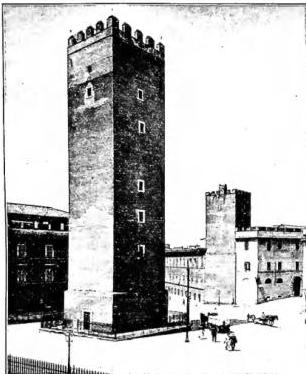
However, the alliance of R. with Liutprand in the struggle against iconoclasm had ended. Yet the Exarch's renunciation increased the prestige of the Pope, who, for his part, could now see in Eutychius the representative of the legitimate authority of the Empire—never denied by Gregory II—and not the instrument of the impious religious doctrines of an emperor. This explains how Gregory II, immediately afterwards, supported—having her accompanied by high officials of the Church—the expedition led in the Roman Tuscia by the Exarch against that Tiberius Petasius, who had made the inhabitants of Luni (just downstream from the confluence of the Vesca into the Mignone), Blera, and Monterano (near the western shore of Lake Bracciano) swear allegiance to him as emperor. And this also explains why the Roman troops obeyed the Pope's exhortations in following the Exarch on the enterprise, which concluded with the killing of the rebel at Monterano. The populations of the Roman Duchy now felt themselves indissolubly united with the Vicar of St. Peter. All strata of the urban laity, from the aristocracy to the common people, attended the Council presided over in St. Peter's in Nov. 731 by Gregory II's successor, Gregory III (731-41). The Council launched excommunication against the adversaries of the sacred images. Because of his tenacity in the struggle against iconoclasm, the Roman Duchy was stripped by the Isaurian of the territories of Terracina and Gaeta, which were transferred to the Duchy of Naples, which had remained loyal to the Emperor.
And when, in the final years of Gregory III, the Isaurian was led to more conciliatory proposals, and made the patrician Stephen—then appointed duke of R.—the executor thereof, the latter, the exercitus Romanus, and the Pope collaborated against Liutprand's ambitious plans, focusing decisively on the traditional antagonism of the dukes of Spoleto and Benevento with the kings of Pavia, to attract them to form a political-military bloc with R. capable of keeping the former in check. In 738 Gregory III as arbiter declared that Gallese—which the duke of Spoleto Transimund II claimed as his domain—belonged to the Empire and the corpus of the exercitus Romanus; and the non-aggression and mutual assistance pacts stipulated by the Church and the Roman people with the same duke and with the duke of Benevento Godescalc, and guaranteed by the Church, were the first signs of a political program in which the duke of R. and the military class of the Roman Duchy were in solidarity with the Pope and relied on him to be his most authoritative interpreter. The patrician Stephen and the exercitus Romanus, together with Gregory III, refused to submit to Liutprand's injunction that Transimund II be handed over to him when the latter, in 739, took refuge in R. to escape the King, who had invaded his domains; and they persisted in their refusal even when Liutprand had pitched his camp beneath R. At that terrible moment the Romans agreed with Gregory III in another extremely daring political move: to send a papal mission to Charles Martel carrying secret documents which provided, in the event of the omnipotent Mayor of the Palace of the Merovingians intervening against Liutprand, for the stipulation of a formal pact with him binding the Roman people to break away from the Emperor and to place themselves, by virtue of a senatus-consultum proclaiming the lapse of Byzantine rule, under the protection of the Frankish prince. For the first time since R. had been a subject of Byzantium, its bishop with the consent of his people dared to become the promoter and interpreter of a political design intended to tear it away from the nexus of the Empire and insert it directly into the sphere of the political interests of the Frankish Kingdom; the Roman Duchy now intended to pursue its own policy independent of the Emperor's interests, and this course was inspired and directed by the Pope, and oriented towards seeking the most effective support in the most dangerous crises among the Franks.
In Aug. 739 Liutprand withdrew from R., though leaving Blera, Orte, Bomarzo, and Amelia garrisoned on this side of the borders of the Roman Duchy. Still in agreement, Gregory III, the patrician Stephen, and the Romans renewed the pact with Transimund II, and upon the promise of being helped by him in retaking the four lost locations in Roman Tuscia, they placed the exercitus Romanus at his disposal for the reconquest of his domains, which was rapidly concluded at the end of
740. The driving force behind the political-military action aimed at preventing Liutprand's counter-offensive was Gregory III's successor, Zacharias (741-52), who, reversing alliances, offered the King the assistance of the Roman army against Transimund II—who had failed in his commitments to R
and indifference to the fate of the duke of Benevento Godescalc, although the latter, during the Spoleto crisis, had shown himself favorable to R. At Terni, in 742, Zacharias, having met with Liutprand and obtained the restitution of Blera, Orte, Bomarzo, and Amelia for the Roman Duchy, stipulated a twenty-year peace, and six years later obtained its confirmation from Ratchis at Perugia.A decisive turning point in the history of the Roman Duchy was imprinted by the complex political work of Zacharias's successor, Stephen II (752-57), against Aistulf, who, after having conquered Ravenna between 750 and 751 and captured the last exarch of Italy there, Eutychius, was also aiming at R. For two years, the Pope induced the Lombard King to defer the implementation of his plan to attack R. thoroughly, without letting himself be intimidated by Aistulf's growing pressure on the Roman Duchy, which culminated in the summer of 753 with the capture of Ceccano. At the same time, Stephen II urged the Eastern Emperor Constantine V to send troops and negotiated with Pepin, King of the Franks since 751, so that he would take an interest in the situation in which R. found itself. The Pope obtained from the Emperor, not reinforcements, but the task of going to Pavia to negotiate in his name with the Lombard King; and from Pepin the official invitation to go to France to examine with him what was to be done. But when the Pope departed on Oct. 14, 753, the problem of saving R. was no longer merely political-military, but once again also religious. Constantine V had in fact returned to iconoclast doctrines, and the Church of R. naturally feared that a restoration of direct imperial rule over the Ravennate exarchate might offer the Emperor the opportunity to attempt, just as his father had done, to use those Senators to fight R.
But the populations of Ravenna and the adjacent territories, unlike those of the imperial duchies in southern Italy and Sicily, had stood alongside Gregory II and Gregory III, thereby earning a strong claim to be considered by the Popes, together with the populations of the Duchies of R. and of Perugia, as the flock more particularly entrusted by Christ to the care of St. Peter, and which the Popes, as the vicars of St. Peter, therefore had a particular duty to defend. Already this spiritual factor had moved Zachary when in 743 at Pavia he wrested from Liutprand the restitution to the Empire of a large part of the latter's recent conquests in the territories of Ravenna and Cesena. But now Stephen II considered it his duty to snatch the Lord's little sheep in the Ravennate Exarchate not only from the Lombard wolf, but also from the heretical Byzantine wolf. During his stay in France in 754, he learned of the intensification of the Iconoclast threat in the East in connection with the decisions made by the Council of Constantinople (Feb. 10 - Aug. 8, 754). Stephen II therefore increasingly shaped his policy around the notion of transferring the scriptural concept of the Lord's little sheep onto the political plane—in the sense that the dominus of the populations of the Roman Duchy and the Exarchate should be considered, as long as the particular religious conditions of the moment in the East persisted, not the Emperor, but St. Peter, and therefore the Pope as his vicar; and that Astolfo should return the territories he had conquered to the Church of R. rather than to the Emperor. Thus the idea of a new politico-religious system, led by R. and its Church, was taking shape. The idea is transparently synthesized in the expression "Sancta Dei Ecclesia rei publicae Romanorum", which precisely in these years begins to appear in the writings of the papal Chancery and among Lateran circles. This politico-religious system was to be implemented through the acquisition of an autonomous position with respect to Byzantium—while remaining within the framework of the State and the Empire—through the work of the Pope, with the help and protective action of Pepin, which would successfully overcome the Lombard danger and create a safeguard against the Byzantine Iconoclast danger. The Roman Duchy was to be the essential core of the system, providing it with a precious basis through its administrative, ecclesiastical, and lay institutions, and through its army, though with a de facto subordination of the civil and military institutions, and of the Duke of R. himself, to the person of the Pope. The leading circles of the Roman laity, the very high officers and functionaries who, by virtue of their rank and office, ought to have acted in the exclusive interest of the Emperor, undoubtedly adhered to these politico-religious ideas.
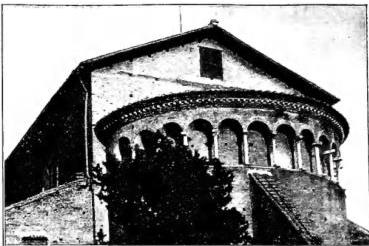
The transfer of the latter to the temporal government of the Popes was in a way sanctioned by the "promissio" of Quierzy-sur-Oise of 754, the "donatio" of the summer of 756, both issued by Pepin to Stephen II; and by the agreements stipulated with Stephen II by Desiderius between Jan. and March 757. For R. and for the Roman and Perugian Duchies, the new state of things was instead the consequence of an acceptance by all classes of the laity and the local civil and military authorities of a de facto situation that already existed. The operation of public services had for some time been provided or overseen by the papal administration, because the offices of the lay administration, whose duty it was to care for them, were paralyzed and were disappearing due to the growing scarcity of resources to which they were forced by the abandonment in which Byzantium left its
In contrast to the drying up of resources available to the lay authorities, the Church drew conspicuous means from its landed properties, the most extensive, productive, and best managed of the entire Duchy, and diverse in localities of great strategic and military importance, with inhabited centers arranged as fortified strongpoints along the borders, such as, to mention no others, Ceccano. Furthermore, the diaconies (v.) were passing under the control of the Church, extending their activity to food supplies inasmuch as foodstuffs could not otherwise be procured. The fact that the Popes, from Gregory II onwards, had become the driving center of the political-military life of R.; the spread of the conviction that only under their guidance could R. be saved from the Lombards and from the fiscalism and iconoclasm of the Byzantines, amply explain why everyone, not excluding the Duke of R. himself, accepted the transfer of temporal government to the Vicar of St. Peter. This acceptance, as far as can be surmised, was formally expressed
by an oath of fidelity to St. Peter. Certainly this occurred with Stephen II in the parts of the exarchate of Ravenna ceded to him by Aistulf and Desiderius. It is not known whether and to what extent the Roman military aristocracy had solicited and obtained from Stephen II to be in any way a sharer in the government, as might be suggested by the fact that the Duke of R. of the time, Eustachius, was sent by him together with the presbyter Philip to administer temporally in the name of the papal authority Ravenna and the territories of the Exarchate "restored" to St. Peter.
What is certain is that during the pontificate of Paul I (757-67), brother of Stephen II, but far less endowed than him with political qualities, the high officials of the papal administration, the so-called primates or proceres Ecclesiae or de clero, among whom the six general directors excelled, called indices de clero, led by a man of great energy, the primicerius of the notaries Christopher, worked to make the government of R. their monopoly. They were supported by families and kinships who shared an identity of interests with them and formed an aristocracy that in this sense could be called ecclesiastical. They were opposed — and this too is certain — by at least a part of the army officers, with whom the lay aristocracy now identified, the so-called optimates or proceres exercitus or de militia, among whom the indices de militia excelled. Indeed, it appears that the military class had split between supporters of friendly relations with the proceres Ecclesiae, which included the Duke of R. of the time, Gregory; and supporters of action decisively aimed at depriving the proceres Ecclesiae of political predominance. The counter-offensive was attempted by four brothers, Toto, Passivus, Paschal, and Constantine, from a family originally from Nepi, who upon the death of Paul I (June 28, 767), violently imposed the elevation of Constantine to the Chair of St. Peter, spreading terror with masses of armed peasants brought in from the lands they owned in Tuscia. Duke Gregory was killed, and his place was taken by Toto; Christopher fled into Lombard territory together with his son Sergius, who was the sacellarius of the Church.
Brief were the fortunes of Toto's faction. After barely a year, at the end of July 768, Sergius re-entered R., at the head of armed men gathered, with the consent of Desiderius, in the Duchy of Spoleto, after a brief skirmish on the Janiculum in which Toto fell, killed by treachery by the chartularius Gratiosus. Sergius was immediately joined by Christopher, who took back power with an iron hand. The energetic primicerius, after having brought minds back to a unanimous consensus so that Stephen III (768-72) would be given to Paul I as a legitimate successor, was the implacable accuser of Constantine at the Council which the new Pope presided over in the Lateran in April 769, and which, besides condemning the usurper, regulated the procedure of papal elections so as to remove them from the violence of armed factions and prevent other dangerous interference by the laity, restricting the actual active electoral right to the clergy, and reserving the right to be elected exclusively to cardinal priests and deacons who had previously regularly progressed step by step through the entire ecclesiastical career. Christopher, having consolidated his personal position by securing from Stephen III the appointment of his son as secondicerius and nomenclator, and by giving a daughter in marriage to the officer who had killed Toto, Gratiosus, promoted to Duke of R., concentrated all his energies on orienting relations with Desiderius toward the combative course followed twenty years earlier against Aistulf by Stephen II. On this ground he collided with new adversaries, led this time not by one of the proceres de militia, but by one of the dignitaries of the papal court himself, the cubicularius Paul Afiarta, whose greed and personal ambitions Desiderius had skillfully known how to flatter, and who therefore instead championed a policy of friendship with the King of Pavia.
The conflict became complicated, hurtling toward its epilogue, as soon as King Carloman of the Franks gave his support to Christopher and Sergius. This prompted Desiderius to hurry personally to the aid of his partisans. In Lent of 771 the Lombard King camped outside R., and forced Stephen III, worried by the excessive
influence acquired by his two ministers, to abandon Christopher and Sergio to the mercy of their enemies, who gruesomely mutilated them of their eyes and tongues. The primicerius died three days later; the son survived in harsh imprisonment, only to perish in his turn under the blows of Paul Afiarta's assassins at the beginning of 772, a few days before Stephen III died. The revolt led against the proceres Ecclesiae by Toto, and the internal palace struggle between papal dignitaries, with the intervention of Franks and Lombards, in which the cubicularius Paul Afiarta had overpowered the primicerius of the notaries Christopher, and the secondicerius and nomenclator Sergius, were a sign of the value that was now attributed to the Chair of St. Peter as an instrument of temporal dominion; and the prelude to the dramatic contests with which, during the Middle Ages, Roman factions and those of other parts of Italy, as well as foreign powers, would dispute the papacy in order to subjugate it to their own political ends.
The borders of the Roman Duchy at the death of Stephen II (757). — The Roman Duchy had arisen from the union into a single military circumscription of the remnants of the ancient civil provinces of Tuscia and Umbria, Valeria, and Campania north of the Garigliano. It bordered to the north with Lombard Tuscia and the imperial Duchy of Perugia; to the east with the Lombard duchies of Spoleto and Benevento; to the south with the Duchy of Benevento and the imperial Duchy of Naples; to the west with the Tyrrhenian Sea. The course of the borders at the death of Stephen II, insofar as can be deduced from the sources, can be outlined roughly in the following manner. The border with Lombard Tuscia began on the sea, at the mouth of the Mignone torrent, a short distance north of Civitavecchia; it headed toward the southern shores of Lake Vico, leaving Blera in Roman territory; it skirted Lake Vico to the south and east, which was in Lombard territory; to the east of it, it followed the ridge of the Cimini Mountains, from which it descended in a northerly direction to the Vezza torrent, so that Soriano nel Cimino and Bomarzo were in Roman territory and Bagnaia in Lombard territory. From the confluence of the Vezza into the Tiber, the border lay between the two imperial duchies of R. and Perugia, to the first of which Amelia belonged. From Amelia the border descended to the Nera river, dividing the Roman Duchy from the Lombard one of Spoleto, to which Terni belonged, while Narni and Orte were in Roman territory. South of Otricoli the border coincided with the Tiber up to the area upstream from Mentana, where it detached itself from it, to cross the area of the Cornicolani Mountains and reach the Aniene upstream from Tivoli; it then ran along the southern slope of the Simbruini Mountains and through the area of the Ernici Mountains descended to the Liri valley, where the border with the Lombard Duchy of Benevento began. The border then coincided with the course of the Liri up to the confluence of the Sacco, whence it headed toward the depression between the Ausoni Mountains and the Aurunci Mountains. After Fondi and before Terracina began the border with the imperial Duchy of Naples, leaving the territory of Terracina to the latter, and reached the sea in the area adjacent to Mount Circeo.
List of the dukes of R. in the 8th century until the death of Stephen III (772). — Christopher (around 712-13); Peter (around 713); Basil, Marinus, Hilarator, Peter (all four at the time of Gregory II, 715-31); Theodore (around 731-38?); Stephen (from c. 738 to c. 741); Eustachius (around 757); Gregory (around 767); Toto (767-68); Gratiosus (around 768-72). The dates indicate the years to which, with a certain probability, they can be re-
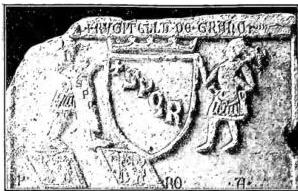
ROMA - Coat of arms of R., supported by a Crossbowman and a Pavesate soldier (first half of the 14th century). Detail of the cippus of Agrippina the Elder, wife of Germanicus, formerly in the Mausoleum of Augustus, reused in the Middle Ages as a grain measure (tugitella) in Piazza del Campidoglio - Musci of Rome.
refer to the mentions of these dukes found in the sources.
Ottorino Bertolini
IV. CENTURIES VIII-XII
The fall of the Lombard Kingdom, the coming of Charlemagne to R., the renewal of mutual commitments between the Frankish Sovereign and the Pope, the fortunate economic policy of Hadrian, and his cultural and artistic merits led toward the great episode of the imperial coronation. However, this was preceded, upon Hadrian's death, by an attack against the new pope Leo III—who was weaker and more hesitant—by his flight to France, and by his return under Frankish protection and public acquittal in S. Pietro. For the internal history of R., the ceremony of 799 had no consequences because Charles did not reside in the city; nevertheless, the prestige of the Urbe grew in the memory of its ancient glories and in the common conviction that a legitimation of political power could be obtained only in R. and from a religious consecration.The entire 9th century is dominated by the conflict between ecclesiastical forces (familia sancti Petri) and lay aristocratic forces (exercitus Romanus), which with alternating fortunes sought to seize control of the city government, alternately asking for or rejecting Frankish imperial aid; this resulted in insurrections, schisms, conciliar decisions, or imperial constitutions of short duration and scarce efficacy. Meanwhile, a more urgent danger threatened R.: namely, the Arab incursions. The basilicas of S. Pietro and S. Paolo themselves were plundered, causing an enormous impression throughout the Catholic world and prompting Pope Leo IV to construct a protective wall, erected with the contribution of various monasteries and domuscultae and with the labor of the citizens divided into scholae; in 849 at Ostia the enemy fleet was dispersed by the ships of various southern cities united in a league blessed by the Pope.
Despite this glorious episode, Roman life tended to become impoverished, shutting itself within a limited local sphere and remaining influenced by family intrigues; typical is the case of the imperial missus Arsenio and his sons Eleuterio and Anastasio—the famous librarian author of various lives included in the Liber pontificalis—who failed in their ambitious design to seize control of the ecclesiastical and civil direction of the city, but opened the way to other
ROMA - Personification of R. in the index of a historical-descriptive guide of R. for the use of pilgrims (late 14th century) - Novara, Cathedral, Archive of S. Maria.
more fortunate attempts of the kind. The violent death of Pope John VIII (882); the ferocious violence of the "Cadaver Synod" when the dead Pope Formosus was judged, deposed, and thrown into the Tiber at the instigation of the dukes of Spoleto who had been harmed by his policy favoring Arnulf of Carinthia (897); double elections, sieges, and many other dark and obscure events are manifestations of a process of laborious readjustment that was to lead with the new century to a strengthening of noble forces, to the formation of a genuine aristocratic dynasty capable of ruling with an energetic grip on ecclesiastical and urban politics, imposing members of its own family upon pontiffs and utilizing neighboring powers (Spoleto, Tuscany, the maritime republics of southern Italy) or distant ones (emperors, kings of Italy, great monasteries) for its aims of enlarging territorial possessions in the Sabina and other localities of the Roman countryside.
The first prominent figure is Theophylact, who was at the same time papal vesterarius and head of the city militia, related to Alberic of Spoleto, and had on his side first Pope Sergius III and then John X. Theophylact's wife, Theodora, was also an energetic and able woman, but not as corrupt as some chroniclers have described her; indeed, against her, her daughters, and other Roman women of the time, opprobrious accusations were launched, supinely copied by historians of all tendencies, so that the Roman pornocracy of the 10th century became one of the most abused clichés. Against such a prejudice it is necessary to react by showing all its absurdity and seeking, on the contrary, to understand the political attitudes, ideals, and achievements of those often tragic and enigmatic figures.
Under John X a new, fortunate battle took place against the Arabs at the mouth of the Garigliano (Aug. 915), but the Pope's plan to free himself from the tutelage of the local aristocrats by relying on the kings of Italy failed, and Marozia, the daughter of Theophylact and Theodora, governed the city with the titles of senatrix and patricia. However, when she wished to marry Hugh of Provence against the canons and for political ends, the Romans rose up under the leadership of her own son, Alberic (932); and for over twenty years the Urbe lived gathered under the princeps et omnium Romanorum senator, who with wisdom and ability knew how to resist external assaults, reach agreements with Byzantium, reform the monasteries, improve economic conditions, and, in a word, successfully concentrate all civic energies. Instead, his son, given the auspicious name of Octavian and elevated to the pontificate under the name of John XII, proved immoral and reckless; after calling Otto of Saxony to R. and crowning him emperor (962), he joined Otto's enemies and ended up being overthrown, while in the city the anti-German reaction continued with the choice of Benedict V against the imperial pope Leo VIII. This was of short duration, and in the second half of the 10th century German imperial influence triumphantly opposed the dominion of local families, among whom the Crescenzi were famous.
The crucial point of the duel was represented by the insurrection attempted against Otto III in 998 by a Crescenzi who met a tragic end in Castel S. Angelo where he had shut himself up. The Emperor tried to win the Romans over to his side, but with little success, and he soon died; nor could the popes chosen by him, Bruno of Carinthia (Gregory V) and Gerbert of Aurillac (Sylvester II), do much in the face of the return of the Crescenzi. From 1002 to 1012 the city remained tranquil under the patriciate of John of Crescenzi; then another great Roman family came to the fore, that of the Tusculans, who repeated the maneuver of occupying religious and civil offices by successively placing no fewer than three of their own on the papal throne, and dealing with various emperors of West and East. But around 1044, partly due to the dissoluteness of Benedict IX, partly to the hostility of the Crescenzi and the margraves of Tuscany, and partly to the pressure of the reformed clergy on Henry III of Franconia, the political system of the Tusculans fell. With the Synod of Sutri, a direct imperial intervention in ecclesiastical affairs began, contested—as regards the sovereign's position vis-à-vis the citizens—by the conferral of the patriciate and the relative right of the principatus in electione papae.
The consequences of the great Gregorian reform movement and the long investiture struggle on Roman civic life were of incalculable scope, because in the duel between popes and emperors the inhabitants of the Urbe benefited—not the old families, but new nuclei, such as the Pierleoni, who based their power on money, and the Frangipani, of popular origin. Concurrently, new political bodies took shape, and communal expansion moved along lines that would remain constant in the following centuries. In turn the Church, decisively breaking away from lay bonds, became somewhat estranged from the city; the Curia filled with people who had come from afar, and the gaze of the pontiffs could expand to a horizon much broader than the severely limited one of the previous period. The resistance of the old elements was long and ferocious, as various bloody episodes occurring under the pontificates of Alexander II and Gregory VII show (such as Cencio's assault at Christmas in 1075); to these must be added the various sieges by Henry IV, who finally succeeded in entering the city, having himself crowned by his antipope Guibert, and occupying the Campidoglio. But the arrival of the Normans caused further horrors, and such grim vicissitudes were repeated several times under the successors of Gregory VII, with frequent flights of the popes, appointments of antipopes, sackings of nobles' houses, and visits of emperors who were now well received and now chased away. Only Callistus II, after concluding the Concordat of Worms (1122), was able to resume the government of the city, decisively relying on the Pierleoni. Instead, the Frangipani prevailed under his successor Honorius II, such that the clash between the two houses appeared inevitable, and that duel constituted one of the constant recurrences in the Roman history of the 12th century. The culminating episode of this was the schism opened in 1130 with the double election of Innocent II and Anacletus II; the latter, a Pierleoni, had to yield to the former, who had St. Bernard and the Emperor on his side, but from this bitter struggle, only seemingly religious, there emerged, like other Italian cities, the Commune of the people.
Much uncertainty reigns regarding the exact sequence of events that led to the establishment of the new institution, but it is certain that, dissatisfied with the outcome of the war against Tivoli, the Romans rose against the Church, restored the Senate, reformed the equestrian order composed of the middle class and the petty urban nobility, and shortly afterwards elected a patrician invested with full rights; the acts of the Chancery were dated with a new era as a symbol of conscious pride and in memory of ancient, unforgotten glories. But the pontiffs, after a brief bewilderment, soon got the better of the new forces and after forty years succeeded in signing an agreement (Clement III, in 1188) by which the Senate was placed back under ecclesiastical investiture, renouncing the regalia and usurped property in exchange for the annual payment of a sum; the prefecture became little more than an honorary title, but the city magistrates retained civil jurisdiction, the determination of weights, measures, duties, tolls, etc. Before this peace there had been the violent clash between Frederick Barbarossa and Alexander III, which had been useful to the Roman Commune in taking advantage of both sides; however, in 1167 a terrible defeat of the city army at Monteporzio had been neutralized only by the pestilence that had struck the imperial troops. The foreign policy of the Commune proved more fortunate with an expansion of the territory subject to its control (from Radicofani to Ceprano) and with commercial agreements with other cities, such as Genoa, in favor of small local industries; R., however, always lacked a robust middle class and effective economic autonomy, which would have allowed a solid consistency to be given to the periodically recurring aspirations for freedom.
The case of Benedetto Carushomo, sole senator in 1191, is significant; after having tried to remove some provinces from the jurisdiction of the Church, he was expelled, and shortly afterwards the great Innocent III succeeded in taking another step forward in curial interference in municipal affairs; furthermore, the entry of nobles into the Senate, which increased more and more during the 13th century, emptied that institution of much of its meaning. Instead, new fuel for the disputes between the city and the Church came from the resumption of the struggle between popes and emperor at the time of Frederick II, who was generous with promises and flatteries to the Romans, without however obtaining much in concrete terms. First with Giovanni Poli, then more effectively with Luca Savelli (1234), the whole city rose against Gregory IX, claiming rights over Tuscia, imposing burdens on the clergy, demanding the free election of the Senate, etc.; but it was once again a flash in the pan because R. could not live without reckoning with that complex of interests bound to the Curia. Instead, once the energetic Pontiff had passed away, the exponent of a new family asserted himself, the senator Matteo Rosso Orsini, who for two years during the interregnum acted at his own discretion, but succeeded in keeping Frederick away, sparing the city from a rule that would have been much harsher than the bland papal supremacy.
V. I SECC. XIII-XV. - The history of the city of R. during the thirteenth and fourteenth centuries (and indeed until 1420) is essentially that of the struggle of that Commune for autonomy, of the ever-renewed attempt of the Romans, and more precisely of the popular class, to constitute themselves into a city-state, like all the other great Italian Communes.
However, particular difficulties stood in the way, which made the medieval history of R. very different from that of any other urban Commune. First of all, the economic preconditions were unfavorable to the formation of a solid and wealthy bourgeoisie, or rather "popolo", in the technical sense of the time; environmental conditions did not allow for the development of a flourishing craftsmanship, let alone any noteworthy export trade; the city's geographical position was also unfortunate, being too far from the great European trade routes. The greatest source of income for the Romans always remained the industry of the foreigner, inextricably linked with the presence of the Curia in the city: the influx of ecclesiastics coming ad limina together with pilgrims visiting the basilicas and sanctuaries. Therefore, it was of vital interest for R. that the Pope and the Curia reside there. But it would not be fair to evaluate everything solely on the level of simple economic convenience: the Romans were also proud to have the Pope as bishop and sovereign, and were attached to him, even if they often failed to show it, and were not
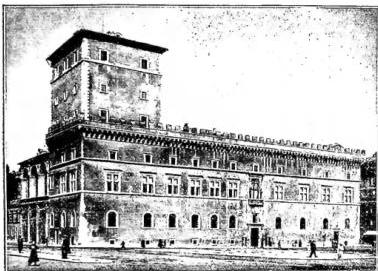
(fot. Alinari)
However, it is likely that a certain availability of capital was formed predominantly through the hotel and hospitality trade, which seems to have been fairly strong, especially between the mid-thirteenth century and the first decades of the following century. Roman merchants and bankers were able to make substantial loans to Italian and foreign figures (the famous one to Charles of Anjou, before the battle of Benevento); not only that, but we also see them present at the great international fairs of France, and indeed, at least once, they were even accredited to the papal Curia, a field usually reserved for Florentine bankers.
Roman life was hampered by another obstacle unknown to other Communes, at least to this extent: the local nobility, the barons, equally strong in the city and the countryside and therefore very difficult to eradicate, all the more so since they could always count on solid support within the Curia. Their fierce struggles for dominance paralyzed city life; in the surroundings of R. they blocked the expansion of the Commune, not only that, but with their overbearing behavior and even highway robbery, they made the roads unsafe or impassable, thereby preventing the arrival of pilgrims and the provisioning of the city. For at least a century (from the mid-thirteenth century onwards) repeated attempts were made to suppress them through special, often severe, anti-magnate laws, but without success; it was only with the formation of the popular militia of the "banderesi" that the situation improved, aided by the strengthening of papal power. But in the fifteenth century the nobility once again brought very sad days to the city.
The most serious obstacle to a normal communal life, however, was represented by the presence of the Pope. No other Commune had to, like R., live alongside its own supreme lord; cities that depended on the Empire were, from this point of view, infinitely better off. For R., autonomy was practically impossible, except for brief periods. But this is a rather complex problem. On the one hand, the papacy by its very nature was elusive and invincible in the realm of power relations (nor would R. have ever been in a position to inflict a Legnano upon it); on the other hand, R. could not do without the Pope, without the presence of the Curia, for the reasons already mentioned. Thus, the history of relations between the citizenry and the Pontiff curiously oscillates between invitations and repulses, between slights and demonstrations of devotion. On the whole, however, loyalism predominated.
Yet R., it was said at that time, had two sovereigns, two spouses: the Pope and the Emperor. Relations with imperial power were much simpler. R. was never
a typical "imperial city," nor did it pay much heed to the allurements that occasionally came to it from the Emperor. Not even at the time of Frederick II, when one might even have considered, in a damned hypothesis, the detachment of the city from the Ecclesiastical State and its actual function as the capital of the Empire. It was seen precisely then that, between the Pope and the Emperor, the Romans—realizing they could not be independent—preferred to stand with the Pope. Account must be taken, in this regard, of a singular, entirely Roman-municipal myth: the "imperial idea," that is, the conviction still held, as in ancient (and mythologized) times, that it was up to the Roman people to confer the imperium, of which they were the depository—a claim that to the mentality of the time was far less strange than it seems today. A Cola di Rienzo could actually build a large part of his adventure upon it, and for this, he was not treated as a madman by his fellow citizens. This "imperial" claim, eminently rhetorical and cultural, this "Capitoline complex," always maintained its charm, but it never truly moved or stirred the Romans to action. It is probable that it was not cultivated
except within a small circle of idealists and utopians of extreme anti-church tendency; in other words, of Roman "nationalists."
During the aforementioned period, the Roman people therefore developed their communal constitution. But with noticeable differences compared to what can be called the "average type" of the Italian Commune. Such diversities had begun, moreover, from the very first moment, in 1144, when a typical aristocratic Commune with a consular regime was not formed, but the Senate instead assumed a popular stamp. In any case, it is clear that R. completely lacked the intermediate class, the lesser nobility, the secundi milites or valvassors, who elsewhere were precisely the soul of the early Commune. Correlatively, the popular commune did not form in opposition to the commune unius, but as a new creation. In short, the entire life of the Roman Commune presented itself in its own unique way.
It was not an easy life at any time; the city never managed to truly flourish and, in a hypothetical ranking of the importance of Italian Communes, R. would occupy a very modest place. As for cultural life as well: although it cannot be called a crude or uncultured city, nevertheless it is undoubtedly true that it was singularly poor in intellects; the single, most notable exception being the anonymous author of the life of Cola di Rienzo—but is he truly a Roman? One final observation, which applies to the entire period: unlike almost all other Communes, R. does not seem to have truly known partisan strife, the factional discord between Guelphs and Ghibellines. Naturally, Roman sources also speak of the two factions, and it is clear that here as elsewhere these two famous names were merely labels for alignments of local interests; but it appears certain that the phenomenon remained circumscribed within the baronal world and did not involve the "people," the citizenry proper, except sporadically and for a short time. This is proof of their common sense.
At the beginning of the thirteenth century, the life of R. was still mortified by the powerful personality of Innocent III and absorbed into the renewed political-state structure of the Church. However, it revived under the weak Pope Honorius III and, above all, by taking advantage of the open struggle between Frederick II and Gregory IX. From 1232 to 1235 a truly great rebellion took place, the most considerable effort toward autonomy that R. had made since the renovatio Senatus. Above all, the "conquest of the contado"—more precisely, of the "district," meaning jurisdiction over the surrounding territory—was systematically undertaken in order to improve the living conditions and security of the city. Over a wide radius around R., special delegates demanded the oath of fidelity and the payment
of tribute from various centers (and often
not even very small ones, such as Viterbo, Anagni,
etc.); in R. itself, ecclesiastics were subjected
to civil jurisdiction and Capitoline taxes,
the free election of senators (leaders of the civic regime)
was demanded, and then the issuance of its own currency:
there was enough here to provoke the protest
of the Pope, against whom the incredible
decision was made that he was to be considered
"in perpetual exile" from R. if he failed to pay
a sort of contribution to the citizens. These were provisions
of undeniable gravity, certainly dictated by extremist "nationalists,"
and it cannot be excluded that a certain heretical
tendency was also manifested therein.
Roman autonomism received a strong impetus then that lasted for a long time, and the formation of a new "people's" consciousness was encouraged. Highly favorable to these developments were the 22 months of sede vacante that followed the death of Gregory IX in 1242. At that time Matteo Rosso Orsini, the senator, committed acts of incredible arbitrariness, outright terrorizing the cardinals of the Conclave. Precisely around that period, on the occasion of the signing of an anti-imperial treaty between R. and Narni (this is the first time the Commune acted on an inter-communal level), the names of Roman bankers appear for the first time. It is to be believed that professional associations, the guilds of arts and crafts, were taking shape at that time, and that the Commune therefore assumed an increasingly democratic and anti-noble (not necessarily anti-papal) orientation. In 1232 the "people" were so strong as to conquer the city regime; by analogy with what had occurred in Florence only two years earlier, we can also speak for R. of the advent of the "first people," of the government of the arts, of the popular regime, which until the end of the fourteenth century was to be "the only great, living, and fruitful line of civic history" (Falco). Great credit for this is due to the vigorous personality of the senator Brancaleone degli Andalò. The people, who had called him from Bologna, had conferred upon him true dictatorial powers, of which the senator made very wise and cautious use, above all to better establish the new regime. Thus, he introduced the captaincy of the people and divided the citizenry according to its productive categories (cohadunatio artium); the conquest of the district was pursued vigorously, public order was assured, and true anti-magnate legislation was introduced. With him, civic autonomy reached its highest degree of efficiency and lasted for a very long time; Pope Innocent IV (and subsequently Alexander IV as well) had to resign themselves to coming to terms with the Romans.
Although in 1238 the nobility regained the upper hand (though for a long time there would be an alternation between it and the people on the Campidoglio), it is certain that R. acquired a new importance, a new political weight, during the interregnum. This is proven by the fact that between 1261 and 1263 there was a veritable competition among sovereigns and princes for the Roman senatorship: Alfonso of Castile, Manfred, Richard of Cornwall, Charles of Anjou. Exceptional candidacies through which great European politics entered R. In 1263 the Angevin became senator, remaining in relation with R. for twenty years. For thirteen years (in total, between 1263 and 1284, but with interruptions) he would even be its senator and its stern and fair administrator, and the city perhaps never knew a period of greater peace. A great pope, the Roman Nicholas III Orsini, in 1278 attempted to oust him from the Campidoglio through the constitution Fundamenta, which forbade the election of foreign senators or those of royal dignity, but shortly thereafter, with the compliant support of the Frenchman Martin IV, Charles took the reins of R. once again; only in 1284, as a remote consequence of the Vespers, did the people drive him out.
Shortly before, Nicholas III had renewed the legal figure of the Pope-senator, being elected senator himself
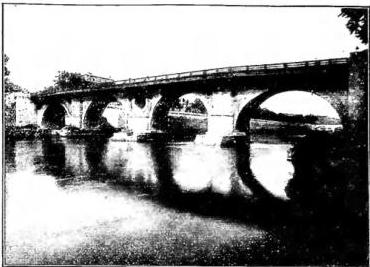
If with Nicholas III the Orsini family had come to the fore (or rather, their power had been consolidated), with Nicholas IV (1288-92) the Colonna would rapidly acquire importance. From then on, the two families would have almost uninterruptedly their senators on the Campidoglio and their cardinals in the Curia, and their contest for civic supremacy would last for centuries.
The history of R. for some time records no further events worthy of note. This is also because it was clearly overshadowed by the activity of the papacy, especially under the royal and magnanimous Boniface VIII, with whom a new family came from the Campagna to insert itself among the Roman ones: the Caetani. To this Pope R. owes many opportune provisions, including the establishment of the Studium, a certain flourishing of art and culture, and then a particularly precious gift: the Jubilee of 1300. Precious not so much for the economic profit, which was not lacking, but rather for the extraordinary increase in importance and resonance that R. gained throughout the world. It was the sanction, such as only the Pope could give it, of its position as an ecumenical city.
Shortly thereafter, however, the beginning of the Avignon period dealt a very heavy blow to R., which for 70 years lost, along with the Curia, the inherent economic advantages as well. It was then clearly seen that, without the Curia, the city could not live, and that any autonomism was illusory. Not that attempts were lacking, though dictated by desperation. At the beginning they were combined with a revival of the "imperial idea," but understood and invoked as a means of pressure or blackmail. If the Pope did not return, Clement V was told in 1305, the Romans would create an emperor; similarly, in 1327, when the Bavarian was at the gates, the citizens let John XXII know that, if he did not come, they would welcome the excommunicated pretender, because they did not want to be eternally "orphaned of Pope and Emperor."
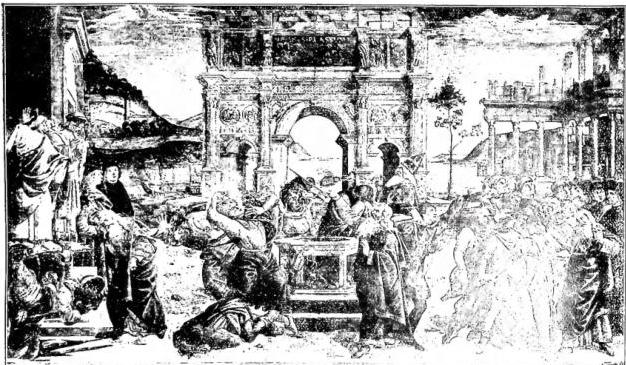
ROMA — Arch of Constantine and remains of the Septizonium. Fresco by Sandro Botticelli in the Sistine Chapel (ca. 1483) depicting the Punishment of Korah, Dathan, and Abiram.
There were two occasions particularly favorable to the development of autonomism, which nevertheless left no traces: the two imperial coronations, of Henry VII in 1312, and of Louis the Bavarian in 1328. The second was of exceptional importance, since the imperial crown, as the candidate was in complete rupture with the Church, was conferred by the Roman people, certainly upon the basis of those imperial rights of theirs, which were put into operation for the first and last time. But perhaps it was the initiative of a few people, among whom Sciarra Colonna was certainly present. To be sure, the Bavarian found the matter very convenient. Afterwards, the Roman imperial claim seems to have fallen completely into oblivion.
After this truly sensational event, R. offers no more notable episodes. The consequences of the papacy's absence made themselves felt more and more. Especially in the very serious internal upheavals of 1335-38, caused by the usual Orsini-Colonna rivalry, but now so violent as to drag in the entire citizenry. Still amidst an atmosphere of violence, a ceremony of high ideal value took place in 1341: the coronation of Petrarch as poet and citizen of R. on the Campidoglio. This was an act whose importance should not be underestimated and which was also understood by the Romans; certainly, it indissolubly united the poet to R. and made him its most passionate defender in the polemic against Avignon.
Already in 1342 Cola di Rienzo (v.) appeared before the papal Curia. His fantastic enterprise can be judged the most resolute and desperate attempt made by the people to establish communal autonomy. It is nonetheless remarkable because Cola joined it to an albeit vague program of Italian national rebirth, thus reinserting R. into the Italian political world. Once the crazy and generous dream had failed, and the second Jubilee (1350) had taken place, R. gradually renounced autonomy, although it was still attempted a few times more. Moreover, a genuine civic assertion became increasingly difficult from the time when an iron hand like that of Card. Albornoz governed and consolidated the Papal State, a prelude to the inevitable return of the Pope. As a new development, the nobility declined. In 1358 it lost the senatorship, and the people, now in agreement with the Pope, organized themselves into the "Happy Society of Crossbowmen and Shield-bearers" (more commonly called the banderesi), a strong civic militia and garrison of R. both against the barons and against the free companies, a new scourge. In 1363 R. drew up its statutes, characterized above all by measures against the magnates; the Pope was not held in very high regard there, but it cannot be said that there was hostility toward him. By now it was clear that nothing other than submission was possible for R. With the first, ephemeral return of Pope Urban V (Oct. 16, 1367 – Apr. 17, 1370), and the second, definitive return of Gregory XI (Jan. 17, 1377), the long absence of the papal Curia came to an end. And the final phase of the communal regime began.
Tragic were the conditions of the city during the Great Western Schism, which was itself a sort of struggle centered around R. If the city had so willed, that would have been another favorable moment for autonomist assertions, and indeed the regime of the banderesi was attempted there; but the energetic and able Boniface IX, just as he fortified the Campidoglio (which still bears his coats of arms), in 1393 imposed very clear terms upon the city, whereby he became its "true lord" (and the banderesi regime then ceased for a while); moreover, he was also energetic toward the barons who had tried to take advantage of the situation, above all the fierce Onorato Caetani, but also the Colonna. Unfortunately, he was succeeded by the weak Innocent VII, and the most chaotic period of the schism ensued. Then the city fell directly under military occupation (Ladislaus of Durazzo, 1408–10 and 1413–14; Braccio da Montone, 1417) and its conditions became appalling: wolves descended to devour corpses in the Vatican cemetery.
In 1417 the election of Martin V Colonna brought a Roman Pope back to R. (1420) and also a certain order. It can be said that the medieval period for R. came to an end then, along with the history of its Commune, completely obliterated by the presence of the Pope, by then a true temporal prince. At that time "democracy yielded power to the Pontiff, after having fulfilled its task of working vigorously toward the resolution of the secular conflict between the two supreme powers, of highly affirming the consciousness of empire and the universal value of R., of strengthening civic energies, and of wearing down communal and feudal particularism within the territory to the advantage of itself and of a leveled, unified, and centralized Papal State" (Falco).
What follows, still in the 15th century, is, from the viewpoint of R.'s municipal history, merely a progressive exhaustion of local "nationalism" impulses, ever less clear, less self-aware, less "medieval," because they were overlaid by classical phantoms. A more concrete political reality speaks from the continuation of the baronial struggles, but they too were debased, because the barons were no longer the rulers of R., but merely quarrelsome courtiers. The people were by now completely outside public affairs, lost interest in them, and knew only some isolated outburst of fury. On May 29, 1434, the Romans rose up, created a revolutionary magistracy, the "Seven Governors of Liberty," and resorted to violence against the cardinals: the Pope, who was Eugene IV, fled from R. What is interesting is that the city declared it would regulate itself according to the will of the Council of Basel. However, it was an episode without consequences. The city was occupied for a short time by Niccolò Fortebraccio in the name of Filippo Maria Visconti; then the stubborn resistance of Castel S. Angelo, which sided with the Pope, and the resumption of factional strife between the Orsini and Colonna induced the Romans, after about five months, to submit once again. Not very clear is a somewhat later event: a valiant and stern prelate, the bishop and later card. Giovanni Vitelleschi, who in 1434 had retaken R. on behalf of the Pope and had subsequently acted with energy in the surrounding countryside, seems in 1440 to have wanted to make himself lord of it; once again the loyalty of the castellan of Castel S. Angelo, Antonio del Rio, who arrested and caused the death of the cardinal, saved the city for the Pope. Eugene IV returned there in 1443 and found it once again in wretched conditions: famous is the description left by Vespasiano da Bisticci. From then on R. began to live again: Nicholas V, the cultured pope who placed his passion "in books and building," did much to clean and embellish II. In 1450 there was the new Jubilee, and in 1452 the coronation of Frederick III, the last and faded pageantry. Immediately afterwards Porcari (v.), truly without any connection to the authentic Roman milieu; in the same way must be judged the strange "conspiracy" of the Roman Academy, attributed to Pomponio Leto and Platina at the time of Paul II (1468), though it is also true that the trial did not provide concrete proof of its existence.
By now the Renaissance is in full development. The Vatican is becoming an increasingly magnificent and worldly court; R. as a city falls more and more into the background; above all, it no longer thinks of impossible autonomous adventures; from an administrative standpoint, it is content with what Paul II grants it in 1469 on the occasion of the revision of the statutes: at the head of the city a senator and three conservators, in addition to a governor on behalf of the Pontiff; all offices and benefits reserved for citizens, all the proceeds of the Capitoline possessions and of the submissive localities (there were still a fair number of them), destined exclusively for Roman needs. The city is also satisfied with the rapid building renovation to which one pope after another dedicates himself; Sixtus IV and Card. Pietro Riario are especially active, the first of the great cardinals whose magnificence eclipses baronial power. This still has its tragic splendor, especially in the disturbances following the death of Sixtus IV (1484), when the city is truly under a regime of terror, and under Innocent VIII, when the repercussions of the conspiracy and war of the Neapolitan barons are felt there. It can be said that these chronicled episodes also conclude the history of the Roman aristocracy, so often master of the city in the Middle Ages, but now definitively crushed by the power of the Church, especially under Alexander VI and then Julius II.
VI. FROM THE 16th CENTURY TO THE FRENCH REVOLUTION
I. The Early 16th Century
During the 15th century, the Curia certainly gained the upper hand over the civic regime; yet Rome, thanks to its newly attained splendor, rose to a political importance that gradually led it, through the work of the Pontiffs, to exercise a directive primacy over the affairs of Italy.Constant artistic, literary, and demographic progress further enhanced the development of this new phase of Roman life, despite the predominance of foreign domination in Italy and the religious schism of Europe, both of which began at the outset of the 16th century. The threatening descent of Charles VIII of France in 1498 toward Naples had a resounding episode also in Rome, which saw Alexander VI, having retreated to Castel S. Angelo, forced to receive that King and negotiate with him. Charles VIII passed through Rome again, almost like a fugitive on account of the League that the Pope had opposed to his rear. Then Julius II and Leo X restored to Rome that momentum which had suffered a halt under Alexander.
Roman society of the 15th century found its development in the 16th; among the classes that composed it, the high baronial nobility—always represented by the Colonna, the Orsini, the Conti, and the Savelli—was ousted from predominance in the affairs of the City and consumed itself in sterile jealousies that vented themselves in vulgar crimes born of individual arrogance. To sustain their standing, its members were forced to practice the profession of condottieri: the Colonna for the Empire, the Orsini for Venice; the members of other principal families continued to do likewise.
Within the Curia, Romans of various classes competed with foreigners, who had rushed in from all parts, to attain the highest offices, such as cardinals, nuncios, official governors, and prelates of various ranks. The foreign element, moreover, increasingly predominant in the Curia, did not conceal its purpose of securing a permanent residence in Rome, where the multiplicity of business and the tangle of political interests offered the opportunity to build solid economic positions and rise in careers. In the previous age, the relatives of the Pontiffs had extended their ambitions so far as to aspire to create principalties for themselves; now they aimed to amass fortunes and to excel by establishing new civic dynasties in competition with the existing ones.
If political-national interests, rather than religious ones, found themselves in conflict at the time of the election of individual
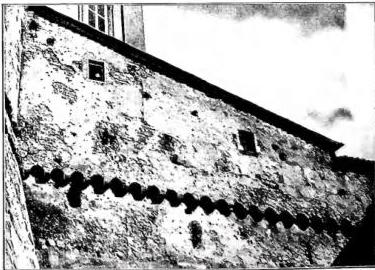
It is not to be wondered at that in such a society where many, too many, were celibates and those who were for a time, sometimes long, away from their families, morals left much to be desired, so much so that they seemed to tend toward paganism. Splendid feasts, banquets, hunts, luxury in clothing, furniture, silverware, works of art, horses, created an exhibition of worldliness without example; and it was a cause of scandal and invectives that became ever more furious. If it must be admitted that they were not undeserved, it would nevertheless be unjust to suppose that every trace of true spiritual life was extinguished in R. This asserted itself ever in those multiple manifestations of piety and charity that the times suggested in relation to new needs and as a remedy for growing abuses, and which were to be fundamental for that reaction against the worldly spirit which will be called the Catholic Reformation. In fact, besides new churches, new hospital provisions, orphanages, shelters for fallen or endangered women, confraternities and religious houses with specific apostolate purposes arose with an uninterrupted rhythm. The Roman University was also reorganized during the 16th century with a broader scope of studies and in seats more suited to the purpose. The Roman College of St. Ignatius, founded in 1552, under Gregory XIII implemented the didactic experience of the Jesuit Ratio studiorum, extending it to a more rational teaching for the progress of knowledge. Alongside the Roman Seminary (1564) under that Pontiff stood the Germanic-Hungarian, English, Greek, Maronite and Armenian Colleges; later St. Joseph Calasanzio established free schools for the people.
However, dangers to the safety of R. were not lacking. Alexander VI had attended to making Castel S. Angelo stronger and safer with new munitions including a large tower in the front at the end of the bridge. Paul III, to face a possible Turkish danger and make the city strong against any enemy irruption—since the Aurelian walls were completely inadequate against the most modern siege means—entrusted Antonio da Sangallo with the task of providing for it by erecting new bastions: thus arose those on the Aventine almost sheer over the Tiber, those at Porta Ardeatina, those between the Vatican and the Janiculum behind S. Spirito, as well as the Belvedere bastion; but a new complete defense system was not possible given the expanse of the city. However, a well-organized urban militia was always lacking; and the consequences unfortunately were seen.
2. Roman Misadventures. — Card. Pompeo Colonna, acting in agreement with the representatives of Charles V, entered through the Porta di S. Giovanni in Laterano with his troops on Sept. 20, 1526, and having crossed the whole city assaulted the Vatican Palace, pillaged it together with the Borgo, causing very serious damage, while the Pope, defenseless, took refuge in the Castle and on the 22nd saw himself forced to come to terms with the attackers.
Worse was the following year when the imperial bands serving in Lombardy, unpaid, moved toward the Mezzogiorno under the leadership of Bourbon, terrorizing the whole center of Italy, until they arrived under R., which attempted a hurried defense. Bourbon moved to the assault on May 6 from the side of S. Spirito and lost his life there; but the militias, having overcome the resistance, penetrated into Borgo, spread rapidly into the square, moving toward the Castle where Clement VII had precipitously taken refuge with part of his court in the hope of being able to resist. From there they moved toward Ponte Sisto, broke the courageous resistance of a few Romans and penetrated into the city, which suffered that horrible sack, the ferocity of which remained memorable in history. Nothing was spared, neither sacred places, nor monasteries, nor citizens' palaces. For months the city remained at the mercy of the unrestrained license of the soldiery. The Pope, unhelped by his allies, on June 6 had to accept very heavy terms, remain shut up in the Castle under enemy guard, forced to give hostages, to ultimately undergo a most onerous treaty which, concluded on Oct. 31, was signed only on Nov. 15. On Dec. 8 he left the Castle and took refuge in Orvieto; but the invaders left R. only in Feb. 1528 after having reduced it to complete ruin like the surrounding lands: 30,000 citizens had died there. Four-fifths of the dwellings were "deserted", so that "it looked rather like a desert than R." Clement VII, who had moved to Viterbo on June 1, 1528, re-entered it on Oct. 6 and took prompt measures to repair the troubles, so that R. immediately began to breathe again, returning to its ancient standard of living. However, although in Roman society and in the Curia, which was a large part of it, a start toward that reform which was in everyone's heart was not yet made manifest, the sack had remained as a stern admonition, thanks to which an ever more insistent appeal to reform was being repeated and which had to be applied "in capite et in membris".
A serious threat of war for R. loomed on the occasion of the disputes between Paul IV and Charles V and Philip of Spain, caused by the political maneuvers of the Carafas. Hostilities having opened on October 1, 1556, the need to provide for defense with hurried fortifications at various points of the city under the direction of Camillo Orsini was immediately felt; while in February 1557 the Pope opened a trial for felony against the Habsburg sovereigns. Since the Duke of Alva, having occupied Tivoli and then Ostia (November 18, 1556), brought the war close to R., a grave danger to the city seemed imminent, especially after the defeat suffered by the papal troops (July 27, 1557) and the loss of Segni. But the defeat suffered by the French at St. Quentin and the withdrawal of the troops of the Duke of Guise, sent to help Paul IV, led to the Peace of Cave on September 8, obtained, thanks to the intervention of Venice, on good terms.
A major riot broke out instead in R. upon the death of Paul IV (August 18, 1559), when the Romans, mindful of the recent dangers and the damage caused to them by the war, and driven also by those who had felt the consequences of the recent reforms and the rigors of the Inquisition
so promoted by the Pope, attacked the prisons of the Inquisition itself, freeing the prisoners and burning its records; the statue of the Pope on the Campidoglio was also knocked down.
Less than twenty years later, R. felt the repercussions of the high-handedness of that large-scale organized banditry which then kept the Papal States in turmoil, as it found favor and impunity even within the city. Only the well-known energetic reaction of Sixtus V succeeded in crushing it, though without completely eradicating II.
Urban VIII, in the following century, to prevent possible dangers on the occasion of the War of Castro, renewed the defenses, especially around Castel S. Angelo; these remained definitive until the French invasion.
741. From the 17th Century to the Revolution
With the end of the 16th century, following the subjugation of Italy to the dominion and political supremacy of foreign powers—namely France and Spain, and later also the Empire—R. lost its importance as a political center; the destinies of Europe were decided in Madrid, in Paris, in Vienna; and the spiritual authority itself, fiercely combated by Protestantism, would be undermined by the new political-religious currents arising within Catholic nations, eventually culminating in anti-religious encyclopedism. However, it seemed that each of these powers pressed upon R. with greater petulance to make an influence prevail that would eliminate that of its competitors and to extract those national advantages that the center of Catholicism could still offer. Everything served to guarantee this prevalence: the pomp and privileges of their representatives, the credit of devoted cardinals and prelates, of canonists, of theologians, of scholars; flattery or threats directed at the relatives and friends of the pontiffs, and favor shown to the interests of particular categories of people.Moreover, R. lacked the specific guarantees offered by dynastic tradition, and the short duration of individual pontificates led to frequent shifts in political orientation and in the composition of the Curia's personnel; thus, during conclaves, the often unscrupulous skill of diplomats had free play to favor or hinder candidacies according to circumstances. No regard was paid to the protracted lengths of vacancies, which had multiple repercussions on the public life of the city.
Serious incidents, which the governor of R. was not always able to prevent or suppress, were provoked by the exemptions that the envoys of the powers (especially the most important ones) continually demanded, on an ever-broader scale, for their residences. They claimed that everything was permissible to them within these bounds. Thus, when Urban VIII on November 22, 1636 prohibited games of chance in any place, the French envoy, Marshal de Coeuvres, claimed he did not have to take this into account. In addition to their palaces, the envoys demanded immunity also for adjoining houses and streets; prisoners were not to be led past their dwellings; within them they even claimed the right to execute justice against guilty or suspected persons. In 1662 the Frenchman Duke of Créqui, a notorious brawler, exasperated the citizens' minds with his arrogance; he wanted to extend the so-called freedom of the quarter beyond the palace he inhabited "as far as his gaze could reach." A brawl between his men and the Corsicans of the papal militia provoked the resentment of the latter, who ran toward Palazzo Farnese; a scuffle ensued and there were deaths. Apologies on the part of the Pope were of no avail; Louis XIV threatened war; the Chigis and Alexander VII himself had to humble themselves by accepting the terms imposed by the King; the Corsicans were banished and were no longer to be enrolled in the papal guards; in perpetual execration of the event, a pyramid was erected with an infamous inscription that was removed only much later.
All this did nothing but increase abuses. Malefactors sought refuge in the houses and streets of the privileged quarter, and Roman and foreign scoundrels sought a hiding place; Palazzo Farnese was open to them even at night, and bloody struggles resulted. To obtain protection from the envoy, refugees sometimes paid
considerable sums, while suppliers raised the coats of arms of the respective nation over their homes and thus participated in the freedom of the quarter in exchange for a fee paid to the envoy. Also for a fee, certificates were issued by which those who obtained them, as being part of the entourage, were removed from ordinary jurisdiction. Since they enjoyed customs immunity, the envoys arranged with commercial houses to obtain goods without paying customs duties, subsequently sharing the profits of resale with them. Innocent XI wished to put an end to such intolerable abuses, which also continually threatened public tranquility. In 1677 the King of Spain declared himself ready to renounce these alleged rights if the others did likewise. Meanwhile, it was ordered that the insignia be removed, extending this order also to cardinals who had begun to imitate the diplomats. Venice yielded in 1679; Spain in 1682. Upon the death of Ambassador Duke d'Estrées (1687), the Pope declared that he would not accept his successor unless the quarter was first renounced. Louis XIV instead appointed the Marquis de Lavardin outright. On November 16, 1687, the latter entered R. with a large retinue against the will of the Pope, who refused to receive him and treated him as excommunicated. And since at Christmas he presented himself for the sacred functions in the church of S. Luigi dei Francesi, he placed that church under interdict. Lavardin continued in his authoritative demeanor, supported also by the favor of Christina of Sweden, a guest in R. Threats of armed intervention by Louis XIV and attempts at mediation followed. Although Lavardin had to be recalled (April 14, 1689), the dispute was smoothed over under Alexander VIII with the renunciation of the quarter.
There was no lack of other episodes demonstrating how heavily the interference of foreign powers' representatives—even ecclesiastical ones—weighed on the internal life of the city to the detriment of the Pope's effective sovereignty. One of the most sensational occurred under Clement XII, when the Spanish side, defying all prohibitions, dared to proceed with troop enlistments, creating almost a forced conscription. The recruiters, aided by the worst local elements, lay in wait and, through every sort of deception, forced young Romans into military service; others were even assaulted at night and taken to be embarked at Ripa Grande. This caused a great uproar in R., kept alive also by the party opposed to the Spaniards, as a result of which on March 23, 1738, Trastevere rose up; it freed the kidnapped young men and threatened the seat of the Spanish embassy where a number of these forced conscripts were being held. The Pope intervened and, despite the protests of Card. Acquaviva, the rioters were amnestied and the conscripts released with the prohibition of new enlistments. But these measures provoked a diplomatic controversy that could not be resolved immediately.
Moreover, public life in R. unfolded in relative tranquility, despite sensational private vendettas and disputes over precedence. It was not deeply disturbed by theological questions, sometimes very heated within the clerical class, or by that concerning the suppression of the Jesuits, which inflamed the representatives of the Bourbon courts. Gradually interrupting this uniformity were solemn religious celebrations, such as those for the Jubilees every 25 years, canonizations, papal elections, and academic gatherings enlivened by music. Illustrious visitors from every country alternated with artists who sought unexhausted inspiration in R., while scholarly researchers gathered for their investigations into the past. However, new times were approaching that no one would have imagined to be so disastrous.
VII. ROMAN REPUBLIC (1798-99)
In R. the course of events in Paris from 1789 was followed with anxiety, both from the religious and the political side. Very soon Card. Bernis (v.), the King's representative, had to leave his office, while the envoys of the new government did not conceal their intention of provoking incidents to legitimize an intervention. The first important episode was the one that led Bassville (v.). With the subsequent Napoleonic invasion of the Po Valley and the fall of the Venetian Republic Legations (v.), the impudence backed by Joseph Bonaparte—who wanted to create a pretext for intervention—grew, until on Dec. 28, 1797, in a clash between Roman pro-Jacobins and papal soldiers near the French embassy at La Lungara in Trastevere, General Duphot was killed. With this, the pretext was found. Having rejected any attempt at mediation, General Berthier advanced to R. without encountering resistance and on Feb. 1 occupied Castel S. Angelo. Five days later, some "patriots," under the protection of French soldiers, proclaimed the Roman Republic and the fall of the temporal power in the Forum Boarium. Pius VI, forced to leave R. (Feb. 20), was taken to Tuscany, and the Sacred College dispersed.The Republic received a constitution modeled, with some adaptations and under classical names, on the French one of 1795. At the head of the executive power were five consuls; two assemblies, the tribunate and the senate, held legislative power; the State was divided into eight departments: Cimino, Circeo, Clitunno, Metauro, Musone, Tevere, Trasimeno, and Tronto. Practically, however, the government and the assemblies were under the strict control of the French.
The exorbitant exploitation of state resources by the agents of the Directory, monetary inflation, and dilapidations worsened the economic situation—already serious in the final years of the pontificate of Pius VI—and compromised the vitality of the new institutions. These were favored by some elements of the bourgeoisie, especially the industrious ones, a few aristocrats, and some ecclesiastics, while the majority of the population remained irreducibly opposed. The silent resistance through which this popular opposition manifested itself often exploded into open insurrection; the Trastevere revolt of Feb. 25, 1798 could be easily quelled, but the uprising, despite bloody repressions, spread to the departments bordering Tuscany and the Kingdom of Naples (Trasimeno, Circeo, Tronto) and became general after the first Neapolitan invasion (Dec. 1798), which failed to pass beyond R. and was driven back in a few days, but resulted in the transformation of the State into a new Vendée.
Difficulties in communications, the abandonment of cultivation, and the closure of maritime traffic due to privateering caused a famine that was extremely severe in R., which soon remained almost isolated. The invasion of the French, the financial collapse, the clashes between state organs and among the supporters of the Republic themselves (radicals, irreligious and doctrinaire Jacobins were opposed by the moderates), and the impossibility of resolving the grave problem of relations between Church and State were other elements that ensured efforts to create an autonomous administrative and political life bore no fruit. The new ruling class, having replaced the papal Curia, demonstrated generosity and enthusiasm, but also inadequacy for its task and, in many cases, corruption. A first provisional consulate (Riganti, Pessuti, Angelucci, Costantini, Bassi, Bonelli) was followed, with the entry into force of the Constitution, by a second one (Angelucci, Panazzi, Reppi, De Matthaea, Ennio Quirino Visconti) which was overthrown by the French (Sept. 12-17, 1798). The final consulate (Zaccaleoni, Brizi, Rey, Pierelli, Callisti) saw its authority increasingly restricted, also contested by the legislative assemblies. Faced with the grave military situation created by the Second Coalition, the French dissolved Parliament and the consulate, placed the Republic in a state of siege, and governed through a provisional committee directly under their orders (July 1799).
While the Republic was unraveling internally, the Austrians were pressing from the north, and the Neapolitan army was advancing in the south. On Sept. 30, 1799, the French capitulated and the Neapolitans entered R.; Ancona, besieged by land and sea, held out until Nov. 13.
VIII. FROM THE LATE 18TH CENTURY TO 1849
In the following years, R. followed without major upheavals the events that led to State (v.), the coming of Pius VII (1800), the new abolition of the State in 1809 by Napoleon, the deportation of Pius VII, and the proclamation of R. as an imperial city. For his part, Bonaparte nurtured a great love for R. and took pride in restoring II. He appointed de Tournon as prefect, who administered it skillfully; and from 1810 a new building era opened for the city. Indeed, notable embellishments took place, such as, e.g., the successful transformation begun on the Monte Pincio (cf. I. Ranieri, Lavori a R. nell'epoca napoleonica. Il Palazzo di Venezia e il Pincio, in Civ. Catt., 1906, IV, pp. 129-49). But the Emperor failed to win the sympathies of the people; only a section of the Roman nobility rallied around the new regime and did not disdain to intrigue to obtain offices and positions in the imperial court (cf. L. Madelin, La Rome de Napoléon. La domination française a Rome de 1809 à 1814, Paris 1906, pp. 255-63, 382-87). Returning triumphantly to R. on May 24, 1814, Pius VII had once again to fear for his personal safety when, on the occasion of the Hundred Days, Gioacchino Murat announced his arrival in the city. The Pope left on March 22, 1815; but he was already returning on June 7 following, after the defeat of the Neapolitan troops at Tolentino (May 3-4, 1815), and could finally think about favoring the growth of the city and the restoration of ancient monuments. Gregory XVI promoted excavations at the Forum; and on his initiative three museums were opened: the Egyptian, the Etruscan, and the Lateran.However, restoring to R. an incomparable splendor under the artistic and religious aspect could not constitute the essential task. In fact, some not large, but active strata of the population were troubled by a new spirit; they aimed at reforms in the structure of the Papal State, better attuned to the liberal tendencies asserting themselves in Europe, and oriented themselves toward a representative regime. Gregory XVI limited himself to broad reforms and provisions of a purely administrative character. His successor Pius IX understood that denying even constitutional modifications was becoming dangerous and could have compromised the existence of temporal power. The publication of the usual amnesty decree extended also to political exiles aroused surprising enthusiasm among the Romans and throughout all of Italy (July 16, 1846; cf. A. Mercati, In margine alla amnistia concessa da Pio IX, in Aevum, 24 [1950], pp. 103-32). This was followed (on Oct. 1 and 3, 1847) by the creation of a Municipal Council with the power to elect nine magistrates, who would form a Senate and look after the civic interests of R. (Atti del Sommo Pontefice Pio IX, part 2nd, vol. I, Rome 1857, pp. 1-47, 151-90). The promulgation of the Fundamental Statute
for the Temporal Government of the States of the Church (March 14, 1848), granted unfortunately in part due to pressure from the streets, had important consequences for the city, because a parliament was now to reside there, whose members would be elected on the basis of approximately one deputy for every 30,000 inhabitants and by restricted suffrage (ibid., pp. 222-38). The attempt at a very mitigated and tardily implemented constitutional regime satisfied neither the reactionaries nor the extremists. Among the latter, many of the political exiles, having returned to R., began to maintain there, consciously or not, a state of dangerous agitation. They argued on the Corso or at the entrance of cafes, emphatically recounting the sufferings endured far from their homeland and pointing out the abuses, true or false, that flourished in the Papal States. The firm hand of the minister Pellegrino Rossi, supported by the moderates and the Neo-Guelphs, only exasperated and excited the fury of the instigators of disorders, enemies of the Pope and the Church, and pushed them to attempt upon his life. Once Rossi was assassinated, the revolution broke out, and Pius IX, besieged in the Quirinal Palace, was forced to seek safety and freedom in Mola di Gaeta (Formia; Nov. 25, 1848).
Guglielmo Mollat
IX. FROM THE ROMAN REPUBLIC (1849) TO R. AS CAPITAL OF ITALY. — Following the popular uprising that culminated in the assassination of Pellegrino Rossi (Nov. 15) and the imposition of the democratic Muzzarelli-Galletti ministry (Nov. 16), Pius IX on the night of Nov. 24 left R. for Gaeta. On Nov. 27 he appointed a Government Commission, presided over by Card. Castracane, and on Dec. 7 he prorogued the parliamentary session; but the Chamber of Deputies, judging such measures unconstitutional, entrusted the direction of the State to a Provisional Junta (Dec. 11).
Failed the attempts to make contact with the Pontiff, the resort was to radical solutions: the Junta dissolved Parliament (26 Dec.) and called elections by direct and universal suffrage. Pius IX, who had protested against the appointment of the State Junta (Dec. 17), inflicted major excommunication against anyone who attempted to violate the integrity of the Church State and against those who participated in the elections (Jan. 1, 1849). The Constituent Assembly, elected Jan. 21-22, thus resulted in a heavily democratic majority; having gathered in R. on Feb. 5, at dawn on the 9th it declared the temporal power fallen (with the promise of guarantees for the independence of the Pontiff's spiritual authority) and proclaimed the republic.
The new State, governed by an Executive Committee (Armellini, Montecchi, Saliceti), confiscated ecclesiastical property (partly alienated to reduce the public debt and partly assigned as perpetual leaseholds to peasants); reformed the educational system, until then subject to the jurisdiction of the bishops; abolished all jurisdictional privileges and the tribunal of the Holy Office; suppressed the grain supply office (annona) and the milling tax (tassa del macinato); and removed prior press censorship.
The failure to implement more radical reforms caused discontent among the common people, while the financial and monetary crisis, which remained severe even after the issue of a forced loan, caused, along with inflation, rising prices and the stagnation of productive and exchange activities. Consequently (also due to the political and military situation that soon arose), there followed a famine of primary necessities and an increase in unemployment, which was aggravated by the dismissal of employees loyal to the Pontiff.
The government, caught between pressing needs for defense against powerful internal and external adversaries and the demagogic agitations of extreme currents, had to intervene energetically to restore order in Ancona and other localities where bloody violence had occurred against the clergy and the upper classes, who were mostly opposed to the new regime. On the other hand, once the proposal for a religious reform—initially championed by the most ardent Mazzinians—fell through, also due to the contrary attitude of the Constituent Assembly and the majority of the republicans themselves, an attempt was made to implement a conciliatory policy toward the Catholic masses.
Considered by Roman political currents predominantly as the solution to a local problem, the Republic assumed, with Mazzini's arrival in R. (March 5) and with volunteers rushing there from all parts of Italy, the significance and function of the primary nucleus of national unity. Mazzinian influence became preponderant when, after the Piedmontese defeat at Novara, a Triumvirate (Mazzini, Saffi, Armellini), endowed with broader powers, replaced the Executive Committee (March 29).
Against the proclamation of the Republic, Card. Antonelli had protested on Feb. 18 with a note to the diplomatic corps, which had followed Pius IX to Gaeta, in which armed intervention by Austria, France, Spain, and the Two Sicilies was requested to safeguard the freedom of the teaching office and the rights of the Pontiff. Thus, the Spanish thesis—which, harking back to the Treaty of Vienna of 1815, maintained the preeminent international interest in the preservation of the Papal State—prevailed over the Piedmontese thesis (which favored the intervention of Italian powers alone). The appeal was favorably received by Louis Napoleon, who was eager for the support of Catholics and determined to counter Austrian influence in Italy. An expeditionary corps commanded by Gen. Oudinot landed on Apr. 26 at Civitavecchia, but, surprised beneath the walls of R. by the unexpected resistance of the volunteer and regular troops, had to withdraw (Apr. 30). On May 9 at Palestrina and on May 19 at Velletri, something similar befell the Neapolitans. While the French concluded an armistice with the Republic and attempted a peaceful solution through the mission of Ferdinand de Lesseps, Austria, freed from the burden of the war in Lombardy, invaded the Romagna and the Marches, and the Spaniards, with small forces, infiltrated from the south into Sabina.
The new political situation brought about in France in the middle of May by the electoral victory of the conservatives caused the intransigence of the Prince President and the military to prevail, for whom the expedition to R. had also become a matter of national prestige. On June 3, before the truce had even expired, Gen. Oudinot launched a surprise attack on Villa Pamphili, the fulcrum of the defense of the Gianicolo, and succeeded in seizing Villa Corsini as well, repulsing the desperate counterattacks of the defenders. The fierce struggle continued throughout June in front of the Porta di S. Pancrazio, but, despite the heroism of the defenders, the French managed on June 21 to conquer a stretch of the walls and thus direct the fire of their cannons straight onto the city. On the 30th, the Assembly, against Mazzini's advice, decided to cease resistance, which had become untenable. A new Triumvirate (Saliceti, Calandrelli, Mariani) replaced the resigning Mazzinian one. On July 3 the French, who had rejected the surrender conditions offered by the Roman municipality, occupied the city, while the Assembly, which had proclaimed the Constitution as its final act, was dispersed.
The extremists, however, did not admit defeat and treacherously struck down some moderates and several soldiers with daggers: while the military authority failed to carry out the secret orders received from Paris vedi to establish "a wisely liberal government" and to present the Holy See with a fait accompli. The government of the State and the city was thus handed back to the legitimate sovereign (June 15) and provisionally entrusted to a Commission of cardinals, which removed everything that had been extorted or imposed upon the Pope by the most violent innovators. Agitation and restlessness immediately spread once again among the latter (cf. Oudinot's dispatches in Mémoires posthumes d'Odilon Barrot, III, Paris 1876, p. 410). Even after the triumphal return of Pius IX to R. (Apr. 12, 1850), political attacks continued to occur and, what is worse, in 1853, some of the most subversive elements even conspired against the life of the Supreme Pontiff, who, through ever-new and well-conceived administrative and social provisions, and through the introduction of telegraphs and railways, strove to adapt the Papal State and the city itself to the needs of the times, including through excellent urban planning and beautification works. There was consequently had in R., under the not always welcome protection of French bayonets, a relative calm; but after the cession of the Veneto to Italy (Aug. 10 - Sept. 3, 1866) a speech by Victor Emmanuel II seemed laden with threats: "Italy is made, but not complete," the King had said, and Pius IX understood that the target was unquestionably R. (cf. R. De Cesare, R. e lo Stato del Papa, II, Rome 1906, p. 300).
Instead of intervening directly, the Italian government allowed Garibaldian troops to attack Lazio and R. for over a month while the Cairoli brothers attempted to lead, descending the Tiber, a convoy of arms for the revolutionaries, who were supposed to spark the insurrection in the city. But the planned revolution was promptly repressed and Garibaldi suffered a bloody setback (Nov. 3-4, 1867) Mentana (v.) at the hands of the papal and French troops. The fall of the French Empire facilitated the Italian invasion. On Sept. 20, 1870, a few pieces of artillery opened a breach in the walls of R. between Porta Salaria and Porta Pia; after a fierce resistance of over five hours along the entire Aurelian walls, the pontifical forces, by order of the Pope, ceased fire; at 3 p.m. a capitulation stipulated at Villa Albani, with the honors of war granted to the garrison, the occupation of the city "except for the part bounded to the south by the bastions of S. Spirito, which included the Vatican and Castel S. Angelo and constituted the Leonine city" (cf. Archives diplomatiques, II, Paris 1874, p. 84). But Card. Antonelli "begged" General Cadorna (Sept. 25, 1870) to occupy also the territory excluded from the capitulation, due to the excesses perpetrated by "evildoers" who had flooded in following the regular troops (ibid., p. 107). The annexation of R. to the Kingdom of Italy thus took place on Oct. 2 (ibid., pp. 110, 121, 123-31).
BIBLI: le opere concernenti questo periodo sono in numero considerevole; se ne ha una parziale citazione in G. Mollat, Question romaine de Pic VI à Pic XI, 2ª ed. Parigi 1932; P. Balan, Storia univers. della Chiesa, II, Torino 1879, V. indice; A. M. Bonetti, La liberazione di R. « del gen. R. Cadorna. Osservazioni e critiche, Siena 1889; A. Vigevano, La fine dell'esercito pontif., Roma 1921; F. Hayward, Le dernier siècle de la Rome pontificale (1824-70), Parigi 1927-28; P. Romano [P. Fornari], La satira nella R. Napoleonica, Roma 1936; P. Dalla Torre, L'anno di Mentana, Torino 1938, passim; id., L'opera riformatrice ed amministrativa di Pio IX dal 1850 al 1870, Roma 1945, passim; id., Lettere ined. di mon. V. Vannuelli al gen. E. Kanzler (1870-71), in Riv. di st. della Chiesa in Italia, 1 (1947), pp. 431-43; id., L'opera riformatrice ed amministrativa di Gregorio XVI, in Gregorio XVI. Miscell. commemor., II, Roma 1948, pp. 29-121; id., Pellegrino Rossi, il neugueffiano e l'Italia, in Arch. Soc. rom. di st. patria, 71 (1948), pp. 163-68; S. Negro, Seconda R., Milano 1943. Qualche lavoro più importante: U. Marinelli, Pio IX e Cicerucchio, Roma 1937; id., Stato degli inquisti dalla S. Consulta per la rivoluzione, del 1849, ivi 1937; M. Petrocchi, La restaurazione, il card. Consalvo e la riforma del 1816, Firenze 1941; id., La restaurazione romana (1815-22), ivi 1943; D. Demarco, Pio IX e la rivoluzione romana del 1848, Modena 1947; P. Silva, Il 1848, Roma 1948; L. Marchetti, Il 1848. Fonti bibliogr. e documentarie, Milano 1949; A. M. Ghisalberti, Rapporti delle cose di R., Roma 1949; E. de Levis Mirepoix, Un collaborateur de Metternich. Mémoires et papiers de Lebseltern, Parigi 1949;
S. Mastellone, Pellegrino Rossi ambasciatore francese a R., in Riv. stor. it., 61 (1949), pp. 76-100; Ch. H. Pouthas, Un observateur de Tocqueville à Rome pendant les premiers mois de l'occupation française (juillet-août 1845), in Rass. stor. del Risorg., 38 (1950), fasc. 1 e 11. Guglielmo Mollat
IX. R. CAPITAL OF ITALY. — The history of R. as the capital of Italy begins with the plebiscite of Oct. 2, 1870, which saw only 46 "no" votes cast because proponents of the temporal dominion abstained from voting. Official results nonetheless legalized the military conquest of Sept. 20, and in 1871 the Italian government transferred from Florence to R. Meanwhile, urban development works — discussed elsewhere — intended to transform the small "second R." into a vast metropolis began: a building boom that stagnated at the end of the century into a severe crisis. But what characterized the first decades of R. as the capital of Italy was the bitterness of political passions between "liberals" and "clericals," culminating in the attempt to throw the corpse of Pius IX into the river during its transfer from S. Pietro to the Verano (1882) and in the inauguration, as a challenge to the papacy, of the monument to Giordano Bruno in Campo de' Fiori (1887). To the apparent triumph of sectarianism — the Freemason Nathan served as mayor of the city for many years — there responded, however, a revitalization of Catholic forces, which, besides taking part in municipal administration in due time and with great merit, counted themselves, finding themselves more numerous than expected, on the occasion of the Jubilee of 1900. Thus, together with the Holy Door, the last thirty years of the nineteenth century came to a close, a period that had witnessed the deaths, a few days apart from one another, of Vittorio Emanuele II and Pius IX, and the successions to them of Leo XIII and Umberto I respectively. The new king was perhaps more popular, hence R., although struck, like the whole of Italy, by the misfortune of Adua (1896), enthusiastically greeted the marriage of the Prince of Naples to Elena of Montenegro.
The new century brought a further easing of tensions, and the Roman people loved with equal affection the sovereign who succeeded his father after the tragedy of Monza (July 29, 1900) and Bl. Pius X, pope in 1903. Without ceasing to be Christian, R. increasingly made itself Italian: so much so that the monument to Vittorio Emanuele II (1911) became increasingly associated in the hearts of the Romans with the Vatican dome. R. vibrated with sincere patriotism for the Libyan enterprise (1911-12) as well as for the war of 1915-18, ideally initiated on the Campidoglio during the days of the so-called "radiant May." Amid the emotional consent of the Romans, Benedict XV — who became pontiff in 1914 — carried out his admirable pacifying and charitable action from the Vatican, and the two queens transformed their palaces into military hospitals. New thrills of civic enthusiasm greeted the return of the sovereign after the armistice; Vittorio Emanuele Orlando, returning from Versailles after the Wilsonian manifesto; and the entombment of the Unknown Soldier (Nov. 4, 1921).
The postwar period, marked by fratricidal struggles, closed with the Fascist "march" of Oct. 1922. The events did not surprise the Romans, who at the beginning of that same year had acclaimed Pius XI blessing the crowd from the external loggia of S. Pietro, for the first time since 1870. It must also be acknowledged, for historical objectivity, that cautious consent to Fascism was consolidated in 1929 with the signing of the Lateran Pacts. The conclusion of the disastrous dispute between Church and State, especially felt by the Romans who were its most direct witnesses, permeated R. with sincere satisfaction. Vatican City was born then, which in 1929 no one would have believed destined by Providence to ensure, a few years later, the very safety of R.
The dark years were indeed about to begin. The "oceanic" gatherings in Piazza Venezia could no longer conceal the growing unease of R. regarding a dictatorship that suppressed liberties, pursued an imperialist policy, offended the Christian conscience through violence against Catholic Action, maintained an alliance alien to the public spirit, and showed racial political incompetence. And finally came the disastrous war, the tragic bombings of July and August 1943, which saw Pius XII bending in tears over the dead of Tiburtino and Prenestino, and the specter of hunger. Not even the clamorous fall of Fascism (July 25, 1943) brought back tranquility: on the contrary, after Badoglio's "forty-five days," there followed the unexpected armistice, the abandonment of R. by the court and the government, and the fighting at Porta S. Paolo (Sept. 10), prelude to the nine months of Nazi occupation. In that grave hour — perhaps the gravest of its millenary history — R. gathered around the Pope, awaiting salvation from him. Nor was this filial expectation disappointed, for Pius XII succeeded in curbing Hitler's ferocity, provisioning the city, sparing it the deportation of able-bodied men even after the dual massacre of Via Rasella and the Fosse Ardeatine (March 1944), and finally preventing it from becoming a battlefield after the collapse of the German front at Cassino and Anzio. As if by a miracle, R. found itself free and safe on June 4, 1944, and the Romans rushed to S. Pietro to hail the Pontiff as defensor civitatis, to whom alone the realization of the prodigy was owed. Amid a renewed flare-up of political passions, the new order of things was established. The referendum of June 2, 1946 followed, and in subsequent political and administrative elections the Romans consistently cast their votes for democratic popular parties, guardians of Christian civilization. These very brief outlines of eighty years of Roman history cannot be better concluded than with the memory of the Jubilee of 1950, which must be counted among the most auspicious of the series, no less for the impressive influx of pilgrims than for the great event by which it was sealed: the definition of the dogma of the Assumption of Mary. A happy omen for R.'s appearance on the threshold of the second half of the century was the discovery of the tomb of St. Peter: the unshakable foundation upon which rests the greatness of the Urbe, center of Christendom, seat of the Vicar of Christ.
II. CHRISTIAN LATIN LITERATURE.
SUMMARY:
I. Literary Latinity: origin, fundamental characteristics up to the 6th century
II. Classical Latin literature, Christian Greek literature, and Christian Latin writers
III. Ancient Christian Latin literature
IV. Medieval
V. Modern.I. CHRISTIAN LITERARY LATIN: ORIGIN, FUNDAMENTAL CHARACTERISTICS UPON THE 6th CENTURY
Christian Latin (v.) has already been discussed, it is now appropriate to see how and when this Latin became literary. "Primis fidei temporibus" Christianity was entirely, or rather almost devoid of any literary concern. From the few clues that can be gathered and the hypotheses that can be advanced, it does not appear that there was any intention to create a new Latin in opposition to the common one; rather, there was only the careful study to make Latin an effective, clear, and faithful expression of the "new," using all legitimate and normal means, some of which were also in use among pagans to create that latinity which, with an unfortunate expression, has been called "silver."In both endeavors, one seems to discern that entirely Roman spirit of preservation that is present in all the crises of this language. At the end of the 2nd century and the beginning of the 3rd century, true literary concerns begin within Western Christianity, and this is also reflected in the language, which, as a spoken language, had reached its complete development. Writers, as sons of the school, found themselves at a crossroads between following the pagan exemplaria, and above all those pointed out as such by the school, and opening up new paths: the first choice did not appear free from grave dangers, while the second was fraught with difficulties and doubts. There is no need here to touch upon the problem of the priority of Minucius or Tertullian in the history of Christian Latin literature. The only thing to be absolutely discarded is placing Minucius any later than the beginning of the 3rd century, unless one wishes to demonstrate one's own critical incompetence. In any case, the former followed the first path, Tertullian the other: as regards language and style, the former scholarly strives to act the classic, like Pliny the Younger; in Tertullian's language there is a mixture of much spoken Latin, much biblical Latin, with its Hellenisms and Hebraisms, much school Latin, and a good deal of silver latinity. It is clear that neither the ideal of the former nor that of the latter, both conceived in the twilight dawn of Christian Latin literature, was practicable. But the school intervened, and, as far as language is concerned, Tertullian's Latin after about half a century was transformed into Cyprian's Latin, where the various elements are fused together. However, the school also intervened in another way: less than a century and a half after the appearance of the Octavius, it resumed with Lactantius (early 4th century) the ideal of Minucius with the evident, conscious effort, on the formal side, to create a Latin of Ciceronian flavor, capable of expressing Christian ideology not only "copiose et ornate," but also with precision.
Lactantius realized, however, that his attempt was not achieving its purpose, and it failed because it was an insurmountable undertaking even for someone endowed with writing qualities superior to his; he changed course and produced the Latin of the De mortibus persecutorum, the authorship of which has been denied by some, especially for linguistic reasons (J. G. P. Borleffs, An scripserit Lactantius libellum qui est de mortibus persecutorum, in Mnemosyne, 58 [1930], pp. 223-92).
Sometimes the school wanted to overdo it, as must have happened in the Aquitaine region, from which Hilary of Poitiers emerged, rich in culture which he later increased in the East. Half a century after Lactantius, he believed that theological subjects could be treated (v. , for example, the De Trinitate) in a language and style regulated by the precepts of Quintilian, then misunderstood by more than one master, and he became that writer whom Jerome sketches in one of his epistles (58, 10). But Jerome was a pupil of Donatus; and schools like that of Donatus produced the Latin of Ambrose, Prudentius, and Jerome himself.
The school (of grammar and rhetoric in general) revived the tone of Latin letters in the 4th century among both pagans and Christians: among the latter in particular, literature held more vigorous germs of life. As regards language, Christian writers aimed to create a form that would be adequate to the content and give it the light and splendor that pagan writers had been and were able to give to their works—which was a very different thing from pouring Christian thought into the language of Cicero, Sallust, Virgil, and so on; and such was the effort of Ambrose, Prudentius, and Jerome, which was crowned with success.
To the formation of the Latin of such writers, pagan masters had contributed unconsciously, and Christian ones consciously; then, due to a complex of causes, the school began to decline. The work of Donatus came to an end toward the end of the 4th century, but perhaps the educational provisions of the very brief reign of Julian the Apostate also reflected the dominant thought in the mind of this Emperor—who was also a scholar—to defend classical letters: in reality, such measures disrupted the school both in the East and in the West, and because of them the Christian school was deprived of teachers such as Marius Victorinus. It was a time when Christian thought was rising toward the highest peaks to which it was carried by the lofty mind of Augustine, who, around 400, thought of the African grammar schools in which he had been educated what one reads in chapters 16 and 17 of book I of the Confessions, and of the language in which it should be
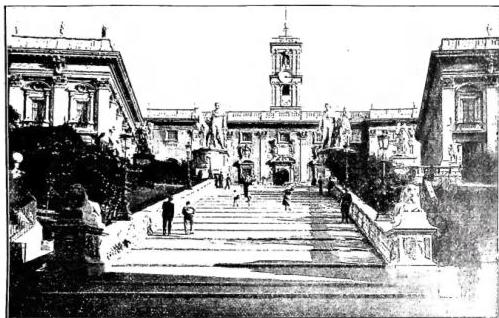
In the present state of studies on the language of Christian Latin writers of the 5th and 6th centuries — studies whose completion cannot yet be foreseen, given that secure editions of individual writers are indispensable for them — it is to be held that Augustine's doctrine concerning language spread early and rather widely, albeit in varying degrees according to different countries; widely, for example, in Gaul, very sparsely in Spain; in none of the lands where it arrived was it understood in its essence. The mediocre teachers of the time, at most, achieved no more in regard to Augustine's thought than the effort to break free from classical form both in vocabulary and in grammar, both in prosody and in meter; more than one of them became lost, and some others did not know how to free themselves from the «mera linguae Latiaris proprietas». Thus in Gaul, alongside Salvian of Marseille (d. ca. 480), in whom Augustinian reflections are evident, one finds the linguistic bewilderments of Sidonius Apollinaris (ca. 430 - ca. 482) and the efforts of Avitus (5th-6th centuries) to imitate the classical form, especially in poetry. In Africa, the Latin of Victor of Vita, of Dracontius, of Fulgentius, to whoever examines it closely, attests to the conditions of those schools (when Fulgentius [b. 468 in Thelepte in Byzacena] left Africa for the first time, he was over 30 years old), into which Augustine's literary doctrines had tumultuously penetrated. Highly interesting would be a comparative study of the Latin of the writers of Italy in the 5th and 6th centuries (Sedulius, Leo the Great, Cassiodorus, Boethius, Arator, Venantius Fortunatus) and of the attitudes of our schools toward the linguistic principles proclaimed by the native of Tagaste, attitudes that were highly varied. In no other place did these principles make teachers and writers ponder as much as in Italy, and in no other place was their scope understood so deeply. Cassiodorus (ca. 485-ca. 575), a writer closely tied to the past also by family traditions, conceived the thought that Latin ought henceforth to be such as to be able to serve, by linking its destiny to that of Christianity (he was the true founder of ecclesiastical schools), the future posteritas (Variae, I, Praef., 1), and, not knowing how to do otherwise, he formed his
Latin by putting together freely that of the classics of various centuries. More modestly, Venantius Fortunatus was concerned with writing a Latin which, arriving pleasingly to the ears of the Germanic barbarians, would make the sweetnesses of the muses penetrate their hearts, and he did not recoil in the face of barbarisms. But on the threshold of the 6th century Gregory I (540-604) solemnly proclaimed with Augustine: «indignum vehementer existimo ut verba caelestis oraculi restringam sub regulis Donati» (Ep., V, 53). This meant that, as the Empire of R. was becoming an ideal empire through Christianity, adequate means were required to welcome the beating of the heart and the thought of the mind of those who formed this ideal empire. Donatus was no longer enough.
II. CLASSICAL LATIN LITERATURE, CHRISTIAN GREEK LITERATURE, AND CHRISTIAN LATIN WRITERS
The literary problem presented itself to Christian writers as much more complex than the linguistic one: its solution in fact necessarily implied an assiduous and profound study of the classics, the harms and dangers of which they had to fear, especially for the education of the young (Tertullian, De anima, 39; Minucius, Octavius, 23, 1 ff.: Basil, Πρὸς τοὺς νέους). Faced with it, the attitude of Christians in the Greek world was different from that of the Latins, but in the Greek world Christian literature was born when the Greek genius, by then weary of nine centuries of work done to create pagan literature, lacked the strength to attempt new daring endeavors, so that the new literature was placed for its formal part in the furrow of tradition with some rare and superficial retouching, and for its content was forced by the demands of the times to be predominantly theological and philosophical.There, therefore, the problem of the relations that this literature should have with the classical one was not even addressed in its precise terms, and only justifications for the study of the classics were sought, justifications often even puerile (cf. Socrates, Hist. eccl., III, 16: PG 67, 417-24). In the Latin world, on the other hand, the literature of the "new word" arose when it, with forces still intact, was striving toward the "new," with a profound spiritual labor: hence artistic intents prevailed in it, and let us even call them "rhetorical," if this adjective is given the value it had at that time. In fact, in Christian Latin literature the thought of literarily renewing the "ancient" is soon evident, even more than once, with a revolutionary spirit (cf. Tertullian, Arnobius,
Commodian). In Justin absolute literary indifference is patent, in Minucius there is the attempt to renew Ciceronian art; in Tatian negligence is manifest, in Tertullian the continuous toil to open new paths to letters. It followed that Christian Latin writers faced and solved, in the only way it could be solved, the problem of relations with the pagan writers of all centuries. And it was proclaimed that the study of the classics served to transform, not in the light of ethics—save for rare exceptions—but in the light of art, the "ancient" into the "new." This explains how at the decline of the 4th cent. Basil, who had nevertheless been a famous master of rhetoric in Caesarea, in his Discourse to the Young does not mention the great Greek poets without adding to their name not even an adjective expressing an aesthetic judgment, whereas Jerome, some years later, in his letter Ad Magnum oratorem urbis Romae, found a way to do this by citing Cyprian, Aristides, Minucius Felix; and, at the beginning of the following century, Augustine set to work on his De doctrina christiana (completed later in 426), that is, the most thoughtful treatise on rhetoric in Christian literature: of these two, the former was the most authoritative representative of the trend in Christian literature that wanted classical literature to be renewed, but with a certain moderation, while the latter pointed out and carried out the renewal with the greatest—yet well-considered—freedom. And indeed the Greeks continued in Christian literature almost all the genres of pagan literature—some more than those cultivated by the Latins (e.g., drama; cf. Gregory of Nazianzus, Χριστὸς πάσχων)—and produced a literature certainly interesting in many respects, but which from an artistic point of view sent forth only rays of setting light. Whereas Christian Latin literature, by renewing the pagan literature that was gradually eclipsing, sent forth rays of dawn light: one thinks of Ambrosian eloquence and poetry; Jerome's commentaries and epistolography; Prudentius's poetry, the majority of Augustine's writings. And if it entered into competition with the Greeks, it defeated them: this is attested among other things by Ambrose's Homilies and Hexameron. And it created Augustine's soliloquy. When Julian, applying the measures spoken of, let Victorinus leave the chair of Rome and showed himself willing to keep Prohaeresius on that of the Academy of Athens, he demonstrated that he had understood that the danger to classical letters, so dear to him, was more serious in the West than in the East; but he had not understood, and could not understand, that it was the Christian literature of the West that had hitherto ensured and ensured for the future how much of the thought, of the literary art, and of the language of R. was destined to live through the centuries.
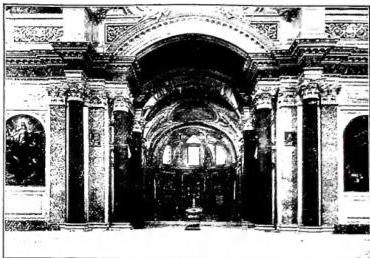
III. ANCIENT CHRISTIAN LATIN LITERATURE
It is not easy to capture, in the development of Christian literature, notes that clearly characterize its various periods, since from the very beginning a multiplicity of interests and a variety of forms assert themselves, in which one can scarcely discern any peculiar elements. Taking into account the historical climate in which the writers operate, the somewhat prevalent literary trends, and the influence exercised by the most prominent personalities, three periods can be distinguished.The periods: from the end of the 2nd century to ca. 326. - Christian Latin literature is born, so to speak, adult, both because it expresses the life of a group now widespread and solidly constituted, and because from the beginning it is represented by strong personalities, trained in a school capable, despite its gaps and defects, of educating in a composed and effective expression. The first literary works arise in the Church of Africa, which will continue to hold the field, almost alone, for over a century. Tertullian (if, as many scholars think, he is prior to Minucius Felix) is the leader of the band of valorous men. Minucius Felix (v.), an African lawyer who writes in R., treats in the Octavius the same topics as the apologist Tertullian, from whom he draws extensively, but with the intent to show, according to a trend already nobly established in apologetics, the consonance between Christianity and philosophy. Much of Minucius Felix and especially of Tertullian passed into the writings of s. Cyprian (v.). Formerly a pagan rhetorician, then a priest and bishop of Carthage for a decade, he put his pen at the service of the pastoral mission in about a dozen short treatises (almost all sermons) and in 65 letters, leaving aside all cultural interests, so much so that he never cites the pagan authors whom he nevertheless knew thoroughly. At the same time, in R., Novatian (v.), author of the well-known schism, elaborated the Trinitarian doctrine in a classical Latin and treated moral and disciplinary issues. The polemical tradition against polytheism and idolatry, which had some vigorous accents also in Cyprian's work, was resumed with fiery ardor by another African, Arnobius (v.), formerly a rhetorician at Sicca Veneria, in the seven books Adversus nationes, composed around 304. Lactantius, also an African, closes the first period of Latin Christian literature not only because
his activity took place straddling the two ages, first under Diocletian, who called him to Nicomedia to teach Latin eloquence, and then under Constantine, who wanted him as preceptor to his son Crispus in Trier (ca. 317), but also because in this writer the polemical interest combines, foreshadowing one of the characteristic aspects of the golden age, with the intent of systematic exposition. With Lactantius, in the lost Hoedoporicon and in the De ave phoenice, of whose authorship he does not seem able to be denied, Christian Latin poetry of sure dating makes its first appearance. To the age of Constantine belong the Laudes Domini (v.), a graceful poem composed in Gaul. With some probability, other poetic compositions are placed in the second half of the 3rd century, or at the beginning of the following one, such as the pseudo-Tertullian Carmen adversus Marcionem, the Instructiones and the Carmen apologeticum Commodian (v.), didactic and polemical writings of a popular character in language and meter, which interprets the rhythm of the classical hexameter according to a free accentual criterion.
Among the prose writers, Victorinus of Pettau, martyrized in 304, is still worthy of mention for his exegetical work. It will also be convenient to recall hagiographic literature, which makes its first appearance in this period (to speak only of literarily elaborated writings) with the Passion of ss. Perpetua and Felicitas (202-203), perhaps due to Tertullian, and the Life and Passion of s. Cyprian, written shortly after his martyrdom by his deacon Pontius.
The period: from 326 to 430. — The Evangeliorum libri IV by the Spaniard Juvencus, a modest paraphrase of the Gospels, especially that of Matthew, in diligently crafted hexameters, were composed around 330. But this and other figures are overshadowed by a group of writers in whom Western Christianity expresses itself with a vigor of thought and a perfection of style that constitute the golden century of Christian Latin literature: Hilary (v.), Ambrose (v.), Jerome (v.), Augustine (v.), Prudentius (v.), Nola (v.).
After the greats, the minors must also be named: s. Damasus (v.), known for the metrical epitaphs of the martyrs, C. Marius Victorinus (v.), Firmicus Maternus (v.), Lucifer of Cagliari (v.), Fortunatianus (v.) and Chromatius (v.) of Aquileia, Vercelli (v.), Brescia (v.), VERONICA (v.), Optatus of Mileve (v.), Pacian of Barcelona (v.), Elvira (v.), Bologna (v.), Ambrosiaster (v.), Nicetas of Remesiana (v.), Sulpicius Severus (v.), biographer of s. Martin and historian, Paulinus of Milan, biographer of s. Ambrose, Orosius (v.), historian and polemicist, Marius Mercator (v.), the heretic Pelagius (v.).
III period: from 430 to 636. — The vigorous creative impulse has waned. In poetry, in oratory, in theological controversy, in dogmatic and moral treatment, a tradition has been formed through the work of the majors, both in that literature of a pragmatic character which documents the action of men of government and theologians, and in the more strictly artistic forms, primarily in poetry. Putting together, by analogy in literary expressions, also some writers who operated at the end of the preceding period, one notes the metrical paraphrases of the Old and New Testament, due to Cyprianus Gallus, Cl. Marius Victor, Sedulius, Hilary; at the end of the 5th century and in the following one this genre will still be cultivated by Avitus of Vienne and by Anatore. An accent of sincere poetry is found in some poems of the African Dracontius (d. 496); rhetorical artifice dominates in the compositions Ennodius (v.), bishop of Pavia from 513 to 521. Venantius Fortunatus (ca. 530-607) shows an easy vein, but scarce originality of thought and superficial sentiment. Lyricism, hagiography, and didactics provide material for the verses of Orientius, Paulinus of Pella, Paulinus of Périgueux, Apollinaris Sidonius. Pastoral oratory is represented with dignity by s. Maximus of Turin (v.), s. Peter Chrysologus (v.), s. Leo the Great (v.), whose wide periodic style, rhythmized by clauses with Roman solemnity—which also appears in doctrinal letters—is characteristic; and by s. Caesarius of Arles (470-542; v.), author also of theological and ascetic works. In the homilies on Ezekiel and on the Gospels, s. Gregory the Great (v.), pope from 590 to 604, resumes many Augustinian motifs of thought and form, reworking them with an acute practical sense and a simplicity of speech not devoid of composed decorum.
Controversy and theological speculation in this period had as their object in particular the Trinitarian dogma and the Incarnation, in polemic against the Arianism of the barbarians, with the Africans Fulgentius of Ruspe (v.), Vigilius of Thapsus (v.), and Facundus of Hermiane (v.). The extreme theses of the Augustinian doctrine of Grace, resolutely defended by s. Prosper of Aquitaine (v.), during the master's life and after his death, met John Cassian (v.), known above all as a fortunate writer of ascetic works and a promoter, from his cenobium in Marseille, of the monastic life, Lérins (v.), founded by Eucherius of Lyon and illustrated, among others, by s. Vincent (v.), Arnobius the Younger (v.), Riez (v.), Salvian of Marseille (v.), in which theological and ascetic interests broadened into a passionate meditation on the history of his time in the De gubernatione Dei. History, and especially biography, underwent a considerable development: one may cite Possidius of Calama, who between 432 and 437 wrote the life of s. Augustine; the deacon Ferrandus, biographer of Fulgentius; Eugippius, author of the life of s. Severinus, apostle of Noricum; Gennadius of Marseille, continuator of the De viris illustribus of s. Jerome; and Cyprian, bishop of Toulon, who, with other disciples, composed the life of s. Caesarius of Arles, Tours (v.), the historian of the Franks, who also left a broad mark on hagiographical literature.
A place apart is deserved by Severinus Boethius, Cassiodorus (v.), and Isidore of Seville (v.). Boethius (ca. 480-524; v.), who represented and defended at the court of Theodoric the cause of Romanitas with a dignity that cost him his life, gathered the heritage of ancient philosophy and culture, transmitting it to the Middle Ages through translations, commentaries, and treatises—especially on the Trinity and the Incarnation—and composed in prison the De consolatione philosophiae, where the problems of thought are relived, as in Plato and Augustine, in the fullness of humanity, and presented, in the alternation of prose and verse, with a nobility worthy of the best classical tradition. Cassiodorus (490-c. 583), having retired in the full maturity of his years from public activity, dedicated himself to a life of moderate ascetism in the monastery of Vivarium, in Calabria, which became, through his impetus, a hearth of intense cultural activity. A notable interest in ancient culture was also shown by Martin, bishop of Braga (v. ca. 515-79), in his moral treatises largely derived from the philosophers and in other more original works. But he was largely surpassed by another Hispanic figure, Isidore, bishop of Seville (v. ca. 570-636). With these men, who strove to educate the new barbarian world in the light of classicism and Christianity, the interests, methods, and spirit of medieval culture are now clearly affirmed, in which the seeds sown during the first centuries of Christian literature would in due time undergo a luxuriant development.
IV. MEDIEVAL
1. From the Fall of the Empire to the Carolingian Renaissance. — The fall of the Roman Empire with Romulus Augustulus, the successive Ostrogoth and Lombard Empires, the various wars with the resulting ruins that devastated Italy, threatened to cause the eclipse of Christian culture along with whatever it had managed to save of the ancient heritage of the Roman world, which it had amply absorbed. Amidst all these ruins, it was of indisputable utility that the example of Cassiodorus did not remain solitary, but found fertile ground in the Benedictines and especially in St. Gregory the Great, poet, monk, and pope, who succeeded in reviving the Church in Italy and Gaul and in winning over the Visigoths of Spain and the Anglo-Saxons. A powerful means of union among so many nations was then the unity of the language of the Church, used especially in the liturgy and in worship and consequently also employed in religious writings, oratory, law, and the sciences. Already among the first companions of St. Benedict is found the poet Mark of Montecassino, who composed the life of the founder in distichs; and St. Gregory the Great, if he does not share Boethius's enthusiasm for ancient writers, nevertheless does not prove at all mediocre in the art of style and composes very beautiful hymns, which were introduced into the liturgy.In North Africa, the Vandals destroyed everything; nor did the Byzantine conquest succeed in remedying II. Nevertheless, there flourished at that time the grammarian Flavius Cresconius Corippus, author of Johannidos seu de bellis lybicis libri VIII, rich in fine narratives; Verecundus, bishop of Byzacena, author of a short poem De poenitentia, of exact meter, but devoid of true poetry; Fulgentius Ferrandus of Carthage with various canonical writings. With this, Latin literature disappeared from Africa. In Visigothic Spain, on the other hand, letters achieved a fine flowering; even several kings practiced them with small poems, distichs, inscriptions: Sisebut, Chintila, Reccesvinth, Wamba. And great credit for the classical education of the Visigoths goes to the great bishops of the time: Severus of Cartagena, Tajon and Braulio of Zaragoza, Ildephonse and Julian of Toledo, Fructuosus of Braga, Eugenius II of Toledo, with the short poem Hexaemeron, which mastered various types of verse like a master; and above all Isidore of Seville (v.). In Gaul, amidst numerous political upheavals, the Church knew how to hold fast to unity and Latin culture, in which Gregory of Tours ([v.]: Historia Francorum) distinguished himself; Venantius Fortunatus with his approximately 250 Christian poems in content, but clothed in the garments and forms of ancient mythology; his hymns on the Cross were introduced into the liturgy.
Latin literature found a fertile haven in Ireland through the work of St. Patrick (v.); his deeds were sung by his disciple Secundinus in 23 trochaic strophes. From Ireland comes the monk Columba, who founded the monastery of Iona, a center of culture and radiation for all of Caledonia; the abbot Adamnan left a life of him in verse, where traces of exquisite poetry are encountered, to which he added De situ Terrae Sanctae, derived from the accounts of Arculph, a bishop of Gaul who was shipwrecked there. Englishmen, instead, are: Gildas the Wise ([v.]: De excidio Britanniae); Aldhelm (v.), of the royal stock of Wessex, founder of the monastery of Malmesbury, another center of cultural radiation, and author of prose and short poems, among which Synopsis, a collection of 100 riddles to « primi ingenioli rudimenta excitare », and De laudibus virginum, a survey of men and women commendable for their virginity. Equally a center of cul-
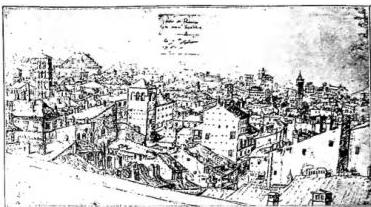
2. Carolingian Age. — This may rightly be called a literary renaissance, because letters experienced a magnificent flourishing not only at Charlemagne's court, but also in the principal abbeys of Fulda, Reichenau, St. Gall, and many others. Charlemagne showed an extraordinary care for culture. At Aachen, his residence, there flocked from Italy Paulinus of Aquileia, the grammarian Peter of Pisa, the historian Paul the Deacon; from Spain, Theodulf; from Ireland and Scotland, Dungal, a researcher of codices, and Joseph Scott, famous for his acrostic figures; among the Franks, Angilbert and Einhard (v.), biographer of the Emperor; the soul Alcuin (v.) of York. But Aachen failed to be, as dreamed, an ideal center to be compared to R., and even before Charles's death several paladins scattered in various directions and letters, after their promising spring, returned to the confines of the monasteries, because laymen cared little for them. At Fulda, Rabanus Maurus (v.), the "praeceptor Germaniae", distinguished himself among others for his zeal devoted to schools and instruction. At Reichenau, the following made their mark: Walafrid Strabo, who with De visionibus Wettini preluded the Divine Comedy and with Hortulus produced a didactic poem with very graceful and lifelike touches; Ermoldus Nigellus, with the poem on the deeds of Louis the Pious; Sedulius Scotus, Floro, Ratramnus of Corbie, Gottschalk. At St. Gall, where the first attempts at a German literature began with interlinear versions and vocabulary, the following distinguished themselves: Notker the Stammerer, of great musical gifts, who originated the Sequences, which spread rapidly and were imitated by many; Tutilo, who did the same for the Introits with the Tropes; Ratpert and the five Ekkehards, the first of whom was commissioned to render certain Germanic sagas into Latin verse and thus produced the heroic poem Waltherius manu fortis; later purged of the remaining excessive barbarisms ("Haec, quicunque legis stridenti ignosce cicadae") by the last Ekkehard, the V. The poem narrates the flight of Waltherius from Attila's court and his most varied adventures. Slightly later is another adventure poem by an unknown author,
the Ruodlieb, the story of the young knight Ruod, who, forced to leave his homeland, spends two years in exile amid adventures of arms and loves.
An animal epic appears with the Ecbasis cuiusdam captivi, in 1175 hexameters, by an unknown author, but thoroughly imbued with Virgil; it concerns a monk who describes under the fleece of various animals his apostasy, his vicissitudes, and finally his return to the fold. Of the same genre, but shorter (344 distichs), is Isengrinus (the author, very fond of Ovid, is unknown and belongs to the early 12th century) with two adventures: the illness of a lion and the pilgrimage of a chamois; to this poem can be linked the more extensive reworking by Master Nivard (mid-12th century), Reinhardus Vulpes. Special mention is deserved by the nun Hrosvitha (v.) of Gandersheim, who, aside from various poetic works of hagiographical subject matter, undertook to transform Terence's theater, replacing its risqué material with healthier loves, treated at times with naive casualness.
3. Toward the Renaissance (9th-13th centuries). — In this epoch the new European peoples were developing their own new literatures, and laymen began to cultivate these with care and even with talent, while Latin continued to be the language of the Church, of law, of diplomatic relations, and also of the Universities, producing above all a very rich historical output, of unequal literary value. Since a detailed list is impossible amidst such abundance (the very works published in MGH, RIS, Acta SS., PL, and similar collections are far from exhaustive), it will be fitting to outline the various literary genres in broad terms, all the more so since the best literary histories of the various nations, alongside works written in their own language, usually also treat those written in Latin.
Therefore, in the field of historical production, an important place at this time is held by the Vitae sanctorum, especially those related to churches, monasteries, and shrines that were pilgrimage destinations (Liudger, Æthelwold, Rembert, Wandelbert of Prüm, etc.), to which were soon added the annals and chronicles of the principal abbeys (Fulda, Hersfeld, Montecassino, etc.), the histories of dioceses (Verdun, Auxerre, Agnellus for Ravenna, etc.), and the affairs of lesser peoples, their sovereigns, and various conquest enterprises (Erchempert for the Lombards in Benevento, Liutprand for the history of his times, Widukind for the Saxons, Hermann Contract, Master Adam, Anastasius the Librarian, George Syncellus, Orderic Vitalis, Flodoard, Otto of Freising, William of Tyre, etc.). A fertile field was found here for histories blended with legends, the naive credulity of multiple hagiographers, and the eagerness for edification, due to which in the various collections of golden legends (Jacobus de Varagine, Thomas of Cantimpré, Caesarius of Heisterbach, etc.) it is not always very easy to extract the core of truth from beneath the heavy robes of exaggeration and contamination. Nor should we overlook attempts to give an epic guise to the vast material thus offered by legends, both in the hagiographical field (e.g., the various De triumphis Christi concerning the saints and martyrs of Palestine, Antioch, and Arabia by the aforementioned Flodoard of Reims; the Vita et passio s. Christophori by Walter of Speyer; the Passio s. Mauritii, etc., by Sigebert of Gembloux) and in the historical field (the Victoria Pisana de Saracenis [1088], the deeds of the Perugians, the conquest of Jerusalem, the Solymarius on the enterprises of the First Crusade, the Ligurinus on Frederick I Barbarossa, the Alexandreis of Walter of Châtillon, the Historia Mahumetis by the monk Hildebert, the Carolinus of Giles of Paris on Charlemagne, the Aurora of Peter Riga on the Old and New Testament).
Meanwhile, a sort of marriage is noticeable between philosophical and humanist culture (Policraticus and Entheticus of John of Salisbury, etc.); humanist studies are then regarded as a preliminary stage to philosophical studies (the Labyrinthus of Eberhard the German); indeed, a strong influence of Plautus and Terence becomes evident (e.g., the story of Paulus et Polla by a certain Judge Richard, "Venusinae gentis alumnus"). The shadow zones of the Middle Ages are brought to light by an entire production
satirical poetry which reaches its culmination in that commonly called goliardic poetry of the clerici vagantes, where now help is asked in order to study, now the thickest matters, the pleasures of wine and love are unfurled with ample and sometimes excessive freedom of words (« Mihi est propositum in taberna mori »), and now the weaknesses of the clergy and the vices of all professions are ruthlessly stung. The lack of true art and true dramatic poetry is made up for by sacred representations united to the liturgy, especially of Easter and Christmas and other Mysteries referring to them, which however passed into reprehensible contaminations with the feast of asses or fools. Religious lyric poetry and hymnology (hymns, sequences, tropes) reflect very well instead, not only with classical meters, but also and above all with rhythmic meters (St. Peter Damian, Hermannus Contractus, Peter the Venerable, Hildebert of Lavardin, Abelard, St. Bernard, Adam of St. Victor, St. Thomas Aquinas); and the encyclopedic work of Vincent of Beauvais offered a special and ample path to the further development and study of literature: Speculum triplex, naturale, doctrinale, historiale, with its rich treasure of quotations and passages derived from an extraordinary quantity of authors of the pagan and Christian world.
V. MODERNA
In this period of humanism's greatest flourishing, characterized by a vigilant study of ancient authors, alongside pagan or paganizing literary production—sometimes of a deplorable lightness and audacity—there is no lack of Christian literature works quite worthy of mention not only for their perfect stylistic form, but also for the loftiness of their thought and feelings. For Italy, the following must be remembered: Enea Silvio Piccolomini (Pius II), one of the greatest proponents of the Renaissance, with De viris illustribus, De puerorum educatione, and his autobiography Commentarii rerum memoribilium; Pier Paolo Vergerio with De ingenuis moribus ac liberalibus studiis adulescentiae; Maffeo Vegio with De educatione liberorum; Giacomo Sadoleto with his short poems and his philosophical and pedagogical writings; Girolamo Vida with Hymni de rebus divinis and the Christiades; Jacopo Sannazaro with De partu Virginis; Gian Giorgio Trissino, and Gerolamo Fracastoro. Outside of Italy, one can cite: John Gerson, Willibald Pirkheimer, Trithemius, St. Thomas More, St. John Fisher, Jan Dantyszek, Germain de Brie, H. Stephanus, Justus Lipsius, Hugo Grotius, and the Lutheran bishop of Ireland Brinjolf Sveinsson with his fine collection of Marian poetry.In the 17th and 18th centuries, the so-called Jesuit theater remained famous, that is, the numerous series of dramas that teachers composed and pupils performed in their various colleges. The field of action, so to speak, was rather limited, both because of the purely pedagogical purpose and because of the performers' not-yet-fully-developed artistic proficiency. Nevertheless, it exerted a very notable influence, and the number of compositions is quite high. Generally, the theme was derived from Greek and Roman history, the Bible, salient events in the lives of saints, episodes from medieval and contemporary history, or abstract and allegorical subjects concerning virtues and vices. Among the very dense crowd of those who practiced it, some distinguished themselves: Jakob Bidermann, Nikolaus Avancini, Nicolas Poussin, and Giovanni Spinelli. This school theater, adopted in almost all religious schools, finds a counterpart in parallel Protestant literature, already stimulated by Luther himself and counting the Dutchman Willem van de Voldergroft as its forerunner.
In the same period, lyric poetry—favored by numerous occasions of births, commemorations, weddings, and religious professions—had some noteworthy cultivators: M. Sarbiewski, Jakob Balde, and Simon Rettenbacher; epic poetry yielded J. Masen's Sarcotis (in some respects a prototype of Milton's Paradise Lost), the aforementioned Balde's Urania victrix, Tommaso Ceva's Jesus puer, and the Vita di Maria by the missionary Ven. José de Anchieta; didactic and satirical poetry was represented by Giovanni Lorenzo Lucchesini and Giulio Cesare Cordara.
The modern neoclassical movement. — In the second half of the 19th century, one notes a valid revival of Latin literature, especially in the field of poetry. Unanchored from humanist schemes and freely wandering in the open seas of the modern era, poetry finally seemed to close the parenthesis of the 17th and 18th centuries, during which, if Latin exercises were many, truly worthy voices were few by comparison. Cooperating in this neo-Humanism was the Dutch foundation of Amsterdam, instituted by Jacob Hendrik Hoeft, and various others that followed it (in Italy: the Ruspantini Contest [Rome], the Triumviri Contest [Gerace Marina]). To remain within the assigned field of Christian Latin literature, mention must be made of the Swiss Pietro Esseiva, with his Poemetti biblici and Elegie vomane; Diego Vitrioli (Xiphias); Leo XIII with Odi, Epigrammi, and Elegie, responsive to the events of the times; Pascoli (v.) with his Poemetti cristiani; Herman Weller (Lucius, Fabius et Cornelia); A. Zappata (Mater Jesu, Mater Judae); Alfredo Bartoli (Sophronia); A. Casoli (Telemachus Lyricorum liber I et II); G. A. Rocco (Africa, Triumphale melos); F. S. Alessio (Vitus); G. Morabito (Martyres); Diego Verghetti (Gloriosus Ordo B.M.V. de Mercede); A. Monti (De arte volandi, Ad Polum versus); R. Carrozzari (Caecilia); O. Cagnacci (Odae); A. Trazzi (Formicae magistrae, Pio Papae XI); V. Genovesi (Carmina, Carmina fidei); A. Bacci (Inscriptiones, Orationes, Epistolae). To be welcomed with sympathy is the new (1953) quarterly Latin periodical Latinitas, published under the auspices of the Holy See, which will deal, among other things, with ancient and recent Christian Latin writers as well.
### III. ART.
SUMMARY:
I. Ancient age
II. Art from the 4th century to the second half of the 18th century
III. Art from the second half of the 18th century to our days.I. ANCIENT ERA
The evidence left behind by the people who lived in prehistoric times on the hills where R. later arose, and subsequently by the earliest inhabitants of the city, is closely connected to that of other populations living at that time in the center of the peninsula. Yet around the 7th century, elements of Etruscan culture seem to prevail even in the field of the figurative arts, and the name of the sculptor Vulca of Veii is linked to the most ancient images venerated in the temple of the Capitol and to the splendid bronze she-wolf, a work of the 6th century B.C. preserved in the Capitoline Museums, which serves as the very emblem of the city.Thus, the most ancient architectural works of R., such as the Mamertine Prison, the Tullianum, or the Cloaca Maxima—which channeled the waters of the Forum toward the Tiber and testifies to the high degree of civilization and technical skill attained in the region at that time—are related to Etruscan culture. On the other hand, the cippus with an inscription in archaic Latin discovered beneath the so-called tomb of Romulus in the Forum certainly predates the year 500 B.C. Meanwhile, starting from the 4th century B.C., Hellenic influences arrived with greater intensity in southern Italy and in Etruria itself, and were soon reflected also in the architectural, plastic, and pictorial manifestations of the Romans, as attested not only by the three temples of the Forum Boarium located beneath the church of S. Nicola in Carcere or the other one known as the Temple of Portunus (erroneously called Fortuna Virile), but also by Roman coinage, bronze urns, marble cippi and sarcophagi from the 4th century B.C. onward, and the
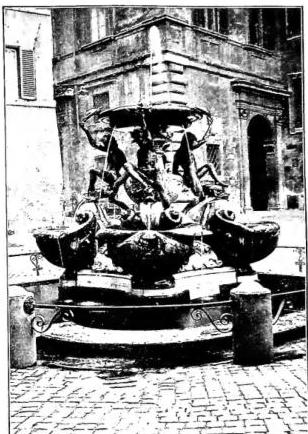
Subsequently, in the last two centuries of the republic, art developed with greater intensity. The elements contributing to it were predominantly Etruscan and Hellenic, but fused with ever-greater independence and originality. Indeed, it could be said that the architectural culture and great technical skill of the Etruscan engineers, admirable builders of arches and vaults, provided the framework of the buildings at that time, while the achievements of Hellenic culture were kept in view above all for their decoration and their facing of polychrome marbles.
Yet already from those times, constructions of an official or celebratory character tended toward the grandiose and imposing; not only did primitive wooden and terracotta temples gradually yield to stone buildings, but they were adorned with wide access staircases, such as the one dedicated to Magna Mater on the Palatine, which dates from 191 B.C., or they featured large porticos like the temples erected in the Campus Martius in honor of Jupiter and Juno by the architect Hermodoros of Salamis by order of Metellus, victor of the Macedonian War, in 146 B.C. At the same time, the Romans undertook the construction of their first basilicas, large markets, ports, aqueducts, and roads. The construction of the latter implied that of bridges, which featured increasingly tall, robust, and daring arches set, as in the aqueducts, on strong piers. These works already possessed that excess of structural power later characteristic of the major constructions of the imperial period. Thus, there asserts itself already in the republican age in works of a utilitarian character - and much could be said regarding the architectural values of fortification works - that particular tone of solemn and grandiose imposition which, in the city renewed in the imperial era, would be characteristic of R. Meanwhile, in increasingly rich villas and houses, forms closely connected to Hellenic ones evolved, architectural orders (v.) that had by then become traditional, namely the Doric, Ionic, Corinthian, Tuscan, and subsequently the various types of Composite.
However, by the 1st century B.C., while the temple of Jupiter on the Capitol—which had burned down in 83 B.C. during the Sullan struggles—was being rebuilt with a new taste, Pompey in 55 built the city's first large stone theater, while Caesar, having erected the Saepta (a great columned portico that extended from the Campus Martius toward the Capitol along the Via Flaminia), undertook the construction of the Forum that bore his name and the Basilica Julia. Thus began that radical transformation of the city center which subsequently, within the span of four centuries, was to crowd it with one of the most important architectural complexes seen in the West.
742. Architecture
At first, one witnesses a strengthening, so to speak, of Etruscan and Hellenic forms, characterized by a greater imposingness of the buildings in which those forms appear. This is followed by a second phase, which begins in the late 1st century of the Christian era. In it, the elements of the ancient classicist tradition of Hellenic derivation are coupled with others independent of it, or—even if derived from it, from the Etruscan tradition, or from still other cultures—evolved with independence and novelty of orientation. And finally, a third phase occupies almost the entire 3rd century and the beginning of the 4th of the Christian era. In this last phase, the architectural forms of the Romans, matured through previous experiences, evolved with absolute independence and acquired absolute originality even in the goals to be pursued: chief among them being that of elevating structures in which the plastic masses, clearly defined and contrasted in a wise alternation of light and shadow, make the sense of architectural space almost concrete.The principal works of the first phase existing in R., in addition to the aforementioned constructions from the time of Sulla, Pompey, and Caesar, are those erected in the time of the emperors of the 1st century of the Christian era from Augustus to Trajan: the Tomb of Augustus and that of Cecilia Metella, the so-called House of Livia on the Palatine, the imperial palace of Tiberius and that of Domitian also on the Palatine, the Arch of Titus, the Theater of Marcello, the Flavian Amphitheater (the Colosseum), the Forum of Augustus, and that of Nerva. In all these buildings, albeit with new inflections and a new force of chiaroscuro reception, the laws of the preceding architectural syntax of Hellenic tradition still hold value in the relationships between individual members. Such value appears in the individual parts of the major building complex that initiates the successive phase, namely the completion of the Imperial Fora, carried out by Trajan on the design of Apollodorus of Damascus between 111 and 114, and conceived with an admirable sense of unity and a grandeur of intent hitherto unknown in the West. Having now conquered and perfectly mastered new construction techniques—such as the use of brick in place of tufa and stone, and of cement mortar, as well as an extraordinary ability in turning barrel and cross vaults and domes—these achievements make their greatest test in the reconstruction, which took place between 115 and 125, of the Pantheon, previously erected by M. V. Agrippa and burned down in 110. Here, however, the great rotunda, covered by a hemispherical dome measuring 43.50 meters in diameter (which is in a sense the most original element of the building), is placed alongside but not fused with the classicist-tradition element constituted by the pronaos. A sort of eclecticism, of which we will also find a reflection as a juxtaposition of architectural expressions of very diverse taste in the various buildings of the villa of the Emperor Hadrian under Tivoli, in that Emperor's mausoleum, and finally in the architectures of the time of Marcus Aurelius and Septimius Severus, such as the arch in the Forum and the palace of the latter Emperor on the Palatine. In these buildings, there is evident an ever-greater imaginativeness in plans and structures, and an accentuation of the taste for the picturesque and the scenographic in the alternating play of projecting columns, pediments, niches, and variously moved and undulating walls. In the imposing buildings of the third phase of Roman architecture—which began with the construction, between 212 and 216, of the Baths of the Emperor Caracalla—this resolves into expressions of the highest and newest aesthetic value. Thus in the Mausoleum of the Gordians (238–44), which recalls the Pantheon; thus in the thermal or nymph-hall known as the Temple of Minerva Medica; thus in the Baths of Diocletian (284–305); thus in the basilica begun by Maxentius and completed in the year 312 by Constantine; and finally thus in the triumphal arch erected in 315 in honor of this emperor by the Senate and the Roman people. In these buildings, and in others of the same age reflecting the same taste, the limpid and straightforward structures express with absolute clarity architectural ideas that are both logical and harmonious. This is pursued through the full mastery of an admirable technique whereby the various elements of the constructions—walls, piers, arches, vaults, domes—pose with absolute apparent freedom, dominated as they are by the minds of greatest architects.
The gigantic Basilica of Maxentius, completed by Constantine, is, in this sense, the masterpiece of Roman architecture. The perfect correspondence between voids and solids, the alternation of plastic masses that generate a sense of solemn harmony, the precise balance between stress and resistance, the vigorous relationships of shade and light contribute—in addition to rendering the sense of space concrete—to fully expressing the dominion of human intelligence over matter. From its contemplation thus springs a sense of confidence in human capabilities itself, yielding a full and complete enjoyment.
Nonetheless, in R. itself, alongside these extremely important testimonies of an architectural activity of an official character, another architectural trend continued to live—and multiple testimonies of it survive, ranging from the so-called House of Livia on the Palatine to the Portico of the Dei Consenti at the foot of the Tabularium beneath the Capitoline Hill. It had a simpler and almost modest tone, which manifests itself in smaller buildings, especially in houses where rooms are arranged around columned peristyles and courtyards, covered by ceilings protected by sloping roofs and terraces. These are buildings where the serious problems of vaulted and domed ceilings set on pillars—characteristic of the major architectures mentioned above—do not arise, but everything is resolved in simple, serene forms without rhetorical display; and the weight of the roofs, which have a wooden framework, rests perpendicularly and directly on the walls or on the entablatured columns and pillars. It was largely from this second trend of Roman architecture that the forms used to erect the first churches in R. in the 4th century were drawn (v. BASILICA; CHIESA; ITALIA, L').
743. Sculpture
Mention has already been made of the activity of Vulca, an Etruscan sculptor from Veii, active at the beginning of the 5th century B.C., author of sculptures for the Capitoline temple of Jupiter and perhaps of the bronze she-wolf in the Museo dei Conservatori. It is certain that, as in the field of architecture, in that of plastic arts the most ancient Roman activity merges with the Etruscan one. This is evident in the Ficoroni cista in the Museo di Valle Giulia, a bronze urn depicting scenes from the story of the Argonauts with wonderful finesse, bearing a Latin inscription stating that it was executed in R. by a Novios Plautios. Thus, the numerous portraits of the Republican era have links with the characteristic, accentuated realism of the Etruscan tradition. However, by the 1st century B.C., the more cultured and refined forms connected with Hellenistic modes—following in this a parallel movement to that noted in the fields of architecture—frequently turned toward representations where images are transferred from the plane of individual reality to that of generality, rising to the dignity of types. Thus in the frequent portraits of Cicero, Pompey, Caesar, and finally Augustus—among which the one found at Prima Porta is extremely beautiful—and subsequently in the portraits of the other emperors and the principalpersonages of their families. In this series, however, the more accentuatedly realistic modes of the ancient local tradition often also intervene, asserting themselves independently in a large quantity of portraits of citizens and private individuals.
Alongside the series of portraits, Roman art—which has also left numerous copies of Hellenistic sculptures from various eras—excels in a group of splendid reliefs of historical and commemorative content, ranging from those of the Ara Pacis of Augustan times (9 B.C.), to those of the Arch of Titus, to those of Trajan's Column (where a greater independence from Hellenistic culture asserts itself), to others that decorated the arch erected in honor of Hadrian along the Via Flaminia (where there is a return to cultured modes of that tradition), and finally to the subsequent ones of the time of Marcus Aurelius and Septimius Severus, characterized—like contemporary architecture—by a clear pursuit of pictorial effects. Then in the 3rd century, in the fields of the plastic arts, one witnesses a twofold movement. On the one hand, as in the famous portrait of Caracalla, an accentuated veristic quest prevails, resulting in an intense torment of surfaces in search of incisive and defined marks; on the other hand, subsequently, as in the portraits of Gallienus, one witnesses a gradual softening and almost pictorial dissolution of surfaces, achieved through subtle passages of blended planes.
In the second half of the century the two modes coexist and sometimes appear in the same work, until, at the time of Constantine, they are once again distinguished, although in two new aspects. On the one hand, in the reliefs of the famous arch, pictorial intents serve to give vigor and character to images linked to popular and provincial modes—which, as often happens in moments following the transition from one civilization to another, are a new source of inspiration; on the other hand, surface images enclosed within almost architectural schemes appear static, hierarchical, abstract, outside of any human contingency. Hellenistic naturalism, delicate pictorialism, the soft, skilled plane transitions marking the gradual fading of surfaces—in a word, the ancient ideals of classical beauty—gradually decline, inasmuch as the new spirituality brought about by the triumph of Christianity now requires new forms of expression. Nor does it matter that sometimes during the 4th century and then again in the 5th the ancient forms still assert themselves in works of high beauty; suffice it to cite the Sarcophagus of Junius Bassus in the Vatican Grottoes. Whatever subsequently appears as a valid force for the path of art will derive more from those marbles where anti-academic and anti-classical ideals are affirmed than from the others where such ideals, albeit with ever-decreasing vigor, are resisted. They represent the weight of tradition rather than its force.
3. Painting. — The number of paintings by the ancient Romans that have come down to us is relatively scarce. The fragment with combat scenes found on the Esquiline Hill and today in the Capitoline Museum is the oldest testimony (3rd century B.C.) of pictorial activity in R. It was evidently connected to Etruscan art. That painters nevertheless carried out a very intense activity in R. and reached the highest peaks in expression can be deduced from ancient testimonies and from what still remains of their work. The temples, palaces, houses, and tombs of the Romans were all decorated with paintings reflecting modes very similar to those of the paintings of Pompeii and Herculaneum, which, having survived in greater numbers, perhaps give a more organic picture of the evolution and various stylistic modes of painting in Italy in the 1st century of the Christian era. However, the decorations of the Villa della Farnesina, those of the House of Livia on the Palatine and of the so-called Villa of Livia at Prima Porta, as well as those coming from a house on the Esquiline, now in the Vatican Museum, in addition to the decorations of the imperial palaces and particularly of Nero's Domus Aurea,
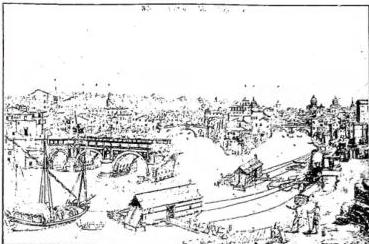
ROMA - Two floating mills on the Tiber near Ponte Rotto. Drawing by Lieven Cruyl, March 1665 - Vienna, Albertina Gallery.
document the high degree of pictorial culture achieved in R. in the 1st century of the empire.
The stylistic modes of those paintings can be considered, due to their relations with Hellenism, analogous to those noted in the fields of contemporary sculpture and architecture. And painting evolves in a similarly analogous sense during the 2nd and 3rd centuries of the empire, when excellent pictorial monuments are identified in the catacombs, indicating an attitude of taste that evolves according to modes analogous to those noted in the field of sculpture. Until in the 4th century we note a coexistence of the modes most closely bound to ancient and official tradition and other anti-academic and anti-classical modes to which, as already stated for sculpture, the stylistic modes of art in R. during the Middle Ages will for the most part be linked.
4. Ancient and medieval urban planning. — Despite the splendor of some monuments, the city continued to be for the most part built of timber, if the fire that broke out during the time of the Emperor Nero on June 18 in the year 64 of the Christian era raged unstoppably for nine consecutive days, completely destroying three regions and partially another seven. In the reconstruction that followed — Tacitus narrates — the buildings were aligned with new regularity, isolated from one another, and limited, or at least disciplined, in height. A city now too large and too rich not to attract the greed of the barbarians who were becoming increasingly threatening beyond and within the borders of the empire itself. Thus it was that Aurelian in the year 271 began the construction of the new, splendid ring of city walls that still largely exists. A ring with a perimeter of 19 km., where there were 383 defense towers, 14 major gates, 5 minor ones, and which for a century and a half approx. effectively preserved R. from the outrage of invaders. At the beginning of the 4th century of the Christian era, R. was truly the most splendid and rich city in the world. It had 27 public libraries, 11 thermal baths, 856 bathing establishments, 1,352 public fountains, 8 playgrounds, 5 naumachiae, 11 large Fora, 15 nymphaea, 10 major basilicas, 19 aqueducts, 36 triumphal arches, 8 bridges over the Tiber, 3 large theaters. Then Constantine transferred the capital of the empire to the banks of the Bosphorus at Constantinople and, by the inescapable law of human destiny, R. began to decline.
The new society, educated in the ideals of Christianity, pursued goals very different from the ancient ones, while the imperial militias and the walls of Aurelian were no longer a sufficient bulwark to contain the barbarian fury. And in August 410 the Goths of Alaric, having overcome those bulwarks, sacked the city for two days. Forty-five years later, in 455, it was the Vandals, the Arabs, and the Bedouins who put R. to fire and sword for fourteen
days. The city was now going to ruin, nor did the provisions of the intelligent barbarian king Theodoric succeed in arresting its decline. He restored the Theater of Pompey, the Colosseum, some aqueducts, the sewers. But it was very little in the face of the abandonment in which everything was decaying. An abandonment that became almost complete when Vitiges, having besieged the city for over a year, from Feb. 537 to March 538, cut off the aqueducts from which its lifeblood flowed. By now even the suburb was all in ruins, the villas, the vegetable gardens, the vineyards. The countryside was invaded by criminals, and from the ever-growing marshes advanced the terrible scourge of malaria. Nor did the provisions of pontiffs such as Hadrian I (772-95), Leo III (795-816), or Paschal I (817-24) avail, who restored ancient buildings or constructed new ones. R. preserved its ancient splendor only in the memories and imaginations of men. Then in the 11th, 12th, and 13th centuries, with the general reflourishing of consciences and energies that characterizes the rise and development of the Romanesque age, urban construction also received a new impulse, and R. in the year 1300, as the Jubilee was being celebrated, could appear splendid even with new buildings to the two million pilgrims who flocked there from all parts of Europe. But it was a brief rebirth, as internal struggles during the Avignon exile exhausted it once more, nor did the fiery words of Cola di Rienzo or the provisions of Card. Albornoz suffice to stop its renewed decline. The 14th century, which in so many other cities of Italy marked a period of true splendor and imprinted on their streets, squares, public palaces, and entire neighborhoods a character of beauty, strength, and elegance that subsequent centuries have not erased, marked a period of stagnation for Roman building activity, which would have a new revival only toward the end of the first quarter of the 15th century. Then Martin V Colonna, returning on Sept. 30, 1420 to his native city,
finding it in a state of complete abandonment, dedicated his greatest efforts to the restoration and reconstruction of ancient buildings. And he had the motto engraved on the commemorative medal of his pontificate: «Dirutas ac labentes Urbis restauravit ecclesias».
II. ART FROM THE 4TH TO THE SECOND HALF OF THE 18TH CENTURY
744. Architecture from the 4th to the 11th century
None of the basilicas erected by Constantine, members of the imperial family, or his court has survived intact to the present day. Indeed, among the basilical architectures of the 4th century, only the church of S. Pudenziana retains a large part of its primitive building within its structures. For the others, such as those of S. Peter, S. Paul, S. Croce, S. Lorenzo, and so on, whatever remains of the original construction can only be useful for an ideal graphic reconstruction of them. In any case, they were linked to that trend of Roman architectural tradition mentioned above, characterized by essentially simple and clear forms. Walls and parallel alignments of columns supported roofs (trussed roofs) that weighed perpendicularly upon the load-bearing elements. On the shorter side of the building, opposite the entrance, an apse curved outward, decorated, like the walls, with paintings or mosaics. The mausoleum of Costantina, known as the church of S. Costanza, as well as the most ancient parts of the Lateran Baptistery, instead suggest the close ties uniting these central-plan constructions to analogous types of Roman buildings covered with vaulted domes. In the following centuries, up to the 10th-11th centuries, these two types of construction were transformed through a process of simplification and often impoverishment of their primitive aspects. To the 5th century, in fact, belong the general layout of the basilica of S. Maria Maggiore, that of S. Sabina on the Aventine, and that of S. Pietro in Vincoli, all reflecting the Constantinian basilical scheme, as well as the circular church of S. Stefano Rotondo, which can be considered, in its layout, a simplification of a preceding central-plan building type.In Roman constructions of the 6th and 7th centuries—some of which nevertheless resemble those of the 5th in various aspects (S. Pancrazio)—elements derived from the Byzantine East appear. Thus in the part of the basilica of S. Lorenzo fuori le mura built by Pope Pelagius II, and in that of
S. Agnese reconstructed by Pope Symmachus (498-514) and decorated by Honorius I (625-38). The construction of the primitive church of the SS. Quattro Coronati is also attributable to Honorius—a truly grandiose and most beautiful building. But to the 7th century also belongs the construction of the church of S. Giorgio in Velabro, which reflects a quite different architectural sentiment: a sense of neglect and ostentatiously displayed indifference to old formulas, a careless and languid air. The same is true of the older parts (8th century) of S. Maria in Cosmedin and S. Giovanni a Porta Latina. Then, at the beginning of the 9th century, there is something like an architectural revival reflected in the clear spatial harmonies created by the architects of Pope Paschal I (817-34) in S. Prassede, S. Maria in Domnica, S. Cecilia, in the later basilica of S. Marco, and in the parts assignable to the 9th century in the church of S. Maria in Aracoeli. What remains of the 10th century does not suggest that this revival movement had any follow-through in immediately subsequent times.
745. Sculpture from the 4th to the 11th century
The two aspects assumed by plastic arts at the beginning of the 4th century—clearly exemplified in the reliefs of the Arch of Constantine and those of the sarcophagus of Junius Bassus, the former tending toward an expressionistic pictorialism of a distinctly anti-classical taste, the latter still reflecting precisely the ideals that had belonged to classical art for centuries—are reflected in numerous marbles of the 4th, 5th, and 6th centuries. Thus in certain statues, such as, for example, the Constantinian ones of St. John and the Campidoglio, as well as in the reliefs of the door of S. Sabina (422-32) or in the monograms of John II (532-35) of the church of S. Clemente. At that time, in certain decorations of architectural elements, the plastic taste also suggests decisive oriental influences (capitals at S. Agnese, S. Clemente, SS. Quattro). Then between the 7th, 8th, and 9th centuries, the taste for low-relief plastic decoration of a generically termed barbarian type (v. BARBARICA ARTE) also spread to Rome, frequently featuring wicker plaitwork alongside representations of the sun, the moon, palms, the cross, etc. We have examples of this at S. Sabina, S. Maria in Trastevere, S. Clemente, S. Maria in Cosmedin, S. Maria del Priorato, etc. But in the 9th century, in the decorative elements of the architecture from the time of Paschal I, the aspiration toward plastic forms closer to ancient sculpture is already clear, as seen in the portal of the chapel of S. Zenone at S. Prassede.746. Painting between the 4th and 11th centuries
In Rome, better than in any other place in the world, it is possible to follow, reflected in pictorial works, the evolution of figurative taste throughout the Middle Ages. But even in the field of painting, starting from the 4th century, two distinct currents can be distinguished. One is still academic, tied to traditional modes of classicism; the other is expressionistic and anti-academic, and at least in part to be connected with the modes of compendiary painting widespread not only in catacomb painting. The mosaics of the annular vault of S. Costanza, those of the apse of S. Pudenziana, which date from the very first years of the century, the others also from the 5th century on the nave wall of S. Maria Maggiore and the counter-façade wall of the church of S. Sabina; as well as those of the 6th century in the apse of the church of SS. Cosma e Damiano, can be linked to the various gradations of ancient classicism, which was also modified through contact with oriental modes, already recognizable in the 5th century in the mosaic of the triumphal arch of the basilica of S. Paul. But in the 5th century, forms related to impressionistic painting are evident in the mosaic of the triumphal arch of S. Maria Maggiore. Nevertheless, at the end of the 6th century in the mosaics of the triumphal arch of the ancient S. Lorenzo fuori le mura, and in the 7th century in those of the apse of S. Agnese and subsequently in those of the oratory of S. Venanzio near the Lateran Baptistery, Byzantine modes prevail; these continue to assert themselves in the 7th and then in the 8th and 9th centuries, in forms and accents that we might call dialectal, within the fresco paintings found in S. Maria Antiqua, S. Saba, S. Clemente, S. Crisogono, S. Maria in Via Lata, etc. Yet it is in the 9th century that a most beautiful group of mosaics—at S. Prassede, S. Maria in Domnica, S. Marco, S. Cecilia—bears witness to a substantial changein taste whereby the values of a vivid, even violently bright chromatism are exalted, even in works of a monumental character; this chromatism had already appeared in the 5th-century mosaic of S. Maria Maggiore, marking an anti-classical and anti-traditional resolution in the developments of medieval Roman painting. However, as with contemporary architecture and sculpture, that particularly felicitous moment of Roman art did not have a follow-up in the immediately subsequent times, when in the 10th century, in the frescoes of the apse of S. Stefano del Palatino, in another depicting Christ surrounded by angels in SS. Giovanni e Paolo, and in other fragmentary ones in S. Crisogono, etc., tired forms of a vague Byzantine imprint appear. But in the 11th century, a masterpiece—the Madonna painted on panel and venerated in S. Maria in Aracoeli—heralds new times for Roman painting as well.
4. The Romanesque Age. - It was during the Romanesque age that the figurative arts experienced a rebirth in Rome, with an independence and originality compared to what was happening in other Italian cities, while anticipating and defining more clearly than elsewhere within its walls certain principles that were to remain at the base of the Italian Renaissance itself. Above all, the principle of: antico, synonymous with bello.
In architecture this is manifest in a complex and important series of constructions to be assigned precisely from the 11th to the 13th century: such as the churches of S. Maria in Cappella, S. Maria in Trastevere, S. Crisogono, S. Lorenzo fuori le mura, or the porticos of S. Cecilia, S. Giorgio in Velabro, S. Lorenzo in Lucina, SS. Giovanni e Paolo, etc. In these constructions the forms seem to connect directly to those of the buildings from the time of Paschal I, but they are even closer to those of certain great 5th-century architectures whose relationships were certainly taken as models by the new builders. Despite this, some new, or partially new, type also appears in Roman architectures of the Romanesque age. Thus those square bell towers (v.), with superimposed dice, which were raised in great numbers at that time to flank the new and old churches, while the Lombard-style loggia that crowned the exterior of the apse of the church of SS. Giovanni e Paolo in the 13th century is a truly new thing.
Nonetheless, the most characteristic and original aspect is given in these architectures by the admirable decorative garment that the marble workers commonly known, from the name of one of their families, Cosmati (v.) were able to provide for it, with cosmatesca being their manner of decorating with polychrome marbles and mosaics. Architects themselves, these marble workers raised what we can in many respects consider the masterpieces of Roman architecture of that time: the two cloisters of the Lateran and S. Paolo basilicas, works precisely of the members of one of the most illustrious families of Roman marble workers from the early 13th century, Vassalletto (v.). In the architectural and decorative elements of the two cloisters it will not be difficult to recognize certain elements of Gothic taste, the greatest if not the only testimony of which remains in R., in the architectural field, in the church of S. Maria sopra Minerva erected, it is said, by those friars Sisto and Ristoro who built S. Maria Novella in Florence.
Sculpture of the Romanesque age presents characters analogous to those of architecture, also because for the most part it was practiced by those aforementioned marble workers who gradually, keeping an eye on ancient models but also on Eastern and Nordic ones, recaptured the sense of a rigorous plasticity that allowed them, at the end of the 1300s, to also understand some essential values of the sculpture Arnolfo di Cambio (v.). The latter was in R. in the last quarter of the century, leaving behind illustrious works such as the monuments to Charles of Anjou on the Campidoglio, the ciboria of S. Paolo and S. Cecilia, the fragmentary tomb of Card. Annibaldi in the cloister of S. Giovanni in Laterano, and the figures of the Presepe in S. Maria Maggiore.
In painting, the achievements between the 11th and 13th centuries were certainly no less, if one considers not only the beauty of the frescoes—specifically from the end of the 11th century—in the basilica of S. Clemente, to be linked to the vein of narrative and popular painting that here rises to a very high
dignity of style, but also the great mosaic decorations in the apses of S. Clemente, S. Maria Nuova, S. Maria in Trastevere, S. Paolo fuori le mura, S. Maria Maggiore, and S. Giovanni in Laterano, the latter two being works by Jacopo Torriti. And it is also in R. that the great personality of one of the greatest pictorial geniuses of the Italian Middle Ages asserts and dominates: Pietro Cavallini (v.), while Giotto himself works in R.
Then during the 14th century, at the time of the Avignon exile and internal struggles, the arts declined completely, and in the abandoned city few foreign artists, arriving from Tuscany or Campania, found work. But in the third decade of the 15th century, at the time of Martin V Colonna, R. returned to be a very lively center of artistic activity. And while basilicas, churches, and palaces were being rebuilt and restored, illustrious artists arrived in R. from all parts of Italy, called by that Pontiff: the painters Masolino, Masaccio, Gentile da Fabriano, and Pisanello, and then Donatello the sculptor. Later, at the time of Nicholas V, Fra Angelico was also called to R. to work in the chapel dedicated to SS. Stephen and Lawrence in the Vatican; and summoned by Paul II, famous architects such as Bernardo Rossellino and Giuliano da Majano later arrived as well, working successively and respectively on the restoration of the basilica of S. Marco and on the palace built beside II. But lo and behold, Sixtus IV della Rovere, elected pope in 1471, wished to prepare the city to worthily celebrate the Jubilee of 1475. The architectural works then promoted by that Pontiff at the hand of a vigorous architect, Pontelli (v.), were extremely numerous, but three excel above all: a new bridge over the Tiber, which took and retains the name of Sixtus; a grandiose renewed hospital, that of S. Spirito in Sassia; and the construction of the Sistine Chapel. When Sixtus IV died in 1484, the frescoes of the earliest decoration of that very famous room had been completed for about a year. Under the guidance of Sandro Botticelli, some of the greatest painters of the time had worked in them, such as Luca Signorelli, Perugino, Pinturicchio, Domenico Ghirlandaio, Cosimo Rosselli, Fra Diamante, and Bartolomeo della Gatta, while by the will of the same Pontiff, Melozzo da Forlì and Piero della Francesca operated in R. with equal effect.
At that time, the marbles of the choir lofts and chancel screens of the Sistine Chapel were sculpted in the workshop of a very active Lombard master, Andrea Bregno, in which almost all the other chisel masters active in the city worked, including Mino da Fiesole and Giovanni Dalmata themselves. But not Antonio del Pollaiolo, who left the mark of his power in the funeral monuments of Sixtus IV and Innocent VIII—the Pope who had also called Andrea Mantegna to work in the Vatican. Bregno, the dominant personality in the field of Roman building practice, is also the one to whom we owe for the most part one of the most characteristic 15th-century architectural expressions of the city: the oldest Cancelleria (v.), later completed or resolved, as Vasari says, by Donato Bramante.
5. The Modern Age. - Thus we reach the beginning of the 16th century, and the city—where during the 15th century artists had flocked from everywhere without succeeding in imparting a unitary character to its production (only Antoniazzo degli Aquili, known as Antoniazzo Romano, following the style of Melozzo, was such by birth)—principally through the force of the genius of certain supreme artists who took up residence and worked in R., was transformed into the true artistic capital, not only of Italy but of the entire Europe. Donato Bramante, Baldassarre Peruzzi, Antonio da Sangallo the Younger, Michelangelo Buonarroti, Raphael, and Leonardo operated simultaneously in R. during the pontificates of Julius II, Leo X, and Clement VII. It is they who imparted a solemn, august, and new tone to the art of the Renaissance. No longer the ancient R. of the Caesars, but the new R. of the Popes assumed undisputed prestige, indeed a total dominance over the art of all Europe. It was the pupils, imitators, and followers of those very great masters who spread everywhere the beautiful forms they had conceived on the banks of the Tiber; of ancient art those forms possess the grandiosity,
the power, and the beauty, but they reflect the inflamed spirit and imagination of the new times. And even when the art of those great masters in the hands of imitators seems mannerism (v.) in the architecture of an Ammannati, a Giacomo della Porta, a Guido Guidetti, a Domenico Fontana, or a Carlo Maderno, the new yet ancient spirit of the city finds solemn expression, while in its clear sky, through their work, arch the most beautiful domes that have crowned churches on this earth. Then, while the Carracci, together with Domenichino, were creating in the gallery of Palazzo Farnese the masterpiece of eclecticism derived from the Bolognese academy, the Lombard Michelangelo da Caravaggio—who as a youth in R. had made his first experiences in the workshop of our most bloated and pompous native mannerist, the Cavaliere d'Arpino—pointed out from R. new paths for painting upon which Rembrandt himself and Velasquez were to set out.
A new force, that of light which reveals and exalts plastic masses together with color, characterizes the art of the Baroque age from its very beginnings. And in R. the Baroque taste finds its most vital center of action and diffusion. This is true even in its characteristic dual aspect of a deliberate break with tradition, and of continuous recalls and ties to it, generated by nostalgia for the beautiful forms of classicism.
In architecture this manifests itself along the line that—from Francesco Borromini, the one who most clearly broke with tradition, Martino Longhi the Younger, Carlo Rainaldi, through Carlo Fontana—reaches Francesco de Sanctis, Giuseppe Sardi, Gabriele Valvassori, Filippo Raguzzini, and Domenico Gregorini, who still in the second half of the 18th century pursued Borrominian themes; or along the other line which, in a certain sense continuing the tradition of Antonio da Sangallo and the mannerists, has its most authoritative representative in Gian Lorenzo Bernini. Of this second current, alongside Bernini, very authoritative exponents are the great Pietro da Cortona and subsequently Nicola Salvi, the architect of the Trevi Fountain façade; and linked to it is the art of Luigi Vanvitelli, Carlo Murena, Ferdinando Fuga, and Alessandro Galilei—architects who, operating in R. with their neo-16th-century style, foreshadow aspects of our native neoclassicism.
In sculpture, the mannerism of the last two decades of the 16th century had testified to nothing more than the incomprehension or the impossibility of reducing the desperate fury of Michelangelo's art to the measure of the new times. Neither Stefano Maderno, nor Nicolò Cordier, nor Pietro Bernini—all sculptors of some merit—had succeeded in imparting a true character to the Roman sculpture of the time, something that architects and painters had instead managed to do, nor, we might say, in stirring the depths of the stagnant mannerist pool.
Instead, between the late 16th and early 17th century, two sculptors who had likewise come from elsewhere attempted this: Camillo Mariani from Vicenza and Francesco Mochi from Montevarchi. The two were then pursuing new researches starting from a pictorialism that harks back to Vittoria and which in Mochi had grafted itself onto the modes of the Florentine tradition. At the beginning of the 17th century the two found themselves in a position of preeminence in R., so that both Francesco Duquesnoy and François Duquesnoy (Francesco Algardi) may be linked to Mochi's art. The latter was a solidly gifted sculptor, yet of an austere composure and almost caution that smacks of the academy. Beside him, however, Gian Lorenzo Bernini immediately appears to us as a temperament of a very different stature, and a man of a decidedly anti-academic mentality, despite his own culture constantly pulling him precisely back toward the academy and tradition. But Gian Lorenzo Bernini is a genius, and in the practice of sculpture, even more than in that of architecture, he often worked by abandoning himself to happy imagination, free fancy, inspiration, and invention. Thus those who came after him were almost never able to forget him, even when they wished to. Domenico Guidi attempted it, laying claim to keeping alive Algardi's tradition; Ercole Ferrata attempted it, gathering numerous followers around him and enjoying great credit well into the 18th century; even Antonio Raggi, Andrea Bolgi, Francesco Baratta, Cosimo Fancelli, Pietro Le Gros, and the even later Camillo Rusconi (1628-1728) attempted II. In his statues in S. Giovanni in Laterano, sculpted in the second decade of the 18th century, Rusconi appears to us—despite continuous recalls to Algardi—as a "stray Berninian" in his extremely complicated draperies.
Indeed, even in the 18th century, very few were those who managed to evade Berninian imitation or did not reduce it to rhetorical manner: Antonio Montanti from Florence, who went to R. to assist Alessandro Galilei in his architectural enterprises; Filippo della Valle; and in many respects Pietro Bracci. Yet they did not succeed thereby in creating anything truly new and great before the advent of neoclassicism and Canova.
To the names of the Carracci and Caravaggio, as exponents of pictorial currents in R. at the end of the 16th century, that of Federico Zuccari must be added. The latter, along with the Cavaliere d'Arpino and alongside the innovators—such as the Carracci and Caravaggio appeared to be—could also be considered the custodian of the tradition dating back to Raphael. But such a traditional manner soon merged with the modes practiced by the Bolognese. Thus, while the Caravaggesque derivation is clear in the group of the tenebrosi such as Valentin de Boulogne, Tommaso Salini (Manfredi), Giovanni Baglione (Borgianni), Giovanni Saraceni, Carlo Saraceni, Giovanni Serodine, the two Gentileschi, and subsequently Gerard van Honthorst (Gherardo delle Notti), Dirck van Baburen, as well as other Flemings who resolve the master's illumination into realistic counterfeits, the line of derivation is quite clear that leads from the Carracci through Albani and Domenichino, with contributions from Guido Reni, to Andrea Sacchi and then to Carlo Maratta. At the end of the 17th and in the early years of the 18th century, Maratta still appears to us as the major custodian of the tradition boasting lineages going back to Raphael.
But alongside those two main currents, another one emerges from the third decade of the 17th century: the one that then had its major exponent in Pietro Berettini da Cortona. He takes up the decorative problem as it had been framed by the Carracci on the vault of the Palazzo Farnese gallery and by the other great painters of the late 16th century. He takes it up with the greater experience derived from the progress painting had made in fifty years. Thus in his style we find Tuscan design elements, Emilian compositional elements—including those of a Giovanni Lanfranco and a Guercino—as well as experiences tracing back from the Carracci to Correggio, alongside Venetian chromatic elements and that degree of Raphael-esque vein which had always found success in R. In short, painting was like summing up the most recent experiences by a man of genius. The vault of the main hall of Palazzo Barberini is his masterpiece and the work in which Pietro da Cortona—a great architect here in the guise of decorator—appears to us, among all those then operating in R., the closest to Bernini, even in power of intellect and fantasy. Almost his equivalent in the fields of grand pictorial decoration. The host of Cortonesques is large; the best at the time was Pietro Testa, but the master's grandeur of conception was matched only by the Genoese Gian Battista Gaulli, known as Il Baciccia, who with inspiration and supreme authority created his masterpiece in the vault of the nave of the Chiesa del Gesù in the great fresco representing the Triumph of the Name of Jesus. Later, Brother Andrea Pozzo, with the imagination of a set designer, further developed certain themes of Berettini's art on the vaults of the Church of S. Ignazio.
Meanwhile, while foreign artists such as Paul Bril, Poussin, Claude Lorrain, and Gaspar van Wittel developed landscape painting, followed by native painters such as Salvator Rosa and Locatelli, painters from other regions of Italy continued to arrive in R. Thus, at the threshold of the 18th century, Corrado Giaquinto and Sebastiano Conca worked there, coming from Naples, along with Gian Paolo Pannini from Piacenza, a painter of ruins and ceremonies; and the Venetian engraver Gian Battista Piranesi also acquired dominance in the world of archaeological culture.
We have now reached the middle of the century, and while on the one hand the restless Marco Benefial sometimes lingers in a persistent anti-academic verism as revealed in the painting at the Aracoeli with the Death of St. Margaret, Cades, Corvi, Cavallucci, and Pompeo Batoni himself from Lucca, alongside the Polish painter Anton Raphael Mengs, once again look back to Raphael and at times foreshadow neoclassical forms. On the other hand, neoclassicism — this "foreign fashion" — had found its most accredited center in R., whence Winckelmann had most authoritatively disseminated its theories, and it is of great significance in the history of modern painting that Jacques-Louis David's large canvas with the Oath of the Horatii was painted in R. in 1784. That is a painting that truly marks the beginning of a new season for art.
6. Urban planning during the Renaissance and the Baroque era. — The work of restoration and arrangement of ancient buildings and the construction of new ones begun by Martin V, which characterizes the activity of the popes, cardinals, and major Roman figures during the 15th century, was not carried out according to an initial organic plan. Each person took an interest in their own church, their own palace, or a particular group of buildings. Only Nicholas V and Sixtus IV della Rovere had broader ideas, and while the former conceived a new arrangement of constructions around St. Peter's and initiated them, the latter, on the occasion of the Jubilee of 1475, had a unitary vision of building and urban traffic problems. Therefore, according to an organic plan whose essential lines can easily be identified, he restored or built from the foundations new churches and other buildings including the bridge over the Tiber that bears his name, widened streets, and arranged building complexes, such as the one around the current Campo dei Fiori, soon dominated by the marble bulk of the palace of Cardinal Riario, later known as the Cancelleria.
However, during the early years of the 16th century, despite this and despite the imposing and splendid buildings erected in R. at that time, urban planning was generally not carried out with more unitary ideas. But from then on, while Julius II resumed Nicholas V's idea of renewing the entire Vatican, with the layout of Via Giulia and those of Via Ripetta and Via Babuino (designed by Chiarini), diverging from the axis of the Corso, some fundamental themes for the further development of the city began to be defined. Indeed, one might think, regarding the Corso, the ancient Via Ripetta, and the other street of Babuino, which starting with their organic trident arrangement from Piazza del Popolo plunge straight into the heart of the city, that they provided the initial spark for what we can undoubtedly define as a true city master plan conceived by Domenico Fontana for Sixtus V. It was based on a star-shaped layout of large straight arteries connecting Santa Maria Maggiore to Trinità dei Monti, St. John in Laterano to Santa Croce and San Lorenzo, Trajan's Forum to San Susanna. The obelisks of the piazzas of St. Peter's, St. John, Santa Maria Maggiore, and Popolo, erected at that time by that Pontiff always through the work of Domenico Fontana, marked and still mark like destinations or fulcrums for urban development.
The importance of Sixtus V's urban planning conception also consists in having urged the Romans, still all crowded into the great bend of the Tiber, to reoccupy the upper parts of the city. To this end, he brought wholesome water there by means of the Aqua Felice, the fountain of which can still be seen today in Piazza San Bernardo. A sure index of the new impulse given to city development by Sixtus V is also the increased number of inhabitants of R. In fact, the Roman population, which during the early Middle Ages had dropped to very few thousand inhabitants, and which in the most splendid period of the Renaissance, in the time of Leo X, had risen to 125-130 thousand, but which in the years following the sack of R. (1527) had dropped again to 40,000 souls, during the pontificate of Sixtus V rose again to 100,000 people.
During the 17th century, work continued on the urban fabric of Sixtus V, developing themes that, although grandiose, were limited to environmental details. Suffice it to mention the arrangement of the square near Palazzo Barberini,
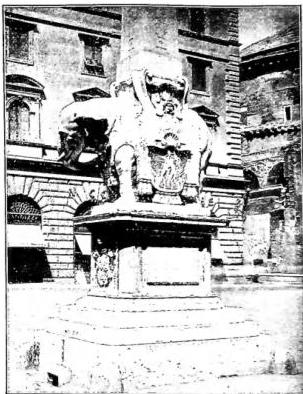
III. ART FROM THE SECOND HALF OF THE 18TH CENTURY TO THE PRESENT DAY
Towards the end of the 18th century, in the eyes of many, R. still appeared to be the most important artistic center in the world, and architects, sculptors, and painters from every country traveled to R. to study. Yet despite this, the neoclassical architecture, sculpture, and painting produced on the banks of the Tiber does not appear today any better or different from that produced elsewhere. Whoever then traveled to R. to study did so to draw inspiration from the monuments of the classical period admired there, from the works of art in museums and public and private collections, or simply to become enthusiastic, imagining that the aura breathed on the banks of the Tiber was still that which had filled the chests of the ancient heroes. Nevertheless, it is still in R. that, with Canova, the art flourishing on the banks of the Tiber succeeds in maintaining a tone of universality and dominance. Then, after Canova, as in the field of painting with the Nazarenes, the purists, and the fresco painters of the time of Pius IX, and in that of architecture with Poletti, Vespignani, and Pietro Comparese, etc., the sculpture produced in R. could also in a certain way differentiate itself, up to the last thirty years of the century, from that of other Italian cities, by a certain coldly academic tone that did not change even when it made such concessions as could not be denied to the novelties brought by the strong romantic gust.When R., having become the capital of the Kingdom of Italy, found itself to be, also for practical reasons, the most active center of artistic production in the entire peninsula, that certain tone and the very imposingness of the splendid works of the past acted as a brake upon the more daring manifestations of a now internationalizing taste. This, while on the one hand avoiding what elsewhere at that time appeared as more or less deplorable excesses, on the other hand delayed the free path of the most genuine forms of expression. And after the group of purists and academicians there came, clearly identifiable in the domain of architecture, that of the eclectics. The Palace of Justice, the work of Calderini, and the monument to Victor Emmanuel, the work of Sacconi—both begun before 1890 and both brought to completion in 1911—are the most characteristic expression of that eclecticism, which was perhaps not devoid of skill but bloated with oratory and rhetoric. At that time it also had its reflections in the fields of sacred art (v. ARTE), which today, precisely in R., in some of its most recent realizations, has demonstrated and demonstrates that it does not shrink from the most modern and daring manifestations of taste wherever they are intimately sustained by a spontaneous, sincere need for expression.
Urban and building developments of modern R. - In R. as well, the final decades of the 18th century are characterized by a more widespread awareness of urban planning problems, and if new realizations are not numerous, the questions raised at that time are instead very interesting, reflected, for example, in the topics discussed by the Academy of St. Luke. The reorganization of the Borghi, that of Piazza del Popolo, the creation of a large public park, etc.
The French administration sought to provide a solution to many of these problems between 1809 and 1814, while certain works barely begun or merely conceived at that time were realized in subsequent years during the pontificates of Pius VII, Leo XII, Gregory XVI, and Pius IX. Among the major ones we recall that of Piazza del Popolo and the public promenade known as the Pincio, Valadier's masterpiece, the creation of the suburban cemetery of Verano, the reconstruction of the Ostian Basilica, the creation of new neighborhoods such as the Mastai, the arrangement of the Trastevere area near the new large tobacco-processing plant, as well as the inclusion in the city's development plan of the tract between S. Maria degli Angeli and the slopes of the Quirinal—that is, the land upon which the present Via Nazionale and other streets perpendicular to it were opened, along which so many new buildings arose that helped to maintain for Roman architecture that solemn, austere, definitive yet familiar tone which was proper to old R.
During the first 24 years of the pontificate of Pius IX from 1846 to 1870, the Roman population had almost doubled, reaching and exceeding 200,000 inhabitants. After 1870 this growth trend continued at an accelerated pace, so much so that today we can say the Roman population has increased tenfold compared to that of the time. In direct relation to this rapid growth—indeed, its justification—is the rapid development of the city and the manner in which that development took place.
In fact, when R. on September 20, 1870, was occupied by the troops of General Cadorna, to anyone arriving from other cities of the peninsula such as Florence, Turin, and Milan, it appeared, even if splendid in its ancient architecture, very backward from the point of view of modern building. And it was that very general who, on the 30th of that same month of September, appointed a commission chaired by the architect Pietro Camporese to study the "enlargement" and beautification of R. and especially the project for constructing new neighborhoods in the part best suited for new buildings. The commission worked with great speed, presenting its conclusions after forty days in a report that also included projects and proposals. This conclusion served the engineer Alessandro Viviani to draw up a true master plan for the city, published in 1873, which, although never becoming law, exercised a great influence on subsequent master plans
and consequently on the further development of R. This development has taken place over the last fifty years, as the saying goes, like an oil stain. Or rather, it has happened as in almost all cities that possess a strong individuality, an ancient beating heart that cannot fail to exercise a strong attraction. Thus it was that the ancient urban center of the R. of 100,000–150,000–200,000 inhabitants remained approximately the same as the R. of 1,500,000 to 2,000,000 inhabitants, with all the damages and inconveniences that one can easily imagine.
To prevent the occurrence of such a phenomenon—due to laws that are in a certain sense biological—is evidently not easy; indeed, it appears to be almost impossible. In any case, if we now look back in our minds to the old R. of Pius IX, still entirely contained within the bend of the Tiber, a city full of contrasts, rich in works of art and fine architecture, but uneven and chaotic from an urbanistic point of view, and compare it with the present one, we must agree that the difficulties that had to be faced to transform the old R. into a city that would also meet modern requirements without completely destroying that admirable ancient ensemble were enormous, and that not all the solutions adopted are to be condemned. Although the destruction of the large parks of the princely villas that crowned the old R. with greenery represented an injury and an error without parallel, even if their areas were used for the rise of new districts such as the Esquilino, the Boncompagni Ludovisi, and the Salario; nevertheless, considerable merits were often possessed by the works that served to graft the manifestations of new needs onto the character and fabric of the old city without too jarring a break in continuity. Thus, for the majestic straight stretch of Via Nazionale, for the placid layout of Corso Vittorio Emanuele, for the airy Via Arenula, for the widenings of Via del Tritone, Via due Macelli, the Corso, and finally for the more modern Via dei Fori Imperiali and Via del Mare, which nevertheless entailed the destruction of remarkable architectural complexes. This also occurred with the demolition of the "spina" of the Borghi and the opening of Via della Conciliazione, which implemented an ancient idea that had perplexed popes, architects, and urban planners for centuries upon centuries.
IV. FOLKLORE.
An accurate documentation of the popular traditions of R., compiled with scientific criteria and a properly folkloristic intent, is still lacking: the collections by Sabatini and Zanazzo, however extensive and appreciable, cannot stand on the same level as the works of a Pitré, Finamore, De Nino, and others. However, there are numerous literary and iconographic sources (suffice it here to recall the names of Goethe, Müller, Stendhal, Thomas, De Brosses, Bresciani, Belli, and Pinelli) which, because of their affirmed and substantial fidelity to truth, even if they are not lacking in a natural artistic magic, allow us to critically reconstruct the popular life of the first half of the nineteenth century: an era that marks, for the popular manifestations of R., the moment of their maximum flourishing and at the same time the beginning of their decline. The picture of Roman folklore is completed by certain ceremonies, historically documented (Gregorovius, Burchhardt, etc.) and literarily (especially in comedies), of medieval and Renaissance R.
Of the ancient Roman carnival, known for the singular pomp of its festivities, only those elements and details that are of greatest folkloristic interest are noted. Remarkable is the personification of the carnival in the bear, which was led with a chain around its neck to the scene of the action and made to dance to the sound of music, as a print by Pinelli set near the Trevi Fountain depicts for us. In addition to the numerous harlequins, clowns, and Punchinellos, the most characteristic masks were the matti (madmen), covered only in a shirt, who harked back to the characters of the scandalous feasts of fools (against which the Church made energetic opposition in the middle ages); and among the most typical caricatures, the King of Acerra, riding a donkey and escorted by a group of Punchinellos; Don Pirrone, who proceeded in a gestatorial chair, holding in his hand a pair of fire tongs with which he hurled satirical madrigals at women, and the unforgettable General Mannaggia La Rocca, who on the afternoon of Shrove Thursday atop a wretched little nag, with a large wooden broadsword and with his imposing retinue of ragamuffins in full dress uniform, advanced intrepidly down the Corso, taken as a target by the crowd with oranges and carrots. Ancient in the tradition of the Roman carnival was the race of the barberi from Piazza del Popolo to Piazza Venezia. The carnival closed with the festival of the mocoletti, which consisted in extinguishing each other's candles, while along the Corso the dying Carnival appeared upon a triumphal float: "Er Carnevale è morto e sseppellito: [Lì moccoli hanno chiusa la funzione]" (Belli, no. 2221).
During Lent, it was traditional in R. the custom, recalled in the following popular verses, of going to St. Peter's and giving a maritozzo to one's sweetheart: "Oggi ch'è 'r primo Vennardi ddè Marzo. [Sè va a Ssan Pietro a ppija èr maritozzo] Che cce lo pagherà 'r nostro regazzo." Solemn were the celebrations of Holy Saturday: sacred representations took place in the Middle Ages at the Colosseum by the Compagnia del Gonfalone (in the 15th-16th centuries the Passion of G. Dati was repeatedly performed on such an occasion); today the ceremonies of Holy Saturday take place with peculiar solemnity in the basilicas of St. John and St. Peter, where the ritual blessing of the baptismal font is made to coincide with a baptism, of an adult in St. John and of a child in St. Peter. When the bells were untied, it was a custom of former times (called divozione de li bbotti) to pile up used terracotta pots and vases along the walls, which were then sent flying into the air with firecrackers. On this day chimney sweeps descended to R. for the cleaning of the walls, with special tools called "scacciaragni": all rites of renewal. A comic-carnival ceremony, called cornomània (v.), which was maintained from the 9th century until the time of Gregory VII, was celebrated in the Lateran and was followed by the blessing of the houses: the date and elements reveal the propitiatory character of the feast.
From the days of Salvator Rosa, it seems, until 1893, on April 21 of each year artists would revive the carnival by gathering near the caves of Cervara, on the Via Prenestina, renewing banquets, jests, processions, and masquerades: a painting by Pinelli depicts this singular Roman artists' carnival. May Day was and still is celebrated with the maypole, which was otherwise widespread throughout Italy as the ultimate survival of the competitions of the "king of May," and until a century ago with the ballo de li guitti, that is, of the destitute: each young man chose a bride, and the various couples presented themselves in Piazza S. Marco, before the statue of Madama Lucrezia, adorned for that occasion with onions, garlic, multicolored ribbons, and carrots; the marriage was celebrated as if before the mayor and the parish priest, and afterward the dance began, which provoked laughter... even from Madama Lucrezia!
On Ascension night, popular tradition holds that Jesus descends to turn the watery humor of the wheat ears into milk, and the Madonna descends to bless the fresh egg of the day placed by the devout outside their windows in a small basket, which then becomes an effective amulet against lightning and illnesses. On June 13, in honor of S. Antonio di Padova, the triumph of strawberries was celebrated with a procession of strawberry vendors starting from Campo dei Fiori: the procession was led by a strawberry vendor carrying a large basket on his field, a symbol of triumph, trimmed all around with silver-paper baskets full of strawberries, and surmounted by a small statue of S. Antonio; they were followed, at a dancing pace and to the sound of tambourines, by the other strawberry vendors, dressed in their Sunday best, singing refrains in honor of the Saint and of the strawberries. On the evening of S. Giovanni, the float parade takes place, and the custom of going to eat snails in the taverns is still alive: the most frequented one in the past was the osteria delle Streghe, whose name derives from the belief that on this night, in the stretch between S. Giovanni and S. Croce in Gerusalemme, witches can be seen if one places one's chin inside the fork formed by branches of a laurel tree (Belli, no. 1905).
One of the most characteristic processions of medieval R. was the nocturnal procession of August 15, in which representatives of every kind of laborer took part: the Acheiropoietos image of Christ was carried on the shoulders of 12 men from the chapel of S. Lorenzo in Laterano to S. M. Maggiore, passing under arches of leaves and flowers. In Piazza Navona, on Ferragosto and every Saturday and Sunday of the month, according to a tradition that lasted with some intervals from 1652 to 1865, the lake was made: the spectacle was animated by the tossing of coins, the passage of carriages amid splashes and shouts of joy, the falling of horses, the music of the fire brigade band, and the voices of the watermelon sellers shouting "run, firemen, it's on fire."
Picturesque are the ottobrate at Testaccio (Pinelli's prints depicting them are among the finest for the history of popular costume), enlivened by competitions, songs, and dances: with great frenzy to the sound of castanets and tambourines, the saltarello was danced, a very famous popular courtship dance. One of the Roman traditions of the Christmas cycle is to attend the so-called cotto in the night between Dec. 23-24, that is, the wholesale fish market that was once held in the fish market of S. Teodoro and today at the General Markets. Also alive is the tradition of the crèche: famous is the one in Aracoeli, whose Baby Jesus is a prized olive-wood sculpture entirely covered with gems. Particularly Roman is the tradition of throwing used earthenware pots and other utensils out the window on New Year's Day as an act of expelling the old and renewing. Traditional and popular is the depiction of the Befana, as it appears in Pinelli's canvases and Belli's sonnets; still today, on the eve of the holiday, the very crowded toy fair takes place in Piazza Navona, which was once held in Piazza S. Eustachio. The feast of S. Antonio Abate (Jan. 17) is dedicated to the blessing of animals: adorned with ribbons and flowers, horses, donkeys, dogs, cats, and hens are brought before the church of S. Eusebio where they receive the parish priest's blessing; at one time the ceremony, described by Goethe and Müller, took place in front of the actual church of S. Antonio near Piazza S. M. Maggiore. This opens the carnival, a typical new year's beginning festival.
No less rich is the musical-poetic heritage of the people of R., naturally including, alongside songs created in loco, those imported and adapted to local taste and dialect, which reveal the work of creation-elaboration proper to the people. Already around 1787 Goethe collected from the living voice of the common people of R. in his Viaggio in Italia some songs that were more in fashion in those years than truly traditional, recalling the song of Marbrucche (= Malborough), and finally observing that the most usual song for the common folk of R. consisted of the stornello. The stornello (called by the common people "aritornello," which is not, however, to be confused with the ritornello, as Blessig believed) is in fact the most widely used form of lyrical-monostrophic song in R. and throughout Lazio. Popular love poetry also takes the form of the strambotto, called a sonnet (with the meter now of the Sicilian octave
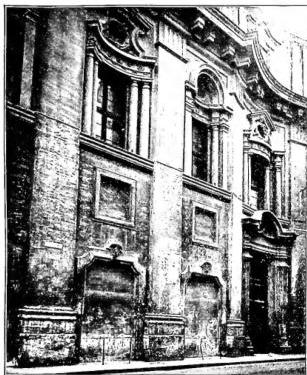
But old R., with its festivals, its customs, its poets and its songs, is increasingly disappearing: only certain rioni, such as Trastevere and Monti, retain a bit of the old color (among the liveliest is always, for example, the «festa de' noantri» in Trastevere, with dances and sporting competitions), and in some corner of R. (such as Villa Borghese) children and adults still crowd around puppet theaters, on whose stages much of the street singers' repertory has taken refuge: famous among the puppets of the past was Ghetanaccio with his character Rugantino.
The Roman people's tendency toward biting satire found its most genuine expression, from the late Middle Ages onward, in the «pasquinate», the most famous of which from the 16th century to the Napoleonic era were collected by P. Fornari.
V. TOPOGRAFIA.
SOMMARIO:
I. Origini cristiane
II. S. Giovanni in Laterano e il Patriarchium. -III. Le basiliche patriarcali
IV. I cognomi delle chiese medievali
V. Basiliche e chiese secondo l'epoca della loro fondazione
VI. Le chiese mariane:747. Santa Maria Maggiore
748. Le Chiese mariane minori
VII. Le basiliche cimiteriali
VIII. Le abbazie
IX. Le regioni ecclesiastiche e i rioni
X. Gli antichi cataloghi delle Chiese.I. CHRISTIAN ORIGINS
The first meeting places of the Christian communities were in private houses, as attested in the Acts of the Apostles (12, 12: 19, 9; 20, 6-9) and in the letters of St. Paul (Rom. 16, 23; I Cor. 16, 19; Col. 4, 15; Phil. 1, 2) who states that in R. his fellow workers in Christ, Aquila and Prisca, placed their house at the disposal of the faithful (Rom. 16, 3, 5). But the medieval legend that points to the house of Prisca where the church of S. Prisca now stands on the Aventine cannot be accepted, because excavations have shown that it is built on top of a mithraeum from the end of the 2nd century A.D. and there is no trace of an earlier house (A. Ferrua, Il mitreo sotto la chiesa di S. Prisca, in Bull. della Commis. archeol. municip. di R., 68 [1940], pp. 59-96).The origin of the Christian community of R. is traced back to those Israelites who, having come from R. to Jerusalem for the feasts of Pentecost, witnessed the descent of the Holy Spirit and listened to Peter's discourse. Peter then converted Roman soldiers as well, namely at Caesarea the centurion Cornelius of the Italian cohort and his retinue. The first nucleus of the Christian community of R. would therefore date from the time of Tiberius, and then developed under his successors Caligula and Claudius. Eusebius of Caesarea places the coming of St. Peter to R. in the second year of Claudius (Jan. 42-43 A.D.) both in the chronological canon of his Chronicon and in his Historia ecclesiastica (II, 17); indeed, he adds that the philosopher Philo met with St. Peter in R., but the latter was in R. in 39-40 A.D. The same report is found in the Historiae adversus paganos of P. Orosius, written in Africa between the years 417-418 at the suggestion of Bishop Augustine of Hippo (PL 31, 1072-73). St. Jerome also has St. Peter come to R. in the second year of Claudius (De viris ill., 1), but such a dating cannot be proven. Around the year 49, however, Claudius was forced to drive out of R. "the Jews who were in continuous unrest on account of Chrestus" (Suetonius, Claudius, 25). The Roman historian Tacitus reports that the people called them chrestianos ("quos vulgus chrestianos appellabat"; Annales, XV, 44). Still at the end of the 2nd century Tertullian reproached the pagans for pronouncing "chrestiani" instead of "christiani" (Apologeticum, 3). That Christian ideas had already penetrated the Roman milieu at that time is documented by Thallus, in a fragment of Julius Africanus preserved by the Byzantine chronicler George Syncellus (Fragmenta historicorum Graecorum, ed. C. Müller, III, Paris 1850, p. 519). But confirmation of the expulsion of Christians from R. under the empire of Claudius is also found in Act. 18, 2, where it is stated that the two Christian spouses Aquila and Priscilla were forced to leave R. "because Claudius had by an edict expelled all the Israelites from R." and thus met the Apostle Paul in Corinth. But the decree could not have been very rigorously enforced, because Cassius Dio shows that its application was limited to the prohibition of holding meetings; the same historian then observes that the Israelites, "although they have been the object of repressive measures, have never ceased to prosper greatly, so much so that they ended up regaining the free exercise of their rites" (XXXVII, 17). Another proof that the exile of the Israelites was of short duration is given by the fact that around 58 Aquila and Prisca were back in R. (Rom. 16, 3-5).
St. Paul, writing to the Romans around 58, states that he had wished to go and visit the Christian community of R. "ex multis iam praecedentibus annis" (ibid. 15, 23); it was already well established and flourishing since Paul declares to the Roman brothers "fides vestra annuntiatur in universo mundo" (ibid. 1, 9). He calls the brothers of R. "beloved of God and saints" and hopes to come and visit them soon to be comforted with them "by our mutual faith, both yours and mine, and to revive memories." In said letter he names no fewer than 24 persons of this community whom he had already met either in Corinth or in Asia, such as Aquila and Priscilla, Epenetus, Mary, Andronicus and Junia, Ampliatus, Urban, Stachys, Apelles, Herodion, Tryphaena, Tryphosa, Persis, Rufus and his mother, Asyncritus, Phlegon, Hermes, Asyncritus, Patrobas, Hermas, Philologus, Julia, Nereus and his sister, and two groups, one belonging to Aristobulus, grandson of Herod, and the other to Narcissus, the famous freedman of Claudius (ibid. 16, 3-16).
It is known that when St. Paul came to R., the brothers of this community went out to meet him on the Appian Way as far as Forum Appii and Tres Tabernae (Act. 28, 15) between Cisterna and Terracina (cf. A. Harnack - Th. Mommsen, in Sitzungsberichte der Berliner Akad. der Wissenschaft., 1895, pp. 491-503). It is not known where he chose his lodging; it is certain that three days after his arrival he summoned the notables of the Jewish colony and had a long conversation with them. He then remained for two whole years in this rented house where he readily welcomed and instructed all who came to him (Act. 28, 16-30). Writing later from R. to the Christians of Philippi in Macedonia, Paul sends them the greetings of the faithful of R., especially of those belonging to the imperial household (4, 22). Finally, from the second letter to Timothy we learn four other names of members of the Christian community of R., namely Eubulus, Pudens, Linus, Claudia (4, 19-21). From all these names one gets an idea of the ethnic composition of the first Christian community, where, while names of non-Roman origin are in the majority, those betraying a provenance rather from the "Ecclesia ex gentibus" than from that "ex circumcisione" are not lacking.
Of great importance is the testimony of Tacitus concerning the Roman protomartyrs who were victims of the Neronian persecution. He speaks of a "multitudo ingens". No other topographical record of their holocaust has remained except that of the Neronian gardens in the Vatican; ne-
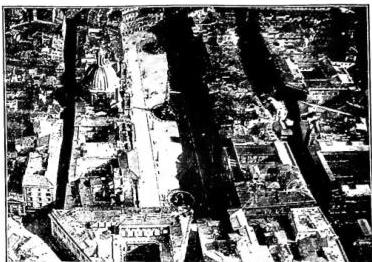
Between 163-67, most likely in 165, Justin himself along with the disciples Chariton, Euelpistos, "servus Caesaris," Hierax, Paeon, and Liberianus were condemned to decapitation by the prefect of R. Junius Rusticus; he asks where the Christians meet and Justin responds evasively (Acta s. Justini et sociorum, II, 5-7; P. Franchi de' Cavalieri, Note agiografiche [*Studi e testi*, 8], Roma 1902, pp. 25-36).
At the beginning of the 3rd century, c. the year 205, a flood ruined the "temple of the Christians" at Edessa (Chronicon Edessenum, ed. I. Guidi, in Corpus scriptorum christian. orient. Chronica minora, 3rd series, IV, Paris 1903). From the historian Lampridius we learn that under Alexander Severus (222-35) a dispute arose in R. over the possession of a plot of land between a group of innkeepers (popinarii) and the Christian community; the Emperor preferred that a Christian religious building should rise on that spot (Hist. Augusta, Alexander Severus, 49).
Hippolytus c. the year 204 in his Commentary on Daniel writes that just as the two elders penetrated Susanna's garden, so the Jews entered the house where the faithful are gathered to hunt down Christians and drag them before the tribunals (F. Dölger, Unserer Taube Haus. Die Lage des christlichen Kultbaues nach Tertullian, in Antike und Christentum, 2 [1930], pp. 41-56). Dura Europos (v.), in Mesopotamia, in the middle of the 3rd century a private house was transformed into a Christian church with its baptistery; at the same time, in Carthage, St. Cyprian indicated that the young man who had confessed his faith in R. was well worthy of ascending the pulpit, that is, where the Holy Scriptures were read—in a place that Tertullian had already called the "house of our dove" (Contra Valentinianum, 3). All the more reason to suppose that in the middle of the 3rd century the Christian community of R., organized during the period of peace experienced from 236 to 250 under Pope Fabian, had its own places of worship; to this Pope indeed the Liberian Catalogue assigns the formation of the seven ecclesiastical regions, each entrusted to one of the seven deacons, so much so that the emperor
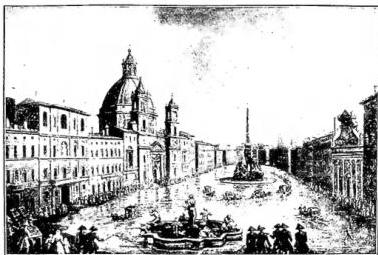
The Emperor Aurelian in 272 decreed that the house of the church, occupied in Antioch by Paul of Samosata, be returned to those who should be designated by the bishops of Italy and of the city of R. The same Emperor, writing to senators who had shown themselves unready to open the Sibylline books, wondered that they had hesitated so long, as if they were gathered almost "in christianorum ecclesia" and not in a temple of the gods (Hist. Augusta; Flavius Vopiscus, Vita Aureliani, 20).
Under Diocletian in the East, besides Lactantius who witnessed the burning of the Christian church of Nicomedia, Eusebius recounts having seen with his own eyes houses of prayer being destroyed and the Holy Scriptures burned in public squares (Martyr. Palestin., 1). But in 311 Galerius granted that Christians could once again build houses for assembly, provided they did nothing against discipline: indeed, they were to pray for the Emperor (Eusebius, op. cit., VIII, 17, 9-10).
To this time the Basilica Apostolorum on the Appian Way seems to date, owing to its banded brickwork, of the same type as that of the nearby circus of Maxentius and the mausoleum of his son Romulus.
St. Augustine, in a conference held in 411 at Carthage, spoke of an ancient document stating that Pope Miltiades (d. Jan. 314) had sent deacons carrying the letters of the emperor Maxentius and the praetorian prefect to the prefect of R., "ut ea recipient quae, tempore persecutionis ablata, memoratus imperator christianis iusserat reddi... Melchiales Stratonem diaconum ad recipienda loca ecclesiastica cum aliis misit" (Breviculus collationis cum Donatistis, XVIII, 34-35; PL 43, 645-46). In the regulations enacted by Constantine regarding the restitution of property to Christians, it is specifically declared that all places where they "antea convenire consuerunt" must be restored immediately; and all must be handed back "corpori christianorum." And it is added that Christians not only possessed these meeting places, but others as well belonging "ad ius corporis eorum id est ecclesiarum non hominum singulorum": these too must be restored without any ambiguity or delay "eisdem christianis id est corpori et conventiculis eorum" (Lactantius, De mortibus persecutorum, 48: CSEL, 27, pp. 231-32; Eusebio, Hist. eccl., X: PG 20, 884).
At the same time, one must lament the destruction of the archives of the Church of R., whose storage location is unknown; Pope Damasus constructed a new building for them in region IX (Circus Flaminius), near the Theater of Pompey and the "stabulia factionis prasinae."
In Constantinian times Optatus of Milevis indicates in R. "quadraginta et quod excurrit basilicas" (De schismate Donatistarum, II, 4: PL 11, 954). The list of Polemius Silvius from the year 449 limits itself to indicating "religiosa aedificia cum innumereis cellolis martyrum consecratis" (MGH, Auctores antiquiss., IX; Chronica minora, I, p. 545). Around 550, Zacharias in his ecclesiastical history of R. in Syriac indicates in R. "ecclesiae Apostolorum beatorum, ecclesiae catholicae XXIV," which may be the tituli (the Latin version is by I. Guidi, in Bull. della Commiss. archeol. com. di R., 12 [1884], p. 228).
The frequency of the tituli in certain regions shows that the centers of the Christian community were more numerous in those zones. At the summit of the Quirinal near the Alta semita and a short distance from one another were situated the titulus Gai, also called "ad duas domos iuxta Diocletianas" (Martyr. Hieronymianum, p. 434) and the titulus of Cyriacus, also indicated as "iuxta Diocletianas" (ibid., p. 189). The area must have been heavily populated; near the Servian agger there was a fruit shop and a Jewish "prosecus" (C. Frey, Corpus inscript. Iudaicarum, I, Vatican City 1936, p. 391). In the valley between the Esquiline and the Viminal was situated the titulus of Pudentiana (v.), not far away on the Esquiline, near the Macellum Liviae, the titulus of Praxedes, and on the Oppian the titulus of Equitius. These three tituli were also on the edge of one of the most populated and dense neighborhoods of the city: the Subura, where numerous Jews were settled, forming the synagogue of the "Suburenses" (C. Frey, op. cit., I, pp. LXXXIII-LXXXIV). In the northern zone of the Caelian stood the titulus of Clement, near the Mint, that of Nicomedes (perhaps SS. Peter and Marcellinus), and that of Matthew; in the lower part, instead, the titulus of Aemiliana (SS. Quattro Coronati) and on the ridge of the Caelian the titulus of Byzantius. In Trastevere the most ancient titulus is that of Callistus, the Pope who was martyrized in 223; then those of Cecilia, for whom there is no certain date of martyrdom, and of Chrysogonus.
Regarding the development of Christian communities within the city and its liturgical centers, a precious indication is provided by the number of cemeteries along the various consular roads, corresponding to an equal number of urban Christian centers; one finds on the Flaminia, in the time of Pope Julius (336-52), the cemetery basilica of St. Valentine; the annexed cemetery has yielded an inscription from 318 and later another will show that it served the faithful of the titulus of Lucina; on the Salaria vetus, the cemetery of Bassilla with the tombs of the female martyr of the same name, of St. Hermes, and of SS. Protus and Hyacinthus; later documents on the same road mention a group called "ad S. Ioannem, ad septem palumbas" or "ad clivum cucumeris" (unidentified), Pamphilus (v.), which excavations have allowed to be traced back to the 2nd half of the 3rd century. On the Salaria nova are the four cemeteries of Maximus with the martyr Silanus, of Thraso with the martyr Saturninus, of the Jordani, and of Priscilla. On the Tiburtina there are three cemeteries from the 3rd century: that of Hippolytus, which would later be linked with the tituli of Praxedes and Pudentiana; the one called of Novatian with inscriptions from 266 and 270; and the large cemetery of St. Lawrence where epigraphs from the tituli of Clement and Nicomedes were found; the Christian population in the area from the Esquiline to the Subura must therefore have been numerous.
In the cemetery "inter duas lauros" on the Labicana, of
end of the 3rd century, faithful belonging to the tituli of Eusebius and Matthew were buried, that is, from the area between the present-day Piazza Vittorio Emanuele and Via Giusti and Via Alfieri; then on the Via Prenestina we find the cemetery of Castulo; on the Via Latina the groups of Gordianus, Epimenius, Tertullinus, Apronianus; on the Appian Way the Praetextatus group for the faithful of the Caelian Hill around the Lateran, with inscriptions of a "Quintus Lactearius qui fuit de domu Lateranis nobili", of the Annia, Insteia, Postumia families, etc.; the one "in catacumbas" for the faithful in imperial service on the Palatine, who later had the "titulus Bizantis" on the Caelian; that of Callixtus under the direct control of the community's administrative deacon since the beginning of the 3rd century; numerous ones on the Via Ardeatina: the cemetery known as that of Domitilla for the faithful of the Public Pool region (Via Nova and Antonine Baths) and where the "titulus" known as de fasciola arose; the cemetery of Balbina with the mausoleum of Pope Mark; the one where Damasus made the tomb for his mother, his sister, and for himself; the one at the tomb of the martyrs Marcus and Marcellinus; the faithful of the Aventine (titulus of Prisca and Sabina) had their
cemeteries on the Via Ostiensis (Commodilla, S. Paolo, Tecla). Trastevere had cemeteries on the Via Portuensis (Ponziano "ad ursum pileatum"), three nuclei on the Via Aurelia (Pancras, Processus and Martinian, Callixtus, later called Calepodius) and on the Via Cornelia at the Vatican.
II. SAINT JOHN LATERAN AND THE PATRIARCHIUM
The Basilica of the Savior of the Lateran is Constantinian; the indication in the biography of Sylvester (Lib. Pont., I, p. 124) has been confirmed by the Constantinian foundations discovered beneath the central nave of the current Basilica during the renovation of the floor (cf. E. Josi, Scoperte nella Basilica Costantiniana al Laterano, in Riv. arch. crist., 11 [1934], pp. 335-58; A. M. Colini - I. Gismondi, Storia e topografia del Celio nell'antichità in Atti della Pont. Accad. rom. di archeol., 3ª serie, 7 [1944], pp. 364-380). Said nave had thirty Numidian columns which had all already been replaced at the time of Martin V in 1425 with masonry piers, and only four remained when Borromini made the accurate survey of the Basilica, which is kept today in the Albertina Library in Vienna, before embarking on the radical transformation under Innocent X. The minor naves were divided by 42 columns of green marble, some of which were used in the 17th century for the large niches with the Apostles, while others were taken by F. Borromini to S. Agnese al circo agonale, which was rebuilt by him under Innocent X.Gregory the Great in 591 called the Constantinian Basilica of the Lateran "golden" (Registr., II, 1, ed. P. Ewald -
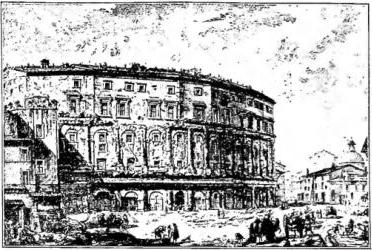
The primitive Baptistery was adapted within a thermal room and its remains have been identified beneath the current one, the work of Sixtus III; it is octagonal in type with a pronaos and eight porphyry columns supporting the entablature upon which was engraved that poem of such profound doctrine and elevation of form that F. X. Dölger believed it to have been dictated by the deacon Leo, later the successor of Sixtus III (Die Inschrift im Baptisterium S. Giovanni in Fonte an der Lateranischen Basilika aus der Zeit Xystus III. (432-40) und die Symbolik des Taufbrunnens bei Leo dem Grossem, in Antike und Christentum, 3 [1930], pp. 252-57). The structures of the baptistery of Sixtus III, as well as the earlier structures and subsequent events, were studied by G. B. Giovenale, Il Battistero lateranense nelle recenti indagini della Pontificia Commissione di archeologia sacra, Rome 1929. Pope Hilary had two oratories built on the eastern and western sides of the Baptistery, decorated with precious marbles and mosaics, with silver altars and bronze doors; the one was dedicated to St. John the Evangelist, near whose tomb he had been saved at Ephesus (the inscription on the architrave reads: Liberatori suo beato Ioanni Evangelistae, Hilarus episcopus Famulus XPI); the other oratory was dedicated to St. John the Baptist (the bronze door still reads: in honorem beati Ioannis Baptistae Hilarus episcopus Dei famulus offert). The same Pope erected a third oratory, splendidly adorned with precious marbles, columns, and mosaics, northwest of the Baptistery in honor of the Holy Cross (Lib. Pont., I, p. 243); it was demolished by Sixtus V, but drawings of it by F. G. Martini, Lafrery, Sansovino, Peruzzi, Sangallo, Ciacconio exist, along with descriptions by O. Panvinio and P. Ugonio. Pope John IV (640-42) built the portico and the oratory in honor of St. Venantius near the oratory of St. John the Evangelist (Lib. Pont., I, p. 334), where he deposited the relics obtained by Abbot Martin in Dalmatia. The mosaics of the apse and front wall still remain. In the conch of the apse, in the upper part, is the Savior between two angels; in the lower zone, in the center, is the B[lessed]. Virgin between the apostles Peter and Paul, followed by SS. John the Baptist and Evangelist; St. Venantius, St. Domnius, and John IV. On the two front walls flanking the apse are Paulinianus, Telius, Antiochianus, Gaianus, Anastasius, Asterius, Septimius, Maurus. Stephen III had also served in the patriarchate since his youth (Lib. Pont., I, p. 471). Hadrian I welcomed Charlemagne to the Lateran (Lib. Pont., I, p. 498) where every day beneath the portico
food was provided for a hundred poor people (ibid., p. 520). Leo III had been a student of the patriarchate; he embellished and restored the Basilica (ibid., pp. 1, 2, 8, 25, 27); he erected two triclinia in the patriarchate and decorated them with mosaics (ibid., II, pp. 3, 10, 14, 25); in one of them he received Charlemagne on Nov. 30 of the year 800. In the apse semi-dome the Savior was depicted among the Apostles; at the extremities, on one side the Lord handing the keys to s. Silvestro and the labarum to Constantine, on the other s. Peter offering the pallium to Leo III. The Pope also offered the cypress chest located in the chapel of S. Lorenzo, which served to hold the most precious reliquaries, with the inscription Leo indignus Dei famulus tertius episcopus fecit. Students of the patriarchate were also the popes Stephen IV and Paschal I (Lib. Pont., II, pp. 49, 52); the latter restored the monastery of SS. Sergio e Basco and offered the famous gilded silver reliquary with the scene of the Resurrection; Gregory IV erected an habitaculum near the oratory of S. Lorenzo and restored the eastern part of the Palace (Lib. Pont., II, p. 76). Leo IV continued the restoration work in the patriarchate which is called "Romanum palatium" (Lib. Pont., II, pp. 134, 139). Nicholas I added the Basilica Nicolaitana (ibid., II, p. 172), finished by Hadrian II (ibid., II, p. 176) who received Lothair II at the Lateran; under Stephen VI (896-99) the city suffered from a terrible earthquake that enormously damaged the Basilica, which was restored by Sergius III (904-11) and under the apsidal mosaic a tetrastich was placed that compared this aula Dei to Sinai. The work of Sergius III was continued by John X who was killed there in 928 and buried near the entrance to the portico of the Basilica. John XII erected the oratory of S. Tommaso, in which he was depicted. John XV canonized, in the Palace, Ulrico (v.), bishop of Augsburg, on Jan. 31, 993. Benedict VIII welcomed Henry II at the Lateran. At the time of Stephen IX, s. Peter Damian, bishop of Ostia, pointed to the Lateran Basilica as the mother and head of all the churches in the universe, where the faithful flocked from all parts (Epist., 2, 1: PL 144, 253 sq.). The Lateran was truly the center of ecclesiastical life in the Middle Ages with its patriarchate, where for nearly a millennium the activity of the Holy See took place in the large basilical halls, in the administrative offices for the Curia, in the archives, in the porticoes, in the hospices, in the oratories, and especially in the private chapel of the Pontiff containing the most illustrious relics (hence the denomination Sancta Sanctorum). Alexander II had significant restorations carried out in the Basilica. In 1079 Countess Matilda arrived there; Emperor Henry IV occupied the patriarchate with the antipope Clement III, but Gregory VII re-entered it with the help of Robert Guiscard (1084). Urban II received Anselm of Canterbury there in 1098. Callistus II erected the chapel of S. Nicola there, a monument of the Concordat of Worms; works were carried out by Innocent II who also enriched the Treasure of the Basilica (Lib. Pont., II, p. 384); Lucius II donated the church of S. Giovanni ante portam Latinam and the hospital near the Lateran to the Chapter; Anastasius IV transformed the ancient atrium of the Baptistery into the chapel of SS. Rufina e Seconda. Hadrian IV restored the Palace. Alexander III had a description of the Lateran made by John the Deacon. Martin of Troppau recalls the work done on the Palace by Clement III; to him are due the mosaics that decorated the external portico and the fresco with the episode of Ananias and Sapphira which is still preserved. Dating from Celestine III are the bronze doors still in existence, executed in 1196 by Umberto and Pietro of Piacenza. Innocent III Acheropita (v.) with silver lamellae; he received s. Francis and s. Dominic at the Lateran. Restorations carried out by the popes Innocent II (1130-43), Celestine III (1191-98), Gregory IX (1227-41), Nicholas III (1277-80), Boniface VIII (1298-1303) are also mentioned; the latter promulgated the first jubilee of 1300 from the loggia of the Patriarchate, of which memory remains in Giotto's fresco in the side aisle of the current Basilica. The Basilica suffered greatly from the departure of the popes for Avignon and from the fires of 1308 and 1361; nevertheless, Clement V (1305-14) and Benedict XII (1334-42) had restorations carried out there. Urban V renewed it and transported into the tabernacle
of S. Pancrazio (Lib. Pont., I, p. 506). Under Leo III (795-816) there is mention of a female monastery near the Claudian aqueduct dedicated to the martyrs Sergius and Bacchus (ibid., II, p. 24). Paschal I (817-24) replaced them with monks who had the obligation of psalmody «nocte dieque» in the basilica of the Savior (ibid., II, p. 58; P. Fr. Kehr, op. cit., I, p. 34). Alexander II called the Regular Canons of S. Frediano of Lucca there. The Basilica also had its own schola cantorum endowed by St. Gregory the Great. The pueri «bene psallentes» were chosen from the various scholae and nourished in the Schola cantorum, whence they later became cubicularii (R. Casimiri, Cantantibus organis, Rome 1924, p. 460 ff.). Cardinal Bernard (d. 1176), formerly prior of the Basilica and then cardinal of Porto, composed an ordo officiorum Ecclesiae Lateranensis (L. Fischer, Bernardi cardinalis et Lateranensis ecclesiae prioris Ordo ecclesiae Lateranensis, Munich 1916) in which the task of the schola is illustrated together with that of the Lateran Regular Canons entrusted with the liturgy. In the Lateran Archive is preserved the text of an agreement stipulated in 1232 between the Lateran Regular Canons and the schola cantorum for the liturgical musical service. John the Deacon attributes the institution of the schola cantorum to Gregory the Great (sancti Gregorii Magni vita, II, 6: PL 75). The Liber diurnus calls it an «orphanatrophium» (form 97); in a letter of Paul I from 761-67 it is called scola cantorum (MGH, Epistolae, III, p. 553); in a document from 919 we read scola cantorum qui appellatur orphanatrophium (L. Allodi-G. Levi, Regestum Sublacense, Rome 1885, p. 159, no. 112). Its oratory was S. Stephanus orphanatrophii, recorded in the Catalogue of Paris, whereas in that of Turin this church appears already destroyed (R. Valentini-G. Zucchetti, Codice topografico d. Città di Roma, III, Rome 1946, p. 310). The property of the schola cantorum, which was no longer functioning, was granted by Urban V, with a bull dated June 13, 1370, to the Chapter of the cathedral of Montefiascone following the fires of the Basilica in 1307 and 1361 (R. Casimiri, L'antica schola cantorum romana e la sua fine nel 1370, in Nel XVI centenario della dedicazione della Arcibasilica Lateranense del S.mo Salvatore, Rome 1924, pp. 56-59). Boniface VIII with a bull of Sept. 3, 1299 removed the Regular Canons and instituted fifteen secular canons. Eugene IV with a bull of Feb. 6, 1439 called the Regular Canons of S. Maria di Frigionia near Lucca there. Sixtus IV with a bull of Apr. 16, 1472 reinstated the secular Canons there. The residence of the bishop of Rome was established near the Basilica very early on. As early as 314 we have news that Pope Miltiades gathered the first Council against the Donatists in the domus Faustae in the Lateran. The oratory dedicated to St. Lawrence later bore the name of Sancta Sanctorum; it was the pontiff's private chapel, where only the Pope could celebrate on the altar which enclosed within the cypress chest of Leo III the most distinguished relics of the Roman martyrs: the heads of the apostles Peter and Paul, of St. Lawrence, St. Agnes, St. Pancras, St. Praxedes; furthermore relics of the Holy Cross, of the most celebrated shrines of Palestine, and the acheiropoieta image (v.). The Lateran Patriarchium was devastated by Maurice and Isaac (640). Pope Zachary restored the Patriarchium (Lib. Pont., I, pp. 432-38, no. 38); he frequently provided food for the poor (Lib. Pont., I, p. 435). Stephen II had been elevated in the venerable Lateran cubiculum, where he was subsequently elected (Lib. Pont., I, p. 443). Under the threat of the Lombard invasion, Stephen II carried the acheiropoieta image in procession on his own shoulders from the Lateran to S. Maria Maggiore. Zachary (741-52) built the triclinium near the basilica of Pope Theodore in the Lateran Patriarchium, which he restored, where he also decorated the oratory of S. Silvestro and the portico; there he constructed near the Treasury a tower with an upper triclinium embellished with representations of Rome and the world. In the Patriarchium, the biographer of Pope Sergius I (687-701) records the oratory of S. Silvestro and the basilica of Pope Theodore, both within the area of the present Lateran Palace (Lib. Pont., I, pp. 333, 374-76).
The possessions of the popes at the Lateran after Avignon. After Avignon, the popes preferred to dwell in the Vatican, generally limiting themselves to going to the Lateran for the solemn
ROMA - The Scalinata della Trinità de' Monti (Spanish Steps). Designed by A. Specchi and F. de Sanctis (1721-25). At the bottom, the fountain by Pietro Bernini (ca. 1620). At the top, the church of the same name (1585).
ceremony of possession, immediately after the coronation and sometimes for the feast of the Ascension. There is record of Martin V's possession and the opening of the Jubilee of 1425. Eugene IV (1431-47) carried out some restorations there and made a brief stay. Aeneas Silvius Piccolomini described the possession of Nicholas V (1447-55), who opened the Jubilee there on Dec. 24, 1449; Callistus III came for the possession on Apr. 20, 1455; Pius II on Sept. 3, 1458; Paul II on Sept. 16, 1464; Sixtus IV on Aug. 25, 1471; Julius II resided there during the Fifth Lateran Council in 1512; a few days after taking possession, Leo X stayed there in 1513. The Sack of Rome also damaged the Patriarchium. Pope Sixtus V (1585), immediately after taking possession, began the demolition work on the decaying Patriarchium from the side where the Councils were held (notice of R., June 5, 1585 in Cod. Vat. Urb. 1053, p. 243). The architect of the new building was Domenico Fontana; it was already completed in 1589, but it occupied only part of the area of the new Patriarchium, while the oratory of S. Lorenzo, known as the Sancta Sanctorum, remained detached from II. However, Sixtus V himself stayed very little at the Lateran, and his successors preferred the Vatican and the Quirinal. Innocent IX (1591), after taking possession, renewed the ancient rite of the presbytery in the Sixtine Hall, followed by Clement VIII in 1592 and Paul V in 1605, who arranged for the palace to be inhabited by the cardinal archpriest and the canons. Urban VIII transformed part of the Palace into large military quarters, part into a granary, and part into a lazaretto and men's hospital. Innocent X (1644) welcomed the crippled and infirm there; Innocent XII carried out new restorations there, transforming it into a hospice together with the apostolic hospice (bull Ad exercitium pietatis of 1692). Benedict XIII (1724-30) had planned to use it as the site for conclaves, but later established a workshop for young maidens there, which remained even under Pius VI in 1776. Pius VII carried out works there to house the public archives, but it was later converted into a barracks. After the solemn possession of Pius IX in 1846, the ceremony was resumed by Pope Pius XII on the day of the Ascension in 1939.
III. THE PATRIARCHAL BASILICAS
In the 12th century, the basilicas of the Lateran, St. Peter, St. Paul, St. Mary Major, and St. Lawrence each constituted a patriarchatus, and the adjoining residential buildings were called patriarchia; indeed, O. Panvinio writes: «palatiaque conspicua illes adiuncta patriarchia appellarunt». Moreover, to commemorate these five basilicas, the following distich had been formed: «Paulus, Virgo, Petrus, Laurentius atque Iohanes» la Patriarchatus nomen in Urbe tenent». At the high altar of the patriarchal basilicas, only the pope or someone receiving a special mandatum from him may celebrate. Furthermore, the palaces annexed to the individual patriarchal churches—besides that of the Lateran, used as the residence of the Pontiff and for the offices of the administration and the Curia—served respectively for the patriarchs of Constantinople, Alexandria, Antioch, and Jerusalem, in the event of their presence in R.The four patriarchal basilicas (v. BASILICA), where the Holy Doors were established to gain indulgences during the Jubilee, are: St. John in Lateran, St. Peter (v. VATICANO), St. Paul (v.) and St. Mary Major. The seven churches are: St. Peter, St. Paul, St. Sebastian, St. John, Holy Cross, St. Lawrence (v.) and St. Mary Major, in the topographical order in which the most traditional visit to them is made (G. Severano, Memorie sacre delle sette chiese di R., Roma 1630).
IV. THE EPITHETS OF MEDIEVAL CHURCHES
In the Middle Ages, many churches acquired epithets derived from their topographical location: de flumine, such as S. Lorenzo, S. Lucia, S. Maria (from their proximity to the Tiber); or de insula such as S. Bartolomeo or S. Benedetto; trans Tiberim, such as S. Abbaciro, S. Agata, S. Cecilia, SS. Cosma e Damiano; de Aventino, such as S. Maria; in Caelio, such as S. Stefano; in Capitolio, such as S. Maria; de Ianiculo, such as S. Angelo; de Palatio, such as S. Cesareo; ad duas domos, such as S. Susanna.Other churches took their names from monuments or ancient streets, such as S. Angelo, S. Giacomo, S. Giorgio de Augusta (the Augusteum); in clivo Scauri, such as S. Gregorio, the S.ma Trinità; de Coliseo, such as S. Giacomo, S. Marina, S. Nicola, the SS. Quaranta; de columna (column of Antoninus), such as S. Andrea and S. Lucia, S. Nicola (from the column of Trajan); in foro (of Augustus), such as S. Maria; in gallina alba, such as S. Sisto; in or de horrea, such as S. Giacomo, S. Pietro; in Laterano, such as S. Giovanni, S. Pancrazio; in macello (of Livia), such as S. Vito; in Martio, such as S. Gregorio al Laterano; in or de Merulana, such as S. Bartolomeo, S. Matteo, S. Severino; in mica aurea, such as the SS. Cosma e Damiano, S. Giovanni; in Minerva, such as S. Maria; in Orphea, such as S. Lucia; or iuxta Orfea, such as the SS. Silvestro e Martino ai Monti; de or in Pallacina, such as S. Andrea, S. Lorenzo; de Palladio (corrupted into Pallara), such as S. Maria; in Panisperna, such as S. Lorenzo; in Pinci, such as S. Felice; de Porta Appia, such as S. Apollinare and S. Cesareo; *de Porta Pla-
(fol. Alinari)
Yet other churches received their appellation from the relics they contained, thus S. Giovanni and S. Silvestro de capite; S. Lorenzo ad craticulam; S. Agapito, S. Maria, S. Pietro ad vincula.
Many churches belonged to scholae or nations: S. Maria schola Saxonum then S. Maria in Saxia; S. Salvatore scholae Francorum, S. Michele schola Frisonum, S. Giustino schola Langobardorum (for the scholae, V. VATICANO); S. Stefano de Ungariis, S. Cesario, S. Gregorio de Graecis; S. Salvatore, S. ma Trinità Scottorum; S. Gregorio, S. Giacomo de Armenis; S. Andrea, S. Tommaso de Hispanis. Hospices also gave rise to the names of some churches, such as S. Lucia in xenodochio Aniciorum; S. Maria in xenodochio Firmis; S. Abbarico in xenodochio Valeriorum; S. Stefano de orphanotrophio or de schola cantoris; S. Nicola de hospitali.
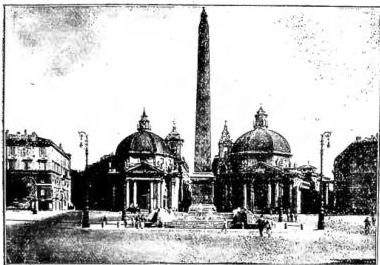
ROMA - Piazza del Popolo designed by G. Valadier (1816-20). In the background: the churches of S. Maria dei Miracoli (1678) and S. Maria in Montesanto (1675), in the center the obelisk of Ramses II (12th century B.C.) erected in 1585 - Rome.
Not a few other churches took surnames from guilds, such as S. Andrea de aquarizariis; S. Benedetto de caccabariis; S. Nicola de calcarariis; S. Maria de cambiatoribus; S. Biagio de circlaris; S. Maria de ferrariis; S. Nicola de forbitoris; S. Andrea de Junariis; S. Andrea de marmorariis; S. Lorenzo de mondezariis; S. Andrea de mortarariis; S. Stefano de vaccinariis. Some churches derived their names from ecclesiastical places, such as S. Nicola de capella papae; S. Benedetto de clausura; S. Agata in diaconia; S. Maria in episcopio; S. Agata, S. Maria in monasterio.
For the diaconates V. the relevant entry.
V. BASILICHE E CHIESE SECONDO L'EPOCA DELLA LORO FONDAZIONE
Nella biografia di S. Silvestro tra le fondazioni costantiniane, oltre la basilica Costantiniana del Laterano, viene indicata quella « in Palatio Sessoniano », trasformazione di un'aula antica a metà del sec. IV in basilica cristiana che dalla lista delle donazioni è collegata con la dinastia Costantiniana (R. Krautheimer, Corpus Basilicarum christianorum Romae, Città del Vaticano 1937, pp. 165-94). Il titolo di Equizio è indicato nelle sottoscrizioni del Sinodo del 499; si ha invece titulus S. Silvestri in un frammento detto Laurenziano di un catalogo di papi dell'inizio del sec. VI (Lib. Pont., I, p. 46; R. Vielliard, Les origines du titre de St-Martin aux Monts, Roma 1931). Eusebio è il nome del « conditor tituli », nel Martirologio geronimiano, e un'iscrizione in suo onore si lesse ancora da P. Ugonio (Stationi, ecc., Roma 1588, f. 259). La chiesa fu restaurata dai papi Zaccaria (Lib. Pont., I, p. 435), Adriano I (ibid., p. 508); ebbe doni da Leone III (ibid., II, pp. 11 e 21), da Gregorio IV (ibid., p. 76) è da Niccolò I (ibid., p. 154). Fu riconsacrata da Gregorio IX (v. Forcella, Iscrizioni delle chiese di R., X, Roma 1877, p. 407); poi da Niccolò IV (E. Müntz, Les arts à la cour des Papes, I, Parigi 1878, p. 143). L'attuale fu ricostruita tra il 1711-50. MARCO (336) fondò la basilica « iuxta Pallacinas » (Lib. Pont., I, p. 202) che porta ancora il suo titolo. GIULIO I (337-52), a testimonianza del Catalogo, detto Liberiano, eresse in R. « basilica » Iuliam quae est regione VII iuxta forum divi Traiani » (MGH, Auct. antiquis., IX, Chronica minora, Berlino 1892, p. 78; cf. R. Krautheimer, op. cit., p. 79). DAMASO (366-84) fondò la basilica presso il teatro di Pompeo e gli « stabula factionis prasinae » (Lib. pont., I, pp. 212; G. B. De Rossi, Inscript. christ., II, 1, Roma 1888, p. 134). Al tempo di SIRICIO (385-98) viene eretta la basilica Pudentiana; vengono compiuti lavori in quella di S. Clemente (A. Petrignani, La basilica di S. Pudentiana in R., Roma 1934). Il titulus Vestinae venne fondato da INNOCENZO I (401-17) R. Vielliard, Saint Vital, in Riv. di arch. crist., 12 [1935], pp. 103-18).S. Sabina, fondata dal presbitero Pietro d'Illiria al tempo di CELESTINO I (422-32), come attestano l'iscrizione musiva nell'interno della parete d'ingresso e il Lib. Pont. (I, p. 235), che l'indica compiuta sotto Sisto III (432-40), è titolo nel Sinodo del 499; l'epitafia di un « presbyter Basilius tituli Sabinae » è in S. Paolo fuori le mura (A. Silvagni, Inscriptiones Christ., nuova serie, II, Roma 1935, n. 5154). Restaurata e abbellita da Leone III (795-816) Lib. Pont. II, p. 20), e da Eugenio II (824-27) ibid., p. 69). Onorio III la concesse all'Ordine dei Frati Predicatori. Fu modificata e danneggiata nel 1559 e 1585. Fu restaurata in pristino per iniziativa del p. M. Gillet quando nel 1936 decise di riportarvi la Caria generalizia del suo Ordine, affidando la direzione dei lavori al p. M. D. Darsy che ne ha dato una prima limpida relazione (DACL. XV, t. coll. 218-38). Il papa SIMPLICIO (468-83) eresse una basilica alla martire Bibiana, presso il « palatium Licinianum » (Lib. Pont., I, p. 240; V. E. Donckel, Studien über den Kultus der hl. Bibiana, in Röm. Quartalschr., 43 [1935]; id., Der Kultus der hl. Bibiana in Rom., in Riv. di arch. christ., 15 [1937]), ed anche S. Andrea in Cutobarbara sull'Esqui-
lino; un goto di nome Valila adattò a chiesa cristiana la basilica eretta dal console Giunio Basso nel sec. IV. Il musaico absidale rappresentava Gesù Cristo tra gli Apostoli (G. B. De Rossi, Inscr. chr., II, 1, Roma 1888, p. 436; Lib. Pont., I, p. 249; G. Lugli e T. Ashby, La basilica di Giunio Basso, in Riv. di arch. crist., 8 [1932], pp. 221-55; R. Krautheimer, Corpus, cit., pp. 64-65). Anche S. Stefano « in Caelio Monte » fu fondata dal papa Simplicio (Lib. Pont., I, p. 249), decorata da Giovanni I (523-26) e da Felice IV (526-30) G. B. De Rossi, Inscr. christ., II, 1, p. 152, nn. 29, 32). Papa Teodoro (642-49) vi trasferì i corpi dei martiri Primo e Feliciano (Lib. Pont., I, p. 332). Rinnovata da Adriano I (772-95) ibid., p. 510), ebbe doni da Leone III (795-816) ibid., II, pp. 20-31), Gregorio IV (ibid., II, p. 76) e Leone IV (ibid., II, p. 119). Divenne titolo presbiteriale dopo il 1000. Innocenzo II la restaurò (ibid., II, p. 384). Gregorio XIII nel 1573 la concesse al Collegio ungarico (R. Krautheimer, S. Stefano rotondo a R. e la chiesa del S. Sepolcro a Gerusalemme, in Riv. di arch. crist., 12 [1935], pp. 51-102; P. F. Kehr, Italia Pontificia, I, Berlino 1906, p. 42; E. Mâle, La mosaïque de S. Stefano Rotondo à Rome, in Scritti in onore di Bartolomeo Nogara, Città del Vaticano 1937, pp. 237-52). SIMMACO (498-514) eresse l'oratorio dei SS. Cosma e Damiano presso S. Maria, costruì dai fondamenti la basilica dei SS. Silvestro e Martino ai Monti, fece una scalea dietro l'abside dei SS. Giovanni e Paolo (Lib. Pont., I, p. 262). Sotto Simmaco si ha il Sinodo del 499 in cui sottoscrivono i presbiteri dei vari titoli. L'elenco del 499 fa conoscere i seguenti tituli: di Bizante, di Pammachio, di Emiliana, di Clemente, degli Apostoli, di Equizio, di Prassede (iscriz. del 491 in Bull. arch. crist., 4ª serie, 1 [1882], p. 65), di Eusebio, di Pudente, di Vestina, di Gaio, di Ciriaco, di Marcello, di Lucina, di Damaso o di S. Lorenzo, di Marco, di Anastasia, Fasciola, Crescenziana, Tigrida, Matteo, Romano, Sabina, Prisca, Giulio, Cecilia, Crisogono. Il titulus Aemilianiae del 499 è stato identificato con quello dei SS. Quattro Coronati del Sinodo del 595 (A. Muñoz, Il restauro della chiesa e del chiostro dei SS. Quattro Coronati, Roma 1914). Il titulus Anastasiae figura nel 499. Nel primo stadio S. Anastasia ebbe nave unica con transetto e abside semicircolare decorata da Damaso (G. B. De Rossi, Inscr. Chr., II, 1, pp. 24 e 150); in un secondo tempo furono aggiunte le due navatelle; nel terzo appartiene il restauro di Leone III (795-816). La nuova facciata è del 1634-40, l'ultimo grande restauro del 1721-1722 (R. Krautheimer, S. Anastasia, in Corpus, cit., pp. 43-63). Il titulus Byzantis si è ritenuto lo stesso che quello di Pammachio, il che non è provato, e si è identificato con
quello dei SS. Giovanni e Paolo del 595 (J. P. Kirsch, Die römischen Titelkirchen, Paderborn 1918, pp. 26-33). Il titulus Callisti è stato identificato con il «titulus Iuli et Callisti» del 595, cioè con S. Maria in Trastevere (J. P. Kirsch, op. cit., p. 104 sgg.). Il titolo di Cecilia nel Trastevere diviene titulus S. Caeciliae nel Sinodo del 595 (bibl. in R. Krautheimer, Corpus, cit., pp. 95-112). S. Ciriaco in Thermis fu eretto su terreno pubblico e certo non prima del sec. iv; esso stava verso il padiglione sud ovest del Ministero delle finanze (R. Krautheimer, Corpus cit., pp. 115-17). Il titulus Clementi era antico al tempo di s. Girolamo il quale scrive che «nominis eius (Clementis) memoriam usque hodie Romae extructa ecclesia custodit» (De viris ill., 15); sul «dominicum Clementis» V. G. B. De Rossi, in Bull. arch. crist., 1863, p. 25, e 1874, p. 159; per il resto R. Krautheimer, Corpus, cit., pp. 118-36.
Il Titulus Fasciolae ha la sua più antica iscrizione in una epigrafe dell'a. 377 (G. B. De Rossi, Inscript. christ., I, Roma 1857-61, n. 262; Cinnamus, Opus lector de Fasciolae; J. B. Kirsch, op. cit., pp. 90-94). Il titulus Gai diviene di S. Susanna nel Sinodo del 595; è detto «ad duas domos iuxta Diocletianas» nel Martirologio germaniano all'11 ag. (natale s. Susanna). Nel Sinodo del 499 Benedetto e Severo firmarono come presbiteri del «titulus Gai». È indicato «iuxta S. Quiriacum» nella biografia di Sergio I (687-701) che ne fu prete titolare, la restaurò e l'arricchi (Lib. Pont., I, pp. 371, 375; G. B. De Rossi, in Bull. arch. crist., 2ª serie, 1 [1870], pp. 89-112; L. Duchesne, in Melanges d'arch. et d'hist., 36 [1916], p. 33 sgg.). Il titulus Lucinae, con S. Lorenzo in Lucina (J. P. Kirsch, op. cit., pp. 80-84). Il titulus Marcelli, diventa «S. Marcelli» nel Sinodo del 595 (G. Albarelli, Il titolo di S. Marcelli in Via Lata e la scoperta di un antico battistero, in N. Bull. di arch. crist., 19 [1913], pp. 109-29; J. P. Kirsch, op. cit., pp. 77-80). Il titulus Marcì diviene nel 595 «S. Marcì» (J. P. Kirsch, op. cit., pp. 87-90; A. Ferrua, La basilica di S. Marco, in Civ. Catt., 1948, III, pp. 503-13). Il titulus Matthaei (Kl. Henze, S. Matteo in Merulana, in Miscellanea Ehrle, II [Studi e testi, 38], Roma 1924, pp. 404-14; pianta in S. Du Pérac-Lafrery, 1577; G. B. Nolli, 1748, tav. 15, n. 28), fu riconsacrata il 25 marzo 1110 da Pasquale II; l'altare fu restaurato dal presbitero Anastasio (P. Fr. Kehr, Italia Pont., cit., I, p. 39). Il titulus Nicomedis con i SS. Marcellino e Pietro in Via Merulana nel Sinodo del 595 (J. P. Kirsch, op. cit., pp. 54-58). Il titulus Priscae appare già in un epitafio del 491, la chiesa attuale è al di sopra di un mitreo (A. Ferrua, Il mitreo sotto la chiesa di S. Prisca, in Bull. arch. com. di Roma, 68 [1940], pp. 59-86. Il titulus Sabinae è certo anteriore al presbitero Pietro che costruì la Basilica (oggi S. Sabina) al tempo di papa Celestino (422-32) altrimenti egli sarebbe stato il «conditor tituli» e questo avrebbe preso il suo nome (v. SABINA, santa). Il titulus Tigridae del 499 è stato identificato con la S. Balbina del 595 (J. P. Kirsch, op. cit., pp. 94-96). Il titolo di S. Balbina appare per la prima volta nel Sinodo del 595 dove firmarono due presbiteri; un frammento epigrafico dello stesso secolo lo ricorda pure: TT. SCE Ra (G. B. De Rossi, Roma sotterr., III, Roma 1877, p. 515. Per la bibl. V. R. Krautheimer, Corpus, cit., p. 84 sgg.).
FELICE IV (526-30) eresse la basilica dei SS. Cosma e Damiano presso il «templum urbis Romae» (bibl. in R. Krautheimer, Corpus, cit., pp. 137-43). GREGORIO MAGNO (590-604) dedicò alla martire Agata la chiesa dei Goti situata nella Suburra eretta già da Ricimero tra il 459-470 (Lib. Pont., I, p. 312; Dialoghi, III, 30; Registr. epist., in MGH. Epist., I, Lipsia 1891, p. 253). A questo Papa si ricollega anche S. Saba: Giovanni diacono (Vita s. Gregorii, I, 9: PL 75, 66) scrisse che s. Silvia, madre di s. Gregorio,
(fot. B. N. Marconi)
ROMA - The Portico of the church of S. Gioacchino, which was built on the occasion of the jubilee of Leo XIII (1898). Drawing by architects R. Inganni and Lorenzo M. de Rossi.
dwelt in the place called Cella Nova, a name that recurs in the biography of Stephen III (768-72), Hadrian I (772-95), Leo III (795-816) and Gregory IV (P. F. Kehr, Italia Pont., I, Berlin 1906, p. 118; G. B. Cannizzaro, in Boll. d'Arte, 9 [1915], pp. 129-35). After the Latin monks there were the Greeks. In the church there are frescoes from the 6th-7th centuries (P. Styger, Die Malereien in der Basilica auf dem kleinen Aventin in Rom, in Röm. Quartalschrift, 28 [1914], p. 53 seqq.; Wilpert, Mosaiken, plates 169-71; A. Steinhuber, Geschichte des Collegium German.-Hungaricum in Rom, I, 2nd ed., Freiburg i. Br. 1906, p. 113; G. Lestocquoy, Notes sur l'Eglise de St-Sabas, in Riv. arch. crist., 6 [1929], pp. 213-47). The building was remodeled by the Cluniac monks to whom Lucius II assigned the monastery with a bull of Jan. 11, 1145. It passed to the Cistercians in 1503; under Gregory XIII in 1573 it was united with that of S. Apollinare for the foundation of the Collegio Germanico Ungarico; since 1932 it has been a parish entrusted to the Jesuits.
BONIFACE IV (608-15) obtained from the Emperor Phocas the transformation of the Pantheon into a church dedicated to S. Maria «ad Martyres» (Lib. Pont., I, p. 317). HONORIUS I (625-38) rebuilt the church of SS. Quattro Coronati. He transformed the Senate Curia into the church of S. Adriano, later a deaconry (Lib. Pont., I, p. 324; M. Dattoli, Appunti per la storia di S. Adriano nell'età moderna, in Archivio della soc. rom. di st. patria, 43 [1920], pp. 323-53). JOHN III (640-642) erected near the Lateran Baptistery the church in honor of the martyrs Venantius, Anastasius, Maurus, etc. (Lib. Pont., I, p. 330). LEO II (682-83) built the church of S. Paolo near S. Bibiana (ibid., p. 360), and the church of S. Sebastiano and S. Giorgio «in velum aureum», today S. Giorgio in Velabro. It is indicated in the biography of Pope Zachary as a deaconry. The same Pope Leo II restored S. Lorenzo in Lucina (ibid., p. 363). BENEDICT II (684-85) restored the church of S. Maria ad martyres and of S. Lorenzo in Lucina (ibid., p. 363). SERGIUS I (687-701) made the ambo and the ciborium in SS. Cosma e Damiano, where he repaired the dome of the vestibule; he placed a marble ciborium in S. Susanna and restored the basilica of S. Eufemia al vico Patricio (ibid., pp. 375-76). Pope JOHN VII (705-707) renewed S. Maria Antiqua (ibid., p. 385). SISINNIUS (708) restored the city walls (ibid., p. 388), work continued by his successor Gregory II (715-31) (ibid., p. 396). GREGORY II (715-31) renewed the hospice for the aged behind S. Maria Maggiore and founded there a monastery which took its name from the nearby oratory of SS. Cosma e Damiano (ibid., p. 397), restored the church of S. Croce in Gerusalemme, erecting the marble ambo therein; he transformed his maternal home into the monastery of S. Agatha (R. Krautheimer, Corpus, cit., p. 13, n. 4). At that time the Tiber overflowed, invading the area from Ponte Milvio to the present Piazza S. Pietro and from the other bank reaching as far as the basilica of S. Marco (Lib. Pont., I, pp. 399 and 411, note 14). S. Eustachio is named for the fir-
GREGORIO III (731-41) placed in the Oratory of the Presepe in S. Maria Maggiore, which he restored, a gold image of the Madonna with the Savior; he restored and embellished the church of S. Crisogono, establishing there the monastery of SS. Stefano, Lorenzo e Crisogono; he restored the monasteries near the Basilica Lateranense, the basilica of S. Maria ad martyres; he transformed into a basilica the oratory of S. Maria in Aquirro; he renovated the church of SS. Marcellino e Pietro near the Laterano; he restored the walls of the city (Lib. Pont., I, pp. 418-20). ADRIANO I (772-95) restored S. Prisca, S. Clemente, S. Pudenziana; he transformed the «statio annonae» into S. Maria in Cosmedin (ibid., p. 404 ff.); he rebuilt S. Giovanni ante Portam Latinam, an earlier church therefore, erected in honor of the Evangelist who was said to have suffered the martyrdom of boiling oil there (ibid., p. 508); rebuilt again in 1191 by Celestino III (P. Styger, La decorazione a fresco del XII sec. della chiesa di S. Giovanni ante Portam Latinam, in Studi romani, 2 [1914], pp. 260-328; R. Krautheimer, An Oriental Basilica in Roma, in American journal of archaeology, 11 [1936], p. 485 ff.). PASQUALE I (817-24) rebuilt S. Cecilia, S. Prassede, S. Maria in Domnica.
S. Alessio sull'Aventino: originally the monastery was dedicated to the martyr Bonifacio, and its basilica is indicated in the list of the itinerary de locis among the urban ones (R. Valentini and G. Zucchetti, Codice topografico della città di R., II, Roma 1942, p. 130). At the time of Leone III (795-816) it is noted among the diaconies (Lib. Pont., II, p. 39, n. 42). Pope Benedetto VII in 977 granted the buildings to Sergio, a Greek metropolitan; the cult of S. Alessio was then introduced there and the monastery also assumed the name of Blachernae like the one in Costantinopoli. S. Cesario «in Palatio», a Roman building on the Palatino transformed into a church, mentioned for the first time in the 9th century (Ch. Hülsen, Die Kirchen des heiligen Caesarius in Rom, in Miscellanea Ehrle, cit., II, p. 377 ff.; R. Krautheimer, Corpus, cit., p. 113).
LEONE III (795-816) built the quadriporticus of the «basilica Apostolorum» in Via Lata (Lib. Pont., II, p. 28); ca. the year 806 he offered rich gifts to all the churches, oratories, chapels, monasteries, hospices of the city (v. CATALOGHI). An oratory of S. Barbara martyr «in Subura» is mentioned only under STEFANO IV (816-17) and never elsewhere (Lib. Pont., II, p. 50). LEONE IV (847-55) renovated SS. Quattro Coronati, built S. Maria Nova on the Via Sacra, restored and offered gifts to many churches (ibid., p. 112 ff.). NICCOLÒ I (858-67) adorned S. Maria Nova. PASQUALE II rebuilt the basilicas of S. Clemente and SS. Quattro Coronati, dedicated S. Adriano al Foro and the church of S. Maria in Monticelli (ibid., p. 305). CALLISTO II (1119-1124) rebuilt after the Diet of Worms the chapel of S. Nicola, destroyed in 1733 for the new façade of the
Basilica Lateranense (ibid., pp. 378-79; G. B. De Rossi, Dell'immagine di Urbano II papa e delle altre antiche pitture nell'oratorio di S. Nicola entro il Palazzo Lateranense, Roma 1881); and restored S. Maria in Cosmedin. LUCIO II in 1144-45 renovated and embellished S. Croce in Gerusalemme (Lib. Pont., II, p. 385). ADRIANO IV (1154-59) restored SS. Giovanni e Paolo and S. Giovanni a Porta Latina, rebuilt and dedicated in 1191 by Pope Celestino III. ALESSANDRO III (1161) transformed S. Maria Nova, which was restored by ONORIO III (1216-1227). Under BONIFACIO VIII (1298-1303) Card. Caetani had the tabernacle and the Paschal candlestick made in S. Maria in Cosmedin.
VI. MARIAN CHURCHES
1. S. MARIA MAGGIORE. - The Liber Pontificalis attributes the construction of the basilica « nomini suo iuxta macellum Libiae » to Liberius (352-56) (Lib. Pont., I, pp. 208-209); Ammianus Marcellinus, c. 390 (Rerum Gestorum libri, 27, 3, 13), St. Jerome in his Chronicon, and Rufinus (in his version of Eusebius's Hist. eccl., in CB, IX, II, p. 1017) mention the Basilica Sicinii where a tumultuous massacre took place by Ursinus, competitor of Damasus (PL 27, 694); the Jewish writer Isaac, c. 370, reporting the same massacre, says that the people were gathered in the basilica of Liberius (E. Caspar, Kleinere Beiträge zur älteren Papstgeschichte, 5. Der Prozess des Papstes Damatus und die römische-bischöfliche Gerichtsarbeit, in Zeitschrift für Kirchengeschichte, Neue Folge, 47 [1928, x], p. 184).Pope Sixtus III « fecit basilicum sanctae Mariae quae ab antiquis Liberi cognominabatur, iuxta macellum Libiae » (Lib. Pont., I, pp. 232, 235). His name is still on the triumphal arch: « Xystus episcopus Plebi Dei », and a metrical inscription in the interior, above the entrance, began: « Virgo Maria tibi Xystus nova tecta dicavi » (G. B. De Rossi, Inscript. christ., II, Roma 1888, pp. 71, n. 42; 98, n. 6; 139, n. 28). The triumphal arch is the glorification of the divine maternity of the Blessed Virgin; the mosaics represent: the Annunciation, the dream of Joseph, the adoration of the Magi, the Presentation in the Temple, the arrival of Jesus at Aphrodisium, the massacre of the Innocents; in the center is the divine throne with the « insignia Christi », between the two acrostic Princes of the Apostles. In the mosaics of the nave are 28 Old Testament scenes referring to Abraham, Jacob, Moses, and Joshua. The Martyrologium Hieronymianum indicates the dedication of the Basilica on August 5: dedicatio S. Mariae. In the 6th century a certain Flavia Xanthippe made a foundation, and a 9th-century copy of said document calls it the basilica « Sanctae Dei Genitricis, q(uae) a(ppellatur) ad Praesepe », a title that already appears in the biography of Pope Theodore (642-49, Lib. Pont., I, p. 331; H. Grisar, S. Maria ad Praesepe, in Analecta Romana, I, Roma 1899, p. 577; id., S. Maria ad Praesepe, la Betlemme di Roma, in Civ. Catt., 1895, IV, pp. 467 ff.; id., Origine dei presepii in Roma, ibid., 1908, IV, pp. 702 ff.). In the Itinerarium de locis it is called Sca Maria Major (G. B. De Rossi, Roma sotterr., I, Roma 1864, p. 143); in the biographies of Hadrian I and Paschal I the denomination ad Praesepe returns (Lib. Pont., I, p. 500; II, pp. 60, 67). But Pope Hadrian himself in a letter to Charlemagne, recalling the work of Sixtus III for the Basilica, calls it « S. Dei genitricis Mariae cognomento Maioris quae et ad praesepe dicitur ». In 1169 Giovanni Diacono still describes the decoration of the apse (PL 194, 1557) which would be demolished at the time of Pope Nicholas IV (1288-92), who constructed a new transept and a new apse. In the apsidal mosaic executed at the time of Pope Nicholas IV by Card. G. Colonna, by the hand of the Franciscan Giacomo Torriti, the coronation of the Madonna is represented, and surrounding it are Card. Colonna, St. John the Baptist and St. John the Evangelist, St. Anthony, Pope Nicholas IV, St. Peter, St. Paul, and St. Francis. Below, between the windows, are the Dormitio of the Blessed Virgin, the Nativity, the Annunciation, St. Jerome, the Epiphany, the Presentation, and St. Matthias. At the end of the 13th century Filippo Rusuti decorated the facade in mosaic, today situated behind that of Benedict XIV. At the top is the Savior between four angels and the symbols of the four Evangelists; below are the Blessed Virgin, St. Paul, St. James, St. Jerome, and on the other side St. John the Baptist, St. Peter, St. Andrew, St. Matthias. In the lower zone, Gaddi depicted the visions of the Madonna to Pope Liberius and the patrician John, the patrician reporting the vision to the Pope; then the miracle of snow and Pope Liberius with the clergy and the patrician John as he traces the ground plan of the Basilica in the snow. c. 1450 Card. G. d'Estouteville carried out new works in the Basilica (J. Marx, Quatre Documents relatifs à Guillaume d'Estouteville, in Mélanges d'arch. et d'hist., 35 [1915], p. 51 ff.). The two Borgia popes, Callistus III (1455-58) and Alexander VI (1492-1503), renewed the ceiling, partially covering the mosaics of the triumphal arch. O. Panvinio describes the state of the Basilica before 1568, in which the verses of Sixtus III could still be distinguished in the interior above the entrance (Le sette chiese di R., Roma 1570, p. 300). Card. D. Pinelli in 1593 placed stucco decorations between the pillars and restored the mosaics; Sixtus V and Paul V, for the construction of the chapels of the Most Holy Sacrament and of the Madonna, removed columns and destroyed mosaic panels; Benedict XIV in 1750 carried out repairs to the roof, cleaned the mosaics, and reduced the columns to equal dimensions; he made the new baldachin at the high altar, the facade, and the arrangement behind the apse, and rebuilt the Palazzo, which had been constructed by Nicholas V. The open Confessio in front of the high altar was executed at the behest of Pope Pius IX, who is represented kneeling before it (F. M. Fabi Montani, La confessione della Basilica Liberiana, Roma 1867). In 1931 Pope Pius XI, on the centenary of the Council of Ephesus, restored the triumphal arch to its ancient form and brought the transept back to light. Further restorations have been carried out under the care of the reigning Pontiff. Buried in the Basilica were the popes Honorius III (1216-27), Nicholas IV (1288-92), St. Pius V (1566-72); Sixtus V (1585-90); Clement VIII (1592-1605); Paul V (1605-21); Clement IX (1670-76). On the Grotto of Bethlehem reproduced in the Basilica, cf. G. Biasiotti, La riproduzione della grotta di Betlem nella basilica di S. Maria Maggiore, in Dissertazioni della Pont. Accad. rom. di arch., 2nd series, 15 [1921], pp. 95-110; on the relics known as the cradle: G. Cozza Luzzi and G. Lais, Le memorie Liberiane dell'infanzia di N. S. Gesù Cristo, Roma 1894; H. Grisar, La culla del divin Bambino, in Civ. Catt., 1895, 1, p. 209 ff. Around S. Maria Maggiore were the following monasteries for the service of the Basilica: the oratory of SS. Cosmas and Damian, called ad S. Mariam Majorem or ad praesepe, is first mentioned in the biography of Pope Symmachus ([498-514] Lib. Pont., 1); there was the Geocomium post absidam S. Genitricis ad praesepe, founded under Gregory II (715-31), later converted into a monastery and enriched with gifts by Leo III (795-816); it was destroyed under Sixtus V; S. Andrea in assaio or in Exaiolo, mentioned in 998-99 in the charters of S. Prassede, in a bull of Benedict VII of Feb. 8, 1024; it became filial as attested by the bulls of Celestine III of Jan. 4, 1192, and of Innocent IV of March 19, 1244; the hospital de Piscina or piscinula was built there, remaining until the 15th century. S. Adriano, mentioned as a monastery in the biography of Leo III, was destroyed under Nicholas V for the construction of the Palazzo annexed to the Basilica. S. Andrea in massa Juliana. It was at the summit of the clivus Suburanus near S. Vito. It is mentioned in the biography of Leo III (795-816), and in the charters of S. Prassede of 998-99 mention is made of an archipresbiter of said monastery, which recurs several times in the Regesto Sublacense (years 1005, 1015, 1051). It seems to have been abandoned after the 13th century and replaced by S. Andrea de fractis, founded in 1270 by Card. Ottobono, archpriest of S. Maria Maggiore. It is mentioned in bulls of Nicholas IV of Jan. 27, 1290, and of Benedict XI of Jan. 9, 1304; Eugenius IV in 1433 united it to S. Paolo fuori le mura, while the property went to the Liberian Chapter (L. Duchesne, Les monastères desservants de Ste Marie Majeure, in Mélanges d'arch. et d'hist., 27 [1897], pp. 479-91).
749. Minor Marian churches according to ancient catalogues
Rome also holds the record for the greatest number of churches dedicated to the Mother of God, dating back to the early centuries of the Middle Ages. Indeed, the following Marian churches are recorded up to the 16th century.S. MARIA DEGLI ANGELI, begun by Pius IV in 1561 in the Baths of Diocletian. S. MARIA DE ANIMA: recorded in the Catalogue of 1492, it was completed under Alexander VI; today it is the national church of the Germans (J. Schmidlin, Geschichte der deutschen Nationalkirche S. Maria dell'Anima, Friburgo in Br. 1906). S. MARIA ANTIQUA AL FORO ROMANO: adapted from a previous Roman building, with frescoes from the end of the 5th century onwards, embellished especially by John I [705-707] (H. Grisar, S. Maria Antiqua, in Civ. Catt., 16ª serie, 1896, vi, p. 458 sgg.; 1901, i, p. 228 sgg.; 1901, iv, p. 491 sgg.; G. Wilpert, S. Maria Antiqua, in L'Arte, 13 [1910], pp. 1-20; 81-107; id., Mosaiken, II, passim, and IV, tavv. 133-35; 142-46; 151-66, 1-3; 167-68; 177,4, 87; 192-201; 215,2,5; W. De Grüneisen, Ste Marie Antique, Roma 1911; E. Tea, La basilica di S. Maria Antiqua, Milano 1937). S. MARIA « DE ARCU AUREO »: a church east of the Forum of Nerva (Ch. Hülsen, Le chiese di R. nel medioevo, Roma 1927, p. 312). S. MARIA ANNUNZIATA DEL COLLEGIO ROMANO: erected by Vittoria della Tolfa, niece of Paul IV, it had its entrance on Via S. Ignazio; it is recorded in the Catalogue of the Spaniard. It was demolished between 1649-54 for the new church of S. Ignazio. S. MARIA ANNUNZIATA DELLA NUNZIATELLA: located at the third milestone of the Via Ardeatina; an inscription existing there dates from the time of Honorius III and bears the date of August 12, 1220. S. MARIA « DE AQUARICARIS » is recorded in the list of Cencio Camerario, and must have been near Piazza Navona (Ch. Hülsen, op. cit., p. 310). S. MARIA « IN AQUIRO »: still existing in Piazza degli Orfani, it is mentioned for the first time in the biography of Gregory III as S. Maria a Cyro (Lib. Pont., I, pp. 419, 424, n. 24; P. Fr. Kehr, Italia Pontificia, I, Berlino 1906, p. 85). S. MARIA « DE ARCHA NOE » (L. Duchesne, S. Maria in Foro, S. Maria in Macello, in Mélanges d'arch. et d'hist., 35 [1905], p. 153). S. MARIA « DE ARMENIS »: recorded in a document of the Archive of St. Peter's dated April 13, 1325 (Bullarium Vatic., II, p. 34). Cardinal Ehrle located it at the southeastern corner of the Constantinian Basilica (F. Ehrle, Ricerche su alcune antiche chiese del Borgo di S. Pietro, in Dissertaz. della Pont. Accad. rom. di arch., 2ª serie, 11 [1907], p. 32). S. MARIA « DE ARCONIBUS »: is recorded in the bull of John XII of March 8, 962. S. MARIA « DE ASTARIS »: a name derived from the Astalli family; a document of May 9, 1337 mentions one of its priests; it was demolished for the construction of the Church of the Gesù (P. Tacchi Venturi, in Studi e documenti di storia e diritto, 21 [1989], p. 314). S. MARIA « DE AVENTINO », today S. Maria del Priorato; the Benedictine monastery founded by Alberic in 989 was annexed to it and was among the twenty Roman abbeys (P. Fr. Kehr, Italia Pont., I, pp. 116-17). S. MARIA « DE CACABARIS »: from cacabi or boilers; the bull of Urban II of 1186 mentions it among the subsidiaries of S. Lorenzo in Damaso. S. MARIA « DE CACCHABELIS »: west of the Caelian Hill; it is recorded in the Turin Catalogue and in the bull of Honorius III of February 25, 1217 (Ch. Hülsen, Le Chiese, cit., p. 316). S. MARIA « DE CAMBIATORIBUS »: in the area between Piazza delle Carrette, Via S. Pietro in Vincoli, and Via del Colosseo. It is recorded as S. Maria « in candiatore » in a bull of Adrian IV of March 18, 1116 (P. Fr. Kehr, Italia Pont., I, p. 14, n. 24; p. 48, n. 3). S. MARIA « DE CANNELLA »: at the time of Paschal II (1099-1118) it was dependent on the church of S. Marcello. The name derives from the conduits of the Acqua Vergine; it was located on the street between the Corso and the Quirinal and was demolished by Paul V (P. Fr. Kehr, Italia Pont., I, p. 76; id., Römischen Analekten. S. Maria de cannella, in Quellen und Forschungen aus italienisch. Archiven und Bibliotheken, 14 [1911], pp. 27-32). S. MARIA IN CAMPITELLI: existed on the piazza of the same name in the 13th century, but with its facade facing the Torre del Melangolo; it is marked on the plans by L. Bufalini of 1551 and S. Du Pérac-Lafery of 1577; the present building dates from 1661. It is a diaconia.
(C. Cecchelli, S. Maria in Portico, Roma s. d.). S. MARIA IN CAMPO CARLEI, detta più tardi « Spoglia Christi » o « in campo Carleo prope Forum Nervae », appare nel Liber anniversariorum del Salvatore, e sotto il nome del Salvatore è segnata nella pianta di Roma di L. Bufalini del 1551; fu demolita nel 1684 (Ch. Hülsen, Le Chiese, cit., p. 319). S. MARIA IN CAMPO A DOMO GREGORI: è nel Catalogo di Cencio già senza clero; non si è identificata. S. MARIA « DE CANNAPARA »: ad occidente del Foro Romano; appare nei Cataloghi del secc. XII-XIV: è indicata nelle piante di Roma di L. Bufalini e anche in quelle di Nolli del 1748. S. MARIA « IN CAPITOLLO »: V. ARACOLLI, in Enc. Catt., I, coll. 1751-53. S. MARIA IN CAPELLA: appare nel Catalogo di Torino, una lapide attesta che fu dedicata nel 1090; nel 1540 fu data alla compagnia dei fabbricanti di « cuppelle » o barletti (Ch. Hülsen, Le Chiese, cit., pp. 322-23). S. MARIA « IN CAPUT PORTICI »: ad ovest del portico di S. Pietro in Vaticano, è ricordata quale diaconia nelle biografie di Stefano II [1752-57] Lib. Pont., I, p. 456, n. 6) e di Adriano I [1772-95] ibid., p. 520, n. 80; P. Fr. Kehr, Italia Pont., I, p. 150). S. MARIA « DE CASTRO S. PAULI »: è ricordata nel Catalogo di Torino; si trovava dentro il « Castrum S. Pauli » creato dal papa Giovanni VIII (880-82); era abbandonata nel 1300. S. MARIA « IN CATERINA »: è la chiesa oggi detta S. Caterina della Rota; è menzionata nel Mirabilia e nella bolla di Urbano III del 1186, dove è indicata tra le filiali di S. Lorenzo in Damaso (C. Cecchelli, Note su chiese e case romane specialmente del medioevo, in Bull. della Commissione archeol. munic. di R., 65 [1937], pp. 240-42). S. MARIA « CELLA FARFAE » o « DE THERMIS »: si trovava dove è ora S. Luigi dei Francesi, appartenere alla « abbazia di Farfae » è ricordata per la prima volta nel Regesto Farfense in un documento del 998: « ecclesia S. Mariae sita Romae regione nona in thermis Alexandrinis » (Ch. Hülsen, Le chiese, cit., pp. 326-27). S. MARIA « DE CURTE IN CAMPITELLO »: è ora nell'interno del monastero di Tor de' Specchi; è ricordata fin dal tempo di Bonifacio VIII; fu parrocchia fino a tutto il sec. XV, venne poi incorporata nelle costruzioni delle monache di « Tor de' Specchi; è detta anche dell'Annunziata o di S. Francesca Romana (Ch. Hülsen, Le chiese, cit., p. 329). S. MARIA « DE CONCEPTIONE »: nel Catalogo di S. Pio V è indicata tra Monte Citorio e S. Biagio di Monte Citorio. S. MARIA « DE CURTE PRAEFECTI »: è citata nella bolla di Urbano III del 1186; non identificata. S. MARIA « DE CONSECATIONE »: chiesa consacrata presso quella della Grazie il 3 nov. 1472; ricordata nei Cataloghi del 1492 e dello Spagnolo. S. MARIA IN COSMEDIN: diaconia eretta da Adriano I [1772-95] Lib. Pont., I, p. 507; G. B. Giovenale, La basilica di S. Maria in Cosmedin, Roma 1927). S. MARIA « DE CRYPTA PINCTA »: era tra le filiali di S. Lorenzo in Damaso nella bolla di Urbano III del 1186; si trovava dove è oggi la Piazza omonima; il cognome deriva dei sotterranei delle costruzioni della cava del Teatro di Pompeo (Ch. Hülsen, Le Chiese, cit., pp. 328-29). S. MARIA « IN CURTE DOMNE MICINE »: tra la parte occidentale del Campidoglio e Piazza Montanara. Domna Miccina appartenne ad una famiglia romana del sec. XI o XII: la chiesa è ricordata nell'Anonimo Magliabeccchiano ed è scomparsa nel sec. XV. (R. Lanciani, in Bull. della Commissione archeol. munic. di R., 45 [1917], p. 186). S. MARIA « DE EPISCOPIO »: sul versante occidentale dell'Aventino; chiesa ricordata nel Cataloghi di Torino e di N. Signorili, il primo la indica già senza porte e senza servizio. Scomparata dal sec. XV (Ch. Hülsen, Le chiese, cit., p. 322, n. 41). S. MARIA « DOMNAE BERTAE »: presso l'antica Via di Porta Leone; la chiesa è ricordata in un documento del 1238 (L. Schiaparelli, in Arch. Soc. rom. di st. patria, 25 [1902], p. 29); nella prima metà del sec. XVII ne restavano le vestigia. S. MARIA « DOMNAE ROSAE »: eretta tra le rovine del Circo Flaminio, vi fu annesso un monastero ricordato nella bolla di Celestino III del 4 ott. 1192. Fu una delle venti abbazie e detta S. Maria « in Castro aureo »; in suo luogo il card. D. Cesi eresse nel 1564 l'attuale S. Caterina dei Funari (G. Marchetti Longhi, in Memorie dei Lincei, 5ª serie, 16 [1923], p. 668 sgg.). S. MARIA « IN DOMINICA » o DELLA NAVICELLA (da un'antica nave votiva marmorea
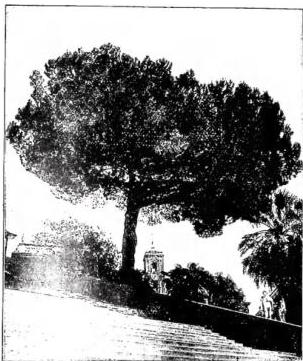
(Int. Encl.)
S. MARIA « IN FALCONE »: perhaps beneath Monte Mario, near Villa Madama; mentioned in a document of April 12, 1483 (P. Fr. Kehr, Italia Pont., I, p. 168 n. 16; Ch. Hülsen, Le chiese, cit., pp. 332–33). S. MARIA « DE FERRARIUS »: a church near the Colosseum, which disappeared in the 15th century. It appears in a document of 1205 and in the bull of Innocent IV of March 18, 1254 (G. Gatti, in Bull. della Commissione archeol. com. di R., 23 [1895], p. 124 sqq.). S. MARIA « DE FLUMINE »: it was near Monte Cenci; the bull of Urban III of 1186 lists it among the filial churches of S. Lorenzo in Damaso. It was secularized on February 1, 1573 (Ch. Hülsen, Le chiese, cit., pp. 333–35). S. MARIA « IN FORMOSA »: disappeared; it was also among the filial churches of S. Lorenzo in Damaso (ibid., p. 335). S. MARIA « IN FORO »: where the Forum of Augustus was located (ibid.). S. MARIA « DE FOVEA »: today S. Giovanni Decollato; the church was granted by Innocent VIII with a bull of August 23, 1490, to the Compagnia della Misericordia dei Fiorentini (ibid., pp. 335–36). S. MARIA « DE GRADELLIS »: near S. Maria in Cosmedin. From the Catalogue of 1492 onward, it is called S. Maria Egiziaca (ibid., pp. 336–38). S. MARIA « DE GUINIZO »: on the western slope of the Campidoglio. Already mentioned in the Turin Catalogue (ibid., pp. 338–339). S. MARIA « DE INFERNO »: erected in the 14th century above S. Maria Antiqua. Demolished at the beginning of the 20th century (ibid., pp. 339–400). S. MARIA « INTER DUO » or « DUAS »: between two ancient Roman roads near the Colosseum (ibid., p. 340). S. MARIA « IN IULIA »: church and monastery already mentioned in the biographies of Leo III; a filial church of S. Lorenzo in Damaso, it was later called S. Anna de' Funari or de' Falegnami and was demolished in 1887 (ibid., pp. 240–41). S. MARIA LAURETANA: at the Trajan's Forum, today Madonna di Loreto. Founded by the Compagnia dei Fornari in 1507; it appears in the Catalogues of 1555, of Pius IV, and of St. Pius V. S. MARIA « DE LUTARA »: oratory and monastery mentioned in the biography of Leo III (Lib. Pont., II, p. 45, n. 103). Unidentified (Ch. Hülsen, Le chiese, cit., p. 341).
S. MARIA « DE MACELLO »: toward Piazza Montanara (ibid., pp. 341–42). S. MARIA ET S. BLASII: perhaps the same as S. Benedetto in Thermis (ibid., p. 378). S. MARIA MAGGIORE: V. above. S. MARIA « IN MAURENTA »: near Piazza Navona; it appears for the first time in the Catalogue of Cennio Camerario, already without clergy; disappeared in the 16th century (ibid., pp. 342–43). S. MARIA « DE MANU »: on the slopes of the Palatine, toward the Circus Maximus. It appears in a document of December 20, 1215, later called S. Maria dei Cerchi (ibid., pp. 343–44). S. MARIA « DE MAXIMA »: church or monastery, today S. Ambrogio della Massima. Already in the biography of Leo III (ibid., pp. 344–45). S. MARIA « AD MARTYRES » or ROTUNDA or S. MARIA DELLA ROTONDA: the Pantheon transformed by Boniface IV (Lib. Pont., I, p. 363; P. Fr. Kehr, Italia Pontif., I, p. 99). S. MARIA « MEDIANAE »: oratory mentioned in the biography of Leo III (795–816; Lib. Pont., II, p. 42, n. 70), it was near the portico of the basilica of S. Pietro in Vaticano (Ch. Hülsen, Le chiese, cit., p. 345). S. MARIA « DE METRIO »: near the Arch of Constantine, at the beginning of the Via Sacra; the bull of Alexander IV of April 9, 1256, indicates the church as already existing, the remains of which are a little beyond the "meta sudans" toward the Palatine hill (ibid., pp. 345–46). S. MARIA « IN MINERVA » or « SUPRA MINERVAM »: already in the Einsiedeln Itinerary. Passed from the Senate and the Roman people to the Order of Preachers, confirmed by a bull of John XXI on November 3, 1276 (J. Berthier, L'église de la Minerve à Rome, Roma 1910; R. Spinelli, S. Maria sopra Minerva, ivi 1924). S. MARIA DEI MIRACOLI: near the Tiber. At the beginning of the 16th century there was a chapel dedicated to the Madonna in the arches of the Aurelian Walls near Piazza del Popolo. The Archconfraternity of S. Giacomo degli Incurabili erected an oratory in 1525 to house the image, which was transferred to the current church in Piazza del Popolo in 1664. S. MARIA « IN MONASTERO »: mentioned in a placitum of Benedict VII from 1014 (Regestum Farfense, III, p. 199, n. 492). It was in front of S. Pietro in Vincoli; demolished in the 16th century (Ch. Hülsen, Le chiese, cit., pp. 347–48). S. MARIA « IN MONASTERIO MICHAELIS »: already in the biography of Leo III; it was near SS. Quattro Coronati (ibid., p. 348). S. MARIA « DE MONTERONE »: appears among the filial churches of S. Lorenzo in Damaso in the bull of Urban III of 1186; the name derives from the Monteroni family, from Siena, who founded it as a pilgrim hospice (ibid., pp. 348–49). S. MARIA « IN MONTICELLIS »: belongs to the Arenula rione; it was consecrated by Paschal II (1099–1118; Lib. Pont., II, p. 305), and later by Innocent II on May 6, 1143 (P. Fr. Kehr, Italia Pont., I, p. 96; Ch. Hülsen, Le chiese, cit., pp. 350–51). S. MARIA « IN MONTICELLO » or « DE MONTE IOHANNIS RONZONIS »: appears in the bull of Alexander III of February 21, 1178, then in that of Urban III of 1186 among the filial churches of S. Lorenzo in Damaso. It was also called « S. Maria de monte Giordano ». Desecrated at the beginning of the 20th century (Ch. Hülsen, Le chiese, cit., pp. 350–51). S. MARIA « MONTIS BALNEANAPOLIS »: on the western slope of the Quirinal. Mentioned in the Catalogue of 1555 near the church of S. Agata al Quirinale. It stood on the site of the present-day SS. Domenico e Sisto (ibid., p. 351). S. MARIA « MONTIS SERRATI »: established in the 16th century on the site of a Catalan hospital with the chapel of St. Nicholas. The church appears in the Catalogues of the Spaniard from 1555 and of St. Pius V. S. MARIA NOVA: a diaconia founded by Leo IV among the ruins of the Temple of Venus and Rome. Rebuilt by Honorius III and in 1615 (P. Lugano, S. Maria Nova, Roma s. d.; P. Fedele, Il Tabularium S. Mariae Novae in Arch. Soc. rom. st. patria, 23 [1900], p. 171 sqq.; A. Frandi, Vicende edilizie della basilica di S. Maria Nova, in Rendiconti della Pont. Accad. rom. di arch., 13 [1938], p. 197 sqq.)
S. MARIA « DE OBLATIONARIO »: a chapel that appears in a privilege of Paschal II, Honorius II, and Innocent II, with an adjacent cemetery for pilgrims between Porta Asinaria (S. Giovanni) and the basilica of S. Croce; perhaps later called « de Spazolaria » (P. Fr. Kehr, Italia Pont., I, p. 32; Ch. Hülsen, Le chiese, cit., p. 352). S. MARIA « DE OLIVA »: it seems it was in Trastevere where S. Apollonia now stands; a female monastery of St. Francis was annexed to it; mentioned in the Catalogue of St. Pius V. S. MARIA DELL'ORTO: erected in 1488 in Trastevere near S. Cecilia. The Compagnia di S. Maria dell'Orto was established there
l'8 sett. 1492. Si trova nei Cataloghi del 1555, di Pio IV e di s. Pio V. S. MARIA DELLA PACE: fondata sotto Sisto IV col titolo di S. Maria della Virtù dove era la chiesa di S. Andrea degli Acquari. S. MARIA IN PALAZZOLO: in quella costa del Gianicolo prospiciente il Vaticano. Chiesa scomparsa nel sec. XV; appare soggetta a S. Pietro in Vaticano dal sec. XI (Ch. Hülsen, Le chiese, cit., pp. 352-353). S. MARIA « IN PALLAZA »: chiesa sul Palatino prospiciente l'arco di Costantino con monastero del sec. X. Appartenne al monastero di Montecassino. Denominazione dal Palladium. Contiene affreschi della fine del sec. X e della fine del sec. XII, editi da G. Wilpert, Mosaiken, tavv. 224-25. È detta anche di S. Sebastiano; passò nel 1630 in patronato ai Barberini (P. Fedele, in Archivio Soc. rom. di st. patria, 26 [1903], pp. 343-80; Ch. Hülsen, Le chiese, cit., pp. 353-55). S. MARIA « IN PARVI »: è ricordata in un'epigrafe del 1088. Sembra fosse ad ovest della Via Appia (ibid., pp. 355-56). S. MARIA « IN PEREGRINO ». Fu presso S. Angelo in Pescheria. È nel Catalogo di Parigi e di N. Signorili. Scomparsa (ibid., p. 356). S. MARIA « IN PETROCHIO »: fu tra l'angolo della Via della Bocca della Verità e Via dei Cerchi. È nel Catalogo di Cencio Camerario. Nel 1614 fu concessa alla Compagnia degli Scarpinelli e dedicata a s. Aniano (ibid., pp. 356-57). S. MARIA « AD PINEAM »: in Trastevere, V. Cappella. S. MARIA DELLA PIETA: con ospedale per poveri stranieri e per malati di mente: « xenodochium insanorum » lo chiama l'Anonimo Spagnolo. Nel sec. XVII fu concesso alla Compagnia dei Bergamaschi che eressero l'attuale chiesa in Piazza Colonna. S. MARIA « DE POPULO »: è ricordata nel 1265 da una iscrizione. Rifatta sotto Sisto IV (P. Fr. Kehr, Italia Pont., I, p. 86; Ch. Hülsen, Le chiese, cit., p. 358; E. Lavagnino, S. Maria del Popolo, Roma 1923). S. MARIA « DE PORTA »: attestata nel Catalogo di Parigi e in quello di Torino che la pone nella zona Nomentana; ma già senza personale. Non appare più nel 1492 (Ch. Hülsen, Le chiese, cit., p. 359). S. MARIA « DE PORTICU »: una tradizione attribuisce alla nobile Galla figlia di Simmaco l'erezione di un santuario mariano nel proprio Palazzo. La denominazione « porticus » viene dal « porticus Gallatorum ». Nel 1650 il papa Alessandro VII fece trasportare l'immagine della Madonna ivi venerata in S. Maria in Campitelli, detta da allora S. Maria « in Porticu in Campitelli » (P. Ferraroni, S. Maria in Campitelli, Roma s. d.). Fu consacrata da Gregorio VII l'8 luglio 1073 (G. B. De Rossi, Inscript. christ., II, 1, Roma 1888, p. 436; P. Fr. Kehr, Italia Pont., I, p. 110; L. Pasquali, S. Maria in Portico nella storia di R. dal sec. VI al XX, Roma 1902; Ch. Hülsen, Le chiese, cit., pp. 359-60). S. MARIA « DE POSTERULA »: quasi incontro all'albergo dell'Orso demolita alla fine del sec. XIX. Fu detta anche S. Maria « ad Flumen ». Appare già nel Catalogo di Cencio Camerario (Ch. Hülsen, Le chiese, cit., pp. 360-61). S. MARIA « DE PUBLICO »: è presso S. Carlo a Catinari; annoverata nella bolla di Urbano III nel 1186 tra le filiali di S. Lorenzo in Damaso. È detta anche « de Publico » in Publicolis (ibid., p. 361). S. MARIA « PURITATIS »: del Collegio dei caudatari dei cardinali, fondata sotto Clemente VII nel Borgo Nuovo. È ricordata nel Catalogo di s. Pio V. S. MARIA « DE PUTEO PROBAE » o « IN CAMPO »: fra S. Vitale e S. Agata alla Suburra. Vi fu annesso un ospedale per gli Albanesi. Appare già nel Catalogo di Parigi; era già in rovina nel Catalogo di s. Pio V (ibid., p. 362).
S. MARIA « REGINA COELI »: fu in Piazza S. Pietro, ricordata nel Catalogo del 1492 e di Pio IV. S. MARIA DELLO RIPOSO: sulla Via Aurelia. S. MARIA ROTONDA: V. S. Maria « ad Martyres ». S. MARIA « IN SAXIA », oggi S. Spirito in Saxia. Fondata nel 727 dal re Ina; rifatta da Leone IV (Lib. Pont., II, p. 128). Con bolla di Innocenzo III del 13 marzo 1198 divenne filiale di S. Pietro in Vaticano (P. Fr. Kehr, Italia Pont., I, pp. 145-51; Ch. Hülsen, Le chiese, cit., pp. 363-64). S. MARIA « DE SCALA »: con annesso monastero, oggi S. Maria della Scala, eretta nel 1592. S. MARIA « SECUNDICERII »: è citata nel Catalogo di Cencio Camerario e nella biografia di Gelasio II (Lib. Pont., II, pp. 315 e 347). Era vicino al Ponte Rotto. S. MARIA « AD S. SILVESTRI »: è ricordata
in una bolla di Giovanni XII dell'8 marzo 962; era davanti all'ingresso del monastero di S. Silvestro in Capite. S. MARIA « IN SYNODOCHIO »: è lo Xenodochium di Belisario presso l'acqua Vergine (oggi S. Maria in Trivio) (Ch. Hülsen, Le chiese, cit., pp. 365-66). S. MARIA « DE SPATULARIA »: presso S. Croce in Gerusalemme, con annesso monastero, demolita da Sisto IV per erigervi la cappella detta S. Maria del Soccorso o del Buon Aiuto (ibid., pp. 366-67). S. MARIA « IN TEMPULO » o « DE TEMPORE »: da Tempulus, monaco greco secondo la leggenda. Il monastero è nella biografia di Leone III. Era presso S. Sisto vecchio (ibid., pp. 367-68). S. MARIA « IN TOFELLATO » o « IN TOFELLA »: nel rione Ripa, era già in rovina sotto s. Pio V (ibid., pp. 368-70). S. MARIA « IN TRASPADINA » o « IN HADRIANO »: diaconia fondata da Adriano I presso l'ingresso al mausoleo di Adriano, demolita da Pio IV nel 1564. L'attuale chiesa di S. Maria in Transpontina invece è del 1566 (P. Fr. Kehr, Italia Pont., I, p. 154; Ch. Hülsen, Le chiese, cit., pp. 370-71). S. MARIA TRANSTIBERINI: V. SORA. S. MARIA « IN TUBRE »: era in Trastevere presso il porto di Ripa Grande, denominata così da una torre di Leone IV (ibid., p. 372). S. MARIA « IN TURRI » o « IN TURRIBUS », era tra i due campanili della Basilica di S. Vaticano (v.).
S. MARIA « IN VALLICELLA »: si trova già al tempo di Eugenio III (1145-53). Nel 1575 s. Filippo Neri iniziò la costruzione della Chiesa Nuova (E. Strong, La Chiesa Nuova, Roma 1923). S. MARIA « IN VIA »: appare in un atto, del 1042, di S. Maria in Via Lata; il nome deriva da una via che dalla Flaminia si dirigeva all'arco dell'acqua Vergine (C. Cecchelli, S. Maria in Via, Roma s. d.). S. MARIA « IN VIA LATA »: diaconia arricchita da Leone III nell'806. Eugenio IV con bolla del 19 marzo 1433 vi unì il monastero dei SS. Ciriaco e Niccolò (L. Cavazzi, La diaconia di S. Maria in Via Lata e il monastero di S. Ciriaco, Roma 1908; L. Hartmann - M. Merores, Ecclesiae S. Mariae in Via Lata Tabularium, Vienna 1896-1923). S. MARIA « VIAE PONTIFICALIS REGIONE COLUMNAE »: ricordata nel Catalogo del 1555. S. MARIA « DE VIRGARIIS »: chiesetta sulla Piazza S. Pietro circa il luogo dove ora sorge l'obelisco; è già in una bolla di Leone IX del 1053 (L. Schiaparelli, Le carte antiche dell'Archivio capitolare di S. Pietro, in Archivio Soc. rom. di st. patria, 24 [1901], p. 472). S. MARIA « DE VIRGINIBUS »: oratorio presso il vicolo al Colonnato e il Corridoio del Borgo, ricordato in un documento del 13 apr. 1345 dell'Archivio di S. Pietro, con annesso un monastero di canonichesse. Scomparve nel sec. XV (Ch. Hülsen, Le chiese, cit., pp. 377-78). S. MARIA « IN XENODOCHIO FIRMIS »: oratorio ricordato nella biografia di Leone III presso quello di Belisario (Lib. Pont., II, p. 46, n. 108).
VII. THE CÆMETERIAL BASILICAS
The first record of basilicas erected over the tombs of the Roman martyrs is found in the biography of Sylvester, where those on the tombs of St. Peter (v.), St. Paul (v.), St. Lawrence (v.), St. Agnes (v.), and SS. Peter (v.) are indicated as Constantinian constructions. S. SILVESTRO was buried in Priscilla, on the Via Salaria, on December 31, 335, as recorded by the Depositio episcoporum and his biography (Lib. Pont., I, p. 187). His tomb would later be pointed out in the "ecclesia" or "basilica S. Silvestri" erected over the tomb of the martyrs Felix and Philip, indicated in the same cemetery by the Depositio martyrum (R. Valentini and G. Zucchetti, Codice topografico della città di R., Rome 1942, pp. 77, 144). But as for the cœmeterial basilica called "Apostolorum" on the Appian Way at the locality "in catacumbas", although there is no written documentation regarding its foundation, its antiquity is demonstrated by its structure, of the same type as that of the nearby circus and mausoleum of Maxentius.POPE MARK (336) erected a basilica in "cymiterio Balbinae Via Ardestina" where he was buried (Lib. Pont., I, p. 202). JULIUS built three cœmeterial basilicas, recorded in the Liberian Catalogue: the first "in Via Portuense miliario III", which G. B. De Rossi identified with the basilica of S. Felice; the second is the basilica "in Via Flaminia, miliario II quae appellatur Valentini"; the third on the Via Aurelia at the third milestone near the tomb of Pope Callistus (MGH, Script. Antiquiss., I, Berlin 1892, p. 76):
"in Via Aurelia miliario III ad Callistum", that is, where he was buried, as the Depositio episcoporum confirms: "Iuli in Via Aurelia, miliario III in Callisti" (ibid., p. 70; identical information is also reported in Lib. Pont., I, p. 206); Liberius (352-66) adorned the tomb of St. Agnes with marble slabs (Lib. Pont., I, p. 208). DAMASUS (366-84) adorned with verses the marble slab "in catacumbas" where the relics of the Apostles Peter and Paul had been deposited. Furthermore, his biography attests that he "multa corpora sanctorum martyrum requisivit et invenit, quorum etiam versibus declaravit" (ibid., p. 212). In fact, Damasus brought into cult and embellished the tombs of the martyrs Marcellinus and Peter, whose executioner himself had narrated to him, while he was a puer, the details of the martyrdom (A. Ferrua, Epigrammata Damasiana, Vatican City 1942, no. 28). Damasus points out to the faithful the example of the two soldier-martyrs Nereus and Achilleus (ibid., no. 8); he commissions the priest Verus to adorn the tomb of the martyrs Felix and Adauctus, in whose honor he composes an epigram (ibid., no. 7). In the area of the ancient cœmeterial Basilica on the Portuensis, G. B. De Rossi discovered in 1868 a fragment of a marble epistyle where in Filocalian letters is the dedication in honor of the martyrs "(Fau)stino, Viatrici", which De Rossi himself restored as "sanctis martyribus Simplicio Faustino, Viatrici et Rufo Damasus episcopus fecit" (ibid., no. 6). Damasus is the first to make known the episode of the martyrdom of the deacon or acolyte Tarcisius, protomartyr of the Eucharist, in the epigram placed on his tomb in Callistus (ibid., no. 15); through the work of Damasus "quaeritur, inventus colitur" the body of the martyr Eutyches, whose "expressit Damasus meritum venerare sepulchrum" (ibid., no. 21).
Fragments of a carmen discovered in Praetextatus, not transcribed in the epigraphic sylloges, but composed by Damasus ("Damasus episcopus fecit. Furius Dionysius Filocalus scribsit"; ibid., no. 26) with express reference to the castra and in armis, are attributed to the soldier-martyr Quirinus, who is recorded in a later dedicatory inscription found in the same cemetery (R. Kanzler, Relazione ufficiale degli scavi eseguiti dalla Pont. Comm. di archeol. sacra nelle catacombe romane [1907-19], in N. Bull. arch. crist., 15 [1909], p. 1210, pl. 1, 1) and whom the Martyrologium Hieronymianum attests was venerated in Praetextatus, where also the Acta ss. Alexandri Eventi et Theoduli, which qualify him as a "tribunus", place his tomb (BHL, no. 266).
Damasus places a carmen on the tomb of the martyr Tiburtius deposited in the cemetery "inter duas lauros" (A. Ferrua, op. cit., no. 31) depicted together with the other local martyrs Marcellinus, Peter, and Gorgonius in a fresco in the same cemetery (Wilpert, Pitture, pl. 252). Nothing is known of the time when the little basilica over his tomb was built, of which ruins remain (O. Marucchi, La cripta storica dei ss. Pietro e Marcellino, in N. Bull. arch. crist., 4 [1898], pp. 181 and 183). Damasus embellishes the tomb of the martyrs Protus and Hyacinth by carrying out works, as attested by the carmen placed there (A. Ferrua, op. cit., pp. 190-93); he also carries out works at the tombs of Pope Cornelius on the Appian Way (ibid., pp. 136-37) and of the martyr Januarius in Praetextatus, where he places a large dedicatory inscription in prose (ibid., pp. 151-52). He placed a carmen on the tomb of the martyr Saturninus of Carthage deposited in Thraso (ibid., pp. 188-90), but it is not known when the little basilica in his honor was erected, which was burned and later restored, its ruins still being visible at the time of A. Bosio, and its name having become corrupted into that of S. Citronina. Damasus also placed a dedicatory inscription in Filocalian characters on the tomb of the martyrs Abdon and Sennen, indicated as deposited sub duo, "ad Ursum pileatum" by the Depositio martyrum. The basilica in their honor, of uncertain construction date, came to light in 1917 (F. Fornari, in Notizie degli scavi, 1917, p. 283).
Under Pope SIRICIUS (385-98) is built the ba-
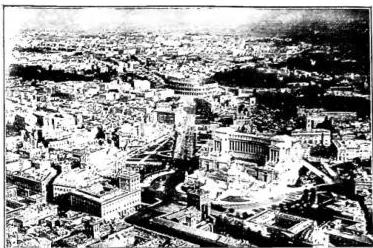
LEO THE GREAT (440-61) renewed the central nave of the basilica of S. Paolo (v.) and restored that of S. Peter (v.) following the earthquake of 443. He built a basilica over the tomb of Pope Cornelius on the Via Appia and founded a monastery near the basilica of S. Peter ([v.], Lib. Pont., I, pp. 238-39). In his time, Annia Demetrias erected a basilica on the Via Latina in honor of the protomartyr Stephen (L. Fortunati, Relazione generale degli scavi e scoperte fatte lungo la Via Latina, Rome 1859). Pope HILARY (461-68) established a monastery near S. Lorenzo al Verano and built a bathhouse for pilgrims there (Lib. Pont., I, p. 245). SIMPLICIUS (468-83) erected a basilica to S. Stephen near that of S. Lorenzo al Verano; he established that the administration of the Sacraments at the major cemetery basilicas should be served by the priests of the 1st ecclesiastical region at S. Paolo, those of the 3rd at S. Lorenzo, and those of the 6th and 7th at S. Peter (ibid., p. 249). FELIX III (483-92) built the basilica of S. Agapitus near the basilica of S. Lorenzo al Verano (ibid., p. 252). ANASTASIUS II (496-98) covered the confessio of the martyr Lawrence with silver (ibid., p. 258). Pope SYMMACHUS (498-514) built the oratory of S. Andrew near the basilica of S. Peter, where he also erected the oratory of the Holy Cross and carried out other works. He erected the basilica of S. Agatha on the Via Aurelia. He also built a basilica over the tomb of S. Pancras; he renewed the apse of S. Paolo and
that of S. Agnes, restored that of S. Felicitas, and [restored] the cemetery of the Jordani or the basilica erected over the tombs of the martyrs Vitalis, Alexander, and Martialis (Lib. Pont., I, pp. 262-63).
JOHN I (523-26) rebuilt the basilica of SS. Nereus and Achilleus, of SS. Felix and Adeodatus, and, probably above the cemetery of Priscilla, the basilica where St. Sylvester was buried (ibid., p. 276). Under FELIX IV (526-30), the aforementioned basilica of S. Saturninus burned down and was rebuilt by the Pope (ibid., p. 279). Under SILVERIUS (536) there occurred the great devastation of the cemetery basilicas and of the tombs of the martyrs: "ecclesias et corpora martyrum sanctorum exterminatae sunt a Gothis" (ibid., p. 291); his successor VIGILIUS (537-55) labored to restore them, as is attested by a poem preserved in the syllogae and by some surviving fragments (G. B. De Rossi, Inscrip. christ., II, 1, Rome 1888, pp. 84-87, 116, 135). Pope JOHN III (561-74) went to live near the sanctuary to the left of the Via Appia where the martyrs Tiburtius, Valerian, and Maximus had been buried, and he also performed consecrations of bishops there (Lib. Pont., I, p. 306). Pope PELAGIUS II (579-90) covered the confessio of S. Peter (v.) with marble slabs, built the basilica over the tomb of the martyr Hermes (R. Krautheimer, Corpus Basil. Christianarum, Vatican City 1936, pp. 195-208), and erected the basilica with a double tier of columns in S. Lorenzo (v.) al Verano (Lib. Pont., I, p. 309).
GREGORY THE GREAT carried out works in the basilicas of S. Peter (v.) and S. Paolo (ibid., p. 312). BONIFACE V (619-25) completed and consecrated the cemetery church of S. Nicomedes on the Nomentana (ibid., p. 325; Martyr. Hieronymianum, p. 291). Pope HONORIUS I (625-38) built the basilica over the tomb of St. Agnes on the Nomentana, with a double tier of columns like that of S. Lorenzo, decorating the apse with the still-surviving mosaic; the church of S. Apollinare called "ad palmata" near S. Peter in Vaticano; the church over the tomb of St. Cyriacus at the 7th milestone of the Portuense; he restored the cemetery or church of the martyrs Marcellinus and Peter on the Labicana; he reconstructed the basilica of S. Pancras on the Via Aurelia; he covered the basilica of S. Peter in Vaticano with the bronze tiles of the Temple of Rome (Lib. Pont., I, p. 323). Pope SEVERINUS (640) repaired the apse mosaic of the basilica of S. Peter (v.). Pope THEODORE (642-49) was the first, according to the Liber Pontificalis, to perform translations of the bodies of martyrs; he transported the bodies of the martyrs Primus and Felicianus, buried "ad arcos Nomentanos" at the 15th milestone of the Nomentana, to S. Stefano al Celio (ibid., p. 332). He is also credited with the restoration of the basilica of S. Valentino on the Flaminia, which the Notitia ecclesiarum attributes to Honorius (R. Valentini-G. Zucchetti, Cod. top. cit., II, p. 333). Pope Theodore built and adorned an oratory in honor of the martyr Euplus. ADEODATUS (672-76) restored and dedicated the basilica of S. Peter located on the Via Portuense near the "pons Meruli", the remains of which were destroyed in 1858 for the construction of the Rome-Pisa railway line (A. Pellegrini, Cenni storici intorno ad una basilica di S. Pietro in Campo di Merlo, Rome 1860). LEO II (682-83) transferred the relics of the martyrs Simplicius, Faustinus, and Beatrice from the cemetery of Generosa, depositing them in a church he dedicated to St. Paul located near S. Bibiana (Lib. Pont., I, p. 360). BENEDICT II (684-85) restored the basilica of S. Peter in Vaticano, and erected a ciborium on the altar of the basilica of S. Valentino on the Flaminia (ibid., p. 363).
Pope SERGIUS I (687-701) restored the basilica of S. Peter, especially the mosaic of the facade, the basilica of S. Paolo, and its annexes (ibid., p. 376). JOHN VI (701-705) made the ambo in the oratory of S. Andrew near S. Peter in Vaticano and donated vestments for the altar of S. Paolo (ibid., p. 383). JOHN VII (705-707) restored the basilica of Eugenia on the Via Latina, and on the Ardeatina the one containing the tombs of the martyrs Marcus and Marcellinus and the other with the tomb of Pope Damasus (ibid., p. 385); he erected the oratory of the Blessed Virgin in the basilica of S. Peter in Vaticano (ibid., p. 385). GREGORY II (715-31) restored the roofs of the basilicas of S. Lorenzo and S. Paolo, renewing their monasteries (ibid., p. 397). GREGORY III (731-41)
embellished the basilica of St. Peter in the Vatican; he restored the basilicas of St. Callisto and of SS. Processus and Martinian, as well as the mausoleum of Pope Mark; he established an annual station in the basilica of St. Petronilla; he restored the roof of the buildings in the cemetery of Praetextatus (ibid., pp. 419-20). Pope ZACHARIAS (741-52), at the fifth milestone of the Via Tiburtina, where he established a domusculta, enlarged and decorated the oratory of St. Cecilia and built an oratory to St. Abba Cyrus, where he deposited many sacred relics (ibid., p. 434). Pope STEPHEN II (752-57) built two hospices near St. Peter's, placing them under the local diaconies of St. Mary and St. Sylvester (ibid., p. 441). At that time Aistulf took away many bodies of saints from the cemeteries (ibid., p. 451) and restored the sepulchral building of St. Soter. Pope PAUL I (757-67) transferred many bodies of martyrs to R. from the cemeteries and deposited not a few of them in the monastery of SS. Stephen and Sylvester founded by him in his own house. He transported the body of the martyr Petronilla to the mausoleum adjacent to the oratory of St. Andrew in the Vatican; also near St. Peter's he erected an oratory to Our Lady near that of St. Leo (ibid., pp. 464-65).
Pope ADRIAN I (772-95) is the restorer of almost all the cemetery buildings, beginning with the basilicas of St. Peter, St. Paul, St. Lawrence, St. Pancras, St. Valentine, St. Tiburtius, and SS. Peter and Marcellinus, where he also built the stairway to descend directly to their tomb; of St. Genovefa near the Porta di S. Lorenzo (Tiburtina), of SS. Abdon and Sennen, of St. Agapitus and St. Stephen near St. Lawrence, of St. Sebastian, of St. Eugenia, of SS. Gordian and Epimachus; of SS. Tiburtius, Valerian, and Maximus, and of St. Zeno in Praetextatus, of St. Felicity, of St. Saturninus, of SS. Alexander, Vitalis, and Martialis at the Giordani, of St. Sylvester on the Salaria, of St. Agnes, of St. Emerentiana, of St. Hippolytus; in many of these basilicas he provided liturgical furnishings and precious fabrics (Lib. Pont., I, pp. 499-500, 504-12). LEO III (795-816) continued the work with rich donations and precious fabrics to almost all the sacred buildings of R., oratories, chapels, and monasteries. His restorations at St. Peter's in the Vatican, at the basilica of Felix and Adauctus, of St. Mennas, of St. Sixtus, of St. Cornelius, and of St. Zoticus on the Labicana are recorded (Lib. Pont., II, pp. 1-33). Pope PASCHAL I (817-24) sought out many bodies of saints in the cemeteries and transferred them to urban churches, especially those rebuilt by him, such as St. Cecilia and St. Praxedes. Particularly remembered are the translations of the bodies of SS. Processus and Martinian to St. Peter's, of St. Zeno to St. Praxedes, of SS. Cecilia, Valerian, Tiburtius, Maximus, and of Popes Urban and Lucius, whose relics he placed beneath the altar of the titular church of St. Cecilia (ibid., pp. 54-56). GREGORIO IV (827-44) restored the basilica of St. Saturninus on the Salaria; he transferred the body of St. Gregory the Great inside the basilica of St. Peter into a chapel erected by him, wherein he deposited the relics of the martyrs Sebastian, Gorgonius, and Tiburtius (M. Andrieu, La chapelle de St Grégoire dans l'ancienne Basilique Vaticane, in Riv. di arch. crist., 13 [1936], pp. 61-99); he offered gifts to the basilicas of St. Peter, St. Paul, St. Lawrence, St. Pancras, and St. Valentine (Lib. Pont., II, pp. 74-88).
SERGIUS II (844-47) erected a basilica in honor of St. Romanus near the Via Salaria, mentioned only in his biography (ibid., p. 92). The Pope translated many bodies of martyrs to the titular church of SS. Sylvester and Martin, which he renovated (ibid., pp. 93-94). Under his pontificate the basilicas of the apostles Peter and Paul were "funditus depraedatae sunt" by the Saracens (ibid., p. 106). Pope LEO IV (847-885) tried to remedy such a great disaster with rich and continuous donations and with precious fabrics. He instituted the celebration of the octave of the Assumption of the Blessed Virgin Mary in the basilica dedicated to her near St. Lawrence extra moenia, where he restored the monastery of SS. Stephen and Cassian, and where he also placed Greek monks for the laus perennis; he made gifts to the basilicas of St. Lawrence, St. Pancras, St. Agatha, St. Stephen on the Latina, St. Rufina and SS. Cosmas and Damian at Silva Candida; into the basilica of the Quattro Coronati on the Caelian, restored by him, he translated the bodies of the Quattro Coronati and a notable group of other bodies of martyrs (ibid., pp. 109-16, 119-22, 125, 127-29, 130, 132-34). BENEDICT III (855-58) adorned
The Ground Truth image displays a single, solid horizontal line. According to Rule 2 (UNDERSCORE & LINE RULES), this is a stylistic or background line, not a placeholder underscore. Therefore, the OCR result must ignore II. The provided OCR content is "____", which consists of four underscores. This is an incorrect interpretation of the line as a placeholder, violating the rule that stylistic lines must be ignored. The OCR has hallucinated text (underscores) where none should exist. Hence, the result is inconsistent with the Ground Truth.
The Ground Truth image displays a single, solid horizontal line. According to Rule 2 (UNDERSCORE & LINE RULES), this is a stylistic or background line, not a placeholder underscore. Therefore, the OCR result must ignore II. The provided OCR content is "____", which consists of four underscores. This is an incorrect interpretation of the line as a placeholder, violating the rule that stylistic lines must be ignored. The OCR has hallucinated text (underscores) where none should exist. Hence, the result is inconsistent with the Ground Truth.
The Ground Truth image displays a single, solid horizontal line. According to Rule 2 (UNDERSCORE & LINE RULES), this is a stylistic or background line, not a placeholder underscore. Therefore, the OCR result must ignore II. The provided OCR content is "____", which consists of four underscores. This is an incorrect interpretation of the line as a placeholder, violating the rule that stylistic lines must be ignored. The OCR has hallucinated text (underscores) where none should exist. Hence, the result is inconsistent with the Ground Truth.
The Ground Truth image displays a single, solid horizontal line. According to Rule 2 (UNDERSCORE & LINE RULES), this is a stylistic or background line, not a placeholder underscore. Therefore, the OCR result must ignore II. The provided OCR content is "____", which consists of four underscores. This is an incorrect interpretation of the line as a placeholder, violating the rule that stylistic lines must be ignored. The OCR has hallucinated text (underscores) where none should exist. Hence, the result is inconsistent with the Ground Truth.
The Ground Truth image displays a single, solid horizontal line. According to Rule 2 (UNDERSCORE & LINE RULES), this is a stylistic or background line, not a placeholder underscore. Therefore, the OCR result must ignore II. The provided OCR content is "____", which consists of four underscores. This is an incorrect interpretation of the line as a placeholder, violating the rule that stylistic lines must be ignored. The OCR has hallucinated text (underscores) where none should exist. Hence, the result is inconsistent with the Ground Truth.
RO
LE XIII REGIONES
Regio I. Marinum et Biberalicon
Regio II. Trinit et Vice Lariæ
Regio III. Calumnae et Sanctae Manæ et Aqueæ
Regio IV. Campi Manæ
Regio V. Partis et Scandiclorarium
Regio VI. Pavonis et S. Laurentii in Domœia
Regio VII. Annulus et Coccoborarium
Regio VIII. S. Eustache et Vineae Thiodemani
Regio IX. Pineae et S. Marci
Regio X. Campitelli (et S. Hadriani)
Regio XI. S. Angeli in Fara Piscium
Regio XII. Ripae et Marmoratae
Regio XIII. Transtiberum
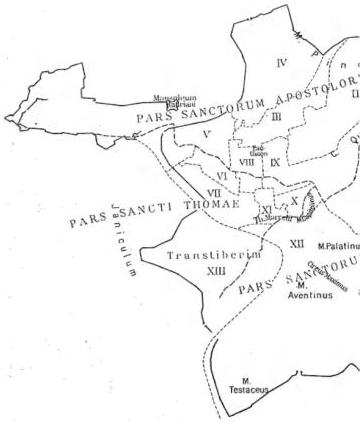
LE XIII REGIONES (RIONI) DI ROMA DAL SEC. XI AL
OMA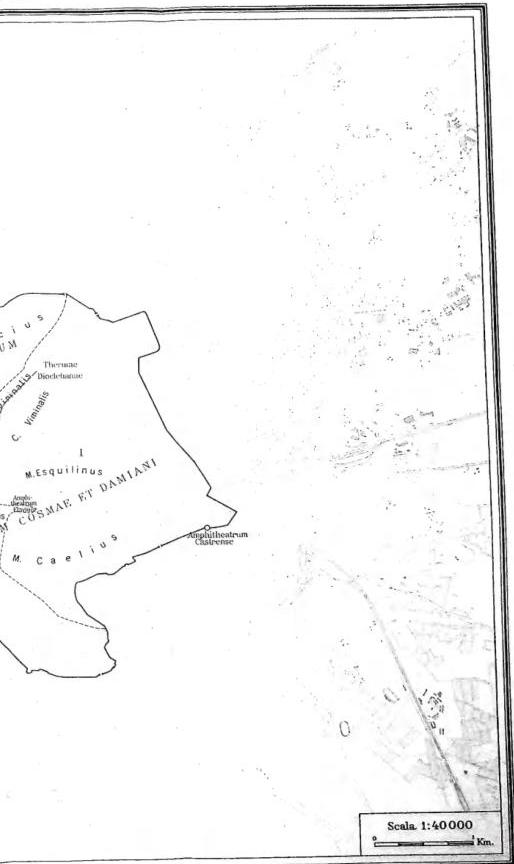
-
VIII. THE ABBEYS
MANILIO (v.) made a list of 20 abbeys, namely S. Cesario "in palatio", S. Gregorio "in clivo Scauri", S. Maria "in Aventino", S. Alessio, S. Saba, called "cella nova", S. Pancrazio, SS. Cosma e Damiano "in vico aureo", S. Silvestro "inter duos hortos", S. Maria "in Capitolio", S. Basilio "iuxta Palatium Trajani imperatoris", S. Agata "quae est Subure monte", S. Lorenzo "in Panisperna", S. Tommaso "iuxta formam Claudiam", S. Biagio "de captu secuta", SS. Trinità "Scotorum", S. Valentino "in Via Flaminea", S. Anastasio "in Via Ostiensi", S. Maria "in Pallara", S. Maria "in monasterio iuxta S. Petrum ad vincula", S. Maria "in castro aureo" (cod. Vat. lat. 3627, f. 22 v); Giovanni Diacono (v.) also enumerated 20, though omitting S. Anastasio and adding that of SS. Prisca e Aquila (cod. Vat. Reg. 712, f. 89).IX. ECCLESIASTICAL REGIONS AND RIONI
G. B. De Rossi, from epigraphic indications and documents, concluded that ecclesiastical region I comprised the 1st, 12th, and 13th Augustan regions; eccl. reg. II: the 2nd, 8th, 10th, and 11th Aug.; eccl. reg. III: the 3rd and 5th Aug.; eccl. reg. IV: the 4th and 6th Aug.; eccl. reg. V: the 7th and 9th Aug.; eccl. reg. VI: the 9th and part of the 14th Aug.; eccl. reg. VII: the remainder of the 14th Aug. (Roma sotterr., III, Rome 1877).In the Liber Pontificalis, ecclesiastical region I is mentioned in the biographies of Popes Simplicius (468-83), Silverius (536-37), where mention is made of a "Johannis subdiaconus regionarius regionis primae", and Eugene I (654-57), who originated "regionis primae Aventinensis".
Ecclesiastical region II appears in the life of Pope Zachary (741-52), which designates as "regione secunda" the diaconia of S. Giorgio "ad Velum aureum".
While the Augustan regions continue to be mentioned in the biographies of Anastasius II (496-98), who belonged to region V "Caput Tauri", i.e., of the Esquiline, and of Benedict VI (973-74), designated as "de regione VIII sub Capitolio", i.e., of the Roman Forum area, etc., C. Re in his study on Le Regioni di R. nel medioevo (v. art. cit. in bibl., p. 185 ff) maintained that the Augustan regions continued to be indicated in documents up to the 11th century, promiscuously with the ecclesiastical regions. L. Duchesne argued that from the middle of the 6th century, i.e., after the Gothic invasion, the use of the Augustan regional division ceased, being replaced by the ecclesiastical circumscription into seven regions; moreover, that the 12 regions of the Middle Ages, from which the "rioni" derive, represent that grouping which took place under the Byzantine period for the formation of the Roman army and the military distribution of the Roman population. Furthermore, the system of the seven ecclesiastical regions would have remained in use until about the end of the 11th century, though with some variants in this latter period; and finally, that the 12 regions have nothing in common topographically either with the 14 Augustan or the 7 ecclesiastical ones. In the time of Theodoric, the Roman deacon John wrote that "septem regionibus ecclesiastica apud nos militia continetur" (Johannis diaconi epistola ad Senarium: PL 59, 405). The clergy and the people were grouped into the seven ecclesiastical regions, as indicated by the seven Crosses carried during stational processions and litanies, which crosses were at that time kept in S. Anastasia. Later, the military insignia of the "milites draconarii" appear, called banda, then bandora, whence the modern flag.