
BRONZO. — Used for a great variety of purposes since antiquity, bronze played a preponderant role in Greek statuary beginning in the Attic period (6th century B.C.). The ancient sources mention its use on numerous occasions, and many of the original objects made from it that have survived provide significant evidence of this.
Even before it was used in casting sculptures or reliefs, bronze was employed in numerous sheet-metal applications: for household furnishings, personal ornaments, weapons, chariots, and also architectural decorations. Pliny, in his Naturalis Historia (XXXIV, chaps. 1–93), gives a detailed account of these uses and comments on and describes many of the most celebrated bronze sculptures of antiquity. Indeed, the greatest craftsmen of ancient Greece made extensive use of bronze in their most renowned works, from Mirone to Policloto, from Fidia to Scopa, Prassitele, and Lisippo; and although only very few have come down to us in the originals, there are instead many small votive and ornamental bronzes preserved in museums throughout the world.
The technique used in antiquity for melting and casting reveals a marvelous perfection, well matched to the high artistic quality. The figurative elements (plastic emphasis, the function of line and planes, chromatic sonority) found an elevated coefficient in the ductility of the material.
The Egyptians and Etruscans, and later the Romans, were also skilled in the art of bronze, which they employed extensively following the example of Greece. Among the most celebrated Etruscan and Roman bronzes are the Marte of Todi, the Lupa capitolina, the equestrian statue of Marcus Aurelius, the Erme and the decoration of the ships of Nemi, the Vittoria of Brescia, and several busts of emperors.
Bronze was also used in the East from the most ancient times: in China for vases, weapons, ornaments, sacred statuary (statues of Buddha), and all the accessories of worship. Japan, tributary to China, gave the use of bronze a distinctive character of its own. In India many sacred sculptures, including some of great size, were cast in bronze (for example, the Sivo dancing in the circle of fire in the museum of Madras and in the collection of the Banca d'Italia). Tripods, bells, incense burners, and other objects were also produced, often damascened with silver and gold and enriched with precious stones and enamels.
From the beginnings of Christian art, small objects such as lamps, medals, liturgical furnishings, accessories for worship, screens, candelabra, and door panels (such as those in the Lateran baptistery dating from the 5th century) were made of bronze. The technique was increasingly perfected through the contributions of Byzantine art in countless objects decorated with reliefs or inlays. A remarkable example is provided by the great doors of the church of Hagia Sophia in Constantinople, dating from the 9th century. The tradition imported from the East, which had also independently maintained its vitality in other European centers, was fostered above all by the cenobies and monasteries flourishing in the revival around the year 1000. They continued the practice of artistic casting that had been revived in the Carolingian age, during which a great number of interesting sculptures were produced (among them, the statuette of Charlemagne from Metz, now in the Louvre). The school of the mo-
monastery of Hildesheim played an important role in spreading it throughout Germany, producing works that still astonish today for their technical perfection, such as the doors and the bronze column preserved in that cathedral.
With the Romanesque period, Italy saw a more intense revival of the use of bronze in works among the noblest achievements of the art of those centuries. The great Romanesque sculptors—Bonanno Pisano for the doors of the cathedrals of Pisa and Monreale, Barisano for those of Trani and for the others at Ravello and Monreale, Oderisio for those of Troia, together with the anonymous artist responsible for the door of the cathedral of Benevento, much damaged in the last war—all engaged in works in bronze. In the other countries of Europe, ecclesiastical furnishings, bells, and other objects were produced above all, with a vigorous plastic sense. The elaborate candelabrum of Milan Cathedral, attributed to Nicola di Verdun, is among the most notable northern examples of this period. The Romanesque age also saw important imports of works from the East, including the silver-damascened bronze doors for the basilica of S. Paolo fuori le mura, Montecassino, and S. Michele al Gargano.
Among the earliest fourteenth-century documents are the doors that Andrea da Pontedera sculpted in 1332 for the Florentine baptistery; they were cast by specialists who had come expressly from Venice. Seventy years later, victory in the competition announced by the Opera del Duomo enabled Lorenzo Ghiberti to sculpt in gilded bronze, first the northern door and then the eastern door of the same baptistery. The first, commissioned to him in 1403, was completed in 1424; the second, commissioned in 1425, was finished in 1452. Alongside him, the greatest sculptors of the Renaissance made extensive use of bronze for their most successful works: Brunelleschi, Donatello, Verrocchio, and Pollaiolo left incomparable evidence of this in Florence and elsewhere. Lesser artists also tried their hand at working the metal. The Paduan Bartolomeo Bellano collaborated on the high reliefs of Donatello’s pulpits in S. Lorenzo in Florence for the final Storie di Cristo, and left his masterpiece in the reliquary cabinet in the church of the Santo in Padua; the Sienese Vecchietta sculpted in 1467 the tomb figure of M. Sozzini the Elder, now in the Bargello Museum in Florence. Other works by him are the ciborium of Siena Cathedral and the Cristo risorto, of 1476, in the church of the Ospedale in Siena. Francesco di Giorgio Martini, in his multifaceted activity, also left many works in bronze. Among those unanimously attributed to him by critics are the two reliefs with the Flagellazione, in the picture gallery of Perugia, and the Deposizione in the church of the Carmine in Venice, as well as the angels of Siena Cathedral, datable to around 1497–99. A vigor never before experienced was impressed upon their castings by Sansovino in Venice, Giambologna in Pisa, and later Benvenuto Cellini, whose own famous description recounts the labor involved in casting the Perseo.
During the Renaissance, many ecclesiastical accessories were also produced in bronze and were genuine works of art, whether gratings (the Cingolo Chapel in Prato Cathedral) or pulpits, or smaller objects such as candelabra, bells, basins, and collection plates. medal (v.) deserves particular mention for its flourishing development in fifteenth-century Italy, with Pisanello as its most celebrated craftsman.
In sixteenth-century Germany, decorative statuettes were produced; among the leading artists, Peter Vischer and Hans Leigenberger achieved great renown, although they never attained a high artistic level.
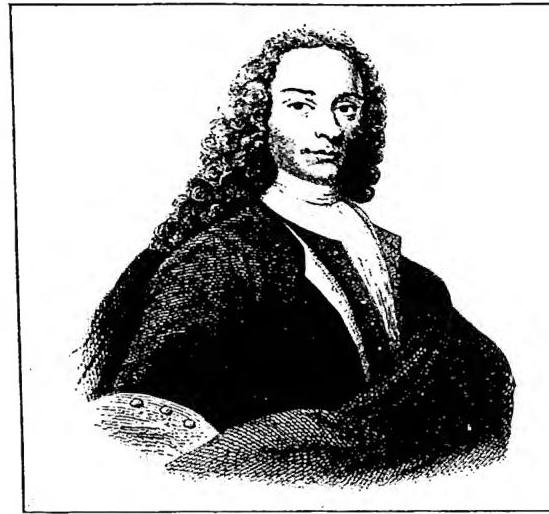
(from Ch. de Brosses, L'Italie il 9 a cent ans, Paris 1835)
BROSSES, CHARLES de — Portrait. Engraving by Coupé.
at the beginning of the Empire, furniture in different styles was fashioned, but frequently decorated with bronze. The French example was soon followed in England and Germany, but the productions of these countries could not equal the refined elegance of the Parisian chasers. Primacy was maintained throughout the nineteenth century, and among the greatest artists of France Auguste Rodin must be remembered, the author of commemorative sculptures and portraits (Les Bourgeois de Calais, La Porte de l'Enfer, the busts of Clemenceau, Victor Hugo, and Benedetto XV, all in the Rodin Museum in Paris), as well as of several religious sculptures, including a St Jean-Baptiste prêchant of 1879.
Rodin’s art stimulated numerous sculptors who, at the end of the century and in the early years of the twentieth, produced numerous bronze works in the academic style then prevailing. The decoration of large monumental structures was very widespread (quadrigas on the triumphal arches in Paris, Berlin, etc.; sculptures for the monuments to Vittorio Emanuele II and Garibaldi in Rome).
In more recent times, the use of bronze in art has declined, with the exception of some successful works by contemporary artists (among them Arturo Martini deserves mention), who often also treated religious subjects. Bronze has rather passed into industrial use, in which it has subsequently been combined with many other metals employed in the same way. - Vedi Tav. X.