
POLLAIUOLO, Antonio di Jacopo Benci, Called Del. - Painter, sculptor, goldsmith, architect, b. in Florence ca. 1431 (according to others 1426, or 1429, or 1433), d. in Rome, where he is buried, in S. Pietro in Vincoli, on 4 February 1498. By his contemporaries he was considered among the greatest artists.
In all likelihood his first education took place in the workshop of a goldsmith; the goldsmith's character echoes, more or less vividly, in all his works. His relations with goldsmiths such as Sali and Finiguerra (for whom he often supplied the designs for nielli), and the very fact that Antonio kept a goldsmith's workshop in via Vacchereccia for a longer time, confirm this. On the other hand, the Silver Cross for S. Giovanni (Florence, Museo dell'Opera del Duomo), to which P. contributed together with Betto di Francesco Betti and Miliano Dei (1475), is technically a work of goldsmithing; and, later (1478), the Silver Altar, for which he executed the Nativity of the Baptist, also for S. Giovanni (now in the aforesaid Museum), a work divided among Verrocchio, Antonio di Salvi, Francesco di Giovanni and Bernardo di Cenni. Such activity and goldsmith's sensibility, in the incisive precision of the expressive medium that is line, does not conflict with, but rather contributes to, the development of Antonio's plastic language.
As a painter, in 1460 he executed three large canvases depicting the Labors of Hercules, for Piero de' Medici, now lost. Contemporaneously and afterwards (1466), he supplied the designs for the vestments of the Duomo (the famous Embroideries, now in the Museo dell'Opera). Other works of goldsmithing are recorded in the documents, between 1460 and 1465. The fresco decoration of the chapel of the cardinal of Portugal in S. Miniato began in October 1467. Alongside Antonio and Piero, Baldovinetti worked there. At the beginning of that year, together with Verrocchio and Luca della Robbia, P. was part of the commission charged with placing the ball on the lantern of the dome of S. Maria del Fiore.
The year 1469 dates a first Roman sojourn of the artist. The impression of his stay in Rome is noticeable in the landscape, as in the plastic maturity that the Martyrdom of St. Sebastian (1475; London, National Gallery) expresses. Besides his oath as « aurifex aurario », other documents concerning P.'s position and activity as a goldsmith run from 1472 to 1480. These are the years of his relations with Pope Sixtus IV; of his collaboration (1478) on the Silver Altar; of the execution of the paliotto of Assisi: when the artist's fame was by then high. This is confirmed by the presence (1474) of a cartoon « cum quibusdam nudis Poleyoli » in the studio of Francesco Squarcione. For P.'s architectural activity, the report that he sent a design (1491) for the facade of S. Maria del Fiore is important. The bronze monument to Pope Sixtus IV, in S. Pietro, was finished in 1492; and, in collaboration with his brother, he executed that for Innocent VIII, completed later in 1498. He was unable, however, to realize the equestrian monument to Francesco Sforza, of which two drawings survive, respectively in Munich and New York. The attribution to A. d. P. of the two putti of the Capitoline Wolf is uncertain.
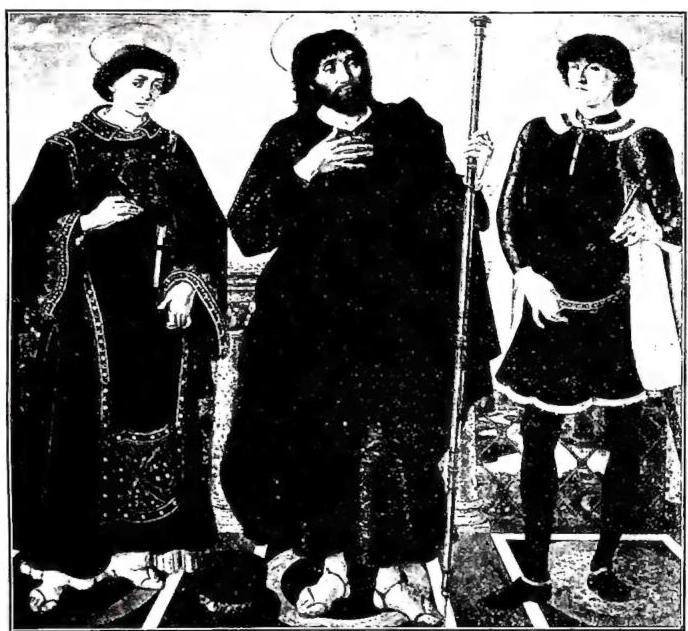
Both the works of goldsmithing and those of sculpture and painting due to P. manifest a unity of intent and meaning, in the energetic rhythm of the plastic and dynamic line: the St. Mary of Egypt of the pieve of Staggia, the admirable Female Portraits in profile: the one in Berlin (Staatliches Museum) and the other in the Poldi Pezzoli Museum in Milan; Tobias and the Archangel Raphael (Turin, Pinacoteca). In this work the collaboration of his brother Piero can still be excluded. The pictorial level remains high, e.g., in the Sts. Vincent, James and Eustace (Florence, Uffizi). Another fresco, in bad condition, typical for its sense of movement, is the frieze with the Dance of the Nudes in the Villa Gallina at Arcetri (Florence), which can be attributed to Antonio alone. It is
(phot. Alinari)
Works of genuine and intense spiritual value belong exclusively to him, such as the Donatellesque small David in Berlin (State Museum); the Apollo and Daphne in London (National Gallery); the Hercules and Deianira in the Jarves Museum (New Haven, U.S.A.); the two finished sketches for the Labors of Hercules, formerly in the Uffizi (lost after the Second World War). In these last paintings the "aerial" passage reflects the same vibrant, sensitive linear exaltation of the figures, and the ductus of the color of the impasto, which breaks up across the painted surface, also comes to its aid. As regards his activity as a sculptor, the monument to Sixtus IV fully exalts Antonio's style, and is all a nervous bundle of plastic elements. These qualities are attenuated in the monument to Innocent VIII, also in St. Peter's, owing to the predominance of his brother's collaboration. Parallel to the Labors of Hercules on canvas is the bronze of Hercules and Antaeus (Florence, Bargello), of incomparable dynamic and "expressionistic" effect. And at least the terracotta Bust of a Warrior, also in the Bargello, must be mentioned. Many drawings are attributed to Antonio and to his school, identifiable by the "functional" meaning of the contour line. Typical of Antonio are: the Adam and Eve (Uffizi), the Hercules and the Hydra in the British Museum; the Hercules and the Giants in the Cambridge Museum (U.S.A.), etc. From drawings by Antonio derive the Ricensi for S. Maria del Fiore (Museum of the Opera); the engraving of the Battle of the Nudes, etc.
Bibliography9 works
His brother, PIERO di JACOPO BENCI, was also a painter, born probably in 1443, died almost certainly in 1496 in Rome, buried with Antonio in S. Pietro in Vincoli.
He collaborated with his brother on the Labors of Hercules; on his own he executed (1469-70) the Virtues for the backrests of the seats of the Florentine tribunal of the Mercatanza. Here too, however, Antonio must have supplied the designs to his brother, as is proved by the cartoon for Charity. Piero executed Faith, Hope, Temperance, Justice, Prudence (Florence, Uffizi). In these allegories Piero is shown to follow in the footsteps of his brother's manner, more or less successfully. The artist displays a calmer figurative vision, resolved into smoother, more precious, limpid chromatic surfaces; at times with a sense of detail that presupposes a knowledge of Flemish painting. This is evident especially in the panel of the Annunciation, in the Berlin Museum. On the other hand, P. del P. also has a feminine type, characterized by a broader oval of the face, and at the same time full. Verrocchio also influenced him (van Marle), as appears from the St. Michael in the Gardini Museum, in Florence. Another work in which P. worked alone, engaging in a complex composition, is the panel of the Coronation of the Virgin, in the Collegiate Church of S. Gimignano, signed and dated "Piero del P. Florentino 1483". As a portraitist Pietro is recognized in certain female profiles: a Female Portrait in the Uffizi, another in the Pitti Gallery, a third in the National Gallery of London. He probably accompanied his brother Antonio to Rome in 1483, that is, when the latter was beginning the monument to Pope Sixtus IV. If Pietro collaborated on it, his intervention was certainly entirely material, given the genuine individuality of the work; whereas the shortcomings of the monument to Pope Innocent VIII reflect his extensive intervention.
Bibliography
Luigi Grassi