
NUOVA YORK, ARCIDIOCESI di. — City and archdiocese in the State of N. Y. The foundation of the diocese of N. Y. coincided with the multiplication of dioceses in the United States, when the diocese of Baltimore became, on 8 Apr. 1808, an ecclesiastical province with the following suffragan sees: N. Y., Philadelphia, Boston, and Bardstown (today Louisville). At the time of its creation, the see of N. Y. comprised the territories of the dioceses of Albany, Brooklyn, Buffalo, Ogdensburg, Rochester, Syracuse, Newark, and Trenton; that is, the entire State of N. Y. and also part of New Jersey.
Catholic life in the archdiocese is ancient, since it goes back to the explorers Verrazano and Gomez, who visited the shores of the Hudson River at the beginning of the sixteenth century. The Dutch Calvinists subsequently obtained the foundation of Hudson in order to establish a new colony there. To demonstrate their loyalty to the state church, the Calvinists decreed that the Christian Reformed religion should prevail according to the doctrines of the Synod of Dordrecht. The Catholic rite was therefore not tolerated, but the Dutch governor William Kieft and the inhabitants of New Amsterdam were very generous toward the Jesuit b. Isaac Jogues, the first priest to exercise the sacred ministry in the State of N. Y., and also toward his confrères Giuseppe Bressani and Simone Le Moyne. The first chapel in which Holy Mass was celebrated was begun on 18 Nov. 1655 by the Jesuits Claudio Dablom and Pietro Chaumonot under the title of S. Maria. The Church was established in Manhattan only in 1664, when the Duke of York claimed the territory as an English colony. Twenty years later the Catholic governor Tommaso Dongan favored religion and instituted religious freedom in N. Y.; the first Mass was celebrated on the Island on 30 Oct. 1683.
After the fall of James II and the succession of William of Orange, the Catholic colony of N. Y. suffered persecution; Catholics were excluded from public office and, in 1686, Lord Bellomont obtained the death penalty for Catholic priests. In 1690
all the hopes of the Church in the English colonies seemed to have vanished. The American Revolution, which was anti-Catholic, further aggravated the situation. But through the efforts of the French consul H. Saint-Jean de Crèvecoeur, an act of “incorporation” for the Catholic Church was obtained on 10 June 1785, and on 5 October of the same year the church of S. Pietro, the first permanent structure, was begun. The church was inaugurated on 4 Nov. 1786, and the first parish school was established in 1801. On 8 Apr. 1808, through the papal bulls Muneris and Ex debito pastoralis officii, Pius VII divided the diocese of Baltimore in order to form those of N. Y., Philadelphia, Boston, and Bardstown. In a letter dated 8 Nov. 1808, Fr. Antonio Kohlmann, S. J., vicar general of the bishop of Baltimore, stated that the Catholic population consisted chiefly of Irish, several hundred French, and many Germans, with a total population of approximately 14,000 souls.
When Msgr. Carroll (v.), bishop of Baltimore, learned that the Holy See wished to multiply the dioceses in the United States,
he proposed that N. Y. be placed under the jurisdiction of Boston until such time as a candidate for the see could be found. Following the recommendation of Msgr. Troy, archbishop of Dublin, the Pope appointed the Irish Dominican Riccardo Luca Concanen, prior of S. Clemente and librarian of the Minerva (Rome), known for his learning, as the first bishop of N. Y. Consecrated in Rome on 24 Apr. 1808, Msgr. Concanen died on 19 Feb. 1810, before he could reach his see; he had already proposed to the Pope that the Rev. Ambrogio Maréchal be appointed his coadjutor. However, Msgr. Troy subsequently proposed to the Pope the Dominican Giovanni Connoly, who was consecrated in Rome on 6 Nov. 1814 and arrived in N. Y. on 24 Nov. of the following year. Everything had yet to be created; there were only 4 priests, and in 1822 the diocese had 2 churches in N. Y., 1 in Albany, 1 in Utica, 1 in Carthage, 1 in Auburn, and 8 priests.
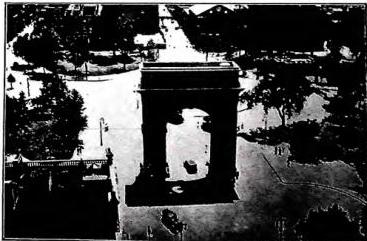
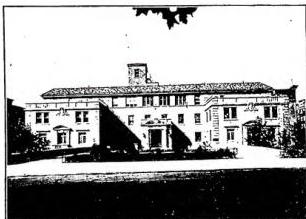
(phot. U.S.I.S.) NUOVA YORK, ARCIDIOCESI di — Washington’s Arch in N. Y.
(phot. U.S.L.S.)
The archdiocese comprises a territory of 4,717 square miles with a total population (1951) of 4,000,000 inhabitants, of whom 1,288,469 are Catholics. In addition to the cardinal archbishop, it has 4 auxiliary bishops, 2,205 priests (of whom 1,068 religious belonging to 20 different congregations), 387 parishes, quite a few of them Italian, 484 chapels, 80 missions, 993 brothers, 96 women’s congregations (with 8,047 sisters), 2 diocesan seminaries, 20 religious seminaries or scholasticates, 11 colleges and universities (including the celebrated Fordham University directed by the Jesuits) with 19,860 students, 11 orphanages, 15 general hospitals and 6 specialized hospitals, and 10 homes for the elderly. In 1949 there were 3,874 conversions.
The ecclesiastical province consists of N. Y., Albany (1847), Brooklyn (1853), Buffalo (1847), Ogdensburg (1872), Rochester (1868), and Syracuse (1886).
Gastone Carrière
L'UNIVERSITÀ DI FORDHAM. – Founded in 1841 near Fordham Road, N. Y., under the name of St. John’s College, by Msgr. Giov. Hughes, then auxiliary bishop of N. Y. and later its first archbishop. The College’s first president was Rev. G. McCloskey, later the second archbishop of N. Y. and the first cardinal of the United States. For the first five years the College was under the direction of the diocesan clergy, but in 1846 it was entrusted to the Jesuits, who came from Kentucky at the invitation of Msgr. Hughes. In those early years the diocesan Seminary was attached to St. John’s College, but in 1862 the Seminary was transferred elsewhere.
In 1906, faculties of law and medicine were added to the Faculty of Arts and Sciences, and in that year the College began to be called Fordham University. The Faculty of Medicine was suspended in 1921, but other faculties were subsequently added: pharmacy and commerce, as well as various schools: education, social service, and advanced studies (called Graduate). More recently, in 1950, an institute for contemporary Russian studies was established. Religious women from various congregations, who come to Fordham from every part of the United States, live in a separate residence, “St. Mary’s Hall.” Special courses and lectures are offered to certain students selected for their intellectual and moral abilities; enrolled in the so-called “Honors Program,” they study for one year at the Institut Catholique and the Sorbonne in Paris. It is thus hoped to form a superior type of Catholic “leader.”
Fordham University, from its humble beginnings in 1841, with only six students, to the present day, when it has approximately 13,000, including female students admitted to some faculties, has become a considerable force in the American university world. Among its 31,000 alumni are two cardinal-archbishops of N. Y., the eminent Farley and Spellman, more than twelve bishops, hundreds of priests and religious, politicians, generals, judges, diplomats, etc. In accordance with the custom of American universities, Fordham has also awarded honorary degrees to various distinguished figures, among them His Holiness Pius XII, who, during his visit to Fordham as cardinal secretary of state in 1936, received a degree in law there; Cardinals Tisserant and Griffin, Dr. Salazar of Portugal, President Truman, Hon. De Gasperi, and others also deserve mention.
As for publications, besides the university newspaper and various literary and cultural journals published by the students, the University’s professors exert a salutary influence in philosophical and cultural circles through the quarterly Thought, and in the field of law through the Fordham Law Review. The history section was recently commissioned to oversee the reprinting of The Catholic Encyclopedia.