
MASS. - It is the sacrifice of the New Law, in which, under the sacramental species, the same victim of Calvary, Jesus Christ, is offered to acknowledge God's supreme dominion and to apply to the faithful the merits acquired on the Cross.
The word missa is equivalent to missio (= "dismissal"); analogous cases are found in offensa-offensio, collecta-collectio, oblata-oblatio (cf. Ch. Du Cange, s.V. in Glossarium, ed. L. Favre, V, Paris 1938, p. 412). From the 4th century onward, the rite of dismissing the catechumens before the Offertory gave its name to the entire complex of ceremonies in which the Eucharistic Sacrifice is accomplished. St. Augustine explicitly refers to the ritual dismissal with the word missa: «Ecce post sermonem fit missa catechumenis, manebunt fideles» (Sermo 49, 8: PL 38, 324). St. Ambrose was perhaps the first to use the term missa in its current meaning (Ep. 20, 4: PL 16, 995). Other common explanations of the term M. appear unfounded (cf. K. Kellner, L'anno ecclesiastico, trans. by A. Mercati, Rome 1914, pp. 73-80; G. Brinktrine, La S. M., trans. by G. Sölch and A. Pintonello, ibid. 1945, pp. 11-12; G. F., Quel est le sens étymologique du mot Messe: renvoi ou repos sacré?, in L'ami du clergé, 59 [1949], pp. 293-95). The Greeks designate the altar sacrifice with μυσταγωγία ("mysteric action"), ἱερουργία ("sacred action"), λειτουργία ("public action").
SUMMARY:
I. The Mass in dogmatic theology
II. The Mass in moral theology and canon law
III. The Mass in the Latin liturgy
IV. The Mass in the Eastern liturgy
The chants of the Mass.I. THE MASS IN DOGMATIC THEOLOGY.
SUMMARY:
I. The sacrificial nature of the Mass
II. The nature of the Sacrifice of the Mass
III. The Mass in the economy of salvation.I. THE SACRIFICIAL NATURE OF THE MASS
1. Errors
The exaggerated spiritualism of the medieval sects resulted in a decisive denial of the Mass as a sacrificial rite. Already at the Council of Arras (1025), Gerard, CAMBIO (v.), condemned the «novam haereses sectam» that, rejecting the entire sacramental system, also denied the sacrificial nature of the Eucharist (PL 142, 1271-78). In the following century, Peter of Bruys was stigmatized by Peter the Venerable as a denigrator of the Christian people, from whom he withheld the glory of the Eucharistic Sacrifice (Contra Petrobrusianos: PL 189, 787-89).At the beginning of the 13th century, the Albigensians formulated their denial in a concise phrase, reported by Durand of Mende: «Nec Christus nec Apostoli eam (Missam) instituerunt» (Rationale divinorum officiorum, IV, 1, Lyon 1672, p. 88). The Council of Constance condemned a proposition in which Wycliff had condensed the medieval denials: «Non est fundatum in Evangelio, quod Christus Missam ordinaverit» (Denz-U, 585).
In the 16th century, Protestants, with the unhidden desire to overthrow the greatest defense of the papacy («Triumphata Missa, puto nos totum Papam triumphare»: Luthers Werke, ed. Weimar, X b, p. 220), advanced specious biblical arguments to shake faith in the divine origin of the Mass. Luther relied on the word testamentum used by Christ at the Last Supper: «Non enim Christus cum condere testamentum, illud obtulit Deo Patri» (De captivitate babylonica, ed. Weimar, VI, p. 523). Melanchthon, starting from the clause in Hebr. 10:14: «Una oblazione consummavit in sempiternum sanctificatos», concluded that the sacrifice of the Cross was absolutely unique and consequently denied the Mass: «Sola igitur Christi mors fuit sacrificium... non alia opera levitica aut postea secuta» (Loci theologici communes, Basel 1561, p. 416). Zwingli, placing in the definition of sacrifice the idea of a physical and bloody immolation, believed he had easily disposed of the Mass: «Christus illic tantum offertur ubi patitur, sanguinem fundit... Christus non potest ultra mori, sanguinem fundere, ergo Christus ultra offerri non potest» (Adv. H. Emserum antibolom, in Opera omnia, I, Zurich 1928, p. 142). Calvin, while preserving for the Eucharist the idea of a remembrance (memoria) of the sacrifice of Calvary, rejected the Mass with fiery words: «Horrendae abominationis caput fuit... quum pestilentissimo errore totum paene orbem obcecavit Satan, ut credere Missam sacrificium esse» (Institutio relig. christ., IV, 18). This doctrine of the early reformers became official in the various Protestant confessions, including the Anglican (cf. Confessio Westmonasteriensis prima, p. 31). Nevertheless, especially in England, there were isolated proponents of the sacrificial nature of the Mass, e.g., Grabe and Leibniz (18th century), Gore, Frankland, Warfield, Goetz, Herbert (20th century). At the beginning of this century, two Catholic writers, F. Renz (Die Geschichte des Messopferbegriffs oder der alte Glaube und die neuen Theorien über das Wesen des unblutigen Opfers, 2 vols., Munich 1901-1902) and especially F. Wieland (Mensa und Confessio. Studien über den Altar der altchristlichen Liturgie, 2 vols., ibid. 1906) supported ideas similar to those of Protestants. According to Wieland, the New Testament knows only the sacrifice of the Cross, of which the Eucharist is a figure. Only in the 2nd century did Irenaeus introduce the idea of an oblation, while in the two preceding centuries the Eucharist was considered a simple prayer.
Liberal Protestantism and rationalism, with a new tactic, have attempted to eliminate the entire Eucharistic phenomenon (v. EUCARISTIA). It is necessary to mention two theories directly aimed at explaining, through evolution, the appearance of a sacrificial rite linked to the Eucharist. According to G. P. Wetter (Altchristliche Liturgien, 2 vols., Göttingen 1921-22), at the dawn of Christianity the Eucharistic supper was a domestic celebration, prepared by one or another of the faithful. As the primitive community developed, the need was felt for all the faithful to contribute to the common banquet. The offering of food was soon enriched with ceremonial and accompanied by moving prayers. Later, the rite of the offering, for various reasons, slowly disappeared, but the liturgical formulas remained, which were applied to the bread and wine, now the only surviving elements of the primitive banquet, and under the influence of the mystery conception, it began to be believed that the presence of the Body and Blood of Jesus was linked to the two elements. Thus the Catholic Mass was born.
According to H. Lietzmann (Messe und Herrenmahl. Eine Studie zur Geschichte der Liturgie, Bonn 1926), there were two primitive types of liturgy: the Palestinian type (represented by the Didaché and the anaphora of Serapion), having no relation to the Last Supper, is to be considered as the repetition of the ordinary meals that Jesus took with his disciples. In the fraternal agapes, soon introduced by the Apostles after the Master's death, it was believed that the Lord was spiritually present; then, under the influence of Hellenism, the supper was considered a sacrifice. The Pauline type (represented by I Cor. 10 and 11 and the Traditio Apostolica of Hippolytus) is in direct relation to the Last Supper, in which Jesus, breaking the bread, symbolized the imminent torment to which his Body would be subjected. The disciples renewed the rite as a remembrance of Christ's Passion and, under the influence of Hellenic mysteries, believed they were mystically united with the divine victim, whom they later believed to be present. This conception spread throughout the regions of the Pauline apostolate and prevailed in the Roman Church, originating the Mass as it is known today in Catholicism.
2. Catholic Doctrine. — The Council of Trent (sess. XII, cann. 1-4) established the Church's teaching in dense and lapidary formulas, with which it condemned all shades of Protestant error: can. 1: «If anyone says that in the Mass a true and proper sacrifice is not offered to God, or that this oblation is nothing other than partaking of Christ, let him be anathema»; can. 2: «If anyone says that with those words: Do this in memory of me (Lk. 22:19; I Cor. 11:24), Jesus Christ did not constitute the Apostles as priests and did not order that they and other priests offer his Body and Blood, let him be anathema»; can. 3: «If anyone says that the Sacrifice of the Mass is only one of praise and thanksgiving or a bare commemoration of the sacrifice of the Cross and not truly propitiatory, or that it benefits only the one who partakes of it and that it should not be offered for the living and the dead, for sins, punishments, satisfactions, and other necessities, let him be anathema»; can. 4: «If anyone says that by the Sacrifice of the Mass the most holy Sacrifice of the Cross is blasphemed or that it is detracted from, let him be anathema» (Denz-U, 948-51). These definitions are preceded and followed by numerous other documents of the ecclesiastical magisterium (cf. Denz-U, 424, 430, 435, 441, 464, 698, 1045, 1528, 2049; Leo XII, encyc. Mirae caritatis [18 May 1902]; Pius XII, encyc. Mediator Dei [20 Nov. 1947]).
3. Proofs of Catholic Doctrine. — The sacrificial nature of the Eucharistic rite is affirmed several times in the documents of Revelation.
a) Scripture. — In the Old Testament, the Fathers discerned figures (e.g., the paschal lamb: Ex. 12:17; Deut. 16:17) and allusions (e.g., Ps. 21:23: «adorabunt et manducabunt»; Is. 19:19: «in illa die erit altare Domini in medio terrae»; Dan. 3:39; 12:11) to the Eucharistic Sacrifice. Today, two texts are considered true prophecies of the Mass, upon which the attention of the Church and theologians has concentrated: Ps. 109:4: «Tu es sacerdos in aeternum secundum ordinem Melchisedech». The psalm, universally regarded as messianic, affirms three things: Christ is a priest and therefore offers sacrifice; He will fulfill this priestly function forever; His sacrificial offering will be made according to the rite of Melchisedech. In Gen. 14:18, according to the Hebrew text, we read: «Melchisedech, rex Salem, protulit panem et vinum; erat autem sacerdos Dei Altissimi et benedixit ei (= Abrahae)». It is certain that the Hebrew word hōsī («protulit») can indicate either a sacrificial offering or the presentation of food for an ordinary meal; however, the clause «et erat sacerdos Altissimi» suggests the idea of a sacrificial oblation of bread and wine, made by Melchisedech for Abraham’s victory, especially since the mention of Melchisedech’s priesthood to explain the subsequent phrase «et benedixit ei» would have been superfluous, for in the Semitic concept, blessing was not reserved to priests. This interpretation is accepted by the Vulgate, the Canon of the Roman Mass, and the Holy Fathers with unanimous consent. This prophecy can be considered fully verified only under the assumption that the Mass is a true sacrifice; indeed, only in the daily offering of consecrated bread and wine does Christ appear as a priest who perpetually offers a sacrifice according to the rite of Melchisedech.
Malachi (5th century B.C.), rebuking the lukewarmness of the Old Testament priests who offered defective goods (blind, lame animals), expresses himself thus: «I have no pleasure in you, says the Lord of hosts, and I will not accept an offering from your hand. For from the rising of the sun to its setting my name is great among the nations, and in every place incense is offered to my name, and a pure offering; for my name is great among the nations, says the Lord of hosts» (Mal. 1:10-11).
In this prophecy, a true sacrifice is spoken of (as evidenced by the terminology muqār: «adoletur»; muqāf: «offertur»; minhāh: «oblatio»), which will be offered in the messianic age, characterized by the abrogation of the Levitical system («non est mihi voluntas in vobis... et munus non suscipiam de manu vestra»), by universality («ab ortu enim solis usque ad occasum magnum est nomen meum in gentibus et in omni loco sacrificatur»), and by holiness («offertur nomini meo oblatio munda»). The prophetic vision, which beneath the vast arc of Yahweh’s glory discerns the dawn of peoples emerging from darkness to offer a pure sacrifice to the one God, finds its perfect fulfillment in the Mass, which from every corner of the earth and from all nations is offered as «hostia immaculata» to the Lord.
The New Testament offers certain indications and apodictic testimonies. At the Last Supper, Jesus performed a true sacrifice when He said that His Body was «given» («Hoc est corpus meum, quod pro vobis datur»: Lk. 22:19) and His Blood was «poured out» («Hic est Sanguis meus Novi Testamenti, qui pro multis effunditur in remissionem peccatorum»: Mt. 26:28), since in biblical language these two expressions, even when taken separately (for the traditio corporis cf. Is. 53:12; Mt. 20:28; Rom. 8:32; Gal. 1:4; 2:20; Eph. 5:25; I Tim. 2:6; Tit. 2:14; Hebr. 10:10; for the effusio sanguinis cf. Rom. 3:25; 5:9; Eph. 1:7; I Cor. 14:20; Hebr. 9:7; I Pt. 1:19; I Io. 1:7), always indicate a sacrificial immolation. Nor can it be held that the Lord intended to allude to the imminent sacrifice of the Cross (as the Vulgate text: effundetur [*Mt. 26:28] might suggest), since the present participle (διδόμενον: «datur»; ἐκχυννόμενον: «effunditur») refers to what was happening at the very moment Jesus spoke. At that very instant, Christ gave the command to renew that sacrificial rite: «Hoc facite in meam commemorationem» (Lk. 22:19; I Cor.* 11:24). The Church, therefore, by repeating the Eucharistic gesture of her Founder, performs a true and proper sacrifice, the very one that Jesus offered.
This sacrificial interpretation of the Last Supper is effectively confirmed by other expressions in the context: Lk. 22:19: «Quod pro vobis datur: τὸ ὑπὲρ ὑμῶν διδόμενον»: the Lord’s Body is not only offered as food to the disciples («illis»), but also given for them («pro illis»), an evident allusion to the sacrificial character of the rite. The text of Lk. 22:20: «Calix novum foedus est in Sanguine meo, qui pro vobis effunditur: τὸ ποτήριον ἡ καινὴ διαθήκη ἐν τῷ αἵματί μου, τὸ ὑπὲρ ὑμῶν ἐκχυννόμενον», especially in its Greek construction, indicates that the Blood is poured out as contained in the Eucharistic chalice. In the same clause, the New Covenant is considered established in the Eucharistic Blood, with a manifest allusion to Ex. 28:8: «Hic est sanguis foederis, quod pepigit Dominus vobiscum». The two Covenants are seen in the sacrificial perspective of the effusion of the victims’ blood. Within this same framework, the Eucharist is regarded as the new Passover, which, in the Blood of the one Lamb who takes away the sin of the world (Io. 1:29), brings to an end the innumerable sacrifices of the Law.
St. Paul aligns with the evangelical testimonies: I Cor. 10:20-21: «Quae immolant gentes, daemonis immolant et non Deo. Nolo vos socios fieri daemoniorum: non potestis calicem Domini bibere et calicem daemoniorum: non»
MASS - Last Supper. Enamelled copper bas-relief from Limoges (13th century).
Paris, Musée de Cluny.
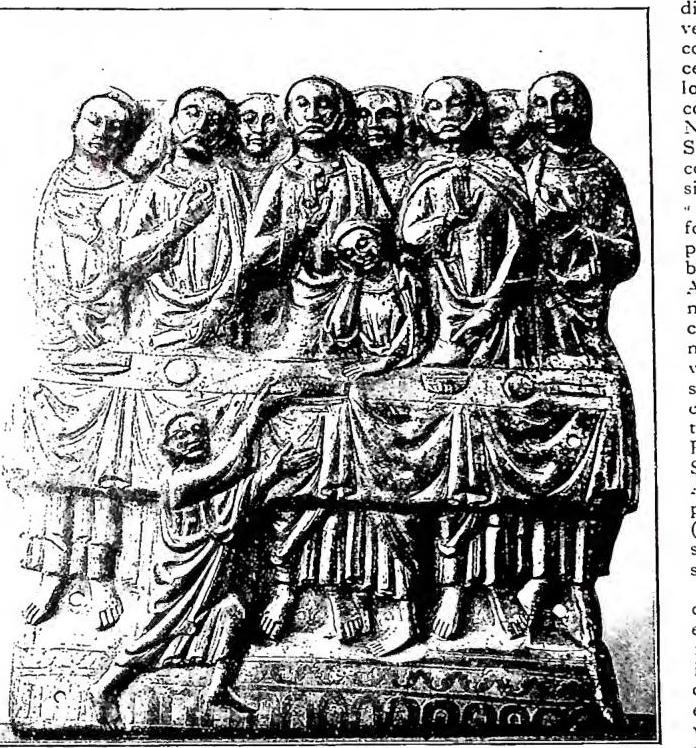
Another transparent allusion to the Sacrifice of the Mass is found in Heb. 13:10: “We have an altar, from which those who serve the tabernacle have no right to eat.” Indeed, the realistic verb φαγεῖν (“to eat”) naturally directs thought to the Eucharistic altar, where the victim is truly consumed, rather than to the altar of the Cross, whose victim can be said to be eaten only metaphorically (cf. Teodorico da Castel S. Pietro, La Chiesa nella lettera agli Ebrei, Rome 1945, pp. 225-30).
b) Tradition. - The Church, obedient to the Lord’s command: “Do this in memory of me” (Lk. 22:19; I Cor. 11:24), immediately celebrated the Eucharist in Jerusalem (Acts 2:42), at Troas (ibid. 20:7-11), at Corinth (I Cor. 10-11), and in all the places of its conquests. From the beginning, it surrounded the rite of the fractio panis (v. FRACTIO PANIS) with ceremonies and prayers, in which, in simple form, the common faith expressed the sacrificial nature of the Eucharistic worship: the Didaché (14:1-3) affirmed that the κλάσις τοῦ ἄρτου is the sacrifice (ἡ θυσία) foretold by Malachi. St. Justin provided its first liturgical description (I Apol., 65-67), St. Hippolytus (Traditio apostolica) the first Roman canon (oblatio Ecclesiae), Serapion (Euchologion) the first Eastern anaphora (“sacrificium”: θυσία; “obtulimus”: προηγένεχομεν).
The Holy Fathers, in agreement with liturgical tradition and New Testament data, offer a detailed testimony on the sacrificial nature of the Eucharist and its constitutive elements. They hold, in fact, that the Mass is:
α) a true and proper sacrifice: St. Irenaeus (Adv. haeres., 4, 18, 1-2 [PG 7, 1024-25]: “Ecclesiae oblatio... sacrificia in populo [Iudaico], sacrificia in Ecclesia”); St. Hippolytus (In Danielam, 22 [PG 10, 656]: “Sacrificium et libamen, quod ubique locorum offertur Deo”); Tertullian (De oratione, 19 [PL 1, 1182-83]: “Ara Dei... participatio sacrificii”); St. Cyprian (Ep., 63, 14 [PL 4, 397]: “Sacrificium verum et plenum”; “Summum verumque sacrificium... verissimum et singulare sacrificium”); St. Augustine (De civitate Dei, 10, 20: PL 41, 298; De spiritu et littera, 11: PL 44, 211).
β) foretold and prefigured in the Old Testament: Didaché, 14:1-2; St. Justin (Dial. cum Tryphone, 116-117: PG 6, 746); St. Irenaeus (Adv. haeres., 4, 17, 5: PG 7, 1023; ibid., 4, 18 [PG 7, 1024]: “Oblationes enim et illic, oblationes autem et hic”); St. Cyprian (Ep., 63, 4 [PL 4, 38]: “Christus obtulit hoc idem quod Melchisedech obtulerat, idest panem et vinum, suum scilicet Corpus et Sanguinem”); St. Augustine (De Civitate Dei, 17, 20 [PL 41, 556]: “Id enim sacrificium successit omnibus illis sacrificiis Veteris Testamenti, quae immolabantur in umbra futuri”).
γ) instituted by Jesus Christ at the Last Supper: St. Irenaeus (Adv. haeres., 4, 17, 5: 18, 1 [PG 7, 1023-24]: “Christus... Novi Testamenti novam docuit oblationem, quam Ecclesia ab Apostolis accipiens in universo mundo offert Deo... Ecclesiae oblatio, quam Dominus docuit offerre in universo mundo”); St. Cyprian (Ep., 63, 1 [PL 4, 373]: “Christus, Dominus et Deus noster, sacrificii huius auctor et doctor”); Eusebius of Caesarea (Demonstr. evang., 1, 10 [PG 22, 90]: “Eiusque rei [Passionis] memoriam, ut nos ipsi Deo pro sacrificio offerremus, instituit”).
In addition to repeating these data of simple faith (ὑλλὰ πίστες), the Fathers, especially those of the golden age, sketched a theologia sacrificalis, in which all the elements of the Redemption are harmonized:
α) Christ, truly present under the species of bread and wine (v. EUCHARIST), is the priest and the victim of the Eucharistic Sacrifice: St. Ephrem (ed. Th. J. Lamy, S. Ephrem sermones et hymni, I, Malines 1882, p. 660: “Ipse altare et agnus, victima et sacrificator, sacerdos et esca”); St. Augustine (De civitate Dei, 10, 20 [PL 41, 298]: “Christus sacerdos est, ipse offerens, ipse et oblatio”).
β) as priest, He offers invisibly: St. Gregory of Nyssa (In Christi resurr. oratio, 1 [PG 46, 611]: “Christus arcano sacrificii genere, quod ab hominibus cerni non poterat, seipsum pro nobis hostiam offert et victimam immolat, sacerdos simul existens et agnus Dei”). The mysterious work of the divine Offerer appears externally through the sensible oblation of His ministers: St. Cyprian (Ep., 63, 14 [PL 4, 385]: “Utrique ille sacerdos vice Christi vere fungitur, qui id quod Christus fecit imitatur et sacrificium verum et plenum tunc offert in Ecclesia Deo Patri, si sic incipiat offerre secundum quod ipsum Christum videat obtulisse”); St. Ambrose (Enarr. in Ps., 38, 25 [PL 14, 1051-52]: “Sequimur, ut possumus, sacerdotes, ut offeramus pro populo sacrificium... quia etsi nunc Christus non videtur offerre, tamen ipse offertur in terris quando Corpus Christi offertur; immo ipse offerre manifestatur in nobis, cuius sermo sanctificat sacrificium, quod offertur”).
γ) as victim, He is immolated anew, unbloodily, mystice, in the Sacrament, in mysterio: Tertullian (De pudicitia, 9 [PL 2, 1050]: “Rursus mactabitur Christus”); St. Gregory of Nazianzus (Ep., 171 [PG 37, 279]: “Quando incruenta sectione secaveris Corpus et Sanguinem dominicum, vocem adhibens pro gladio”); Gregory of Nyssa (In Christi resurr. oratio, 1 [PL 46, 611]: “In cena iam arcana et non aspectabili ratione Corpus erat immolatum”); St. Ambrose (De officiis, 1, 48 [PL 16, 94]: “Nunc Christus offertur, sed offertur quasi homo, quasi recipiens passionem... hoc in imagine”); St. Cyril of Jerusalem (Catech., 23, 10 [PG 33, 1118]: “Christum mactatum offerimus”); St. John Chrysostom (De sacerdotio, 3, 4 [PG 48, 642]: “Cum videris Dominum immolatum et iacentem”); St. Cyril of Alexandria (De adoratione in spiritu et veritate, 10 [PG 68, 707]: “Christus... mystice sacrificatus a nobis et pro nobis offertur”). St. Augustine summarizes the patristic teaching in a phrase rich in content: “Nonne semel immolatus est Christus in seipso? Et tamen in Sacramento omni die populis immolatur” (Ep., 99, 9: PL 33, 363).
The unbloody and sacramental immolation represents the bloody death of Calvary and perpetually renews its memory: St. Cyprian (Ep., 63, 17 [PL 4, 387]: “Passionis eius mentionem in Sacrificiis omnibus facimus, Passio est enim Domini Sacrificium quod offerimus”); Eusebius of Caesarea (Demonstr. evangelica, 1, 10 [PG 22, 90]: “Eiusque rei memoriam... instituit”); St. Ambrose (De fide ad Gratianum, 4, 10 [PL 16, 641]: “Quotiescumque Sacramenta sumimus... mortem Domini annuntiamus”); Serapion of Thmuis (4th century; Anaphora eucharistica, 4, in C. Kirsch, Enchiridion historiae ecclesiasticae, 5th ed., Freiburg im Br. 1941, n. 479: “Propterea et nos similitudinem mortis [τὸ ὑμύλομεν τοῦ θανάτου] celebrantes, panem obtulimus”); St. Augustine (De Trinitate, 3, 4 [PL 42, 873]: “Corpus Christi et Sanguinem... rite sumimus in memoriam pro nobis dominicae Passionis”).
At the end of the 6th century, St. Gregory the Great, gathering all the elements of Tradition, constructed a particularly felicitous synthesis: “Haec victima... illam nobis mortem Unigeniti per mysterium reparat, qui licet resurgens a mortuis iam non moritur et mors ei ultra non dominatur (Rom. 6:9), tamen in semetipso immortaliter et incorruptibiliter vivens, pro nobis iterum in hoc mysterio sacrae oblationis immolatur... Hoc sacrificium... Passionem Unigeniti Filii semper imitatur” (Dial., 4, 58: PL 77, 425).
BIBL.:
J. DE GUIBERT, Theologia dogmatica catholica, Rome 1946, pp. 353-402; M. DE LA TAILLE, Mysterium Fidei, Paris 1921; J. BRINKTRINE, Die Lehre von der Eucharistie, Paderborn 1933; A. MICHEL, V. EUCHARISTIE, in Dictionnaire de Théologie Catholique, V, coll. 1111-1642; H. LENNERZ, De Sacrificio Missae, Rome 1945; J. JUNGMANN, Missarum Sollemnia, Vienna 1948; A. D'ALÈS, L'Eucharistie, Paris 1927; P. BATIFFOL, L'Eucharistie, Paris 1927; L. LIGIER, La Confirmation. Sens et conjoncture œcuménique hier et aujourd'hui, Paris 1973; G. DIX, The Shape of the Liturgy, London 1945; J. BETZ, Eucharistie in der Schrift und Patristik, Freiburg 1955; J. RATZINGER, Das Problem der Transsubstantiation und der Begriff der Verwandlung, in Theologische Quartalschrift, 147 (1967), pp. 1-12.
A. PIOLANTI
The symbolism of Ratramnus, which in its origin and early development likely remained within the bounds of orthodoxy, in the 11th century, taken to extremes by Berengarius of Tours (v. BERENGARIO), led to the denial of the real presence and the consequent absolute subjectivization of the Sacrifice (cf. Berengarius, De S. Coena, ed. W. H. Beekenkamp, Aia 1941, passim).
Then, through the work of eminent theologians (Lanfranc of Bec, Guimond of Aversa, Gregory of Bergamo, Alger of Liège), traditional realism, in the line of Paschasius Radbertus, was tenaciously reasserted, and in the centu-
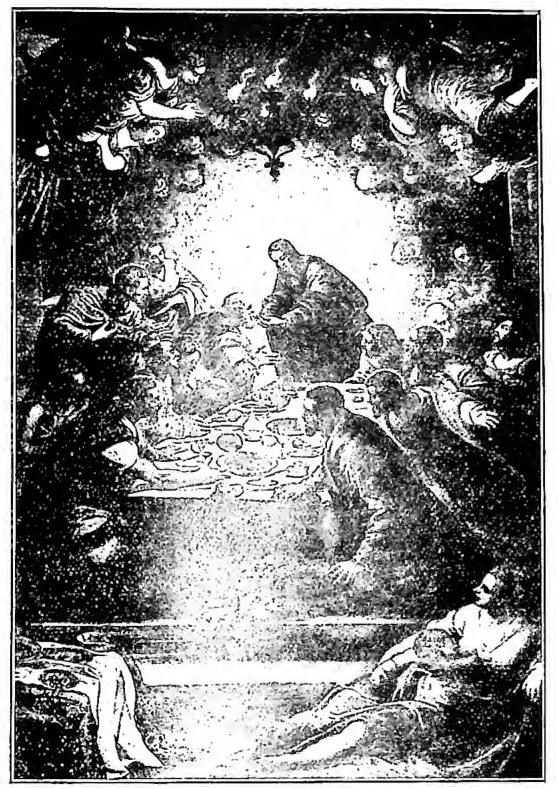
MESSA - Last Supper. Painting by Tintoretto (2nd half of the 16th century). (photo: Alinari)
and flourishes under the pen of Stefano di Beaugé (de Balgiaco), in the Tractatus de Sacramento altaris (PL 172, 1280: «Christus quotidie sine vulnere sacrificatur»), of Gratian (Decretum, dist. II, de cons., cap. 51 [PL 187, 1755]): «Non mentiri eum, qui dicit Christum impassibilem et immortalem quotidie in Sacramento immolari», and of Peter Lombard (IV Sent. d. 12, c. 5; 2nd ed., II, Quaracchi 1916, p. 812-14), until, in the swift synthesis of St. Thomas, it harmonizes, almost in a complete system, with the symbolism of the Fathers («memoria»: ἀνάμνησις). Indeed, the Aquinate, in brief and concise phrases, summarized and fused all the elements of Revelation: «Eucharistia est Sacramentum perfectum dominicae Passionis, tamquam continens ipsum Christum passum» (Sum. Theol., 3ª, q. 73, a. 5, ad 2), and lest the expression be understood in the Berengarian sense, he added: «Continent ipsum Christum passum, non solum in significatione et figura sed etiam in rei veritate» (ibid., q. 75, a. 1). Christ, truly present, is in a state of victim (passus), since in every Mass He is immolated: «Proprium est huic Sacramento, quod in eius celebratione Christus immoletur» (ibid., q. 83, a. 1). Such immolation recalls and represents the death on the Cross: «Per hoc Sacramentum repraesentatur Passio Christi» (ibid., q. 79, a. 2), insofar as in the Consecration the sacramental separation of the Body from the Blood occurs: «Repraesentatio dominicae Passionis agitur in ipsa Consecratione» (ibid., q. 80, a. 12, ad 3).
Three centuries later, in a period of stormy controversies, the Council of Trent took up the Thomistic themes and fixed them in sess. XXII, in one of the most beautiful pages of Eucharistic literature: «In caena novissima, qua nocte tradebatur, ut dilectae sponsae suae Ecclesiae visibile relinqueret sacrificium, quo cruentum illud semel in Cruce peragendum repraesentatur eiusque memoria in finem usque saeculi permaneret... novum Pascha instituti seipsum ab Ecclesia per sacerdotes sub signis visibilibus immolandum» (Denz-U, 938).
II. THE NATURE OF THE SACRIFICE OF THE MASS
Until the negations of Protestantism, no one had deliberately studied the intimate nature of the Eucharistic Sacrifice. When, under the pressure of circumstances, theologians set about this task, the Council of Trent, gathering the data of Revelation as explained by the Fathers and the Scholastics, established certain principles destined to be the polestar of all further inquiry. After implicitly establishing (sess. XII, chaps. 1-2; Denz-U, 939-40) that the Sacrifice of the Mass is realized in the consecration of the two species, it specifies: a) that in that central act of the liturgy there occurs a bloodless immolation, numerically distinct from that of Calvary: «In hoc divino sacrificio quod in Missa peragitur idem ille Christus continetur et incruente immolatur, qui in ara crucis semel seipsum cruente obtulit» (sess. XXII, chap. 2; Denz-U, 940); b) that the Eucharistic immolation represents and recalls that bloody immolation of the Cross: «Quo cruentum illud semel in Cruce peragendum repraesentatur eiusque memoria in finem usque saeculi permaneret» (ibid., chap. 1; Denz-U, 938); c) that the immolation of the Mass is sacramental since «sub signis et symbolis»: «Seipsum sub signis visibilibus immolandum... sub earundem rerum (panis et vini) symbolis offerent» (ibid., chap. 1; Denz-U, 938).The path was marked, but not everyone followed II. Alongside the traditional vein of immolation «sub signis et symbolis», theories and systems developed that, by clinging to only one part of the complex sacrificial doctrine, either exaggerated its significance or diminished its content.
1. Systems of physical immolation. – The Protestants, especially Zwingli, posited the principle that a true sacrifice implies a physical immolation, directly affecting the victim. The principle was false, but, due to a misunderstanding explainable in the heat of polemics, some Catholics accepted it, and each sought to discover in the Mass an element that would satisfy this requirement.
St. Robert Bellarmine (De Missa, I, 27) held that in the priest’s Communion a physical destruction occurs, since the Eucharistic Body of Jesus, as the species advance, loses its «essere sacramentale». F. Suárez (De Eucharistia, disp. 73, sect. 1; disp. 75, sect. 5) argued that at the moment of Consecration the substance of the bread is destroyed and the substance of the Body of Christ is reproduced; in such a reproductive and «in melius immutativa» destruction, he believed he had found the essential element of the Eucharistic Sacrifice.
G. B. Franzelin (De Eucharistia, 5th ed. edited by G. Filograssi, Rome 1932, pp. 451-55), developing the thought of F. Lugo (De Eucharistia, disp. 19, sect. 5), held that in the Mass the Lord’s Body, besides being subject to an external destruction insofar as it is reduced «in statum declivorem», internally suffers an «exinanitio» (κένωσις), superior to that of the Cross, since, stripped of its corporeal extension (quantitas magnitudinalis), it is deprived of the exercise of the senses.
Each of these theories rests on the false presupposition (v. EUCARISTIA) that in transubstantiation or in Communion the Body of Christ is affected, or something belonging to Him is destroyed. Moreover, they prove radically unsuited to providing that relationship of likeness between the Mass and the Cross, a requirement of Revelation, and are incapable of evoking the idea of that sursum actio or «anaforia», inherent in the very concept of sacrifice.
2. Theories of oblation. – At the end of the 19th century, during the flourishing of the history of religions and under the influence of the historical-cultural school of Wilhelm Schmidt, some theologians, who connected with the sacrificial tradition of Bérulle and Olier (French school), believed that the essence of sacrifice in general consisted in the offering. They also believed that the simple act of oblation was the guiding thread of the history of human sacrifices, from the offerings of the firstfruits among the Pygmies to the sacrifice-gift of many classical religions, from the oblationes of the Old Testament (showbread, handfuls of barley on the day of Pentecost) to the «oblates» of Christian liturgy: an idea crystallized in the προσφόρο of the Greeks and the offero of the Latins. G. Graneris (La religione nella storia delle religioni, Turin 1935, p. 244) compared the history of sacrifice to a single trunk of oblation, onto which frequent grafts of immolation had been made over the centuries.
This current of ideas, transposed into the theological plane, gave rise to two strong syntheses on the essence of the Eucharistic Sacrifice. M. de la Taille (v.) holds (Mysterium fidei. De augustissimo Eucharistiae Sacrificio atque Sacramento, 3rd ed., Paris 1931) that every sacrifice, after the fall of Adam, consists of three elements: the external and liturgical oblation (essential and primordial element), immolation (accessory element, in the hypothesis of sin), and consummation, that is, the sensible acceptance by God (complementary element); immolation can precede, accompany, or follow the oblation, so that the sacrifice can be the oblation of a thing already immolated in the past, or immolated in the present, or to be immolated in the future.
The redemptive sacrifice of Christ, which was expiatory for the sin of Adam, had its external and liturgical oblation in the Last Supper, its bloody immolation on Calvary; the Supper and the Cross therefore form a single reality, united as matter and form to constitute the one Sacrifice of Redemption: «La Cène et la Passion se répondent et se compénèrent l'une l'autre. L'une présente à nos regards l'oblation sacerdotale, sensible, rituelle, que constitue l'immolation mystique; l'autre vient y ajouter l'immolation réelle, sanglante, pleinement suffisante, dont la première était l'image. Au Cénacle, parmi le décor de splendeur qu'il a affecté, le Christ est principalement prêtre; au Calvaire, dans son silence et sa nudité, il est principalement victime... La passion est immolatio hostiae oblatae, la Cène est oblatio hostiae immolandae»» (id., Esquisse du Mystère de la Foi, Paris 1924, pp. 12-13; cf. Mysterium Fidei*, 3rd ed., ibid. 1931, p. 701).
Offered at the Supper, immolated on the Cross, the sacrifice of Christ reached its perfection (consummatio) in the Resurrection and Ascension and endures eternally not actively, but passively, insofar as the humanity of the Savior remains in the state of victim «Agnus tamquam occisus», forever accepted by the Father, who by crowning the humanity of His Son with glory visibly shows His perpetual acceptance of the sacrifice; therefore, Christ in heaven, though glorious, is in an immolated state before the eyes of God: «est ergo Christus hostia, antecedenter ad nostram oblationem, penes seipsum» (op. cit., p. 151).
The Mass is nothing other than the liturgical oblation, made actualiter only by the Church, of the bloody immolation that occurred once on the Cross but now passively perseveres before the divine Majesty: that is, the Church, by taking possession through transubstantiation of the Body of Christ in its immolated state, offers it in that condition to the Father and thus accomplishes a true sacrifice, namely the actual and present oblation (Altar) of a past immolation (Cross) but passively persevering (Heaven).
The system of this brilliant theologian enjoys great organic coherence, which is a strength but also a weakness, for if one point fails, the entire edifice collapses. Many points, in fact, do not withstand criticism. The numerical unity of the sacrifice of the Supper and that of the Cross is «inaudita a saeculo», as the author himself candidly confesses (op. cit., p. 30). Such unity is openly contradicted by the Council of Trent, which sees in the Supper and the Cross two complete and distinct sacrifices (Denz-U, n. 940). As Ch.-V. Héris observes (Il mistero di Cri-)
The sacrifice of the New Law, in which, under the sacramental species, the same sacrifice of the Cross is "unheard of from the ages," as the author himself candidly confesses (op. cit., p. 30). This unity is openly contradicted by the Council of Trent, which sees in the Last Supper and on the Cross two complete and distinct sacrifices (Denz-U, n. 940). As Ch.-V. Héris observes (Il mistero di Cristo, Italian trans., Brescia 1938, p. 268), by seeking to integrate the Eucharistic consecration of the Last Supper with the sacrifice of Calvary, two realities of a different order are united—one sacramental and the other physical. Moreover, even overlooking the immolatory state of Christ in heaven (far from proven), the Mass cannot be reduced to a simple ritual oblation on the part of the Church, since the Council of Trent (Denz-U, 940) requires a new oblation and a new immolation on the part of Christ Himself.
In this perspective, the Mass is nothing other than the ritual oblation, made by the Church, of the interior offering that Jesus currently elevates toward the Father under the Eucharistic species. The Church apprehends the internal sacrifice of Christ, in the mystery of the Consecration, and makes it her own, as the body associates itself with the sentiments of the Head, to offer it to the Father under the sensible symbols of sacramental immolation; or rather, it is Christ who draws the oblation of the Church into the orbit of His offering, ennobling and unifying it: "Ainsi le Christ n'ajoute pas son offrande à celle de l'Eglise : il s'incorpore cette première offrande, l'absorbe et la convertit en la sienne, de telle sorte que l'offrande de l'Eglise devient l'offrande même du Christ" (op. cit., p. 755).
Yet even this conception, however seductive and presented with solemn historical apparatus by the learned Sulpician, has faced no small criticisms. Apart from the improbability of the idea of internal sacrifice-oblation, from a dogmatic standpoint, the present system does not seem to perfectly align either with Scripture, which highlights the immolation of the Cross as the prevailing element of the redemptive sacrifice, or with Trent, which in the Mass requires (Denz-U, 940) a new immolation distinct from that of Calvary.
3. The sacrifice-communion. — With the theory of R. Smith gaining ground at the beginning of the twentieth century, according to which sacrifice is nothing but a meal shared by a group of men to strengthen social and religious bonds, the idea of sacrifice-communion also took hold among some theologians.
F. S. Renz (Die Geschichte der Messopfer-Begriffs oder der alte Glaube und die neuen Theorien über das Wesen des unblutigen Opfers, 2 vols., Dillingen-Freising 1902), after a detailed examination of the patristic and theological tradition, sketched a speculative synthesis whose guiding principles are as follows: the Mass, by its nature as a relative and unbloody sacrifice, presupposes a victim previously immolated; such immolation (which does not constitute the essence of sacrifice) took place on Calvary, which was the only true sacrifice of Christ, of which the Mass is but a representation and, as it were, a continuation. The Consecration in the Mass does not immolate Jesus Christ anew but forms the connecting link between Christ and the faithful, between the Head and the members, because, by making present the Lamb previously immolated and presenting Him under the species of bread and wine, it almost prepares Him for the faithful in a mystical banquet. It appears as the preliminary and indissolubly united act of Communion, in which the essence of the
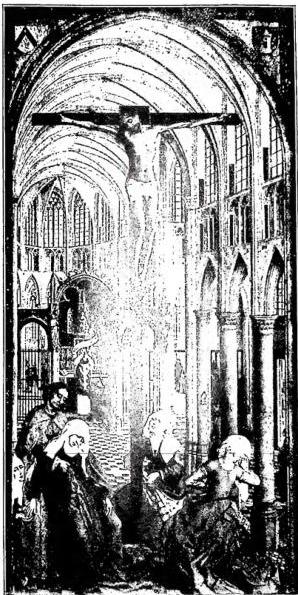
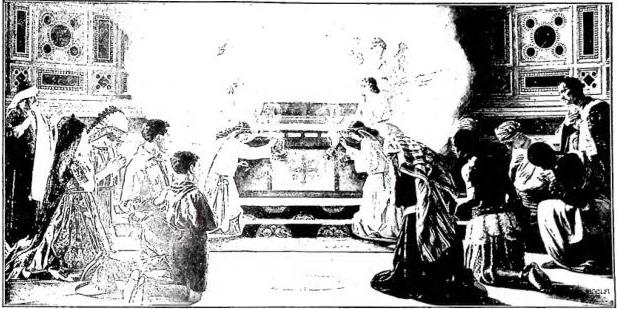
(from G. Cantanini, Dio Nascento, Rome 1911, p. 109)
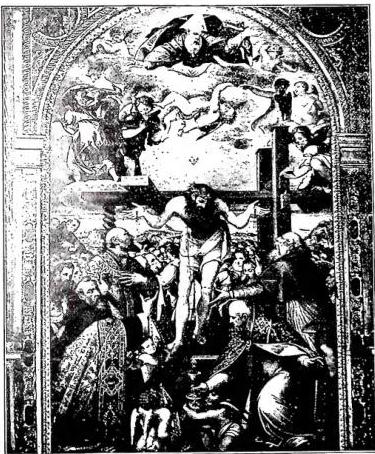
MESSA - The sacrifice of the Cross renewed in the Holy Mass. Painting by Ugo Van der Weyden (1400-64) - Antwerp, Museum.
M. In Communion, the faithful, by consuming the divine victim, distances himself from sin and draws nearer to God. In this act of union with God, St. Augustine discerned the primary end and the intimate nature of sacrifice, which is « omne opus, quod agitur ut sancta societate inhaereamus Deo » (De civitate Dei, 10, 6: PL 41, 283). The Holy Doctor summarized the entire thought of the nascent Church, which never saw in Communion a descent of the Divinity toward man, but an ascent of man toward God. Thus, the Eucharistic banquet stands intermediate between the human table of the earth and the wholly divine table of Heaven. Indeed, the earthly table does not unite with God, the heavenly table constitutes perfect union, while the Eucharistic table separates man from sin and draws him nearer to God, sanctifying him, that is, « sacrificing » him. In the Consecration, Christ is made present as vital nourishment: it is almost the beginning and the presupposition of human sanctification (objective sacrifice); in Communion, Christ enters the soul to unite it with God, sanctifying it, that is, sacrificing it (subjective sacrifice).
J. Bellord (The notion of sacrifice & The sacrifice of the New Law, in Ecclesiastical review, 33 [1905], pp. 1-14, 258-73), after a vehement indictment of the sacrifice-immolation (destruction-theory), fully embraced the thesis of the sacrifice-communion (banquet-theory). In his view, the sacrifice of the Redemption was accomplished on the Cross, but subordinately to the Last Supper, whose banquet constituted the principal and essential part of Christ’s salvific work. The Mass, therefore, which repeats the Last Supper, is essentially nothing but a table, where the faithful, through the Body and Blood of Jesus, unite intimately with the Father, becoming His friends, heirs, and table companions. The use of the two species in the Eucharist has the sole purpose of providing a perfect nourishment, consisting of food and drink; it therefore bears no symbolic function regarding the separation of Blood from Body that occurred on the Cross.
According to A. Stolz (De Sacramenti, Friburgo in Br. 1942, pp. 162-91), in present-day man, two antithetical states—elevation and sin—are combined. Through the first, man tends toward union with God; through the second, he is repelled from II. God devised a wondrous plan of salvation: the Incarnation and Passion of His Only-Begotten Son. Indeed, Jesus Christ: a) through the Incarnation, assumed the dual condition of man: on the one hand, union with God (as the Word always united with the Father, as man always conjoined to the Word through the Hypostatic Union), and on the other, separation, because the assumed humanity was caro peccati, taken from the condemned mass and destined for death (Gen. 2:17); b) through the Passion, He overcame the second (for, by dying, He destroyed the flesh of sin) and made the first triumph (for, by rising, His flesh became πνεύμα, as St. Paul says [1 Cor. 15:45], that is, so spiritualized as to be capable of perfect union with God, which followed in the Ascension, when « apparuit vultui Dei » [Hebr. 9:24]).
To escape his fate, man must follow the path traced by Christ, dying to sin and rising to Grace, that is, to union with God. This process of real imitation of the twofold phase of the Redemption begins with Baptism (death to sin and resurrection to Grace, according to Rom. 6:3-11) and is completed in the Eucharist, through which the faithful die perfectly, at least sacramentaliter, and unite with God through Christ. The Mass is a sacrifice because, since Jesus Christ, always united with God, is present in it, the faithful takes possession of and makes his own that act of union, thus conjoining himself to God; for it is in union with God that the formal reason of sacrifice is found, according to the classic doctrine of St. Augustine: « Sacrificium est omne opus, quod agitur ut sancta societate inhaereamus Deo » (De civitate Dei, 10, 6: PL 41, 283).
The Mass, therefore, is a sacrifice because the Mystical Body, in Communion, sacramentally appropriates the death of Jesus Christ (separation from sin, the negative element) to unite with Christ and, through Him, with God (resurrection to Grace and consequent union with God, the positive element). Such appears to be the genuine thought of Stolz, as it can be gathered from his rich, though not always clear, exposition.
These theories agree in identifying the essence of the Mass in sacramental Communion. Against such a conception, serious difficulties arise. It is historically established that many true sacrifices lacked communion, for example, the Jewish holocaust and the immolation of the Cross. Furthermore, since Communion is an act directed toward the benefit of the faithful, it cannot constitute the essence of sacrifice, which in its fundamental concept evokes the idea of something presented to God: while Communion descends to man, sacrifice ascends to God. In this hypothesis, the Mass is no longer the sacrifice of Jesus united with His Church, as the Council of Trent teaches (Denz-U, 940), but becomes the exclusive sacrifice of the Mystical Body, in some way severed from its Head. Renz then fell into an evident error when he affirmed that the Mass is not in itself a perfect sacrifice, but only the prolonged shadow of the Cross. Moreover, if this theory were true, one would have to conclude that when the faithful do not approach the Eucharistic table, they have not participated in the sacrifice. Finally, Renz and Stolz seem to confuse the intrinsic nature of the sacrificial act with its more or less secondary end, union with God through an act of love (cf. the condemnation of Pius V against Baius; Denz-U, 1945).
4. Sacramental immolation. — With the revival of Scholasticism, a return to the traditional conceptions of the Eucharistic Sacrifice was determined. The liturgical renaissance and the renewed study of the Fathers led many theologians to rediscover the thread of that theologia perennis, which connects the earliest speculations with the canons of the Council of Trent. The first decisive step was taken by Card. L. Billot (De Sacramentis, I, 7th ed., Rome 1932, pp. 582-654), who, at the end of the last century, highlighted the necessity of seeking in the Mass the immolation of Jesus not in a physical reality, which would compromise the absolute identity of the Eucharistic Body with the glorified one, but in the order of signs, that is, in that same economy of symbolic and sacramental realities in which the sacrifice is accomplished. Starting from the idea of transubstantiation, the keystone of the entire Eucharistic mystery, Billot drew an important corollary: since under the species of bread, by virtue of the words of Consecration (si verborum), only the Body is present, and under the species of wine, only the Blood, in the Eucharist there occurs sub signis a separation of Body from Blood, a mystical immolation present (status immolationis; habitus externus violentae mortis), which vividly evokes the death of the Cross, representing its bloody immolation.
While the explanation of the eminent theologian garnered widespread consensus, in Germany the liturgical school of O. CASEL, ODO (v.) gained ground, finding the doctrine of mystical immolation too cold and external. The purely representative sign was to be given a real and profound content. A vast and complex synthesis was laboriously constructed, dominated by ideas of striking originality. According to O. Casel (Das Gedächtnis des Herrn in der altchristlichen Liturgie, Freiburg im Br. 1918; Das christlichen Kultmysterium, Regensburg 1932), the essence of Christianity consists in the union of the Church with Christ, so that all men may be made partakers in the salvific work of the Redeemer. This union is not realized in a purely moral manner, but through a physical contact between the work of the Redeemer and the activity of the redeemed. This contact, which time and space seem to impede, is wondrously achieved in the liturgy, which implies in every act (in the Sacrifice and the Sacraments, in the Sacramentals and the Divine Office) not only the presence of Christ but also of every one of His salvific actions, both internal (acts of love, of obedience) and external (Incarnation, Passion, Resurrection, Ascension, Parousia).
In this conception, the Mass is considered a sacrifice not because an interior offering (Lepin) or an exterior one (De la Taille) is accomplished therein, nor because a physical immolation (Bellarmine, Suárez, Franzelin) or a mystical immolation (Billot) takes place, but because it makes present (re-presents) the very immolation of Calvary. The Mass is the same (numerically identical) sacrifice of the Cross, which through transubstantiation acquires a new ubi and a new quando. The Mass, as it were, forces its way through the crowd of centuries, seizes the drama that unfolded two thousand years ago, and through a wondrous sacramental transposition re-presents it in this particular fragment of time and space (a new location and "quandocation" of the Cross).
The Caselian conception, though supported by numerous philological and liturgical arguments, immediately drew sharp criticism and serious reservations, as it seemed metaphysically repugnant to posit a new quandocatio of the historical event of Calvary. The hypothesis indeed implies a singular "contemporaneity" of the bloody immolation of the Cross with all times, from which would inevitably follow the irreparable compromise of the absolute identity of the Eucharistic Christ with the heavenly Christ, an insuppressible demand of Catholic faith.
To address these difficulties, A. Vonier (A key to the doctrine of the Eucharist, London 1925) deemed it necessary to return to the interpretation of Thomistic flavor offered by Billot, refining it with a new element. For Vonier, sacramental immolation is not merely a representation of the Cross but a continuation and prolongation of II. By separating si Sacramenti the Body from the Blood, the Church realizes and prolongs the essence of the sacrifice of Calvary. In the Eucharist, the earthly phase of Jesus’ life—the state of death—does not exclude the heavenly phase—the state of glory—but what surrounds, even really, the Body separated from the Blood transcends the sphere of the sacramental sign.
This brilliant explanation had the defect of neglecting the interior element, which constitutes the soul of every sacrifice. Other theories thus emerged, seeking to harmonize the external element with the internal (cf. Ch. V. Héris Le mystère du Christ, Paris 1927, pp. 332-68; E. Masure, Le sacrifice du chef, ibid. 1932, pp. 253-250; A. Michel, Messe, in DThC, X, cols. 1276-77). Staunch proponents of the interior offering of Jesus, actualiter elicita in every Mass as the vivifying principle of all worship, and sacramentaliter significata by the external immolation, include R. Garrigou-Lagrange (L'amore di Dio e la Croce di Gesù, II, trans. by I. Paci, Turin 1936, p. 321) and M. Cordovani (Il Santificatore, Rome 1939, pp. 219-20).
Gathering the finest of these speculations, one may hold that in the Mass a mystical immolation occurs, that is, an external mactatio, constituted by the sacramental separation of the Blood from the Body of Christ, a mactatio which, realized "in genere signi sacri seu Sacramenti," simultaneously signifies the immolation of the Cross (the Mass is therefore a relative sacrifice) and the internal, actual oblation of Christ and the Church, which constitutes the soul of Eucharistic worship (the Mass is thus a true sacrifice, de praesenti, while renewing and applying the sacrifice of Calvary). This doctrine is in harmony with the three dogmatic principles of the Council of Trent (Denz-U, 938, 940), which definitively established the data of the Revolution. Scripture indeed affirms that in the Eucharist the Body of Jesus is "given," διδόμενον (Lk. 22:19), and that His Blood is "poured out," ἐκχυννόμενον (Mt. 26:28). Such immolation, being unable to physically affect the Body and Blood of Jesus, reaches them in their sacramental state, separating the one from the other insofar as they are under the Eucharistic signs. This concept forms, as it were, the guiding thread of the entire patristic-theological tradition, from the incisive affirmations of St. Gregory Nazianzen (Ep. 171: PG 73, 279), St. Augustine (Ep. 98, 9: PL 33, 363), and St. Gregory the Great (Dial., 4, 58: PL 77, 425), to the first attempts at scholastic synthesis, from the clear formulas of St. Thomas to the slow systematic elaboration of modern theologians.
This age-old doctrine received its seal in the encyclical Mediator Dei (20 November 1947): "On the altar, the shedding of blood is not possible, but divine wisdom has found a wondrous way to make manifest the sacrifice of our Redeemer through external signs that are symbols of death ('per signa externa, quae sunt indices mortis'). For through the transubstantiation of the bread into the Body and of the wine into the Blood of Christ, just as His Body is truly present, so too is His Blood; the Eucharistic species, under which He is present, symbolize the bloody separation of Body and Blood. Thus, the memorial of His real death on Calvary is repeated in every sacrifice of the altar, because through distinct symbols ('per distinctos indices'), it is signified and shown that Jesus Christ is in a state of
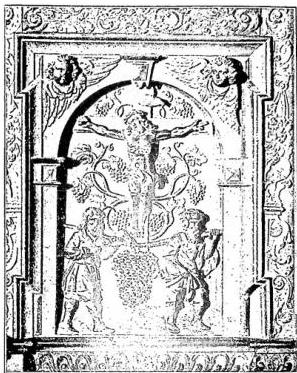
(from Villes d'art de la Suisse, Neuchâtel 1930, pl. 22)
MESSA - The Mystic Vine. Detail of the choir stalls (17th century)
of the church of Valère (Switzerland).
victim... It must also be noted ("etiam atque etiam animadvertendum"), that the Eucharistic Sacrifice consists essentially in the unbloody immolation of the divine victim, which is mystically manifested by the separation of the sacred species and their oblation made to the Eternal Father" (AAS, 39 [1947], pp. 548-49, 563).
III. THE MASS IN THE ECONOMY OF SALVATION
Catholic faith holds, in harmony with the conviction of all peoples, that sacrifice is the supreme act of worship, but adds that, since this has ceased to be purely symbolic after Christ replaced figures with reality, the sacrificial rite acquires a new and unique value, now fully imbued with the reality it expresses. Just as all forms of Mosaic worship were concentrated in sacrifice, so in the Mass all elements of religion converge, reaching their highest manifestation therein. The ancient oblation still subsists, the offering of bread and wine continues, as the firstfruits of nourishment and symbols of life; yet in the more spiritualized Christian worship, nothing remains of these material realities but a mystical veil, beneath which the Word of God communicates Himself to men as the "bread of life" (Jn. 6:51) and the "drink of immortality" (St. Ignatius, Eph., 20, 2).Immolatio remains, but with the reign of shadows vanished, the victim is Christ Himself. The Flesh and Blood of the God-Man are presented under distinct signs, become mortis indices, a reminder of His Passion, and at the same time are given under the species of bread and wine, emblems of life, for life flows from His death. The elements of the offering—symbols of creation, as those of bloodless death are emblems of redemption—are united and identified in the sacrifice of the Mass, since redemption is a restored creation (cf. St. Irenaeus, Adv. haeres., 5, 2: PG 7, 1126-27).
Through the firstfruits of creation, transformed into the Body and Blood of Jesus, the Church receives from God Himself the gifts to offer Him, which, by a divine exchange, become seeds of life sown in the furrows of time to germinate in eternity (cf. St. Irenaeus, Adv. haeres., 4, 18, 5: PG 7, 1027-29).
The fulfillment of the figures of the Old Testament and the elevation of creation, the Mass is above all the completion of Redemption: "Effectum quem Passio Christi fecit in mundo, hoc Sacramentum facit in homine" (St. Thomas, Sum. Theol., III, q. 79, a. 1). By dying on the Cross, Christ redeemed the world; by sacramentally renewing His death in the Eucharist, He applies to each soul the merits acquired by His Blood. The Cross and the Mass are integral parts of the same salvific plan, two panels of the same picture. On Golgotha, all were redeemed de iure (in actu primo); at the Altar, through the conscious and willing adherence of individual faithful, Redemption becomes proper to each: de facto (in actu secundo). Christ, who on the Cross represented as Caput Ecclesiae constituendae the entire humanity, and for it offered Himself as an infinitely pleasing victim, at the Altar, as Caput Ecclesiae constitutae, renews the same oblation together with all members of His Mystical Body, who as a "redempta civitas offert seipsam per ipsum universale sacrificium" (St. Augustine, De Civitate Dei, 10, 6 and 20: PL 41, 283 and 921), making individual faithful in Christo and per Christum a single catholica hostia (cf. L. Thomassin, De Incarnatione, l. 10, c. pp. 20-21). Mediator between God and men on Golgotha, Jesus prolongs His work at the Altar, present with all the prerogatives of Glory beneath the symbolic veils. At the moment of Eucharistic Consecration, all converges toward Christ in Glory, all gravitates around Him on earth. In both states, it is the same Incarnate Word, the Supreme and Eternal Priest of the New Covenant (cf. Sum. Theol., III, q. 83, a. 4).
Raphael’s genius rendered in sensible forms, in the Disputa del Sacramento, the internal logic of this divine plan. The first scene depicts the most distinguished Doctors and thinkers of Christianity in the attitude best suited to their theology and the various nuances of their sanctity. The Host, placed on the Altar in a golden disk of light, forms the center of the ideal assembly. The second scene, placed above the first, shows Paradise. At the center of a glory of Angels appears the Eternal Father, blessing the world. He is half-hidden by a luminous circle, where the three figures of Jesus, showing His wounds, Mary adoring Him, and the Baptist pointing to Him as the Lamb of God, are framed. On the sides, two suggestive ranks of patriarchs, prophets, and apostles. The first scene shows the Church Militant gathered around the Eucharist, Sacrifice and Sacrament; the second shows the Church Triumphant gathered around Christ, who, displaying the stigmata of the Passion, perpetually offers His merits and satisfactions to God for men: "Semper vivens ad interpellandum pro nobis" (Heb. 7:25). The two parts are united by the symbolic bond of the dove. The work of Creation, presided over by the Father, the work of Redemption accomplished by the Son, find their perfection in Sanctification, appropriated to the Holy Spirit. The mystical dove is surrounded by four graceful Angels, holding open the Gospels. This indicates that the Christian faith, in the sacrifice of the Eucharist, opens directly onto Glory and is founded on the word of God contained in the Scriptures. In this theological and pictorial synthesis, the centrality of Christ is evident: the same Word who, in the bosom of the Father, created the world, incarnate in the womb of Mary saved the human race, in the heart of the Church sanctifies souls in the bloodless sacrifice consumed by the fire of the Spirit, to draw all into the light of Glory.
Special works: a) On Scripture: I. E. Belser, Der Opfercharakter der Eucharistie, in Theologische Quartalschrift, 95 (1913), p. 1 ff.; J. Lebreton, Eucharistie, in DFC, I, coll. 1563-1567; C. Ruch, La Messe dans l'Écriture, in DTHC, X, coll. 795-863; W. Goossens, Les origines de l'Eucharistie Sacrement et sacrifice, Gembloux 1931; J. Coppens, Eucharistie, in DBL, II, coll. 1178; B. Mariani, De sacrificio a Malachia praedicto, in Antonianum, 9 (1934), pp. 193-242, 261-82, 451-74; A. Vaccari, Melchisedech, rex Salem, proferens panem et vinum, in Verbum Domini, 18 (1938), pp. 208-14, 235-43; F. Amiot, L'enseignement de saint Paul, II, Paris 1938, pp. 45-47; F. M. Braun, Les origines de la Messe, ibid. 1946 (booklet); J. Bonsérven, L'Évangile de Paul, ibid. 1948, pp. 269-75.
b) On the Holy Fathers: A. Vacant, Histoire de la conception du sacrifice de la Messe dans l'Église latine, Lyon 1894; L. Ruch, La Messe d'après les Pères, in DTHC, X, coll. 864-964; M. Blain, Le sacrifice de l'Eucharistie d'après saint Augustin, Lyon 1906; G. Philips, Le sacrifice eucharistique dans la tradition africaine, in Revue ecclésiastique de Liège, 22 (1930-31), pp. 137-54; A. Meunier, Sacrificium eucharisticum apud Patres latinos, ibid., 29 (1937), pp. 358-66; W. Lampen, Doctrina i. Io. Chrysost. de Christo se afferente in Missa, in Antonianum, 18 (1943), pp. 1-16.
d) Sui protestanti e il Concilio di Trento: I. Rivière, La Messe durant la période de la réforme et du Concile de Trente, in DTHC, X. coll. 1085-1142; M. Alonso, Di sacrificio eucaristico de la Ultima Cena del Señor según el Concilio Tridentino, Madrid 1929; E. Messenger, The reformation, the Mass and priesthood, Londra 1935; S. Frankl, Doctrina Horii de sacrificio Missae cum decreto tridentino comparato, in Collezionee theologiae, 1935, pp. 281-339; S. Resende, O sacrificio da Missa em D. Frei Gaspar do Canal, Porto 1941; I. Armaibo Suárez, La imolación del sacrificio eucarístico según el Concilio Tridentino y el decreto conciliar, Quito 1942; E. Jamalullo, Le sacrifice eucharistique au Concile de Trente, in Nouvelle revue théologique, 67 (1945), pp. 513-31; id., L'unité sacrificielle de la Croix et l'autel au Concile de Trente, in Ephem, theologie, Louvain, 22 (1946), pp. 34-69.
Opere sull'essenza della M.: a) Sguardo generale: A. G. Martimer, Eucharistie sacrifice, Londra 1901; A. Michel, La Messe chez les théologiens postérieurs au Concile de Trente, in DTHC, X. coll. 1143-1316; F. Kramp, Scrittura eudita de sacrificio Missae, in Gregorianum, 2 (1921), pp. 416-42 (esame delle opere uscite nel decennio 1910-20); A. Collart, Théories sur l'essence de la Messe, in Collations Namurcenses, 1930, pp. 210-19, 376-91; 1931, pp. 10-25, 207-27; E. Leroux, La controverse sur l'essence du sacrifice de la Messe, in Revue ecclésiastique de Liège, 1930-31, pp. 341-51; M. Báuerle a Neukirch, Doctrina speculativa theologorum recentiorum de sacrosancto Missae sacrificio, in Estudis franciscans, 44 (1932), pp. 321-38; E. F. Dowd, A conspectus of modern catholic thought on the essence of the eucharistic sacrifice, Washington 1937; I. Van der Meersch, Annotat. de sacrificio Missae, Bruges 1940; F. A. Piersanti, L'essenza della M., Roma 1942; B. Cappello, Du sens de la Messe, in Les quest. liturg. et paroiss., 30 (1945), pp. 1-25, 59-78.
b) Sui sistemi dell'immolazione fisica. Moderni sostenitori: I. C. Broussolle, Théorie de la Messe, 2ª ed., Parigi 1913; E. Hugon, La ste Eucharistie, 2ª ed., ivi 1917, pp. 311-28; I. Nicolassi, Die hl. Eucharistie als Opfer, Bosen 1919; I. M. Buathier, Le sacrifice dans le dogme et dans la vie chrétienne, 11ª ed., Parigi 1922; I. Brinktrine, Das Opfer der Euchar., Paderborn 1938.
c) Sulle teorie dell'oblazione: oltre il Mysterium fidei, già citato, M. De la Taille ha svolto il suo pensiero in Esquisse du mystère de la foi, 2ª ed., Parigi 1924 e in M. Brillant, Eucharistia, Encyclopédie populaire sur l'Eucharistie, ivi 1934, pp. 153-81. Fu seguito da A. D'Alès, De Eucharistia, ivi 1929, pp. 109-24; Girolamo da Fallette, Stato attuale degli studi riguardo al sacrificio della s. M., in Palestra del clero, 19 (1931), pp. 1234-40; I. Connell, De Sacramentis Ecclesiae, Bruges 1933, pp. 271-73. A lui s'accostano il gesuita F. de Lanversin, Esquisse d'une synthèse du sacrifice, in Recherches de science religieuse, 17 (1927), pp. 193-209; G. Albarelli, Il s. sacrificio della M., Pesaro 1937; G. Anichini, Sacramentum Redemptoris, L'Eucaristia nel dramma della Redenzione, Lucca 1947 (amplifica le idee del De la Taille). Numerosi avversari, talvolta spietati: anon., Le sacrifice
selon le p. de la Taille, in L'ami du clergé, 1923, p. 72 sgr. (critica serrata); V. Mac Nabb, A new theory of the sacrifice of the Mass, in The Irish ecclesiastical record, 1924, pp. 361-73 (molto severo); V. Cremers, Quelques réflexions sur le Mysterium fidei, in Studia catholica, 1925-26, pp. 57-70, 179-202; A. Swabs, The last Supper and Calvary, Londra 1926; I. Brodie-Broanan, The sacrifice of the New Law, Londra 1926; I. Classe, Etude critique de certaines propositions du Mysterium fidei, Delhaim 1927 (il più acre: forse il più ingiusto); I. Puig de la Bellacasa, La esencia del sacrificio de la Missa, in Estudios eclesiásticos, 10 (1931), pp. 65-96, 385-408; 538-33; 11 (1932), pp. 95-102; A. Verbanime, De distinctione inter sacrificium Crucis et sacrificium Missae, in Collations Brugenses, 1936, pp. 230-36; I. De la Taille più volte si difese in dotti articoli: Cornu et Poissio, in Gregorianum, 9 (1928), pp. 177-241; A propos d'un livre sur la Cène, ibid., 11 (1930), pp. 194-203 (risposta ad Alonso); The mystery of faith and human opinion contrasted and defined, Londra 1930 (raccolta di vari articoli). La polemica sostenuta dal De la Taille con il Billot, risoluto avversario, è narrata da I. Puig de la Bellacasa, La esencia del sacrificio de la Missa, in Estudios eclesiásticos, 8 (1929), pp. 365-80. Non meno rumore ha suscitato M. Lepin: L'idée du sacrifice dans la religion chrétienne, principalement d'après le p. de Coudron et M. Olier, Parigi-Lionne 1897; questa tesi giovanile fu sviluppata nell'ampio volume: L'idée du sacrifice de la Messe d'après les théologiens, sopra citato; cf. anche La Messe et nous, Parigi 1937. Larghi furono i consensi raccolti dal Lepin. Egli ritenne di essere nella linea dei grandi teologi della « scuola francese » (De Berulle, De Coudron, Olier, Thomassin), ma sul loro oblizionismo molto riserve su son fatte. Consapevoli oblizionisti sono P. Batifol, Leçons sur la Messe, Parigi 1919, pp. 175-90; I. Rivière, Un nouveau système sur l'essence de la Messe, in Revue des sciences religieuses, 1921, pp. 86-91 (a proposito dell'opera del Lamiro); I. M. Bover, De oblatione Christi eueresti secundum Epistolam ad Hebraeum, in Verbum Domini, 1 (1921), pp. 161-66; I. Bitterneieux, De nota destructivum in sacrificio Missae, in Divus Thomas, 4 (1927), pp. 35-36; F. Cimitier, Oblation et immolation, in Revue apologetique, 44-45 (1927), pp. 682-94; P. De Vooght, Le si sacrifice de la Messe, in Les questions liturgiques et paroissiales, 1927, pp. 195-224; A. Collart, De sacrificio-oblatione, in Collations Namurcenses, 9 (1931), pp. 207-27; B. V. Miller, The essence of the sacrifice of the Mass, in The clergy review, 10 (1935), pp. 329-41.
d) Sul sacrificio-comunione. Poco si è scritto: cf. F. Cabrol, Le canon romain et la Messe, in Revue des sciences philosophiques et théologiques, 3 (1909), pp. 514-15; A. Tanquerra, Synopsis theologiae dogmaticae, III, 22ª ed., Roma 1930, pp. 534-35; A. Van Hove, De Eucharistie, 2ª ed., Malines 1941, p. 255; A. Piolanti, De essentia sacrificii Missae sec. A. Stolle, in Eunice docese, Commentaria Urbaniana, 1 (1948), pp. 63-75; G. De Broglie, Pour une théologie du Festus Eucharistique, in Doctor Communis, 2 (1949), pp. 3-36; 3 (1950), pp. 16-42.
e) Sull'immolazione sacramentale. Vastissima produzione provocata da O. Casel, il quale espose il suo pensiero, non sempre in modo limpido, in numerose pubblicazioni: oltre le già ricordate, cf. Mysterium und Martyrium in den römischen Sakramentarien, in Jahrbuch für Liturgiewissenschaft, 2 (1922), pp. 18-38; Die Liturgie als Mysterienfeier, Friburgo in Br. 1923; Altchristlicher Kult und Antike, in Jahrbuch für Liturgiewissenschaft, 3 (1923), pp. 1-17; Die Messe als heilige Mysterienhandlung, in Benediktinische Monatschrift, 3 (1923), pp. 20-28, 97-104, 155-61; Das Gebet der Kirche im täglichen Offizium, in Die betende Kirche. Ein liturgisches Volksbuch, Abbazia S. Maria Laach 1924, pp. 182-206; Das Mysteriengedächtnis im Licht der Tradition, in Jahrbuch für Liturgiewissenschaft, 6 (1926), pp. 113-204; Mysterienfrömmigkeit, in Bonner Zeitschrift für Theologie und Seelsorge, 4 (1927), pp. 101-17; Antike und christliche Mysterien, in Bayerische Blätter für das Gymnasialschulwesen, 63 (1927), pp. 329-40; Mysteriengegenwart, in Jahrbuch für Liturgiewissenschaft, 8 (1928), pp. 145-224; Die Stellung des Kultmysteriums im Christentum, in Liturgische Zeitschrift, 3 (1930-31), pp. 39-53, 72-83, 103-15; Die Messopferlehre der Tradition, in Theologie und Glaube, 23 (1931), pp. 351-367; Zum neuen Kirchenjahr, in Liturgische Zeitschrift, 4 (1931-32), pp. 37-44; Das christlichen Kultmysterium, Ratisbona 1932; 2ª ed. ivi 1935; Neue Zeugnisse für das Kultmysterium, in Jahrbuch für Liturgiewissenschaft, 13 (1936), pp. 99-171; Glaube, Gnosis und Mysterium, ibid., 15 (1941), pp. 155-205; Das christliche Festmysterium, Paderborn 1941. Aderirono al Casel: J. De Séguier, Quelques réflexions sur le sacrifice eucharistique, in Nouvelle revue théologique, 56 (1929), pp. 289-99; G. Rohner, Messopfer-Kreuzesopfer, in Divus Thomas (Friburgo), 8 (1930), pp. 3-17, 145-74; I. M. Scheller, Zur Mysterienlehre, in Zeitschrift für Aszese und Mystik, 11 (1936), pp. 61-93. Simpatizzante: W. Goossens, Les origines de l'Eucharistie, Sacrament et sacrifice, Gembloux 1931, pp. 52-57. Avversario irriducibile è stato J. B. Umberg, Mysterium-Frömmigkeit, in Zeitschrift für Aszese und Mystik, 1 (1926), pp. 351-66; id., Die These von der Mysteriengegenwart, in Zeitschrift für katholische Theologie, 52 (1928), pp. 357-400; id., Sacramenta efficiunt quod significant, ibid., 54 (1930), pp. 95-105. Combatterono, più mode-
ratamente, la stessa tesi I. Coppens, Le mystère eucharistique et les mystères poêters, in Cours et conférences des semaines liturgiques, VII, Lovanio 1920, pp. 111-124; I. Dillersberger, Eine neue Messopfertheorie, in Theologie und Glaube, 22 (1930), pp. 571-88; A. Stohr, Zu P. Odo Casels Mysteriumlehre, in Pastor Bonus, 1931, pp. 351-61; id., Der hl. Thomas, ein Kronzenge für P. Odo Casels Mysteriumtheorie, ibid., 1931, pp. 422-36; 1932, pp. 41-49; P. De Vought, A propos d'une conception symboliste de la Messe, in Divus Thomas, 9 (1932), pp. 310-17 (breve e chiaro); I. M. Hanssens, Estre liturgia cultus mysterieux?, in Periodica de re morali, canonica, liturgica, 1934, pp. 112-32, 137-60 (ricco e limpido); B. Poschmann, Mysteriengegenwart im Lichte des hl. Thomas, in Theologische Quartalschrift, 116 (1935), pp. 53-116 (molto importante); K. Prüm, Mysterion von Paulus bis Origenes, in Zeitschrift für katholische Theologie, 61 (1937), pp. 390-425 (osservazioni di uno specialista); G. Söhngen, Symbol und Wirklichkeit im Kultmysterium (Grenzfragen zwischen Theologie und Philosophie), 4, Bonn 1937; id., Der Wesensaufbau des Mysteriums (ibid., 6), ivi 1938 (l'opera più completa scritta contro Casel); A. Hoffmann, Der Begriff des Mysteriums bei Thomas von Aquin, in Divus Thomas (Friburgo), 17 (1939), pp. 30-60 (lucida critica); G. Söhngen, Le rôle agissant des mystères du Christ dans la liturgie, in Les questions liturgiques et paroissiales, 24 (1939), pp. 79-107 (critica di Casel); D. Winzen, Note complémentaire, ibid., pp. 108-13 (risposta a Söhngen). Tutta la polemica provocata da Casel è ben descritta in Th. Filthaut, Die Kontrozerie über die Mysterienlehre, Warendorf in W. 1947; e in sintesi da M. Becqué, Le mystère de la Messe, in Nouvelle Revue Théologique, 82 (1950), pp. 27-30. Il Billot è stato seguito da L. Labauche, Leçons de théologie dogmatique, IV, Parigi 1921, pp. 299-305; I. Grimal, Le sacerdoce et le sacrifice de N. S. J. - C., ivi 1926, pp. 231-42; G. Van Noort, De Sacramentis, I. Hilversum 1927, pp. 374-79; L. Lercher, Institutiones theologiae dogmaticae, IV, Innsbruck 1930, pp. 481-482; I. Van der Meersch, Annotationes de sacrificio Missae, Bruges 1940, e da molti altri. Al Vonier preparò la via M. S. Gillet, Les harmonies de la transsubstantiation, in Revue de sciences philosophiques et théologiques, 8 (1914-18), pp. 258-69; l'opera del Vonier è stata tradotta da P. Roguet, La clef de la doctrine eucharistique, Lione 1943. Della stessa corrente: L. De Faulconier, Le prêtre représentant du Christ et de l'Église dans le sacrifice eucharistique, in Cours et conférences des semaines liturgiques, VII, Lovanio 1920, pp. 103-107; B. Augier, Le sacrifice ecclésiastique, in Revue thomiste, 37 (1932), pp. 739-57; 39 (1934), pp. 201-22; F. Dickamp, Theologiae dogmaticae manuale, IV, Parigi-Roma 1934, pp. 233-35; A. M. Hoffmann, De sacrificio Missae sec. 1. Thomson, in Angelicum, 15 (1938), pp. 262-85.
Per la dottrina, che valorizza i dati migliori della concezione sacramentale della M., cf. R. Garrigou-Lagrange, Le Sauveur et son amour pour nous, Parigi 1933; id., An Christus non solum virtualiter sed actualiter afferat Missas quae quatidie celebrantur, in Angelicum, 19 (1942), pp. 105-18; M. Cordovani, Animadversiones in sacrificium Missae, in Angelicum, 8 (1931), p. 543 sgg.; id., Il Santificatore, Roma 1939, pp. 219-20. Il pensiero dei due domenicani è armonizzato da F. A. Piersanti, L'essenza del sacrificio della M., Roma 1940, pp. 153-71; G. Roschini, La S. M.,
(fot. Alonari)
MESSA - The mystical press from which flows the Most Precious Blood of Jesus Christ. Painting by A. Mainardi (16th century) - Cremona, Church of S. Agostino.
BIBL.:
On the Mass in the plan of salvation: Baldovino di Canterbury, Liber de Sacramento altaris: PL 204, 695; F. Henninger, Apologia del cristianesimo, Italian trans. by B. Galsandere and I. Donzella, III, Pistoia 1896, pp. 469-75; M. D'Hulst, Conferenze sulla morale cristiana e sociale, Italian trans., III, Turin 1912, pp. 161-65;
M. M. Philipon, Les Sacraments dans la vie chrétienne, Paris 1945, pp. 145-98; Th. De man, La spiritualité de la Messe, ibid. 1946; E. Mersch, La théologie du corps mystique, II, ibid.-Brussels 1946, pp. 320-325; R. Graber, Le Christ dans ses Sacraments, Paris 1947, pp. 31-98; F. Taymans d'Eyperson, La Ste Trinité et les Sacraments, Brussels 1949, pp. 141-32; M. I. Scheeben, I misteri del cristianesimo, Italian trans., Brescia 1949, pp. 355-364; C. V. Hérià, Il mistero di Dio, Italian trans., ibid. 1950, pp. 199-200; A. Penzo, De habitudine Cordis Iesu ad mysterium eucharisticum, Rome 1950 (unpublished thesis of the Ateneo di Propaganda Fide), Antonio Piolanti.
II. THE MASS IN MORAL THEOLOGY AND CANON LAW.
SUMMARY:
I. Fruits of the Sacrifice of the Mass
II. Subject
III. Value of the Mass
IV. Application of the Mass
V. Obligation to Celebrate the Mass
VI. Reduction, Remission, and Transfer of Masses
VII. Dispositions Required for the Celebration of the Mass
VIII. Time and Place for the Celebration of the Mass
IX. Founded Masses
X. Gregorian Masses
XI. Manual Masses.I. FRUITS OF THE SACRIFICE OF THE MASS – The fruits of the Eucharistic Sacrifice are linked to its ends. Jesus Christ, in fact, instituted the Eucharistic Sacrifice: a) as a protestative sign of the infinite excellence of God and of His supreme and absolute dominion over the life and death of man (latreutic end); b) to render thanks to God for the benefits received from Him (eucharistic end); c) to placate God for sinners (propitiatory and satisfactorial end); d) to impetrate from God the necessary aids (impetratory end). From these ends derive the fruits of the Eucharistic Sacrifice; that is: merit; impetration; propitiation; satisfaction.
2. Merit
When, through the Eucharistic Sacrifice, the worship due to God is rendered and He is thanked for the benefits received, a good work is accomplished, indeed the good work par excellence; therefore, as such, meritorious before God. This fruit is produced ex opere operantis, though infallibly connected with the offering of the Sacrifice.3. Impetration
Through the Eucharistic Sacrifice (which is perfect prayer), all that is obtained by prayer may be impetrated; that is, conversion to God, the strength necessary to overcome temptations and practice virtues, God’s help in necessities, comfort in adversities, and even temporal goods useful for the health of the soul. The efficacy of impetration depends on those who impetrate, who are Jesus Christ, the Church, the offering priest, and those who in some way participate in the Eucharistic Sacrifice. Now, the impetration of Jesus Christ is by its nature infallible, not depending on the probity of the offering priest; the impetration of the Church is in itself efficacious, independent of the dispositions of the minister; that of the priest and of all other offerers is efficacious ex opere operantis, that is, proportionate to the dispositions of the subject.3. Propitiation. – Propitiation, that is, the remission of sins, operates mediately: a) by way of impetration, insofar as through the Eucharistic Sacrifice sinners obtain the help of actual Grace that excites them to the acts necessary to obtain the forgiveness of sins; b) probably also by way of placation, insofar as God, placated by the Eucharistic Sacrifice, ceases to deny the sinner the aids he needs to do penance. Sins, in fact, provoke the just indignation of God, who therefore denies special aids.
4. Satisfaction. – Satisfaction, that is, the remission of the temporal punishment due to sins already remitted, is produced by the Eucharistic Sacrifice immediately and ex opere operato, according to the measure established by God and unknown to men, having regard also to the dispositions of him for whom the Eucharistic Sacrifice is offered. This is the doctrine taught by the Council of Trent (sess. XII, De Sacrificio Missae, chaps. 2-3; sess. XXV, Decretum de Purgatorio). Propitiation and satisfaction are infallible effects of the Eucharistic Sacrifice when no obstacle (obice) is placed by him for whom it is offered (Conc. Trid., sess. XXII, De Sacrificio Missae, can. 1).
II. SUBJECT
The subject of the fruits of the Eucharistic Sacrifice are all those who participate in it, that is, the offerers. Offerers are: Jesus Christ, the principal offerer, in whose name and by whose virtue the visible priest acts; the Church, which offers through its minister consecrated and delegated by her, as is evident from the entire rite and the prayers of the Mass; the celebrating priest in the name of Jesus Christ and of the Church; all those who participate in the priestly action (that is, those who have the Mass celebrated, offering or providing the alms for the priest; those who offer the material things necessary for the celebration; those who serve at the altar; those who assist at the Mass).He for whom the Eucharistic Sacrifice is celebrated is not an offerer; for, although he may belong to one of the aforementioned categories (and thus be an offerer himself), he is not necessarily so. Indeed, the Mass may be celebrated for the deceased and even for the infidels.
2) As for impetration, without doubt Jesus Christ, as the principal offerer, impetrates for men, as is known from Sacred Scripture: « hic autem, eo quod maneat in aeternum, sempiternum habet sacerdotium. Unde et salvare in perpetuum potest accedentes per semetipsum ad Deum: semper vivens ad interpellandum pro nobis » (Hebr. 7, 24-25). Likewise, the Church impetrates through the ministry of the priest delegated by her.
Finally, the priest, and all those who with him offer this Sacrifice, impetrate not only for themselves but also for those for whom the Sacrifice is offered.
3) The propitiatory fruit can be perceived by all the faithful living in the communion of the Church, because all can and for all it is possible to impetrate the aids necessary to repent of sins and obtain their forgiveness.
4) The satisfactorial fruit is perceived principally by the deceased, because the suffrages of the Mass can shorten the temporal punishment due for sins. But it can also be perceived by the living. It is indeed true that the more common opinion denies this, persuaded that said fruit, being finite, would soon be exhausted if all the faithful participated in it (cf. F. Suárez, De Eucharistia, in Opera omnia, XX, Paris 1860, disp. 88, sect. II, n. 3). But the opposing opinion is not without true and solid foundation, because the satisfactorial fruit, though finite, is nevertheless so abundant that all the faithful can partake of it (cf. A. Ballerini - D. Palmieri, Opus theologicum morale, IV, Prato 1900, tract. X, De Sacramentis, sect. IV, De Eucharistia, n. 239, pp. 193-94).
It has been said that the propitiatory and satisfactorial fruits are perceived by all the faithful. But it is beyond doubt that they are perceived in a particular way by the celebrating priest and by those who in any way concur in the sacrificial action. The fruit perceived by them is called general by some; special by others, because in a certain way it approaches the most special, perceived by the celebrating priest, since these faithful are closest to him in the sacrificial action.
Those for whom the priest applies the Mass perceive the special or ministerial fruit (considered by some as distinct from the special); that is, the impetratory, the propitiatory, and, for those who are in a state of Grace, the satisfactorial.
III. VALUE OF THE MASS — The Eucharistic Sacrifice, considered in itself, is undoubtedly of infinite value, given the infinite dignity of the Victim offered. It follows that through the Eucharistic Sacrifice, worship is rendered to God than which none is greater. If, however, the Eucharistic Sacrifice is considered insofar as through it Jesus Christ applies to men the merits of His Passion and death (undoubtedly of infinite value), it is not as easy to assert that its value is infinite.
In this regard, the following considerations must be kept in mind: 1) impetration may be said to be infinite insofar as the goods requested and the number of those for whom they are requested can be increased without limit, without thereby diminishing its efficacy; 2) satisfaction is truly finite in intensity because, however great the offense for which satisfaction is made, a temporal punishment is always remitted, and thus finite; 3) extensively, because however great the number of those to whom the fruit of satisfaction extends, it always concerns a finite number.
Given this, one may ask whether the Eucharistic Sacrifice, applied to many, benefits each one, under equal conditions, as if it were applied to him alone. It is commonly held that the fruit of impetration and propitiation derived by each does not diminish with the increase of participants. Instead, it is the common opinion that the fruit of satisfaction (that is, the special or ministerial fruit derived by each) diminishes in proportion to the number of participants. And the practice of the Church is to apply to one alone or to a few the special fruit of the Mass. If the contrary opinion were true, it would always be better to offer for all the deceased, indeed for all the faithful living and dead. Moreover, it is the common sentiment of the faithful and of priests that one cannot satisfy multiple obligations of justice with a single Mass. Nor is it helpful to assert that the merits of Christ’s Passion applied to us through the Eucharistic Sacrifice are of infinite value; for the manner of their application depends on the will of Christ, who instituted the Sacrifice of the Mass. That Christ willed to establish a finite mode of application is deduced from the sen-
(Courtesy of T. Ridolfi)
Mass - Fulfillment of the prophecy of Malachi: «Magnum est nomen meum in gentibus» (I, 10). Painting by Tito Ridolfi (1928). Brisbane (Australia), Church of Corpus Domini.
timent and practice of the Church. The opposing opinion is judged by St. Alphonsus (Theologia moralis, I, VI, n. 312, ed. L. Gaudé, III, Rome 1909, pp. 290-94) as more probable. He, however (like all other proponents of this opinion), does not admit that one can satisfy multiple obligations of justice with a single Mass.
Moreover, whoever favors this opinion, as well as anyone else, acts rightly if, in addition to the absolute intention of applying the Mass according to the will of the donor, he adds another conditional intention (that is, if the first has no effect or if the sacrifice is of such efficacy that, without prejudice to the right of the one who requested the application, it may also benefit others).
IV. APPLICATION OF THE MASS
The application of the Mass is the offering of its special or ministerial fruit for a determined person or cause. This is done through the intention of the celebrant, who exercises this power by virtue of ordination itself (Pontif. Rom., De ordinatione presbyteri; cf. Denz-U, 1530).The power to apply is so inherent to the priestly character and so dependent on the applying priest that no one, not even the Church, can effectively nullify the intention, if made, or supply it if not made. The Church can only command or forbid it in certain cases. An habitual intention is sufficient for the application. For the application of the Mass to be valid, it must be made at least before the Consecration of the chalice and for a person or persons at least implicitly determined. If one had two or more intentions for the same Mass, ordinarily the last prevails, except when the first is such that, if noticed, no other would have been added. The subjects of the application are all wayfarers and the deceased.
4. Wayfarers
In general, it can be affirmed that the Mass is licitly applicable to any wayfarer, provided it is done with an honest purpose and without scandal. In particular: a) The Mass can be applied even for infidels, not only for their conversion but also for any honest purpose of theirs. And the stipend offered can be accepted. The Mass can be applied for them even publicly, provided there is no danger that the priest's manner of acting be ascribed to greed for gain, or that the faithful be persuaded that God can be duly honored even outside the Church. Care must also be taken that infidels, in requesting the celebration of the Mass, are not motivated by superstition (cf. S. Congreg. di Propaganda Fide, 11 March 1848; 13 July 1865). b) For apostates, heretics, schismatics, and non-vitandi excommunicates, the Mass can be applied for any honest purpose of theirs, provided there is no danger that the faithful be persuaded that eternal salvation can be attained even in non-Catholic sects, or that censures are held in no account.As a rule, it is licit to apply only privately, that is, as many think, without pomp and solemnity, avoiding all publicity; thus with an intention formulated by the priest insofar as he is a minister of Jesus Christ (cf. F. M. C. Cappello, De Sacramentis, I, 5th ed., Turin 1947, n. 592). However, in the case of a reigning non-Catholic prince, it is licit to celebrate the Mass solemnly. For vitandi excommunicates, it is licit to apply the Mass only for their conversion (can. 2262 § 2, n. 2). c) For sinners, even public ones, though not vitandi excommunicates, it is licit to apply the Mass for any honest purpose of theirs, and this even publicly and solemnly, provided scandal is avoided.
5. The Deceased
Regarding them, the following must be noted: a) The Mass cannot be applied for the deceased who are known not to be in Purgatory. Such are those who died before the use of reason and those who, by solemn decree of the Church, were placed in the canon of saints or blessed. b) The Eucharistic Sacrifice benefits the souls in Purgatory (Conc. Trid., sess. XXV, Decretum de Purgatorio; sess. XXII, De Sacrificio Missae, can. 3; Sum. Theol. Suppl., q. 71, a. 9). c) It is a nearly common doctrine that the souls of the just, not yet enjoying the beatific vision, are infallibly aided by the Eucharistic Sacrifice, whose fruit is applied ex opere operato. It is not, however, equally certain that the fruit of the Mass is always applied to the soul for which it is offered. It may indeed happen that God, for a just reason unknown to men, prevents the satisfactions offered for a particular soul from benefiting it (cf. A. Lehmkuhl, Theol. moralis, II, 12th ed., Freiburg im Br. 1914, n. 288). d) The souls in Purgatory can therefore benefit from the fruit of the Mass, not only the satisfactorial but also the impetratory and propitiatory. The impetratory, insofar as with the Eucharistic Sacrifice one implores God to apply the satisfactions to that soul for which it is offered. The propitiatory, insofar as with the Eucharistic Sacrifice the just wrath of God is placated, so that He ceases to prevent a soul from receiving the satisfactions offered for it (F. Suárez, De Eucharistia, in Opera omnia, XX, Paris 1860, disp. 79, sect. X, n. 4). That being said, it is licit to apply, at least privately, the Mass for any deceased who passed to the next life after the use of reason and was not canonized or beatified.Suffrages are not excluded for: a) Those who died without Baptism or separated from the communion of the Church or lived even publicly in a state of mortal sin, nor gave any sign of penitence. For it cannot be known what passed between them and God before their death. b) Those for whom the heroic nature of their virtues or martyrdom was authentically declared; because, besides the fact that the infallibility of such a decree is not certain, from it one cannot conclude that these servants of God already enjoy the beatific vision of God (S. Congregazione de Propaganda Fide, 6 Aug. 1860).
Public application of the Mass is forbidden for those whom the CIC excludes from ecclesiastical burial (cann. 1241, 2262 § 1). Such are: those who died without Baptism, except in the case of a catechumen involuntarily deprived of the Sacrament; notorious apostates from the faith or notoriously enrolled in a non-Catholic or impious sect (such as Freemasonry); those excommunicated or interdicted by sentence; those who deliberately took their own lives; those who died in a duel or from wounds received therein; other public and manifest sinners. All these are deprived of the public application of the Mass, unless before death they gave signs of repentance.
BIBL.:
F. M. C. Cappello, De Sacramentis, I, 5ª ed., Torino 1947; A. Lehmkuhl, Theol. moralis, II, 12ª ed., Friburgo in Br. 1914; F. Suárez, De Eucharistia, in Opera omnia, XX, Parigi 1860; S. Congreg. di Propaganda Fide, 11 marzo 1848; 13 luglio 1865; 6 ag. 1860; Pontificale Romanum; Codex Iuris Canonici; Denzinger-Ulm, Enchiridion Symbolorum; Conc. di Trento, sess. XXII e XXV.
A. VERMEERSCH
OBLIGATION TO CELEBRATE THE MASS
The obligation to celebrate the Mass may arise from: the priesthood itself, a precept, the office one holds, an ecclesiastical benefice, a promise, or a pact.
1. Obligation to celebrate by reason of the priesthood. — By ecclesiastical law, the priest, as such, is bound to celebrate the Mass several times a year (can. 805), and this under pain of mortal sin. Many teach that he is also bound by divine law, basing this on the words of St. Paul: «Omnis pontifex ex hominibus assumptus, pro hominibus constituitur in iis quae sunt ad Deum, ut offerat dona et sacrificia pro peccatis» (Hebr. 5, 1), and of Jesus Christ: «Hoc facite in meam commemorationem» (Lc. 22, 19; cf. Conc. Trid., sess. XXII, De Sacrificio Missae, cap. 1; Sum. Theol., 3ª, q. 82, a. 10; F. Suárez, De Eucharistia, in Opera omnia, XX, Paris 1860, disp. 80, sect. I, n. 3). But many others deny this, among whom are St. Bonaventure, In IV Sent., d. 12, pars 2ª, a. 2, f. 1; and J. Lugo, De Sacramento Eucharistiae (in J. B. Migne, Cursus theol. compl., XXIII, Paris 1862, disp. 20, n. 2). According to them, the words of St. Paul express not a precept but only the power to offer. Those of Jesus are undoubtedly a precept, but one given to the college, not to individuals.
The ecclesiastical precept mentioned above, according to the more common opinion, is satisfied by celebrating three or four times a year, on days of one’s choosing. Celebrating only twice a year is not sufficient; for if the legislator had intended this, he would have used a formula such as: «At least twice a year», as he has done elsewhere (can. 552). There is no evidence that the priest must celebrate on the greater solemnities, nor even at fixed intervals (St. Alphonsus, Theologia mor., VI, n. 313, ed. cit., III, Rome 1909, p. 294 ff.). In itself, one does not even commit a venial sin by celebrating only three or four times a year; however, one may sin due to some circumstance, e.g., an evil intention or scandal. And the latter would occur almost always, if not always, today if a priest were to behave in this manner. According to can. 805, confirmed by the Council of Trent (sess. XXIII, cap. 4, De reformatione), bishops and religious superiors must ensure that their subordinate priests celebrate the Mass at least on Sundays and holy days of obligation; and they must do so not only with exhortations and admonitions, but also, when necessary, with the threat of penalties and censures.
2. Obligation to celebrate by reason of precept. — The priest may also be bound to celebrate by a legitimate precept, given either directly, when the celebration of the Mass itself is commanded, or indirectly, when an office is imposed to which the obligation to celebrate is attached.
a) The Supreme Pontiff may command the celebration of the Mass either directly or indirectly. b) Local Ordinaries: a) may directly command their subjects to celebrate on holy days of obligation when the needs of the faithful require it, naturally providing suitable remuneration; b) on other days, they may command it only indirectly (cf. can. 128); c) they may probably command their subjects to apply the Mass, and certainly may command that Masses pro populo and bination Masses with the obligation to transmit the entire alms to the diocesan Curia be applied for pious causes (S. Congr. of the Council, 8 May 1920; 18 Nov. 1937). c) Religious superiors must ensure that their subjects celebrate the Mass not only on holy days of obligation but also on the other days established by their own Constitutions, imposing this, when necessary, even by virtue of obedience. Furthermore, they may command their subjects, even by virtue of obedience, to celebrate according to the intention prescribed by the Constitutions or by the superiors themselves, except for the exceptions sanctioned by the Constitutions or by legitimate custom (S. Congr. of Religious, 21 March 1914).
3. Obligation to celebrate by reason of office. — Pastors of souls are bound by divine law to celebrate for the faithful entrusted to their care (Hebr. 5, 1; Conc. Trid., sess. XXII, cap. 1, De reformatione). Bishops, whose office was divinely instituted, are absolutely bound by this law; therefore, they may be dispensed from this obligation by the Pope only for a most grave reason. Other pastors, whose office is of ecclesiastical institution, are bound by this obligation only conditionally, that is, until the Church dispenses them. Pastors of souls are bound not only to celebrate but also to apply the Mass for the faithful entrusted to their care. Among pastors of souls, some are bound to celebrate and apply for the faithful entrusted to their care on all holy days, even suppressed ones, while others are bound only on the more solemn days. To the first category belong: a) those who govern dioceses, that is, residential bishops (can. 339, 240); apostolic administrators permanently constituted (can. 315, col. 313); capitular vicars and others placed over a vacant diocese (can. 440); abbots and prelates nullus (can. 323); b) those who govern parishes, even non-territorial ones (cf. cann. 216 § 4; 451 § 3), that is, parish priests, even regular ones (can. 416 § 1); actual vicars (can. 471 § 4); vicar economi (can. 473 § 1). To the second category belong: a) apostolic vicars and apostolic prefects (can. 306); b) quasi-parish priests who govern a quasi-parish of the apostolic vicariate or prefecture (can. 466 § 1).
The obligation of parish priests and quasi-parish priests to celebrate and apply the Mass is both personal and local. As personal, they must celebrate themselves, not through others, unless legitimately impeded; and if impeded, they must arrange for a substitute (can. 466, col. 339, § 4). As local, they must celebrate in the parish church (can. 466 § 4), except when particular circumstances require or suggest otherwise. Furthermore, they must celebrate and apply on the established days, except for exceptions permitted by the Ordinary. Pastors of souls are bound by a grave obligation of justice to celebrate for the people.
4. Obligation to celebrate by reason of ecclesiastical benefice. — Here we speak of an obligation of justice, the extent of which depends on the conditions set by the founder’s will (can. 1475 § 1).
When nothing else is established, the obligations of the beneficiary are generally as follows: a) the celebration of the Mass also implies its application; b) the beneficiary may celebrate and apply even through others; c) if bound to celebrate personally, he is not obliged to arrange for a substitute in case of illness, provided the suspension does not last more than one or two months; d) if bound to celebrate every day, he may, for a just reason, omit it once a week; he may also celebrate five or six times a year gratuitously for himself or for others.
The beneficiary who, without reasonable cause, omits even a single Mass commits a grave sin. Likewise, if he frequently celebrates in another church or at another altar, to the grave detriment of those for whom he must celebrate; or if, bound to celebrate at a privileged altar, he frequently celebrates at another that is not privileged, unless he enjoys the indult of a personal altar or applies another plenary indulgence; if he frequently celebrates arbitrarily on different days, to the grave detriment of those for whom he must celebrate.
5. Obligation to celebrate by reason of promise. — Whoever makes a gratuitous promise to celebrate the Mass is bound to fulfill it not by duty of justice but of fidelity; he is therefore bound only under pain of venial sin. To satisfy this obligation, a single Mass suffices even when the promise was made to many, unless a separate Mass was promised to each; thus, it suffices to apply with a secondary intention a Mass already owed to others by pact.
6. Obligation to Celebrate Due to a Pact
Due to a pact, the obligation to celebrate Mass falls upon whoever has received the alms (v. below: MANUAL MASSES). VI. REDUCTION, CONDONATION, AND TRANSFER OF MASSES — The reduction and condonation of manual Masses fall under the exclusive competence of the Holy See, to which recourse may be had in highly exceptional cases, for example, when someone who has celebrated many Masses discovers that one of the materials used, such as the wine, was invalid, and his poverty does not allow him to make up for it with another celebration of Mass. For the reduction of founded Masses, V. below: M. M. FONDATE.Those who have Masses available for others must distribute them promptly. However, unless otherwise established, the time allowed for their celebration begins on the day the celebrating priest receives them (can. 837). Those who have available Masses may distribute them to priests of their trust, provided they are certain that these priests are in every respect worthy or are presented as such by their Ordinary (can. 838). Whoever has transmitted to others Masses received from the faithful or entrusted to him in any way remains responsible for them until he obtains a declaration of assumption of the obligation and receipt of the alms (can. 839). The alms for manual Masses must be transmitted in full, except when the offeror expressly permits retaining a portion, and it is certain that the excess over the diocesan fee was given in consideration of the person. For quasi-manual Masses, if no other intention of the founder is evident, the excess may be legitimately retained, and it is sufficient to remit only the manual alms of the diocese in which the Mass is celebrated, if the substantial alms form part of the endowment of the benefice or of the greater cause (can. 840).
VII. REQUIREMENTS FOR THE CELEBRATION OF THE MASS — To celebrate the Mass lawfully, the celebrant must possess the proper dispositions of soul and body.
7. Disposition of the soul
These consist in the state of Grace and immunity from irregularities and any other penalty that prohibits the exercise of the priestly Order. Furthermore, the priest must prepare himself suitably for the celebration of the Mass.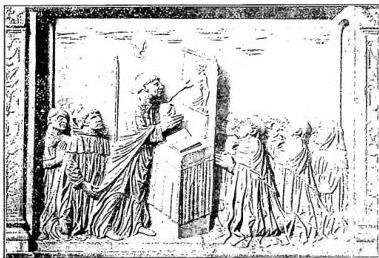
One who knows himself to be in mortal sin must, as a rule, attain the state of Grace through sacramental Confession (can. 807); and this is required not only by divine law, but certainly by ecclesiastical law. There are, however, cases in which one who knows himself to be in mortal sin may celebrate without confessing, namely when there is a necessity to celebrate and, at the same time, an impossibility of confessing.
The necessity to celebrate arises: a) when one must celebrate by reason of office or obligation; b) when otherwise the faithful cannot satisfy the holy day precept or a dying person cannot receive Viaticum; c) when it is not possible to omit the celebration without danger of scandal, infamy, or other grave evil. The impossibility of confessing occurs when there is no priest provided with jurisdiction or capable of understanding the penitent’s language; or when the available priest cannot hear the Confession without harm to himself or a third party; or when it is not possible to have a confessor without grave inconvenience, either because there is no time to confess, or because the confessor lives far away, or because there is danger of encountering serious difficulties. Even a grave extrinsic inconvenience, e.g., of reverence, may excuse from the obligation to confess to the only available priest. One who, conscious of being in mortal sin, must celebrate and cannot confess is bound: a) before the celebration, to make an act of perfect contrition; b) after the celebration, to confess as soon as possible, that is, within three days; even sooner if he wishes to celebrate again, or if he must celebrate and has the opportunity to confess.
b) Immunity from irregularities or penalties prohibiting the exercise of the priestly Order. — Therefore, apart from grave necessity, he who celebrates while bound by irregularity or censure or any other penalty prohibiting the exercise of the priestly Order commits grave sin.
c) Prayers to be recited before the celebration of the Mass. — According to the prescriptions of the rubrics (Ritus servandus in celebratione Missae, tit. I, n. 1), the following must precede the celebration of the Mass: a) the recitation of Matins with Lauds (though this is only a directive rubric); b) the oration (cf. can. 810), which does not seem to be obligatory even under light precept.
8. Dispositions of the body
The principal one is that of the Eucharistic or natural fast, to be observed from midnight with such rigor that it does not permit the consumption of even the smallest portion of food or drink (can. 808). This is a most grave ecclesiastical law that admits no parvity of matter (v. COMUNIONE EUCARISTICA; DIGIUNO).The law of the Eucharistic fast is excused by: the necessity to complete the Eucharistic Sacrifice after the consecration, and probably also the necessity to administer Viaticum; grave harm or inconvenience arising from not celebrating; a dispensation granted by the pope through the Sacred Congregation of the Holy Office (can. 247 § 5). Indeed, local Ordinaries, based on a disposition of the Holy Office dated 23 March 1923, may exercise the faculty (which they possess by right in the most urgent cases), even habitually, to dispense celebrating priests from the law of the Eucharistic fast, provided that: a) this is required for the spiritual good of the faithful; b) only liquid foods are taken, excluding intoxicating beverages; c) scandal is avoided.
In some countries, the Holy See permits that on holy days of obligation, Mass may be celebrated in the afternoon at a certain interval after meals (cf. the Indult of the Holy Office of 28 January 1947 to the Belgian bishops, and that of 28 October 1947 to Cardinal Suhard; cf. Il monitore ecclesiastico, 72 [1947], pp. 111-12; 73 [1948], pp. 78-80).
VIII. TIME AND PLACE FOR THE CELEBRATION OF THE MASS — The Mass may be celebrated on all days, except those excluded by the proper rite of the celebrating priest. In the Roman Rite, the only aliturgical day is Good Friday: moreover, not all priests may celebrate on Holy Thursday and Holy Saturday (can. 820). The Mass may not be celebrated except within the timeframe from one hour before dawn to one hour after noon (beginning of the celebration). An exception is made for the night of Christmas (other exceptions, not of common law but by indult, have already been mentioned), during which the conventual and parochial Mass may begin at midnight; and a single priest may celebrate the three Masses, beginning at midnight, in the oratories of religious houses that have the faculty to habitually reserve the Holy Eucharist (can. 821). The Mass may be celebrated only in churches (Catholic and not in those of heretics or schismatics: can. 823 § 1) or in public or semi-public oratories. Churches and public oratories (can. 1191), however, must first be consecrated or at least solemnly blessed (can. 1165 § 1). No blessing is required to celebrate in a semi-public oratory, although it may be given.
To habitually celebrate the Mass in a private oratory, an apostolic indult is required (can. 1195 § 1).
The indult ordinarily grants permission for only one Low Mass per day, and even this Mass is prohibited on days of greater solemnity. The bishop may permit it once or twice, even on these days, per modum actus, for reasons other than those for which the indult was granted (can. 1195 § 2). In the private chapels of cemeteries, which the CIC considers private oratories (can. 1190 § 1), the Ordinary may permit the celebration of more than one Mass in a day, whereas in other private oratories he may permit only one Mass per modum actus and after inspecting the premises (can. 1194).
The celebration of the Mass in a place that is neither a church nor an oratory, or in the open air (sub divo), may be permitted by the bishop and by the Ordinaries of exempt religious only for just and reasonable cause, in some extraordinary case and per modum actus (can. 822 § 4). They may never grant permission to celebrate the Mass in a bedroom (loc. cit.); they may, however, under certain conditions (including the deceased’s distinguished dignity), permit the celebration of Masses (no more than three) in the so-called camera ardente (AAS, 18 [1926], p. 388). The celebration of the Mass aboard ships may be granted only directly by the Holy See (it is a privilege of cardinals and even titular bishops: cann. 239 § 1, n. 8°; 349, n. 1°) through the Sacred Congregation of the Sacraments, which usually imposes certain conditions. The Mass in the field, on the occasion of secular commemorations or political festivities, may never be granted; and if the promoters insist for special reasons, the bishop must forward the request to the Congregation of the Sacraments (26 July 1924: AAS, 16 [1924], p. 370).
The Mass must be celebrated only on a consecrated altar (can. 822 § 1). The privilege of the portable altar, however, for those who possess it, carries with it the faculty to celebrate anywhere, except at sea, provided it is a decent place and the celebration takes place on the sacred stone (v. cf. can. 822 §§ 2-3). In the absence of an altar of one’s own rite, it is permissible to celebrate on a consecrated altar of a different rite, but not on the antimensia of the Greeks (can. 823 § 2). No one may celebrate on the so-called papal altars without an apostolic indult (can. 823 § 3; V. ALTARE).
(fot. Alinari)
MESSA - M. of St. Gregory, Detail of the marble antependium, work of Luigi da Milano (1470) - Rome, church of S. Gregorio al Celio.
1942; J. I. Guiniven, The precept of hearing Mass, ibid. 1942; I. Vitoria, El pan y el vino eucarístico, Bilbao 1944; A. Verhamme, De materia remota S.mae Eucharistiae, in Collat. Bruges., 41 (1945), pp. 415-18; id., De pane ad Consacrationem requisito, ibid., pp. 418-22; id., De vino ad Consacrationem requisito, ibid., 42 (1946), pp. 18-22; id., De verbis essentialibus Consecrationis, ibid., pp. 22-27; I. Thomas, La Consécration, partie essentielle de la Messe, in Rev. docés. de Tournai, 1 (1946), pp. 46-49; id., La Messe et ses parties principales, ibid., pp. 411-15; R. Michel, Le pain eucharistique, ibid., 1 (1946), pp. 49-51; id., Le vin eucharistique, ibid., pp. 296-97; id., De quelques accidents qui peuvent survenir pendant la Messe, ibid., pp. 415-17; I. Dermine, Les dispositions spirituelles requises pour célébrer licitement la sainte Messe, ibid., pp. 500-504; J. A. Henry, The Mass and Holy Communion, Washington 1946; I. Godley, Time and place for the celebration of Mass, ibid. 1948, Andrea Gennaro
IX. FOUNDED MASSES
I. Nature
Founded Masses (Messe fondate) are those for which the alms are drawn from the revenues of pious foundations (can. 826 § 3). By the term pious foundations are understood temporal goods in any way entrusted to a determined moral person of the Church, with the perpetual or long-lasting obligation to celebrate with the revenues determined Founded Masses; or to perform other determined ecclesiastical functions, or determined works of piety and charity (can. 1554 § 1).It pertains to the local Ordinary (if it concerns pious foundations even in the parish churches of exempt religious) or to the major superior of an exempt clerical religious institute to determine the norms regarding the constitution of the endowment, the distribution of the fruits, and the placement of the capital. For the acceptance of the foundation, the written consent of the same Ordinary or major superior is required (cann. 1545, 1546 and cf. can. 1550).
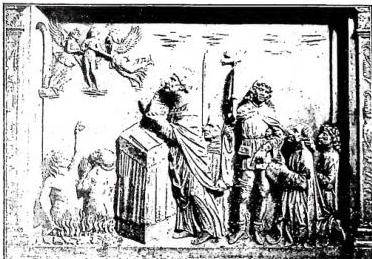
All and each of the Founded Masses must be celebrated and applied under pain of mortal sin. It is also obligatory to fulfill all the prescribed conditions: of quality, of place, of time; so that he sins gravely who, without reason, frequently (that is, more than twice a month) neglects circumstances prescribed for a grave reason.
2. Commutation. - It pertains to the Apostolic See to commute or diminish the obligations of pious foundations unless the founder has left such faculty also to the Ordinary (can. 1517 § 1). It is, however, probable that the Ordinary may, for a just reason, temporarily permit that the Mass be celebrated at another hour or in another place, provided that the purpose established by the founder is not gravely violated.
Furthermore, if due to the decrease of revenues or for another reason not imputable to those charged with the pious foundation, it is no longer possible to sustain all the obligations, the Ordinary, having heard the opinion of the interested parties and respecting as far as possible the will of the founder, may diminish the obligations, but not the number of Masses. But even this may be diminished if the founder has left such faculty (can. 1517 § 2; cf. 1551 § 2). It is the same Pontifical Commission for the Authentic Interpretation of the CIC, when asked «whether the Ordinary, according to cann. 1517 and 1551, due to diminished revenues, may reduce the obligations of Masses, when this is expressly indicated in the foundation tables», responded affirmatively (AAS, 14 [1922], p. 529).
If the revenues are totally extinguished without fault of the one upon whom the obligation of celebrating falls, the obligation of celebrating the Masses ceases by this fact (cf. S. Congregazione del Concilio, 8 Aug. 1705).
The general indult to reduce the obligations of pious foundations must be understood in the sense that, unless it is otherwise established, the indultary should reduce other obligations rather than the Masses (can. 1551 § 2).
At the end of December 31 of each year in which the Founded Masses should have been celebrated, the sums corresponding to those not celebrated must be delivered to the proper Ordinary according to the modalities established by him (can. 841 § 1).
X. GREGORIAN MASSES (SERIES GREGORIANA, tricenarius Gregorianus)
This is so called, from the name of the institute of the pious practice (St. Gregory the Great), the celebration of 30 Masses in suffrage for a soul, for 30 continuous days.1. Origin and nature of Gregorian Masses. - The first example of this kind is reported in the Dialogues of St. Gregory (bk. IV, ch. 55: PL 77, 420-21), who, abbot of the monastery of St. Andrew in Rome, after having taken, during his mortal illness, measures against the monk Justus, guilty of violating the vow of poverty by having kept hidden three gold coins, upon his death commanded the burial of the corpse in a non-sacred place. Subsequently, he ordered Prior Precious to celebrate the Holy Sacrifice «for 30 consecutive days... without omitting a single day». On the 30th day, the deceased monk appeared to his brother Copiosus, a monk in the same monastery, announcing: «Until now I have suffered, but now I am well».
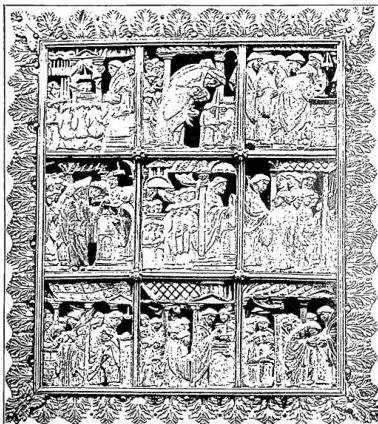
The Holy Office (17 March 1934) reproved the practice, which had spread in Poland, specifically in the diocese of Przemyśl, whereby it was inculcated that the celebration of 44 Masses, applied for a person still living, after three days from death liberated his soul from Purgatory, and this was certain by divine Revelation.
MESSA - M. of St. Gregory. Detail of the marble antependium, work of Luigi da Milano (1470) - Rome, church of San Gregorio al Celio.
2. Conditions. - a) The 30 Masses must be celebrated for 30 consecutive days; b) it is not necessary that the Mass be a Requiem on days permitted by the rubrics; c) it is not required that all the Masses be celebrated by a single priest, but also by several; d) during the last three days of Holy Week, the series is not interrupted but, continuing afterward, the privilege is not lost; e) if the series is interrupted culpably, it must be repeated anew, as the obligation remains; f) if the series is interrupted without fault due to a legitimate impediment, according to some it would be necessary to begin again; according to others, if the alms equal those of manual Masses, then the obligation of justice to complete the number of 30 Masses remains, as well as the obligation of fidelity to begin anew; if the alms are greater than those of manual Masses, in the case of an involuntary interruption, one must either begin again or return the entire sum to the offerer, unless the latter grants a remission or reduction. According to a third, more common opinion, in the case of an involuntary interruption, it suffices to add the uncelebrated Masses, advising the priest to celebrate one of the Masses at the privileged altar or to apply a plenary indulgence to II. In practice, to remove all doubt, it is enough to place the intention of the entire Gregorian series at the beginning, noting that, if by forgetfulness another intention should be made, that of the Gregorian series prevails.
It should also be noted that the Sacred Congregation of Indulgences (15 March 1884) declared pious and approved in the Church the faithful's confidence in holding that every Holy Mass celebrated at the altar of St. Gregory in his church on the Caelian Hill in Rome is effective in liberating a soul from the pains of Purgatory.
XI. MANUAL MASSES
These are Masses for which the alms are offered, as if by hand, by the faithful, eitherfor their own devotion or to fulfill perpetual obligations imposed by the testator upon their heirs (can. 826 § 1).
Analogous to manual Masses are the so-called quasi-manual Masses (ad instar manualium); that is, founded Masses that cannot be applied in the designated place or by those who are obliged to apply them according to the foundation tables, and which therefore, by law or by indult of the Holy See, may be transferred to other priests for celebration (can. 826 § 2).
Regarding manual or quasi-manual Masses, the Codex Iuris Canonici establishes the following: 1) no one may accept obligations for Masses to be celebrated personally in a number exceeding what can be celebrated within the year (can. 835); 2) undoubtedly, the superior of a religious house may accept as many obligations for Masses as can be satisfied within the year by his subjects; likewise, one may accept a greater number who undertakes to have them celebrated within the year by others, even if not his subjects (cf. cann. 836, 837); 3) indeed, one may accept a greater number even if celebrating them personally, provided the offeror knows that not all can be celebrated within the year and consents to II.
The obligation to apply the Mass according to the intention of the one who gave the alms is grave. This obligation is not extinguished either by prescription or by the accidental loss of the alms (can. 829).
It is never licit: 1) to apply the Mass according to the intention of one who will request it by offering alms but has not yet done so, and to retain the alms given afterward for the Mass already applied (can. 825, n. 1). An exception, according to many, is the case of applying a Mass for a cause already existing at the time of application, e.g., for a deceased person for whom relatives have not yet requested the celebration of Mass. 2) To receive alms for a Mass that is owed and applied by another title of justice (can. 825, n. 2). 3) To receive double alms for the application of the same Mass (can. 825, n. 3). 4) To receive one alms for the mere celebration and another for the application of the same Mass, unless it is certain that one alms was offered for the celebration without application (can. 825, n. 4). Except on Christmas Day, one who celebrates more than one Mass on the same day and applies one by reason of justice may not receive a stipend for the application of the others (can. 824 § 2).
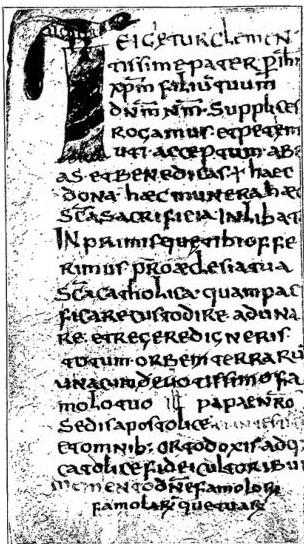
Masses must be celebrated at the time set by the offeror, either expressly or equivalently, e.g.,
for the successful outcome of a matter known to take place on a specific day. If the time is not set even equivalently, nor expressly left to the priest’s discretion, Masses must be celebrated within a short time, depending on the greater or lesser number of Masses. For this purpose, the following formula may be used in calculation: X = N + (N : 2) - 30; that is, X = the useful time for celebrating the Masses; N = the number of Masses. Thus, if the Masses to be celebrated are 40, the formula is expressed as: X = 40 + 20 - 30 = 30. Therefore, 40 Masses may be celebrated in 90 days. Finally, if the offeror expressly left the priest the freedom to determine the time of celebration, the latter may celebrate them whenever he wishes, provided he does so within the year, computed from the day the obligation was undertaken (can. 834).
(from DACL, XI, 1, fig. 8836)
MESSA - Pontifical Mass, Cover of the Sacramentary of Drogo in ivory and silver frame (9th century) - Paris, Bibliothèque nationale, ms. lat. 9428.
However, quasi-manual Masses must be celebrated by December 31 of each year (can. 841 § 2). Beyond the time, the celebrating priest must also observe the circumstances of the celebration that the offerer, in delivering or promising the alms, has expressly declared and the priest has at least tacitly accepted (can. 833). For the juridical relationship between the offerer and the priest, V. ELEMOSINA, III.
III. THE MASS IN THE LATIN RITE LITURGY.
SUMMARY:
I. Fundamental elements
II. The Roman Mass in the 1st-4th centuries
III. The African Latin Mass in the 3rd-5th centuries
IV. The Roman Mass in the 4th and 5th centuries
V. In the 6th and 7th centuries
VI. From the 7th to the 12th century
VII. From the 12th to the 15th century
VIII. From the reform of Pius V to our times
IX. The Mass outside Rome: AMBROSIANA, MOZARABICA, CELTICA, GALLICANA
X. Nomenclature, classifications, and divisions of the Mass.I. FUNDAMENTAL ELEMENTS
The Mass derives its origin from the institution by the Lord during the Last Supper, according to which the fundamental rites are three: 1) the Offering of bread and wine; 2) the Consecration, preceded by a prayer of thanksgiving; 3) Communion.In the earliest times, these rites were performed successively: first those of the bread, then those of the wine, followed by the Consecration and the Communion of the Eucharistic bread, with that of the chalice following at a distance. Following Christ’s example, the prayer of thanksgiving and the Consecration were also performed first over the bread and then over the wine; between the two, the meal was taken, as is evident from St. Paul (I Cor. 10:16; 11:23-25). When the common supper was later separated from the Eucharistic celebration, the two prayers of thanksgiving were united into one, with the double consecration followed by the double Communion.
The distinction made by H. Lietzmann between the Jerusalemite type and the Pauline type—whereby the former is a simple meal ("breaking of the bread") imitating friendly meals (chaburoth, from chaburoth, chaber = friend) and the latter, with the use of wine, would commemorate the Last Supper, the Passion, and the Death of the Lord—is unfounded. Both the Gospels and St. Paul refer the Consecration of the two species to the Last Supper and either presuppose (Mt. and Mk.) or command (Lk. and Paul) their renewal.
The prayer of thanksgiving, not yet fixed in writing, was freely recited by the celebrant following formulas used by Jews in thanksgiving after meals; but to the type of Jewish eucologies (celebrating God’s benefits in the creation of the world and the history of the Jewish people) was added a Christological type of thanksgiving for the redemption accomplished by Christ (cf. the prayers of the Didache). At the Consecration, the narrative of the Eucharistic institution was recited, and the celebrant’s actions imitated those of Christ. The formulas found in all ancient liturgies appear almost independent of the biblical accounts, which means they date back to a practice already in existence when the Gospels were written, and before St. Paul’s letter to the Corinthians. Later, according to the laws of symmetry (in actions and words) and biblical influence, they varied and theological reflections were added. In Mt. and Mk., the command for renewal is not found, but it is presupposed, because the narrative itself shows the influence of liturgical usage, given the symmetrical arrangement of Christ’s actions. In accordance with the Lord’s admonition, an anamnesis or commemoration of the Passion, Death, Resurrection, and Ascension of Christ followed.
Beyond this Eucharistic action, the worship of the early Christians included preaching, readings, and other prayers and hymns, purely didactic parts. This was explained by the imitation of the synagogue practice of reading the sacred books (Law and Prophets) on the Sabbath; a practice that would have continued even when participation in the Temple sacrifices was entirely replaced by the Eucharist (Duchesne). However, this theory of a double worship—Eucharistic and non-Eucharistic or synagogal—does not seem acceptable. All Christian worship is one. Following the example of St. Paul, at Troas the preaching preceded the Eucharistic Supper (Acts 20:7-11); in the Apostolic Letters, the reading in assemblies is presupposed (Col. 4:16; II Pt. 3:16); St. Paul (I Tim. 2:1-3) refers to "supplications, prayers, intercessions, and thanksgivings for all men," elements that later recur in the prayer of the faithful. Hymns are also mentioned in the letters of St. Paul, particularly in the Apocalypse. The distinction between Eucharistic worship and merely didactic worship, therefore, has no foundation. The didactic Mass, as described by Justin Martyr, is not the result of an evolution but is found in germ already in apostolic times.
II. THE ROMAN MASS IN THE 1ST-4TH CENTURIES
The earliest traces of the Roman liturgy are found in the First Epistle of Pope Clement to the Corinthians, dated 96 (40, 1-3; 41, 1-4; 44, 4-5), where he speaks of a sacrificial rite performed by bishops and priests ("to offer the gifts") and cites certain texts of the Mass, not as a reproduction of a fixed formula but as a fine example of that improvised prayer.(from E. A. Lowe, The Bobbio Missal, London B38)
The Beginning of the Canon in the Bobbio Missal (8th century).
Paris, Bibliothèque nationale, ms. lat. 13246, f. 117.
This text is characteristic of the euchological assembly (Duchesne) or didactic assembly (Baumstark), namely: a) the oratio fidelium (59-60); b) the Eucharistic prayer (in two parts: 20, 1-12; 33, 2-6 and 59, 2-3); c) the Trisagion (34, 5-7); d) the solemn conclusion of the Eucharistic prayer with the people’s response Amen (20, 12 and 61, 3). The words of institution and consecration are not recorded, but in their place reference is made to another type of litanic prayers (59, 4).
Fifty years later (in 150), in his Apologia (chapters 65, 66, 67) for Christians to Emperor Antoninus Pius and in the Dialogue with Trypho (41, 70, 117), St. Giustino provides the first description of the Roman Mass, in which he distinguishes two parts: the didactic and the sacrificial. In the first, the sacred Scriptures of the Apostles and the Prophets were read "as long as there is time" (Apologia, 67, 3); this was followed by the bishop’s homily (67, 4). The dismissal of the catechumens is presumed, since only the baptized were present for the subsequent prayer. The prayer of the faithful, for all classes of people (65, 1; 67, 5), concluded with the kiss of peace (65, 2). The sacrificial part began with the Offering of bread and wine by the bishop (65, 3; 67, 3), followed by the Eucharistic prayer or anaphora, recited by the bishop "expressing praise and glory to the Father in the name of the Son and the Holy Spirit" (65, 3); it was not yet interrupted by a chant from the people, the Sanctus.
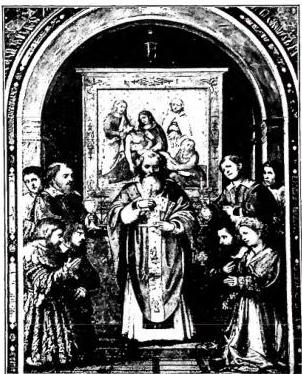
(from A. Ruppel, J. Gutenberg, Leipzig 1917, p. 159)
MESSA - Prayers before Communion in the Mistule abbreviatum, printed by J. Gutenberg (ca. 1457) - Benedictine Abbey of S. Paolo in Carinthia.
The central part is the memorial of the Lord’s Passion, with the recitation of the institution and the Consecration (66, 2-3; Dial., 41), which in Justin is also accompanied by the epiclesis, the invocation of the Logos over the elements to be consecrated. The people conclude by saying: Amen (65, 5; 67, 5). It then mentions the fraction of the Eucharistic bread and Holy Communion, which was distributed under both species, and to the absent was brought by deacons (65, 5; 67, 5).
The third witness is St. Hippolytus in his Apostolic Tradition (of 218 or 220), where one finds the most complete and detailed description of the Mass, as it also contains a text of the Eucharistic prayer presented as a model. Hippolytus does not treat the didactic part of the Mass, which could be omitted on certain occasions, such as Baptism, the consecration of bishops, and the like, but he presupposes it, having already discussed the office of the lector and described his ordination. The oratio fidelium and the kiss of peace followed. All this didactic part was conducted as in the time of St. Justin. The second part is also presented as in St. Justin, but with some details; at the Offertory, the faithful bring their oblations to the altar. In Hippolytus, one finds the first example of an anaphora; in particular, Dominus vobiscum, Sursum corda, Gratia agamus. The anaphora, which was still left to the inspiration of the celebrant, consists of: a) a thanksgiving in a Christological sense (the theological element and even the trisagion are lacking); b) the narrative of the institution (the text of the Consecration is quite archaic and simple); c) the anamnesis; d) the epiclesis. The fraction of the bread (as in St. Justin, without the Pater noster) and Holy Communion under both species follow. There is no dismissal, nor a special prayer of thanksgiving, and it concludes: festinet unusquisque operam bonam facere. The Mass is said in Greek. The deacons are assisted by subdeacons, mentioned here for the first time.
III. THE LATIN AFRICAN MASS IN THE 3RD-5TH CENTURIES
While in Rome the liturgy was still celebrated in Greek, the African Church from its very beginnings used the Latin language, as attested by Tertullian (197-222) and St. Cyprian (249-58). In the didactic part, Scripture readings were included (Cyprian, Ep., 38, 2; 39, 4-5), interspersed with psalm chants (Tertullian, Ad ux., 2, 9); after the Gospel, the homily typically took place (Cyprian, De mortal., 1); then followed the dismissal of catechumens and penitents. During the oratio fidelium, the names of those offering the DITICO (v.); it concluded with the kiss of peace, omitted only on Good Friday (Tertullian, De orat., 18; Ad ux., 2, 4). The faithful brought bread and wine for the sacrifice. A little water was added to the wine in the chalice (Cyprian, Ep., 63, 13). The Eucharistic prayer began with the verses Sursum... Habemus..., called the Prefatio (Cyprian, De orat., 31). St. Cyprian (Ep., 63, 9, 10, 17) reports the words of institution, consecration, and the commemoration of the Passion. This was followed by the fraction of the consecrated bread and the Pater noster, here mentioned for the first time by Cyprian (De orat., 2) and Tertullian (De orat., 3-4). Holy Eucharist under the species of bread was distributed by the celebrant and placed in the hands of the faithful; the chalice was presented by the deacons. The Eucharist was also taken by the faithful to their homes and kept in a special casket.These indications are further completed by the writings of St. Augustine (d. 430). They include: a solemn entrance of the bishop (without chant); his greeting Pax vobis (not followed by any prayer); immediately after, the triple reading of the Old Testament, the Acts or Apostolic Epistles, and the Gospel, interspersed with psalm chants; the dismissal of catechumens, usually the prayer of the faithful (with the dittici); but the kiss of peace follows the Pater noster. In Augustine’s time, a chant was introduced at the Offertory (Retract., 2, 37), and he cites the acclamation Dignum et iustum est. Another novelty: after the fraction of the consecrated bread and the recitation of the Pater noster came the kiss of peace, followed by a blessing of the people before Communion (Ep., 149, 2, 16; Serm., fragm. 3 contra Pelag.). As at the Offertory, a psalm (Psalm 33) was also chanted at Communion. The Eucharist was given with the formula: Accipite et edite corpus Christi... Accipite et potate sanguinem Christi or more briefly: Corpus Christi - Sanguis Christi, to which the faithful responded: Amen (Serm. ined., 3, 3; PL 46, 827; Serm., 272; PL 38, 1274). The Mass concluded with a thanksgiving (gratiarum actio cuncta concludit, Ep., 149, 2, 16), though the details of its content and text remain unknown.
IV. THE ROMAN MASS IN THE 4TH AND 5TH CENTURIES
In the time of Hippolytus, the Roman Mass was still in Greek. But Latin soon prevailed. Marius Victorinus still cites, in 360, a passage from a Greek-Roman oblation prayer. Between 374 and 380, the author of the Quaestiones Veteris et Novi Testamenti (109, 20) alludes to the use of Latin in worship. However, even earlier, the sacred reading in Greek was followed by a Latin translation. A further step was taken with the translation of the Eucharistic prayer (Canon). Simultaneously, some changes were introduced into its text. Beginning with the Prefatio, interrupted by the Sanctus, the Canon continued with the Te igitur, to which were added Quam oblationem and Qui pridie. Before Innocent I (401-17), the intercessory prayers of the Memento with the reading of names (the dittici) were introduced; in the course of the 5th century, the others were added: Communicantes, Hanc igitur (only in special Masses), Nobis quoque—prayers that already belonged to the most ancient form of our Canon, perhaps from the time of Gelasius I (492-96). The entire Canon exhibits the same style throughout (parallelism of members, a certain predilection for the number three, a tendency toward richness of expression in the use of odd numbers (cf. A. Baumstark, Antik-römischer Gebetstil im Messkanon, in Miscellanea Mohiberg, I, Roma 1948, pp. 300-31). The most ancient form of the Latin Canon is found in the treatise attributed to St. Ambrose, De sacramentis (I, IV, cap. 5). It is unclear whether Milan took the Canon from Rome or vice versa, but the Latin Canon was elaborated in Rome.With the translation and formation of the fixed Canon, the other prayers of the celebrant were also established. While the Canon no longer varies, the Prefatio changes according to the time of the ecclesiastical year, which from this period begins to influence the prayers and readings of the Mass. The structure of the Mass receives further additions: before the readings, a prayer is recited; at the Offertory follows the Super oblata, preceding the Canon; Communion concludes with the prayer Postcommunio. At the beginning, and until Gregory I, another prayer was added to the first, though its exact placement is uncertain: it was either the prayer after the Gospel reading (post Evangelium) or the one before the Offertory, similar to the Milanese prayer Super sindonem. Furthermore, a second prayer was added to the Post Communionem, called Super populum, with which the people were blessed before being dismissed.
From the 4th and 5th centuries, the arrangement of prayers in the Mass was as follows: two collects, before and after the readings; a prayer Super oblata; the Prefatio with the Canon, the Postcommunio, and the prayer Super populum (Leonine and Gelasian schema = 3-VD = Prefatio and Canon) - 2). St. Gregory abbreviates and abolishes the second collecta or prayer of the readings and reserves the Super populum only for the days of Lent (Gregorian schema: 2-VD-1). The celebrant may formulate the prayers, but well-composed formulas are collected in an archive book.
Another novelty: until the time of Felix II [III] (483-92), the intercessory prayers were recited after the readings, that is, before the Mass of the faithful; but from this time, the Oratio fidelium disappears, and an introductory part in the form of a litany appears before the reading: the Kyrie followed by the collect prayer. This innovation likely occurred under Gelasius I (492-96), Felix’s successor. From this time, the intercessory prayers also appear in the Canon: Memento, Communicantes, Nobis quoque. Perhaps there is a relation between these two novelties, and Gelasius is credited with abolishing the Oratio fidelium, introducing the Kyrie and the prayers before and after the readings, as well as the intercessory prayers in the Canon. During this period, liturgical books (v.) appear.
At the end of the 5th century, the rite of the Mass thus unfolds as follows: it begins with the litany of the Kyrie, followed by the prayers (preceded by the celebrant’s greeting), one before the reading and another after; between the readings, the Gradual and Alleluja are chanted. There are still, before the Gospel, two lessons from the Old and New Testaments (Apostolus), with the Gospel as the third; after which comes the second prayer (post Evangelium), later abolished; the Dominus vobiscum with the Oremus remains. After the Gospel or after the homily, the faithful bring their offerings to the altar; the Oratio fidelium is no longer recited (replaced by the Kyrie). At the end of the offerings, the celebrant recites the prayer Super oblata (still aloud); no chant is sung during the offerings.
The following then occur in this order: the Canon, the fraction of the Host, the Pater noster, and the kiss of peace. The latter, which took place at the end of the Oratio fidelium, is moved after its suppression. At the end of Communion, the Postcommunio and the prayer Super populum are said. The dismissal is given with the Ite, missa est.
V. IN THE 6th AND 7th CENTURIES
The Mass assumed great solemnity from the presence of the pope. At his entrance, the Introit was sung, an antiphonal chant, perhaps already introduced in the time of Celestine I in 431. Another chant was performed at the Offertory, that is, during the offerings of the faithful, and similarly at the Communion of the people; all these chants were executed by the Schola cantorum, which also performed the Gradual before the solo chant. The singing of the Gloria in excelsis was transferred from the Morning Office to the Mass, first at Christmas, then also on other feasts, but it was reserved for the pontiff.In this century, some changes were made to the rite or the prayers, attributed to St. Gregory I. The daily acclamations of the Kyrie were abbreviated, and it was added
MESSA - M. of St. Apollonius. Painting by Romanino (16th century). Brescia, church of S. Maria Calchera.
the Christe eleison. Gregory I suppresses the prayer after the readings; reserves the Super populum for the days of Lent; reforms the Hanc igitur, adding diesque nostros. An important change is the transposition of the Pater noster, immediately after the Canon before the fraction of the Host. At the fraction of the Host, the Agnus Dei is sung from the time of Pope Sergius (d. 701). Prayers, chants, and rites are codified, and thus the solemn Roman Latin Mass receives its more or less definitive form, as it appears in the various liturgical books.
VI. FROM THE 8TH TO THE 12TH CENTURY
The Roman liturgy began to spread beyond Italy starting in the 5th-6th centuries. Indeed, for Spain, Bishop Profuturo requested the Roman Canon (in 538), and the Synod of Braga in canon 4 (in 563) ordered the assimilation of the Spanish liturgy to the Roman one. In England, with the mission of Augustine commissioned by Gregory I, the Roman liturgy was also introduced. In Gaul, the reform initiated by Pepin and continued by Charlemagne, with the aim of replacing the Gallican Mass with the Roman one, over the years in turn influenced the rite and prayers of the Roman Mass itself.In the regions of the Gallican Mass, there was a predilection for performing rites in a more dramatic form: they thus grew in number and grandeur. Incensation, used in the Roman Mass only at the pontiff’s entrance, was also practiced at the beginning of the Offertory: the altar was incensed from the four sides, and the oblations were also incensed. Incensation of the altar was also added immediately after the entrance, before the Gloria or the Dominus vobiscum (Pax vobis). Incense was carried in procession for the Gospel announcement, as a triumph of the Lord himself; the book was incensed, as were the celebrant, the acolytes, and the people. Incense for the people was reserved only after the incensation of the oblations to indicate that with the offerings, the offerers were also included in the Sacrifice. Before the Gospel announcement, the deacon greeted the people, like the celebrant, and at the announcement, the people responded with Gloria tibi, Domine. The rite of the Orate fratres was introduced before the beginning of the Canon.
Prayers also increased. To the single prayer of the feast, others were added, but not exceeding the number of seven. As in the Gallican rite (cf. the African rite of the time of Augustine), solemn blessings by the pontiff were given after the Pater noster before Holy Communion.
In Gaul, the first signs of the Cross in the Canon are encountered. The ancient rite of blessing was the imposition of hands; in Gaul, however, the sign of the Cross was used, which appears in seven points of the Canon: a) in the Te igitur, at the words haec dona, haec munero, haec sancta sacrificis; these are the first and oldest signs (already in the ancient Gelasianum of the 8th century [cod. Vat. 316], a sign is also added before, at benedicas); then from the 8th-9th centuries come: b) in the Quam oblationem (five signs, as today); c) in the Qui pridie and Simili modo (account of the institution); d) in the Unde et memores; e) in the Supplices; f) in the Per quem (these six groups are found in the oldest codices of the 8th-9th centuries, and they are mentioned in the Ordo Romanus II, 10). By the end of the 10th century, they appear in group g) from the Per ipsum to the Pax domini for the insertion of the particles. These signs of the Cross were made for four purposes: a) to reinforce the idea of blessing or sanctification, b) to emphasize certain sacred words, c) as an ancient rhetorical gesture of indication, d) as a gesture of oblation. There was a certain predilection for odd numbers (3 or 5).
From France, beginning in the 9th century, various tropes and verses were inserted into the melodies of the Ordinary and the texts of the Mass: a) to the Ordinary of the Kyrie, Gloria, Sanctus, Agnus Dei, Ite (never to the Credo), b) to the Proper of the Mass de tempore and of the saints, that is, to the Introit, Gradual, Offertory, Communion; sometimes also to the Epistle, rarely to the Gospel. Similarly, the so-called sequences were sung at the Alleluia. All these chants flourished until the 13th century but only five sequences were preserved in use: that of Easter (Victimae), of Pentecost (Veni), of Corpus Domini (Lauda Sion), of the Sorrowful Mother (Stabat), and of the dead (Dies irae).
In addition to this, the celebrant privately recited prayers called Apologies; for the preparation for the Sacrifice, in assuming the sacred vestments, during the chant of the Gradual, the celebrant recites with the deacon a prayer for the Gospel announcement; as the offering of the faithful diminished, the rite and prayers for the preparation of the elements increased: special prayers for the Offertory of the bread, of the chalice, etc. Thus, the new rite of the Offertory was formed. The celebrant prepared himself with special prayers for Holy Communion. Typical of these apologies is the awareness of one’s own sinfulness. While the ancient Church prayed with open and raised hands, as is done today in the prayers of the Mass and in the Canon, the apologies were recited with hands joined (a gesture derived from the homage of the Germanic vassal who placed his joined hands in those of his lord).
In the 8th-11th centuries, these four parts of the Mass were formed: 1) for the entrance: the preparatory prayers for vesting, special prayers at the approach to the altar (Iudica and Confiteor); 2) for the Offertory: the prayers for the Offertory of the bread and the chalice; the Lavabo came into use after the incensation; 3) for Communion: the chant of the Agnus Dei was prolonged until Communion, because there was no fraction of the Hosts. During this chant, the celebrant recited special prayers for his preparation. The rite of the ablution of the chalice also began in these centuries; 4) finally, after the Ite, missa est, the blessing was added (before the Placeat); in the sacristy, special prayers were recited for the removal of the sacred vestments.
Other changes prepared in these centuries: the prayer Super oblata was recited secretly, in a low voice, beginning from the middle of the 8th century. The term Secreta occurs for the first time in the Capitulare Ecclesiae ordered by the Archcantor Giovanni and derives from Gallican usage. The Canon was also no longer recited aloud. The moment of the sacrifice was surrounded by a solemn silence: «Quae dum (the Sanctus) espleverint, surgit solus pontifex et tacite intrat in canonem» (Ordo Romanus II, 10: PL 78, 974a). The celebrant himself began this act with sacred trembling; hence the new rite of the Orate, fratres!; the clergy sometimes recited special prayers and psalms for him (e.g., gradual psalms). In the Memento, the words pro quibus tibi offerimus were added to indicate that only the priest is the minister of the Sacrifice.
With the use of unleavened bread, the use of a large Host for the celebrant and small Hosts for the Communion of the people was introduced: the paten became smaller because the fraction of the Hosts for the Communion of the people was no longer necessary and was used only for the Host of the celebrant; for the Communion of the people, the ciborium was introduced, and the people received Holy Communion kneeling.
These customs were also introduced in Italy and even in Rome. Significant was the introduction of the Credo into the Roman Mass, made by Benedict VIII at the request of Emperor Henry (1014), but later limited to certain days. In Gaul and Germany, the Credo was sung after the Gospel as early as the end of the 8th century, introduced on the occasion of the condemnation of Adoptionism at the Council of Frankfurt (794). In Rome, the Credo was recited only in the administration of Baptism.
BIBL.:
J. A. Jungmann, Missarum Sollemnia, I-II, Vienna 1948; P. Browe, Die Verehrung der Eucharistie im Mittelalter, Munich 1933; F. Cabrol, Les origines liturgiques, Paris 1906; L. Duchesne, Origines du culte chrétien, Paris 1920; E. Bishop, Liturgica Historica, Oxford 1918; A. Ebner, Quellen und Forschungen zur Geschichte und Kunstgeschichte des Missale Romanum im Mittelalter, Freiburg 1896; H. Leclercq, Histoire des conciles, Paris 1907-1952; M. Righetti, Manuale di storia liturgica, I-IV, Milan 1945-1949; A. Baumstark, Liturgie comparée, Chevetogne 1939; P. de Puniet, Le cycle liturgique, Paris 1932; J. M. Hanssens, Institutiones liturgicae de ritibus orientalibus, Rome 1930-1932; A. Wilmart, Auteurs spirituels et textes dévots du moyen âge latin, Paris 1932.
A. RIGHETTI
VII. FROM THE 12TH TO THE 15TH CENTURY
To determine the Roman Mass in the 12th century and beyond, the starting point is the Micrologus of Bernoldo of Costanza (v. written ca. 1089), while the endpoint is the Ordo of Burcardo (d. 1506); in between lie Pope Innocent III’s De sancto altaris mysterio of 1198, the Rationale divinarum Officiorum of Guglielmo Durando of Mende (d. 1296), the Ordo Romanus XIV (ca. 1311) of Cardinal Stefaneschi (d. 1343), and the Ordo Romanus XV of Pietro Amelio (d. 1401). During this period, the Ordo Missal (v.) were compiled for the private use of the Pope and his court. The Friars Minor propagated the Roman usage everywhere «secundum consuetudinem Romanæ Curiae». The celebrant was required to read privately all the texts that were read or sung. Already according to the Ordo Ecclesiae Lateranensis of 1145 by Cardinal Prior Bernardo and Durando’s Rationale, the bishop read cum ministris the texts of the Introitus, Kyrie, Gloria, Epistola, Credo, Sanctus, and Agnus Dei! The Ordo XIV, however, does not yet mention the Epistle, Gradual, Gospel, Offertory, and Communio. Burcardo’s Ordo contains these prescriptions.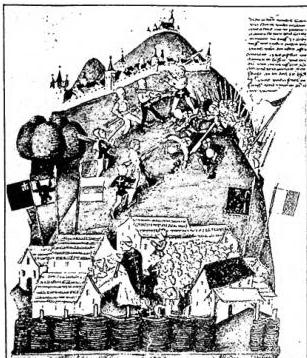
The Ordo of the Papal Chapel contained some other particularities: it introduced in Rome the incensation of the oblations and the altar at the Offertory; unlike current usage, the celebrant, having ascended the altar, gave the peace to the deacon and washed his hands before offering the bread and wine.
In the 12th century, the elevation of the consecrated Host was introduced into the ceremonies of the Mass, making it the culminating point of the Mass. The first to mention it is Odo of Sully, Bishop of Paris (1196-1208). Compared to the minor Elevation at the end of the Canon—honor et gloria—older because it involves the gesture not of showing the gifts to the people but of offering them to God, the new rite is called the "greater" Elevation. The desire to see the Host became one of the most characteristic devotions of the 13th-15th centuries; sometimes, for the faithful, the entire Mass consisted in seeing the Host ("ocular Communion"). The Elevation of the chalice, after the Consecration of the wine, was not performed simultaneously but was introduced by symmetrical analogy; Durando in the Rationale provides the first certain evidence of it; practiced in the Papal Chapel in the 14th century, it was made obligatory by the Missal of Pius V (1570).
This greater Elevation led to the use of genuflections in the Canon, which were also imposed only by the Pian Missal. Previously, the celebrant and ministers bowed deeply. The same applies to the incensation of the Eucharistic species, introduced around the middle of the 12th century. The Last Gospel of St. John was added in the 13th century (Durando).
The Roman Ordo, that is, of the Papal Chapel disseminated by the Friars Minor, was the final stage in the evolution of the Ordinary of the Roman Mass.
VIII. FROM THE REFORM OF PIUS V TO OUR TIMES
The spread of the Ordinary of the Papal Chapel did not yet represent the unification of rites, which was the aim. Particular rites remained, both of dioceses and of the great Orders; abuses also unfortunately persisted. To put an end to this almost liturgical anarchy, the Council of Trent established a special commission; but the task was later left to the pope: Pius V, on 14 July 1570, by publishing the new Missal, determined that the texts and rites of the Roman Mass were to be observed throughout the Western Church, except for those Churches that had possessed their own for at least 200 years. New revisions took place under Clement VIII (1604), Urban VIII (1634), and finally under Pius X.List of additions to the Mass over the centuries. Ps. Judica, 11th-12th centuries; Aufer a nobis (Roman style) and Oramus te (Gallican style), 12th-13th centuries. Incensation of the altar at the Introit, 9th-13th centuries; more than one oration, from the 11th century. Sequences: Victimae (11th century), Veni sancte (11th century), Dies irae (13th century), Lauda Sion (13th century), Stabat (14th century); accepted in Rome in the 18th century. Munda cor meum, 11th century. Sequentia of the Gospel, 9th century (in Gaul). Gloria tibi Domine-Dominus vobiscum, 13th century. Per evangelica dicta: after 1570 (in Rome). Incensation of the oblations, 11th century. Per intercessionem, Incensum istud, Accendat, 13th century. Ps. Lavabo (gesture already in the 7th century), 11th century. The Orate fratres and the Suscipiat (as response) added after 1200. Elevation of the Host, around 1200. Elevation of the chalice, 14th century. Genuflections instead of bows, toward the end of the 14th century. Haec commixtio, 9th-13th centuries. Confiteor, Agnus Dei, Domine non sum dignus (for the Communion of the faithful), 13th century. Communion of the faithful under the single species of bread, 14th century. Purification with wine and water, 14th century. Blessing of the people, first a privilege of the bishop from the 7th-8th centuries (in Gaul), begins to be imparted also by the priest. The Placeat, in the 11th century a prayer recited after the Mass, was introduced by the Pian Missal of 1570. Kiss of the altar, Benedicat vos, Last Gospel, Pian Missal of 1570. The prayers at the foot of the altar were added by Leo XIII.
IX. THE MASS OUTSIDE ROME: AMBROSIAN, MOZARABIC, CELTIC, GALLICAN
Besides the Roman-Latin rite and the African-Latin rite, there existed four other great Latin liturgical families: the Ambrosian (the older or archaic-Roman rite), the Mozarabic (an indigenous national liturgy), these two rites still in use today; the Celtic (a varied complex of liturgical usages) and the properly Gallican. While the Ambrosian Mass is more of the Roman type, the other three form an almost common family, despite the particularities of each.Mass - Procession of the Pontifical Mass in the Ambrosian rite. Milan, Duomo.
It is therefore sufficient to describe the rite of the Mass properly called Gallican as a general type.
In it, three parts are clearly distinguished: introductory, didactic, and sacrificial (= Mass of the Faithful). The offerings of the faithful (bread, wine, and other items) are brought into the sacristy before the Mass. Here, the oblations for the Mass are also prepared in advance and placed in a vessel to be carried to the altar after the litany of the faithful; the offerings not necessary for the Mass are set aside at the altar to be blessed at the end of the Canon, for the use of the clergy and the poor.
1. Introductory part: at the entrance of the celebrant, the "antiphona ad praelgendum" (= before the exhortation) is sung, corresponding to the Roman Introit (or ingresa in the Ambrosian liturgy, called Officium in the Mozarabic liturgy). The deacon calls for silence, "Silentium facitei," and the celebrant greets the people, "Dominus sit semper vobiscum" (in Milan as in Rome, "Dominus vobiscum" or "Pax vobis"). Three chants follow: a) the "Aius" in Greek and Latin (Trisagion), already introduced before the Council of Vaison (529), which ordered it to be sung at every Mass (in the Roman Mass, it is used on Good Friday, "agios o Theos"); b) the Kyrie, sung in unison by three boys, only three times; c) the "Propheta," that is, the "Benedictus" (Lk. 1:68-79), sung by two choirs. This is followed by the "Collectio post prophetiam," composed of a Praefatio (address to the faithful) and the Collect. In place of the Trisagion, the Ambrosian and Mozarabic liturgies say the "Gloria in excelsis" (Roman influence).
2. The didactic part follows: three readings, the first from the Old Testament, the second from the Apostolic Epistles (after Easter, the books of Acts or Revelation are also read; on the feasts of saints, their lives). After these two lessons, the hymn of the three youths in the furnace (Dan. 3:51) is sung, followed by a gradual responsory. With the repetition of the Trisagion, in a procession with seven candles, the Gospel book is brought to the ambo for the third lesson, that of the Gospel; the bishop’s homily follows. This practice was observed in Gaul better than
(Courtesy of Dr. B. Degenhart)
Mass - Mass in the field at Hedingen (22 July 1443) in the Tschachtlan Chronicle of 1470 - Zurich, Central Library, ms. A. 120.
in Rome, for in the absence of the bishop, priests also preached, or deacons read passages from the Fathers, a custom extended even to rural parishes by the Council of Vaison (529). The Mass of the Faithful begins with a litanic prayer, intoned by the deacon, to which the people respond. In the Ambrosian liturgy, a trace of this prayer is preserved on the Sundays of Lent, but immediately after the ingresa; and also in the triple Kyrie after the Gospel. The litany concludes with the oration, called "Collecta post precem," after which the penitents and catechumens are dismissed. In the Roman liturgy, remnants of this litany are found in the solemn prayers of Good Friday; now, a separation is noted after the "Dominus vobiscum" before the Offertory. After the prayers of the litany, in a solemn procession, the deacon carries to the altar the oblations prepared in advance: the bread enclosed in a tower-shaped casket, the wine in a chalice covered with a precious veil. During the procession, the sonus is sung, similar to the Byzantine Cherubikon; this chant concludes with the Alleluia (called laudes in the Mozarabic liturgy; in the Ambrosian liturgy, "Antiphona post Evangelium"). This rite of carrying the oblations must be distinguished from the offerings of the faithful, which in the Roman rite occur at the same moment. Once the oblations are placed on the altar, a little water is poured into the wine; a triple Alleluia is sung (Laudes, Sacrificium in the Mozarabic liturgy; Offerenda in the Ambrosian). The priest recites the prayer of the "veil" (so called because at that moment the oblations are covered with a large veil), composed, like all other orations, of a Praefatio and the Collect "ante nomina" (in the Ambrosian and Mozarabic liturgies, preceded by a greeting), corresponding to the "Secreta" or "Super oblata" of the Roman rite. The names of the bishops and of the faithful, both living and deceased, are recited according to the dittici (v. DITTICI), followed by the "collectio post nomina." All exchange the kiss of peace, while the priest recites the "Collecta post pacem."
3. The "contestatio" ("immolatio," "illatio") follows, the Eucharistic prayer corresponding to the Preface of the Roman rite, followed by the "Sanctus." The "Post sanctus" is a brief transitional formula connecting the Praefatio and the Sanctus with the narrative of the institution. The text of this narrative is not known, as it was often indicated with a few words and recited from memory, in a low voice (in contrast to the loud voice in the Roman rite), but it was similar to the Roman one, by analogy with the following prayers called "Post pridie" (and also "post secreta," from the recitation in a low voice).
After the final doxology of the "post pridie," the fraction of the Host was performed, accompanied by the chant of the confractorium; then the Pater noster was recited, according to Greek usage, by the celebrant and the people; the oration "Ante orationem Domini" preceded it; the "post orationem dominicam," generally shorter than the Roman "Libera," but of identical content, followed. The rite of the "Commistio" follows. As preparation for Communion, the bishop imparted a special blessing; priests used (in the Celtic and Ambrosian rites) a shorter formula: "Pax et communicatio D. N. J. C. sit semper vobiscum."
Communion was received under both species of bread and wine at the altar (in Spain, for the faithful outside the choir). Men received the Host on the bare hand, women on a cloth called the "domenicale"; the deacon presented the Eucharistic chalice. The "Trecanon" was sung, a chant composed of Psalm 33, "Gustate et videte," interspersed with Alleluia; sometimes, as a variant, the hymn "Sancti venite" (Antiphonale of Bangor: PL 72, 587). The prayer of thanksgiving, "Post Communionem," also preceded by a praefatio, concludes the Mass. The dismissal formula in the Gallican rite, corresponding to the "Ite, missa est," is unknown; in the Stowe Missal (Celtic rite), it reads, "Missa acta est. In pace."
X. NOMENCLATURE, CLASSIFICATIONS, AND DIVISIONS OF THE MASS
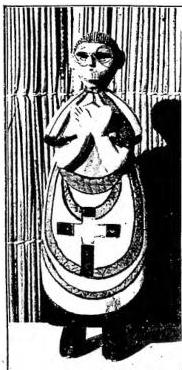
2. According to the rite or solemnity, the Mass is solemn (pontifical, presbyteral); sung; private.
a) Pontifical Mass. — This is the solemn Mass officiated by a bishop or a priest having the use of pontificals, either by canon law (can. 325 and 625; abbates regiminis benedicti, abutes nullius, praelati nullius), or by apostolic concession, according to the rite prescribed by the Caeremoniale Episcoporum (1600). The rites of the current pontifical Mass derive from the ancient solemn papal Mass described in the Ordines Romani and have preserved some of its particularities. The ordinary bishop is assisted by a representation of his clergy, by the assistant priest (beginning in the 12th century), by the ministering deacon and subdeacon, and by two assisting deacons; he enjoys the privilege of seven candles on the altar (instead of the seven acolytes of the solemn papal Mass), greets the "sancta" upon his entrance, adoring the Most Blessed Sacrament, kisses the Book of Gospels at the beginning of the Mass, presides over the liturgical assembly from his cathedra during the didactic part of the Mass (before the Offertory), and uses the Lavabo before the Offertory. The ancient practice of the fraction and Communion performed at the cathedra is reserved for the papal Mass. In antiquity, only the bishop, as hierarchical head, celebrated the Mass on Sundays and feast days; other priests concelebrated with him (v. CONCELEBRAZIONE). In accordance with that ancient usage, even today the deacon and subdeacon receive Holy Communion in the papal Mass.
The solemn papal Mass has these additional particularities: at the entrance, seven acolytes with candles precede; as in the Ordines, at the altar the three youngest cardinal priests greet the pope with the kiss of peace; the readings of the Epistle and Gospel are done in Latin and Greek; at the Offertory, the pre-tasting occurs, that is, the sacristan must pre-taste two of the three Hosts and the wine; at the Elevation after the Consecration, the pontiff shows the sacred species toward three directions—center, right, and left; after the fraction of the Host, the pope goes to the cathedra and there communicates, reserving a part of the sacred Host and the consecrated chalice for the deacon and subdeacon. For the Communion of the Precious Blood, the pope uses a metal tube (fistula, calamus, pugillaris).
b) Presbyteral Mass. — The solemn Mass, officiated by the priest with deacon and subdeacon, with the chanting of the officiants and choir, and with other solemn rites of incense, etc., derives from the pontifical type and is an adaptation of the papal Mass of the Ordines Romani to occasions when a bishop was not present (v. the "Capitulare ecc. ord.", ed. by Silva-Tarouca). Even the De officiis ecclesiasticis of John of Avranches (1065; PL 147, 32) grants many particularities of the pontifical rite (excepting the cathedra) to the simple priest. The rite later simplifies: only a deacon and a subdeacon, the priest greets with "Dominus vobiscum", everything is done at the altar (Gloria, Oratio, Credo), Lavabo after the incense. These simplifications are already seen in a Dominican ordinary of 1256. There are also reverences to the celebrant and multiple kisses in presenting and accepting. The celebrant recites with the assisting ministers the texts chanted by the choir.
c) Sung Mass. — From the second, presbyteral type derives the sung Mass. There was a Mass used in the presbyteral churches of Rome: the priest with a deacon or at least with a lector or acolyte. The latter read the Epistle, recited the Gradual with the response of the faithful, and performed the auxiliary services of the Mass. There were no chants of the Introit, Offertory, or Communion by the cantors. The faithful responded to the greeting and the end of the Prayers and Canon, chanted the Sanctus. Later, this sung Mass developed in the manner of the pontifical Mass, that is, it assumed the rite of the solemn entrance with the chant of the Introitus, first, already in the time of Gelasius I, that of the Kyrie and the Oration, later also of the Gloria (Credo), Agnus Dei; the celebrant recited the chant parts himself from the 12th century onward. This form of the sung Mass (by the celebrant alone) was ordinary in small rural parishes, where there was not sufficient clergy. The form of the sung Mass was also ordinary in convents, called since the Middle Ages conventual Mass. The Carthusians still today have only one deacon to assist the celebrant, a lector who reads the Epistle; the same applies to the Cistercians on ferial days. The conventual Mass in monasteries is that of the day, in which all members participate. The Mass, corresponding to the Office of the day, is celebrated as a rule after Terce, on ferial days after Sext, on fast days after None.
All these three types of Mass, celebrated on Sundays and feasts, are also called public Mass, because they are intended for the community. Today, to satisfy the Sunday obligation of the faithful, the public Mass is not always sung or solemn, but a simply read Mass suffices.
d) Private Mass. — In its original and strict sense, it was that which was celebrated in private homes or in the shrines of martyrs, a practice used since the earliest centuries, especially during times of persecution (Tertullian, Basil, Gregory Naz., Augustine: "qualiter poterant et ubi poterant"), and in the Middle Ages in the villas of great landowners or lords. After the Council of Trent, Masses in private homes were prohibited. This form, more or less public, is distinguished from the private (or solitary) Mass of the celebrant alone with his minister. It was celebrated out of devotion in the form of a votive Mass, especially for the dead, from the 7th century to satisfy the personal piety of priests and monks and to foster the devotion of the faithful. From the 9th century onward, the presence of at least two people was prescribed. It was celebrated with the simplest rite, in a low voice ("in directum"), omitting all chanted parts; the priest vested at the altar. Thus, the private Mass became the read or low (or secret) Mass. Today, in the rite or prayers, there is no difference between the private or read Mass and the public or sung Mass. Indeed, the read Mass, as recognized by the Missal of Pius V, is almost the ordinary form, because the rubrics speak of the read Mass to which the special rites of the solemn or pontifical Mass are added. A more recent form is the dialogued (recited) Mass, which adds nothing to the rite but intensifies the participation of the faithful; the faithful respond to the celebrant, recite with him the Gloria, Credo, and Pater; the didactic texts of the Epistle are read, in addition to the celebrant, by a lector, and sometimes even those of the Gospel; silence is observed after the Sanctus. Another variation is that the people sing in the vernacular texts corresponding to the celebrant’s Latin.
3. According to the text, there is the temporal Mass, sanctoral Mass, common Mass, and votive Mass. The Masses of the temporal cycle are those formularies composed for the feasts of the Lord: Christmas, Resurrection, Pentecost, and for the Sundays preceding or following Christmas, Easter, and Pentecost. Another series of...
MASS - "The Mass of the Artists." Artists leaving Santa Maria in Via Lata (1946). Rome.
(fot. A. Santos d'Almeida)
MESSA - Bishop celebrating the Mass. Indigenous sculpture - Lândana (Angola).
Missions of the Holy Spirit.
of the sacred species consecrated on Holy Thursday, preceded by readings, prayers, and the veneration of the Cross. Originating in Gaul, it was already in use in Rome by the 9th century. In the Greek liturgy, it was initially celebrated every day of Lent except Sundays, later twice during the weeks of Lent, and on the first three days of Holy Week.
Today, only one Mass per day is said by the same priest; only on the feast of Christmas and, since Benedict XV, on the day of All Souls is each priest permitted to say Mass three times. At the beginning of the 5th century, the private and daily celebration of the Sacrifice by the same priest had become so frequent that some allowed themselves three, four, or more (Pope Leo III "often celebrated seven or nine solemn Masses in a single day," Walafrid Strabo, De exord., cap. 21). Pope Innocent III (d. 1216) prohibited multiple celebrations except on Christmas, "unless for necessity." This necessity arises when, on Sundays or holy days of obligation, a significant portion of the faithful would otherwise be deprived of the holy Mass.
4. For historical reminiscence, the so-called bifaciata or trifaciata Mass of the 13th century should be recalled. Particularly in France, a specific formulary was read up to the Offertory, then a second, and even a third was begun, after which the Mass proceeded regularly. Different is the dry Mass practiced from the 9th century (Pontifical of Prudentius) until the time of Durandus (d. 1296). It was a Mass without Consecration and Communion, though the ceremonies were performed by the celebrant and the two ministers; in Rome, it remained in use until the time of Burchard of Strasbourg (d. 1506). Durandus distinguishes two forms: a) a lesser one: consisting of the Epistle, the Gospel, the Pater noster, and the Blessing (the priest wore only the stole); b) a greater one: all texts were recited except the minor Canon of the Offertory and the major one "Te igitur"; that is, the Preface, Pater noster, Agnus Dei, etc. were sung (without Communion); the celebrant and ministers wore sacred vestments. Perhaps today’s blessing of palms was modeled on a dry Mass.
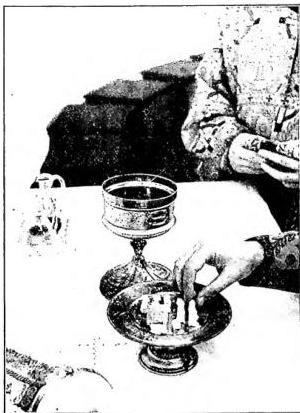
In the Roman rite, the Missa praesanctificatorum is used solely on Good Friday; that is, with pre-consecrated Species. Lacking the Offertory and Consecration, it is reduced to a solemn rite of Communion.
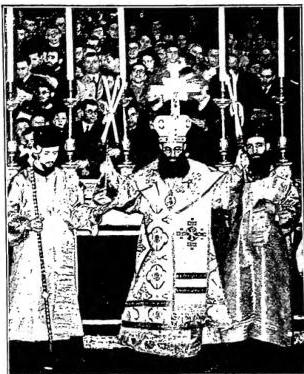
IV. THE MASS IN THE LITURGY OF THE EASTERN RITES.
SUMMARY:
I. General notes
II. The liturgy of the Byzantines
III. The Armenian badarak
IV. The Syriac qārbānā
V. The Maronite qārbānā
VI. The Chaldean qādālā
VII. The Malabarese qādālā
VIII. The Coptic aghiasmos
IX. The Ethiopian qēdāsē.I. GENERAL NOTES
Among the Greeks and those who follow the Byzantine rite, the Mass is called the "holy and divine liturgy," thus emphasizing the concept of a sacred public function; the Armenians call it baradak, the Syrians and Maronites qārbānā, meaning oblation, sacrifice; the Chaldeans qādālā, intending by this word sanctification, consecration; the same applies to the Coptic word haghiasmos and the Ethiopian qēdāsē.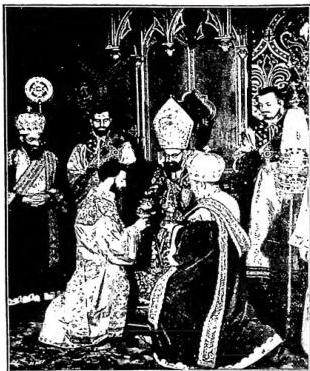
In the current Mass of the Eastern rites, one can still find the division into Mass of the Catechumens and Mass of the Faithful, or rather into an instructive and exhortatory part and a Eucharistic part. In the Eucharistic part, the liturgical actions can be grouped around three principal acts: the Offertory, the Consecration, and Communion. However, in all Eastern rites, the Offertory, or preparation of the bread and wine, has come to be placed before the Mass of the Catechumens and has often been united, with an increase in its rites, to the preparatory prayers that already preceded the exhortatory part of the Mass. For clarity of exposition, the Eastern Mass is divided into six sections: 1) preparatory rites; 2) liturgy of the catechumens; 3) transfer of the gifts, symbol of faith, and the kiss of peace; 4) anaphora with the Consecration; 5) Lord’s Prayer, fraction, and Elevation; 6) Communion and thanksgiving. In this division, the most ancient parts (2, 4, and 6) remain clearly distinct from secondary creations, less essential and often more complicated.
Here, the ordinary Mass is described, that is, the sung Mass, with the assistance of the deacon and choir, not the pontifical Mass, which introduces certain particular rites.
II. THE "LITURGY" OF THE BYZANTINES
1. The priest, together with the deacon, dressed in the rjassa, bow before the iconostasis (v. ICONOSTASIS), recite some prayers in a low voice, kiss the image of the Savior and that of the Mother of God; then the priest, with arms outstretched, says a prayer for himself. Having entered the sanctuary, they kiss the altar, don the liturgical vestments, and wash their hands. At the altar of the prothesis, the priest first prepares the principal offering, extracting from the bread the central part called the Lamb, marked with the sigla frac{IS | XS}{NI | KA}, and pours wine and water into the chalice, then the secondary offerings; to this end, he places on the diskos around the Lamb a particle of bread(courtesy of Fr. W. De Vries)
MASS - Byzantine Rite. Preparation of the Bread and Wine.
(from Het Christelijke Oosten, IX, Heemstede 1911, inv. 19)
MASS - Byzantine Rite. Blessing of the bishop with the dikirion and the trikirion.
in honor of the Mother of God, nine others in honor of nine categories of saints, others for the living, for the deceased, and for himself. The remaining bread is cut into pieces which, blessed after the Consecration, will be distributed at the end of the liturgy as antidoron. After covering and incensing the offerings, the priest recites the prayer of the prothesis: «O God, our God, who sent the heavenly bread, food of the whole world, our Lord and God Jesus Christ, Savior, Redeemer, and Benefactor, who blesses and sanctifies us: do Thou Thyself bless this prothesis and accept it upon Thy supercelestial altar...». The deacon incenses the altar, the iconostasis, and the entire church to purify the place of sacrifice. Then the veil of the central door is drawn; the priest and deacons are seen kissing the altar, the deacon exits the sanctuary and stands before the door, near the people whose prayer he will lead; but first he says to the priest: «Bless, master», and the priest, elevating the Gospel which always rests on the altar, exclaims: «Blessed be the Kingdom of the Father, and of the Son, and of the Holy Spirit...». The choir: Amen. And the deacon begins the Great Litany, followed by the Office, abbreviated, of three antiphonal psalms; each psalm is accompanied by a litany and a priestly prayer. These three ancient Byzantine prayers are most beautiful in their conciseness.
2. The ancient beginning of the Mass is found in the rite of the entrance with the Gospel, called the minor entrance. The deacon, carrying the Gospel and followed by the priest, exits the sanctuary, stops before the royal doors, and after presenting the Gospel to the priest to kiss, elevates it saying: «Wisdom! Let us stand!». And as they enter the sanctuary, the choir sings: «Come, let us worship and bow down before Christ...». This is followed by the chanting of the troparia of the feast or the mystery of the day and that of the Trisagion: «Holy God, Holy Mighty, Holy Immortal, have mercy on us». Once the hymn is finished, a reader stands in the middle of the nave, recites the verses of the prokimenon, and reads the Epistle of the day. After this, the deacon incenses the sanctuary and the people, the choir sings the Alleluia, and the deacon, standing at the door of the sanctuary or on the ambo, reads the Gospel. As in the ancient Church, one
MASS – Armenian Rite. Imposition of Incense.
They now offer fervent supplications for the needs of all, particularly for the catechumens, who are dismissed with these words from the deacon: «Quanti siete catecumeni, uscite; catecumeni, uscite; catecumeni, quanti siete, uscite; nessuno dei catecumeni rimanga qui», and thus passing to the Mass of the faithful, he immediately adds: «Quanti siamo fedeli, ancora e poi ancora, in pace preghiamo il Signore». The diaconal litany is doubled, as is the priestly prayer.
3. The deacon (in practice, often the priest) takes the thurible and incenses the altar, the iconostasis, and the people; then he joins the priest in reciting the Cherubic Hymn, and both proceed to the prothesis, where the deacon takes the diskos and the priest the chalice. Meanwhile, the choir devoutly sings: «Noi che misticamente rappresentiamo i cherubini, e alla Triade vivificante cantiamo l'inno trisagio, su via, deponiamo ogni mondana sollecitudine». At that moment, the procession exits the sanctuary; holding the offerings in hand, the deacon and the priest express prayers for the Supreme Pontiff, the hierarchy, the authorities, and the faithful, and as they re-enter the sanctuary, the choir concludes the hymn: «Per ricevere il Re dell'universo, scortato invisibilmente dalle schiere angeliche. Alleluia». This is the solemn transfer of the gifts or the «Great Entrance». The deposition of the gifts on the altar is accompanied by a dialogue between the priest and the deacon. The latter resumes his place before the iconostasis and begins the litany of petitions. This is followed by the kiss of peace, and after the ancient exclamation of the deacon: «Le porte! Le porte! Stiamo sapientemente attenti!», the Creed is sung or recited.
4. Thus begins the central part of the Mass, the most ancient Eucharistic prayer. The deacon admonishes: «Stiamo devotamente, stiamo attenti ad offrire in pace la santa oblazione». The priest greets and blesses, and after the dialogue of the Preface, he secretly recites the first prayer, which concludes with the Sanctus by the choir. If in the preceding prayer the priest has praised God for His greatness and magnificence, in this one the Most Holy Trinity is exalted, along with the love of the Father who sent His beloved Son into the world, who «la notte che venne tradito... prese il pane nelle sue mani», and thus, with the narrative of the Last Supper, the words of Christ are sung, to which the people respond with the Amen of their faith. After the anamnesis, quite brief, the deacon crosses his arms and elevates the diskos and chalice while the priest says aloud: «Le cose tue scelte tra quelle che sono tue ti offriamo in tutto e per tutto». The epiclesis, in which the priest now asks the Holy Spirit to descend upon these gifts to transform them into the Body and Blood of Christ, so that they may be spiritually profitable for the communicants, is performed with repeated signs of the cross and bows, but secretly. This is followed by the commemoration of the Theotokos (the Madonna), in whose honor the choir sings, then that of the saints, the deceased, and the living, among whom the Supreme Pontiff is named first, and finally the deacon concludes: «E di quelli che ciascuno ha in mente, e di tutti e di tutte», and the choir repeats: «e di tutti e di tutte». A beautiful doxology by the priest concludes the anaphora.
5. The following part is a remote preparation for Communion. After the priest’s blessing and the deacon’s litany, the Pater noster is sung or recited, followed by a prayer with bowed head. Then the deacon exclaims: «Stiamo attenti», and the priest, elevating the holy bread, says aloud: «Le cose sante ai santi». The choir responds: «Uno solo è il santo, uno solo è il Signore, Gesù Cristo, nella gloria di Dio Padre». Meanwhile, the priest breaks the holy bread into four parts and places the part marked IC into the chalice; the deacon adds a little hot water, called zeon.
6. Meanwhile, the two recite the preparatory prayers for Communion and receive the consecrated bread and wine. Then the deacon, holding the chalice, steps to the door and exclaims: «Con timore di Dio, con fede e carità, appressatevi». The priest then distributes Communion with a spoon to the faithful, who receive it under both species. In some regions, the custom has been introduced of giving Communion in this manner: on the diskos, the priest holds prepared thin and long pieces of consecrated bread; he takes them one by one, dips them in the wine, and presents them to the communicants. The deacon returns the diskos to the prothesis, and the priest returns the chalice. A chant by the choir, a brief litany by the deacon, and a prayer by the priest constitute the thanksgiving. Emerging from the sanctuary and standing before the image of the Savior, the priest recites the prayer of inclination called epistambona (= behind the ambo). He then gives the blessing and pronounces the apolysis. Meanwhile, the deacon has gone to the prothesis to consume what remains of the sacred species.
III. THE ARMENIAN "BADARAK". – 1. While the priest, after some preparatory prayers, begins to vest in the sacristy, the choir, which takes its place in the middle of the nave, sings the hymn: «O mistero profondo...», and when the priest with the ministers advances in procession, it intones the antiphon: «O Re celeste, conserva immobile la tua Chiesa e custodisci in pace gli adoratori del tuo nome». Arriving at the foot of the altar, the priest washes his hands, invokes the Mother of God, recites the Confiteor with the Misereatur while two clerics recite Psalm 99; he then says the first part of a prayer for the Church, interrupts it to recite «Introibo ad altare Dei» and Psalm Iudica, and resumes the prayer while ascending the steps of the altar; then the great curtain before the sanctuary is closed. It is easy to recognize in this beginning the introduction of Latin elements. What follows, however, is taken from the Byzantine rite: the preparation of the bread and wine without secondary offerings, the prayer of the prothesis: «O Dio, Dio nostro, che mandasti il pane...», the recitation of Psalm 92 used in the Byzantine rite while covering the offerings, the general incensation, the priest’s exclamation: «Benedetto sia il regno...», and finally, during the singing of the hymn proper to the day, the recitation of the three prayers that in the Byzantine rite accompany the three antiphonal psalms.
2. The procession with the Gospel begins with the deacon’s exclamation and the priest’s prayer, which are those of the Byzantine rite. Here, however, the Trisagion is sung while the deacon, holding the Gospel, circles behind the altar with a escort of candles and flabella, incensed by the thurifer; one of the faithful is invited to kiss the Gospel, and the priest blesses him. The major Collect is now recited, which is probably its ancient place. Then a lector reads the antiphon and the Epistle, and after the Alleluia, the deacon chants the Gospel while the thurifer incenses II. Immediately afterward, the deacon, still holding the Gospel, recites the Creed, which has a text proper to the Armenians. This is followed by the ancient universal prayer in the form of a litany, and after the priest’s blessing, the deacon exclaims: «Nessuno dei catecumeni, nessuno degli imperfetti nella fede e nessuno dei penitenti e degli impuri si accosti al divino mistero».
3. The great entrance is announced by the chant of the clerics: "The Body of the Lord and the Blood of the Redeemer are about to become present. The heavenly powers sing invisibly and with unceasing voice: holy, holy, holy is the Lord of hosts." The priest at the altar recites secretly the same long prayer that the Byzantine priest says before the great entrance. Meanwhile, the deacons carry the bread and chalice to the altar, where the priest receives them, shows them to the faithful, and places them on the altar. He then incenses them, concluding his prayer: "For you, O Christ our God, are the offerer and the offered, the one who receives and the one who distributes, and to you we give glory..." The chant of the entrance is called the Agiologia and varies with the feasts. After washing his hands, the priest recites a secret offertory prayer while the deacon makes an exhortative proclamation to the faithful: "Let us stand with faith and holiness to pray..." Then, after a blessing from the priest, the deacon exclaims: "Greet one another with the holy kiss, and those who are not fit to partake of the divine Sacrament, go to the doors and pray." The chant "Christ among us..." accompanies the kiss of peace.
4. The deacon admonishes: "Let us attend with fear, let us attend with reverence, let us attend devoutly and with firm attention." The priest blesses, and the deacon continues: "The doors, the doors (keep them) with all attention and caution," and immediately adds the Sursum corda and the Gratias agamus... In his Eucharistic prayer, recited in a low voice, the priest adores and glorifies the Father, who through the work of His Word has removed the obstacle of the curse; "therefore, let us unite," he says, raising his voice, "with the Seraphim and the Cherubim and sing the Sanctus." The secret prayer continues to develop the theme of Christ’s redemptive work, who, taking the bread in His holy, divine, and venerable hands... and so the Last Supper is recounted with the consecratory words spoken aloud, to which the people respond twice with Amen.
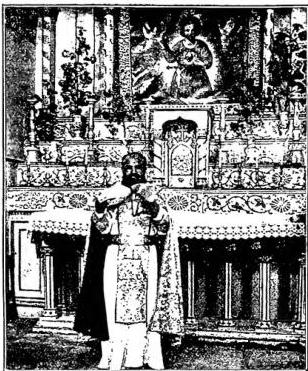
5. This part begins with the priest’s blessing and the great diaconal litany. Then the people, with arms outstretched, chant the Pater noster, to which the priest adds the embolismic prayer and the prayer of inclination of the head. Now the great Elevation takes place: all kneel, the deacon exclaims: "Let us attend!" and the priest, elevating the consecrated bread, says: "To the holiness of the holy," and after the response: "Only holy, only Lord, Jesus Christ, in the glory of the Father," he adds: "Blessed is the holy Father... blessed is the holy Son... blessed is the Holy Spirit..." Then, having placed the consecrated bread down, he raises the chalice while the people chant: "Holy Father, holy Son..." He then places the chalice down, kisses the altar, and, taking the sacred Body, dips it entirely into the most pure Blood (at least, this is what the dissidents do), and, turning to the people prostrate in adoration, he blesses them with the sacred species, saying: "Let us sanctify ourselves with the holy and precious Body and Blood of our Lord and Redeemer Jesus Christ, who descended from heaven and is distributed among us. He is life, hope, resurrection, expiation, and forgiveness of sins. Sing psalms to the Lord our God, sing psalms to our heavenly, immortal King, seated on the chariot of the Cherubim." This solemn development of the Elevation into a Eucharistic ostension and blessing is entirely particular to the Armenian rite. All rise, and while the choir sings, the priest breaks the consecrated bread into three parts and places one into the chalice.
6. The priest recites the long preparatory prayers for Communion, holding the consecrated bread in his hands. When communicating, he says: "May your incorruptible Body be life for me, and your sacred Blood propitiation and remission of sins." The Communion of the faithful takes place in a rite and with formulas similar to those of the Byzantine rite, except that Catholics administer Communion under the species of bread alone. Then the ablutions are performed, and in thanksgiving, the choir sings a hymn, the deacon gives an exhortation, and the priest recites a prayer. He adds a prayer aloud, which is the opistambona of the Byzantines, but then, like the Latins, recites the Last Gospel, that of St. John. Finally, turning toward the people, he says the customary invocation to the holy Cross, and the clerics recite Psalm 33 while the blessed bread is distributed. Then the priest blesses and simultaneously gives the dismissal: "May you be blessed by the grace of the Holy Spirit; go in peace, and the Lord be with you all. Amen."
Armenien (Texte und Untersuchungen, 15), Vienna 1897 (in Armenian); V. Hatzuni, Messale secondo il rito della Chiesa armena (esaminato e corretto secondo gli antichi), critical edition with notes, Venice 1936.
### IV. THE QŪRBĀNĀ OF THE SYRIANS.
1. The preparation is clearly divided into two parts, so that the first may be performed by the deacon; if the priest performs it, he does not yet don the liturgical vestments. It begins with the priest standing before the door of the sanctuary and saying "Gloria Patri..."; after the choir’s response, the choir sings the hymn of light. Meanwhile, the deacon—or the priest—recites the opening prayer, Psalm 50, asks forgiveness of those present, and enters the sanctuary. On the altar, he offers the bread and places it on the diskos, puts wine and water into the chalice, and covers the diskos and chalice. Then he exclaims: "Stomen kalos" (Let us stand well!) and, with arms outstretched, recites the sedrā, a prayer composed of an introductory laudation (proem), the central part (sedrā), a hymn of four strophes, and the conclusion. All that precedes is called the Office of Melchisedech; what follows, the Office of Aaron. The priest dons the liturgical vestments, recites a prayer for himself before the altar, crosses his arms, and taking the diskos in his right hand and the chalice in his left, raises them while saying the Offertory prayer, which commemorates the redemptive work of the Lord, the saints, and the particular intentions of the Sacrifice. He then covers the offerings with the great veil, and while another sedrā is recited, the altar, the offerings, and the altar again are incensed.
2. The procession with the Gospel moves around the altar; the accompanying hymn is the Monogenēs, attributed by the Byzantines to Emperor Justinian and by the Syrians to Patriarch Severus of Antioch. The Trisagion is then sung. Currently, the readings are generally two: the Epistle, preceded by the antiphon, and after the Alleluia, the Gospel; but in antiquity, the norm was three from the Old Testament and three from the New. The Gospel is read by the priest facing the people. The universal prayer after the Gospel no longer exists, nor does the dismissal of the catechumens, except in one of the variable hymns now sung: "Who has not received the seal, let them depart, thus proclaims the Church; and you, children of Baptism, enter the sanctuary."
3. Since the preparation of the bread and chalice takes place on the altar itself, there is no longer a transfer of the gifts, though it once occurred, for the sedrā now sung is called the sedrā of the entrance and is accompanied by the blessing of incense. The incensation, however, now takes place while the faithful recite the Creed. The priest then washes his hands, asks forgiveness of those present, and addresses the Most Holy Trinity with a prayer for himself, as he is about to "offer the Sacrifice with his sinful hands," and also prays for the living and the dead. The deacon exclaims: "Stomen kalos!" The priest recites the prayer of peace, and all exchange the kiss of peace. While the priest removes the great veil from the offerings, the deacon admonishes the people: "Let us stand well, with fear, with modesty, with purity, with holiness..."
4. After the blessing and the dialogue of the Preface, the priest, in the secret prayer, praises (generally this depends on the text of the various anaphoras) God for the creation of the universe and of man, and in the prayer after the Sanctus, recalls the Incarnation of the Word and His redemptive work, passing to the account of the Last Supper. At the words of Consecration, pronounced aloud, the people respond Amen. The anamnesis, which recalls the events of our Redemption and the second dread coming of the Son of God, concludes with a supplication of the Church. The epiclesis is very solemn: the deacon says: "How terrible is this hour, how dreadful this moment when the Holy Spirit comes from the sublime celestial spheres, descends upon this Eucharist, and consecrates it..." and the priest: "We prostrate our faces to the earth and ask You, Almighty God... to send Your Holy Spirit upon us and upon the offerings before us," and blessing, he continues: "and to make of this bread the venerable Body of our Lord Jesus Christ... and of that which is mixed in the chalice the Blood..." The "intercessions" or "canons" are six: for the hierarchy, brethren, kings, saints, doctors, and the dead. A doxology concludes this central part of the Eucharistic Sacrifice.
5. In the Syrian rites, the "manual acts" precede the Pater noster. During the signs of the cross, the priest recites a splendid hymn: "O Father of truth..." After the Pater noster, followed by the embolismic prayer and a prayer of inclination, the priestly blessing introduces the Elevation: "The holy things are given to the holy and the pure."
6. The priest recites the preparatory prayers for Communion and communicates. Then, holding the diskos in his right hand and the chalice in his left, he presents himself to the people, blesses them with crossed arms, and should distribute Communion to the faithful (in practice, however, the custom—or rather the abuse—has prevailed, even among Catholics, of giving Communion to the faithful only after the final dismissal). The thanksgiving and the prayer of inclination are followed by the final hūttāmā and the dismissal: "...Go in peace, content, joyful, and pray for me." The veil of the sanctuary is closed, and the priest, in an Office composed of several prayers, consumes what remains of the sacred species and performs the ablutions. Finally, after removing the sacred vestments, he goes to kiss the altar, saying: "Remain in peace, holy altar of the Lord. I know not whether I shall return to you again or not..."
### V. THE QŪRBĀNĀ OF THE MARONITES.
The principal differences from the Mass of the Syrians are:
1. From the very beginning, the priest washes his hands and dons the liturgical vestments. After preparing the diskos and chalice, these are immediately covered with the great veil; then follows a kind of Confiteor, an incensation of the altar, the offerings, and the people, other prayers, and a series of psalmodic verses introduced by the words: "Gloria in excelsis Deo." At the end of these preparatory rites, incensation does not follow but precedes the sedrā.
2. During the singing of the Trisagion, the priest incenses the offerings, the crucifix, and the altar. The entrance with the Gospel is made around the altar while a hymn is sung that precedes the reading of the Epistle. After the Gospel, the rubrics prescribe that the deacon say, addressing the catechumens: "Go in peace."
3. There is no sedrā, but a chant of the entrance that concludes thus: "...And behold, now the priests carry me (that is, the Bread of life) with their hands above the altars." The choir sings the Creed while the priest incenses the offerings, the cross, the altar, and the people—an incensation that must be connected with the ancient transfer of the gifts; so too the Lavabo that follows.
4. The account of the Last Supper and the words of Consecration are a literal translation of the Roman Canon. Before the epiclesis, the priest prostrates himself on both knees and repeats three times aloud: "Have mercy on me, O Lord," each time touching the altar with his fingers and kissing II. The words of the epiclesis have been changed in this way: "It is fitting that this mystery, which is the Body of Christ our God, be for our salvation," but the signs of the cross remain. The Maronites often use the so-called anaphora of the Roman Church, in which the intercessions are greatly abbreviated.
5. The numerous signs of the cross over the consecrated species are made during the prayer: «Abbiamo creduto, abbiamo offerto e segniamo...» followed by another: «O Padre della verità...». The fraction, intinction, and commingling have been moved after the Elevation.
6. After his Communion, the priest blesses the people, first to the right with the holy bread, then to the left with the chalice, and then communicates the faithful under the species of bread alone, saying as the Latins do: «Ecco Agnus Dei...». Particular to the Maronites is, after Communion, that prayer for the dead sung by the deacon with the people; once this chant is finished, the priest blesses once more with the sacred species. The consumption and ablutions take place before the prayers of thanksgiving and the final blessing.
VI. THE «QUĀDĀ» OF THE CHALDEANS
1. Among the Nestorians, there exists a very lengthy rite for the material preparation of the Eucharistic bread in the oven; a particle of bread consecrated in a previous Mass is always mixed into the new dough: this is the "sacred" leaven transmitted, according to legend, from apostolic times. Afterward, all the bread is brought to the prothesis, where the chalice is also prepared. Catholic Chaldeans have abandoned these customs. After the Lavabo and vesting, the priest, standing before the altar, says: «Gloria a Dio nell'alto dei cieli, la pace sulla terra, e la buona speranza agli uomini, in ogni tempo, nei secoli». Then the people recite the Pater noster. This is followed by psalmody, generally Psalms 14, 150, and 116, and, after an introductory prayer, the hymn of the sanctuary; in ancient times, during this hymn, the priest would leave the sanctuary and take his place on the bema in the middle of the nave. The choir then sings the hymn Lahā Mārā: «A te, o Signore dell'universo, rendiamo grazie, e ti glorifichiamo, Gesù Cristo, perché tu sei il resuscitatore dei nostri corpi e tu sei il salvatore delle nostre anime». Then the deacon incenses the altar and the priest.2. The chanting of the Trisagion with a priestly prayer precedes the readings, which are or may be four, two from the Old and two from the New Testament. Before the Epistle, the antiphon (sūriā) is sung, and before the Gospel, the Alleluia with the verses (sūmārā). During the litanic prayers (hārāzūtā), the priest, accompanied by the deacon, goes to the sacristy and there incenses the paten and the chalice; then he places the bread on the paten and prepares the chalice with formulas taken from the Maronites. Returning to the sanctuary, the deacon exclaims: «Inchinate il capo per l'imposizione delle mani e ricevete la benedizione», and the priest recites the corresponding prayer, perhaps a remnant of the ancient dismissal of penitents. Then the deacon, from the door of the sanctuary, says: «Chi non ha ricevuto il Battesimo, se ne vada. Chi non ha ricevuto il segno, se ne vada. Chi non lo riceve, se ne vada. Andate, o uditori. E vedete le porte!».
3. While the hymn ('ōnītā) of the mysteries is sung, the priest, having washed his hands, goes to the sacristy to fetch the offerings and, upon reaching the altar, takes the paten in his left hand and the chalice in his right and says an offertory prayer; having placed the offerings down, he covers them with the great veil. Then, standing before the door of the sanctuary, he says a prayer for himself and then intones the Creed, which is sung by the faithful. While the deacon makes the proclamation «... pregate per la memoria dei nostri patriarchi...», the priest, moving toward the altar, makes three bows, and with each bow takes a step forward, saying supplications; upon reaching the altar, he prostrates himself, rises, and kisses it in the center; then at the right and left corners he does the same; finally, he kisses the altar in the center, to the right, and to the left. After other prayers that prepare him and the people for the Sacrifice, the priest blesses, and the deacon gives the invitation: «Datevi la pace l'uno all'altro». Meanwhile, the diptychs are read. And while the deacon gives his admonitions: «... tenetevi bene in piedi e mirate ciò che si sta compiendo: i misteri tremendi si santificano; il sacerdote si è avvicinato a pregare... tenete abbassato il vostro sguardo... nessuno osi parlare...», the priest removes the veil from the offerings and incenses the altar.
4. After the blessing continues: «Le vostre menti siano in alto». They respond: «A te, Dio di Abramo, di Isacco e di Giacobbe, Re glorioso». The priest: «Il sacrificio si offre a Dio Signore dell'universo». They respond: «È degno e giusto». The Eucharistic prayer, interrupted by the Sanctus, praises the name of the Most Holy Trinity and gives thanks for His mercy toward men, for the Incarnation of the Word, and for our redemption. This is followed by the narrative of the Last Supper with the words of Christ, pronounced aloud, to which the people respond: «Amen. Crediamo e confessiamo». A doxology concludes this part. Intercessions are now made: for the saints, the hierarchy, the Church, the needy, the dead. The anamnesis is not entirely clear, and the epiclesis is expressed thus: «Venga, o Signore, il tuo Santo Spirito, e scenda sopra questa oblazione dei servi tuoi, la benedica e la santifichi, affinché...». Another doxology concludes this section.
5. The priest invokes the Christ of peace, gives thanks to the Father, asks for mercy by reciting Psalm 50, and then prepares for the fraction by having his hands incensed. He takes and elevates the holy bread and pronounces an act of faith and adoration; then he kisses it in the form of a cross, without touching it with his lips, and breaks it; he dips a part into the holy Blood and with it marks the other part and places it on the paten. Raising the chalice, he says: «Si sono separati, santificati, compiuti, adempiti, uniti, commisti, congiunti e sigillati l'uno nell'altro questi misteri...»; however, no rubric here speaks of a commingling. After a prayer and the priest’s blessing, the deacon begins a kind of litany, to which the people respond at various points: «Signore, perdona i peccati e le mancanze dei servi tuoi». The Pater noster is recited by the people; the priest says: «Il Santo conviene perfettamente ai santi» without making the Elevation. Then those inside the sanctuary, dialoguing with those outside, sing the hymn: «Tu sei tremendo...». And while they add the first hymn of the «bema», the priest, holding the holy bread above the chalice with his left hand, says: «O figlio, che ci hai dato il tuo Corpo...» or the «Agnus Dei», three times.
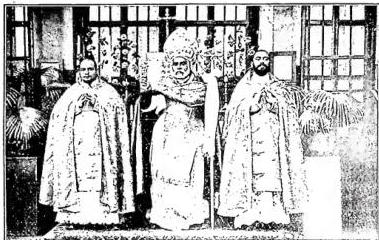
VII. THE «güdāfā» OF THE MALABAR CHRISTIANS
Here are noted the differences, sometimes of great importance, that separate the Eucharistic celebration of the Malabar Christians from that of the Chaldeans. 1. The psalmody is always reduced to the three Psalms 14, 150, and 116. Further on, the incensation precedes the chanting of the hymn Lakū Mārā. 2. There is no procession; there are not four but two scriptural readings; after the Gospel, the chanting of the Creed, as among the Latins; during the litanies, the priest incenses the veil, the paten, and the chalice, but with formulas different from those used by the Chaldeans. 3. There is no transfer of the gifts, because these are prepared on the altar. 4-5. Here the greatest difference is noted: after the prayer that follows the Sanctus, in all Eastern and Western rites one finds the narrative of the Last Supper with the words of Christ; instead, the Malabar Christians proceed immediately to the prayers of intercession and only after the anaphora, upon reaching the preparatory prayers for the fraction, when the priest has his fingers incensed, he takes the bread in hand, not to break it as the Chaldeans do, but to consecrate II. The formulas of consecration are those of the Roman Missal, as are the gestures: elevations and genuflections. Further on, during the prayer of pardon, the Malabar priest recites secretly the hymn: «Padre della verità» which is found among the Syrians and Maronites. 6. Among the prayers before Communion, the priest says the «Domine, non sum dignus». For the distribution of Communion to the faithful, he uses all the formulas in use among the Latins, including the blessing after Communion. The ablutions are performed with the prayers that in the Chaldean book appear after the dismissal.VIII. THE «AGHIASMOS» OF THE COPTS
1. Vested in sacred vestments, the priest approaches the altar and kisses it, turns toward the people, and after blessing them recites with them the Pater noster. The choir begins to chant the hymn that accompanies the procession with the offerings, which will take place shortly. Meanwhile, the priest says a preparatory prayer, arranging the paten, the chalice, and the veils on the altar, and after washing his hands, he selects one of the loaves that the deacon presents to him in a basket (at least the dissidents do so), places it on a cloth, examines the wine, and recites an offertory prayer, adding brief formulas for various intentions. Then, holding the bread at the height of his head, he processes around the altar with the deacon, who carries the wine and water, and with ministers bearing lights. Having returned, he blesses the offerings three times in the name of the Most Holy Trinity, places the bread on the paten, and puts the wine and water into the chalice. The prayer of thanksgiving, attributed to St. Basil and often recited at the beginning of a liturgical function, momentarily interrupts the action. Then the priest pronounces the prayer of the Offertory, which is nothing other than an ancient epiclesis, already requesting the transformation of the gifts. After covering them with the great veil, he leaves the sanctuary and reads over the people a formula of absolution addressed to the Son. The priest performs the incensation of the altar by circling it three times and that of the church, incensing with his left hand and placing his right hand on the head of each of the faithful, while the people chant the beautiful hymn: «Questo è il turibolo d'oro puro... La Vergine è il turibolo aureo, il suo profumo è il nostro Salvatore...».2. There are four readings, all taken from the New Testament: the Epistles of St. Paul, the Catholic Epistles, the Acts of the Apostles, and the Gospel. Each reading is preceded by a prayer of the priest; the Trisagion is chanted after the reading of the Acts. Among the diaconal supplications that follow the Gospel, one concerns the catechumens, another the rising and falling of the waters of the Nile.
3. There is no transfer of the gifts; however, the priest recites the prayer of the «veil» (of the sanctuary), as if he were now entering the sanctuary to begin his ministry. Then, going around the altar three times, he chants with the people the three prayers: for the Church, for the hierarchy, and for those present; then all recite the Creed. After the prayer for peace, the deacon says: «Datevi gli uni agli altri il bacio di pace...» and adds his admonitions: «... state con timore; riguardate verso l'Oriente».
4. The dialogue of the Preface is exactly that of the Latin rite. If the priest takes the anaphora of St. Cyril, he intercalates in the prayer «Vere dignum...» the long prayers of intercession; instead, if he takes that of St. Basil or St. Gregory, he will say the intercession after the epiclesis. Three times the deacon interrupts the priestly prayer to say to the faithful: «Voi che siete seduti, alzatevi» — «Riguardate verso l'oriente» — «State attenti». The Sanctus does not have the addition: «Hosannah in excelsis. Benedictus...», and the prayer that follows connects to the «Pleni sunt». At the words of Christ, the people respond with these acts of faith: «Crediamo e confessiamo e glorifichiamo». The anamnesis briefly recalls the oblation, and the epiclesis, similar to the Byzantine one, is pronounced aloud, and the people respond Amen. The prayers of intercession are long; the priest chants them all.
5. In this rite, the fraction precedes the Pater noster, but the other manual acts follow the Elevation. This fraction, according to the rubrics of the dissidents, is very complicated; the Catholics content themselves with dividing the holy bread into three parts. After the Pater noster, the embolismic prayer, and the prayer of inclination, the priest recites the formula of absolution addressed to the Father. The Elevation, the intention, the consignation, and the immission are performed in a very simple manner. But here the priest pronounces a vivid profession of faith in the incarnate Word with appropriate responses from the people (homologia).
6. The chanting of Psalm 150 serves as preparation for Communion. After his own Communion, the priest turns toward the people, holding the paten in his hand, and blesses them. Among the dissidents, communicants receive first the consecrated bread, then the chalice. During Communion, the people chant: «Benedetto Colui che viene nel nome del Signore». The ablutions are performed while the priest recites the prayer of thanksgiving, followed by that of inclination; then, leaving the sanctuary, he says, with his hands extended over the people, a prayer of blessing, and after the recitation of the Pater noster by the people themselves, he blesses them. Then all approach the sanctuary, and the priest sprinkles them with holy water (at least so the dissidents do). Finally, blessed bread is distributed to all.
IX. THE «QÈDISÈ» OF THE ETHIOPIANS
1. The priest’s personal preparation involves reciting a penitential prayer and several psalms; his approach to the altar and its preparation are likewise accompanied by various prayers. Once the priest has donned the sacred vestments and washed his hands, the ministers arrive bearing a basket of freshly baked loaves from a long chamber adjacent to the church, called Bethlehem. Meanwhile, the choir has intoned the Alleluia. The priest blesses the loaves, selects one, or gives it to the assisting priest, who wraps it in a cloth. Having circled the altar, he presents the loaf to the celebrant, who also walks around the altar before placing the bread upon the diskos. The deacon, holding the wine, circles the altar and hands it to the assisting priest, who pours it with water into the chalice. With the people’s Pater noster, the priest’s «Unus Pater sanctus...», the chanting of the psalm «Laudate Dominum omnes gentes», the deacon’s admonition «State diritti per la preghiera», and the priest’s «Pace a voi tutti», a new part of the Mass begins. This includes the thanksgiving prayer of St. Basil, two offertory prayers, the epiclesis as in the Coptic Mass, and the prayer while the priest covers the offerings with veils. To the absolution «of the Son», the Ethiopian rite adds a long diaconal litany with the response: Kyrie eleison. The priest then blesses five grains of incense, of which he now places three in the thurible. The incensation is very solemn, accompanied by chants and various formulas.2. Four readings follow, as in the Coptic rite; after the third, the Trisagion is chanted, followed by a beautiful hymn to the Virgin. Before the Gospel, the priest places the fourth grain of incense in the thurible, and a procession with the holy book takes place; meanwhile, the assisting priest secretly recites the litany of supplication, which normally occurs after the Gospel, and includes a petition for the catechumens. After the Gospel, the people express their faith, and the deacon says: «Uscite, catecumeni».
3-6. In the subsequent parts, the Ethiopian rite differs little from the Coptic. The following points are noteworthy: the priest removes the veil from the offerings even before the kiss of peace; he has fourteen traditional formularies for the anaphora; the Elevation is more solemn and is followed by the deacon’s admonition: «Voi che siete nella penitenza, inclinate il vostro capo», to which the priest adds an appropriate prayer. After Communion, the people repeatedly intersperse the Pater noster among the thanksgiving prayers, and after the prayer of inclination, blessing, and pardon, the deacon says the «Andate in pace».
V. MASS
Historical-liturgical study makes it clear that the various parts and prayers of the Mass were introduced at different times; consequently, the musical repertoire of the Mass was gradually formed and presents various varieties.
SUMMARY:
I. Different styles
II. Musical forms
III. Liturgical destination (or function)
IV. Choice of texts
V. Technique of melodic composition
VI. Modality
VII. The unity of composition in Gregorian and polyphonic chants of the Mass
VIII. Expressiveness of Gregorian chants of the Mass
IX. Polyphonic Mass.I. DIFFERENT STYLES
The chants of the Mass are of various styles. The Communio is generally a chant of neumatic style; during Lent, however, interspersed among the series of 26 psalmodic Communiones for ferial days, there are some Communiones with Gospel texts; the psalmodic series is of neumatic style, while the majority of the Gospel Communiones are of syllabic style; but precisely these belong to an earlier period of composition, the beginning of the 6th century and even the 5th, whereas the well-known 26 psalmodic Communiones date from the second half of the 6th century.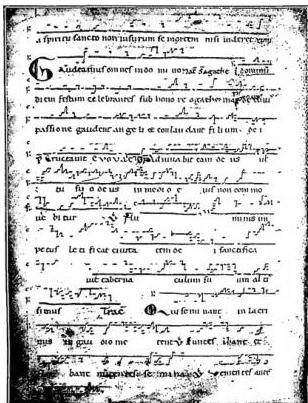
The classification of the Mass chants according to style is not absolute, since within the same piece a transition from one style to another is permissible, but also because chants assigned to one category may present examples of another. This is explained in many cases by the fact that composition spans several centuries.
The same applies to the Offertoria: generally adorned with vocalizations, especially on the word Alleluia (Bonum est, Intonuit, In die, Erit vobis, Benedictus, etc.), they can be treated neumatically (Vir erat, Domine in auxilium, In te speravi, etc.); and, in at least one case, the style approaches the syllabic (Domine concertere), and this may perhaps be a vestige of the primitive antiphonal form of the Offertorio.
II. MUSICAL FORMS
The chants of the Mass are classified into two main groups with respect to their literary composition and musical form. Indeed, the chants that constitute nearly the entire ancient repertoire, the Proprium Missae, are drawn from the Psalter or from scriptural canticles. Their structure may be: 1) Responsorial, form A¹ A² BA³ CA⁴ etc.; this is the form now reduced in the Gradual and the Alleluia, recognized as the most ancient. 2) Antiphonal, form A BC A DE A FG A etc. The Introit and the Communio are the Mass chants of antiphonal form; their structure could vary in that the repetition of the refrain A occurred after each psalmodic verse A B A C A D A etc., or even after a group of four verses A B¹ B² C¹ C² A etc., as still in the chant for Holy Thursday Ubi caritas et amor. The difference from the responsorial form lies in the absence of the soloist and in the psalmody by two alternating choirs in the antiphon, whereas in the Re-MESSA - Introit of the Mass of St. Agatha in diastematic notation.
Gradual of the 12th century - Bergamo, Archive of the parish of
S. Alessandro in Colonna.
In the responsory, the psalmody is entrusted to the soloist and the entire choir,
that is, the assembly of the faithful, which repeats the refrain after
each verse. 3) A third psalmodic form is called "directanea" or "in directum" and is distinguished by
the absence of a refrain. It is believed that the Tractus, the only
representative of this form in the Mass, was sung entirely by the soloist due to its ornate style, and there is no difficulty in admitting this for the two verses of the Tractus:
Laudate Dominum of Holy Saturday or the three verses of
Cantemus on the same day; however, the 13 verses of
Qui habitat or the 14 of Deus Deus meus perhaps exceed
the soloist's capacity and the receptivity of an assembly with a quarter of an hour of little-varied chant, since it involves a typical formula repeated for each verse. It is true that the Tractus with numerous verses of the 2nd mode are originally Graduals from which the refrain has disappeared; while the Tractus of the 8th mode are brief and easier.
This observation suggests that for forms as well as for style, every idea of fossilization must be eliminated:
within well-defined frameworks, a certain freedom exists, and evolution is a vital law. The example of the Offertory is demonstrative. Initially, it was antiphonal: "Antiphona ad offerenda" "Antiphona ad Offertorium". Later, the verses appeared highly ornate. In its current form, the Offertory would be almost directanean, since it is sung without a refrain; but it no longer has verses and lacks the musically psalmodic structure characteristic of the Tractus, that is, intonation, tenor, tonic or cursive cadence.
The Offertory has thus become a kind of motet;
unfortunately, it is rarely sung, though it contains some masterpieces of diatonic melodic composition, the two Iubilate Deo, the Precatus est, the Ave Maria, the Iustorum animae, etc.
Not all chants are psalmodic: both in terms of the origin of the literary text and the musical structure, the chants of the Ordinarium Missae fall outside this classification; the alternation of choirs, or of the choir with the soloist,
as in the Kyrie and the Gloria in excelsis, is not sufficient to characterize antiphonal chant; nevertheless, sometimes the non-psalmodic chants of the Ordinary recall psalmodic formulas, as, for example, Gloria XV.
III. LITURGICAL DESTINATION (OR FUNCTION)
The evolution in the structural form of the chants reaches its peak in the Offertory, but is also noticeable in the Gradual, the Communion, and the Introit, where the verses have been reduced to a minimum or have even disappeared. This may perhaps be explained by the forgetting of these chants' original purpose.Some are action chants, that is, they accompany a rite or a movement: the entrance procession (Introit), the offering of gifts for the Sacrifice (Offertory), the distribution of Holy Communion (Communion). Other chants are called rest chants, or, better, contemplative chants; they follow readings whose purpose is to give the listener time to assimilate the instruction received, meditating upon and savoring II. These are: 1) the Gradual responsory after the reading of the Old Testament; indeed, sometimes the last passage is taken up again as the text of the chant, as, for example, on Epiphany. 2) The Tract, initially, is not a chant of sorrow: it is sung after the reading of the Apostle and is sung, for example, in the Easter Vigil after the announcement of the Alleluia, the only primitive Alleluia of the Roman liturgy. 3) Finally, the Alleluia, before or after the Gospel, took the place of the Tract on Sundays and feasts and is perhaps the only chant that has remained in its original structure, responsorial and melismatic. Losing sight of the functional purpose of the Introit, it began to be sung only when the celebrant had reached the altar, and it was no longer possible or useful to multiply the psalmodic verses. The chants of the Ordinarium Missae do not easily fit into the aforementioned classification. Assuming that the Kyrie is the conclusion of the litany and not the reduction of the Deprecatio instituted by Pope Gelasius I (492-96), it should be counted among the action chants. The Agnus Dei also serves the purpose of accompanying an action in the papal Mass; it was introduced by Sergius I (687-701) and occupies, after the Tractio panis, the long time of the procession to the throne where the pontiff will receive Communion and where, upon arrival, he would sing the Pater noster, until St. Gregory the Great moved the Pater to before the Tractio panis. The repetition of the Agnus Dei, originally more than three times beyond its historical origin, suggests the true functionality of this chant. Three other chants could be considered contemplative chants; they do not follow readings but perfectly correspond to the idea of laudatory, eucharistic prayer: the Gloria in excelsis, the Sanctus, and, to a greater extent, the Preface, which should not be separated conceptually or practically from the Sanctus. Only the Credo is a chant of a didactic nature; it is a superficial explanation to say that the Credo was not part of the ancient Roman Mass because in Rome there was no danger of heresy: was there such a danger from the 11th century onward? The public proclamation of the true faith was never lacking in Rome, but its place was in the rite of Baptism, from which it passed into the Mass, both text and music.
IV. SELECTION OF TEXTS
The selection of texts for the Proprium Missae follows at least three criteria. 1) For the major solemnities, the melodist seeks in the Psalms or Sacred Scripture a passage applicable to the event in the Lord’s life being commemorated, since the liturgy recalls facts, not ideas. For example, the Introit for Christmas: « Dominus dixit ad me... ego hodie genui te ». For the Blessed Virgin or a saint, a text is chosen that alludes to a particular episode in their life; for St. Peter, « Nunc scio vere... », or to the church dedicated to the saint, « Confessio et pulchritudo » for St. Lawrence, with an allusion to the splendor of his Basilica; or simply a generic text of praise, « Vultum tuum deprecabuntur » for the feasts of the Blessed Virgin in the 7th century. But new festive texts are also composed: « Gaudeamus omnes » for the feast of St. Agatha. 2) For the Sundays after Pentecost, the Psalter provides the Introit for the first 16 Sundays (Gelasian foundation), in a progression of arithmetic order. This irregular progression is also observed in the aforementioned 26 Communia of the Lenten ferias, beginning with Psalm 1. 3) Even the nocturnal readings may suggest the choice of a text: the Offertory « Vir erat... nomine Iob » is sung approximately at the time when the Book of Job is read. The current organization of the Liber gradualis, with regular series of Introit, Gradual, Alleluia, and Communion, was neither universal nor obligatory even in the 10th century, when Alleluias were still found grouped together at the end of the Cantatorium: the choice was left to the capo cantore, as the rather broad rubric sometimes states: « Quale volueris ».TECHNIQUE OF MELODIC COMPOSITION
In its general principles, the technique of melodic composition remains identical across the various Gregorian chants of the Mass, whether for the Proprium or the Ordinarium: the melodic line develops the musical design inherently contained in the well-declaimed text, emphasizing the naturally higher—if not more intense—tone of the verbal accent. The divisions into phrases, members, and musical incisions correspond to the logical division of the literary text; the very word of the oratorical discourse often delimits the elementary musical motif. At times, a musical motif appears so closely tied to a word that its use leads to the reprise of the same motif—for example, the intonation of the Introit Dominus illuminatio is repeated in the other Introits Dominus defensor, Domine ne longe, Dominus fortitudo.
It does not seem that specific compositional procedures are reserved for any category of pieces: in all chants, one will find parallelism, amplifications, imitations, inversions, etc. The composition adheres to the logic of musical discourse, formulated with antecedent and consequent, that is, protasis and apodosis; the development in both is suggested by the very proportion of the text or by the importance given to a thought, which will be highlighted if it reaches the culminating phraseological accent of the entire piece. Only the Offertory enjoys the privilege of verbal repetitions, which, as a rule, are also accompanied by melodic repetition. This is the procedure of affirmation formulated as A A¹ B, as in the Offertory Precatus est Moyses and the two Iubilate; or A B A¹, as in the Offertory De profundis and, with a brief repeated incise, the Offertory for the dedication Domine Deus in simplicitate. In the verses, moreover, these repetitions reach excess, at least in the Offertory Vir erat, where the incise ut videat bona is repeated up to nine times. The broader proportions of both the Offertory and other chants, as well as the repetitions themselves, are perhaps justified by the prolongation of the action of offering the gifts; the cantor could ad libitum truncate when the procession of donors had ended. However, when the more ornate Offertories intended for the schola and highly skilled soloists are composed, the offering of gifts during the Mass is no longer in use: perhaps these chants, the longest in the repertoire, accompany an action, that of the incensation of the oblata. The purely musical intent of these antiverbal repetitions is indicated by the fact that they are absent in the missal used by the priest.
VI. MODALITY
Even regarding modality, no strictly observed canons exist, with the exception of the Tractus. There is no ideal correspondence between a specific mode and a particular category of chants; nearly all modes are used for all chants. However, some clear preferences are evident. The Gradual, for example, favors the tritus to such an extent that one might think its typical formula—being essentially centonic—was originally in tritus alone.| Mode | I | II | III | IV | V | VI | VII | VIII |
|---|---|---|---|---|---|---|---|---|
| No. of Graduals | 23 | 32 | 18 | 5 | 73 | 18 | 3 | — |
The absence of Graduals in Mode VI should not be surprising: in reality, according to traditional modal classification criteria, the first part of the Gradual is normally sung in the plagal scale, while the second part—that of the soloist—is in the authentic scale, particularly for Graduals in tritus.
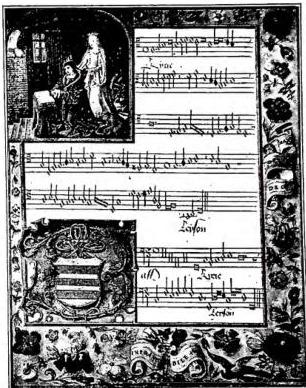
MESSA - Kyrie of the Mass Ecce Ancilla Domini by J. Ockeghem
Vatican Library, cod. Chig. C. VIII. 234, f. 20° (ca. 1500).
Was it a reaction by the melodists of the Alleluias—who came after those who composed the Gradual in modes 5 and 6—to have almost completely abandoned the tritus and favored the protus and tetrardus, modes little exploited by the Graduals? Here is the distribution of Alleluias according to the eight modes in the current Vatican edition:
Mode I II III IV V VI VII VIII
No. of Alleluias 76 36 23 31 10 4 36 45
The Introits and Communions do not raise questions about the choice of modes: the protus is the most represented, also because, as Ferretti notes, it is written within an ambitus accessible to all voices, i.e., D-D; but it is known that singers did not observe the indicated tone, primarily because the mode was well defined but not the tone, which was not written on lines.
Mode I II III IV V VI VII VIII
No. of Introits 42 28 47 28 21 17 24 18
Mode I II III IV V VI VII VIII
No. of Communions 50 25 16 24 20 24 24 40
Many new texts have been adapted to the ancient Gradual of the 2nd mode, later called Tractus and no longer sung by a soloist but by alternating choirs; thus, mode 8 no longer appears as it probably did originally, that is, a mode reserved for a specific genre of chants. Due to a lack of knowledge of the true Gregorian tradition and less respect for it, the polyphonists responsible for the Medici edition wrote Tractus in modes 1, 3, 4, and 7. In the current Vatican edition, the count is:
Mode II VIII
No. of Tractus 36 44
The minimal proportion of Offertories in mode 7 is curious:
Mode I II III IV V VI VII VIII
No. of Offertories 24 24 21 28 14 21 3 37
Before drawing conclusions or hypotheses from such statistics, it must be kept in mind that the Vatican edition is practical, not critical, and does not reflect the repertoire of the 7th–8th centuries, the period of maturity of Roman liturgical monody; the systematic compilation was completed in the 9th century before corruptions, ignorance, or new trends in taste arose. These statistics will need to be revised when the long-awaited edition prepared by the Benedictines of Solesmes appears. Moreover, it is known that the number currently marked in the margin of Gregorian chants indicates only the final note, that is, the mode in which the piece ends, not always the mode of the entire piece.
Continuing the inquiry into the chants of the Ordinarium Missae, one would discover that in the series of 18 Masses, Kyrie in modes 2 and 6 are missing. This does not mean that a Kyrie was never written in these modes: the Vatican edition presents a selection of Ordinary chants, not all the pieces contained in the codices. In fact, in the appendix of chants ad libitum, Kyrie in mode 2 and Kyrie in mode 6 appear.
| Mode | I | II | III | IV | V | VI | VII | VIII |
|---|---|---|---|---|---|---|---|---|
| No. of Kyrie | 10 | 1 | 2 | 3 | 2 | 1 | 2 | 7 |
Comparing this last table with the previous ones, one should rather note the lesser importance of this part of the repertoire, perhaps the best known but not the most interesting and certainly not the most representative of the melodic genius of Latin musicians, also because it was composed after the classical period of Gregorian chant.
VII. THE UNITY OF COMPOSITION IN GREGORIAN AND POLYPHONIC CHANTS OF THE MASS — An essential conceptual divergence in the composition of a Gregorian Mass strikes anyone familiar with the repertoire of classical polyphony: among the successive pieces, Kyrie, Gloria, Credo, Sanctus, Agnus Dei, the Gregorian lacks thematic unity; there is no connection from one to the other, except in some cases, such as in the first Mass for Paschal Time, «Lux et origo», the first words of the now-lost 1st trope. The final Kyrie begins like the intonation of the Gloria, and the Agnus Dei like the Sanctus. The differing dates indicated above the chants of the Ordinarium Missae suggest that these were not grouped in manuscripts as they are in current printed editions; moreover, this date does not indicate the date of composition but the age of the oldest known manuscript at the time of the Vatican edition’s compilation. Indeed, not only does the current collection leave many chants of the Ordinary unpublished, but it can be said that the order now proposed does not correspond to that of any single codex. This justifies the practice of certain choir masters who alter this order, especially since a rubric legitimizes such freedom.
Thematic and modal unity is equally lacking in the Masses of the «Proper», both for the temporal and sanctoral cycles. Of no Mass for a feast or a saint can it be demonstrated with certainty that it is the work of a single author. The Masses of the Common of Saints even less than others meet the criterion of contemporaneous composition. The various chants were initially composed for a specific saint; later, an Introit, a Gradual, an Alleluia were assembled, or an already known series was taken and assigned to another saint or martyr, thus giving rise to a first, second, or third Mass for several martyrs.
Certain chants of the Mass are traditionally and without exception performed in Gregorian chant: the celebrant’s recitatives, or certain chants of Holy Week. Over the course of musical history, even pieces of the «Proper» were set polyphonically, especially the Introit. The part of the Mass that has inspired the most abundant musical composition is the Ordinarium Missae.
VIII. EXPRESSIVENESS OF THE GREGORIAN CHANTS OF THE MASS — The particular expressiveness of the Gregorian chants of the Mass cannot, evidently, be summarized in a single word. In general, what strikes the listener is their gentle character, the absence of contrasts. This impression may result from modern systems of interpretation.
The habit of hearing music with strong contrasts may have dulled the modern listener’s ability to perceive subtle nuances, just as the teaching of instruments with harmonic temperament has diminished the capacity to appreciate the variety of modal nuances. Objectively, however, the expressive possibilities of Gregorian chant have no limits other than the appropriateness of music intended to draw near to the most sacred mysteries: the monodic genre, pure diatonism, and the assignment of the chant to the soloist, the schola, or the people impose their own requirements. On the other hand, the richness of this music shines more in the perfection of form than in the abundance of material means. The study of individual chants alone can reveal the delicacy with which they translate the elevated sentiments that should permeate genuine liturgical sacred music: praise and admiration of God, humility and penitence, gratitude and trust, supplication and hope. Certainly, the greatest freedom is left to the melodist in the manner of expression; he is not even compelled to treat all Alleluias with expansive joy: one need only listen to the 261 Alleluias of the Gradual to realize this. Nor are these varied sentiments musically depicted: Gregorian chant does not aim at musical plasticity, which is rare even in the polyphonic and secular spheres. Yet it is evident that in the most stylized forms (the typical forms of the Tractus in the 8th mode, for example), there was no hesitation in departing from the established path to suggest the effort of a decision on the word montes in the Tractus Qui confidunt. Perhaps, if one wishes to define the intent of the Gregorian musician, one might say that he fears revealing the depths of his soul, that he does not wish to impose himself on others, but always prefers to remain at the threshold of another’s soul, respecting its secret and freedom. The liturgy is classical in its verbal expression; it is sober in its gestures; the Gregorian musician has always sought to avoid the jarring note of bringing into the Church a music that is excessively romantic.
IX. POLYPHONIC MASS
Beginning in the 10th century, the chants of the Mass also came under the influence of the new sensitivity for multi-melodic vocal music, and nascent polyphony gradually made its way into the Church, first as an organal voice added to a cantus firmus and later as free invention for two or more voices, often alternating with the ancient liturgical chant.After the first polyphonic attempts, consisting of isolated pieces, Kyries (with tropes, V. TROPO), etc., one must reach the 14th century to find a true musical composition of the entire Mass in its five fixed singable parts that constitute the Ordinarium Missae (Kyrie, Gloria, Credo, Sanctus, Agnus Dei) in the so-called Mass of Tournai for three voices, transcribed and published by Coussemaker from a now-lost manuscript (
V. Ch
E. de Coussemaker, Messe du XIIIe siècle, Tournai 1861). However, the first organic work entirely by a single author is the Mass of Notre Dame, composed after the mid-14th century by Guillaume de Machaut, for four voices, a true masterpiece of medieval sacred music, rich in Gregorian inspiration and at the same time exquisitely flowing with a multifaceted melodic vein, within an agile rhythmic framework, marked by a new power of invention and expression. In the 15th century, the Flemish school contributed significantly to the artistic development of the polyphonic Mass, endowing it with its own contrapuntal style and the characteristic cyclic form that would make it a type of composition homogeneous and well-organized by an internal and external balance.After the two cited examples—the Mass of Tournai and that of Machaut—one must reach the mid-15th century with Dufay and the other Flemish composers to find complete Masses: documentary sources are the six Trent Codices (Trento, Archivio del Duomo, nn. 87-92) and the Old Hall manuscript (Catholic College of St. Edmunds, Old Hall, England), ca. 1450. In this period, Masses with choral parts (Gregorian chant) alternating with polyphonic parts are still found, while at the beginning of the 16th century, the Mass becomes a compos-
MESSA - MESSENGER OF THE SACRED HEART
a composition entirely unto itself, in which polyphony, independent of alternation with Gregorian chant, absolutely dominates the newly delineated musical form. After an initial period in which the individual parts of the polyphonic Mass were inspired by the corresponding parts of the Gregorian Mass from which they originated, there followed a phase, richer in types and examples, which flourished abundantly throughout the 16th century: the Mass is entirely centered on a single thematic material (hence the strictly cyclic character of the composition), which is taken, in long notes, as the cantus firmus (or dominant motif), mostly by the voice of the tenor (whose name derives precisely from the function it had of "holding" the base melody), which passes it to the other voices, which in turn modify it rhythmically or graphically. Depending on whether the cantus firmus is drawn from the secular or liturgical repertoire, or is invented by the composer, various types of Masses are distinguished: those inspired by popular and amorous secular songs in vogue (the most frequent type in Flemish music of the 15th century, in which the flourishing of madrigals was so fresh and luxuriant as to overflow even into the dark naves of Gothic cathedrals (v. the typical example of the popular song L'homme armé, which provided the thematic inspiration and the name for about thirty Masses composed by polyphonists from various countries and times up to the 17th century, such as Dufay, Busnois, Caron, Ockeghem, Obrecht, Tinctoris, Josquin Des Prez, Brumel, De la Rue, Pipelare, Senfl, de Orto Morales, Palestrina, Carissimi, etc), those based on liturgical themes, mostly antiphons or hymns abundant in the 16th century, especially in the second half, and those in which themes are composed by the author (the least abundant category of all).
The first type of Mass, which draws from secular motifs, persisted over time, even beyond the Council of Trent, which had prohibited its use, and in such cases the title of the Mass no longer alludes to its content: they take vague and generic denominations, such as Missa sine nomine, Missa quarta (the Palestrina Mass that was inspired, in 1582, by the famous song L'homme armé), etc.
An important type is the Missa parodia, in which the melodic derivation is no longer limited to a thematic borrowing but is an extensive adaptation of a pre-existing piece (song or madrigal in the 15th century; mostly motet in the 16th), by the same or another author: with this technique composed Masses: Dufay, Josquin, Ockeghem, Agricola, Palestrina, Lasso, and many others. Lesser importance has the type of Mass called quodlibet, which combines various motifs of secular origin (v. Isaac). Among the Masses with themes freely invented by the author, or taken from syllables or the notes of the scale, are to be remembered the Missa "Hercules dux Ferrariae" (with the theme re-ut-re-ut-re-fa-mi-re, from the vowels of the title) and the other Missa "Lassa fere a mi", both by Josquin Des Prez, and the various Masses based on the first notes of the hexachord do-re-mi-fa-sol-la (Missa super voces musicales by Josquin, Brumel, Palestrina, etc.).
The musical composition of the Mass reached its zenith in the golden age of polyphony, that is, in the 16th century, especially through the work of the Roman school, PALESTINA (v.) who wrote 93 Masses (for 4, 5, 6, and 8 voices) with grandiose architectural lines that clothe the cantus firmus in the most resplendent splendors, G. Animuccia (v.), whose Masses Secundum formam Concilii (where purest melodies confer diamond-like brilliance to the Gregorian cantus firmus) are the living expression of the Catholic Reform concretized in the Council of Trent, and then again with C. Festa, G. M. Nannino, the two Anerio, R. Giovannelli, F. Soriano, A. Cifra, A. Zoilo, Ann. Stabile, Arc. Crivelli, etc. In the same period flourished the Venetian school, predominantly pictorial in a harmonic sense, for exquisitely chromatic and decorative characteristics, whereas the Roman school was the triumph of plastic and architectural counterpoint. Of this school, which is already entirely projected, in a triumph of colors and timbral riches, toward the harmonic novelties of the imminent 17th century, luminous glories are the Fleming A. GABRIELE, (v.), C. de Rore, G. Croce, with the temporal and spatial prolongation of the current called Deutschvenetianer, or German followers of the Venetian style, among whom are remembered Jacob Gallus, H. Praetorius, H. L. Hassler, and M. Praetorius. Nor can one pass over in silence the flourishing of polyphonic Masses in Spain, with the glorious names of Cristobal Morales, T. L. Da Victoria, Francisco Guerrero, and others. Still in the full 17th century, among the ideal continuators of Rome and Venice, V. Ruffo, M. A. Ingegneri, Ludovico Grossi da Viadana; now the Baroque Mass, which seeks to astonish with effect and spectacular display of voices and instruments (eloquent example the Mass for 53 parts composed by Orazio Benevoli for the inauguration of the Salzburg Cathedral in 1628).
In the 18th century, the great Mass of Bach, Hohe Messe in h-moll (1733), composed for the Catholic court of Dresden in cantata form, stripped the Mass of the ornaments that the Baroque had bestowed upon it as cumbersome superstructures and returned it to the realm of the symphonic Mass, a realm in which it had already arrived with Scarlatti, Durante, Leo, and in which it remained with the Viennese classics. The great Missa solemnis of Beethoven (1819-22), along with those of Haydn and Mozart, remains in the sublime heights to which the musical Mass had ascended with Bach, now essentially reduced, however, to a concert composition. Closer to us, the triptych of the three Masses (in D minor, E minor, and F minor) by A. Bruckner (1824-96) still speaks the language of Romanticism in this form, but the characteristic unction due to the correspondence of notes with the sacred text is already distant: the secularization of the Mass, apart from isolated accents of moved mysticism, is now an accomplished fact.
The reform of sacred music in the last century led to a revaluation of traditional currents, and there was then an abundant flourishing of Masses in Germany and Italy, with Witt, Haberl, Haller, Mitterer, Griesbacher, Goller, Santini, Alfieri, etc., while in the new Mass of today there is an attempt to restore ancient immortal values in the light of a new sensibility. Besides the Masses of Lemacher, Ahrens, Haas, Refice, Perosi, and many others, a final singular example of our time is cited: the Mass of J. Stravinsky, in which the sweetly archaic flavor of the most ancient Gregorian chant is united with the echo of the liturgical melodies of the Eastern Church.
A particular genre of Mass is the Missa pro defunctis, also called, from the first word of the Introit, Requiem. The characteristic parts, besides the Introit, which replaces the Kyrie, are the Sequence (Dies irae) and the Offertory (Domine Jesu Christe); the Sanctus with the Benedictus and the Agnus Dei are also present here, while the Gloria and the Credo are absent. Conspicuous examples of Requiem Masses have been left by Pierre de La Rue, Joh. Prioris, Ant. de Févin, Palestrina, Morales, Lasso, Victoria, Kerll, Cavalli (1706), Jommelli (1756), Mozart, Cherubini (1816 and 1836), Berlioz (1838), Dvorak (op. 88, 1891), Bruckner (1885), Verdi (1874), Saint Saëns (op. 54, 1878), Fauré (1887), etc. - Vedi tavv. XLVI-XLIX.
BIBL.:
A. Schering, Geschichte des Oratoriums, Lipsia 1911; K. G. Fellerer, Geschichte der kath. Kirchenmusik, Paderborn 1929; A. Pirro, Histoire de la musique de la fin du XIV siècle à la fin du XVI, Parigi 1940; G. Reese, Music in the Renaissance, New York 1954; A. Einstein, The Italian Madrigal, Princeton 1949; H. Besseler, Die Musik des Mittelalters und der Renaissance, Potsdam 1931-34; R. Casimiri, Palestrina, Roma 1918-22; K. Jeppesen, La frottola, Copenaghen 1923; G. Gaspari, Catalogo della Biblioteca del Liceo musicale di Bologna, Bologna 1890-1905; A. W. Ambros, Geschichte der Musik, Lipsia 1862-82; H. Riemann, Handbuch der Musikgeschichte, Lipsia 1904-13; G. Adler, Handbuch der Musikgeschichte, Berlino 1924; F. X. Haberl, Bibliographischer und thematischer Musikkatalog des päpstlichen Kapellarchivs im Vatikan zu Rom, Lipsia 1888; E. van der Straeten, La musique aux Pays-Bas avant le XIX siècle, Bruxelles 1867-88; J. Wolf, Handbuch der Notationskunde, Lipsia 1913-19; P. Wagner, Einführung in die gregorianischen Melodien, Lipsia 1911-21; A. Gastoué, Les primitifs de la musique française, Parigi 1922; H. Leichtentritt, Geschichte der Motette, Lipsia 1908; A. Schering, Studien zur Musikgeschichte der Frührenaissance, Lipsia 1914; O. Ursprung, Katholische Kirchenmusik, Potsdam 1931; A. Schmitz, Die Musik der Messen Palestrinas, Lipsia 1931; G. de Van, Inventaire des manuscrits de musique polyphonique qui se trouvent en Italie, Parigi 1941; A. Smijers, De Illustribus musicis, Amsterdam 1939; J. Handschin, Der Organum-Traktat des Anonymus IV, in Archiv für Musikwissenschaft, 1924; H. Anglès, La música en la corte de los Reyes Católicos, Barcellona 1941-51; G. Reese, Music in the Middle Ages, New York 1940; F. Ghisi, Alle fonti della monodia, Firenze 1940; A. Einstein, The Golden Age of the Madrigal, Roma 1942; K. Jeppesen, The Style of Palestrina and the Dissonance, Copenaghen 1927; G. Adler, Der Stil in der Musik, Lipsia 1911; H. Leichtentritt, Musikalische Formenlehre, Lipsia 1911; R. Giazotto, La musica a Genova nella vita pubblica e privata dal XIII al XVIII secolo, Genova 1951; A. Schering, Beethoven und die Messe, Lipsia 1925; A. W. Thayer, Ludwig van Beethovens Leben, Lipsia 1866-1908; P. Mies, Die Messen von J. Haydn, Lipsia 1933; E. Bücken, Die Musik des Rokokos und der Klassik, Potsdam 1927; A. Schering, Das Symbol in der Musik, Lipsia 1941; H. J. Moser, Geschichte der deutschen Musik, Stoccarda 1920-24; A. Schmitz, Die Bildlichkeit der wortgebundenen Musik Johann Sebastian Bachs, Magonza 1950; A. Pirro, J.-S. Bach, Parigi 1906; A. Schering, Johann Sebastian Bach und der deutsche Geist, Lipsia 1921; H. Besseler, Die Musik des Mittelalters und der Renaissance, Potsdam 1931-34; F. Blume, Die evangelische Kirchenmusik, Potsdam 1931; K. G. Fellerer, Der Palestrinastil und seine Bedeutung in der vokalen Kirchenmusik des 18. Jahrhunderts, Augusta 1929; A. Schering, Geschichte der Musik in Beispielen, Lipsia 1931; H. Leichtentritt, Geschichte der Motette, Lipsia 1908; G. Adler, Handbuch der Musikgeschichte, Berlino 1924; R. Haas, Die Musik des Barocks, Potsdam 1928; A. Einstein, A Short History of Music, New York 1936; G. Reese, Music in the Renaissance, New York 1954.
G. Pannain