
DIACONO and ARCIDIACONO. — Etymologically derived from διάκονος (attendant), it is today the second of the major Orders (v. SACRO). In the Gospel this name occurs eight times, always in the sense of attendant. In its present technical sense, it is first attested in St. Paolo (Phil. 1:1 and I Tim. 3:8–12). The diaconate is certainly a Sacrament, although this has not been defined as a matter of faith, and it belongs to the hierarchical order.
I. INSTITUTION. – The first mention of the d. in the New Testament, following not the order of the writings but that of the events, occurs on the occasion of the disturbances that arose in the primitive Christian community, when it seemed that the distribution of aid to widows and orphans was not being carried out with due impartiality. The Apostles entrusted such a task to “seven men of good reputation, full of the Holy Spirit and wisdom” (Act. 6:3), “and, after praying, they laid their hands on them” (ibid., 6:6). In this account tradition sees the accomplishment of a truly sacramental act. Indeed, the handling of charitable activities did not exhaust the entire activity of the d.: they were also assistants to the Apostles. Stephen and Philip preached the Gospel (ibid., 6:8 ff.; 8:5; 26:40), and Philip even baptized (ibid., 8:12 ff.; 38). Beginning with s. Ignatius Martyr, the Fathers place the diaconate as the lowest of the three degrees of the hierarchy of Orders. S. Ignatius (Ad Trall., 2:1) calls the d. “ministers of the mysteries of God”; and says: “let everyone respect the d. as Jesus Christ, and likewise the bishop and the priests; without them there is no church” (ibid., 3:1).
II. RITE OF ORDINATION. – Today, in order to be admitted to the diaconate, in addition to the bonum testimonium, of which the Acts already speak, celibacy is also required (can. 132, 1); in the East, from the Council of Nicaea onward, only a first marriage is permitted.
It is also required that the candidate have reached 22 years of age (can. 975), have begun the fourth year of the theological course (can. 976 § 2) in schools approved by the ecclesiastical authority and organized in accordance with can. 1365 (can. 976 § 3); that he have already been a subdeacon for three months and have exercised the Order of the subdiaconate (can. 978 §§ 1–2). In order then to ascend to the priesthood, an identical interval of three months, together with the exercise of the Order of the diaconate, must be observed (can. 978 § 2).
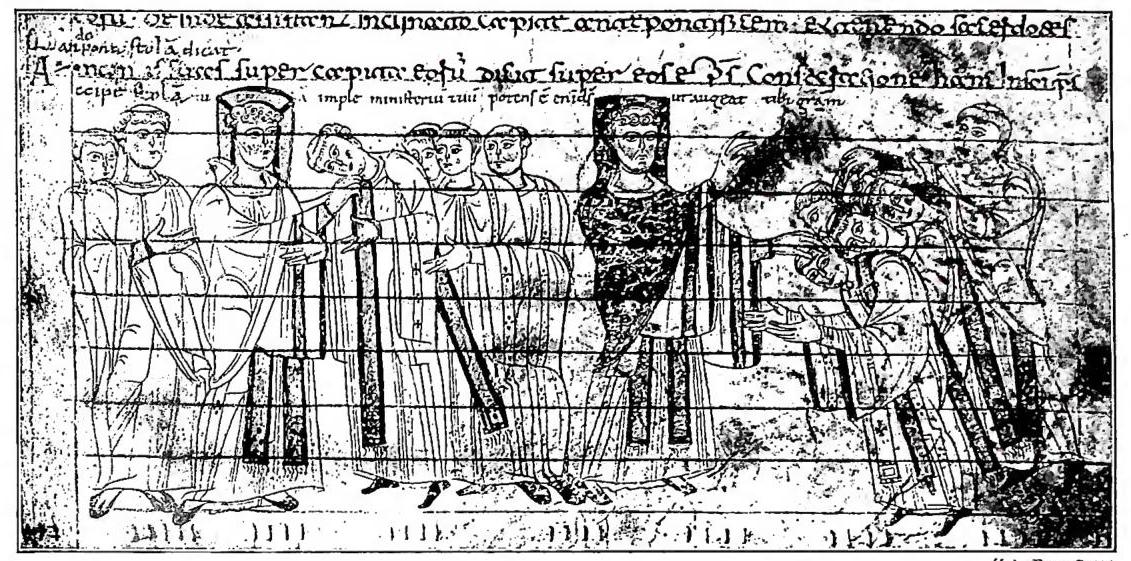
The rite of ordination to the diaconate is described in the Roman Pontifical (title de ordinatione diaconi). The minister of ordination is the bishop. This is the common doctrine, against which difficulties are raised by the bulls Exponii of Innocent VIII of 1489 and Sacrae Religionis of Boniface IX of 1400; but the historical-theological question, still unusual, concerns the minister of the Order (v. SACRO).
Diaconal ordination is conferred, as with the other major Orders, through the laying on of hands and the episcopal prayer, in conformity with Acts 6, 1 ff. (cf. Pius XII, constitution Sacramentum Ordinis, 30 Nov. 1947; AAS, 40 [1948], p. 5). In the Gallican liturgy, during the Middle Ages, the handing over of the instruments (stole, dalmatic, book of the Gospel) was added; in the fourteenth century, following scholastic discussions, the formula “Accipe Spiritum Sanctum ad robur et resistendum” was introduced into the preface, that is, into the consecratory prayer: hence a famous controversy concerning the matter and form of the diaconate, decided (loc. cit.) by Pius XII. III. OFFICE. – In the diaconate no special power is today transmitted to perform particular sacred actions that are exclusive to this Order; rather, the faculty is granted to exercise ex officio certain sacred functions.
The proper function of the d. was at all times to serve the bishop (cf. St Ignatius, Eph., 2,1; Philad., 11, 1–2), with a twofold responsibility: sacred ministry and works of charity, especially the care of the poor.
Liturgical functions were soon assigned to deacons: according to St Ignatius (Trall., 2,3), “they are ministers of the mysteries of Christ Jesus... for they are not ministers of provisions and food, but of the Church of God”; they preach (Philad., 11,1) and, according to St Justin (Apologia, I, 65 and 67), distribute the Eucharist, especially the Blood of Christ, and bring Holy Communion to those absent; they receive the offerings from the hands of the faithful, read the diptychs and, with the bishop’s permission, baptize, instruct catechumens and perform exorcisms over them. From St Cyprian (Epist., 18,1) they received the authority to readmit the “lapsi” in cases of necessity, at least when they could produce the libellus of the confessors; this practice of reconciliation was preserved for deacons until the Middle Ages (B. Bartmann, Lehrbuch der Dogmatik, II, 7th ed., Freiburg im Breisgau 1929, p. 409). According to the old practice, deacons were the bishop’s eye: they watched over discipline; they were his ear, enabling him to hear the requests and complaints of the faithful; his hand, for giving alms to the poor; and his heart, for caring for the sick and needy (Didascalia, III, 13,7; IX, 28, 6; 44, 3 and 4). Already in the Constitutions of the Apostles (2,57), the singing of the Gospel is reserved to deacons.
The care of the poor entailed the administration of the Church’s goods.
Of the many offices of the deacon, the Roman Pontifical and the CIC have preserved chiefly three: serving the priest at the altar when he celebrates solemnly, or replacing him in certain functions; baptizing; and preaching.
1. Assistance to the priest who celebrates solemnly, as his principal minister, entails various duties determined by the liturgical books, such as singing the Gospel, giving him the host at the time of the offering, pouring the wine into the chalice for him, handing him the monstrance during the Eucharistic blessing, etc. The d., as extraordinary minister of the Most Holy Eucharist, may replace the priest and distribute Holy Communion under two conditions: a) that there be a grave reason, understood in a rather broad sense, such as an illness or pressing duties of the parish priest, etc.; b) that there be permission from the Ordinary or the parish priest, that is, from the person to whom the right to distribute Holy Communion to the faithful belongs: in case of necessity, this permission may legitimately be presumed (can. 845 § 2). If either of these conditions were absent, the d., although administering Communion, would nevertheless not commit a grave sin, and still less would he incur the irregularity referred to in can. 985 § 7.
The d. is also a minister, together with the priest, of the exposition or reposition of the Most Blessed Sacrament, but not of the blessing (can. 1274 § 2), which he may and must give only when he brings Communion to the sick according to the rite prescribed in the Roman Ritual (tit. IV, cap. 4, n. 23, 36; Pont. Comm. Cod., 13 July 1930: AAS, 22 [1930], p. 365). Then, as in the ordinary case of distributing Holy Communion, he must also bless with his hand according to the prescriptions of the same Ritual (tit. IV, cap. 2, n. 10; AAS, 22 [1930], p. 365), and sprinkle with holy water at the beginning (Rit. Rom., tit. IV, cap. 4, n. 15).
These, together with the blessing of the Paschal candle on Holy Saturday (cf. Missale Rom., Rubrica in Sabb. Sancto “benedictio cerei”), and the exorcisms and blessings required in solemn Baptism, are the only blessings expressly permitted and therefore allowed to the d. (can. 1147 § 4).
Finally, with the permission of the Ordinary or at least of the parish priest, the d. may replace the absent priest in conducting the funeral (Decr. authent. S. R. C., n. 3074), also wearing, as seems more probable, the cope. In cases of particular necessity, he may also probably conduct ordinary processions in accordance with can. 1290 § 2, under the same conditions as above (F.M. Cappello, De Sacramentis, IV, Rome 1942, n. 119).
The proper insignia of the d. is the stole worn transversely from the left shoulder to the right side, and, in a certain sense, the dalmatic.
2. The d. is an extraordinary minister of Baptism
DIACONO AND ARCIDIACONO – Inscription of the deacon Flavio Secondino (3rd century) – Rome, Lateran Museum.
solemn Baptism, which, however, he may administer only under two conditions: a) the existence of a just cause, which need not be grave, as stated above for Holy Communion; b) the permission of the Ordinary of the place or of the parish priest, which may be presumed in case of necessity (can. 471).

3. The deacon is qualified «qua talis» for the ministry of preaching, like the priest, but may exercise it only after receiving a legitimate mission and the permission of the competent superior (cann. 1342 § 1, 1328).
Moreover, the deacon has all the privileges and all the obligations common to the other clerics; in addition, together with the subdeacon, he has the obligation of reciting the Divine Office (can. 135), and celibacy constitutes for him a diriment impediment to Marriage (can. 1072). The Holy See today grants dispensation from this impediment with less rigor than in the past, and consequently a dispensation from it may be granted in an urgent case and in periculo mortis according to cann. 1043–1045; not, however, according to can. 81 (Pont. Comm. Cod., 26 Jan. 1949: AAS, 41 [1949], p. 158).
IV. L'ARCID
1. Le origini. - In ricordo della primiera istituzione la maggior parte delle Chiese, cominciando da quella di Roma, non ebbero da principio più di sette d., mentre non c'era numero fisso per i preti; e nel Concilio di Cesarea (314) contro alcuni abusi si stabilì che i d. fossero in ciascuna chiesa sette (can. 15). Ma poi la Chiesa orientale prima, come attesta Sozomeno (Hist. eccl., I, 15), e la Chiesa occidentale poi, non si attennero più a questo numero.Ad Alessandria nel sec. IV si contano 9 d. seguaci di Ario e 20 che sottoscrivono al decreto per la sua deposizione (PG 18, 577-81); ad Edessa nel 451 vi erano 39 d. (Mansi, VII, 255), ed a Costantinopoli nel sec. VI ve n'erano 100 (Novellae, III, 1).
A Roma la tradizione si mantenne più costante per la divisione della città in sette regioni (sotto papa Fabiano, 263-51, secondo il Lib. Pont.), a ciascuna delle quali presiedeva un d. (regionarius). Ma anche qui a poco a poco accanto ai regionarii vennero deputati altri d. (stationarii, martyrarii: J. Mabillon, Museum Ital., II, Parigi 1689, pp. XVII-XVIII).
Era naturale che essendo demandata in particolare ai d. l'amministrazione e la distribuzione dei beni della Chiesa, uno fra loro ne avesse la direzione e la diretta responsabilità e che gli altri sottostassero a lui. Sorge così l'arcid. che si trova menzionato prima in Oriente, ma che in Occidente assume un compito più vasto e più chiaramente definito. Sorge come l'uomo di fiducia del vescovo in un settore così delicato; ciò non vuol dire che più tardi non abbia poi osato spadroneggiare e cercato di imporre la sua volontà. Grazie alle sue qualità od al suo ascendente poteva riuscire a farsi valere nell'elezione del nuovo vescovo, quando la sede rimaneva va-
cante, in favore della propria persona o di quella da lui preferita: nei casi ordinari infatti la scelta cadeva nell'antichità o su un d. o su un prete.
La piena evoluzione di quest'ufficio si ebbe dal sec. IV al sec. VIII. Ceciliano, poi vescovo di Cartagine, è il primo in Occidente cui venga applicato il titolo di arcid. dal suo biografo, Ottato di Milevi (ca. 380), mentre narra le rigorose misure prese come tale per correggere alcuni abusi durante la persecuzione diocleziana (De schism. Donatist., I, 16: PL 11, 916). Qualche altro autore applica il titolo a personaggi pure anteriori, ma scrive dopo.
S. Agostino chiama s. Lorenzo arcid. (Serm., 302, 9: PL 38, 1388). « Ducem diaconorum » è invece chiamato s. Atanasio d'Alessandria presso Teodoreto (Hist. eccl., I, 25: PG 82, 980).
Sozomeno (Hist. eccl., IV, 28: ibid. 67, 1204) chiama arcid. il chierico che nel 361 tenta di impedire ad Antiochia al vescovo s. Melezio il Grande di fare una professione ortodossa sulla Trinità e narra che s. Gregorio Nazianzeno (ca. 380) costituì Evagrio arcid. di Costantinopoli (op. cit., VI, 3: ibid. 67, 1384). Ugualmente negli atti del Sinodo « ad Quercum » (403) l'accusatore di s. Giovanni Crisostomo è Martirio, antico arcid. della Chiesa di Costantinopoli (Atto d'accusa, n. 26: Mansi, VI, 1144; Ep. S. Ioh. Crys. ad Inn., I, 1: PG 52, 531).
Dell'arcid. parla ancora il I Concilio Toletano del 400 (c. 20, Mansi, III, 1002) e s. Girolamo in più luoghi delle sue opere (Ep. 125: PL 22, 1080; Ep. 146, 1: ibid., 1194, ecc.).
Nel sec. V il titolo di arcid. diventa comune per molte Chiese e s. Leone Magno poteva scrivere che all'arcid. della Chiesa costantinopolitana (453) era affidata dispensationem totius causae et curiae ecclesiasticae (Ep. 111, 2: ibid. 54, 1021), cioè subordinatamente al vescovo, tutta la disciplina ecclesiastica. Riguardo all'amministrazione dei beni, affidata all'arcid., ci fanno fede le sue lettere (492-96).
Il papa Gelasio che affida all'arcid. Giustino con altri due l'amministrazione dei beni della chiesa di Volterra, di cui aveva privato il vescovo Eucaristo (ibid. 59, 140-45), ricorda il caso del vescovo di Faieria, che aveva rimosso dall'ufficio il suo arcid. Giovanni, per poter disporre più liberamente dei beni a propria utilità (ibid., 100). Il caso si ripeterà sotto Gregorio I a Salona (Ep., II, 18-20: ibid. 77, 552-65).
La cura delle vedove e dei pupilli affidata all'arcid. è ricordata negli Statuta Ecclesiae antiqua (cap. 17: H. T. Bruns, Canones Apostolorum et conciliorum, Berlino 1839, I, 143) e nel II Concilio di Mâcon (cap. 12: Bruns, II, 253) del 585; la cura e la visita dei carcerati è imposta come obbligo nel Concilio V di Orléans ([519], cap. 20: Bruns, II, 214); mentre i Concili di Parigi del 614 (II, capp. 7-9: Bruns, II, 257) e di Châlons-sur-Marne del 650 (cap. 7: Bruns, I, 266) gli impongono, insieme con il vescovo, l'ufficio di esecutore testamentario dei chierici.
L'educazione dei giovani chierici, specialmente di quelli raccolti nel « diacono » della città episcopale, ci è testimoniata in varie fonti (cf. s. Gregorio di Tours, Hist. Franc., 10, 8: PL 71, 536; Statuta Eccl. antiqua, cap. 9: Bruns, I, 142), che insieme ci dicono la parte tenuta dall'arcid. nell'ordinazione dei medesimi (Statuta Ecclesiae antiqua, capp. 5-6: loc. cit.), essendo la stessa ammissione agli Ordini dipendente dal suo giudizio (Concilio di Beiruth [449]: Mansi, VII, 223).
Anche dopo l'ordinazione i giovani chierici rimangono soggetti alla vigilanza dell'arcid. (Concili di Agde del 506, cap. 20: Bruns, II, 150 e di Orléans [541], cap. 26: Bruns, II, 206). L'ufficio di arcid. era liberamente assegnato dal vescovo (Sozomeno, Hist. eccl., VI, 30; 8, 9; 8, 15) e data la sua importanza spesso conservato a vita.
La promozione al presbiterato era ritenuta un'ingiuria (s. Girolamo, Comm. ad Ezech., cap. 48: PL 25, 484) e ad essa i vescovi ricorrevano, quando volevano disfarsi di un arcid. (Ep. Leonis I: ibid. 54, 1021; Ep. Gregorii M.: ibid. 77, 552 sgg.).
2. Vicario del vescovo
Dalla fine del sec. VII l'arcid. ci appare sempre più come il vicario del vescovo in tutto ciò che riguarda il governo della diocesi,tanto che l'Ordo Romanus, I, n. 4 (M. Andrieu, Les Ordines Romani du haut moyen âge, II, Lovanio 1948, p. 68) chiama l'arcid. della Chiesa romana sicarius Pontificis ed Incmano di Reims nel sec. IX nomina il suo arcid. con l'appellativo di commister noster (Capit. a. XII episcopatus super., cap. 1: PL 125, 793). La visita della diocesi è affidata all'arcid. insieme con il vescovo ed anche in suo luogo, e si estende non solo al clero inferiore, ma anche alla visita personale dei preti, su cui vari concili dettano minuziose prescrizioni (Capit. Walteri episc. Aurelian. [871]: ibid. 119, 726-46), mentre Incmaro (Capit. Archidiaconibus, presbyteris data, capp. 1-13: ibid. 125, 800) raccomanda ai suoi arcid. di usare con carità, ma senza debolezza, del loro ufficio di correttori.
L'Ordo Romanus, inserito nelle Decretali (1, X, I, 23), gli sottomette tutto il clero senza eccezioni, urbano e rurale. Un testo della stessa epoca, attribuito a volte ad un Concilio di Toledo (1, X, I, 24) e a volte a s. Isidoro (1, § 12, D. 25), dice espressamente che l'arciprete è sottomesso all'arcid.; gli dovrà obbedire come al suo vescovo, pur essendo il capo dei preti (loc. cit.). Lo stesso ripete per il primicerio (c. unic., X, I, 25) per il sagrista (c. unic., X, I, 26) e per il custode (1, X, I, 27). Con il crescere della potenza dell'arcid. aumenta anche il pericolo di abusi. Capitolari e concili ne mettono in guardia l'arcid. Otto dei tredici Capitoli d'Incmaro sopra ricordati trattano di questo soggetto (capp. 1-6, 9, 11). L'ufficio diviene appetibile anche ai laici, ma i Capitolari si affrettano a precluderne loro la via (Capit. minor. in Theodonis villa [805], cap. 15).
3. The prelate archdeacon, who until the ninth century was merely a deacon, thereafter was often a priest; and whereas previously there had been only one for the whole diocese, from this time onward he ceased to be unique, because Frankish sources began to speak of several archdeacons in the same diocese, each of whom was assigned a particular territory (Council of Chalon-sur-Saône [813], chap. 5; Paris [829], chap. 25).
Germanic sources, on the other hand, speak of several archdeacons in the same diocese only from the tenth century onward; but in the eleventh and twelfth centuries the division had become common (A. Hauck, Kirchengeschichte Deutschlands, IV, Leipzig 1931, p. 11 ff.), and it is also found in England, at Canterbury (PL 214, 1029); whereas in Italy it is scarcely found before the twelfth century. The number of archdeacons varies according to the region. In Germany there was often one for each mother parish.
At Rome, the archdeacon had remained unique and was one of the principal figures in the college of cardinals. We do not really know what his specific functions were in the eleventh century. For the earlier period, there is only the testimony of Pope Martino ([657], ibid., 87, 201), according to which he was responsible for governing during a vacant see, together with the archpriest and the primicerius of the notaries. Yet it was precisely in the eleventh century that an archdeacon of the Roman Church, even before being elected pontiff, came to fill the history of the Church with his presence: Ildebrando.
The multiplication of archdeacons, even if it did not bring this about from the outset, soon led to the division of the diocese into districts (archdeaconries). Where such a division existed, the boundaries of the archdeaconry often corresponded to those of a civil district (pagus); sometimes they corresponded to deaneries, as at Basel; but ordinarily several deaneries formed an archdeaconry, while certain churches and monasteries obtained exemption by privilege, with their own archdeaconal rights. The name archdeaconry, however, does not appear until the eleventh century, whereas previously the term parish is found (cf. B. Guérard, Essai sur le système des divisions territoriales de la Gaule, Paris 1832, p. 93).
With the division into territories, the jurisdiction of the archdeacon, which had previously been delegated ab episcopo, gradually became customary within his own territory. Moreover, since the exercise of jurisdiction was accompanied by certain revenues, the office and benefice of archdeacon thus arose, with jurisdiction no longer delegated but ordinary. From the eleventh century onward, the office constituted one of the dignities of the cathedral chapter or of a collegiate church and sometimes, as in the dio-
Thus, in many places, the archdeacons in the 11th–12th centuries were true prelates with ordinary jurisdiction in their own territory.
It followed that the archdeacons in the dioceses were ordinary judges of first instance, from whom appeal was made to the bishop. Contested jurisdiction was accompanied by very extensive administrative power (7, 9, 10, X, de officio archid., I, 23). This brought about a certain independence from the diocesan bishop, and resistance on the part of the latter to the transformation under way. In this resistance to the archdeacon, they often also had the support of the Roman Pontiffs (c. 4–5, XI, I, 23).
Nevertheless, in the 12th century, the jurisdiction of the archdeacons became ordinary and, as ordinary, delegable. The Council of Tours of 1163 (can. 7) does not censure archdeacons who appoint their delegates, but only because they appoint them for money.
The archdeacons, placed almost on the same level as the bishops, in turn appointed their own vicars and officials (cf. S. Tommaso di Cantorb., Lettere, 173, 182, 189, 191, 225, 292, in Recueil des histor. des Gaules, XVI, pp. 345, 354, 360, 363, 389, 447).
With the 13th century, the power of the archdeacons reached its height. This is visible through the councils and statutes of the period, more than through the sources of the common law, which seem rather to lag behind the existing reality (cf. 7, X, I, 23). As the gloss on the Decretals observes, custom had considerably increased the prerogatives of the archdeacons, who were no longer simple delegates (In Decret., I, I, tit. 23, c. 4, V. Consuetudinis etc.). It is unnecessary to repeat their prerogatives in detail: it will suffice to emphasize some new acquisitions. As regards preparation for ordinations and for those to be ordained, they could do everything, with the exception of the letters dimissory, which could be granted only de consensu episcopi (8, X, I, 23). Thus supervision of the clergy extended to everyone, including archpriests and deans (7, X, I, 23), and, once they had received institution from the bishop, to whom the archdeacons presented them, the archdeacons could install them in possession of any office and benefice (loc. cit.). Sometimes particular law and custom also authorized the archdeacon to override this last exclusive right of the bishop and to install clerics in possession, episcopo irrequisito. Likewise, while the common law authorized archdeacons to install abbots and abbesses in their archdeaconry (9, X, I, 23), custom gave them the right, as at Sens, to install even bishops (cf. A. Ama- nieu, Archidiacre, in DDC, I, col. 969).
There is by now no doubt about the archdeacon’s right to make the pastoral visitation, to be carried out annually; ordinarily, he made it alone. The councils limited themselves to specifying and analyzing the object of the visitation, or to advising the archdeacon not to make it too burdensome through his retinue, increased fees, etc. (cf. Conc. Later. III, a. 1179, c. 4; Later. IV, a. 1215, c. 33 [6, 23, X, III, 39]).
The archdeacon had the same power in the special assemblies, a kind of conferences of the clergy of the archdeaconry and almost a complement to the pastoral visitation (Const. Aegidi Sarriaburieu. [1256], de Capitulis celebrandis: Mansi, XXIII, 905); thus far, the archdeacon’s power of jurisdiction.
With regard to the power of Order, even before the 10th century there had been examples of archdeacons ordained priests while retaining their office: the examples multiplied from the 10th to the 12th century, but this practice never became universal, some of them protesting that receiving priestly ordination did not increase the dignity of the office, but rather diminished it (cf. Pietro de Blois, Epist., 123: PL 207, 365–66). Some were not even concerned to receive the Order of the diaconate, so much so that many councils, and finally the first three Lateran Councils (I, can. 6; II, can. 10; III, can. 3), besides prescribing the age of 25, had to command an archdeacon who had the care of souls to receive the Order of the diaconate within one year of assuming office (23 D. 60; c. 7 X, I, 6).
All in all, at this time the archdeacon was inferior to the bishop almost solely in the power of Order; and his power was personal, no longer vicarious.
4. Decline
The danger of excessive power on the part of the archdeacons increased because the former free collation by the bishop had often been replaced by their designation through capitular election or royal appointment (P. Hin- schius, System des Kath. Kirchenrechts, II, Berlin 1878, pp. 195 ff., 201 ff.).It is therefore not surprising that the bishops sought, by various means, to restrain the excessive power of the archdeacons (Council of Tours, [1239], c. 8), gradually replacing them with other ministers more dependent on their will, because removable ad nutum, and that in this struggle they found support, sought or otherwise, in the capitular rivalries.
The Chapters cooperated with the bishops in undermining the dignity of the archdeacon, first restraining and then seeking to dislodge, for their own advantage, the extent of his powers in the life of the Chapter and of the diocese. In some respects this was also natural; once the archdeacon had entered the Chapter, the other canons tended to regard him as their equal. Favored by discipline and esprit de corps, the canons called into question not only the precedence claimed by the archdeacon, but the jurisdiction itself of a prelate, in order to reduce him to the status of any one of them.
Ordinarily, the archdeacons should have been the first dignitaries in the Chapters; but this was not always and everywhere the case. In France, the Chapters generally had a provost or a dean at their head: the archdeacons thus came second, if not third, as at Paris and Meaux, and sometimes even seventh, as at Chartres.
According to the canonists, this custom was also widespread outside France. In Italy, for example, at Turin, Padua, and Reggio the archdeacon was preceded by the archpriest, while at Antwerp he ranked third. In Spain, at Avila and Barcelona the archdeacon was the second dignitary, and at Zamora the third. S. Antonino di Firenze bears witness in his own time to this diversity (Summa theol. mor., parte 3ª, tit. 19, c. 6 § 1, Venice 1571, p. 345). This determination of precedence was often the fruit of struggles in which, as is evident, the archdeacon frequently remained defeated.
The abbots, too, sought to make their monasteries increasingly independent of the power of the archdeacons (cf. M. Quantin, Cartulaire général de l’Yonne, Auxerre 1854, p. 102 ff., n. 235).
But more than these conclusions, so to speak, based on reservations and compromises, it was the creation by the bishops of vicars general for the ordinary governance of the diocese, and of officials for the administration of justice, that gave the strongest impetus to the decline of the archdeacons’ power.
The archdeacons, in fact, had been transformed from vicars of the bishops into ordinary prelates, acting on their own behalf and no longer as delegates, in one part of the diocesan territory. The bishop had practically been left without assistance at a time when the affairs of the diocese were multiplying and the revival of law required the presence of a legal expert in the episcopal curia.
Between the 15th and 16th centuries the decline of the archdeacon became more pronounced, and in the 16th century he no longer existed except as a capitular dignity, while the common law concerning him was no longer applied. M. Navarro (Manuale confessariorum, cap. 25, n. 136) said that he knew of no archdeacon in Spain to whom the texts of the Decrees could be applied.
5. From the Council of Trent to the Code
This slow erosion of the powers of the archd. reached its conclusion at the Council of Trent, which removed from his jurisdiction the matrimonial and criminal cases of clerics (Sess. XXIV, c. 20 de ref.), especially cases involving clerics living in concubinage; indeed, it even took away the power to excommunicate and to visit the diocese (Sess. XXV, c. 3 de ref.). And even where particular law recognized the archd.’s right of visitation, the Council specified that it had to be exercised personally and with the authorization of the bishop, to whom an account had to be rendered (loc. cit.).Therefore, after the Council of Trent, which had nevertheless highly praised the merits of the archd. (Sess. XXIV, c. 12 de ref.), this office, stripped of all jurisdictional power, was reduced to a merely honorary dignity in Chapters (cf. S. C. C., 23 Jan. 1598; 4 May 1726); it is often the first dignity, but at other times it must yield precedence to the provost or, more rarely, to the archpriest.
The functions of the archd., observed Benedict XIV, had been reduced to assisting the bishop at sacred ordinations (Const. Ex quo dilectus, 14 Jan. 1747; Bullarium, IV, Malines [1826], pp. 369 ff.); and this accords with what the Sacred Congregation of Rites had decided concerning pontifical functions in general.
6. Present discipline
The CIC does not even mention the archd. It does not mention him when, in can. 217 § 1, it recommends that the bishop divide his diocesan territory into regions or districts containing several parishes, although it places no limit on the variety of names by which they may be called, particularly in view of historical designations. Nor does it mention him when it deals with capitular dignities, respecting the variety of names and the hierarchy of precedencethat the development of the centuries has established in each Chapter. But it is natural that, where it exists, the archdignity, as a capitular dignity, should be subject to the canons concerning capitular dignities, whether regarding its erection (can. 391 § 1), its collation (can. 396 § 1, 1435 § 1), the right of option (can. 396 § 1), requirements (can. 396 § 3), rights and duties (cann. 397, 405, 408), relations with the Chapter (cann. 393 § 2; 411 § 3), obligations (cann. 1406 § 1 no. 5, § 2; 410 § 1; 2403), exemptions (can. 416), or distributions (can. 395 § 3). It is equally natural that, in particular, those norms concerning the first capitular dignity should apply (can. 396 § 3), wherever the archd. truly holds that position. Like any other dignity, that of archd. may be restored where it formerly existed, by the bishop himself with the consent of the Chapter, without the need to have recourse to the Apostolic See (can. 394 § 1). In the Roman Pontifical, the assisting priest who presents the candidates for ordination and who is questioned concerning their suitability for Orders is still called the archd. (Pont. Rom., tit. de ordinatione diaconi, prebyteri, etc.).
Concerning the right of precedence, a response of the Sacred Congregation of the Council after the CIC makes clear that, always and in every case, the vicar general has precedence over the archd. or the other capitular dignities: « etiam in choro et actibus capitularibus... est interveniat non ut vicarius et in habitu vicariali, sed ut canonicus et in habitu canonici » (Cuneem. et Utineu., praecedentiae, 17 May 1919; H. Ferretti, De iure praecedentiae Vicarii generalis super clero dioecesis..., Rome 1919, p. 3). - Vedi tav. XCIV.