
HOLY SPIRIT. – Name of the third Person of the Most Holy Trinity. Catholic doctrine concerning the H. S. is summarized in Leo XIII’s encyclical Divinum illud munus (8 May 1895), supplemented, as regards the sanctifying action of the H. S., by Pius XII’s encyclical Mystici Corporis (29 June 1943).
I. REVELATION
Numerous texts are found in the Old Testament that seem to refer to the Holy Spirit (Spirit of Yahweh, Spirit of God): e.g., in Gen. 1:2; 41:38; Ex. 31:3; Num. 27:18; and more frequently in the prophetic books. Isaiah announces the outpouring of the Spirit upon the Messiah (Is. 41:1; 42:1 ff.; especially 11:1-2, a text that became classical for the enumeration of the gifts of the Holy Spirit) and upon all his people (Is. 32:15; 44 ff.), as Ezekiel 37:12 and Joel 2:28-29 subsequently expressed II. The value of these testimonies is assessed in different ways. Some, such as A. Palmieri (DThC, V [1913], col. 683), find in them a clear revelation of the Holy Spirit, although one reserved for the few. It is generally held that the texts of the Old Testament, considered in themselves, are merely an adumbration of the Christian mystery: the inspired authors themselves could not have known the full meaning of the words inspired in them by God, a meaning that becomes evident only in the light of the New Testament. Indeed, on the day of Pentecost, St. Peter cited the text of Joel (Act. 2:17), and many Fathers and writers of the first five centuries readily based themselves on the authority of the Old Testament (J. Lebreton, Histoire du dogme de la Trinité, I, 6e ed., Parigi 1927, pp. 552-58). But they also had the texts of the New Testament with which to complete the ancient texts; there the Holy Spirit is explicitly spoken of, so that St. Thomas could rightly attribute its revelation to the teaching of Jesus Christ (Sum. Theol., 2o-2oo, q. 174, a. 6).In the New Testament, from the Synoptic Gospels through the Gospel of St. John, and including the Acts, the Epistles of St. Paul, and the Apocalypse (J. Lebreton, op. cit., I, pp. 330-41, 373-78, 422-42, 471-72, 529-40), the word πνεῦμα = Spirit occurs frequently, sometimes used in a broad and generic sense, but at other times determined by the article or by the appellations that follow, in order concretely to designate the Holy Spirit: the Spirit (τὸ πνεῦμα), Holy Spirit (τὸ ἄγιον πνεῦμα), Spirit of God, Spirit of Christ, Spirit of the Son, Spirit of him who raised Jesus, Spirit of truth, Spirit of wisdom, Paraclete, Promised by the Father, Love, Gift. These last two designations, together with that of Holy Spirit, remain the proper names par excellence of the third Person (cf. St. Thomas, Sum. Theol., 1o, q. 36, a. 1; q. 37, a. 1; q. 38, aa. 1 and 2).
The New Testament offers an extensive doctrine concerning the Holy Spirit, which may be reduced to the following points: 1) the divinity of the Holy Spirit. Apart from the so-called « comma Johannaem » (I Io. 5:7), whose significance remains under discussion (cf. T. Ayuso, Nuevo estudio sobre el « Comma Johannaem », in Biblica, 28 [1947], pp. 83-112, 216-35), the great Trinitarian texts are to be consulted, in which the Holy Spirit is placed on the same level as the Father and the Son and distinguished from them. Such are the command given to the Apostles: « Docete omnes gentes, baptizantes eos in nomine Patris et Filii et Spiritus Sancti » (Mt. 29:19); the theophany at the Jordan: « Et descendit Spiritus Sanctus corporali specie sicut columba in ipsum et vox de caelo facta est: Tu es filius meus dilectus, in te complacui mihi » (Lc. 3:22; cf. Mt. 3:16-17; Mc. 1:10-11); the distribution of graces: « Divisiones vero Gratiarum sunt, idem autem Spiritus, et divisiones ministrationum sunt idem autem Dominus, et divisiones operationum sunt, idem vero Deus, qui operatur omnia in omnibus » (I Cor. 12:4-6); as well as the formula of blessing with which St. Paul takes leave of the faithful of Corinth: « Gratia Domini nostri Jesu Christi, et charitas Dei, et communicatio Sancti Spiritus sit cum omnibus vobis. Amen » (II Cor. 13:13). To these texts must be added many others, especially Christ’s words concerning the Paraclete at the Last Supper (Io. 15-16).
2) The procession of the Holy Spirit from the Father and the Son is likewise affirmed. The Holy Spirit is called « Spirito del Padre » (Mt. 10:20); « Spirito di Dio » (I Cor. 2:12), precisely because he proceeds eternally from the Father, as is expressly read in the discourse at the Last Supper: « Cum autem venerit Paraclitus, quem ego mittam vobis a Patre, Spiritum veritatis qui a Patre procedit » (Io. 15:26).
With regard to procession from the Son, there are some Catholics who too readily assert that it is not found formally, but only virtually, in the New Testament. Thus, in ancient times, the archbishop of Milan, Pietro il Grossolano, in his Constantinopolitan disputation of 1113 (PL 162, 915 D), and more recently A.-M. Dubarle (in Russia et chrétienté, 4ª serie, 2 [1950], pp. 234-42), who goes so far as to exclude from the literal sense of Scripture not only the procession of the Holy Spirit but also the eternal generation of the Son. Yet St. Hilary of Poitiers had already written, concerning the procession of the Holy Spirit from the Son in the Gospels: « Non enim in incerto Dominus reliquit » (De Trinitate, VIII, 20: PL 10, 250). Together with him, many Greek and Latin Fathers find it expressed in the words: « Misit Deus Spiritum Filii sui in corda vestra » (Gal. 4:6); « Si quis autem Spiritum Christi non habet hic non est eius » (Rom. 8:9; cf. Act. 5:9; 16:15; II Cor. 3:17; Phil. 1:19). In the light of these texts, St. Basil wondered how Eunomius could refuse to admit the procession « ab utroque »: « Quomodo igitur Spiritus causam Unigenito soli attribuat... cum Apostolus modo Christi, modo Dei Spiritum dicat? » (Contra Eunomium, II, 34: PG 29, 652). Among the Latins, it is sufficient to recall St. Augustine: « Nec possumus dicere quod Spiritus Sanctus et a Filio non procedat; neque enim frustra Spiritus et Patris et Filii Spiritus dicitur » (De Trinitate, IV, 29: PL 42, 908; cf. Tract. in Joannem, 99: PL 35, 1888 sg.). Clearer and more conclusive, and therefore more frequently recalled by those who expound the New Testament doctrine on the procession, are the words of Jesus Christ: « Ille me clarificavit, quia de meo accipiet et annunciabit vobis. Omnia quaecumque habet Pater, mea sunt, propterea dixi: quia de meo accipiet et annuntiabat vobis » (Io. 16:14-15; the Greek, in verse 15, uses the present tense: ἐκ τοῦ ὑμᾶς λαμβάναι). St. Hilary of Poitiers uses this testimony to demonstrate that the Holy Spirit proceeds from the Father and the Son (De Trinitate, VIII, 20: PL 10, 251-52), and it became the classical argument during the anti-Phrygian controversy. The texts that speak of the temporal mission of the Holy Spirit are also commonly cited (Io. 14:16; 14:26; 15:26; 16:7; Lc. 24:49; Act. 2:33; Tit. 3:6), a mission that presupposes dependence, with regard to origin, of the Person sent upon the one who sends. A summary of the entire New Testament doctrine on the procession of the Holy Spirit is found in the phrase of the Apocalypse, which shows the Holy Spirit as « fluvium aquae vivæ, splendidum tamquam crystallum, procedentem de throno Dei et Agno » (Apoc. 22:1; cf. J. Lebreton, op. cit., I, p. 538).
3) The work of sanctification is especially attributed to the Holy Spirit: in the discourse at the Last Supper (Io. 14-16), Jesus spoke to his Apostles of the Holy Spirit, who was to remain with them perpetually and bring to completion the work of spiritual renewal that he had begun, a work that belongs by special titles to the Holy Spirit, the bearer of grace: « Caritas Dei diffusa est in cordibus nostris per Spiritum Sanctum, qui datus est nobis » (Rom. 5:5), and together with it, the gift of divine sonship (Rom. 15:16). But along with the gifts, the Holy Spirit himself is also given to us as the Gift par excellence, and he dwells within us: « An nescitis quia membra vestra templa sunt Spiritus Sancti, qui in vobis est, quem habetis a Deo? » (I Cor. 6:19; cf. Rom. 8:11; II Cor. 6:16). This sanctifying action of the Holy Spirit concerns not only the individual faithful but also, in a particular way, the life of the Church, through sacramental graces, beginning with
from Baptism (Io. 3:7), as Leo XIII teaches in his encyclical on the Holy Spirit, adopting the thought of St. Thomas: “Just as the heart exercises a hidden influence, so the Holy Spirit is compared to the heart, invisibly uniting and giving life to the Church” (Sum. Theol., 3ª, q. 8. a. 1 ad 3).
II. THE DOCTRINE OF THE FATHERS AND OF THE ECCLESIASTICAL MAGISTERIUM
S. Ireneo reflects the doctrine of the first Christian writers when he states: « Ecclesia... ab Apostolis et discipulis eorum accept eam fidem, quae est in unum Deum Patrem omnipotentem... et in unum Jesum Christum Filium Dei... et in Spiritum Sanctum, qui per prophetas praedicavit » (Adv. Haer., I, 10, 1: PG 7, 549). Indeed, s. Clemente Romano, the Didachè, Aristide, s. Ignazio martire, s. Policarpo, s. Giustino, and s. Teofilo Antiocheno assert the divinity of the Holy Spirit, referring to the formula and symbol of Baptism, as do, for example, Origene (De principiis, I, 3, 2: PG 11, 147) and Tertulliano (De Baptismo, 5: PL 1, 1314), who finds therein the refutation of the first error against the divinity of the Holy Spirit, namely, Sabellian monarchianism (Adv. Praxeam, 2, 30-31: PL 2, 157, 196). The peaceful possession in which faith in the Holy Spirit stood is apparent from the brief phrase of the Apostles’ Symbol: « Et in Spiritum Sanctum Paraclitum »; and also from the formula of the Nicene Symbol: « Credimus... et in Spiritum Sanctum ». The Constantinopolitan Symbol, on the other hand, uses the phrases: « Credimus... et in Spiritum Sanctum, Dominum et vivificantem ex Patre procedentem, cum Patre et Filio adorandum et glorificandum, qui locutus est per prophetas », a more complete formula that emphasizes the equality of the Holy Spirit with the Father and the Son, responding to the controversies waged in the second half of the 4th century against the adversaries of the divinity of the Holy Spirit and of his consubstantiality with the other two persons of the Most Holy Trinity. As the influence of philosophy on Christian thought progressed, the subordinationist tendency developed, chiefly in Alexandria; it first crystallized in the error of the Arians concerning the Word and then, after the triumph of orthodoxy at Nicaea, among the followers led by Eunomio and Macedonio, known by the name pneumatomachi precisely because they opposed the divine consubstantiality of the Holy Spirit. Against them the Fathers wrote their works on the Holy Spirit, among which stand out the letters of s. Atanasio to Serapione (Epistulae ad Serapionem, I, III, IV: PG 26, 525-608, 624-76), the treatises of s. Basilio (Contra Eunomium: PG 29, 653-70; Liber de Spiritu Sancto: PG 32, 67-218), and those of his brother s. Gregorio Nisseno (De Spiritu Sancto adversus pneumatomachos macedonianos: PG 45, 1301-34; Contra Eunomium: PG 45, 243-1122), and of Didimo Alessandrino (De Spiritu Sancto).Eunomio sought to validate his heresy with the traditional formula concerning the procession of the Holy Spirit, « Dal Padre per il Figliuolo », holding that the Holy Spirit was created by the Son. This prompted the defenders of orthodoxy to place the question of the procession in the forefront; for this they employed different expressions, all nevertheless agreeing in substance, namely, in attributing the origin of the Holy Spirit to the Father and the Son. The Greek Antiochene writers and, later, the eastern Syrians were content with the evangelical words: Ex Patre procedit, which the Symbol of Teodoro di Mopsuestia interpreted in an exclusive sense, as did the Nestorians, for example Babai Magno (Liber de Unione, in Corpus Script. Christ. Orient., 61, pp. 25, 26). The Syrian Monophysites completed the evangelical formula by adding: Ex Patre procedit et ex Filio accipit, as is read in Filosseno di Mabbug (De Trinitate, in Corp. Script., Christ. Orient., 2ª series, 27, p. 174).
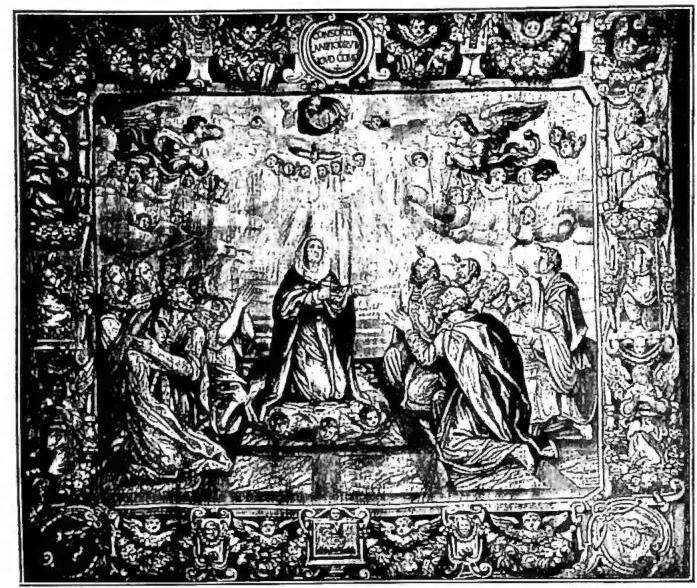
(phot. Alinari)
SPIRITO SANTO — The descent of the S. S. Tapestry of 1596 — Como, Cathedral.
St. Gregorio Nisseno, Ad Abladium quod non sint tres dii: PG 45, 133; Contra Eunomium, I, I: PG 45, 4, 16) and in St. Cirillo Alessandrino (De adoratione in Spiritu et veritate, I: PG 68, 148). Alongside this formula, another appears in the fourth century: « From the Father and the Son », which occurs in St. Gregorio Nisseno (De oratione dominica: PG 46, 1109, according to the more ancient codices; cf. J. Beccos, Orat. Synodalis, 3-5: PG 141, 289), in St. Epifanio (Ancoratus, 9: PG 43, 31), and in St. Cirillo himself, who considers it identical with the other, more classical formula: « Per Filium »: « Si quidem est Dei et Patris et Filii, ille qui substantialiter ex utroque, nimirum ex Patre per Filium profluens Spiritus » (loc. cit.: PG 68, 148; cf. De recta fide ad reginas: PG 76, 1408). While the Greeks retained the « Per Filium », St. Agostino caused the « Ex Patre et Filio » to triumph in the Latin West; he had used it in his writings (Tract. in Io. 99, 6, 8: PL 35, 1888-89; Contra Maximinum, II, 14: PL 42, 770; De Trinitate, XV, 26-27: PL 42, 1095-96, etc.).
The Symbol of pseudo-Atanasio, composed in the West in the fifth century, summarizes the entire doctrine by then established by the Fathers: « Alia est enim persona Patris, alia Filii, alia et Spiritus Sancti; sed Patris et Filii et Spiritus Sancti una est divinitas, aequalia gloria, coaeterna maiestas... Pater a nullo est factus, nec creatus, nec genitus; Filius a Patre solo est, non factus nec creatus, sed genitus. Spiritus Sanctus a Patre et Filio, non factus nec creatus nec genitus, sed procedens » (Denz-U, 39).
III. CONTROVERSIES WITH THE BYZANTINES
The first conflict concerning the procession of the H. S. arose between the faction of Theodore of Mopsuestia and that of St. Cyril of Alexandria. This was in fact what occurred in the dispute between the latter and Theodoret of Cyrus (Cyril of Alexandria, Apologeticum contra Theodoretum: PG 76, 422), who defended the formula: « From the Father alone », a formula soon relegated exclusively to the Nestorians, until it was revived by Photius in the Byzantine Church. The controversy between Latins and Byzantines in the ninth century became more troublesome. The two expressions: « from the Son », « through the Son », according to St. Cyril and according to his adversary Theodoret, are in reality equivalent; but usage began to differentiate them. In the Pseudo-Athanasian Creed, specifically Latin nuances may be observed when, in designating the two Persons who are the principle of the H. S., the same preposition is used: a, whereas the Byzantines increasingly employed the preposition ἐξ for the Father and διὰ for the Son.Moreover, it uses for both Persons the verb: « to proceed », corresponding to the Greek ἐκπορεύεσθαι, which the Byzantines, with the exception of St. John Damascene, employ only when speaking of the procession from the Father. This explains the amazement aroused in Constantinople by the Greek version of St. Martin’s letter, in which they found the phrase: ἐκ τοῦ Πατρὸς καὶ τοῦ Υἱοῦ ἐκπορεύεται (Epist. ad Marinum: PG 91, 136), and why later the future Pope Zacharias, in translating into Greek the dialogues of St. Gregory the Great, where the author has: « Spiritus a Patre semper procedat et a Filio » (Dialog., II, 38: PL 66, 204), wrote: ἐκ τοῦ Πατρὸς προέρχεται καὶ ἐν τῷ Υἱῷ, θνημέναι (cf. PG 102, 369). This is not a purely verbal question. In order to preserve the Father’s property even in the active spiration which he shares with the Son, the Byzantines increasingly became accustomed, distancing themselves from the Alexandrian Fathers, to reserve the notion of cause = αἰτία to the Father alone, without determining the reason for the procession of the H. S. from the Son, whom Leontius of Byzantium called διαπορθμιστὴν, that is, « transveher » of the H. S. (Adversus Nestorianos, II, 20: PG 86, 1485). In any case, Leontius has many texts in favor of the doctrine of the procession of the H. S. as a whole, collected by M. Jugie (v. processione, cited in the bibliography, pp. 173–75). On the other hand,
the Latins very soon began in practice to forget St. Augustine’s declaration: « Ex Patre principaliter » (De Trinitate, XV: PL 42, 1081), and became rigidly attached to: « Ex Patre Filioque », to the point of regarding any other formula as false, including the Greek: « Ex Patre per Filium », against which the Libri carolini launched their attack ([v.] PL 98, 117 ff.).
Photius, during his rebellion against Rome, widened the rift. In his encyclical of 867 and later in the Mystagogia, he attacked the Latin formula according to the understanding of the Carolingians, not in order to avenge the « Per Filium », which his uncle, the patriarch St. Tarasius, had inserted into his profession of faith at the Second Council of Nicaea—indeed, Photius does not even mention it—but in order to defend the formula: « from the Father alone », thus carrying at a single stroke to its ultimate consequences the false opinion that, as has been seen, had begun to emerge among the Greeks.
In the Greek-Latin controversy over the procession of the H. S., which has continued down to the present day, innumerable writers have taken part (cf. Jugie, Theol. dogm. cited in the bibliography); it is sufficient to mention the various forms assumed by the controversy through the centuries. Photius gave it a dialectical character: he multiplied endlessly the arguments of reason, summarized in the syllogisms of his disciple Nicetas of Byzantium, in order to highlight the absurd logical consequences of the Latin formula, namely, the duality of principle and of spiration and the confusion of the divine Persons; instead, he completely neglected the texts of the Holy Fathers. When, at the end of the eleventh century, under Alexius I Comnenus, positive and patristic theology triumphed in Byzantium, the Fathers assumed the primary place in the discussion with the Latins, not without advantage. Indeed, the authors paid close attention to the formula: « from the Father through the Son », which cannot be interpreted exclusively as referring to the temporal mission, but also refers to the eternal procession of the H. S., especially in the classic text of the Damascene: « The Spirit who proceeds from the Father through the Son » (De Fide orthodoxa, I, 12 bis: PG 94, 849). Some, such as Nicetas Blemmidas and John Beccus, recognized the Catholic doctrine in these words; others were compelled to concede to the Son a certain role in the active spiration, while still excluding the Catholic dogma. Such was the position of the patriarchs of Constantinople George of Cyprus in the thirteenth century and Gennadius II (George Scholarios) in the fifteenth century; of Adam Zoirnikavio in the eighteenth century; and, in the second half of the nineteenth century, of Janišev, Bolotov, and the other proponents of the Conferences of Bonn (1874–75). Finally, today the controversy, without altogether abandoning dialectical and patristic arguments, adheres preferably to Sacred Scripture, which was undoubtedly the principal theme of the interconfessional discussions held at Le Saulchoir in January 1950 concerning the Filioque (Le « Filioque », in Russie et chrétienté, 4th series, 2 [1950], pp. 123–244).
At the same time, and proceeding step by step but in the opposite direction, the Latin response developed. At first our authors entrenched themselves behind biblical and patristic arguments, where victory was certain and easy, without venturing too far into the adversary’s field of dialectics. Such was the method employed by the monk of Corbie, Ratramnus (v.), in his reply to Photius, and afterward by our controversialists, until St. Anselm constructed the Latin system of the procession of the H. S., which was rapidly brought to completion by the scholastics of the thirteenth century. Just as at the Council of Bari Anselmian dialectics achieved triumph in Magna Graecia, so too at Constantinople during the thirteenth and fourteenth centuries the arguments of St. Thomas Aquinas engaged the subtle minds of the Byzantines (v. M. Candal, Nilus Cabasilas et theologia s. Thomae de processione Spiritus Sancti [Studi e testi, n. 116], Vatican City 1945). The doctrine of Aquinas, dispersed throughout his works and carefully compiled in his opusculum Contra errores Graecorum, opened the way to the solemn definitions of 1274 at Lyons and of 1439 at Florence (Denz-U, 460, 691) concerning the procession of the H. S. from the Father and the Son as from one principle and by virtue of one spiration, with the addition of the substantial identity between the Greek formula: per Filium and the Latin formula: ex Patre Filioque.
IV. THEOLOGICAL SPECULATION
Beginning with s. Anselmo, the so-called “Latin concept” arose in the West, around which an entire system developed concerning the august mystery of the Most Holy Trinity, no less solid than it was complex. The theological speculation on the Holy Spirit fits within it (v. TRINITÀ, S.MA).Among the problems that our authors pose concerning the Holy Spirit, the central and most important concerns a more profound explanation of the nature of the procession. The Greek Fathers spoke at length about the generation of the Word, but stopped before the procession of the Holy Spirit, contenting themselves with saying that it is ineffable (s. Basilio, Liber de Spiritu Sancto, 18, 46: PG 32, 151). St. Augustine himself limited himself to a few timid references at the end of his great Trinitarian treatise (De Trinitate, XV, 17, 19: PL 42, 1080, 1086). The Scholastics, on the other hand, dwelt on explaining the procession by way of will and love, and the intimate constitution of the single principle quad et quo of the Holy Spirit, raising and resolving a multitude of secondary questions (cf. J. Slypi, De principio spirationis in S.ma Trinitate, Leopoli 1926), which abound in the books of the older theologians. Modern scholars are particularly concerned with the relations of the Holy Spirit with the faithful, examining the very nature of the indwelling of the Holy Spirit in the souls of the faithful, which Pius XII rightly calls an “inscrutable mystery” (encyclical Mystici Corporis: AAS, 35 [1943], p. 231), and the intimate relations between the Holy Spirit and the Church, which the Holy Spirit sanctifies, in which he dwells as a divine guest, and of which he is, indeed, the soul (cf. S. Tromp, De Spiritu Sancto anima Corporis Mystici, Roma 1932; Ch. Journet, L'Eglise du Verbe incarné, II, Parigi 1950, pp. 472-574).
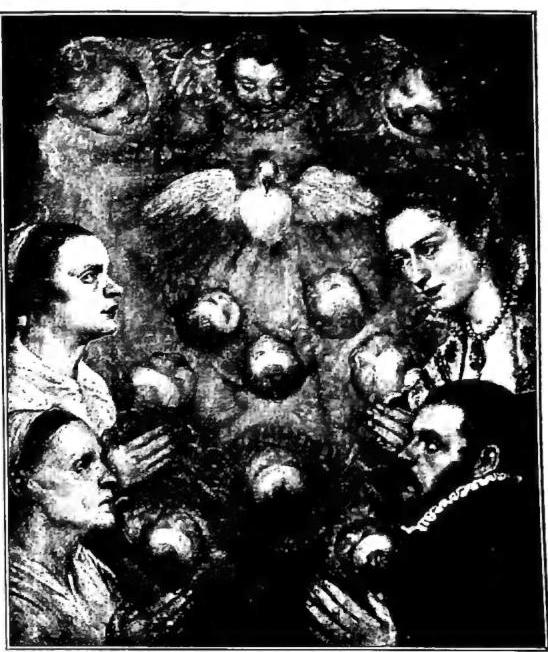
(fot. Anderson)
SPIRITO SANTO - Adoration of the Holy Spirit, attributed to Domenico Tintoretto (1560–1633) - Roma, Galleria Colonna.
Jugie, De Processione Spiritus S. ex fontibus Revelat. et sec. Orient. dissidentes, in Lateranum, new series, 2 (1946, nos. 3–4); P. Galtier, Le S. Esprit en nous d'après les Pères grecs, Roma 1946; id., L'habitation en nous des Trois Personnes, there 1950; A. Segovia, Equivalencia de fórmulas en las sistematizaciones trinitarias griega y latina, in Estud. eclesiast., 21 (1947), pp. 435–78; I. Trütsch, SS. Trinitatis inhabitatio apud theol. recentiores, Trento 1949. See the entries: CORPO MISTICO; DONI DELLO SPIRITO SANTO; FILIOQUE; FOZIO; GIOVANNI DAMASCENO; INABITAZIONE DI DIO NELL'LOOMO; PROCESSIONE. Maurizio Gordillo
V. ICONOGRAFIA
The iconographic representations of the Holy Spirit developed first within the complex subject of the Holy Trinity, and subsequently in those of the Baptism, the Annunciation, and Pentecost.From as early as the tenth century, the Holy Trinity was sometimes represented in the human forms of three identical male persons. This practice continued until the sixteenth century. An example is a Coronation of the Virgin, painted by Hans Holbein the Elder (fifteenth century), in the Museum of Augsburg. Representations of the Holy Spirit in human bodily form are not, however, regular, and were definitively forbidden by the Church in the constitution of Benedict XIV of 1 October 1745. Those recognized as regular are the symbolic representations in which the Holy Spirit is depicted by the symbol of the dove. It should be recalled that, alongside representations of the Holy Trinity in the form of three identical persons, there were others based on a different iconographic conception, namely those in which only the Eternal Father and Christ have human bodily forms, while the Holy Spirit is represented by the symbol of the dove. Thus Raphael depicted the Holy Trinity in a fresco in S. Severo at Perugia (1504) and in the Disputa del S.mo Sacramento. The representation of the Holy Spirit in the second of the Vatican Stanze (1509), in the form of a dove, derives from the iconography of the Baptism of Christ, because the Gospel (Io. 1:32) specifies the participation of the Holy Spirit in that scene in the form of a dove descending from Heaven and hovering over Jesus’ head. This was so from the origins of Christian art (fresco in the cemetery of S. Callistus: V. ill. vol. II, col. 1010). Likewise, by analogy, the presence of the Holy Spirit in representations of the Annunciation was indicated by the symbolic form of the dove, from the time when, in the late Middle Ages, this divine presence began to be indicated in iconographic illustrations of the sacred Mystery. The representation of the Holy Spirit in this symbolic form must likewise be regarded as the only admissible one for images of the Adoration of the Holy Spirit. A painting attributed to Domenico Tintoretto, in the Gallery in Rome, provides an excellent image of such adoration. The Holy Spirit is represented not in the form of a dove but in that of tongues of fire only when the scene of its descent at Pentecost upon the Virgin and the Apostles is being illustrated. This practice was already established in medieval art; it can be seen, for example, in a miniature of the Carolingian Bible of S. Paolo, and was maintained by the art of the Renaissance and the Baroque period.
It should nevertheless be noted that the symbolic form of the dove of the Holy Spirit is also found in some representations of Pentecost, for example in a miniature of the Syrian Gospel Book of the monk Rabbùlà (Florence, Bibl. Laurenziana) from the year 586.