Machine translation of the 1948–1954 Italian original. The original text is authoritative.
CAROLINE. – An archipelago of numerous, mostly coral islands, arranged in parallel chains between the Philippines and the Marshall Islands over 30° of longitude (133–163 E. Greenw.) and 10° of latitude (north of the Equator); largely uninhabited, they cover a total area of 636 sq km. Only the larger islands (Ponape, Truk, Kusaie), generally volcanic and higher, are well populated. The population (39,000 inhabitants, one-fifth of them Japanese) consists of mixed-race peoples (Malayo-Polynesians), engaged in agriculture and commerce. The C., formerly German, were entrusted to the Japanese in 1920 as a Class C mandate; but after their defeat in the Second World War they were transferred to the trusteeship administration of the United States (April 1947).
BIBL.: F. W. Christian, The Caroline Islands, London 1899; O. Lütje, Beiträge zu einer Landeskunde des Karolinen Archipel, Leipzig 1906; W. B. Harris, The South Sea Islands under Japanese Mandate (Foreign Affairs), New York 1932, pp. 691–97; P. H. Clyde, Japan's Pacific Mandate, ibid. 1935; A. Krämer-H. Damm, Zentralkarolinen, Hamburg 1937; T. Yanaihara, Pacific Islands under Japanese Mandate, New York 1940.
Giuseppe Caraci
MEDIATION OF THE HOLY SEE. — The occupation of the Caroline Islands carried out by Germany on 25 August 1885 led to considerable diplomatic tension between Madrid and Berlin. Although Spain had never formally declared its sovereignty over the Carolines, the fact nevertheless remained that the archipelago had been discovered by Spaniards and that the various attempts at evangelization had likewise been undertaken by missionaries of that
(phot. Ambrosiana Library)
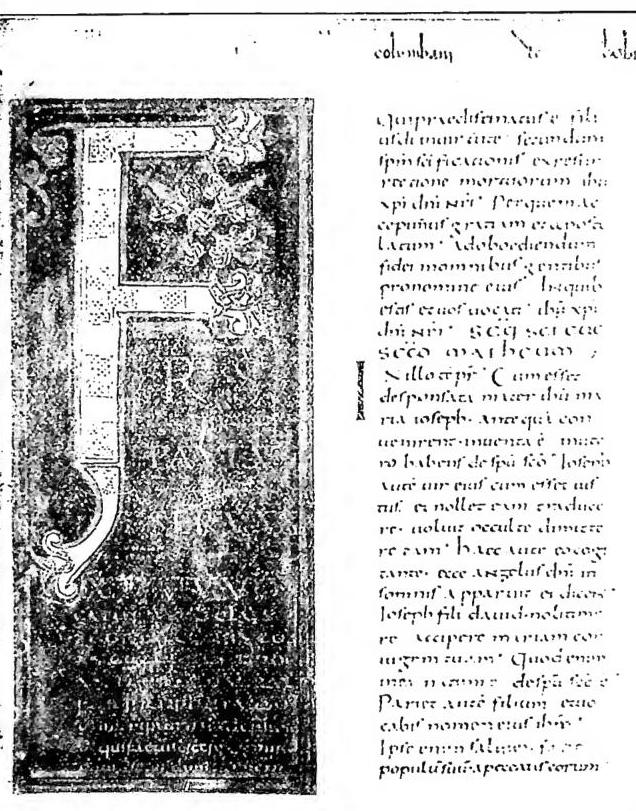
CAROLINA, SCRIPT — Epistolary and Evangeliary from Bobbio (late 9th–10th century), in c. Bobbio script — Milan, Ambrosiana Library, cod. Ambr. C. 228 inf., f. 4°.
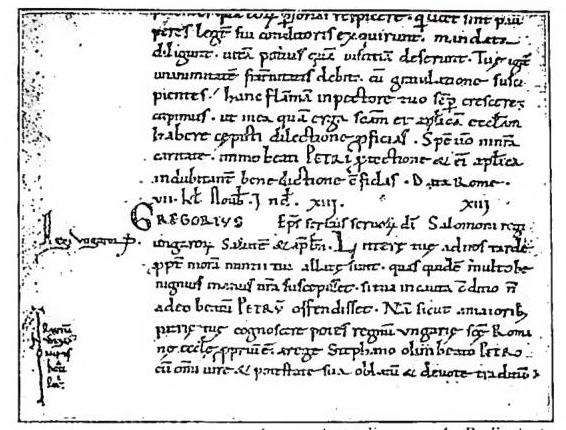
(courtesy of A. P. Frutaz) CAROLINA, SCRIPTURE - Carolingian script from the end of the 11th century. Register of Gregory VII, fol. 58 - Vatican Archivesnation, strengthened the Spanish government and public opinion in the conviction that they had proclaimed sovereignty over the islands, at least from a moral, if not a legal, point of view. Finally, Berlin and Madrid decided to resort to the mediation (not arbitration I) of Leo XIII. On 22 October 1885, Cardinal Jacobini, Secretary of State, submitted to the Pope the mediation project, which recognized, on the one hand, Spanish sovereignty over the islands, and, on the other, granted the Germans full freedom of commerce, navigation, and fishing, together with the right to establish a naval and coaling station on the islands themselves. Germany and Spain accepted these various points of the papal mediation, and the signing of a protocol in Rome on 17 December 1885 brought the dispute to an end.
BIBL.: M. V. Koschitzky, Deutsche Colonialgeschichte, II, Lipsia 1888, pp. 278-317; Fleischmann, Karolinentreit, in K. Strupp, Wörterbuch des Völkerrechts und der Diplomatie, I, Berlino-Lipsia 1924, pp. 621-23. Silvio Furlani
Cite this article
“CAROLINE.” Enciclopedia Cattolica, vol. III (1949), p. 540. Azione Romana digital edition, https://azioneromana.com/article/caroline.