
**CASTIGLIA. -
I. GEOGRAPHY
Historical region of Spain, corresponding, in official usage, to the present provinces of Santander, Burgos, Logroño, Soria, Segovia, Avila, Palencia (Old C.), Guadalajara, Madrid, Cuenca, Toledo and Ciudad Real (New C.), which together cover 122,334 sq. km., that is, approximately ½ of the whole of Spain. Such a designation nevertheless conflicts both with the properly historical one and with the geographical, or rather natural, one: while the latter include within it, wholly or in part, the provinces of Palencia, Valladolid and Albacete, they exclude the peripheral provinces of Logroño and Santander. The name C. recalls the castles (Latin castella) with which the Christian reconquista organized, beginning in the 9th century and proceeding from the territory lying between the Pisuerga, Alava and Rioja, the progressive elimination of Arab rule from the peninsula; these advanced outposts often formed the nucleus of the principal urban centers and impressed upon the region one of its most original characteristics.C., or rather the two C., separated by the so-called Sierre Carpetaniche (Gata, Gredos, Guadarrama), which extend from the Portuguese border to the Ebro basin, essentially coincide with a plateau (meseta) of considerable average altitude (650–800 m.), cut by the channels of the valleys that convey their waters to the Duero (Old C. to the N., 50,000 sq. km.), the Tagus, the Guadiana and the Júcar (New C. to the S., 72,325 sq. km.), and bounded along its perimeter by more or less substantial mountain barriers (with the exception of the western side), which isolate it from the beneficial influence of the sea. The plateau has a typically continental climate, with harsh, long winters, short, very hot summers, and precipitation that is generally insufficient and poorly distributed in relation to the needs of cultivation. The natural vocation of the land, predominantly covered by steppe or thin scrubland (macchia), is therefore pastoral-agricultural (but involving agriculture that is for the most part extensive), and this is in fact how it has remained for centuries, down to the present day. Nothing proves this more clearly than the low population density (39 inhabitants per sq. km. in Old C. and 46 in New C.; but this second figure would also remain below the first if the population of Madrid were not taken into account). The two C. today contain approximately 5,000,000 inhabitants, of whom two-thirds belong to Old C. and one-third to New C. Among the cities, Burgos (79,000 inhabitants) and Logroño (56) stand out,
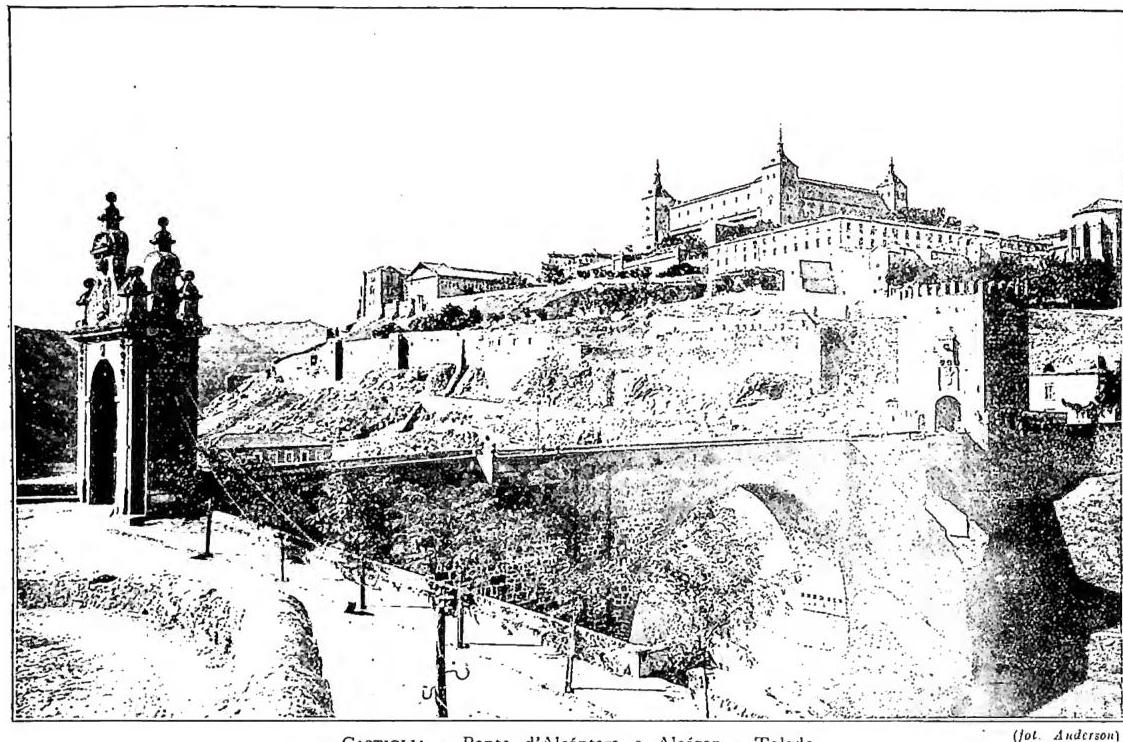
(photo Anderson)
The country’s economy rests on the raising of small livestock (sheep, and cattle only in certain mountainous districts of the peripheral sierras) and on cereal farming (grain, wine, and oil); the industries, mostly small-scale, are confined to a few urban centers and to production of merely local interest.
The population, ethnically highly homogeneous and clearly distinct from the other Spanish populations, also by virtue of its dialect, which has risen to the status of a national language, is almost entirely Catholic. The urban centers are often rich in religious monuments (cathedrals), among the most splendid and famous in the world.
Giuseppe Caraci
II. HISTORY
In the Roman period, C. did not constitute a region with its own designation; it formed part of the Visigothic kingdom and, after the Arab invasion, of the emirate of Cordova. The kingdom of Asturias, which was the first nucleus of the restoration of Christian Spain, established garrisons there, and from the great number of castles that already stood there in the 10th century, the region took the name of C. and entered history as a county. Incorporated into the kingdom of Navarre, it re-emerged in the second third of the 11th century as an independent kingdom and, with its rigid feudal organization, formed from the 9th century onward, was able to protect the faith and social activity of its farmers, merchants, and monks against the Islamic world. At the same time, it displayed great power of expansion and attraction over the other territories of the Iberian peninsula; indeed, it soon absorbed the kingdom of León, giving rise to the kingdom of C. and León. Exploiting its original geographical position and the progress achieved through the Reconquista, it ended by occupying the entire geo-political core of the two upper and lower plateaus; then, during the 12th century, C. further extended its borders southward, occupying the region that would be called New C. The successive stages of the struggle against Islam were in fact marked by the fall of Cadice (1133), Cordova (1236), and Siviglia (1247); then, in the same 13th century, King Ferdinando the Saint definitively united C. and León, occupied all Andalusia, and extended the name of C. to all the newly occupied territories. In this way, the two kingdoms of C. and Aragon constituted, in the late Middle Ages, the vital force of resurgent Spain, until their definitive union was gradually prepared through the marriage of Ferdinando of Aragon to Isabella of Castile. The union remained purely personal during their lifetimes and was completed with the absorption of Navarre and the conquest of the Muslim kingdom of Granata (1492); but it became complete when their grandson Carlo (I in Spain and V in Germany) united in his hands the two kingdoms and the overseas lands that properly depended on C.During the Austrian and Bourbon dynasties established in Spain, C., although it no longer possessed an autonomous political personality because it had been incorporated into Spain, remained at the center of Spanish politics; the council of C. was the body that organized and directed the entire Spanish dominion. Castilian was the national literary language of Spain, the language of Cervantes and Calderón de la Barca, of s. Giovanni della Croce and s. Teresa, of the great missionaries and great politicians of the 16th century; from that time onward, it became the official language of almost all Central and South America.