
SEGOVIA, DIOCESI of. — Diocese and city of Spain, suffragan of Valladolid, situated almost entirely in the civil province of the same name, except for a few parishes located in those of Burgos and Avila.
It has an area of 6,827 sq. km., with a population of 220,000, all Catholics, distributed among 290 parishes served by 310 diocesan priests and 45 religious priests; it has one seminary, 12 male and 35 female religious communities (Ann. Pont. 1952, p. 374).
Despite the importance of the Roman S., still attested today by the grandiose aqueduct dating from that period, it did not have an episcopal see separate from that of Palencia until the sixth century, and even then in a scarcely canonical manner and through the intervention of the Toledan primate Montanus, who established it provisionally. Nevertheless, the people of Segovia obtained the continuation of the succession of their own bishops until the time of the Saracen invasion, which brought calamities upon the faithful and the bishops, of whom few names are known. After the Christian reconquest, the city and the diocese were restored by King Alfonso I.
The Cathedral, consecrated in 1228 and subsequently destroyed in the second decade of the sixteenth century during the wars of the comuneros, was rebuilt in 1522 by Bishop Federico de Portugal in a decadent Gothic style, with a Latin-cross plan, three naves, and a transept. The architect was Juan Gil de Hontañón. A dome 67 m. high rises above the transept; the bell tower is likewise crowned by domes and reaches a height of 110 m. The adjoining Gothic cloister (1463–70) belongs to the ancient Cathedral and has recently been restored. The chapter house is adorned with Flemish tapestries; the diocesan Museum is rich in precious liturgical furnishings, manuscripts, and incunabula.
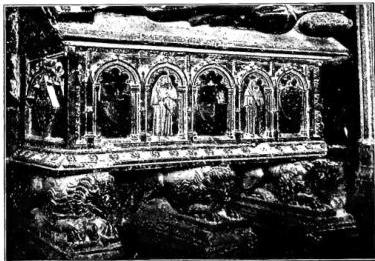
Near the bishop’s residence stands the church of S. Stefano, with a Romanesque bell tower from the thirteenth century, known as the queen of Spanish towers. Also Romanesque is the church of S. Juan de los Caballeros, containing the tombs of the distinguished citizens of S. from the sixteenth and seventeenth centuries. The Romanesque church of S. Lorenzo, restored in 1900, is noteworthy; it has three naves, three apses, and a bell tower with unusual capitals. The church attached to the convent of S. Croce was erected by S. Domenico in 1218. The church «de la Vera Cruz» was built in 1246 on the model of the Holy Sepulchre; it was restored in 1830; since 1949, the frescoes on the walls have been undergoing rediscovery; an Ultima cena from the thirteenth century has been brought to light again. The church of S. Millan dates from the end of the eleventh or the beginning of the following century. Among the monasteries, mention should be made of those of Parral, founded in 1447 for the Hieronymites by Henry IV, who in 1455 also founded that of S. Antonio el Real. In 1586 the convent of the Carmelites of S. Giovanni della Croce was founded; his tomb and the small sanctuary called the «Fuencisa» (seventeenth century) are located there. The titular of the diocese is the Assumption. The ancient cloisters and the exceedingly rich Archive are worthy of mention. — Vedi tav. XVI.
Giuseppe M. Pou y Marti
#### SEGRETARI DELLE SACRE CONGREGAZIONI: V. CONGREGAZIONI ROMANE, SACRE, SACRE.
SECRETARIAT OF BRIEFS TO PRINCES. – This is the first Latin Secretariat of the Roman Curia. Its name derives from one of the tasks entrusted to it: namely, that of drafting in Latin the letters to sovereigns and heads of state, which the Supreme Pontiff himself signs in his own hand (litterae in forma brevi ad Principes).
In addition to these documents, other no less solemn ones are entrusted to this Secretariat for drafting in accordance with can. 264 of the CIC, namely, encyclicals, consistorial allocutions, homilies for the canonizations of saints, and also certain apostolic constitutions, motu proprios, and pontifical letters of greater importance. This office therefore serves the Sovereign Pontiff directly in the exercise of his universal magisterium, inasmuch as, under his high direction and according to precise orders received from time to time, it contributes to the Latin composition of the most important documents.
The head of the office is the Secretary of Briefs to Princes, who, in this capacity, forms part of the noble papal antechamber. Moreover, in public consistories at which the causes of the saints are dealt with, he replies in Latin on behalf of the Holy Father to the consistorial advocates who have pleaded these causes; during the sacred rite of canonization, speaking always in the same language, he announces to those present the solemn proclamation of the new saints, which the Pontiff is about to make; should a Catholic sovereign die, he reads the funeral eulogy of the deceased in the solemn Papal Chapel customarily held on this occasion; and, in the event of a vacant See, before the conclave begins, he delivers before the Sacred College, assembled in the Sistine Chapel, the oratio de eligendo Summo Pontefice.
The historical origin of this office is traced to the Apostolic Secretariat, which was charged with drafting all the correspondence of the Roman Curia in the Latin language; it was subsequently regulated by the constitution of Innocent VIII of 31 December 1487 and comprised 24 apostolic secretaries. It later became a separate and completely autonomous secretariat through the bull Romanus Pontifex of 1 April 1678, when the College of Apostolic Secretaries was suppressed.
In its long history, the Secretariat of Briefs to Princes has included Latinists of great distinction, such as, among the older ones, Bembo, and among the more recent, Nocella, Volpini, Angelini, and Galli.