
GOTHIC, ART. - The designation "Gothic," originally applied more properly to ogival architecture but later extended to all the arts of that period, dates back to the mature Italian Renaissance (Vasari) and, in its historical inaccuracy, implies a judgment: the negative judgment of classical, Renaissance, and Mediterranean taste—including French taste in the 16th–18th centuries—compared to the medieval and Northern creations most prominently expressed in architecture. Though inexact, the term remains in common use; the judgment reverses with the rise of Romantic taste.
This art is truly the final manifestation of medieval civilization, which in it achieved a perfect expressive equilibrium.
This explains two characteristic traits that appear fundamental to the physiognomy of the Gothic.
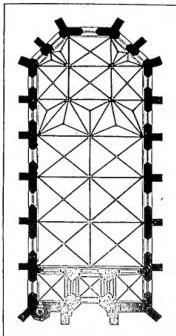
(courtesy of Fr. G. Löw)
GOTHIC ART – Floor plan of the church of
Pöllaberg (eastern Styria), built
around 1350. A typical two-aisled
church, with a choir (apse) supported by four pillars,
of the same width as the aisles.
reject this etymology), the ribbed cross-vault, which
reinforces the vaults to increase their load-bearing capacity.
It is not yet clear whether this element, which is
the key to the entire system, appears early in Italy in
the oldest parts of S. Ambrogio in Milan or in S. Flaviano in Montefiascone;
but it is certain that here such a structural idea remained
sterile, whereas in France it became a seed that sprouted and
developed with marvelous vigor, precisely in the heart of the Île-de-France,
which, after the tribulations of the 10th century, was entering a new period
of ordered prosperity: it was the time when political power, wisely administering the country,
and religious authority, organized in solid hierarchies around the bishops,
equally promoted the great enterprises of culture, with the establishment of the
Universitas Studiorum, and of the arts, with the construction
of magnificent cathedrals, increasingly dedicated to the Virgin,
whose devotion grew ever stronger between the 12th and 13th centuries. It was also the time
of the composition of the great epic songs of the Carolingian cycle and the fixation of a literary language. And it was the time of the Crusades, which brought broad
contacts, not only of conflict, with the East, and thus a new richness and variety of cultural experiences.
In this most felicitous conjunction, the technical motif of the reinforcing rib
reached extraordinary possibilities of development.
Already widely used within the old Romanesque schemes
(e.g., by Guglielmo di Sens in the Cathedral of his city, in the second quarter of the 12th century),
it was destined to radically transform imagination and technique, to formulate a new poetics
of architecture, and even to determine a new spatial conception.
But the ogival arch does not yet strictly mean the pointed arch, although in common usage the terms ogival,
acute, and Gothic have come to be equated and confused.
The pointed arch or "third-pointed" arch (resulting from the intersection of two round arches), not unknown to Eastern architecture, had already found abundant use, more for decorative variety than structural necessity, in
Burgundian Romanesque architecture (Cluny, Autun, Paray-le-Monial, etc.); but only when this pointed profile
is applied to the rib, to the ogive, is its full tectonic value understood in its capacity to bear a much greater
load, the smaller its lateral thrust. Hence a series of ingenious solutions to the problem of increasingly
neutralizing this dangerous lateral thrust by verticalizing it: the arcs boutants, replacing Romanesque buttresses;
the robust keystones of the vaults; the pinnacles and spires designed to overload the piers,
increasing their vertical thrust to absorb the lateral one. This facilitates the task of covering the entire building
with stone material, reducing the true construction to the skeleton: the architectural value is decisively
shifted from walls to ribs, from surfaces to volumes.
On these principles, the activity of the builders intertwines poetic intuitions with technical conquests and elaborates
a marvelous organic system for resistance and elasticity in a play of balances, also favored by the quality of
the stone material from the various French quarries.
The technical possibilities offered by the pointed arch, now closely linked to the ogive, stimulate architects to
a competition in height: the mirage that attracts them is one of the fascinations of this architecture. The soaring upward,
the intoxication of the vertical, which in the vulgaris opinio would be the typical expression of medieval mysticism.
An opinion to be received with many reservations. For, if anything, in these new stylistic attitudes one might discern
the expression of the new tastes and aspirations of collective life; a more agile rhythm, a freer breath, a more serene tone;
especially if one considers one of the most pressing demands and one of the surest results of this new style: the luminosity of the
spaces. In any case, what is usually designated as the expression of the sense of the infinite would be better defined as the representation of the indefinite.
Indeed, once the perimeter masonry is emptied of its original
architectural value, of its meaning as a surface, and the entire tectonic function is transferred to the essential framework
of the building's members, the solid walls can be pierced by windows, swallowed by voids,
until they disappear entirely, as in the Sainte-Chapelle in Paris, which is merely an enormous and marvelous casket of transparent glass.
In contrast, however much reduced to their pure necessity,
piers and ribs increasingly assume evident importance in the economy of the buildings and acquire, with their functional predominance,
an autonomous existence and an ever more distinct and corporeal individuality. The building
thus resolves into a modulation of masses alternately full and empty, and architectural imagination
concretizes in the effects of the atmospheric medium, variously illuminated and colored in relation to the stone consistency
of the supporting volumes around which it flows.
The environmental unity of the construction is thus
broken by a multiplicity of plastic accidents. The
body of the great cathedrals becomes a succession
of stems, which, at the top, open into stellar branches
intersecting in a dense network, constituting an open and indefinite rhythm that absorbs in a single
flow the naves, transepts, choir, apse ambulatory, and
annuls all spatial distinction. A continuous rhythm,
whose development concludes with perfect coherence in the
circularity of the choir with ambulatory. This is a motif that, like many others, Gothic art takes from
the Romanesque-monastic architecture of the north, particularly Cluniac, developing it according to its own principles,
in the circuit of the ambulatory and the wheel of radiating chapels around the sanctuary.
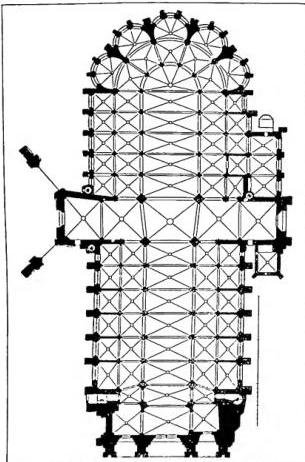
(from R. De Lasteyrie, L'Architecture religieuse en France à l'époque gothique, Paris 1906, p. 163, fig. 116)
GOTICA, ARTE – Floor plans of the Cathedral of Tours (late 13th–14th century).
independence no longer merely cladding the surface of the architectural structure but merging with it in an integral synthesis, and with its richness of movement contributes to the multiplication of chiaroscuro effects.
Above all, however, it is the decoration of stained-glass windows that effectively creates that life of atmospheric masses—the great art born precisely as the necessary corollary of architecture. Stained glass and miniature painting—which, as will be seen, are stylistically akin—are the true painting of the Gothic.
The figurative weave of the narratives is evidently but a pretext for a symphonic composition of color, doubly valid: by transparency, as a medium between the two different luminous potentials of interior and exterior, and by dilution, as the density of the interior penumbra becomes entirely imbued and colored by the light poured into it from outside.
The Gothic cathedral is the supreme and accomplished masterpiece dominating the panorama of French art, even from an urbanistic perspective. And it is almost moving to see how, from afar, in the profile of French cities and villages, the cathedral towers over the crowd of humble houses clustering around it, protecting them and, almost maternally, sheltering them. A sign of the times!
Such a rich and powerful synthesis of figurative languages surely reaches the heights of art as a full and perfect expression of a truly cosmic sentiment. And, in truth, the intimate motivation behind the fantasy of these artists is precisely one of the most solemn natural spectacles: that of the forest, understood not as a model but as a module. The forest in its character of boundless grandeur, dominating and yet liberating. An obvious comparison, moreover, already appearing in Romantic writers from Forster to Chateaubriand.
Born within the womb of the Romanesque, Gothic architecture, after an initial phase in which old schemes resist intermingled with the new, increasingly defines its fundamental characteristics in works where the new language is expressed in all its purity: Notre-Dame in Paris can be considered the example of achieved perfection in this type of construction. The Cathedral of Amiens has been called the "Parthenon" of the Gothic.
These constructions, in the second half of the 12th century and throughout the 13th, are founded and grow in large centers as well as in towns and villages. Colossal undertakings to which all social classes collaborate, sometimes over several generations, which therefore bear in their details the imprint of the evolving style, while almost always preserving a remarkable unity of ensemble, and take on the character of regional schools due to the influence of local taste traditions and the differing genius of architects (Île-de-France, Soissonnais, Champagne, Bourgogne, Normandy).
Beyond these borders of its birth and youth, Gothic architecture rapidly extends its dominion (a true violent conquest, according to Viollet-le-Duc, following the expansion of the Capetian monarchy) throughout France, and then, with ever greater differentiations, across all of Europe, and remains unchallenged until the end of the 14th century and much of the 15th, and especially in Germanic lands, well into the 16th, even into the so-called German Renaissance. And so innate does this language appear to German taste in particular and Northern taste in general that, after the nearly universal triumph of Italianate Mannerism in the second half of the 16th century, at the beginning of the 17th century one sees a sudden rekindling of it, latent in France in especially civil works of the Henri IV and Louis XIII styles, but explicitly declared in buildings in Germany, such as the Jesuit church in Cologne, built in the early years of the 17th century, in a Gothic that can be called "posthumous," in Würzburg, Dettelbach, Prague, and Fribourg in Switzerland. Nor is this all, for there is the case of the Baroque-Gothic of the Italo-Bohemian Giovanni Santini Aichel, who in Bohemia at the beginning of the 18th century translates the Baroque spirit into Gothic letter. To which case is not unrelated that of Borromini (of whom Baldinucci already noted the affinities with the "Gothic manner") and Guarini, who in 1679 designed a Gothicizing church façade for the Theatines of Prague. Not to mention the 19th-century Neo-Gothic revival, partly a spontaneous manifestation of Romantic inspiration, partly a cultural artifice.
The happy spontaneity of conception by which structure and decoration were born together and realized in a synthesis always balanced in essential values gradually gives way to an increasingly laborious pursuit of accessories, to a passion for superficial decorative values, which ends by weakening the vigor of structural invention, distorting the sense of material, and reducing architecture to embroidery or goldsmithing.
The poetics of these late Gothic—or "Flamboyant"—artisans thus culminates in the academic. Examples of this stage are, in France, the "Brou" of Bourg (1512–32); abroad, the cathedrals of Burgos or Milan. And the "Manueline" style in Portugal; the "Mudéjar" (with Islamic influences) in Spain; the "Tudor" in England with its characteristic "net vaults," perhaps the most felicitous outcome of this current.
The golden age of the Gothic lasts about a century and a half. From the early phase of Sens on the plans of William of Sens (author also of the choir of Canterbury Cathedral [begun ca. 1140]), Saint-Denis, by Abbot Suger (1140), the first design of Chartres (1145), Étampes (1150), Langres (1150), Senlis (1155), Saint-Germain-des-Prés (choir, 1157), Laon (1160), Corbeil (1180); to the phase of full bloom but still fresh and almost restrained with Notre-Dame in Paris at the initiative of Bishop Maurice de Sully (completion of the choir, 1250), Soissons (south transept, 1177), the reconstruction of Chartres after the fire of 1194; to the most exuberant flourishing of the Cathedral of Troyes (1208), Reims (1211), on the design of Jean d'Orbais, perhaps the most harmoniously balanced masterpiece despite the extraordinary richness and complexity of its motifs, Auxerre (1215), Amiens (1220), on the plans of Robert de Luzarches, Strasbourg, on an 11th-century crypt, full 13th century; up to the final models: the Sainte-Chapelle, built by St. Louis between 1246 and 1248, and Saint-Urbain in Troyes, the work of Jean Langlois (1262).
In still unripe forms work the sculptors of the single-arched portal of Senlis.
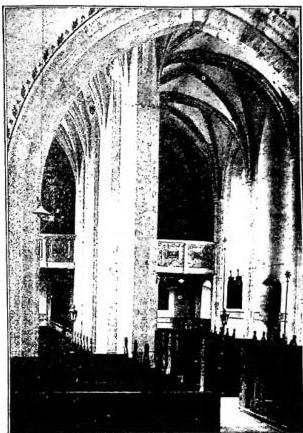
(photo: W. Pjols) GOTHIC, ART - Parish church of Kammern. Gothic reconstruction after the Turkish invasion of 1493. Two aisles, four pillars.
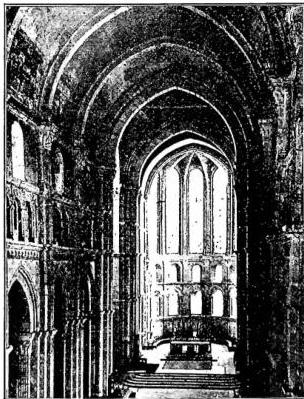
(courtesy of Mons. A. P. Frutuc) The Gothic nave and high altar of the Cathedral of Autun, viewed from the galleries (12th century).
Criticism, especially French, identifies the distinctive mark of Gothic renewal in sculpture as a sense of tranquility, in full contrast with the so-called "stile spirituel" of the Romanesque period of the nearby Burgundian school (Autun, Vézelay, etc.).
A sense of calm and decorum, exemplified by the "Visitazione" of Reims, the supreme ideal beauty of the "Beau Dieu" of Amiens, or the purity of certain nude figures, truly Praxitelean, in the "Storie della Creazione" at the Sainte-Chapelle. This stylistic attitude is the adequate artistic expression of an entirely new economic, social, and political situation, with new tastes and aspirations, which also finds a concrete and precise classical motivation on the cultural plane through the direct knowledge of examples of ancient art.
The classical example is clearly the living ferment in Provençal sculptures (St-Gilles, Arles). And it is certain that a tenacious vein of classicism—albeit with accents of a Celtic dialect—nourishes the inspiration of the nearby Auvergnat sculptors, in many ways akin to the Lombards. In any case, monuments of ancient plastic art were not lacking in the Île-de-France itself, and they abounded, in addition to the south, in the nearby regions of the Middle Rhine, the Meuse, and the Moselle. This is proven, if nothing else, by the "Visitazione" of Reims. But above all, it is admissible that the renewed contact with the East and with the refined Byzantine culture of the Macedonian period, linked to classical sources by a tradition that not even iconoclasm had been able to entirely sever, offered artists examples of a beauty so different from that mostly pursued in the Western Middle Ages (cf. the "Beau Dieu" of Amiens with the Christ in the "Trittico di Harbaville"). This new style tends to become more complex on the one hand through an increasingly detailed—and thus, ultimately, more superficial—observation of natural reality, and on the other through an ever-greater richness of pathetic content. The growing search for characteristic determinations culminates in a revived interest in portraiture, so that from the still entirely generic depictions of the oldest royal, princely, or episcopal tombs with recumbent statues (e.g., those of the abbey of Fontevrault and those dedicated by St. Louis at Saint-Denis) one moves to the stupendous characterizations of the great unknown master of Naumburg. From the lively portraits sculpted by Peter Parler, architect of Prague Cathedral, to the multiple statues of Charles V (especially that by André Beauneveu [1364] in the more recent series at Saint-Denis); to the creations of Claus Sluter (Portal of the Charterhouse of Champmol and the "puits de Moyse" there, after 1389). Beauneveu, who was also a miniaturist, and Sluter, Dutch by birth and Franco-Flemish by culture, already participate in the tastes and stylistic attitudes of the so-called "gotico internazionale." Before which, it is fitting to mention "gotico cistercense."
A reaction to the splendor of Cluniac architecture (Cluny was, until the renovation of St. Peter’s in Rome, the largest church in Christendom), which was not merely an ostentation of luxury and pomp but an organic complexity and refinement of culture, Cistercian Gothic realizes this demand for essentiality with fuller adherence to the proper modes of architectural language, that is, in function of a true spatial configuration, of the delimitation of environments, and without that shift of stylistic tones toward the plastic sector, which has been noted in the other current of Gothic, that of the cathedrals. The accent of this peculiar Cistercian voice of Gothic thus returns to the values of line and surface, in the rigid hardness of sharp profiles, in the fairly broad expanse of walls, in the quadrangular plan of the chapels and the chevet, in place of the broken and jagged layout of polygonal apses and radiating chapels.
The result is a clear design that absorbs, within the new structural functionality of Gothic, remote Paleochristian basilical motifs.
It is therefore obvious that such a spatial conception, on the one hand, proves suitable for the new directions of monasticism, and on the other, becomes particularly fruitful in Italian territory. Here, works of pure Gothic are very rare and always lag behind the French originals; from San Andrea in Vercelli, with relatively primitive and simple forms, a rather provincial version of the "vittorino" type (a French variety not too distant from the Cistercian), to San Francesco in Bologna—one of the few examples of a plan with an ambulatory and radiating apsidal chapels—to San Petronio, also in Bologna, to Milan Cathedral: the latter a hearth, but isolated and almost without consequences, of late Gothic due to the presence of Northern craftsmen and exchanges with the great transalpine workshops such as Strasbourg and Cologne.
Far greater fortune, however, was found in Italy by Cistercian architecture, not only in the offshoots from the mother abbey of Cîteaux—Fossanova, Casamari, San Galgano, Santa Maria d’Arbona, etc.—but above all for the developments given to it by the Franciscans and Dominicans in the numerous buildings they constructed in almost every Italian city.
Assisi (v.), begun immediately after the death of St. Francis, bears the imprint of an improvisational, non-professional genius, perhaps that of Brother Elias himself, who felicitously blends disparate elements: motifs of local tradition, echoes of Eastern visions, suggestions of French Gothic, in the bold and intensely spiritual conception of two different spatial rhythms whose contrast expresses a sense of ascension, of liberation.
This design, after the fall of Brother Elias, finds completion in its upper part, more decisively Gothic, through the work of a brilliant architect, almost certainly Filippo di Campello, who later partially repeats its forms in Santa Chiara. And it is truly remarkable the affinity with the nearly contemporary Sainte-Chapelle, not only in the fundamental idea of the two superimposed spaces but also and above all in the proportions of the upper nave and in the modality of the decoration of the originally polychrome members. But in Assisi, always in accordance with Italian taste, the environment is defined much more clearly and "prospetticamente," in its cruciform shape with broad transepts, due to the greater concrete solidity of the walls, only partially opened to historiated windows of perhaps French origin, and instead, for large stretches, decorated, according to the Italian Romanesque tradition, by the famous frescoes.
Another curious synthesis of Romanesque motifs (the gabled façade), Veneto-Byzantine (the domes), Gothic (the ambulatory and radiating chapels), and even Islamic (minarets) is the Basilica of Sant’Antonio in Padua,
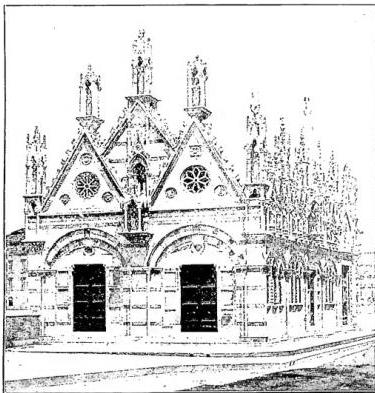
In general, however, Franciscan and Dominican churches tend to model themselves rather on the Cistercian type, with a triple (and sometimes single) nave without a triforium, occasionally replaced by a balcony; a transept onto which chapels are aligned, often quite numerous on the eastern side, and sometimes opening also, opposite these, on the western side and elevated on the northern and southern ends. The vaulting is reserved, in praise of the Lord, for the main chapel, sometimes for the minor chapels and the side aisles. But the central nave, precisely due to an expressed intention of humility, is almost invariably covered, following the basilican tradition, with timber trusses, which are nonetheless left exposed without a coffered ceiling. A typical example is the Franciscan S. Croce in Florence, with its Dominican twin S. Maria Novella, only slightly richer.
With the renunciation of stone vaulting for the vast spaces of the main nave, the very foundation of the entire Gothic system is essentially lost, and with it that impetus toward plasticity which had been noted in II. Thus, even more so than in the Cistercian style, the parietal values of line and surface re-emerge to the forefront, restricting the adoption of Gothic innovations predominantly to the decorative sphere. This explains the entirely particular aspect in which Gothic art in Italy takes shape: a diminished predominance of vertical developments in relation to horizontal ones, the persistent prevalence of pictorial fresco decoration over sculptural decoration and that of stained glass, the use of which is quite rare; the extreme rarity of flying buttresses, pinnacles, and spires. This taste also corresponds to the façades, in which towers are absent, and above all, the motif of the portals is reduced to modest proportions—an element that in France shapes the front of cathedrals in a tumult of vigorous plastic and chiaroscuro effects, whereas in Italy, one sees a spreading out in surface through broad partitions that combine figurations at times of highly poetic planar geometry. Consider the stupendously harmonious and complex composition of the façade of Siena Cathedral, a design imitated by Maitani in Orvieto. In Florence Cathedral, Arnolfo di Cambio, while drawing from the Gothic heritage, returns to ancient sources of inspiration from Tuscan classicizing Romanesque or even early Christian art, while clearly foreshadowing the Renaissance.
In conclusion, therefore, Gothic art in Italian architecture, rather than an internal evolution of style as in France, can be considered a true rupture in tradition due to the adoption of forms from abroad: a crisis, albeit neither deep nor lasting, motivated by external causes.
A more intimate and convinced adherence to Gothic taste is found in northern Italy and in Siena. Certainly, the contribution of the Gothic language is perceptible in Sienese art; but above all, civil architecture elaborates its own type of construction for houses and palaces, which is a genuine and free interpretation of Cistercian principles and so thoroughly identifies with Sienese taste that it endures tenaciously—so much so that the expansion of the upper floors of the Palazzo Comunale in the seventeenth century is carried out with such fidelity to the traditional style as to achieve perfect homogeneity.
The Po Valley in Italy is naturally more exposed to northern and Gothic influence. Gothic preferences endure for a long time, intertwining in the fifteenth century with Renaissance currents of Tuscan origin. A typical example is the art and theory of Filarete, and the rather hybrid art of the Certosa di Pavia. Particular characteristics result from the extensive use of brick masonry and terracotta ornaments, especially in the lower plain; associated, in Lombardy, with decorations of sparse graffiti on plaster; elsewhere, particularly in the Treviso region, with frescoes depicting fake tapestries, or fake bricks in highly varied combinations, or fake colored and carved marbles—this last being an economical translation of Venice’s rich marble decoration. In Venice, where a fourteenth-century Gothic-Byzantine phase had emerged with the Dalle Masegne and the ivories of the Embriachi (a position analogous to...)
(photo: Garcia Carrabella)
GOTICA, ARTE - Detail of the loggia known as "degli Apostoli" on the façade of the Cathedral (14th century) - Burgos.
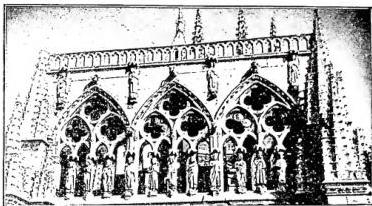
Regarding sculpture as an autonomous art, it can likewise be said that in Italy, the Gothic represented a sudden deviation. The stark stylistic contrast between the two great Pisan sculptors, father and son, suffices to demonstrate this. Nicola, with his highly personal sense of plasticity pushed to an almost barbaric intensity, and with a culture that drew extensively from classical and paleo-Christian formulas; Giovanni, with the fleeting variety of aspects and the warmth of emotions in a flowing plastic wave, congealed yet still seemingly alive within the firm hardness of the material. This plastic wave speaks a sculptural language that veers decidedly toward the pictorial, while offering a greater abundance and agility of expressive means to the heightened pathetic intensity of psychological content. This is precisely what has been observed in French sculpture at its mature phase, which corresponds precisely to the moment of its greatest contact with Italian art. In any case, the break between Nicola’s style and Giovanni’s is unmistakable, and it was due to the intervention of various young disciples—
and especially Giovanni—that the change recognizable in the pulpit of Siena occurred (cf. the Madonna in the trumeau of the north transept portal of Notre-Dame in Paris with the type of Madonnas by Giovanni).
Even Arnolfo, in his activity as a sculptor, appears to have known the great art of France (compare the Stories of the Virgin for the façade of Santa Maria del Fiore with the Nativity from the pulpit of Chartres), though with lingering archaizing accents.
Pisan sculpture, thanks to Giovanni’s authority and the industriousness of his closest followers, spread the Gothic fashion from one end of Italy to the other, propagating it in Northern Italy and enduring over time, particularly in the workshop of Milan Cathedral, where it eventually intersected with those currents of decorators active in Venice.
In the more properly Gothic territories, the vast extent and importance assumed by stained glass nearly extinguished mural painting, which it replaced. This latter is almost nonexistent; rare exceptions include some allegorical-political depictions in public palaces or the renewal of decorations in preserved earlier buildings. The few French examples, such as the Virgin and Apostles of Lavandieu (late 12th century), show a retardataire tendency with a predominant Byzantine influence akin to that of an Italian Margaritone or the Master of the Bigallo. Equally rare are panel paintings, found especially in Germanic lands (e.g., the famous Altarpiece of the Poor Clares in Cologne). The only work from which a concept of French Gothic painting can be formed is the relatively late Antependium of Narbonne, with its Stories of the Passion. Similarly, the few altarpieces aim to simulate the enamels they economically replace, and even the Verdun Altarpiece can essentially be considered a large-scale transposition of a series of miniatures. Enamels are another of the medieval artistic productions that, already flourishing earlier, continued into the Gothic period (Limoges); moreover, due to their affinity of material and effects, they once again recall stained glass, with their combination of flat, vitreous chromatic zones sealed by vigorous metallic contours. But even for the art of illumination, one must refer to the intimate norm of stained-glass art, which can therefore be considered the paradigm upon which, to a greater or lesser extent, all the various branches of Gothic pictorial language were modeled. A world perceived predominantly in its values of limit (surface, line) rather than volume: and consequently, a representation that, disregarding plastic means (chiaroscuro), is satisfied with flat fields and contour definitions; ultimately, an exaltation of the line as an expressive medium. Thus in stained glass, thus in enamels, and thus in illumination. Given this stylistic tendency in Gothic illumination, it will be observed that, once again, its origins developed almost imperceptibly from the modes of Romanesque pen illustration. But with a noticeable attenuation of plastic notations. This elementary technique continued particularly in England and Germany, developing—especially for non-figurative initials—motifs already used, for example, in the Cluniac scriptorium.
Yet in Paris, in the service of a thriving book industry centered around the University, particularly for the production of theological and legal texts, the art of illumination flourished with indescribable splendor, creating a type of decoration harmoniously rich and elegant that, though occasionally imitated, remained peculiar to the capital.
The contacts that Parisian illumination undoubtedly had with Bolognese illumination did not at all give rise to—
fruitful grafts, but at most rather hybrid amalgamations. Codices in litera Bononiensis may have been sent to Paris for illustration; French illuminators (as well as professors and students) were certainly present in Bologna. This explains how some Bolognese legal codices are decorated in the French style: some have French-style quires alternating with Bolognese-style quires; in others, the two decorations intermingle on the same page, but do not blend. There is only one small group of Bolognese codices in which French models are assimilated with great conviction and notable skill, albeit with a Petronian accent. And this is the only moment that can be considered one of effective influence of French illumination on Bolognese: a moment that, according to D’Ancona’s hypothesis, seems reasonable—also because of Dante’s allusion to "illuminating... in Paris"—to associate with the activity of Oderisi da Gubbio, in contrast to that of Franco Bolognese, who rather represented the new, vividly icastic tendencies at the beginning of the 14th century. Conversely, it is probable that precisely these new Bolognese modes were the determining stimuli for the art of the Maître aux boquetaux. In Siena, however, it seems that Parisian illumination offered stylistic motifs capable of autonomous developments. Indeed, even Sienese painting prefers the vibrating line and the superficiality of decorative color as expressive means. Duccio, upon his initial Byzantinizing culture, later benefited from Gothic experiences, particularly in the fluency of the contour line, as appears not only in the Maestà but also in the Madonna of the Franciscans (far more likely late than early), in which the checkered canopy is revealing, though used with a completely different figurative intention than the French backgrounds. It is probable that Giovanni Pisano’s art also contributed to Duccio’s Gothicism.
One of the most exquisite and original Gothic artists, indeed the greatest Gothic painter, is undoubtedly Simone Martini, whereas Giotto cannot be considered a Gothic artist but rather one who foreshadows the Renaissance.
A Gothic vein later permeates Florentine painting through Sienese examples, and through the refined and melancholic decadentism of Agnolo Gaddi, it flows at the end of the 14th and beginning of the 15th century into the exacerbated stylism of Lorenzo Monaco.
Simone Martini’s stay in Avignon during the final years of his life culminates in an intertwining of two kindred sculptures: those of French Gothic and Sienese Gothic. The former had reached extreme maturity after nearly two centuries of fertile creativity, while the latter derived from the former but with entirely original contributions and developments.
Thus, Gothic evolves into the so-called "International Gothic," a designation universally accepted. Upon the refined, now mannered, and ever abstractly decorative forms of the old Gothic, there is grafted the taste and demands of the new era of the imminent Renaissance. However, this naturalism of International Gothic has a character that distinguishes it from Renaissance naturalism and finds correspondences, on the one hand, with other tendencies in 14th-century Paduan painting (particularly that of Tomaso da Modena) and, on the other, coincides with the fundamental Northern (especially Flemish) taste—namely, an interest in nature as content rather than form: an analytical naturalism, therefore, indifferent to the problems of synthetic reconstruction.
This movement originates in Burgundy, a meeting point of Italian, Flemish, and Northern French currents, within the artistic climate fostered by the patronage of the Dukes of Burgundy (centered in Dijon) and of Berry (centered in Bourges). The art of Claus Sluter is but one aspect of this tendency in sculpture. For that same Charterhouse of Champmol, Melchior Broederlam painted (1392–99) the outer panels of the wooden altarpiece carved by Jacques de Baerze (1391) with Stories of the Infancy of Christ, one of the rarest early French panels and a cornerstone of this art. The masterpiece of this current is the Book of Hours of Jean de Berry, illuminated in the early years of the 15th century by the Limbourg brothers. This current, born at the end of the 14th century, does not last, in its most typical manifestations, much beyond 1420, yet within a generation it spreads throughout Europe and finds immediate resonance in Italy, especially in the Po Valley, due to its great affinity with Lombard, Emilian, Veronese, and even Marchigian and Tuscan tastes.
A particularly typical example of this style is the decoration of Torre Aquila in Trento, datable, according to Rasmo’s refinements, to 1407 or shortly before, which expands the traditional theme of the months with new breadth. A work of predominantly Lombard influence, it shows close relations with the art of tapestry (another flourishing artistic industry of the time, in Arras and Brussels) in its composition, where a bird’s-eye view is inserted into the mesh of a predominantly decorative framework—a sort of disarticulated and recomposed perspective, like cells, with figurative episodes scattered within the flat landscape fabric.
This composite taste tends to resolve into its components. In Italy, it rapidly turns toward the Renaissance in its first phase, effectively termed "umbral" by Longhi: one need only consider the transition from Masolino to Masaccio, from Sassetta to Domenico di Bartolo, the developments of Pisanello, and even Domenico Veneziano, who, in his Pisanellian formation, connects precisely to this International Gothic. Elsewhere, it turns rather toward the pole of Gothicness. Thus in Spain, in the two principal Valencian and Catalan schools, already much influenced by Siena; along the Rhine and the Danube. Ultimately, even the art of the great Van Eyck arises from this same ground and develops in perfect coherence with the fundamental Gothic directions, toward a particularistic naturalism that it does not seem reasonable to designate as Renaissance (the so-called Flemish rebirth). And it is still this spirit that asserts itself in the two great Germans, Conrad Witz and Hans Multscher, and in Lucas Moser. In Austria, more specifically French forms penetrate with the remarkable master of Heiligenkreuz and also in that of Castel Tirolo, while more generically international forms appear with the Master of St. Lambrecht, that is, Hans von Tübingen, and intersect with the older Bohemian school (Theodoricus of Prague, etc.), flourishing from the mid-14th century under multiple cultural stimuli (Avignonese, Italian, especially Emilian) and branching out as far as Northern Germany with Meister Bertram in Hamburg. The Bohemian school, in its pursuit of the characteristic, tends to accentuate—sometimes in a grossly grotesque sense—the mimetic impressionism of Tomaso da Modena.
And precisely this taste for representation endures for a long time; a typical expression of it, also technically appropriate, is the widespread association of painting and sculpture in the use of wooden altarpieces (with branches in Carnia and other Alpine regions). In these, the materially illusionistic intentions inherent in the coloring of relief strangely combine with the most extreme anatomical and mimetic deformations.
Gothicism—which, as seen also in architecture, seems an ineliminable foundation of Northern inspiration (so that Gothicness and Northernness nearly coincide)—constantly resurfaces even beneath superficially Mediterranean Renaissance cultural layers. It thus also appears in the work of artists more closely tied, by education and territorial contiguity, to Italian art, such as Michael Pacher, who undoubtedly knew Padua, and even more overwhelmingly in his younger brother Friedrich, who must have known Loreto and who not by chance approaches those Italians of Northern temperament like Crivelli and Alunno. It remains the constant ferment in Dürer despite his fleeting Italian experiences; and above all, expressed in a power of luminous meteors truly cosmic, in a biting torment of line, in a harrowing chromatic agitation that leads to the most hallucinatory visions—sometimes of the highest results—of Grünewald, Altdorfer, and others of the Danube School. And finally, it is still this Gothicism that reappears in the far less elevated, vainly classicizing exercises of the Mannerists of Antwerp and their kind, and in the creations of lofty Italian spirits like Lotto and Pontormo at a critical moment of the Renaissance. - Vedi tavv. LXVI-LXXI.