
SWITZERLAND. - The smallest (41,295 km²) of the States bordering Italy, located in that strip of Central Europe enclosed between the Jura and the Alpine arc.
I. GEOGRAPHY
It is a mountainous country, where from the high peaks of the Alpine arc (Punta Dufour, 4623 m.), which forms more than half of its territory, one passes, through a sort of inclined plane (Mittelland) dotted with lakes, to the stretch of the Jura along the French border. Of the territorial surface, slightly less than 1/4 is unproductive, occupied as it is by rocks, glaciers, and lakes; and barely 1/8 is arable, while pastures and artificial meadows cover more than 2/5 of the total. Mineral resources are almost entirely lacking (salt in considerable quantities, iron in minimal amounts), while hydroelectric resources abound; on the other hand, isolation from the sea is aggravated by the obstacle of the mountain barriers that enclose the territory on all sides, even if among the great valleys that cross it there are some that allow more or less easy passage from one sector to another (Rhône, Rhine, Aare), thus accentuating the function that Switzerland fulfills due to its intermediate position between Western Europe and Central Europe, between the Mediterranean and the Atlantic regions.This explains why the Swiss economy, while not neglecting the modest agricultural possibilities available to the country (enhanced especially under the pressure of supply difficulties that accompanied recent international crises), essentially pivots on an increasingly rational and intensive livestock farming (cattle and swine), and a highly specialized industry focused on high-value and precision goods (mechanical, chemical, and textile), on which the high transport costs imposed by the importation of almost all raw materials have less impact.
Switzerland is a confederation of 22 Cantons (of which 2 are double), governed by a federal assembly that has legislative functions and appoints from its ranks a council of 7 members invested with executive power. The Assembly, in turn, consists of a National Council and a Council of States, both elective. The president is renewed every year. The Swiss population (4.6 million inhabitants) is composed of 72% Germans, 20.4% French, 6% Italians (Canton Ticino and adjacent valleys of the Grisons), and 1% Ladins; the distinction, based on the use of their respective languages, is recognized by the State.


II. CIVIL HISTORY
The history of Switzerland begins with the country’s submission to Rome. The Celtic population of the Helvetii who inhabited it was compelled by Julius Caesar to remain in its settlements to prevent Germanic tribes from establishing themselves there. The country was fully conquered under Augustus: the last to surrender were the Raeti of the upper Rhine and the Lepontii of the upper Ticino.
The region’s importance lay in the routes that, from the Alps and the Rhône Valley, reached the Rhine line through II. During the imperial age, the land of the Helvetii was profoundly Romanized: the main centers were Augusta Rauricorum (Augst), Aventicum (Avenches), Geneva (Geneva), Noviodunum (Nyon), and Lausanna (Lausanne). However, the region did not form a single administrative unit: it was divided among Gallia Narbonensis, Gallia Cisalpina, Gallia Belgica, and Raetia. This division did not facilitate defense against Germanic attacks: the most dangerous point for a breach was the Rhine crossing at Koblenz, and thus the great fortress of Vindonissa had been built on the plain between Königsfelden and Windisch. In the 4th century, the limes received a second line of resistance supported by numerous castles. Attacks by Germanic tribes began around the mid-3rd century; in 260, the Alamanni succeeded in destroying Aventicum. New raids are recorded under Diocletian and again under Gratian. When, at the beginning of the 5th century, Rome withdrew its garrisons from the Rhine to defend Italy invaded by the Visigoths, the tribes of the Burgundians and Alamanni poured without difficulty into the Rhine and Rhône Valleys and settled there with the consent of the imperial government. In the second half of the 5th century, the Burgundians advanced from Savoy into the Valais, occupying Sion, and to the north of Lake Geneva reached Avenches and Basel. Meanwhile, the Alamanni of northern Helvetia advanced southward, occupying Raetia. The Burgundians became Romanized, adopting the language and customs of the local Roman population; the Alamanni, however, overwhelmed the sparse Roman population, perhaps respecting only the main centers; the dominant language became Germanic. After a brief Ostrogothic occupation, the Franks succeeded in occupying the entire Helvetic region, which definitively followed the fortunes of the Merovingian state.
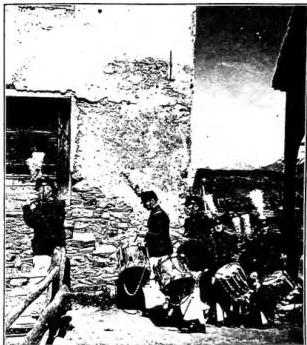
SWITZERLAND - Musicians in costume on the streets of Visperterminen (Valais).
The last Burgundian king, Rudolph III, died without heirs, and in 1033 Emperor Conrad II claimed his inheritance, uniting the Burgundian lands with the Kingdom of Germany while respecting their particular legal tradition. Through his wife Gisela, he also acquired the inheritance of the Dukes of Swabia and assigned Burgundy and Swabia to his son Henry. During his reign, Henry III made the Burgundian-Swabian region the center of his power. After his death, the Empress regent for Henry IV granted this complex of territories to her son-in-law Rudolph of Rheinfelden. However, Rudolph rebelled, and the Helvetic lands became the theater of struggles between the two factions. Henry IV stripped Rudolph of Alamannia-Swabia and granted it to Frederick, Count of Staufen. Rudolph, in turn, bestowed the Duchy upon his son Berthold, from whom the rights passed in 1092 to the related Counts of Zähringen. After reaching an agreement, they established that the Duchy would remain with the Staufen, while the Zähringen would retain the territories south of the Danube, namely the Helvetic lands around Zurich. The Zähringen continued to style themselves as dukes, though no longer of Swabia but of their castle, Zähringen.
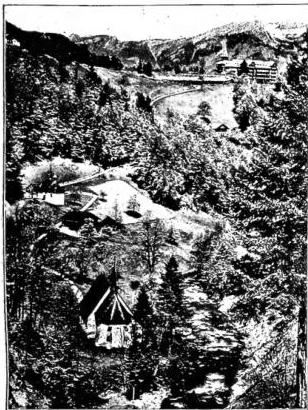
(fot. Reinhard)
SWITZERLAND - The Sanctuary of St. Nicholas of Flüe - Ranft (Unterwalden).
Lords of Upper Alsace, in the 11th century they had become the lords of Habichtsburg ("Hawk's Castle"), built by them between the Reuss and the Aar on a ridge of the Jura, dominating the trade routes that from Basel and western Switzerland led toward eastern Switzerland. The Habsburgs possessed holdings and feudal rights of various kinds in central Helvetia: the advocacy of the monastery of Murbach in its courts of Aargau and in the Zürichgau around Lucerne, seigneurial rights between the Reuss and the Limmat, the advocacy over the convent of Sackingen, properties in Willisau and Sempach, the bailiwick (Vogtei) over Lake Lucerne, in the districts of Schwyz and Unterwalden. From the inheritance of the Zähringen they obtained the bailiwick in the land of Uri. Scattered possessions and rights across a vast region, but for them the Habsburgs, in the age of Frederick II, appeared the most powerful feudal lords between the Rhine and the Danube. The division of the family into two lines did not harm its development, which was particularly fostered by the elder branch. By the mid-13th century, this was represented by Rudolf, son of Albert IV (1239-91). Habsburg policy acquired greater precision through his efforts; now the aim was to create a united territorial state by linking its various elements. Rudolf of Habsburg consistently remained loyal to Frederick II, obtaining various concessions from him. At one point, he faced the opposition of Peter II of Savoy, who also claimed a share of the Kyburg inheritance, but when, in 1279, Rudolf became King of Germany and asserted his prestige by defeating the power of the King of Bohemia, he saw more than ever the need to unify all the family's possessions, from the ancestral lands of Alsace to the newly acquired ones in Austria. He assigned the latter to his eldest son Albert and intended to grant the Duchy of Alamannia-Swabia to his younger son Rudolf. However, the program of consolidating the domains in the Helvetic region clashed with the populations of the Alpine valleys, which had long since gained—often only de facto—judicial and financial autonomies. The reaction was vigorous in the valleys of Uri, Schwyz, and Unterwalden. These regions had emerged from their isolation in the 13th century when international trade had highlighted the route from the Gotthard to the Rhine Valley.
Rudolf was determined to support his local feudal claims with the far greater weight of royal authority. The conflict with the populations was thus already open during the period 1273-91. When Rudolf died on 15 July 1291, his son Albert had not yet been recognized by the princes as King of the Romans, while his younger son, Rudolf, Duke of Swabia, had died shortly before. In early August 1291, the three Alpine valleys decided to secure themselves against any future eventuality by forming an alliance and pledging concerted action. The famous "Letter of Alliance," which is still preserved, established the commitment to mutual aid against all, to reject foreign judges in the valleys, to resolve disputes through arbitration, and to unite against acts of violence, murders, arson, etc. The act of 1291 is linked to another similar alliance document, a few years earlier, which has not survived. As the conflict for the Empire between Albert of Habsburg and Adolf of Nassau took shape, an anti-Habsburg league formed in southern Germany in 1291; the three forest cantons joined II. The Duke of Austria, disappointed by his rival's triumph, hastened to intervene in the Helvetic region, subduing Lucerne and besieging Zurich, but the three Cantons of Uri, Schwyz, and Unterwalden remained steadfast in their loyalty to King Adolf. However, when the latter fell at Gollheim and Albert of Habsburg triumphed, the cantons found themselves once again in the situation of Rudolf's time: their lord was the king, and they could not appeal to the king against their lord. These are the beginnings of the Swiss Confederation, stripped of the legends of the tyrant Gessler and the hero Tell, which arose from late 15th-century chronicles to explain an independence that seemed miraculous.
Albert of Austria, engaged in German struggles, left matters unresolved, as did the problem of reconstructing the Duchy of Savoy claimed by his nephew John, which led to his assassination in 1308. From the new king, Henry VII of Luxembourg, as early as 1309, the Cantons obtained confirmation of King Adolf's decree placing the three valleys under royal protection, as well as the privilege for their inhabitants to be summoned to court only within their borders and to be cited only before the Royal Court. The three valleys, however, pledged to remain within their borders before a royal judge. This was a step toward complete separation from Habsburg jurisdiction. The sons of Albert of Habsburg, through loyal feudal service to the Emperor in Italy, sought to obtain from Henry the revocation of the dreaded document. From Brescia, in 1311, the Emperor promised them that he would verify Habsburg rights in the valleys and, if necessary, restore them to their legitimate possession. After Henry VII's death, in the duel for the succession between Louis the Bavarian and Frederick of Habsburg, the Swiss Cantons took a stand against the Habsburgs. In their war of 1314 against the abbey of Einsiedeln, Leopold of Habsburg intervened energetically; the conflict ended with Leopold's defeat at Morgarten (15 November 1315). After the victory, the three Cantons concluded more solemn pacts at Brunnen on 9 December 1315: none of the allies would recognize a lord without common agreement. Louis the Bavarian, in hatred of the Habsburgs, on 29 March 1316 confirmed their privileges and summoned to the Empire all Habsburg possessions and fiscal rights in the valleys themselves, where royal authority was to be represented by a bailiff (Reichsvogt). Later, when Louis and Frederick seemed to reconcile, the allies, full of fear, formed a perpetual league with the Habsburg city of Lucerne (13 November 1332). The danger reappeared in 1347 when Louis the Bavarian's successor, Charles IV of Luxembourg, to secure Habsburg support, reconfirmed all their old rights and fiefs, declaring the Bavarian's acts null. The confederates then succeeded in securing the perpetual alliance of the powerful Habsburg city of Zurich (1 May 1351); shortly afterward, they also concluded a perpetual league with Glarus, a territory belonging to the abbey of Sackingen (4 June 1352), and immediately after with Zug (27 July 1352). The confederates were now seven. After the Duke of Austria had vainly besieged Zurich and sought to break the league, he entered negotiations mediated by the Margrave of Brandenburg. In the Treaty of 1352, Habsburg sovereignty over Schwyz and Unterwalden was passed over in silence, while patrimonial and protective rights over churches and monasteries were recognized; Zurich retained its alliance with the Cantons but pledged not to make agreements with other Habsburg subjects without their consent; Lucerne, Glarus, and Zug, while retaining their treaties, recognized Habsburg sovereignty. The peace was not maintained; Charles IV intervened; in 1346, an agreement was reached between Zurich and the dukes, and now the Cantons, weary, finally adhered. During this phase of negotiations, the Cantons succeeded in securing the perpetual alliance of Bern, which, however, considered the alliance only as a guarantee of peace and not as a bond in its political activity (6 March 1353).
Peace lasted on the Lake of the Four Cantons for approximately three decades. In 1385, a conflict between Lucerne and the Habsburgs reignited the struggle: Duke Leopold was defeated at Sempach (19 July 1385) and then at Näfels (9 April 1388); peace was reestablished in 1394 for twenty years. The Habsburgs' rights over the Cantons were no longer discussed; Lucerne, Glarus, and Zug had their independence recognized; the confederates' conquests were validated. The Confederation (Eidgenossenschaft) now comprised five rural territories and three cities: Uri, Schwyz, Unterwalden, Glarus, Zug, Lucerne, Zurich, and Bern. These were autonomous states bound by particular treaties that, within the framework of imperial law, agreed to defend their traditional autonomies. Since there was no single treaty but rather different agreements, and since there was no equality among the contracts (Glarus was in fact a protectorate of the three Cantons), disputes were not lacking. These were addressed by the so-called "Priests' Letter" (Pfaffenbrief) of 7 October 1370, concerning ecclesiastical jurisdictions, and later by the "Letter of Sempach" in 1375 (Sempacherbrief), for the discipline of militias in military expeditions.
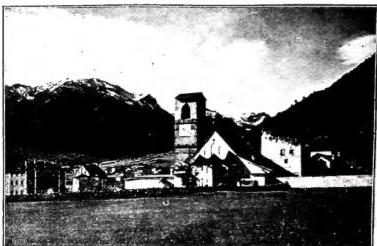
SWITZERLAND - View of Müstair with the church of the monastery of S. Giovanni (Münstertail).
The military victories gave rise to serious internal conflicts between the old urban aristocracies and the popular elements. The crisis subsided when the great wars of hegemony between France, Spain, and Austria broke out. The powers competed to enlist Swiss mercenaries: the Cantons, in turn, divided according to political sympathies. Basel joined the Confederation on 9 June 1501 and Schaffhausen on 10 August. Later, on 17 December 1513, Appenzell also joined. The Confederation thus remained until the French Revolution.
In the Lombard Wars for the Duchy of Milan, Swiss mercenary militias fought on both sides. Ludovico il Moro, expelled by the French, regained the Duchy with the help of the Swiss, who then betrayed him with the Swiss in the French army (1500). The French triumph was exploited by the Cantons of Uri and Unterwalden to occupy Bellinzona and Ticino, which Louis XII ceded to them with the Treaty of Arona (1503). In the following years, the Swiss sided with Julius II; in 1512, they restored the Sforza to Milan and established a true protectorate over the city. Their defeat at Marignano in 1515 forced them to withdraw. A serious crisis emerged with the spread of the Lutheran Reformation and the religious-national preaching of Ulrich Zwingli. The war between Catholic and Protestant Cantons (Kappel War) ended with the Treaty of 20 November 1531, which recognized religious freedom for both sides, and the Confederation managed to survive. The religious question drew the city of Geneva, which had rebelled against the Duke of Savoy and become the center of Calvinism, closer to the Confederates; in 1558, Geneva allied with Bern. During the 16th century, the Confederation secured alliances with cities and princes, distinguishing them by proximity and importance into first-order allies (Zugewandte) and second-order allies (Verwandte), with the aim of ensuring a barrier against the threats of the great powers. In the face of European wars, the Confederation began to assert the principle of neutrality. The treaty of union with Austria (1511) and the perpetual peace with France (1516) now appeared insufficient guarantees. However, neutrality was threatened by the consent given to the Cantons for foreign enlistments. During the Thirty Years' War, the Confederation managed to prevent the outbreak of conflict between the parties and created a military system for the defense of the borders (Defensional).
In the Peace of 1648, the representatives of the Confederation, with the support of France, obtained recognition of sovereignty and the abolition of all feudal dependence on the German Empire. Thus, the Confederation (called the "Helvetic Body") after 1648 became a public-law entity with full independence. In the following era, it underwent a long economic crisis.
The old mercantile aristocracies of the cities and landed aristocracies of the Cantons provoked, with their oppression, the rebellion of the working and rural classes. New conflicts arose between Catholic and Protestant Cantons: the latter were defeated in 1636, then victorious in 1712 (Peace of Aarau). The Catholics placed themselves under the protection of Louis XIV.
In the 18th century, Switzerland came to occupy a prominent place in the European cultural movement: Zurich, Basel, and Geneva were important centers of literary and scientific studies. The influence of European political and economic theories exacerbated the persistent internal imbalance of the Confederation, due to its antiquated organization. Subject territories aspired to equality with the dominant Cantons, and populations sought liberation from the predominance of urban patriciates. In the second half of the 18th century, persistent rebellions preceded the outbreak of the French Revolution.
After 1789, democratic agitations were followed by aristocratic repressions. Switzerland became a battleground between French revolutionary agents and French and European monarchist agents. In Paris, Swiss democrats appealed for the liberation of Switzerland from cantonal oligarchies. After Bonaparte's expedition to Italy, possession of Switzerland acquired great importance as a communication route between Italy and France, and in 1798, French divisions entered Switzerland: in April, in Aarau, under French auspices, an assembly proclaimed the unitary and democratic Helvetic Republic in place of the old Confederation of aristocratic sovereign states. The rural Cantons rebelled in response to the decisions of Aarau but were subdued by force. Requisitions and forced contributions then struck the populations. The Directory of Aarau concluded a defensive and offensive alliance with the government of Paris; France secured free passage for its armies (19 August 1798). Traditionalists filled the country with disputes and conflicts. To put an end to them, the First Consul imposed a new Constitution (Act of Malmaison), which established a Confederation of 17 Cantons with autonomy and a census-based constitution (29 April 1801). The Diet rejected this constitution and established another, which the French in turn rejected. This led to a new military occupation of the country. In the Helvetic Consulta of Paris in 1803, the First Consul granted a new Constitution (Act of Mediation). There were then 19 Cantons with broad autonomy; only the equality of the Cantons forming the Diet united them. Napoleon proclaimed himself protector of the Helvetic Republic and imposed his alliance upon II. After Napoleon's fall in 1814, supporters of the old regime rose up and organized a government in Lucerne. The European powers, however, refused consent and decided that three new Cantons—Neuchâtel, Valais, and Geneva—should be added to the 19 Napoleonic Cantons; then, on 20 November 1815, they signed the "Declaration of the perpetual neutrality of Switzerland and the inviolability of its territory." The Federal Pact of 7 August 1815 established that Switzerland was a perpetual Confederation of 22 sovereign States. Each Canton sovereignly regulated its own Constitution; common institutions were only those of diplomacy and war. The Federal Diet was to sit alternately in the three cities of Bern, Zurich, and Lucerne, under the direction of the local Central Council. After a period of tranquility, what the Swiss called the period of regeneration began around 1830. The triumph of the oligarchic system of 1815 had, in fact, provoked new agitations, revolutions, and civil wars.
A party called "radical" formed, which sought constitutional revision aimed at establishing the sovereignty of the people, universal suffrage, equality, and freedoms of the press, association, and belief. Seven reformist Cantons created a "League for the Defense of Reforms"; in Sarnen, the "League of Traditionalist Cantons" formed. Discussions after 1840 turned into a struggle between Catholic and Protestant Cantons. In 1845, seven Catholic Cantons—Uri, Schwyz, Unterwalden, Zug, Lucerne, Fribourg, and Valais—created a "Separate League" (Sonderbund) to defend their traditional rights.
against Protestant radicalism, which sought the expulsion of the Jesuits. The 1848 Constitution reorganized the Confederation according to the radical program. The federation of states (Staatenbund) of 1815 was replaced by a federal state (Bundesstaat) with a federal public law superior to cantonal law. Bern became the federal capital, hosting the presidency and the assembly composed of the National Council and the Council of States. The Confederation gained full competence in diplomacy, the military, customs, currency, finance, postal services, and railways. Citizens then became citizens of Switzerland rather than of their Cantons, and the concept of the Swiss nation truly emerged (12 September 1848). Internal conflicts thus ceased: the Catholic Cantons gradually adapted, leveraging the advantages of the freedoms ensured by the moderate radical program. Later, constitutional revisions, such as that of 1874, strengthened central authority. New democratic reforms were introduced, including the popular initiative for certain laws and the popular sanction for certain governmental measures. After 1891, it was established that constitutional reforms could be proposed by 50,000 citizens and submitted to a popular vote (referendum). The Confederation's neutrality successfully withstood the two great crises of the 1914–18 and 1939–45 wars: European powers regarded Switzerland as a fortunate oasis of peace, suitable for international negotiations and discussions. However, distrustful of foreign powers, the Swiss created a small but well-trained army to defend their civilization.
III. THE SONDERBUND WAR
Fought in 1847 in Switzerland between the liberal and Protestant Cantons and the conservative and Catholic ones.The conflict was driven by both political and religious reasons. The radical-liberals, who encountered an obstacle to the triumph of their ideas in the federal state system established in 1814—which granted broad governmental autonomy to individual Cantons—aimed to revise the Federal Pact; they were successfully opposed by the conservatives and Catholics of other Cantons in the years following 1830. The conflict soon took on a religious dimension as well, when the liberals of Aargau secularized seven convents (four male and three female) under the pretext that the friars and nuns had incited the population against the constituted authorities. The federal authorities, to whom both parties had appealed, declared the act illegal, but the government of Aargau did not comply with this decision. In response to these infringements, the Catholic and conservative Cantons began to forge closer ties among themselves; their adversaries adopted extreme positions. The suppression of the convents in Aargau was met with the invitation of the Jesuits to the Canton of Lucerne. A
liberal attempt to seize Lucerne with free corps and the assassination of Joseph Leu, the leader of Catholic conservatism in that Canton, led the conservative Cantons to defend their rights against radicals and liberals through a separate alliance (Sonderbund), deemed necessary due to the ineffectiveness of the federal authorities. The Alliance was secretly concluded on 11 December 1845 among Uri, Schwyz, Unterwalden, Lucerne, Zug, Fribourg, and Valais, with the commitment to repel any attack by all means at their disposal. To secure adequate armament, the seven Cantons turned to Austria and France. After the mediation by some Protestant conservatives, led by Bluntschli, failed, the Sonderbund refused to comply with the dissolution order approved by the majority of the Federal Diet, and war broke out. General Dufour, appointed commander-in-chief of the federal forces on 24 October 1847, had under his command approximately 100,000 men with 172 artillery pieces, while the Sonderbund could oppose around 80,000 armed men with 88 cannons; moreover, the strategic situation was unfavorable to the Sonderbund, surrounded by hostile Cantons and further divided into two parts. Dufour first moved against Fribourg, separated from the Sonderbund by the Canton of Vaud, and captured it on 14 November. He then turned his forces against Lucerne, entering it ten days later. The Sonderbund army, in full rout, ceased to exist. Zug had already surrendered without a fight on 21 November. Unterwalden capitulated on the 25th, Schwyz on the 26th, Uri on the 27th, and Valais on the 28th. In all the conquered Cantons, radical governments came to power, hastening to enact laws against the Jesuits and to secularize monasteries. The defeat of the Sonderbund was due to the confidence placed in a military intervention by Austria and France on their side, which led to the abandonment of any offensive plan by General Salis-Soglio, commander-in-chief of the Sonderbund forces.
Silvio Furlani
IV. ECCLESIASTICAL HISTORY
1. Origins. — The earliest Christian origins of Switzerland date back to the 3rd-4th centuries, and Christianity spread there through obscure missionaries, merchants, or soldiers, via the two great communication routes between northern Italy and the regions beyond the Alps: the first crossed the Pennine Alps and led into Valais and Switzerland, from where it then branched toward Gaul and Germany; the other, through the Rhaetian Alps, emerged at Chur and from there followed the Rhine northward.A group of Christian soldiers (Theban Legion [V. THEBANS]), probably sent to suppress the revolt of the Bagaudae, was put to death under the reign of Diocletian and Maximian (285-292) at Agaunum (v.) in Valais, which became one of the most popular sanctuaries of the early Middle Ages. The ruins of a chapel on the Brissago Islands (Ticino); two clay lamps found in Geneva, one bearing the fish and the other the palm; a glass discovered in Avenches with the inscription Vivas in Deo, may date back to the 4th century or even the late 3rd.
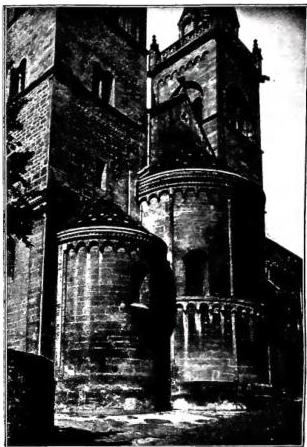
2. The First Bishoprics. — a) The portion of present-day Swiss territory between the Alps and the Jura formed the Civitas Helvetiorum. The capital, Avenches, experienced a brilliant
(photo: Nambum)
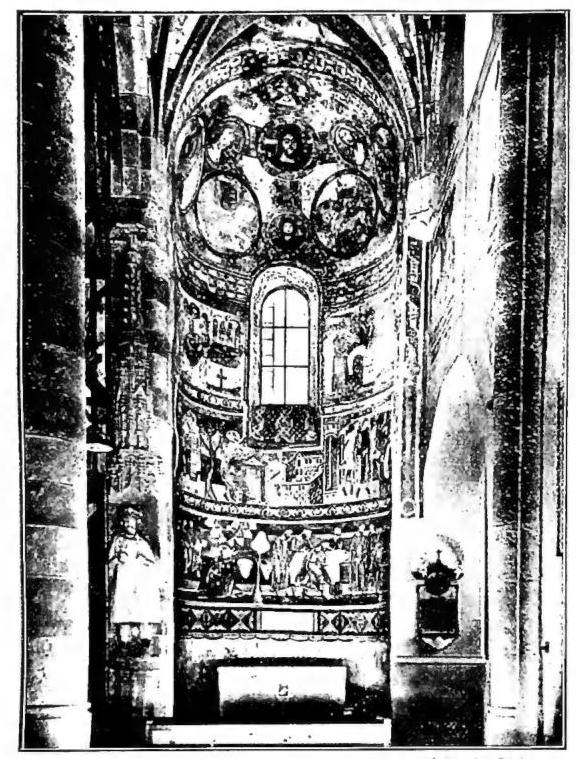
SWITZERLAND — Romanesque apses (12th century) of the collegiate church of Neuchâtel.
prosperity until the day when, around 265, the Alemanni sacked it; a second invasion seems to have struck it again around the middle of the 4th century. Nevertheless, in the Middle Ages, Avenches preserved the memory of having been an episcopal see and even claimed to have had a very long series of bishops (7, according to a petition to the Pope in 1447, or 22, according to a tradition reported in 1228). Be that as it may, no name is known before the 6th century. Indeed, at the beginning of this century, it seems that the see was transferred from Avenches to the city of Windisch, an ancient castrum located at an important geographical point, near the confluence of three rivers, the Aare, the Reuss, and the Limmat. However, when, in 561, the ancient Civitas Helvetiorum was divided between Austrasia (the kingdom of Sigebert) and Burgundy (the kingdom of Guntram), and the border of the two kingdoms was moved to the Aare River, the episcopal see was once again transferred from Windisch back to Avenches. The most celebrated bishop of this see in the 6th century was St. Marius (574-94), originally from Autun and buried in Lausanne: which suggests that he moved his see to this latter city.
St. Theodorus is the first certain bishop of Valais; he appears at the Council of Aquileia in 381 with the title of Octodurum (today Martigny), which was then the capital of this civitas. The order of his signature places him among the bishops who had been in office for a long time, which allows us to
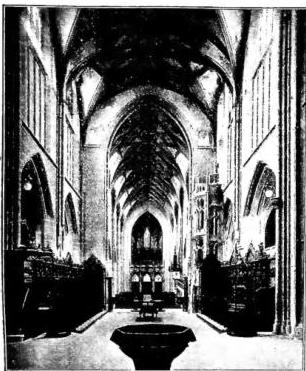
SWITZERLAND - Interior of the Collegiate Church of Bern (1421-1575).
can be traced back to the mid-4th century or shortly thereafter; it is possible that the homonymous prelate present at a Milanese Synod of 389 or 390 is the same person. At the Council of Epaone in 517 and the two Councils of Orléans in 541 and 549, bishops of Octoduro still participate: Costanzo (517) and Rufo (541 and 549). Three other bishops of Valais are known through mentions related to Agaunum, where they may have had their residence: Salvio, in the second quarter of the 5th century; Protasio, toward the end of the same century; and Agricola in 565. The floods of the Drance at Octoduro, then the invasion and sacking by the Lombards at Agaunum in 574, were undoubtedly the cause of the episcopal see's relocation: indeed, by the time of the Council of Mâcon in 585, the bishop Eliodoro (who had sent a delegate) already resided in Sion (v.).
c) Geneva has a certain bishop, Isaac, at the end of the 4th century. Three of his successors in the 5th century and five in the 6th are known; the latter, like their neighbors, the bishops of Valais and those of the Helvetii, participate in the Councils of Epaone (517: Massimo), Orléans (541 and 549: Pappulo), and Mâcon (585: Cariatto). Geneva would remain an episcopal residence until the 16th century. The episcopal see of Geneva thus did not experience the variations of the Helvetian and Valaisian sees. On the other hand, the question of an episcopal see at Nyon, between Geneva and Lausanne, which would have been the capital of the Civitas Equestrium, has been hotly debated; the bishops of Nyon would have later transferred their see to Belley (France), and the territory of Nyon would have been united with the diocese of Geneva. Mons. Besson demonstrated the fragility of this hypothesis; he and Mons. Duchesne showed that no bishop of Nyon is known; as for those of Belley, they do not appear until after the mid-6th century, with no connection to a supposed see of Nyon.
d) The Civitas Rauricorum, which extended from the Rhenish Jura to the southern Vosges, initially had Augusta, east of Basel, as its capital. The episcopal see of this Civitas must undoubtedly have been established there. Information on this bishopric is lacking before the 8th century; indeed, the oldest episcopal catalog of this Church,
written in the 11th century, begins with Bishop Walaua, a contemporary of Pope Gregory III (731-41). However, the name of Justinian, bishop of the Raurici, appears in a list of bishops who would have participated in a Council of Cologne in 346; the reality of this Council is disputed, but the list of bishops would have been compiled with real names. In the 7th century, the monk Jonas, in his biography of St. Eustace, mentions Ragnacarius, bishop of Augusta and Basel, Augustanae et Basiliae. Thus, between 600 and 650, the episcopal see appears to have been established in Basel. It is not known when the transfer occurred, but it undoubtedly took place following the expansion of the Alemanni in the 5th and 6th centuries.
e) Chur (v.) has a certain bishop by the mid-5th century: Asinio, who was represented at a Milanese Synod in 451 by Abbondanzio, bishop of Como. The bishopric of Chur still exists, and the eponymous city is the oldest episcopal residence still located on the territory of Switzerland.
f) Furthermore, the bishoprics of Milan and Como, already established in the 4th century, encompassed in the Middle Ages the Italian valleys of present-day Switzerland, but it is unknown from what period this division dates. Hidber believes that the diocese of Novara originally, and for several centuries, extended its jurisdiction over the entire present-day Canton of Ticino.
g) Information on the foundation of the bishopric of Constance is scarce. In the past, it was believed to be the continuation of the ancient bishopric of Windisch, whose bishop Grammazio had taken part in the Council of Orléans in 549. However, Mons. Besson demonstrated that Grammazio was at the head of the bishopric of the Helvetii, and his see was relocated to Avenches after the division of 561 among the Merovingian kings and later fixed in Lausanne. A 12th-century manuscript, preserved in Stuttgart, places Bishop Massimo at the head of the episcopal catalog of Constance, dating him to the second half of the 6th century; nothing is known of him, notes M. Besson, and L. Duchesne observes that there is no mention of a bishopric in Constance before the more or less advanced 7th century. It should be noted, however, that the Vita Sancti Galli, written toward the end of the 8th century, recalls a Synod held around 615 in Constance, which elected John as bishop of that city.
3. Medieval Bishoprics
From the mid-8th century onward, the ecclesiastical map of Switzerland remains fixed and does not change until the 16th century. Five cities in present-day Switzerland are centers of dioceses: Geneva, Chur, Sion, Lausanne, and Basel. All of eastern Switzerland belongs to the diocese of Constance, which the Aare separates, to the west, from the dioceses of Basel (downstream of the Sigger, a left-bank tributary of the Aare) and Lausanne (upstream of the Sigger). It should be noted that Porrentruy and its region, northwest of the Jura, were part of the diocese of Besançon, and the southern Alpine valleys, of Italian language, were connected to the bishoprics of Novara, Milan, and Como. Novara retained until the 19th century the valley of Gondo (Valais); Milan possessed, at least from the 10th century, the entire Leventina above Bellinzona, with the Blenio Valley as an offshoot, as well as the territories of Brissago, Capriasca, and Campione. The diocese of Como included Mendrisiotto, Lugano, Locarno, Bellinzona, as well as Poschiavo and Brusio (Grisons).4. Metropolitan Sees
The participation of the first bishops of Octoduro (381) and Chur (451) in Italian councils led to the supposition that these bishops originally depended on the metropolitan see of Milan. In the 6th century, the bishops of Valais, the Helvetii, and Geneva instead attended councils of the Frankish Empire. It is risky to establish secure bonds of dependence at this time; however, Valais and Geneva appear within the sphere of influence of Vienne on the Rhône, and it is possible that the bishopric of the Helvetii originally depended on Lyon. When Besançon separated from the province of Lyon to form the center of a new province at the beginning of the 7th century, the bishoprics of Lausanne and Basel became suffragans of the new metropolitan see. At the end of the 8th century, Tarentaise also freed itself from the dependence on Vienne and constituted an Alpine province with Sion and Aosta as suffragans. Finally, Chur was reunited, after 843, with the metropolitan see of Mainz. These relationships lasted until the end of the Middle Ages.From 1492, the bishop of Sion, Jost of Silenen, sought to free himself from dependence on the archbishop of Tarentaise, but without success; his second successor, Matteo Schiner, obtained from Pope Julius II, in 1510, an exemption for the duration of his episcopate; shortly thereafter, in 1513, Leo X abolished it definitively. Sion was thus the first Swiss bishopric to depend immediately on the Holy See. The other bishoprics remained subject to their metropolitans until the beginning of the 19th century.
5. Monasticism
Around 450, St. Romanus, the founder of the "monks of the Jura," established the monastery of Condat (today St-Claude) on the western slope and that of Romainmôtier on the eastern slope. In Valais, Bishop Theodore of Octodurum built in the 4th century a small basilica in honor of St. Maurice (v.) and his companions, martyred at Agaunum (v.); as early as the 5th century, this basilica attracted pilgrims, even from Gaul, as attested by St. Eucherius, Bishop of Lyon (d. ca. 450). Shortly afterward, the Burgundians settled in the Rhône basin; St. Sigismund, son of their king Gundobad, founded in 515 near the basilica of Agaunum a monastery, which must therefore be considered a "monasterium basilicae." These are the oldest monasteries erected in the present territory of Switzerland and predate St. Benedict.The domination of the Alemanni in northern Switzerland delayed the expansion of Christianity and civilization in this region, where one must wait until ca. 600 to find the dioceses of Constance and Basel established and to see the first monasteries appear. These are linked to the group of Irish monks whose leader and legislator was St. Columbanus, who, after founding the monastery of Luxeuil in the Vosges, moved to Bregenz on the shores of Lake Constance, and then to Bobbio, where he died in 615. He was the apostle of the Alemanni. His principal disciple, St. Gall, withdrew to a forest south of Lake Constance; tradition also links to the Columbanian group two other hermits, St. Ursanne, who settled on the banks of the Doubs in the Jura, and St. Sigisbert, who withdrew to the banks of the Rhine in Upper Raetia. On the tombs of these saints, the abbeys of St. Gall, St. Ursanne, and Disentis were formed in the 7th-8th centuries. The monks of Luxeuil were also called upon by Duke Crammelenus to restore the abbey of Romainmôtier and to found the priory of Baulmes (Vaud) in the course of the 7th century; St. Wandregisel made prolonged stays at St. Ursanne and Romainmôtier before founding Fontenelle in Normandy (v. BOUER). The monks of Luxeuil also founded Moutier-Grandval, where St. Germanus was the first abbot around 666. In the 8th and 9th centuries, the Rule of St. Benedict supplanted everywhere the prescriptions of St. Columbanus. It was introduced in 748 at St. Gall, then at Moutier-Grandval, which, in the Carolingian era, was in close relation with St. Gall. From Moutier-Grandval depended, in the 9th century, a monastery that arose on the tomb of the hermit St. Imier in the Suze Valley (Jura). Perhaps the Benedictine Rule was introduced in the 8th century also at St-Maurice, where a chapel of St. Benedict is later recorded. Other Benedictine abbeys owed their origin to St. Pirmin, who founded in 724, on an island in Lake Constance, the abbey of Reichenau; this later established the monastery of Pfäfers (Rheintal); St. Meinrad moved from Reichenau to Einsiedeln, where he was assassinated in 861; in the same period, the Irish monk St. Findan lived at Rheinau, on an island in the Rhine, and died in 878. Furthermore, in the 9th century, the abbey of Murbach in Alsace founded the priory of St. Leodegar in Lucerne. Shortly after 1000, the abbey of St. George, founded around 966 at Hohentwiel, was established at Stein am Rhein, and the monks of Einsiedeln went to populate the convent of Muri in Aargau, founded by the Habsburgs; in 1052, the abbey of Allerheiligen in Schaffhausen appears, to which the new abbey of Wagenhausen was united in 1083, but until 1417 the abbey of Petershausen near Constance also claimed to direct the monastery of Wagenhausen, and it was the monks of Wagenhausen and Petershausen who founded around 1135 the abbey of Fischingen. In the course of the 10th century, the Rudolfing Cluny (v.) the ancient abbey of Romainmôtier and the new abbey founded at Payerne, to which the ancient monastery of Baul-
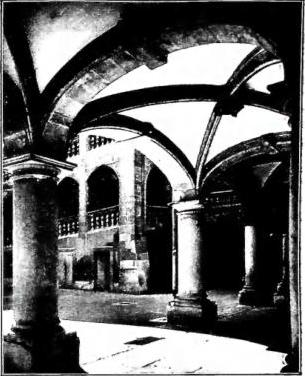
SWITZERLAND - Interior of the Town Hall (15th century) - Geneva.
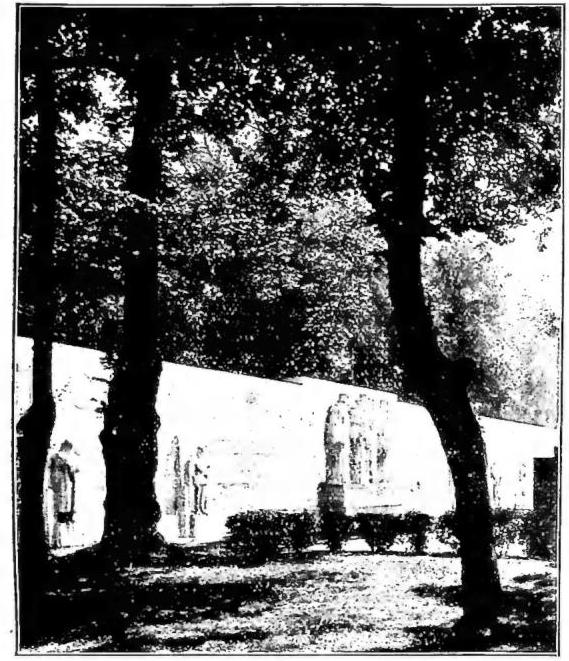
SWITZERLAND - The Wall of the Reformation - Geneva.
Moutier-Grandval experienced a rapid flourishing in the 8th and 9th centuries, then declined. Romainmôtier and Payerne reached their apogee in the 10th and 11th centuries; then came the turn of Disentis, Einsiedeln, Muri, Allerheiligen, and Engelberg, all important abbeys.
6. The Principalities. — From the Middle Ages until the 18th century, the ancient bishoprics and abbeys of Switzerland possessed temporal jurisdiction, making them true states of varying extent, importance, and duration. It should also be noted, regarding the bishoprics, that the territory of the principality did not coincide with the territory of the diocese.
The bishopric of Chur appears to have been the first to enjoy temporal power from the end of the 7th century. Later, Rudolph III, the last king of Burgundy (993-1032), granted similar rights to the prelates of his kingdom. The German emperors, concerned with ensuring free passage through the Alps and maintaining footholds against hereditary lords, favored the development of ecclesiastical principalities, both abbatial and episcopal. The ecclesiastical princes generally united in their hands legislative, administrative, and judicial powers, with the right to levy taxes, demand military service, and mint coinage. Various officials (ministeriales) exercised administrative, judicial, and fiscal functions. However, great variety existed depending on the location, even under the same ecclesiastical lord. This complex and characteristic politico-ecclesiastical situation in Switzerland will be presented, of necessity, in a summary manner; we shall dwell by way of example on the principality of Chur alone, while for the others we shall recall only the essential data.
a) The origins of the episcopal principality of Chur are complex. The Victorid dynasty, which governed Rhaetia from the beginning of the 7th century to the end of the 8th, provided Chur with a series of bishops who, although designated by popular election and ratified by the Frankish kings, nevertheless occupied the episcopal see in an almost hereditary manner. The landed properties of the Victorids thus passed to the bishopric; Bishop Paschal III (d. 695) left to his successor, Victor II (d. 714), the Domleschg, and Bishops Tello (758-73), Constantius (late 8th century), and Remedius (d. c. 805) were at the same time bishops and rulers (praeses) of the country; indeed, Remedius also enacted laws. After his death, Charlemagne separated spiritual power from temporal power, which was entrusted to the ruler Hunfrid, then to Roderic. The latter engaged in a violent struggle against Bishop Victor III, who three times complained about him to the emperor. Finally, in 831, Louis the Pious granted Victor III a diploma of immunity, which formed the foundation of the episcopal state. The Ottonians, especially Otto I, favored its development, so that by the 13th century the state comprised Chur and its region, the Domleschg, the Oberhalbstein, the Val Bregaglia, the Upper Engadine, Poschiavo, Münster, several domains in the Vinschgau (Austria), and Grossängstigen in Württemberg. From 1170 to 1803, the bishops of Chur were princes of the Holy Roman Empire. In 1282, councillors (consules) appeared in Chur; from that moment, the city sought to free itself from episcopal power. The development of communes restricted the rights of the prince-bishop. Bishop Peter Gelyto (1355-68), with his policy of alliance with Austria, irritated his subjects, and their delegates, gathered in Chur in 1367, agreed to resist the prelate; this was the origin of the League of the House of God (Lega Cadri or Ca[sa] Dei), a kind of federal state, which in 1498 formed an alliance with the Swiss Cantons, except Bern. The 15th century saw the progressive emancipation of Chur, which enjoyed, among other things, the protection of Emperor Frederick III. The Articles of Ilanz, in 1526, reinforced in 1541 by six new articles, abolished most of the bishop’s temporal rights; therefore, neither the bishop nor the Chapter ever recognized them. In reality, the bishops retained reduced rights until 1798. During these three centuries, politico-religious conflicts were numerous; one of the last, in 1753, opposed the city of Chur, predominantly Protestant, to the episcopal court (Hof), which formed the upper city, and each of the two parties claimed full independence from the other. Bishop Joseph Benedict von Rost left for Vienna, where Empress Maria Theresa mediated; indeed, upon his return, the prelate was received with honor, and pacification was achieved.
b) The abbey of Disentis, located in the upper Rhine valley east of Chur, began its temporal power with the testament (766) of Bishop Tello of Chur (d. 773). The important geographical and strategic position of the abbatial territory earned the monastery the protection of Otto I (960, 965) and Otto II (976), of Henry III, who granted it immediate imperial dependence (1048); a privilege later confirmed several times. The abbots were princes of the Empire. The Helvetic Revolution of 1798 put an end to the abbatial principality.
c) The abbey of Pfäfers, located north of the diocese of Chur, founded in the 8th century, received from Lothair I (840) the freedom of election, a privilege reconfirmed in 949 by Otto I. The abbatial lordship ceased at the end of the 18th century.
d) The vast diocese of Constance had its bishops as princes of the Empire. As early as the 12th century, the city of Constance entered into conflict with its prince-bishop to gain freedom. The Treaty of Baden (1554) reduced the bishop’s rights, whose episcopal principality lasted, in Germany, until 1803.
e) The abbey of St. Gall possessed from the 8th century to the end of the 18th century such considerable temporal power that it became one of the principal ecclesiastical states of Switzerland, whose acquisitions, wars, and diplomacy repeatedly modified its extent and power. The abbey was suppressed in 1805. From 1077 to 1418, St. Gall was an abbey reserved for the nobility. From 1207 to 1798, the abbot held the title of prince of the Holy Roman Empire, and the House of Savoy granted him the Order of the Annunciation beginning in 1686.
f) The abbey of Rheinau, established at the end of the 8th or beginning of the 9th century, had as its principal benefactor Duke Volvene, who later became its abbot (d. 878). The abbey’s properties were scattered across the present-day territories of Zurich, Schaffhausen, Thurgau, Baden, and even in Italy. Otto II, in 972, confirmed the abbey’s privilege of immunity and the freedom of election of its abbots. Over the city of Rheinau, the abbot exercised high and low justice through his advocatus and, from 1460, the Swiss bailiff of Thurgau. On March 6, 1798, the temporal rights of the abbey ceased.
g) The abbey of Einsiedeln, with the concession by Otto I (October 27, 947) of the privilege of free election of its abbots and immunity, laid the foundation of the abbatial state, which included the region of Einsiedeln and properties and rights in other regions. The temporal power of the abbey definitively ceased at the end of the 18th century.
h) The abbey of Muri (Aargau), founded in 1027 by the Habsburgs and placed under imperial protection as early as 1164, came under the protection of the Confederates after the conquest of Aargau (1415). Emperor Leopold I granted the abbots the title of prince of the Empire (1701), but less than a century later, the temporal rights of the abbey were suppressed by the Helvetic Revolution (1798).
BIBL.:
For the general history of the ecclesiastical principalities in Switzerland: Historisch-Biographisches Lexikon der Schweiz, V. Fürstabteien and Fürstbistümer; Dictionnaire historique et biographique de la Suisse, V. Principautés ecclésiastiques; W. Oechsli, Geschichte der Schweiz im 19. Jahrhundert, I, Leipzig 1903; H. Nabholz, Geschichte der Schweiz, I, Zürich 1932; A. Büchi, Die schweizerischen Bistümer bis zur Gegenwart, in Geschichte der schweizerischen katholischen Kirche, Einsiedeln 1935; E. Gagliardi, Geschichte der Schweiz, I-III, Zürich 1937; H. Ammann, Die schweizerischen Städte im Mittelalter, Aarau 1948.
For the principality of Chur: Urkundenbuch der Abtei Sanct Gallen, ed. Wartmann, I-VI, St. Gallen 1863-1892; Quellen zur Schweizer Geschichte, ed. E. Gagliardi, I, Basel 1901; Fontes rerum Bernensium, I, Bern 1883; Urkundenbuch des Hochstifts Chur, ed. Mohr, I, Innsbruck 1852; Codex diplomaticus Raetiae, ed. Mohr, I-II, Innsbruck 1848-1851; A. Eichhorn, Episcopatus Curiensis, St. Blasien 1797; J. C. Kind, Geschichte der Stadt und Landschaft Chur, Chur 1859; J. J. Blumer, Staats- und Rechtsgeschichte der schweizerischen Demokratien, I, St. Gallen 1850; A. von Sprecher, Die Drei Bünde, Chur 1872; C. Kind, Die Ilanzer Artikel, Chur 1872; P. C. von Planta, Geschichte von Graubünden, I-II, Bern 1892; A. Büchi, Die Beziehungen der Schweiz zu dem Konzil von Trient, Luzern 1919; H. W. Kleiner, Die Bündner Wirren, Zürich 1931.
For the abbey of Disentis: Urkundenbuch der Abtei Disentis, ed. C. Decurtins, Chur 1904; Quellen zur Schweizer Geschichte, ed. E. Gagliardi, I, Basel 1901; Codex diplomaticus Raetiae, ed. Mohr, I-II, Innsbruck 1848-1851; A. Eichhorn, Episcopatus Curiensis, St. Blasien 1797; P. C. von Planta, Geschichte von Graubünden, I-II, Bern 1892.
For the abbey of Pfäfers: Urkundenbuch der Abtei Pfäfers, ed. I. von Arx, St. Gallen 1848; Quellen zur Schweizer Geschichte, ed. E. Gagliardi, I, Basel 1901; Codex diplomaticus Raetiae, ed. Mohr, I-II, Innsbruck 1848-1851; A. Büchi, Die schweizerischen Bistümer bis zur Gegenwart, in Geschichte der schweizerischen katholischen Kirche, Einsiedeln 1935.
For the diocese of Constance: Urkundenbuch der Stadt und Landschaft Zürich, ed. J. Escher, I-VIII, Zürich 1888-1899; Quellen zur Schweizer Geschichte, ed. E. Gagliardi, I, Basel 1901; Fontes rerum Bernensium, I, Bern 1883; Regesta episcoporum Constantiensium, ed. F. X. Wocher, I-II, Innsbruck 1886-1895; A. Schulte, Geschichte der Habsburger in den ersten drei Jahrhunderten, Innsbruck 1887; H. Witte, Die Bischöfe von Konstanz im 14. Jahrhundert, Freiburg 1888; A. Büchi, Die schweizerischen Bistümer bis zur Gegenwart, in Geschichte der schweizerischen katholischen Kirche, Einsiedeln 1935.
For the abbey of St. Gall: Urkundenbuch der Abtei Sanct Gallen, ed. Wartmann, I-VI, St. Gallen 1863-1892; Quellen zur Schweizer Geschichte, ed. E. Gagliardi, I, Basel 1901; Fontes rerum Bernensium, I, Bern 1883; Die Chroniken der deutschen Städte, ed. K. Hegel, XIV, Leipzig 1878; E. G. Rütimeyer, Geschichte der Abtei St. Gallen, I-III, St. Gallen 1829-1834; A. Büchi, Die schweizerischen Bistümer bis zur Gegenwart, in Geschichte der schweizerischen katholischen Kirche, Einsiedeln 1935; W. Vogler, St. Gallen: Geschichte einer literarischen Kultur, I-II, St. Gallen 1997.
For the abbey of Rheinau: Urkundenbuch der Stadt und Landschaft Zürich, ed. J. Escher, I-VIII, Zürich 1888-1899; Quellen zur Schweizer Geschichte, ed. E. Gagliardi, I, Basel 1901; Codex diplomaticus Alemanniae et Burgundiae, ed. L. Weiland, Hannover 1877; A. Büchi, Die schweizerischen Bistümer bis zur Gegenwart, in Geschichte der schweizerischen katholischen Kirche, Einsiedeln 1935.
For the abbey of Einsiedeln: Urkundenbuch der Abtei Einsiedeln, ed. G. Meyer von Knonau, I-III, Zürich 1899-1905; Quellen zur Schweizer Geschichte, ed. E. Gagliardi, I, Basel 1901; Codex diplomaticus Alemanniae et Burgundiae, ed. L. Weiland, Hannover 1877; A. Büchi, Die schweizerischen Bistümer bis zur Gegenwart, in Geschichte der schweizerischen katholischen Kirche, Einsiedeln 1935.
For the abbey of Muri: Urkundenbuch der Abtei Muri, ed. M. Kiem, I-II, Stans 1883-1884; Quellen zur Schweizer Geschichte, ed. E. Gagliardi, I, Basel 1901; Codex diplomaticus Alemanniae et Burgundiae, ed. L. Weiland, Hannover 1877; A. Büchi, Die schweizerischen Bistümer bis zur Gegenwart, in Geschichte der schweizerischen katholischen Kirche, Einsiedeln 1935.
For the abbey of Engelberg: Urkundenbuch der Abtei Engelberg, ed. P. A. Vogel, I-II, Sarnen 1902-1906; Quellen zur Schweizer Geschichte, ed. E. Gagliardi, I, Basel 1901; Codex diplomaticus Alemanniae et Burgundiae, ed. L. Weiland, Hannover 1877; A. Büchi, Die schweizerischen Bistümer bis zur Gegenwart, in Geschichte der schweizerischen katholischen Kirche, Einsiedeln 1935.
A. MERCATI
l) Other monasteries of the ancient diocese of Constance, though not reaching the importance of the great abbeys mentioned above, were at the head of notable lordships. Such were the monasteries: of Stein on the Rhine (Schaffhausen), suppressed in 1525; of Allerheiligen in Schaffhausen, which benefited from the privileges of the Nellenburg confirmed by Gregory VII and Henry V, suppressed in 1524; of Fischingen (Thurgovia), founded ca. 1135, which lost its temporal rights in 1798; of Sankt Johann in Toggenburg, founded in 1152 and incorporated into V. SAN GALLO in 1555; the priory of S. Leodegar, around which the city of Lucerne arose; this priory in the 9th century depended on the Alsatian abbey of Murbach. When Lucerne attempted to emancipate itself, the abbey of Murbach placed the priory of S. Leodegar under the protection of the bishop of Constance (1253) and ceded its temporal rights to Rudolph I of Austria (16 Apr. 1291). The priory obtained from Callistus III the right to erect itself into a collegiate church in 1455. Finally, two women's monasteries of notable importance should be mentioned: the abbey or Fraumünster of Zurich, endowed on 21 July 853 by Louis the German, suppressed in 1524, became a chapter of canonesses, reserved for the nobility, and the abbess held the title of princess of the Empire; the abbey of canonesses of Säckingen, built on an island of the Rhine (Baden), which appears in documents beginning in 878. The abbess was declared princess of the Empire by Albert I in 1307. The last remnants of its temporal power disappeared with its suppression in 1805.
m) To the northwest of Switzerland extended, before 1729, the principality of the bishops of Basel, the most important in the region alongside that of V. SAN GALLO. The origin of the temporal power of the bishops of Basel dates back to the donation made by Rudolph III of Burgundy in 999 to Adalbert II of the wealthy abbey of Grandval in the Jura, founded in the 7th century by the monks of Luxeuil, which resisted until 1210 to preserve its independence. The temporal rights over the city of Basel, recognized to the bishop by Henry II (1030), were a constant source of conflict between the inhabitants and the bishop, despite the establishment as early as the 12th century of a city council. In 1521, the city emancipated itself from the bishop, and in 1529 it adopted the Reformation. The bishop then moved his seat to Porrentruy and attempted to restore his principality, which was again severely tested during the Thirty Years' War, especially between 1635 and 1650, and during the French Revolution. In 1803, the last prince-bishop lost all his territories located on the right bank of the Rhine. From 1579 to 1735, the prince-bishops were allied with the seven Catholic Cantons; thereafter, until the Revolution, a policy of rapprochement with France prevailed.
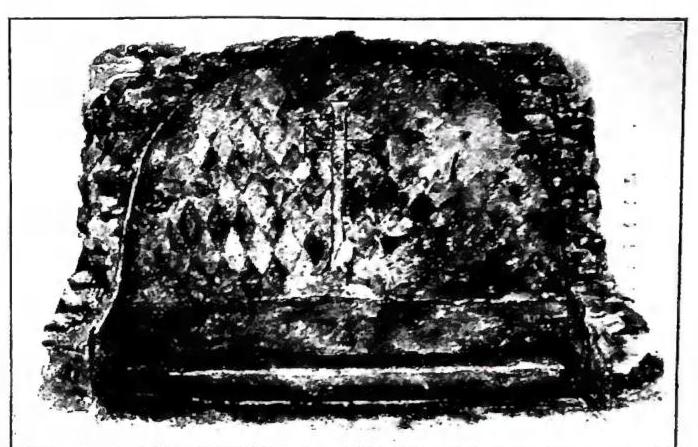
(from L. Blondel, Le caisson funéraires du cimetière d'Agaune et la banlieue du XIe siècle, in Vallesia, 6 [1931], color pl. i.)
SWITZERLAND - Arcosolium decorated with lozenges and a gemmed cross (8th century), discovered in 1947 during the expansion works of the abbatial church. Watercolor by E. Correvon - St-Maurice.
notwithstanding the rivalries of powerful feudal families, such as the counts of Genevois, Gruyère, Savoy, and the barons of Blonay. The bishop held the title of prince-bishop and participated in imperial diets at least since 1125. In 1157, Bishop b. Amedeo granted franchises to Lausanne, and from that time the city council appears, though the inhabitants repeatedly sought to exempt themselves from episcopal authority. In 1434, Lausanne was declared an imperial city; in 1481, unity was achieved between the upper and lower city, and in 1529, a burgomaster was elected. The occupation of Lausanne and the Vaud region by the Bernese (1536), with the subsequent imposition of the Reformation, put an end to the episcopal principality.
o) The abbey of Romainmôtier, in the diocese of Lausanne, a Cluniac priory in the 10th century and generously endowed by Rudolph III, possessed a small lordship, which was governed with wise administration until the Bernese occupation of 1537. In the same diocese of Lausanne, the abbey of Payerne, founded in the 10th century and later affiliated with Cluny, received considerable endowments from the Rudolfini; here too, the Bernese invasion of 1536 put an end to the abbey’s temporal rights.
p) The bishops of Geneva already appear in possession of temporal power since the 11th century, a power contested by the counts of Geneva. Despite the agreement of Seyssel in 1124, the counts of Geneva, later called of Genevois, continued to provoke conflicts against the bishop, to whom Frederick I in 1154 recognized the rights of prince-bishop. From the 13th century, it was the counts of Savoy who attempted to dominate the city, but the latter, organized municipally, preferred to remain under episcopal lordship. However, from 1444 onward, the dukes of Savoy succeeded in seizing the bishopric, placing members of their house or those loyal to it in the position. This interference prepared, by reaction, the ground for the Reformation, which the city embraced in 1535. The Bernese armies, rushing to the aid of the city besieged by the Savoyards (1536), ensured the triumph of the Reformation, and Geneva was able to proclaim itself a republic. The bishop, expelled from the city in 1533, established his see in Annecy, continuing until 1802 to bear the title of prince-bishop.
q) The temporal lordship of the bishops of Sion dates back to 999, the year in which Rudolph III of Burgundy ceded them the county of Valais. In 1189, Henry VI declared the bishop of Sion immediately subject to the empire, and the title of prince begins to appear as early as 1249. To administer their territory, the bishops initially employed hereditary ministeriales, later replaced beginning in the 13th century with removable officials. By 1339, a general council of the country, later called the "diet," was already functioning. The principality of the bishops of Sion faced a formidable external enemy in the counts of Savoy and, internally, the constant action of democrats, or patriots, who sought to reduce
SWITZERLAND - South apse of the church of the monastery of S. Giovanni: the frescoes of the conch and the first zone below, discovered in 1948, are from the Carolingian era, while those of the lower zones date to the late 12th century - Müstair.
patriots managed to have the republic proclaimed in 1627, and the bishop was forced to cede his powers in 1634, with the exception of some honorary prerogatives. The bishop remained nominally head of state until 1798; from 1815 to 1847, he was granted limited participation in legislative power.
r) The abbey of St-Maurice in the canton of Valais, founded in 515 by King Sigismund, was generously endowed by him, which is why the dukes Norberto (c. 735), Uberto (856), Corrado (864), his son King Rudolph I of Burgundy, and his successors until 1032, and later the counts of Savoy, coveted its temporal goods. The abbots found themselves at the head of a conglomerate of lordships, governed by very different statutes and scattered across Valais and Vaud, in the French Jura, the Grenoble region, and the Aosta Valley. These domains were initially administered by a series of ministeriales and later by castellans. The abbots held the right of high justice, which they exercised through regional tribunals, and enjoyed legislative and administrative powers. The temporal rights of St-Maurice suffered a severe blow from the Valaisan, Bernese, and Fribourg conquests of 1475-76 and 1536. From 1571 onward, the abbey had to submit to the protection of the canton of Valais. The temporal dominion of the abbots ended with the revolution of 1798.
s) The cathedral chapters of Lausanne, Geneva, and Sion also possessed, sometimes with the right of high justice, numerous lordships administered by various ministeriales, hereditary or removable castellans. Even the provostry of the Great St. Bernard had its temporal dominion.
t) In the Canton of Ticino, the bishop of Como held various temporal rights since the Carolingian era, which, beginning in the 12th century, he had to cede to the municipality of Como. Another notable ecclesiastical lordship was that of the metropolitan chapter of Milan, consisting of the so-called Ambrosian valleys of Leventina, Blenio, and Riviera. The origin of this lordship dates back to the 10th century; as early as the 12th century, a true ecclesiastical state or county (hence the title of count given to the canons of the Milanese metropolitan) was established in the aforementioned valleys, with communal life, a general council, and statutes. The Visconti in the 14th century then received the investiture of the temporal dominion of Como and the Canons of Milan in the Canton of Ticino. The Swiss occupied Leventina as early as 1403, and the Milanese chapter definitively renounced its temporal power over the Ambrosian valleys in 1487.
7. Religious Life
a) As can be seen, numerous and vast regions of present-day Switzerland found themselves under the temporal government of ecclesiastical princes or lords during the Middle Ages and sometimes until the end of the 18th century: bishoprics, abbeys, and chapters, uniting the two powers, spiritual and temporal, powerfully contributed to the religious development and civil progress of the country. Bishoprics and monasteries became centers of high cultural importance, whose beneficial influences were felt even in the most distant regions of their temporal dominion.From a strictly religious standpoint, the boundaries of the diocese did not coincide with the political ones. Only Sion and Lausanne did not, or hardly, exceed the borders of present-day Switzerland. Most of German-speaking Switzerland belonged to the diocese of Constance, which also extended into southern Germany. Chur reached Vorarlberg and Tyrol. Basel included all of Upper Alsace, and Geneva encompassed all of northern Savoy. Around 1300, there were 66 deaneries or archpriesthoods in the current territory of Switzerland. The cartulary of Lausanne from 1228 records 301 parishes for this diocese; the papal tithe accounts for the diocese of Sion indicate 64 parishes in 1364 and 67 in 1428. The registers of pastoral visitations of the diocese of Geneva count 529 in 1445. While the parish organization had reached its full development in the diocese of Lausanne as early as the 13th century, in the Alpine regions parishes were few in number despite the great distances: this was due to the low population density.
b) All Swiss regions count numerous saints: the best known are the Theban martyrs (v. TEBAEI) with their leader, St. Maurice (v. MAURIZIO). In the diocese of Sion, the bishops Theodore (d. at the end of the 4th century), Salvio or Silvio (425-50), Amatus (d. at the end of the 7th century), and Garinus the Cistercian (1138-1150) are venerated; in the diocese of Lausanne, the bishops Marius (d. 594), Prothasius (d. 659), Amadeus of Hauterive (1144-1159), and Boniface Clutine (1230-39); in the diocese of Chur: Asinius (451), Valentinian (d. 548), Urisicinus (754-58), Adalgott (1151-60); in the diocese of Constance: Conrad (934-75) and Gebhard II (979-95). Among the monks, the following should be remembered: St. Romanus, founder in the 5th century of Condat and Romainmôtier; St. Ambrose (d. 520), one of the first abbots of St-Maurice; St. Imier, hermit at the end of the 6th century; St. Ursanne, disciple of St. Columbanus (d. 615), like St. Gall (d. c. 630-45); St. Amatus (d. c. 630), hermit near Agaunum, later abbot of Remiremont in the Vosges; St. Sigisbert and St. Placidus at Disentis (8th century); St. Othmar (d. 759), restorer of monastic life at St. Gall; St. Magnus (d. 750) and St. Notker the Stammerer (d. 952), both monks of St. Gall.
c) Medieval historical events offered several popes the opportunity to cross Switzerland: Stephen II was met by the ambassadors of Pepin the Short at St-Maurice (753); St. Leo IX (1049-54) and Bl. Eugene III (1145-53) passed through Switzerland, and Eugene III consecrated the church of St-Maurice (1148); Bl. Gregory X, after the Council of Lyon, reached Italy through Switzerland and consecrated the cathedral of Lausanne (1275). During the struggle between Guelphs and Ghibellines, the bishops of Switzerland, who held their temporal power from the emperor, generally sided with the latter. The first Confederate States adopted the same stance. At the initiative of Bishop Hugh of Lausanne, the Truce of God was proclaimed at Montriond in 1036 in the presence of the archbishops and bishops, the lords, and the people of the Kingdom of Burgundy.
d) From the 12th to the 14th century, various religious orders established themselves on Swiss territory, where they erected numerous monasteries and convents; most were suppressed during the Reformation or during the anti-Catholic movements of the late 18th and 19th centuries. The Cistercians appeared in 1124 at Lucelle in the diocese of Basel; the Premonstratensians in 1126 at Lac-de-Joux (Vaud); the Carthusians in 1146 at Oujon (Vaud); the Franciscans in 1216 at Lugano; the Dominicans in 1229 at Zurich; the Augustinians in 1256 at Fribourg; the Antonines in 1304 at Basel. Until the 11th-12th centuries, regular life was led in cathedral chapters, and even longer in about fifty collegiate churches, the oldest of which is that of Solothurn (742). There were also numerous female monasteries: Cistercian nuns, Poor Clares, and Regular Canonesses.
8. From the Western Schism to the Reformation. - The Swiss regions of French language consistently sided with Avignon, which is hardly surprising given that the antipope Clement VII belonged to the family of the counts of Geneva. The German-speaking regions, however, were divided and hesitant: Duke Leopold III of Austria (d. 1386), by placing himself under Avignon obedience, drew in his wake the monasteries of St. Leodegar in Lucerne, Muri, Allerheiligen in Schaffhausen, St. Urban, Wettingen, Kappel, and the chapters of Beromünster, Zofingen, Schönenwerd, and Solothurn. To counter the Habsburgs, the states of Lucerne, Zurich, Zug, Glarus, Schwyz, and Nidwalden, along with the monasteries of St. Gall, Einsiedeln, Engelberg, Stein am Rhein, Zurzach, and Friensberg, remained loyal to Rome. The Cantons of Bern, Uri, and Obwalden, as well as the city of Basel, were inconsistent in their religious policy, shifting allegiance between the two obediences. The diocese of Geneva always adhered to the Avignon obedience, while the other dioceses experienced two episcopal elections: one Avignonese, the other Roman. Notable from this Constance (v.), which ended the schism with the election of Martin V, and Basel (v.), which culminated in the election of the antipope Felix V (v.), crowned in Basel on 24 July 1440 and dissolved in Lausanne on 25 April 1449 after accepting the antipope’s resignation and acclaiming Nicholas V. Thus, for nine years, Switzerland recognized the authority of the antipope.
The numerous ecclesiastical and lay figures who participated in these councils brought the spirit of the Renaissance to Switzerland, and the humanist Aeneas Sylvius Piccolomini, who resided in Basel from April 1432 to September 1433 and from spring 1436 to November 1442, later became pope under the name Pius II. He granted the city council of Basel the privilege of establishing a university, which opened on 4 April 1460 and remained the only one in Switzerland until the 19th century.
9. From the Reformation to the Present Day. - The Swiss religious revival of the 15th century suffered a violent setback in the first half of the following century with the introduction and rapid spread of the Reformation, which found fertile ground in the discontent simmering against prince-bishops and abbot-princes, often foreign and commendatory, due to conflicts over temporal jurisdiction, and against the regular and secular clergy for the worldly life led by some (the Jetzer scandal in Bern). It also thrived in the state of spiritual agitation affecting certain regions, such as Basel, where Swiss humanism flourished with Erasmus, and where men of eminence, some suspect on both religious and political grounds, had gathered. In this environment, the heterodox doctrines of Luther (1520–36) ZWINGLI, HULDRYCH (v.) and their rebellion against ecclesiastical authority found easy acceptance. Zurich, with the assent of civil authorities, became as early as 1519 the driving center of Zwinglian propaganda, which raged in various cantons and subject or allied regions, thanks to the work of fanatical preachers, most notably Johannes Oecolampadius (v.), who spread Zwinglian doctrines in Basel. There, the government and university initially opposed the reformist innovations, but in 1520 the Catholics were overwhelmed, and the reformers indulged in such excesses that Erasmus and several of his admirers, disgusted, left the city for Fribourg in Br. By 1528, Zwinglian preaching had spread to Schaffhausen, Glarus, Appenzell Ausser Rhoden, Bern, St. Gall, and the Grisons. Moreover, as early as 1525, Anabaptists had appeared in Zurich and St. Gall, against whom even Zwingli’s followers turned fiercely. The cantons of Schwyz, Uri, Unterwalden, Lucerne, and Zug remained faithful to the Catholic Church and attempted to stem the schism; Solothurn wavered briefly in the face of the new preaching, while other cantons were forced to split into two parts.
After the war with the Catholic cantons, Bern turned westward and in 1536 came to the aid of Geneva, which was attempting to free itself from the dukes of Savoy. The region of Vaud and the cities of Lausanne, Yverdon, Morges, and Vevey welcomed the Bernese and accepted the reformed doctrines, while Valais remained faithful to the Catholic religion.
(fot. Meerkämper)
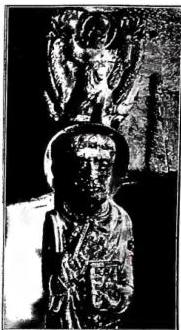
SWITZERLAND - Column with a relief of St. Peter (late 12th century). Chur, crypt of the Cathedral.
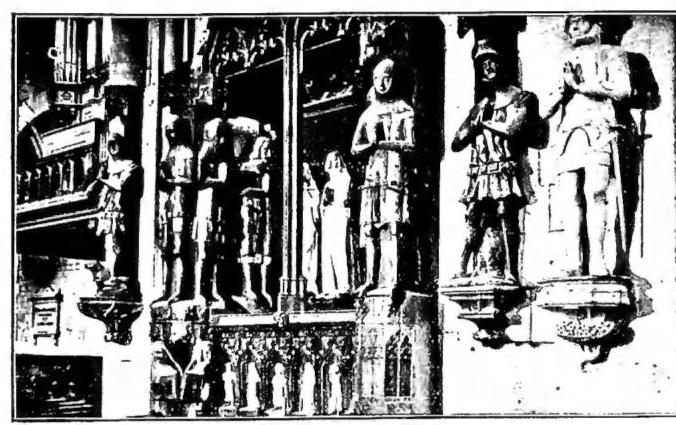
SWITZERLAND - Detail of the cenotaph of the Counts of Neuchâtel (14th-15th century). Neuchâtel, collegiate church.
Catholic. Geneva, freed from the Savoyards, fell into the orbit of Bern with which it had been in a "comburship" since 1526, and thus the reformers had free rein there, including G. Farel and Calvin (v.), who appeared there in 1536. However, since Calvinist doctrine was in conflict with that of the Bernese, the latter, aided by a party favorable to them, managed to expel Calvin and his supporters from the city (1538); nevertheless, at the request of the Genevan city, Calvin returned triumphantly in September 1541 and remained as a true dictator until his death (1564), thus ensuring the triumph of his "City-Church." For political reasons, Calvin made peace with the theologians of Zurich in 1549 (Consensus Tigurinus; the "2nd Helvetic Confession" of 1566 was later to definitively strengthen Swiss Protestantism) and, in 1557, had himself represented at Worms by Beza (v.). With Calvin's death, the religious configuration of Switzerland was fixed and remained so, with the exception of minor changes, until the present day. The Reformed Cantons used the most drastic methods of persecution against the Catholic Church, and Catholics remaining in their territories were frequently harshly oppressed. The bishops of Basel and Geneva had to change their sees, and their territories were significantly reduced; monasteries and collegiate chapters were suppressed, and others had their properties diminished; ecclesiastical temporal jurisdictions were abolished, and churches were profaned. It is worth remembering, however, that the Catholic Cantons, for their part, punished apostates with death.
Although not hastening to implement the decrees of the Council of Trent, the Catholic Cantons formed an alliance with Pius IV on 10 April 1565, and after lengthy negotiations and through the intervention of St. Charles Borromeo (to whom Catholic Switzerland owes much), Gregory XIII sent them an ordinary nuncio on 2 May 1579, in the person of Giov. Francesco Bonhomini, bishop of Vercelli (the first non-ordinary nuncio was Giov. Ant. Volpi in 1559-63). The nuncios made a significant contribution to the Swiss Catholic reform, in which many members of the secular clergy, the Jesuits, and the Capuchins competed. Relations with the Holy See, generally good, experienced difficult moments, for example, in the 18th century due to the controversy over the powers of the nuncio and some civil interference in ecclesiastical matters, as in Chur and Lucerne. At the end of the century, Switzerland was largely hospitable to priests and political refugees persecuted by the French revolutionaries.
In the 19th century, the Catholic Church in Switzerland was again harshly persecuted. The first signs appeared from 1797 with the French invasion and the creation of the Helvetic Republic (1798-1802), which expelled the apostolic nuncio from its territory on 9 July 1798 and suppressed all ecclesiastical temporal jurisdictions. During the Napoleonic period and immediately after the Restoration, lively disputes arose over the establishment of new dioceses or the reorganization of the old ones, which were regulated by various agreements with the Holy See, now collected in the third volume of Lampert. But open conflict against the Church began in 1830 and was waged by all means by the radical party, which triumphed in 1847 with the defeat of the Sonderbund (v. above). Persecution intensified further during the time of the German Kulturkampf (v.). However, radicalism was slowly moderating, and Swiss Catholics immediately took advantage of this to resume their activities and heal the wounds inflicted by persecution: they distinguished themselves especially in the social field, with the creation of trade unions and numerous welfare works for the working class, and in the cultural field with the establishment of the Catholic University of Fribourg (1889), which quickly became an international center of higher learning. In the political field, too, they achieved notable successes, and the Ticinese Catholic Giuseppe Motta (d. 23 January 1940) was elected five times president of the Confederation from 1915. During the world wars of 1914-18 and 1939-45, Swiss Catholics distinguished themselves for their welfare work among the affected civilian populations and prisoners of war; and it was precisely these charitable contacts of the "Swiss Catholic Mission" with the Holy See that led the latter to send a representative to the Federal Government in 1917, elevated to the rank of Apostolic Nuncio on 17 August 1920.
Catholics currently number 1,666,000, distributed across 6 dioceses, all immediately subject to the Holy See: BASEL and LUGANO, CHUR, LAUSANNE GENEVA and FRIBOURG, ST. GALL, SION; and two "nullis" abbeys: ST-MAURICE and OUR LADY OF EINSIEDELN. The Catholic Cantons are: Valais, Ticino, Obwalden and Nidwalden (Unterwalden), Schwyz, Uri, Appenzell Inner Rhoden, Lucerne, Zug, and Fribourg. Protestants number 2,300,000. The Cantons with an absolute Protestant majority are: Vaud, Neuchâtel, Zurich, Schaffhausen, Appenzell Ausser Rhoden, Glarus, and Grisons; with a slight Protestant majority: Geneva, Bern, Solothurn, Basel (city and countryside), Aargau, Thurgau, and St. Gall.
Leone Dupont Lachenal-A. Pietro Frutax
V. RELATIONS WITH THE HOLY SEE
Legal Status of the Church. - Given the particular political configuration of Switzerland, the legal situation of the Church must be considered according to the individual ecclesiastical circumscriptions into which the territory of the Republic is divided.8. Diocese of Lausanne, Geneva, and Fribourg
It encompasses the Cantons of Fribourg, Vaud, Geneva, and Neuchâtel. The government has no involvement in the appointment of the bishop, nor in that of parish priests, with the exception of the parish priest of the cathedral of St. Nicholas in Fribourg, elected by the bourgeoisie of the city from three candidates presented by the bishop (bull Sollicitudo omnium Ecclesiarum, 17 Oct. 1924, AAS, 17 [1925], pp. 56-61). The cantonal government does, however, have a say in the appointment of the ten residentiary canons of the Chapter of St. Nicholas, according to the norms established in the aforementioned bull.9. Diocese of Basel and Lugano
It extends across the Cantons of Solothurn, Lucerne, Bern, Aargau, Zug, Basel, Thurgau, and Schaffhausen. The Convention concluded between Leo XII and the Cantons of Lucerne, Bern, Solothurn, and Zug on 26 March 1828 remains in force; it regulates the composition and endowment of the cathedral chapter, the appointment of canons, the endowment of the episcopal mensa and the seminary, and grants the cathedral senate the right to appoint the bishop, provided that no candidate under consideration is persona non grata to the cantonal governments (brief Quod ad rem of the same Pontiff, dated 15 Oct. 1828). Subsequent and more recent agreements have regulated the appointment of provosts and canons of the two collegiate churches of St. Leodegar in Lucerne and St. Michael in Beromünster, of the rectors of curate benefices, of theology professors in the seminary and of religion teachers in cantonal schools, as well as their economic treatment by the government. 3. Diocese of St. Gallen. - It comprises the Cantons of St. Gallen and Appenzell. According to the Convention of 7 Nov. 1845, still in force, the bishop is elected by the cathedral chapter and must be a person not objectionable to the Supreme Catholic Council, which in the homonymous Canton oversees the interests of the Catholic population. Prior approval from the Holy See is also required. 4) Diocese of Chur. - It comprises the Cantons of Graubünden, Schwyz, Obwalden and Nidwalden, Uri, Glarus, Zurich, and the Principality of Liechtenstein. The cathedral chapter has the privilege of electing the bishop from three candidates proposed by the Holy See. Some difficulties exist in the Canton of Zurich, where that government, in addition to not recognizing the bishop of Chur, acknowledges only three of the over twenty parishes existing in the territory, and only to these does it grant subsidies. 5. Diocese of Sion. - It comprises the Canton of Valais, excluding the part entrusted to the nullus abbey of St-Maurice. The appointment of the bishop is made freely by the Holy See, after ensuring that nothing, from a political standpoint, opposes the election of the candidate. 6. Apostolic Administration of Ticino. - It has been the subject of three Conventions: of 1 Sept. 1884, 23 Sept. 1884, and 16 March 1888. Ticino is nominally aggregated to the diocese of Basel, whose bishop also bears the title of Lugano. In fact, however, it constitutes a proper diocese, distinct and independent. The appointment is made by the Holy See in agreement with the bishop of Basel and must fall upon a Ticinese priest. The administrator has episcopal character.Other matters concerning the legal status of the Church, such as the juridical personality of the Church itself, the protection of the Catholic religion by the State as the religion of the people, the free administration of ecclesiastical goods, their exemption from taxes, freedom of teaching, religious instruction, the legal recognition of religious Orders and congregations, government contributions to ecclesiastical entities and to worship expenses in general, etc., are resolved differently from canton to canton. All Constitutions, however, guarantee freedom of conscience, religion, and worship. The Holy See maintains diplomatic relations with Switzerland. An apostolic nuncio is accredited to the federal government, though without reciprocity.
VI. LITERATURE
It would be more accurate to speak of "literatures," given that this is a multilingual, indeed quadrilingual, country. Swiss literary production in German, French, and Italian might suggest a foreign appendix to the literatures in those languages. This is true only to a certain extent: there exist, in fact, numerous writers, talents, and tendencies that properly belong to Switzerland. The exposition will be limited to the 19th and 20th centuries: the 17th and 18th centuries—if one sets aside Rousseau, who belongs more to France than to Switzerland, and Pestalozzi, an inspired pedagogue rather than a writer—were centuries of culture, theology, and science. Above all, "pastors" wrote, directed journals, and discoursed on literature, morality, religion, etc. Only in the 19th century did Switzerland finally express itself through the novel and the short story, sometimes through poetry, but not yet through theater.1. Literature of German-speaking Switzerland. - In the 19th century, three great narrators stand out: Gotthelf, Keller, and Meyer. Jeremias Gotthelf (1797-1854), a "pastor" misunderstood by his parishioners, wrote stories for almanacs to make himself better understood and, subsequently, novels in which he depicted the rural environment of the Emmental at a time when the patriarchal—and matriarchal—spirit was threatened by the spirit of the new age, by attachment to money, by egalitarian radicalism, etc. He reacted against these trends and thus wrote thesis-driven books, even inserting sermons into his stories; but his perfect knowledge of his region and its people allowed him to evoke them so powerfully that the intent to preach a return to family, Bernese, and Christian tradition is forgotten. Gottfried Keller (1819-91), by contrast, did not preach. A petty bourgeois, his admirable stories express a bourgeois and civic spirit. He is the master of the long novella, in which the protagonist, through errors, loves, and disappointed ambitions, returns to reason and home. The prodigal sons he portrays ignore the path of repentance set forth in the Gospel. Keller is also the author of a splendid Bildungsroman: Der grüne Heinrich. He had wanted to be a painter and, like Rousseau, loved solitary walks: thus, in his work, nature is as alive as his characters. Conrad Ferdinand Meyer (1825-98) was the first in Switzerland to confer dignity upon the historical tale. This patrician of Zurich was fascinated by the Italian Renaissance and its prestigious decorum; but he never lost touch with the severe Protestantism in which he was raised. His novellas possess an imposing stylistic perfection, but, like his poems, they remain compelling due to the inner conflict, the hidden tragedy they suggest, which tormented the author throughout his life.
To these three great figures one might add the poet Carl Spitteler (1845-1924), one of the isolated epic talents of his century, though he did not exert the influence of the former. Each of these writers, in fact, has his epigones today. Many, following Gotthelf, have described domestic crises, stories of dynasties or dominions, often under skies not too dark or at least tending toward hopeful endings. Thus, Rudolf von Tavel (1866-1934) narrated the deeds of numerous Bernese characters and their kin; Josef Reinhart (b. 1875) recounted many anecdotes from the canton of Solothurn; Alfred Huggenberger (b. 1867) depicted the life of the populations of Thurgovia, etc. The literature, as one can see, is provincial and often, due to dialect, difficult for foreign readers to access.
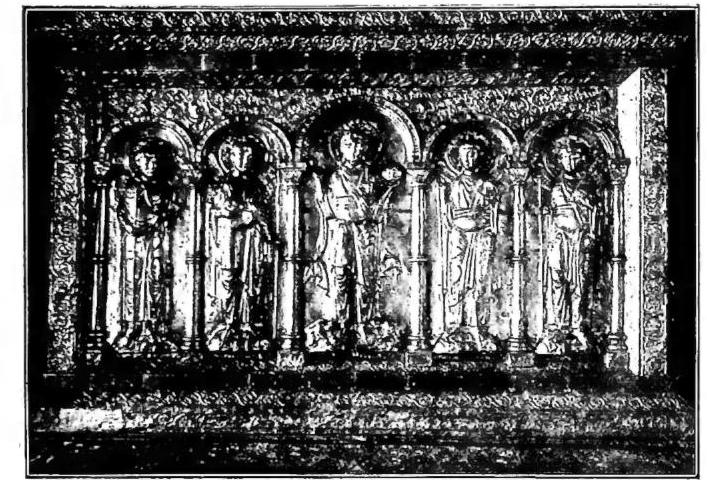
Beyond the legacy of the 19th century, new phenomena have emerged. Theater, first of all, which, with César von Arx, Max Frisch, and Fred Dürrenmatt, has asserted itself significantly in a country where theater previously did not exist. Furthermore, there is that seductive genre, the "novel of escape" or "of spiritual elevation," cultivated by the anthroposophist Steffen. One would like to dwell further on this contemporary literature, where the strange often insinuates itself, as if a magic wand had touched beings, places, objects. See the stories of Cécile Lauber, of Cécile Inès Loos, and, above all, of Regina Ullmann. These new phenomena (and one should
SVIZZERA - Gold pallotto donated by Henry II to the Cathedral of Basel (11th century); Christ between St. Benedict and the archangels Michael, Gabriel, and Raphael. At Christ's feet, the donors - Paris, Musée de Cluny.
the phenomena just outlined, which also emphasize the development of "lyricism," are taking on an increasingly important role.
10. Literature of French-speaking Switzerland
In French-speaking Switzerland, the 19th century is also represented by three authors, though their character differs entirely from those previously mentioned. Alexandre Vinet (1797-1847), author of essays on moral philosophy, discourses on religious topics, freedom of worship, etc., was a Protestant thinker of broad views, more Christian than Protestant. His literary criticism is particularly admirable: Pascalian criticism, in the sense that for him the works of the spirit bear witness to our misery and our potential for greatness (through the Grace of God), both in what they express and what they conceal. Thus, for those who reflect, the study of literature serves to establish the necessity and truth of the Evangelical Revolution. Henri-Frédéric Amiel (1821-81) did not write for a wide audience but primarily for himself and for those concerned with the inner life. From the 16,000 pages of his Journal intime, two volumes were extracted, then three, followed by unpublished fragments. The Journal offers a spectacle of intellectual and spiritual life; it reveals the author’s friendships, his walks, his amorous inclinations, his religious quest, and above all that "indefinite hospitality of thought" that characterizes him. He wanders between Leibniz and Spinoza, between the biblical God and the call of pantheism, between freedom and sanctity. No one better than Amiel represents what is international in the Swiss spirit. Rodolphe Toepffer (1799-1846) also left pages of art criticism, along with one or two novels, short stories, and those astonishing Albums that have delighted four generations. Here, at last, amid a literature of intellectuals, is a writer of imagination, a humorist, Christian like Vinet, a good citizen of a tiny republic (Geneva), who meditates on happiness, "always a relative thing," and teaches the most smiling wisdom. Beyond these three, Marc-Monnier (1829-85), who recognized that Italy "is not at all the land of the dead," and Juste Olivier (1804-76), whose songs express the poetry of the dead and Swiss memories, must also be remembered.The three principal writers of the 19th century left no successors. They are venerated, reprinted, but little followed. For the literary landscape of French-speaking Switzerland has changed considerably since 1900. A generation of thinkers and critics has been succeeded by a generation concerned with creation and invention. A great poet, C. F. Ramuz, meanwhile emerged. Furthermore, the Catholic portion of the French-speaking region, long silent, found an eloquent and brilliant interpreter in Gonzague de Reynold (b. 1880)—historian, lyric and epic poet—and later, narrators such as Léon Savary, Maurice Zermatten, Corinna Bille, etc. Finally, French-speaking Switzerland, more consciously Swiss than ever, is, from a literary standpoint, closer to France than in the past. C.-F. Ramuz (1878-1947) is the greatest figure of 20th-century Swiss-French literature. Reading him, one would believe that waters and mountains, seasons, human conduct, the inflection of voices—everything is captured and reproduced for the first time. And Ramuz represents, alongside the properly French tradition, the purest and noblest effort of verbal expression, of transposing into words the immediate reality that has manifested itself in French-speaking Switzerland.
The literary geography of the region has grown more complex. Today, one finds the analytical novel, not an indigenous product but imported from France, which has yielded excellent results with Robert de Traz (1884-1951), Jacques Chenevière (b. 1886), Bernard Barbey, etc.; the anticipation novel, with Noëlle Roger (b. 1874); the fantastic and poetic novel, with Pierre Girard and Jean Marteau; the novel of spiritual elevation, with Monique St-Hélier; the picturesque and highly moral tale, with Benjamin Vallotton (b. 1877). It seems that the most original and representative writers today are: in the wake of Ramuz, though more humane and with a highly personal talent, C.-F. Landry, and in the field of psychological analysis, Jacques Mercanton. And, as in German-speaking Switzerland, the theater has developed considerably since 1900 (René Morax [b. 1873] and his Théâtre du Jorat, etc.); similarly, with Henry Spiess (b. 1876), later René-Louis Piachaud (1896-1941) and Gilbert Trolliet, and today with the Christian poet Edm. Jeanneret, lyric poetry has found its voice.
11. Literature of Italian-speaking Switzerland
Italian-speaking Switzerland came late to literary creation. Its tradition was one of art (architecture, painting, decoration). For this very reason, Ticino asserted itself in Italy and Europe. In the 18th century, Fr. Soave (1743-1806) was nothing more than a polygraph, a translator, a pedagogue. But from the beginning of this century, Italian-speaking Switzerland has had its great poet, who over the years became the master of the short story: Francesco Chiesa (b. 1871), whom Italy adopted from his earliest works. His attachment to his birthplace, to every aspect of the corner of the world where he grew up, is also found in Giuseppe Zoppi (1896-1952) and Guido Calgari.Poetry, too, in Italian or dialect, has developed over the last twenty years. The most gifted author of the younger generation is undoubtedly Felice Filippini, author of Il signore dei poveri morti, as well as sculptor, painter, and musician.
BIBL.:
1) J. Nadler, Literaturgesch. der deut. Schweiz, Leipzig 1932; J. Moser, Le roman contemporain en Suisse allemande, Lausanne 1934.
2) various authors, Littér. de la Suisse, Paris 1938; P. Kohler, Hist. de la littér. française, III, Lausanne 1949; Ch. Clerc, L'Ame d'un pays, Neuchâtel and Paris 1950; Weber-Perret, Ecrivains romands, Lausanne 1951.
3) Scrittori della S. ital., publ. by the Dipartimento della pubblica educazione del Canton Ticino, 2 vols., Bellinzona 1936.
Carlo Clerc
VII. ART
The remains of sacred constructions in St-Maurice and Geneva date back to the period of the first expansion of Christianity in Switzerland (4th-5th centuries), while the primitive nucleus of the church of Romainmôtier dates to the first half of the 7th century. In Riva S. Vitale (v. LUGANO), however, there is a baptistery, built at the beginning of the 7th century, which is the oldest entirely preserved sacred monument in Switzerland.After the partial destruction of Christianity by the Alemanni following their invasion in the 5th century, new missionary currents emerged in the 7th century thanks to the Franco-Irish apostles, St. Columbanus and his followers, from whose cells a series of Benedictine monasteries originated in the 8th century, including
St. Gall with its famous scriptorium, its library of insular and Carolingian illuminated manuscripts, and the plan of the Abbey dating to around 820, the foremost document of early medieval architecture. With the single-nave churches (Saalkirchen) of the Grisons, featuring three horseshoe apses (Müstair, Mistail, Disentis, Chur, etc.), mostly from the 9th century, a type of construction appears that can be said to be unique to the Rhaetian region. An idea of their decoration is provided by the stucco fragments of Disentis, the most significant example of this genre north of the Alps, and by the valuable New Testament frescoes of Müstair, dating to around 800 and discovered in 1948, which are unique in their kind. Of the few Carolingian circular crypts north of the Alps, two with traces of pictorial decoration are found in St-Maurice—which also possesses unusual inlaid enamels—and one in Chur; meanwhile, the crypt of Disentis has entirely distinctive characteristics.
A particular group of sacred buildings arose in the 10th and 11th centuries in the countries belonging to the Kingdom of Upper Burgundy (Amsoldingen, Spiez, Schönenwerd, Zurzach, Beromünster, St-Imier, etc.), mostly flat-ceilinged basilicas with three apses and no transept, related to the churches of Lombardy and Piedmont. The Cluniac reform movement gave rise in the 11th century to two important buildings that, as basilicas with transept and apsidal choir—except for the vaulting and the absence of a crypt—follow the second construction of Cluny: Romainmôtier (initially with a flat ceiling), whose western forecourt (Westwerk) resembles that of Tournus; and Payerne, which, begun with a western forecourt and a finely articulated choir, was completed only in the 12th century. From Hirsau, the center of the German reform movement, Schaffhausen received in its Cathedral, consecrated in 1104, the finest example of the Hirsau type. From the Ottonian period, the famous golden antependium (Paris, Musée de Cluny), donated by Emperor Henry II to the Cathedral of Basel, and the panels of the Apostles and St. Vincent have been preserved.
In the 12th century, the Zurich Minster was completed as a true basilica with a matroneum, initially built in imitation of the Basilica of Sant'Ambrogio in Milan. The Cathedral of Chur (c. 1150-1250) belongs to the late Romanesque period; as a basilica without a transept, with vaults and pointed arches partly featuring horseshoe ribs, and rich in plastic decoration, it seems to combine Lombard, Burgundian, and southern French influences. In Ticino, the style of the century is most clearly represented by San Nicolao in Giornico. Another singular church is that of the priory of Grandson, dependent on the Abbey of La Chaise-Dieu in Auvergne, where Auvergnat architectural influences are evident. In the 12th century, a series of Cistercian churches arose, whose architectural type—apart from the choir renovated in the Gothic period—has been preserved in all its purity at Hauterive (founded in 1137). As early as 1185, the magnificent late-Romanesque Minster of Basel (v.) was built, whose original character was seriously damaged by the Gothic vaulting and choir of the 14th century (after the 1356 earthquake); in its wall articulation, it recalls the Cathedral of Modena, while in its pointed arches and ribbed vaults, it follows Burgundian models. It is cruciform, later expanded to five naves; it possesses a crypt, whose ambulatory suggests a sunken choir ambulatory, and the famous portal known as the Gallus Portal.
In sculpture, carved wooden Madonnas and Crucifixes from Valais, the Grisons, and central Switzerland deserve mention. In painting, alongside the stained glass of Flums and the frescoes of Montchérand, Payerne, Spiez, Degenau, Prugiasco, and Rovio, the painted wooden ceiling of Zillis, executed around 1140, stands out as the oldest preserved in Europe. At Engelberg, manuscript illumination flourished. In goldsmithing, the various relics of St-Maurice, the chalice of Eptingen in Basel, Engelberg (v.) hold a notable place in the history of art. Belonging to the early Gothic period is Switzerland’s most beautiful cathedral, Notre-Dame of Lausanne (v.), begun in 1173, which, despite its already classical tripartite wall division above the triforia and along the windows, still retains a gallery reminiscent of Norman models. Its distinctive features include a closed narthex with apses on both sides and one of its particular ornaments, the southern rose window, designed by Villard de Honnecourt, whose magnificent stained glass has no equal in Switzerland. Evidently in relation to Lausanne, St. Peter’s in Geneva (v. vol. VII, tav. CIX) was also largely completed by 1232. From the second half of the 13th century onward, numerous churches of the mendicant orders and parish churches modeled after them followed a more or less uniform scheme, with a flat-ceilinged basilical nave and a long choir covered by a stellar or ribbed vault. The Franciscan church in Basel surpasses all others in size, while the simpler one in Königsfelden (1311-30) features stained glass that ranks among the finest of the period (others at Blumenstein, Oberkirch, and Kappel, all around 1300). The characteristic style of their figures, typical of the artistic milieu of southern Germany in the first half of the 14th century, is also represented by the frescoes of Oberwinterthur and those of the "Master of Waltensburg" in various churches of the Grisons, while in the last third of the century, visible Giottesque influences appear on the southern slopes of the Alps (e.g., in Brione, Verzasca). In sculpture, the first half of the 14th century, under the influence of mysticism, produced a series of devotional sacred images carved in wood, as well as various crucifixes, pietàs, and saints' tombs (Ems), particularly the group of Jesus and John from Katharinental. Stylistically parallel to these are some works of architectural sculpture (the main portal of the Basel Minster and the southern portal of St. Nicholas in Fribourg; both under the influence of early 14th-century Strasbourg). Around the middle of the century, sacred images and Madonnas in the so-called "precious style" followed (e.g., in the Spalentor in Basel). With the exception of the choir of the Basel Minster, 14th-century Gothic architecture created nothing of significance.
On the contrary, late Gothic spread even into the most remote mountain valleys, as evidenced especially by the many village churches of the Grisons. The principal work is the collegiate church of Bern, a transept-less church with a frontal tower (completed in the 19th century) akin to the cathedral of Ulm, begun as early as 1421 by Matteo Ensinger, son of the builder of the Ulm cathedral, and finished in the same style in 1575. The historiated stained-glass windows of the choir, interesting from an iconographic point of view, can be considered, together with those of Staufberg and Biel, as the main work of Swiss stained-glass painting of this period. Similarly designed as a basilica was the church of S. Osvaldo in Zug, with a fine figured portal, begun by Franz Felder of Öttingen (Bavaria). Alongside this architectural type, which had by then fallen out of fashion, there are only a few examples of typical late Gothic hall churches (Hallenkirchen) with three naves of equal height: the church of S. Leonardo in Basel, begun by Niesenberger of Graz in 1490, and the churches of Raron and Savièse in Valais, as well as that of the monastery of Müstair, originally Carolingian but rebuilt with three naves at the end of the 15th century. The richest cloister of this period is found in the monastery of Mariaberg in Rorschach, where, among others, Erasmus Grasser worked. In churches spared by the iconoclastic wave, especially in the Grisons and Valais, numerous polyptychs have been preserved, particularly from the second half of the 15th century and the beginning of the 16th. While Valais, western and central Switzerland turned especially to local workshops (Basel, Bern, Lucerne, etc.) linked to the Rhenish artistic milieu (the finest altarpiece is in Münster in Valais, a work by Jörg Keller of Lucerne, 1209), the Grisons and northern Switzerland were supplied by Swabian workshops (one of the most notable altarpieces is in Stürvis, the largest in Chur by Jakob Russ of Ravensburg, with numerous works by Ivo Strigel of Memmingen, etc.). Panel painting of the first half of the century is represented, besides the Madonna among the Strawberries of Solothurn, still influenced by the "precious style," by Konrad Witz, the "Masaccio of the North," with his polyptych featuring scenes from the History of Salvation in Basel, partially preserved, and with his altarpiece in Geneva.
In the second half of the century, they are immensely
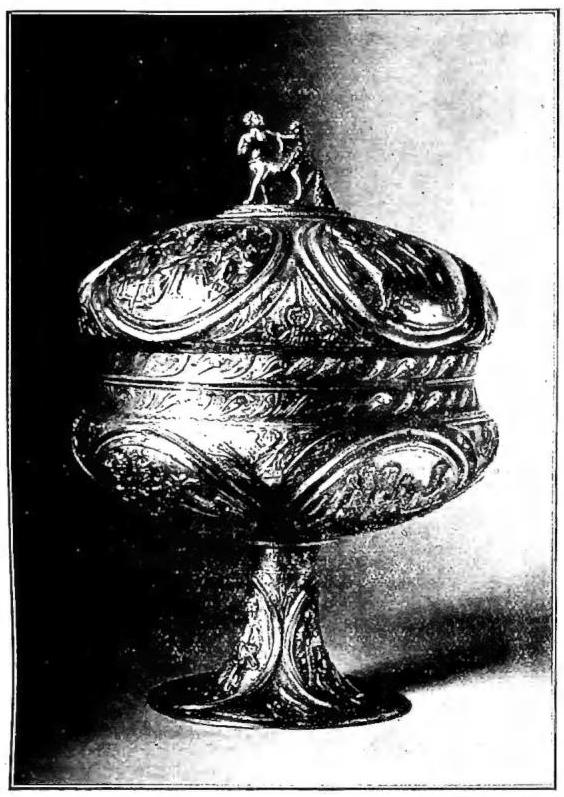
The Jesuit Church in Lucerne (1666-78) and, in relation to it, the Jesuit Church in Solothurn (1680-88) and the cathedral of Arlesheim (1680-81) by Giacomo Angelini, so to speak, inaugurated the Baroque, which triumphantly conquered the Catholic districts and even in the most remote Alpine regions erected enchanting chapels and churches as if by magic, causing many ancient buildings to disappear. The new style did not come directly from Italy
(where it was propagated, among others, by the Ticinese D. Fontana and Maderno), but was rather brought into southern Germany and Austria by southern Swiss and Mesolcinesi such as Zuccali, Viscardi, Barbieri, Angelini, Bertalli, and from there spread into Switzerland in a new form. Architects and builders from Vorarlberg, such as the Thumb, Beer, and Moosbrugger families, played a significant role in this regard. From their collaboration emerged, from 1700 onward, Baroque churches with three naves, variations on the so-called Vorarlberg cathedral scheme: Rheinau, St. Urban, Münsterlingen, Katharinental, Disentis, Pfäfers, etc.; then, as an expansion of this through the combination of longitudinal naves with a central structure, such as the vast complex of Einsiedeln by the skilled Gaspare Moosbrugger and the magnificent abbey church of St. Gall, built in 1752 with the participation of several architects and also strongly influenced by Gaspare Moosbrugger's designs. In Muri, a Romanesque basilica in the shape of a cross was already united in 1695-98 with a grand octagon. The decoration of these churches, through paintings, stuccoes, choir stalls, wrought-iron grilles, and organs, was contributed by very famous artists such as the Asam brothers in Einsiedeln, Appiani in Arlesheim, Giuseppe Antonio Feuchtmayr and Wenzinger in St. Gall, Zeiller in Fischingen—all, except the Asam brothers, artists of the airy Rococo. Also celebrated and active were the Schmutz, Barbieri, Giovanni Betini, the Stauder of Constance, and Francesco Ludovico Hermann.
In central Switzerland, two families of architects, both emigrated from Austria—the Singer and Purtschert families—built numerous imposing parish churches such as Sarnen, Schwyz, and Ruswil. Melchior Wyrsch of Nidwalden, educated in France, distinguished himself as a painter of altarpieces. In Valais, from the last quarter of the 17th century to the end of the 18th century, a flourishing art of carving and altar construction developed, whose most notable representatives, the Ritz and Sigristen families, supplied numerous works to the Grisons and central Switzerland. Among the few Protestant Baroque churches, the Church of the Holy Spirit in Bern stands out. The Church of St. Ursus in Solothurn, built in 1762-73 by Gaetano Matteo Pisoni of Ascona and his nephew Paolo Antonio in neoclassical style, closes the grand and fruitful Baroque era. As a noteworthy architectural work, the otherwise sterile historicism of the 19th century produced the Protestant Elisabeth Church in Basel, and in painting, the highly active Paolo Deschwanden represented the "Nazarene" tendency.
A new and fruitful revival of sacred art occurred in all sectors in the 20th century, when, with religious seriousness and a sense of artistic responsibility, efforts were made to ensure that form corresponded to liturgical requirements. The Church of St. Anthony in Basel, an important work by Carlo Moser (1925), inaugurated the numerous reinforced concrete churches by Metzger, Baur, and others. Their decoration was executed by numerous sculptors (von Matt, Schilling, Rossi), painters (Stocker, Cingria, Severini), goldsmiths (Burch, Feuillat), and embroiderers (Sister Augustina Flücher). Thanks to these works, Switzerland has assumed a leading position, especially in architecture, in contemporary sacred art.
VIII. EDUCATIONAL SYSTEM
In Switzerland, a confederation of twenty-two Cantons, three of which are divided into two half-Cantons, education does not depend on the central government, nor is there a Federal Department of Public Instruction. The Cantons and half-Cantons are sovereign in educational matters; thus, there are 25 departments of public instruction in Switzerland. This situation is explained by the country's history and takes into account differences in language (German, French, Italian, Romansh), religion, cultures, and the particular needs of each region.The Federal Constitution, however, provides some guidelines. It requires, without further specification, that sufficient, free, and compulsory primary education be provided in all Cantons; it does not claim a monopoly on education for the Cantons but simply demands that all children receive an education at least equal to that determined by the official programs of the Cantons in which they live. The establishment of private schools is thus permitted under certain conditions specified by cantonal law. The Federal Constitution further requires that all children be able to attend school without their freedom of conscience and belief being infringed, a requirement that does not imply absolute neutrality in schools. Thus, different Cantons (Catholic or Protestant) have denominational schools. Although the Federal Constitution stipulates that official schools be placed under state direction, clergy, religious men and women may hold positions in public education. A number of federal laws, ordinances, and decrees have influenced education, such as the provision of the federal military organization that mandates an examination (written and oral) for recruits, the results of which are communicated to the various directors of public instruction; the federal law of 26 June 1930, which sets the minimum age for entering apprenticeship at 15 years; the provisions of the federal military organization on the teaching of gymnastics in primary schools and normal schools; the regulation according to which only those with a maturity recognized by the Confederation are admitted to federal examinations for medical professions and to the "Polytechnicum" without examination.
The Cantons, often in collaboration with municipalities, are responsible for education. At the head of the cantonal educational organization is the department of public instruction, directed by a member of the government and assisted by a council; inspectors are tasked with supervising the classes under its jurisdiction. In each municipality, a school commission oversees the proper functioning of schools.
Kindergartens are generally run by private associations, religious congregations, etc. The age of admission to primary school varies by Canton, from 6 to 7 years; the duration of compulsory schooling likewise varies between 7, 8, or 9 years. It includes primary school (elementary level, attended by all children and serving as the foundation for further education; upper level, which gathers children not attending other schools), secondary school, an institution unique to Switzerland, with different names depending on the region (Realschule, district school, etc.), which, depending on its organization, leads in 2 or 3 years either to the end of studies or to entry into a higher school (gymnasium, vocational school, etc.). Children who do not attend one of these schools or do not enter an apprenticeship are required to attend complementary courses (a few hours per week) until the ages of 16–17 or 17–18. In large cities, there are special classes for underachievers. Primary school teachers are generally trained in normal schools (cantonal or municipal), while secondary school teachers are trained at the university.
Secondary schools (with different names depending on the region) prepare students, over a varying number of years based on the level of preparation required for admission, for one or more types of baccalaureate (or maturity): type A, Latin-Greek; type B, Latin-modern languages; type C, mathematics-sciences. Some prepare for a commercial maturity. Their teachers come from universities; for specialized subjects, from specialized schools (fine arts, music).
Universities (Basel, Bern, Fribourg, Geneva, Lausanne, Neuchâtel, Zurich) depend on the Cantons that established and support them. St. Gallen has a commercial university. The Confederation has never exercised its right to establish a university. Only the "Polytechnicum" of Zurich is under its jurisdiction.
Also noteworthy are the types of schools found in almost all Cantons in various organizational forms: industrial, commercial, and vocational schools; agricultural schools; schools of arts and crafts, fine arts, and conservatories; technical institutes, etc. Additionally, there are home economics schools, women's social schools, nursing schools, childcare schools, the many forms of boarding schools, alpine lyceums for children with delicate health, and all varieties of institutions for disabled children (blind, deaf-mute, mentally disabled, etc.).
Pedagogical associations that bring together different categories of teachers are numerous. The pedagogical press is represented by numerous journals and is widely disseminated. - Vedi tavv. CXIV-CXVII.