
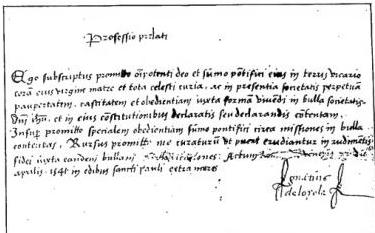
COMPAGNIA DI GESÙ. – A religious order of Regular Clerics, founded by s. Ignazio di Loyola (v.) and approved by the Holy See in 1540. Its members are commonly called Jesuits. The earliest origins of the C. di G. date back to 1534, when s. Ignazio gathered in Paris a first group of carefully chosen companions, desirous of devoting themselves to the good of souls; it took more definite shape later in Rome, in 1539. The fundamental principles, collected in a brief Formula Instituti Societatis Iesu, were verbally approved on 3 September 1539 by Paolo III, who in the following year officially confirmed the new Institute with the bull Regimini militantis Ecclesiae of 27 September 1540.
SUMMARY:
I. Organization
II. Historical development.I. ORGANIZATION
1. The Institute. The body of legislative texts of the C. di G., whether originating with s. Ignazio or dating from a later period, constitutes the Institutum Societatis Iesu (complete editions: Antwerp 1635, 15 vols.; Prague 1705 and 1757, each in 2 vols.; Avignon 1827-93, 7 vols.; Rome-Florence 1869-91 and 1892-93, each in 3 vols.). Its essential parts are as follows:1) the papal bulls of approval or granting of privileges. - 2) The Constitutions of s. Ignazio, preceded by a General Examination for the use of candidates. Each of the ten parts of the Constitutions is accompanied by “declarations” (critical edition of the Constitutions in the Monumenta historica S. I., vols. 63-65, Rome 1934-38; extensive historical and ascetical commentary: J. M. Aicardo S.I., Commentario a las Constituciones de la Compañía de Jesús, 6 vols., Madrid 1919-32). - 3) The Spiritual Exercises of s. Ignazio which, without being a legislative document, provide the animating spirit of the C. di G. (critical ed. in the Mon. hist. S. I., Madrid 1914). - 4) The Rules, among which one series, Summary of the Constitutions, is an extract of the passages of greatest ascetical importance from the Constitutions; the others, Common Rules and Rules of the Various Offices, break down the great ascetical principles into practical prescriptions. - 5) The Decrees and canons of the General Congregations; the formulas or regulations for the celebration of these General and Provincial Congregations may also be added. - 6) The Instructions and ordinances issued or caused to be issued by the Father Generals, and especially multiplied by Fr. Acquaviva. Two were of exceptional importance: the Directory on the manner of giving the Spiritual Exercises (definitive ed., Florence 1599; critical ed. with the Exercises in the Mon. hist. S. I., Madrid 1914), and the Ratio atque Institutio Studiorum S. I. (definitive text, Naples 1599; scholarly edition by Fr. Pachtler in the Mon. Germaniae Paedagogica, V, Berlin 1887; Italian trans. by Fr. Barbera, Padua 1942; not included in the volumes of the Institutum); the Circular Letters of the Father Generals to the entire Order are predominantly paraenetic in character. - For practical purposes, a compendium or Epitome Iustituti Societatis Iesu was compiled (Rome 1689; reprints 1704, 1847, 1882). It was completely revised (1924) after the publication of the new code of canon law.
The form of religious life followed by the C. di G. is that of the Clerics Regular, which arose precisely in the sixteenth century (with the Theatines, Somaschi, Barnabites, etc.) and which abandons many of the external observances of the ancient orders, emphasizing instead the apostolic practice of priestly ministries.
2. The Purpose. - The purpose of the C. di G. is twofold: to obtain the greater glory of God both through personal sanctification and through the salvation and perfection of one’s neighbor. The official texts explain this apostolic end as follows: the defense and propagation of the faith and the advancement of souls in Christian life and doctrine, by means of preaching, spiritual exercises, catechisms, the administration of the Sacraments, and other priestly ministries, without excluding the other works of spiritual and even temporal mercy. The forms of the apostolate are not rigidly limited, but adapt themselves with great flexibility to the needs and possibilities of the age.
An innovation introduced by s. Ignazio was the length of formation and the gradual process by which new recruits were incorporated into the Order, with the consequent distinction of categories or grades among the religious. After two years of novitiate with their “experiments,” the three simple and perpetual public vows place the students in the category of approved scholastics, true religious (“professed” in the common terminology of law), bound to the Order, which, however, is not yet unconditionally bound to them. After studies in letters, philosophy, and theology (ordinarily separated by several years of teaching), and a third year of probation (another Ignatian innovation), the final vows confer the definitive grade: either the solemn profession of four vows (the fourth being one of special obedience to the Supreme Pontiff), accompanied by five simple vows, or the grade of formed spiritual coadjutor with three ordinary public but simple vows (not solemn); in current practice, the solemn profession of only the three substantial vows is an exceptional measure granted only in special cases. The Coadjutor Brothers (laymen) likewise undergo two years of novitiate (after the six canonical months of postulancy), followed by the three simple and perpetual vows. After ten years, they take their final vows, which constitute them formed temporal Coadjutors.
S. Ignazio intended for the C. an extremely strict poverty, which led s. Pio V to recognize it as a mendicant Order. Not only are individual members, after their final vows, incapable of possessing private property, but even the professed houses, the center and heart of the C. di G., may not possess fixed revenues. The houses of formation and colleges, on the contrary, ought to be endowed, so that they may attain their end more freely. The professed houses were few in number, and although their influence was considerable in certain cities (Rome, Naples, Paris, Lisbon, etc.), historically it was nevertheless far less than that of the colleges.
As is well known, obedience occupies a privileged place in the spirit of the C. di G., and s. Ignazio is one of its classical theorists. Characteristic is the fourth vow of the professed, of special obedience to the Supreme Pontiff concerning his “missions,” a vow that manifests, without exhausting it, the particular devotion of the C. di G. to the Apostolic See. The government of the Order is monarchical (with a capitular element) and centralized. The Superior General is elected for life by the General Congregation (all the provincials, plus two deputies for each province). The General Congregation, which alone possesses full legislative authority (the General himself is also subject to it), is not periodic—another innovation opposed by members of the ancient Orders, accustomed to periodic Chapters: except in cases of exceptional gravity, it meets only upon the death of the General. The Assistants are elected by the Congregation to form the General’s ordinary council; they have particular responsibility for the affairs of an Assistance or group of provinces forming a certain geographical unit. All other appointments depend directly or indirectly upon the General.
S. Ignazio sought to bar his members from access to prelacies and ecclesiastical dignities. The professed of solemn vows, by virtue of a special vow, and the others, by virtue of their rules, may neither seek nor accept them unless formally obliged to do so by the Supreme Pontiff. The C. di G. has no Second Order (it always rejected the claims of several women’s Congregations that wished to call themselves Jesuitesses, and refused the ordinary care of the more recent Congregations, even when they had adopted a large part of the rules of s. Ignazio). Nor does it have a Third Order; those affiliated with the Marian Congregations do not constitute one, since these Congregations have been the most ordinary means of extending the apostolic activity of the C. di G. among the laity.
II. HISTORICAL DEVELOPMENT
The history of the C. of G. is clearly divided into two major periods (1540-1773; 1814 to the present day), separated by the suppression of the C. by Clement XIV and linked by the survival of a small group of Jesuits in Russia.1) The first century was marked by prodigious expansion and a generous dedication to every work of the apostolate, but was already accompanied by strong opposition, not only in non-Catholic circles but also in Catholic milieus. Under the generalate of s. Ignatius (1541-50), apostolic activity initially took an itinerant form: the few religious, summoned from everywhere, especially by bishops, hastened to whatever was most urgent: preaching, catechisms, controversies, and the work of ecclesiastical and religious reform. Two were sent by the pope to Ireland, others to Poland and Portugal, to the diets and religious conferences in Germany, and the best theologians to the Council of Trent. Then, with the influx of recruits and the foundation of the first colleges (from 1548 onward), the work became organized in a more stable form, occupying key positions in order to block the advance of Protestantism. Indeed, their activity then appeared as characteristic of the Catholic Reformation, in the fullest sense
Meanwhile, the C. of J. had vigorously committed itself to another field: departing from Lisbon in 1541, s. Francesco Saverio founded his first mission in India, advanced as far as the Moluccas in 1546 and Japan in 1549, though he died in 1552 without being able to land in China. In 1549 India gave the young Order its protomartyr, Antonio Criminali. Other missionaries were sent in 1547 to the Congo and in 1548 to Morocco; in 1549, Emanuele de Nobrega began a mission in Brazil, destined for great expansion. Toward the end of his life, s. Ignatius agreed to send another group of his men to Ethiopia, with a patriarch or two bishops. At his death, the founder left slightly more than 1,000 religious, divided into twelve provinces, with almost one hundred houses, and a solid position chiefly in Italy, Spain, and Portugal.
Under the next two generals, Giacomo Lainez (1558-1565) and s. Francesco Borgia (1565-72), the Society established itself firmly in Germany and France, taking an active part there in the struggle against Protestantism (Canisio, Possevino, Auger, etc.). Borgia, formerly viceroy of Catalonia, particularly favored the systematic development of the missions (Mexico, Peru...). In Rome he undertook the construction of the Church of the Gesù and witnessed the birth of the Marian Congregations. After the generalate of the Belgian Everardo Mercuriano (1573-80), which brought to a close the predominantly Spanish period in the life of the Order, the long government of the Italian Claudio Acquaviva (1581-1615) truly marked a high point in its history.
Elected at the age of thirty-seven, the new general succeeded in confronting grave internal and external difficulties with admirable prudence and energy. He managed to preserve the institute of s. Ignatius unchanged, both against the alterations threatened by Sixtus V and against the intrigues of certain malcontents, who had powerful supporters, especially in Spain. Two Congregations specially convened for this purpose (1595 and 1608) vindicated Acquaviva and restored peace of mind. Meanwhile, the C. of G., which had become the target of repeated attacks in France, was arbitrarily proscribed after Châtel’s attempt (1594; it regained its rights there in 1608). In Italy, obedience to the papal interdict led to its expulsion from the Republic of Venice (1606; it returned only in 1656). In the theological field, serious controversies with the Dominican Fathers concerning the Concordia of Fr. L. Molina (1588) led to the famous disputes in the Congregations de Auxilii divinae Gratiæ (1598-1607).
At the same time, Acquaviva knew how to avoid what might have become a dangerous crisis of growth. Indeed, in thirty-four years he saw the number of his subjects rise from 5,000 to 13,000, erected eleven new provinces, and accepted more than 200 new colleges. The Society entered China with Fr. Matteo Ricci, as well as the Philippines, Indochina, Constantinople, Canada, and Paraguay, where the first of the famous reductions was founded in 1609; in Japan, the most promising hopes seemed legitimate. In Europe, through its colleges, it secured a position of primary importance in humanistic and ecclesiastical education, while extending its conquests northward, where the Protestant nations were flanked by the so-called “apostolic seminaries,” established, among others, through the efforts of Fr. Antonio Possevino. By inspiring and regulating this intense dynamism, Acquaviva ensured religious observance through the dispatch of visitors and important circular letters; particularly noteworthy was his constant concern to preserve the primitive spirit in full vitality.
The C. of G. was then gladdened by abundant fruits of holiness (Pietro Canisio, Luigi Gonzaga, Roberto Bellarmino, Pietro Claver, Bernardino Realino, etc.), and especially was richly granted the grace of martyrdom: in Japan, the three saintly martyrs crucified at Nagasaki (1597) and several beati; in India, a cousin of the general, the b. Rodolfo Acquaviva and companions; in France, the bb. Martyrs of Aubenas (1593); in England, the bb. Campion (1583), Southwell (1595), and companions, etc. Under Acquaviva’s government, and partly through his efforts, the C. of G. developed a distinct ascetical and mystical literature, remarkable for the number of its great treatises that remain classics, such as those of A. Rodriguez, Alvarez de Paz, Luigi de la Puente, Ant. Le Gaudier, Francesco Suárez, etc. Through a parallel effort of major publications, the theological school of the Jesuits simultaneously took its place in post-Tridentine scholasticism; it is enough to mention the exegetes Franc. Toledo, Franc. Ribera, Ben. Pereira, Ben. Giustiniani, Giov. Villalpando, etc., and the dogmatic theologians or controversialists Rob. Bellarmino, Franc. Suárez, Gabr. Vázquez, Greg. di Valenza, Didaco Ruiz de Montoya, Luigi Molina, Giac. Gretser, and others.
2) With the generalate, only slightly shorter, of the Roman Muzio Vitelleschi (1615-45), a more tranquil period begins, which will essentially last throughout the second century. The strong impetus of growth has now run its course: fifty years will be needed to gain 2,000 members.
In France, however, the C. of G. shared in the euphoria of the “grand siècle.” There, after Pietro Coton (d. 1626), it counted men such as Stef. Binet and Franc. Annat; apostles such as Giuliano Maunoir, Vinc. Huby, and s. Franc. Régis (d. 1641); scholars such as Dionisio Petau, Giov. Sirmond, and Fil. Labbe, who initiated the learned tradition of the “Writers” of the college of Paris; and spiritual writers such as Luigi Lallemand, Giov. Giuseppe Surin, and their school. It was then that the mystical and heroic epic of New France unfolded, with the eight martyrs of the years 1646-49, Giov. de Brébeuf, Isacco Jogues, and companions, canonized in 1930. In France, however, serious controversies also arose, especially with the appearance of Jansenism. In Belgium as well, the C. preserved the flourishing condition it had attained under the archdukes Alberto and Isabella, whose expression may be found in the Baroque splendor of the Imago primi saeculi (Antwerp 1640). At a far higher level, this flourishing condition is likewise attested by the beginning, in 1643, of the publication of the Acta SS. by the Bollandists.
Under the following generals, Vinc. Carafa (1646-49), Franc. Piccolomini (1649-51), Al. Gottifredi (1652), and Goswino Nickel (1652-64), the alternation continued between the quiet and fruitful work of the colleges and apostolic successes, on the one hand, and trials, on the other: in Poland at the hands of the Cossacks (1648-54; in 1657 they martyred s. Andrea Bobola) and the Swedes (1655-60), in Ireland under Cromwell (1650), and in England under Charles II (1666). In 1656, the Theotrum asiaticum was published in Spain against the Society, and in the same year in France appeared the far more dangerous “pamphlet de génie,” Blaise Pascal’s Lettres d'un Provincial; from then on, the struggle against the “laxism” of the Jesuits would never cease.
A figure of considerable importance, the Genoese G. Paolo Oliva had a full and troubled generalate (1644–81). It was rich in strong personalities who occupy a place in the history of culture or politics: in France, a Bourdaloue and a Franc. de la Chaise; Everardo Nidhard in Austria and Spain; Edoardo Petre in England; Maur. Vota in Germany and Poland; in Portugal, Ant. Vieira; in Italy, P. Segneri, Dan. Bartoli, and Cardinal Sforza Pallavicino; and in the missions, men such as Ferd. Verbiest in China and St. Giov. de Brito in India. But he encountered difficulties because of the attitude of certain fathers toward the religious policies of their absolute sovereigns, especially in the France of Louis XIV, and because of the infiltration among the religious of an excessive nationalism, which also spread to the eastern missions. In England, the entirely imaginary dossier fabricated by the apostate Titus Oates cost a group of Jesuits their lives, including the provincial Tomm. Whitebread (1679; eight of them were beatified in 1929). In Italy, the Jesuits were involved in various controversies—Quietism, probabilism, and casuistry—which led to the condemnation of several propositions upheld by some of their moral theologians (decrees of Alexander VII, 1665 and 1666, and of Innocent XI, 1679). The question of the oath that missionaries in the Far East had to swear to the apostolic vicars sent by Propaganda also led to painful conflicts. Particular difficulties of this kind must not obscure the undiminished performance of the Society as a whole:
among other things, the flourishing development in France of the practice of spiritual retreats and, in Italy, of popular missions modeled on those of Segneri deserve mention. It was also at this time that devotion to the Sacred Heart of Jesus began in France in its modern form, through the confidant of St. Margherita-Maria, Blessed Claudio La Colombière (d. 1682).
The twelfth general, the Belgian Carlo de Noyelles (1682–86), was paralyzed by the contradictory demands imposed on him by the Franco-Spanish rivalry. Louis XIV demanded that the houses of the Society of Jesus situated in the territories he had conquered be transferred to the French assistance. Under the following general, the Spaniard Tirso González (1687–1705), the conflict grew so acute that the king recalled all the French Jesuits from Rome, together with their assistant (1688), and prohibited all correspondence with the general. Elected under pressure from Innocent XI, but without the preparation afforded by experience in lesser offices of government, Fr. Tirso González was to plunge the Society of Jesus into extremely painful situations. While still in Spain, he had been refused permission by Fathers Oliva and de Noyelles to print a book in which he attacked the doctrine—certainly unofficial, but common within the Society of Jesus—of probabilism; once general, he was thought to be intent on uprooting from his Order a doctrine he regarded as pernicious. But when he attempted to have his Tractatus succinctus on the subject printed in Germany, he entered into a long and open conflict with his assistants and with other prominent fathers, such as Paolo Segneri. After various vicissitudes, Fr. González was finally able to publish his Fundamentum theologiae moralis in 1684, and the Fifteenth General Congregation (1696–1697) restored peace among the members.
Once internal unity had been restored, the Modenese Michelangelo Tamburini (1706–30) found himself facing other trials, such as the devastation accumulated in several provinces by the War of the Spanish Succession and by the wars in northern Europe, while in France the fathers were once again at the center of the struggle over Jansenism and the bull Unigenitus. But the most painful trials came from the missions, as the centuries-old controversy over the Chinese and Malabar rites entered its concluding phase: the eastern legation of the patriarch Maillard de Tournon; the condemnations issued by him at Pondichéry (1704) and Nanjing (1705), confirmed in Rome by Clement XI’s bull Ex illa die in 1710 (and, after several further ordinances, by the definitive condemnation of Benedict XIV, Ex quo singulari, in 1742). Placed in an extremely delicate position by the violent reaction of the Kanghi emperor, the Jesuit missionaries emerged from the affair, on the whole, with honor, and the generals were able to defend them against the charge of disobedience to Rome. Nevertheless, the debate was distorted and thrown before the general public, through an impressive mass of polemical pamphlets; this impassioned campaign was not without consequences in the struggle for the suppression of the Order.
Indeed, under the following generals—the Bohemian Franc. Retz (1730–50), the Milanese Ign. Visconti (1751–55), the Genoese Luigi Centurione (1755–57), and finally the Florentine Lorenzo Ricci (elected in 1758)—it became increasingly clear that the struggle was now being waged for the very existence of the Society of Jesus. The attacks of the French and Italian Jansenists, of the Gallicans of the parliamentary type represented by the French parlements, of the statesmen of the new generation of enlightened despotism, of the Voltairean and Encyclopedic philosophical currents, and of all the tendencies that sought through them to destroy the influence of the Church of Rome now converged upon II.
Studies of recent years have clearly demonstrated how inaccurately it has been claimed that the Society of Jesus, during the twenty or thirty years preceding its suppression, was in a state of genuine spiritual and cultural decline. If some provinces struggled to maintain their numbers, others had an abundance of members, and in 1756 a new Assistance was established for Poland. The eastern missions visibly bore the effects of the controversies that had recently ended, but those of Spanish America were struck by the royal ban of 1767 while they were at the height of their flourishing development; many missionaries of the German Assistance had contributed greatly to them, with distinctive cultural achievements. The intellectual life of the Jesuits certainly did not escape the general conditions of its surroundings at this end of the ancien-
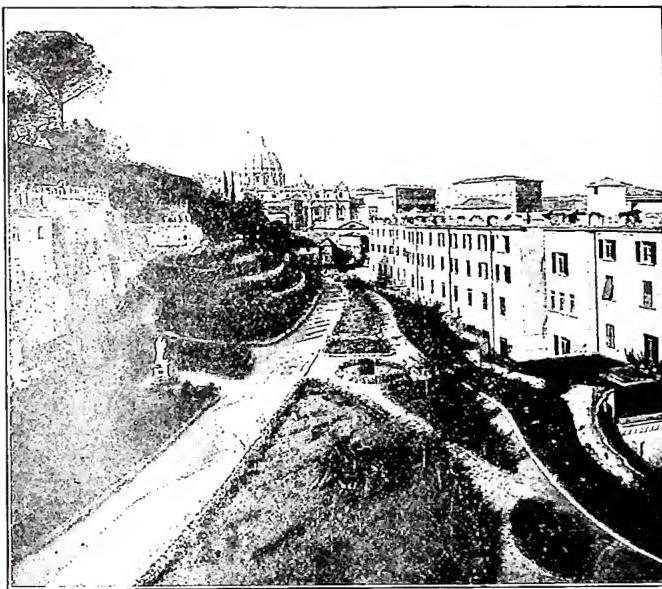
(courtesy of the Generative Curia of the Jesuit Fathers)
COMPAGNIA DI GESÙ – General House – Rome.
The final assault against the order began in Portugal. After a campaign of defamatory pamphlets and the execution of the aged Father Gabr. Malagrida, Minister Pombal had all the Jesuits of Portugal, Brazil and India arrested and deported to the Papal States (1759–61). In France, taking advantage of Father Ant. Lavalette’s unfortunate bankruptcy in Martinique, the parlements condemned the constitutions and doctrines of the Jesuits and closed the colleges (1761–63), compelling Louis XV to dissolve the Order throughout France (1764). The decisive intervention of Clement XIII and of many bishops on behalf of the persecuted achieved nothing. The other Bourbon governments followed suit: Spain, where Charles III, for reasons “concealed in his royal breast,” had all the Jesuits of the kingdom arrested on the same night (2–3 April 1767) and deported to Italy; then Sicily (1768) and Parma (1768). In the colonies dependent on the Spanish and Portuguese crowns, the expulsion of the missionaries of the C. di G. (1760–69) assumed the proportions of a catastrophe, from which the work of evangelization took half a century to recover.
It is known how the Bourbon courts then joined forces to obtain from Clement XIII, who resisted every pressure, and subsequently from Clement XIV, the total destruction of the Order, and how the Pope finally yielded, suppressing the C. di G. with the brief Dominus ac Redemptor (31 July 1773). If one properly understands the Pontiff’s intentions—sacrificing, as he had the right to do, a body that had been too heavily persecuted in order to restore peace to the Church—one must nevertheless recognize that the preparation and execution of the measure were often marked by a pettiness and brutality that were entirely superfluous.
While the secularized ex-Jesuits devoted themselves, wherever they were permitted, to the ministries, or to a life of study (the imposing literary activity of the exiled Spanish ex-Jesuits in Italy is rightly well known), and several shed their blood for the Church during the great Revolution, certain political circumstances, which the Jesuits have always regarded as providential, saved a small portion of the C. di G. from destruction in White Russia (and formerly also in Prussia), where Catherine II prevented the canonical execution of the brief of suppression. The Order was slowly reconstituted there, taking back former members and receiving novices, especially after Pius VII had officially recognized its existence (brief Catholicae fidei, 1801; the Jesuits of Russia had previously relied on oral approvals). The desire to see the fathers resume the place that had remained largely vacant, especially in the field of education, was increasingly felt, and, after several other partial concessions, Pius VII finally restored the C. di G. throughout the world on 7 August 1814 (bull Sollicitudo omnium Ecclesiarum). Certain old Fathers of great virtue—first and foremost the Blessed Giuseppe Pignatelli in Italy and Father de Clorivière in France—were the precious links between the two phases of the Order.
The first years of the restored Order, under the generals Taddeo Brzozowski (1805, died in Russia in 1820) and Luigi Fortis of Verona (1820–29), resembled its beginnings in the sixteenth century to a considerable degree: they likewise constituted a “heroic period,” rich in exceptional personalities in the field of action, but the shortage of personnel in relation to the needs of the times likewise led them to attend to the most urgent matters first. In addition, there was the problem of fusion between the venerable survivors of the “ancient C.” and the new recruits, a moving zeal for gathering up the old traditions, and perhaps also, from the outset, a more abundant harvest of persecutions and expulsions. What Acquaviva had undertaken in the sixteenth century was accomplished in the nineteenth by the general G. Filippo Roothaan (1829–53), a Dutchman, who restored the Ignatian institutions to full and normal operation, particularly as regards the formation of religious. His special merits were the renewed study of the Spiritual Exercises of s. Ignatius and the broad and vigorous resumption of missionary activity, adapted to modern conditions.
Both he and his successor, the Belgian Pietro Bocka (1853–87), saw persecutions repeatedly strike the greater part of the provinces. To give a brief summary for the whole century: the Jesuits were expelled from Belgium in 1818 (under the Dutch) and from Russia in 1820; in 1828 their colleges were closed in France; in 1834 and 1835 they were expelled from Portugal and Spain, and in 1847 from Switzerland after the Sonderbund War; in 1848 they were dispersed or expelled from Italy, Austria and Galicia, and in 1850 from Colombia and Ecuador; in 1868 they were again driven out of Spain, and in 1872 from Germany during the Kulturkampf; in 1873 many houses in Italy, especially in Rome, were confiscated (the generals resided at Fiesole from 1873 to 1892); they were again dispersed in France in 1880 and 1901, expelled from Ecuador in 1879 and Portugal in 1910, and dissolved in Spain in 1932–36. The persecution, for the most part legal, sometimes became bloody: in Spain (1822, 1836, 1932–35), in Paris (1871), and in Mexico (Father Pro in 1927), not to mention here the martyrs in the missions (in China in 1860 and 1900–1902, in Syria in 1859–60, and in Madagascar in 1885 and 1896).
Under the modern generals—the Swiss Ant. M. Anderledy (1887–92), the Spaniard Luigi Martin (1892–1906), the German Fr. X. Wernz (1906–1914), and especially during the long and fruitful government of Father Wladimiro Ledóchowski (1915–42)—the C. di G. attained the development and complexity of works that it presents today, far surpassing what had been its peak before the suppression.
It now numbers (1949) 29,973 religious (15,018 priests), divided into 8 assistancies and 55 independent provinces or vice-provinces. One sixth of them (4,650 religious, of whom 2,859 are priests) are in the missions, which remain one of the Order’s principal activities. Before the most recent events that threaten some of them, the most flourishing were, in the Near and Far East, those of Syria and Japan, several in India and China, with large colleges and universities, and those of Java and the Philippines; in Africa, those of the Congo and Madagascar.
In the missions as in the provinces, the ministry of education has retained a foremost importance; to the colleges are added quite a few flourishing universities, principally in the United States and the missions. In several countries, a considerable part of the educational effort is devoted to the formation of the clergy, not only in the missions, but also in Rome (the Gregorian University with the Biblical and Oriental Institutes and several of the national «Colleges») and in the rest of Italy (regional seminaries), in Spain (Comillas), Austria (Innsbruck), and the two Americas. Together with the care of its own scholastics, this contributes to the abundance of literary production in the field of the sacred sciences. For half a century, the ministry of closed Spiritual Exercises has undergone a new and impressive development, now having more than 170 houses for retreats given mostly to specialized groups; retreats for workers are only one part of the social apostolate, which now absorbs many young forces. The old work of the Marian Congregations, so effective in the ancient C. di G., now presents itself as one of the forms of Catholic Action, particularly fruitful in Spain, Austria, and the United States. Proper to the «new» C. di G. and one of its most characteristic contributions is the Apostolate of Prayer (founded at Vals in 1844), together with the Eucharistic Crusade. Among the more modern means of the apostolate, that of the press has at its disposal in the C. more than 1100 periodicals, from the simple propaganda bulletin to specialized journals for the most varied branches of knowledge; the radio apostolate has now been added to these.
The General Curia, where the Superior
General resides (M.R.P. Gio. B. Janssens since 15 Sept. 1946), is located in Rome, Borgo S. Spirito, 5.