
SICILIA. - In terms of size (25,461 km²), population (4 million), and economic importance, the principal island of the Mediterranean, where it occupies a privileged position at the center of communications between the two basins (western and eastern) of this sea and serves almost as a bridge between the opposing shores of Europe and Africa.
I. GEOGRAPHY
The relief of Sicily continues that of the Apennines and reproduces its characteristics (the Peloritani, Nebrodi, and Madonie recall Aspromonte, the Northern Apennines, and the Central Apennines, respectively), also due to the presence of a broad Anti-Apennine range (Etna and the Hyblaean Mountains) on the island’s eastern side. To this diagram are attached the internal plateaus, where the terrains of the gypsum-sulfur series appear, while to the west, the relief consists of isolated massifs that find their natural continuation in the Egadi Islands. Overall, the island’s average elevation is only 440 meters, and the area above 1,000 meters represents just 6% of its surface. The climate, of a subtropical type, is renowned for its mild winter temperatures, clear skies, and the absence—or rarity—of snow, even in the inland regions. However, the landscape presents a stark contrast between the latter and the coastal strip: in the inland areas, poor or entirely devoid of trees, reduced in the hot season to patches of parched steppe, extensive cereal cultivation prevails, based on large estates, whereas in the coastal plains, where water is more abundant and better distributed, small and medium-sized properties are widespread, and rich arboreal crops dominate, with olive trees, vines, fruit trees (particularly almonds and hazelnuts), and the typical cultivation of citrus fruits, in whose production Sicily surpasses all other Italian regions combined. Livestock farming (free-range and pack animals) and forestry (forests cover just over 3% of the territorial surface) hold comparatively little importance compared to agriculture; nevertheless, they yield non-negligible profits,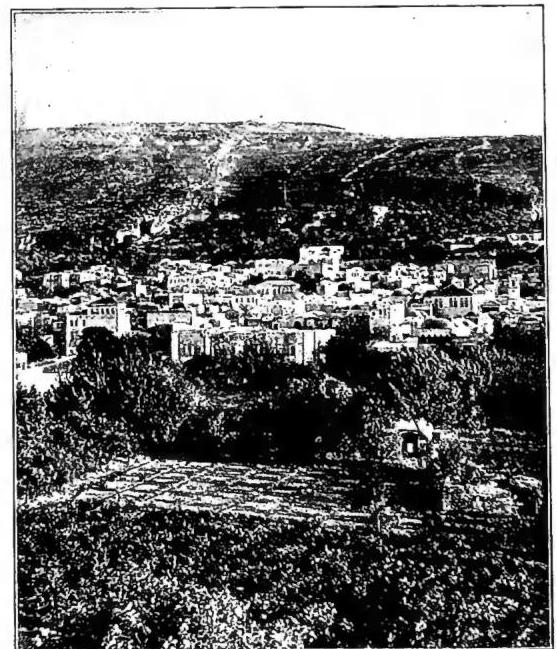
| Province | Area in km² | Population Census 1936 1-1-1950 (in 1,000 inhabitants) | Density per km² | Population of the capital (in 1,000 inhabitants) | |
|---|---|---|---|---|---|
| Agrigento | 3041 | 408 | 465 | 153 | 40 |
| Caltanissetta | 2104 | 250 | 294 | 140 | 57 |
| Catania | 3552 | 701 | 780 | 219 | 292 |
| Enna | 2562 | 213 | 238 | 93 | 27 |
| Messina | 3248 | 612 | 661 | 204 | 227 |
| Palermo | 4977 | 883 | 1005 | 202 | 491 |
| Ragusa | 1523 | 217 | 241 | 158 | 54 |
| Siracusa | 2199 | 276 | 321 | 146 | 70 |
| Trapani | 2500 | 368 | 408 | 163 | 75 |
| SICILIA | 25,706 | 3928 | 4413 | 172 | — |
II. ANCIENT HISTORY
### 1. Civil History
According to Greek historians, the earliest inhabitants of Sicily were the Sicani in the west, who in the island’s extreme tip had intermingled with a foreign population, giving rise to the mixed group of the Elymians, with their centers at Segesta and Erice. In the east dwelt the Sicels, who had immigrated from Italy. In the 8th and 7th centuries B.C., the Phoenicians founded colonies in the west at Mozia, Solunto, and Panormus (Palermo), while the Greeks established settlements in the east at Syracuse, Naxos, Leontini, Catana, Zancle (Messina), Megara, Gela, and later at Acrae, Casmenae, Camarina, Selinus, Agrigentum, and Himera.
The early democratic life of the Greek colonies soon gave way to tyranny, which became widespread in the 5th century, and several cities, such as Gela, Agrigentum, and especially Syracuse, owed their prominence to II. The ongoing conflict between the Carthaginians and the indigenous peoples led to Roman intervention, beginning in 263 B.C. with the occupation of Messana and concluding in 210 with the fall of Agrigentum. In the second half of the 2nd century B.C., Sicily endured the horrors of the servile wars, and in the 1st century, those of the struggles between Octavian and Pompey. Under Augustus’ reorganization of the Empire, Sicily became a senatorial province, governed by a proconsul and two quaestors, and under Diocletian, it formed part of the prefecture of Italy, headed by a consularis. In 440, the Vandals under Gaiseric, rulers of Africa, seized Lilybaeum and Palermo, unleashing a fierce persecution against Catholics. They returned in 455 and 468 but were repelled by Ricimer and Marcellinus, until in 476 the island passed under the rule of Odoacer and in 491 under that of Theodoric. Sicily then enjoyed a brief period of prosperity. In 535, claiming the promontory of Lilybaeum, which had been given as a wedding gift to Amalafrida, sister of Theodoric and wife of Thrasamund, king of the Vandals, Belisarius landed at Catania and began the conquest of the island, which came under Byzantine rule. From 663, Constans II resided there until his death in 668. Constans’ assassination sparked a military revolt led by Mezezius, quickly suppressed, followed by those of Sergius (718) and Elpidius (780). Meanwhile, from the mid-7th century, Arab raids had begun, intensifying in the 8th century: in that century alone, Muslims plundered Sicily twelve times, causing devastation and carrying off booty. In 827, summoned by Euphemius, they landed at Mazara and began the systematic conquest of the island, more or less resisted by the Byzantines. Palermo fell in 831, Messina in 843, Castrogiovanni (Enna) in 859, Syracuse in 878, Taormina in 903, and Rametta in 965. The Byzantines never renounced their claim to Sicily, but their repeated attempts at reconquest were always defeated. Under Muslim rule, the island was governed by an emir residing in Palermo. Living conditions were tolerable despite the heavy taxes imposed on the people, which seemed more bearable compared to Byzantine extortion. There were notable achievements in culture and art, and especially in agriculture, though these did not correspond to developments in religious and civil life.
### 2. Religious History
No contemporary and reliable documents exist regarding the early spread of Christianity in Sicily. However, its privileged position at the crossroads of communication routes between Rome and the East suggests that this must have occurred quite early. On his journey to Rome, St. Paul stopped as a prisoner in Syracuse for three days in the spring of 61 (Acts 28:12), too briefly to engage in apostolic work. For the next two centuries, no certain records exist. The traditions regarding the apostolic origins of some churches on the island are legendary, as is the account in the Praedestinatus of a supposed Sicilian council in the 2nd century (PL 53, 592), and the letters of Popes Zephyrinus and Eutychianus to the bishops of Sicily are apocryphal (Jaffé-Wattenbach, 80, 146).
While literary documentation is scarce, archaeological monuments scattered throughout the island, particularly in the southeastern region, provide some compensation. The underground cemeteries of Syracuse (v. SIRACUSA) and Palazzolo Acreide certainly date back to the 3rd century and possibly even the 2nd. More or less extensive complexes are found at Melilli, Canicattini, Noto, Ispica, Agrigento, Selinunte, Marsala, Carini, Palermo, Termini Imerese, Catania, Lentini, and elsewhere, all dating from the 4th to 5th centuries.
The Byzantine government introduced its rite into the liturgy, and in 732, Emperor Leo the Isaurian, also confiscating the rich patrimony of the Roman Church, subjected the Sicilian churches to the jurisdiction of Constantinople.
Per la storia civile: E. Pais, Storia della Sicilia e della Magna Grecia, I-III, Torino 1894-1898; G. M. Columba, Storia della Sicilia antica, Palermo 1930; A. Holm, Storia della Sicilia nell'antichità, trad. it., Torino 1896-1901; E. Ciaceri, Storia della Magna Grecia, I-III, Catania 1924-1932; G. De Sanctis, Storia dei Romani, II-IV, Torino 1907-1923; P. Orsi, Sicilia bizantina, Roma 1942; E. Gabrici, La monetazione del bronzo nella Sicilia antica, Palermo 1927; A. Ferrua, La Sicilia cristiana, I, Roma 1942; per la storia religiosa: P. Batiffol, L'Église naissante et le catholicisme, Paris 1909; P. Allard, Histoire des persécutions, Paris 1903-1908; H. Leclercq, L'Afrique chrétienne, Paris 1904; G. B. De Rossi, Roma sotterranea cristiana, Roma 1864-1877; P. Testini, Archeologia cristiana, Roma 1958; G. Agnello, L'architettura bizantina in Sicilia, Firenze 1952; G. Cozza-Luzi, I vescovi di Sicilia, Roma 1893; G. Rossi Taibbi, La Sicilia bizantina, Palermo 1959; G. Schirò, La Sicilia e Bisanzio nei secoli XI e XII, Palermo 1962.
Giuseppe Caraci
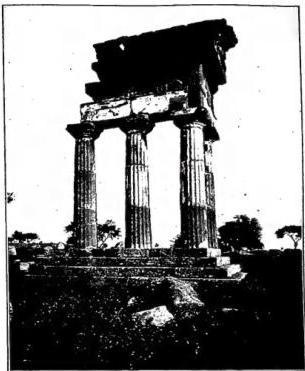
SICILIA - Doric columns of the temple of Castor and Pollux (mid-5th century B.C.). - Agrigento.
During this period, there was a flourishing of Eastern monasteries that became centers of learning and sanctity: hymnographers such as Giuseppe, Giorgio, and Teofane; chroniclers like Pietro and Giovanni; exegete S. Gregorio of Agrigento; all maintained a high cultural level on the Island, while saints like Metodio, patriarch of Constantinople, Elia of Castrogiovanni, Leoluca of Corleone, Luca of Taormina, Vitale of Castronovo, Atanasio of Catania, Simone of Siracusa, Cristoforo, Baba, and Macario adorned it with religious virtues. The Muslim occupation suppressed that thriving activity, of which very few traces survived by the time of the Norman liberation.
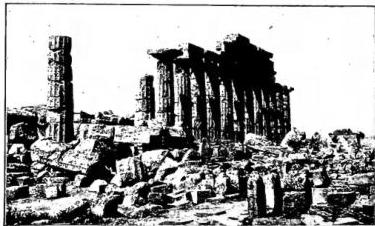
SICILIA - Rovine di Selinunte.
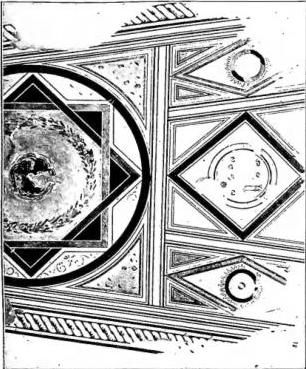
SICILIA - Fresco, of Christian origin according to some scholars, imitating marble inlays, in the Grotto of the Sibyl (3rd century). Watercolor by Salinas - Marsala.
period of autonomous life that gave the Island particular characteristics, and which, with more or less lengthy interruptions, lasted until the Italian national unification. Roger, having severed all ties of subjection to the Duchy of Apulia, first waging war against his brother Robert himself and, after the latter’s death, siding with his son, Duke Roger I, forcefully imposed his will and authority upon all, including the very Normans who had aided him in the enterprise against the Muslims, concerned with nothing other than amalgamating and harmonizing, in the spirit of a superior state exigency, the different subjected populations. Even in religious matters, he sought to act freely in reconstituting the ecclesiastical structures that had gradually disappeared during Muslim rule, and had himself granted by Pope Urban II (1098) those prerogatives that later led to the institution known as the « Sicilian monarchy » (v.). He also greatly limited the rights and prerogatives of the counts and barons, whom he rewarded for their aid in the conquest of the Island, reducing their office to that of true state officials.
With Roger II (1101-54), son of Roger I, who, having emerged from minority in 1112, primarily pursued an expansionist policy (reconquest of the Duchy of Apulia [1127] and the Principality of Capua), Sicily rose to a position of greater importance on the international stage, having become the center of a vast state that also included the Norman domains on the mainland. Roger’s coronation as King of Sicily in the cathedral of Palermo (1130; his father had assumed only the title of grand count), preceded by no minor conflicts with Pope Honorius II, who had viewed his establishment on the peninsula unfavorably, marks the peak of his power. His attempts at expansion into the Balkans and Africa (1146-48) did not, however, yield favorable results. A vassal of the Church for the continental part but an independent sovereign in Sicily,
Roger II sought to uphold, in relations with Rome, the privileges granted by Urban II to his father, opposing any attempt by the Pope to limit their exercise. Though no less authoritarian than his father, in matters of greater importance he was not averse to consulting the Curiae generales or solemnes, which, while not constituting a true constitutional body and representing the interests of the higher classes—composed as they were of barons and high prelates, and at times also of notables from the cities and royal demesne lands—nevertheless had the task of assisting and, in a certain way, limiting royal authority. During Roger’s long reign, Sicily, untouched by the baronial struggles of the mainland, enjoyed relative tranquility and prosperity, which instead waned under his son William I (1154-66), due to the dark conflicts and uprisings of the feudal lords, decidedly hostile to the democratic direction imposed on the Kingdom by the minister Maio of Bari. At that time, Sicily also lost its independence, as William, in the agreements of 26 June 1156, declared himself a « vassal » of the Church, not only for the mainland domains but also for Sicily.
After her death, which occurred in that same year, Pope Innocent III, as high lord of the Kingdom, having in turn assumed the regency, ensured Frederick II’s sovereignty under the condition that it should not be united in the same person with the Kingdom of Germany. Having come of age in 1209, Frederick was soon led by internal dissensions to intervene in the affairs of that Kingdom until he became its sovereign, but his heart remained in Sicily, making it his preferred residence and completing therein that process of Latinization and rapprochement with Italy and Europe, already begun by Roger I. Indeed, in his political action, Frederick aimed to consolidate his absolute power on the Island, and his legislative work, entirely inspired by Roman law, is noteworthy, while he opened his court to scholars of every branch of knowledge, as Roger II had already done, and gave, with the « Sicilian poetic school », considerable impetus to the cult-
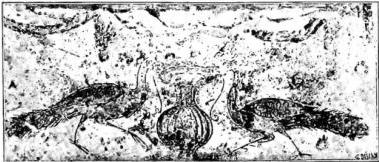
SICILIA - Fresco with two peacocks facing each other on the frontal wall of Marcia’s tomb, in the Cassia Catacomb (mid-4th century). Watercolor by G. Discanno. Siracusa.
The Island was occupied by Peter III of Aragon, husband of Constance, daughter of Manfredi, to whom the Sicilians themselves had offered the crown of Sicily, and the Treaty of Caltabellotta (1302) sanctioned this change of dynasty, recognizing Frederick, the third-born son of Peter II of Aragon, as King of Trinacria. Sicily, in its new international position, thus gravitated no longer toward the peninsula but toward Spain. The numerous attempts by the Angevins of Naples to reconquer Sicily, the consequent devastations, and the prolonged struggles among the most powerful Sicilian baronial families led to a profound spiritual depression among the population, which made the effects of the new isolation in which the Island had fallen even more severely felt. Nor did the reforms introduced by King Frederick himself (1295-1337) and his successor Peter I (1337-42) succeed in improving its conditions. Having become an appendage of the Kingdom of Aragon, Sicily soon lost even the shadow of independence it had retained until 1409, when, with the union of the two crowns of Sicily and Aragon in the person of Martin II, it became nothing more than a simple viceroyalty tightly bound to the Crown of Aragon.
IV. THE VICEROYALTY
With the new order, the long period of conflicts and struggles that had impoverished the Island came to an end, but a phase of near stagnation in spiritual and economic energies also began, which made it easier for the various viceroys to increasingly bind the island to Aragonese interests. The Parliament itself, with its division into three branches—military, ecclesiastical, and demesnial—introduced during the time of Alfonso the Magnanimous (1416-1458) in imitation of the Catalan and Aragonese Cortes and representing not the general interests of the country but those of the dominant classes, became a docile instrument in the hands of the monarchy, which used it to exert greater pressure on the Island and collect its taxes. Under Ferdinand the Catholic (1459-1515), the subordination of Sicily’s interests to those of Spain grew even stronger, and to reinforce royal absolutism, the tribunal of the Holy Office was introduced in the Island according to the Spanish model (1487), whose severity in Sicily was not justified, as in Spain, by local religious concerns. Even against the Jews, proceedings were carried out with relentless zeal.The Island’s conditions did not improve when, under Charles V (1519-1556), it became part of a vast empire that included, along with Italy, Spain and Germany. The viceroys who governed it were primarily concerned with ensuring its submission to Spanish power, thus keeping Sicily isolated from the military competitions of the rest of Europe. The Lutheran Reformation also found few followers on the Island due to the strong spiritual pressure exerted by the Holy Office; in compensation, the Jesuits, introduced to the Island in 1540, opened schools and colleges, providing Sicily with an educational system it had previously lacked. Nevertheless, administrative reforms were not absent, especially under Philip II (1556-1568), aimed primarily at eradicating abuses or curbing arrogance. Famous was the struggle of Viceroy Marco Antonio Colonna against the Holy Office in defense of viceregal authority, and that in defense of the prerogatives of the Monarchia Sicula. Under the successors of Philip II—Philip III (1598-1621), Philip IV (1621-1665), and Charles II (1665-1700)—who witnessed the decline of Spanish hegemony in Europe, Sicily shared the fate of the other Spanish dominions in Italy, where general misery contrasted with the arrogance and frivolity of the wealthier classes, always ready to obey the commands of Madrid. Yet, attempts at revolt for the reconquest of independence did not fail, and above all, as a reaction to that sad state of affairs, though these were rather isolated manifestations of economic distress, reflecting no clear social or political consciousness: the expulsion of Viceroy Moncada in 1516, the revolt in Palermo led by Giuseppe d'Alessi in 1647, and the more complex uprising that broke out in
(photo: Enit)
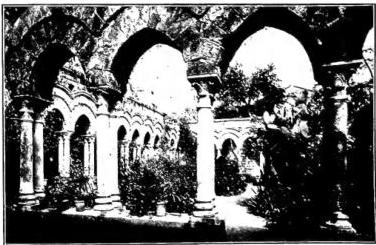
SICILIA - Cloister of the church of S. Giovanni degli Eremiti (13th century). Palermo.
(fol. Anderson)
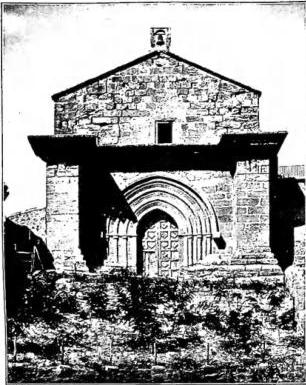
SICILIA - Façade of the church of S. Niccolò (13th century). Agrigento.
Messina in 1674. A middle class was lacking that might have given vigor to those initiatives, in which only isolated figures of fervent "patriots" shone. The same guilds in which the artisans had organized themselves, and which made their weight felt in those revolts, had more of a religious than an economic character, and served more the ambitions of this or that consul than the protection of the interests of their members.
Of this spirit, the Constitution of 1812 partakes, with which the barons renounced all feudal rights, transforming their estates into private possessions: without, however, losing their real preeminence, so that no effective advantage was derived from that Constitution for the lower classes. After the Restoration, reacting to the centralizing policy of the Neapolitan government, which abolished the Constitution of 1812 and dissolved the Parliament (1816), Sicily directed its efforts toward separating from Naples, first attempting to restore the independence guaranteed by the Constitution of 1812 (revolution of 1820). On 12 January 1848, the rebellion began in Palermo and spread throughout the Island, proclaiming the Constitution of 1812 and convening the Parliament on 25 March. But, lacking the hoped-for protection of France and England, Ferdinand II of Naples succeeded in retaking Messina in September 1848 and regaining control of all Sicily on 11 May 1849. Little more than ten years later (11 June - 20 August 1860), Sicily, with Garibaldi's expedition, was wrested from the Bourbons and politically united to Italy thanks to the plebiscite of 21 October 1860. But even this time, the autonomist spirit predominated even among the most determined advocates of unconditional annexation, because, as Michele Amari said, "after a struggle of 45 years with Naples, it would not have been possible to deprive Sicily of this autonomy which it enjoyed under the yoke of the Bourbons," and, therefore, "Sicily, an island of over 2 million inhabitants, hardened in half a century of strife, in two or three revolutions, would have deserved exceptions, even if there were not the example of Tuscany, and the need to provide for other provinces like Lombardy and Naples."
V. SICILY IN THE UNITY OF ITALY
Sicily was therefore the least prepared to endure the administrative centralization immediately extended by the Italian government to all the regions that formed the new State. Moreover, Sicily, almost devoid of public works and industries due to past neglect in this sector, and with an economic structure based on the persistent latifundium, and thus with a large agricultural and urban proletariat, was not in the best social and economic conditions to derive from the new political situation, as it had been implemented, all those advantages that could have ensured prosperity and well-being. Having come, in a short span of time, to coexist under the same laws with socially more advanced and economically wealthier regions, Sicily suffered more than any other region the inevitable discomfort following national unification, which required burdens and sacrifices to consolidate at a time when the Island was in need of special attention. Hence the often violent explosions, such as the revolt of 1866 in the province of Palermo, and those of 1893 in various parts of the Island, which, not understood in their true origins, were repressed by the government of the time in the harshest manner. The government was no more successful in religious matters. Religious Orders were extremely numerous in Sicily: suffice it to recall that at the time of the dissolution of religious Corporations in 1866, there were 629 convents distributed across 212 municipalities and over 239 monasteries; the religious sentiment of the population was profound, and great was the influence that the numerous secular and regular clergy had over them. But the Italian government also greatly opposed this sentiment, or at least did not consider it in its true value, particularly regarding the question of ecclesiastical property, in relation to which it acted with harsh and draconian measures, seeing in the resentment always manifested by the islanders, due to the lack of understanding with which they were treated, almost exclusively a clerical and Bourbon manifestation. Nevertheless, there were attempts by the government to investigate and study the origins of the malaise afflicting the Island, which also manifested in antisocial forms such as brigandage and the mafia (the Franchetti-Sonnino inquiry of 1876 being the most famous), but such attempts, due to a mentality often not free from prejudice, almost never hit the mark, and the remedies adopted were always inadequate.
(fot. Anderson)
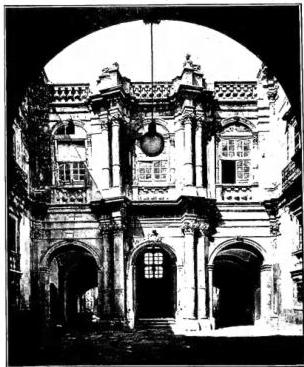
SICILIA - Courtyard of the Palazzo Beneventano del Bosco (18th century). Siracusa.
VI. ARCHAEOLOGY
In addition to its distinguished classical monuments, particularly Greek, Sicily is rich in ancient remains.SICILIA - Particolare di una sottile tela di lino rappresentante la stigmatizzazione di s. Francesco. Sillato siciliano del sec. XV. Assisi, Museo francescano.
morie e monumenti cristiani. Nel Martirologio geronimiano spesso la Cilicia e la Siria sono state confuse con la S., così si spiega all'11 ott. l'indicazione « in acervo Siciliae » che deve correggersi in « Anazarbo Ciliciae »; al 21 luglio si legge « in Silica Simeonis ». Le martiri più venerate della S. LUCINA (v.) Agata (v.); tutte e due sono nel Canone e rappresentate nella teoria delle martiri in S. Martino in caelo aureo (oggi S. Apollinare nuovo) in Ravenna. A Catania fu venerato anche s. Euplo (BHG, n. 1410) ricordato nel Geronimiano al 12 ag., al 2 e al 12 sett.; a lui certo si allude insieme con s. Agata nell'iscrizione di Giulia Fiorentina nell'espressione « pro foribus martyrum » (CIL, X, 7112). A Messina nel sec. VI una basilica fu dedicata ai ss. Stefano, Pancrazio ed Euplo. Diffuso fu in S. il culto di santi greci quali Teodoro, Giorgio e Cristoforo. A Taormina è venerato s. Pancrazio al 3 apr. e all'8 luglio con una leggenda curiosa (BHG, 1410), mentre nel Geronimiano è indicato al 24 giugno e nei sinassari greci al 30 e 31 ott. (Synax. Constantinop., p. 179).
Per Lentini la Passio ALFEO (v.), Filadelfio, Cirico ed altri (BHG, 57-62) è assolutamente priva di ogni fondamento come quella di s. ALFEO (v.) a Lipari. Oltre agli antichi monumenti cristiani di Agrigento, Catania Lipari, Messina, Modica, Noto, Palazzolo Acreide, Palermo, Ragusa, Siracusa, Taormina (per i quali V. le rispettive voci), se ne annoverano anche in altre località. Così a Salemi, l'antica Halicyae, si rinvenne una chiesa cimiteriale con pavimento in musaico e tombe pure con decorazione musiva (cf. B. Pace, La basilica di Salemi, in Monumenti antichi dei Lincei, Roma 1916). Ma tre iscrizioni cristiane di Roma ricordano un « civis Alicensis » sepolto nel 372 nell'area del cimitero di Callisto (G. B. De Rossi, Inscr. Christ. Supplementum, Roma 1915, n. 1621); un altro epitafio dell'anno 407 si riferisce pure a un « civis Alicensis » (A. Silvagni, Inscr. christ. Nova series, ivi 1922, n. 407); un Johannis Alicensis fu sepolto nel 496 nella Basilica Vaticana (G. B. De Rossi, Inscr. christ., I, ivi 1857-61, n. 916); nel portico della stessa Basilica si leggeva il carme sepolcrale di una « Helpis Siculae regionis
alumnae » (ibid., II, Roma 1888, pp. 79, 6; 130, 14). A Lipari nella chiesa di S. Giuseppe un'iscrizione ricorda l'acquisto del sepolcro fatto da Elpiste e Irene, contenente le date degli as. 409 e 470; mentre nello stesso luogo un'altra iscrizione offre la data del 394 (Notizie degli scavi, 1929, pp. 84-85).
Nei dintorni di Catania furono trovate tre lampade cristiane in bronzo dorato (P. Orsi, Bronzi cristiani di Catania, in N. Bull. di arch. crist., 8 (1902), pp. 146-49).
Nel territorio di Gela in contrada Zinghilino furono identificati antichi sepolcri sfruttati poi da cristiani; lo stesso si è riscontrato presso Butera e presso Licata. A Grotta Murata sui monti S. Angelo Muxaro si sono trovati avanzi di un'antica comunità eremitica.
A Roma nel « Coemeterium maius » si è rinvenuta l'iscrizione sepolcrale greca di un siciliano di nome Callisto (M. Armellini, Scoperta della cripta di S. Emerenziana, Roma 1877, p. 100). Per il sarcofago cristiano nella cattedrale di Palermo V. Wilpert, Sarcofagi, II, tav. 239, 2, pp. 324, 352; III, pp. 20-22.
J. Fuhrer e V. Schultze, nell'opera Die altchristlichen Grabstätten Siziliens (Berlino 1907) hanno pubblicato gli ipogei di Ferla (p. 172 sg.), Melilli (p. 174 sg.), Lentini (p. 178 sg.), Molinello (p. 181 sg.), Cassibile (p. 185 sg.), Spaccaforno-Rosolini (p. 190 sg.), Cava d'Ispica (p. 193 sg.), S. Croce Camerina (p. 195 sg.), Licodia Eubea (p. 197 sg.), Chiaramonte-Guelfi (p. 198 sg.), Granieri (p. 201 sg.), Cittadella (p. 202 sg.), Naro (p. 205 sg.), Termini Imerese (p. 218 sg.), Palermo (pp. 220-35), Carini (p. 236 sg.), Lilibeo-Marsala (vigna Spalla, p. 242; ipogeo sotto S. Francesco, p. 246; Grotta della Sibilla e ipogeo presso la chiesa dei Niccolini, pp. 246-53), Priolo (pp. 253-55).
VII. ART
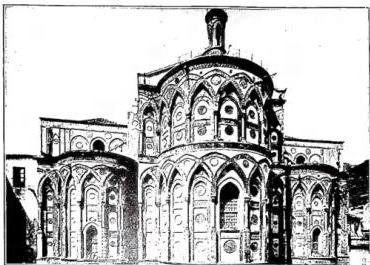
1. Architecture. - In Sicily, remains of Byzantine architecture are rare. The two small churches in the localities of Vigna di Mare and Bagni di Mare near Santa Croce Camerina, as well as the churches of San Nicolicchio and San Micidiario in Sortino, are considered Byzantine basilicas. Arab monuments are also scarce, mostly destroyed or transformed by Christian reconstruction during the Norman period, during which construction continued following Byzantine and Arab traditions with the addition of Romanesque and later Gothic influences. Examples remain not only in PERGAMO (v.), but also in the Cathedral and the Annunziata dei Catalani in Messina; in the cathedrals of Monreale and Cefalù; in the church of the Trinità in Castelvetrano; in the abbey of San Spirito in Caltanissetta and the Benedictine abbey in Bronte; in the apses of the cathedral in Catania and the church of San Pietro, built by the architect Girardo il Franco in Casalvecchio Siculo. The Swabian period is distinguished from the Norman by a more pronounced production of civil and military architecture: fortresses, defensive walls, castles such as the Palazzo dello Steri and the Palazzo Sclafani in Palermo; the Castello Maniace in Syracuse and the Castello Ursino, built by Riccardo da Lentini in Catania; the Osterio in Cefalù; the castle in Paternò, and many others scattered across strategic points of the island. Characteristic of this style are the famous portals and the large windows of the upper floors, often adorned with zigzag friezes and inlays of lava and pumice, contrasting with the severe appearance of the whole. To this period belong the churches of Sant'Agostino and San Francesco d'Assisi, San Giovanni di Bajda in Palermo, Sant'Agostino in Trapani, the Matrice in Enna, Santa Maria in Randazzo, the monastery of San Spirito in Agrigento, the Badiazza at the foot of the hill of San Spirito, Santa Maria degli Alemanni, and San Francesco d'Assisi in Messina. Examples of late Chiaramontano architecture with the addition of Catalan elements are the two Taormina constructions of the Badia Vecchia and the Palazzo San Stefano, already from the early fifteenth century, when Tuscan and especially Catalan influences prevail. In this century, the figure of the architect Matteo Carnelivari from Noto stands out, who worked extensively in Palermo and Messina, where, unfortunately, very little survived the 1908 earthquake.From this period, the Palazzi Corvaia and Ciampoli in Taormina, the Casa Finocchiaro in Randazzo, the Palazzi Lanza, Montalto, and Bellomo in Syracuse, San Giorgio and the bell tower of the Cathedral in Agrigento, the bell tower and the portico of the Cathedral in Erice are also remembered.
The sixteenth century in Palermo presents, in addition to some churches of highly interesting structure, the Archiepiscopal Palace by the architect Di Fazio (1583). Baroque architecture is richer, with its own characteristics for having maintained greater adherence to classical sobriety and composure in its schemes, reserving eccentricity for ornamentation. Palermo preserves the most notable seventeenth-century monuments, the churches by G. Amico, P. Amato, Angelo Italia, Andrea Giganti, and G. Amato, as well as numerous palaces and villas. In Trapani, the church of the Jesuit College and the Carmelite convent are noteworthy. In Catania, destroyed by the 1699 earthquake, little remains from the seventeenth century; the city was rebuilt in the eighteenth century by the architect Vaccarini, whose works include the façade of the Cathedral, the Almo Studio, the Senatorial Palace, and the churches of San Giuliano and Sant'Agata. Noto suffered the same fate, but today it appears as a splendid amphitheater of eighteenth-century churches and palaces, largely due to Pompeo Picherali, who also designed the façade of the cathedral of Syracuse. Here, the Palazzi Beneventano and Del Bosco are also notable. Of the architect Marvuglia, the convent of San Martino alle Scale (1770) near Monreale is remembered.
2. Sculpture
Although in the small church of San Sebastiano in Syracuse there are Byzantine sculptures adapted to the portal, evidence of Byzantine and Arab sculpture in Sicily is very rare. From the Norman period date the beautiful capitals of the churches of that era, as well as those of the cloisters of Cefalù and Monreale, the latter works by marble workers from various regions, while the bronze doors of Monreale are by Bonanno Pisano and Barisano da Trani.The portal of the San Carcere in Catania recalls Burgundian art, while the candelabrum and the sculptures of the pulpit of the Palatina in Palermo are attributed to Campanian neo-Hellenistic art. Even in the Swabian-Chiaramontano period, sculpture reveals itself as essentially decorative. Thus, the capitals of the cloister of San Giovanni degli Eremiti and the overdoor of the Palazzo Sclafani in Palermo. The fifteenth century, however, presents itself as particularly rich in plastic works, as artists from northern Italy, such as Domenico Gagini from Bissone (v.) and Francesco Laurana (v.), arrived on the island. From the fifteenth century, the funerary monument of Viceroy Acuna in the cathedral of Catania by Antonello Freri, and that of Bishop Belloro in the cathedral of Messina by G. B. Mazzola are also remembered. In the sixteenth century, Gagini (v.) stands out, who also worked extensively on tribune ornaments and funerary monuments; other notable sculptors of this period were Giuliano Mancino and Bartolomeo Berrettaro, who worked in Palermo, Alcamo, Termini, and Erice. Ferraro da Giuliana adorned the mother church of Castelvetrano with stuccoes. Toward the end of the sixteenth century, some followers of Michelangelo, such as Montorsoli, who created the fountains of Orion and Neptune in Messina, and Andrea Calamec, author of the monument to Don Giovanni d'Austria, arrived in Messina from northern Italy. A beautiful Madonna with Child by Michelangelo Nacherini is preserved in Castroreale. From the seventeenth century, the monument to Charles V by Scipione Li Volsi in Palermo and the San Benedetto in gloria by I. Marabitti in Monreale are notable. The wooden choir stalls and choir sculptures of the seventeenth century in Sicily are mostly by Vigo La Pica from Trapani or Ferraro da Giuliana. Fra Umile Pintorno from Petralia, on the other hand, dedicated himself to carving famous crucifixes. The art of stucco, which began in the seventeenth century, developed admirably in Serpotta (v.) and his followers.
(fot. Alinari)
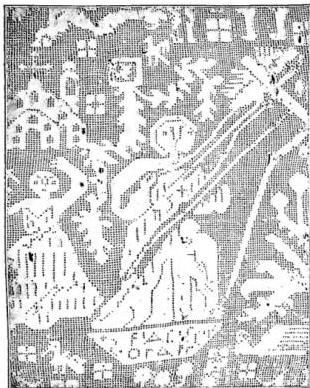
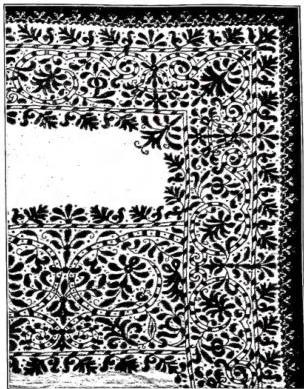
SICILIA - Sicilian needlework (16th century) - Paris, Musée Cluny.
3. Painting
Examples of Byzantine painting can be found in Lentini in the Grotto of the Crucifix and the Grotto of Santa Lucia; in Syracuse in the Oratory of Santa Lucia and the Catacombs of San Giovanni; and traces in the necropolis of Pantalica. Nothing notable remains of Arab painting, while from the Norman period there are the splendid mosaics of the cathedrals of Cefalù (1148) and Monreale and of the churches and the Royal Palace of Palermo, reflecting Byzantine art and Arab reminiscences. Few traces remain of painting from the Swabian period. Important, however, for following the local artistic current is the pictorial decoration of the beams in the ceilings of the cathedrals of Cefalù and Syracuse, of the Palazzo Bellomo in Syracuse, and of San Agostino in Trapani (now in the Museum), which connect to the decorations of the Steri in Palermo by the Sicilian artists Cecco di Naro, Simone da Corleone, etc. In the fifteenth century, painting in Sicily shows various tendencies: Flemish and Catalan, but one can also note a vein of local art connected to the various currents of Mediterranean art through the painters Riccardo Quartararo, Tommaso de Vigilia, and Pietro Ruzzolone, of whom the painted cross on both sides of the Mother Church of Termini Imerese is remembered. Distinct from the others is Antonello da Messina (v.) and his followers, among whom Pietro de Saliba. From the sixteenth century, the names of Vincenzo degli Azani (paintings in the Museum of Palermo), Alibrandi, and Polidoro da Caravaggio (paintings in the Museum of Messina), and Bernardino Niger (paintings in the church of the Holy Prison of Catania) are worth mentioning. Only in the seventeenth century did pictorial art in the island revive with Caravaggio, Rodriguez, Novelli (v.). Lesser-known painters followed, such as the portraitist Antonio Alberti, Quagliata, and Agostino Scilla, who worked extensively in Messina, and finally Mattia Stomer, who with The Adoration of the Shepherds in the municipality of Monreale still shows an example of the influence of Flemish art in Sicily. Among the eighteenth-century decorators, mostly tributary to Campanian art, Olivio Sozzi and Vito d'Anna, certainly the best of all, are worth recalling.VIII. CONCILIAR REGION
Ecclesiastically, Sicily is divided into 14 dioceses (Acireale, Lipari, Nicosia, Patti, Agrigento, Caltanissetta, Cefalù, Mazara del Vallo, Trapani, Caltagirone, Noto, Piazza Armerina, Ragusa), 5 archdioceses (Catania, Messina, Monreale, Palermo, Siracusa), and one nullius prelature (S. Lucia del Mela). It includes a diocese for the Italo-Albanians (Piana degli Albanesi) and the archimandrite of the Most Holy Saviour.With the exception of Catania, Acireale, Piana degli Albanesi, and the nullius prelature of S. Lucia del Mela, which are immediately subject to the Holy See, the others are constituted into provinces. Catania is the only archiepiscopal see that is not metropolitan. Messina is a metropolitan see with three suffragan dioceses: Lipari, Nicosia, and Patti. Monreale is metropolitan for the dioceses of Agrigento and Caltanissetta; Palermo is metropolitan for the dioceses of Cefalù, Mazara del Vallo, and Trapani, and has long been a cardinalatial see. Siracusa is a metropolitan see for the dioceses of Caltagirone, Noto, Piazza Armerina, and Ragusa, the last of which was erected as a diocese on 6 May 1950 and is united aeque principaliter with Siracusa.
The entirety of the listed dioceses and archdioceses constitutes the Sicilian conciliar region. Already, the Sacred Congregation of Bishops and Regulars, with its circular dated 24 August 1889, sanctioning the use of episcopal conferences—introduced as early as 1849 in several regions of Italy—had established their territorial boundaries, adhering to the known divisions of Italy. The Sacred Consistorial Congregation, with its decree dated 15 February 1919 (AAS, 11 [1919], pp. 72-74) and the circular letter of 22 March of the same year, reconfirmed what had been previously established and provided the list of conciliar regions in Italy, fixing for Sicily the above-mentioned arrangement.
With the motu proprio Qua cura of Pius XI, dated 8 December 1938, concerning the establishment of ecclesiastical tribunals for the treatment of matrimonial causes in Italy, it was established that for the entire Sicilian conciliar region, cases of matrimonial nullity must be heard in the first instance at the Ecclesiastical Tribunal of Palermo, and in the second instance at the Ecclesiastical Tribunal of Naples (AAS, 30 [1938], p. 410 ff.; cf. Normae pro exequendis litteris apostolicis v Qua cura, of the Sacred Congregation of the Sacraments dated 10 July 1940, AAS, 32 [1940], p. 304). Vincenzo Fagiolo
IX. FOLKLORE
Of the extremely rich folkloric material offered by Sicily, it is fitting to attempt to identify, in order to characterize the region, what is typical of the island and what is common to other areas, bearing in mind that the insularity of popular traditions in Sicily is not as pronounced as in Sardinia and Corsica—lateral and less exposed areas—because, in addition to being more closely connected with the rest of Italy and open to the various currents of Mediterranean civilization,Sicily itself has been a center of creation and diffusion, throughout the rest of Italy, of manifestations of popular life.
Nevertheless, there are characteristic folkloric elements in Sicily, recognizable primarily in costumes and rural craftsmanship. Of the current female attire, even in Siculo-Albanian and Lombard colonies, the wide mantle, white and red, adorned with gold and silver ribbons, which covers the head and torso, descending to the waist and in some places (Ragusa) to the feet, is distinctive: this mantle, called cappottone in Augusta and elsewhere camagghio-miserii, constitutes the distinguishing ornament of betrothed women and brides (common, in its essential form, to other Mediterranean countries), and ammontorsi (wrapping oneself in it) has the value of a rite marking the passage from one state to another. Betrothed women are also recognized by a ribbon that their future mother-in-law braids into their hair. Very picturesque is the bridal costume of Cesarò, in the province of Messina: a green damask bodice, a velvet jacket with silver buttons, and a heavy pleated skirt (in the Mu-
(photo: Exit)
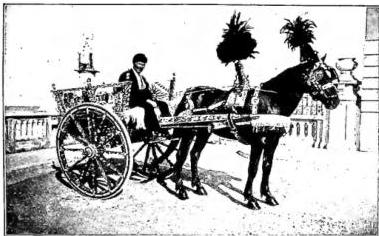
SICILIA - Sicilian cart - Palermo.
During Holy Week, the opra di pupi instead enacts the Passion of Christ. Indeed, the tradition of sacred representations during Holy Week and of religious stories that "the poor of the city—writes Pitrè—sing at dusk each day along the streets or before the houses of those devotees who usually give them a small alms coin" is very much alive in Sicily. Probably modeled on earlier Tuscan examples and widely diffused beyond the island's borders, these narrative sacred poems, with moralizing content, in octaves sometimes epic (ab ab ab cc) and sometimes Sicilian (ab), with almost always miracati (interlocking) rhymes, present their own stylistic physiognomy and a marked regional character: the Passions I and II (Toschi, op. cit. in bibl.) are most original, which Deca Niculaci may have had in mind when composing his own. But the largest group of Sicilian religious stories that we possess dates from the 16th century and later: composed by popular poets (among whom Fullone and Pavone are remembered) or improvised by peasant poets during competitions at the feast of some saint. Regarding particulars and names, Vigo writes of the feast of St. John in Palermo on June 24, 1862: "There were five to six thousand spectators: at midnight the Saint came out onto the plain, was placed on the bier, and five poets mounted it: Antonio Russo, aged six, guided by his father Salvatore, a blacksmith; Giovanni Pagano, a farmer; Andrea Pappalardo, a shoemaker, and Salvatore from Misterbianco, a farmer. One by one they composed poems celebrating the life and miracles of the Saint, recalling the obligations of godparents toward their godchildren, of compari toward comari..., and then they came to a contest among themselves: all used the octave, except Pappalardo, who employed the sestina with the final verses in rhyming couplets: none left the field, all equally happy and imaginative improvisers."
Even in the canzuni, lyrical-narrative songs—brief compositions of sacred subject matter in lyrical meter and narrative content—which the people call 'razinueddi to distinguish them from stories (also called 'razinui), one must recognize a Sicilian origin, where they reach their greatest intensity and diffusion. These compositions, which deal exclusively with the cycle of the Holy Family and are used as lullabies, are connected with cradle songs, which in Sicily are generally indicated by the term va' (probably an abbreviation of voga), and many of which, of rare beauty, succeed in expressing singular nuances of affectivity through the use of diminutives preferred in -eddu (-iddu) and -uzzu. A notable archaic element is the suspended cradle, designated by the term naca (vāz), which, as Rohlfs' investigation shows, occupies a vast area in Sicily but also includes much of southern Italy.
Strambotti in Sicilian octaves reveal themselves to be of insular creation in content and style: even if Sicily cannot be considered, as D'Ancona wished, the birthplace of the strambotto, it was certainly, from the 15th century onward, a center of irradiation, and strambotti of sure Sicilian craftsmanship have been found among Boiardo's papers.
Even the novellas and legends, generically called canti (tales), are a clear mirror of the Sicilian soul, and the repertoire, common to the teatro dei pupi, is connected with chivalric traditions and reflects various epochs in its events and characters, such as the Arab Mamuka, the Norman count Roger, Frederick II of Swabia, the Sicilian Vespers, up to the Bourbons and Garibaldi. Typically Sicilian, for the sentiments expressed therein, is the legend of the Baronessa di Carini.
Among the customs marking the human life cycle, most of which are common to other regions of the peninsula and other countries, a characteristic one—now disappeared—is that of shaving the bride's eyebrows before the wedding; a singular variety of the funeral meal (cunsulo or cunsulatu) is reported by Pitrè in Gioiosa Marea, where a donkey laden with food follows the funeral procession, and immediately after the burial the meal is consumed among relatives, on the ground or in a house near the cemetery.
Sicilian patronal feasts have a particular scenic character: suffice it to recall that of St. Rosalia in Palermo and St. Agatha in Catania. A traditional feature of the Sicilian carnival is the mask of Nannu, a puppet and sometimes a living character representing Carnival, who in some towns, such as Licata, is accompanied by a woman, Nanna, carrying a small child in her arms; in inland towns, Nannu is carried on a donkey and, before dying, makes his will in the presence of a notary represented by another puppet: "I leave to the learned their confused texts / Among so many books and so many writings; I leave to the lawyers their lost axes / And to the doctors I leave the care;—etc." Old dances survive in various transformations: the chiouu, the tarascani, the ruggera, the fasola, the tubiana, the capona. The contradance is still in use, which, though directly derived from the French contredanse, assumes particular forms in Sicily. As Pitrè himself noted, it is difficult to identify the characteristic Sicilian types of games: most, such as campana and ambasciatore, are widespread over a vast area in Europe.
BIBL.:
G. Pitrè, Biblioteca delle tradizioni popolari siciliane, 25 voll., Palermo 1871-1913; id., Usi e costumi, credenze e pregiudizi del popolo siciliano, 4 voll., Palermo 1889; id., Fiabe, novelle e racconti popolari siciliani, 4 voll., Palermo 1875; S. Salomone-Marino, Costumi e usanze dei contadini di Sicilia, Palermo 1897; G. Cocchiara, Popolo e letteratura in Sicilia, Bari 1951; P. Toschi, Le origini del teatro italiano, Torino 1955; G. Rohlfs, Studi e ricerche su lingua e dialetti d'Italia, Firenze 1972; V. D'Ancona, La poesia popolare italiana, Livorno 1878; G. Vigo, Feste patronali in Sicilia, Catania 1887.
G. COCCHIARA
Alla vita religiosa si riportano i numerosi e bellissimi ec-voto conservati nel Museo Pitrè (i più antichi sono del '600) e quelli che ancora oggi vengono offerti nella chiesa di S. Calogero ad Agrigento e nella grotta di S. Rosalia a Palermo. Mentre al mondo magico deve riferirsi il culto dei «corpi decollati» (giustiziati e annegati). È una pratica nota anche in Francia con il nome di enclavement corrisponde la legatura del lupo e della volpe, riferociti dal malocchio, contro i quali occorre ripetere tre volte speciali formole di scongiuro, facendo ogni volta un nodo su una cordicella.
Più legata alla tradizione risulta generalmente l'architettura popolare dei paesi di montagna. Tra le costruzioni di carattere primitivo prevale la forma circolare della capanna (pagghiaru), che nasconde forse un originario significato magico-simbolico, ed è comune anche a costruzioni in pietra, quali i trulli pugliesi e i nuraghi sardi. - Vedi tav. XXX-XXXIII.