
AUGUSTA (Augsburg), DIOCESE of. — The diocese of A., the most important center in Bavaria after Munich, comprises the southwestern part of this region, with 1,200,000 inhabitants, of whom 997,161 are Catholics. It has 992 parishes, 1,401 diocesan priests, and 253 religious priests.
I. HISTORY. — In 15 B.C. the Roman military colony of A. Vindelicorum was founded. A city grew up around it, becoming the capital of the Roman province of Raetia Secunda. Toward the end of the fourth century, a Christian community certainly existed there, probably with a bishop. Some names of seventh-century bishops of Augusta are known, but the succession is complete beginning in the ninth century. The see of A. originally depended on Aquileia, and later on Mainz. Like almost all the bishops and abbots of Germany, the bishop became an imperial feudal prince, with his own territory, sovereign rights, and temporal government. In 955 Otto the Great liberated the city from the siege of the Magyars; its bishop at the time was the celebrated s. Ulrich, who defeated them decisively. From then on, the Magyars ceased to invade central and southern Europe. The city subsequently grew rapidly as a result of commercial exchanges, especially with Venice; after bitter struggles with its own bishops, in 1276 it obtained the status of a free imperial city (Freie Reichsstadt). During the fifteenth and sixteenth centuries it rose to the height of splendor and wealth. The Fugger family was especially renowned, among the most powerful bankers of their time, maintaining relations with popes and emperors who were their debtors. Meanwhile, the bishops had chosen the city of Dillingen as their residence.
A. lost much of its importance during the terrors of the Thirty Years’ War. The city initially adhered to the Reformation, and it was here that in 1530 the celebrated confessio augustana was presented to the imperial diet (v. FAITH); here Charles V promulgated the so-called Interim in 1548 (v. below); and here, too, the Peace of Augsburg was concluded in 1555, by which German Protestantism received full state recognition. The bishops’ temporal dominions were ceded to Bavaria in 1803, and the city itself in 1805.
In 1820, Bavaria, in agreement with the Holy See, undertook a complete reorganization of its ecclesiastical jurisdictions; at that time the present-day diocese of A. was constituted, partly with new territories, while it ceded others to various neighboring dioceses.
It should also be noted that the ancient diocese, which, in addition to the territories under the bishop’s temporal rule, also included territories belonging to many other minor states, numbered more than a thousand parishes in the Middle Ages; but during the Reformation many of these sovereigns changed religion, and, together with them, according to the law cuius regio, illius et religio, their subjects too had to change their faith. The bishops’ own territories naturally remained faithful to the ancestral religion; in 1559 the celebrated Academy of Dillingen was founded, directed by Jesuits and serving as a center of the Catholic faith. Until the Tridentine period, a number of particular rites still survived in the diocese; but from 1597 onward the Roman rite prevailed, with certain Augsburg usages that have been preserved to the present day.
The glory of A. is s. Ulrich, bishop from 973, the first saint to have been «canonized», as is commonly asserted (993). In the Middle Ages, Count Artmann of Dillingen (1248–86) deserves mention, the Mehrer des Stiftes, that is, the one who enlarged and consolidated the sovereign territory; and during the Reformation, Cardinal Otto Truchess of Waldburg (1543–73), thanks to whom Catholicism regained the upper hand in the city.
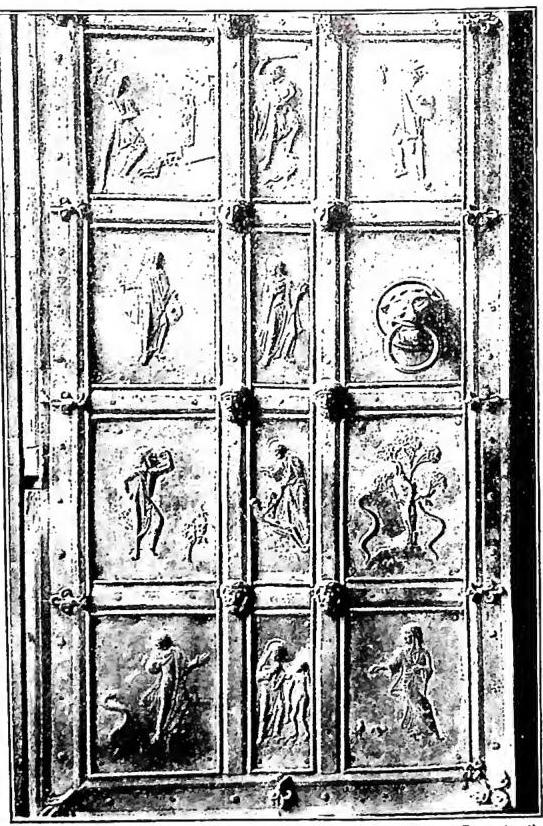
AUGUSTA — Detail of the bronze doors of the Cathedral (11th century).
the Domstift, that is, the canonical chapter of the Cathedral; then, in the same city, S. Ulrico and S. Stefano; famous are the Benedictine monasteries of Wessobrunn, Kaufbeuren, Ottobeuren, Benediktbeuren, and Füssen, to say nothing of so many others. The reform of Hirau met with great success there. The Dominicans and Franciscans also founded convents in the city. The Franciscan Third Order flourished; in medieval Germany it had enormous importance as a universal brotherhood, and especially its female branch could soon count a very large number of sisters in its Regelhäuser. We may note those of A., Dillingen, and Kaufbeuren.
At the time of the Reformation, the Jesuits and Capuchins played a preponderant role in the assiduous and fruitful work of Catholic reform in those regions. Today all the great Orders are represented in the diocese; particularly noteworthy is the revival of the Benedictines, who throughout Bavaria have been able to recover and reopen a considerable number of ancient abbeys. The number of women’s congregations is impressive.
2. Cultural institutions, libraries, archives. — From the time of s. Pietro Canisio, who for seven years was a preacher in the cathedral of A., there existed in the city a celebrated Jesuit college, made possible by the generosity of the Fugger family. Even more renowned was the Academy of Dillingen, founded by Cardinal Truchsess and entrusted to the same Jesuits, later raised (1606) to the rank of a university. The Philosophical-Theological Academy is modern.
3. Monuments. — The Cathedral, S. Maria, with five naves and of pre-Romanesque origin (8th century), with Romanesque sections and Gothic alterations and enlargements, was restored and reduced to its present form according to the neo-Gothic taste of the second half of the last century. Worth noting are the church of S. Ulrico; the ancient cemetery church of S. Afra, now in grandiose late-Gothic forms; and S. Anna, from 1321, with the Fugger family tombs in Renaissance style. Famous are the Town Hall, by Elia Holl (1615–20), and the Fuggerei, the first example of a colony of family houses (1519).
III. COUNCILS OF A
An important council took place in A. on 7 August 952, in the presence of numerous ecclesiastical dignitaries, presided over by Federico, archbishop of Mainz. The initiative was due to King Otto, who, accompanied by his retinue, attended the closing of the sessions and promised to have the decisions promulgated by the Fathers carried out. The first of the canons enacted prohibited clerics who had received Major Orders from marrying, under penalty of deposition. Renewing an old prohibition, the fourth canon forbade them to have a «mulier subintroducta» in their house. The fifth forbade monks to leave their monastery without the abbot’s permission. In general, monasteries remained under the authority of the diocesan bishop, who was to grant his clerics full freedom to embrace the monastic life. Equal freedom was recognized for virgins consecrated to God.On 27 October 1062, Annone, bishop of Cologne, convened another synod in A. A decision had to be made in favor of Pope Alessandro II or the antipope Cadalo. S.
Pier Damiani declared that it was necessary to defend the cause of Alessandro II, and read out the pamphlet entitled Disceptatio synodalis inter regis advocatum et romanae Ecclesiae defensorem, which is a dialogue between a representative of the Roman Church (in this case, s. Pier Damiani) and an advocate of the rights of the German crown. According to the holy Doctor, Cadalo would have been condemned and deposed by all the German and Italian bishops assembled before the young King Enrico IV.
On 12 November 1548, during the pontificate of Paolo III, the bishop of A., Cardinal Ottone di Truchsess, called a Synod that lasted three days, during which 33 canons were promulgated, dealing chiefly with pastoral duties.
Finally, mention should be made of the diocesan Synod of 1567, whose statutes insist on the profession of faith as taught by the Roman Church and deal in particular with divine worship and the Sacraments.
Romualdo Souarn
IV. INTERIM OF AUGUSTA
This name is generally used to designate the pacification agreement concluded between Catholics and Protestants, under the auspices of Emperor Charles V, in 1548. It was called“interim” because it was a provisional agreement, which was to remain in force only until the conclusion of the work of the general council, already begun at Trent in 1545.
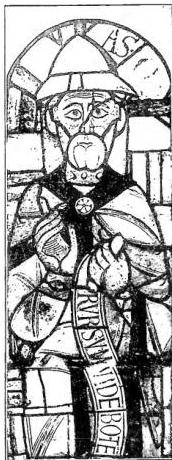
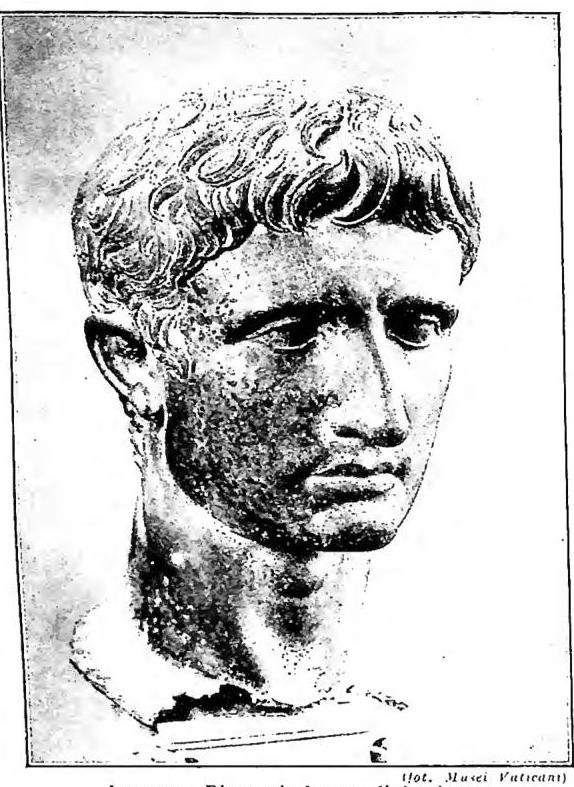
(properly Dagenhart) AUGUSTA – Cathedral stained-glass window (c. 1063).
Carlo V accepted the formula, despite the disapproval of the papal representatives, and promulgated it on 15 May 1548 at the Diet of A., imposing its observance. As was easy to foresee, it satisfied no one: it displeased the Catholics, who asked themselves by virtue of what principle the emperor arrogated to himself the authority to dispense from celibacy, and it offended the Protestants, who wanted to hear nothing of pope, hierarchy, or Sacraments. Magdeburg, a Protestant stronghold, minted coins bearing the inscription: Interim, vade retro, Satana, took up arms, and resisted for ten months the prince Maurizio, whom Carlo, after Mühlberg, had appointed, although he was a Lutheran, elector of Saxony. Neglected by the Catholics and opposed by the Protestants, the “Interim” of A. did not achieve its purpose; instead of bringing pacification, it exacerbated the divisions.