
MONACHISM. – From the verb μονάζω ("I live in solitude") comes the word μονάζων; the more frequent term μοναχος derives from the perfect μεμόναχα. "Monks" were called the ascetics who withdrew from human society to dedicate themselves to the service of God through prayer. In this sense, the word was applied especially to anchorites (v. ANACORETISM); but in the 4th century (St. Jerome, Ep., 14, 6; ad Heliod.: PL 22, 350), it no longer denoted strict solitude but became synonymous with "cenobite," that is, one who has consecrated himself to God in a communal life. Other terms for monk include, for example, "calogero," κανονικός (one who lives according to a rule, canon), etc.
I. EASTERN MONACHISM.
SUMMARY:
I. History
II. Characteristics of Monastic Life.I. HISTORY
1. Institution and Development. – The institution of eremitic and monastic life dates to the 3rd and 4th centuries, but the pursuit of Christian perfection began in the Church from its earliest years. The distinguishing feature of those who wished to follow the evangelical counsels was virginity: men were called continentes, women virgines. They are already mentioned in the Acts of the Apostles, and their numbers grew in subsequent times (Act. 21:8-9; 1 Cor. 7:8-9; Apoc. 14:4; Eusebius, Hist. eccl., III, 31: PG 21, 279; Clement of Alexandria, Strom., II, 18: PG 8, 1040). Later, they were called "ascetics," a term derived from the comparison Clement of Alexandria draws between the Christian life and the rigorous training of athletes (Paedag., I, 8: PG 8, 318; Origen, In Ier. homil., 19, 7: PG 13, 518). The term thus denotes a state of life, not merely exercises in austerity.
These ascetics lived in the world, though they already had some special relations among themselves; later, a tendency toward communal life emerged. St. Athanasius (Vita Antonii, 3: PG 26, 843) mentions the existence of parthenōnas for virgins, but even for men, attempts were made to adopt a more regulated way of life.
The life of ascetics was one of continual renunciation in poverty—though some were wealthy and did not divest themselves of their riches—in fasting and abstinence, especially from meat and wine, but above all in virginity. There was no formal vow, but a kind of consecration (infidelity was considered adultery: Cyprian, Epist., 62, 4: PL 4, 370), which, for virgins, became public in the time of Tertullian (De vel. virgin., 14: PL 2, 908). Later, in the 4th century, some excesses of zeal and certain abuses were denounced and condemned by the Council of Gangra (342).
Asceticism in the sense described was succeeded by anchoritism (v. ANACORETA), that is, a life of perfection withdrawn from human society, marking a second step toward religious life proper. Such was the life led and taught by St. Anthony (v.), and this form never disappeared in the East, though it enjoyed less favor in subsequent centuries. St. Anthony left no rule, neither written nor oral: Scripture was to suffice; yet the examples of the elders provided a practical way of living, and spiritual fathers gathered the monks for their instructions. The so-called Rule of St. Anthony is apocryphal and was composed based on the saint’s letters, the Life written by St. Athanasius, and other writings. Only in the 5th century did St. Sabas (v.) promulgate a true rule for hermits. In anchoritism, two degrees may be distinguished: some led a wholly solitary life, while others, though dwelling in separate cells, formed a kind of colony around a church where they gathered for common prayer. This form of monastic colony is called a laura.
With St. Pachomius (v.), religious life took another step forward in its development. After experiencing eremitic life as a disciple of St. Palemon in Upper Thebaid, he recognized the advantages of a more communal life. Thus, he established a monastery at Tabennisi on the Nile (c. 320), where disciples would live under one roof with a single superior. Soon, he had to multiply his foundations. In all, there were nine monasteries for men. His Rule was also applied to women, who had two monasteries. All of Pachomius’s monasteries remained under the obedience of a single superior general, who visited each house annually. Moreover, twice a year, at Easter and in August, all local superiors, along with many monks from the various communities, gathered to discuss common interests and celebrate the feasts. Pachomius gave a rule, called the Rule of the Angel because, according to legend, he received it from heaven (Palladius, Hist. Laus., 38: PG 34, 1101). In reality, this rule was not the work of a single day and was later perfected through experience. Several recensions of it survive, differing considerably in length (cf. P. Ladeuze [V. BIBLICA.], p. 259 ff.; M. Heimbucher [V. BIBLICA.], I, p. 79 and n. 2). Candidates for monastic life were first subjected by Pachomius to a brief probation of a few days or weeks and then, without formal profession, admitted to the community. The very act of investiture signified dedication to God. Such cenobitism is characterized by common life—that is, shared dwelling, food, spiritual exercises, labor, and goods under the same superior. However, this principle could be, and in fact was, applied differently by the many imitators of Pachomius. The spread of cenobitism was rapid, even in the West. Perhaps already St. Anastasius, but certainly Cassian, introduced the Rule of St. Pachomius to Gaul, where it was translated into Latin by Dionysius Exiguus (d. 540); however, it was especially St. Jerome who made it known. For the history of Eastern monasticism, alongside St. Pachomius, mention must be made of Bguld, founder of the double monastery of Atripe near Tabennisi in Egypt, and even more so of his nephew Shenoute (333/34–421/55), a stern and severe man but compelling. He had under his authority as many as 2,000 monks and 1,800 nuns, and he introduced such severity that it sometimes provoked acts of indiscipline.
In Palestine, monastic life also began with anchoritism under Hilarion (291/92–371), then passed to the laura form (St. Chariton), and finally to Pachomian cenobitism, though the latter did not suppress the two earlier forms. Monasteries existed in Judea, near Eleutheropolis, founded around 335 by St. Epiphanius; near Jerusalem and Bethlehem, visited by Cassian and Palladius. St. Jerome gave the Pachomian Rule to the convents where he and St. Paula were superiors.
In Syria, the various forms of monastic life flourished. The "Sons of the Covenant" are well known, though it is not entirely clear what their way of life was. Some have considered their institution similar to that of the "ascetics," but it seems they were true monks. Indeed, until the time of Rabbula (5th century), there was no special word to designate monks; from then on, the "Sons of the Covenant" referred rather to ascetics outside the monastery. The most notable among Syrian monks were St. James, bishop of Nisibis, who founded the monastery of the Ark at Kardu, and especially St. Ephrem (d. 373–78), who lived near Edessa. Another illustrious monk of this region was St. Nilus (d. 430). Syrian monasticism appears independent of that of Egypt and was an early form of anchoritism.
In Persia, there is the monastery of St. Matthew (Mâr Mattaj) east of Mosul, which became famous during the Nestorian period. In Armenia, monastic life was introduced—after various eremitical forms—probably in the second half of the 4th century; it may have originated from Syria, but its principal source was St. Basil (G. Amaduni, Disciplina armena, Venice 1940, p. XII ff.). The great inspirer of Byzantine monasticism has been mentioned, who brought about a renewal of the monastic spirit by insisting no longer so much on the particulars of separation from the world and bodily mortifications, but rather on the very principles of spiritual life. St. Basil codified religious life primarily through two writings: the 55 Regulae fusius tractatae ("Ὄροι κατὰ πλάτος"), which derive the outlines of monastic life from Holy Scripture, and the Regulae brevius tractatae ("Ὄροι κατὰ ἀπνετομήν"), 333 chapters that serve rather as applications and complements to the former (ed. Garnier, II, 1, 2, Paris 1829; same edition in PG 31; on authenticity V. P. Allard, Basile (Saint), in DThC, II, col. 446 ff.). In St. Basil’s monastic doctrine, obedience constitutes the essence of religious life; other fundamental points are poverty, chastity, and fraternal charity. The whole forms an ascetical treatise more doctrinal than regulatory. Thus, these rules alone were insufficient for organizing monastic life in all its details; they had to be supplemented by tradition and moral precepts. Alongside contemplative life proper, St. Basil assigns great importance to works of charity: orphanages, schools, assistance to the poor and the sick. He also prescribes manual labor and the cultivation of the land.
The Rule of St. Basil found rapid diffusion.
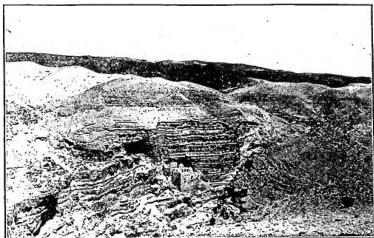
MONACHISM - Monastery of Wâdî el-Qelt - Valley above Jericho.
throughout the East: from Cappadocia, where it came into force everywhere during the founder’s own lifetime, it spread to neighboring lands and beyond, among both the Orthodox and dissidents such as the Jacobites, where the number of monasteries was perhaps even higher. But it also exerted great influence in the West, even on St. Benedict, whose Rule nevertheless prevailed to the point of almost completely replacing that of St. Basil. However, after Rufinus’s Latin compilation of the latter (PL 103, 483 ff.), several monasteries were established according to the same Rule in southern Italy and Sicily; their number grew when iconoclasm (8th century) and the advance of Islam drove many refugee monks to the West. To this day, the Rule of St. Basil remains the foundation of monastic life for all the separated East and for a good number of Eastern Catholics.
The Greek canonist Petrakakos expresses the relationship among the three great organizers of monastic life: “Pachomius was the founder of the cenobium; Basil the Great its ideal legislator; Theodore the Studite the eminent interpreter of St. Basil the Great. These three constitute the Olympus of Orthodox monastic institution.” St. Theodore is called “Studite” from the famous monastery founded in Constantinople by the consul Stoudios for the ascetic monks (H. Delehaye, Stoudion-Stoudios, in An. Boll., 52 [1934], p. 64). Other monasteries also gained, and still retain, great renown. In Russia, the Pečerskaya Laura of Kiev, known as the Monastery of the Caves, founded after 1050 by a monk from Athos, is worth mentioning. It was the cradle of monastic life in Russia, where later monasteries numbered over 500; in 1914, there were still more than 20,000 monks and over 70,000 nuns.
In Greece, Mount Athos (v.), the Holy Mountain, located on a peninsula of the Thracian Chersonese. In Thessaly are the monasteries of Meteora, so named because they were almost in the air, that is, built on high rocks and accessible only by rope ladders. Another well-known monastic center was that of Olympus. But all the lands of the East had their monasteries.
2. Various forms. — Alongside this cenobitic life codified by St. Basil, St. Theodore the Studite, and others, there were numerous forms of religious life quite different from one another, some closer to anchoritism, others to cenobitism.
The Acemetae (v.) are particularly well known, for they “without rest” continued the divine praises, and the Stylites (v.), whose initiator was the Syrian St. Simeon (the Great) called the Stylite (ca. 390–459), who spent 37 years on a column. He had many imitators; the columns ranged from 3 to 18 meters in height. They made a kind of vow to remain upon them. Among the Stylites, some were priests, one was even ordained on his column; some are known as writers. Monasteries for disciples and houses for pilgrims were built around the stylite. Few women followed this way of life.
Other forms are also recalled, such as the Recluses (ἐγκλειστοί), that is, men and women who had themselves walled into a cell to dedicate themselves undisturbed to contemplation, reading, and manual labor. The Council in Trullo decreed (can. 41) that no one could adopt this way of life unless they had first lived for three years in a monastery; but once enclosed, they could no longer leave the cell. The Pabulatores (βοσκοί) had neither roof nor bread nor other things; they lived in the mountains, occupied with divine praises; at mealtime, they went, each on their own, into the woods with a sickle to seek herbs to eat (Niceph. Call., Eccl. hist., IX, 40: PG 146, 711 ff.; S. o. o. m. e. n. o. Hist. eccl., VI, 33: PG 67, 1391 ff.). Others, finally, were called, according to the
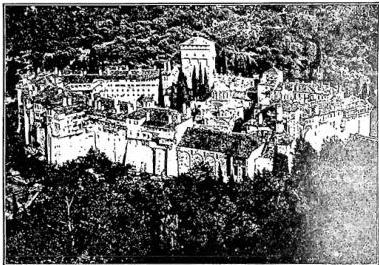
Monasticism - Chilandari Monastery - Mount Athos.
According to the characteristic of their life, they were called Subdivals, Stationaries, Shepherds, Demented, Eusebians, etc.
3. Legal Ordering of Monastic Life. — The Rules of St. Pachomius, St. Basil, and others were internal, that is, they had the authority of the founder; however, with the expansion of monastic life and after the experience of various abuses, more official norms were needed to regulate some fundamental points of discipline. This task was carried out by various councils and also by civil authority. Canons on religious life are found in the Councils of Chalcedon, the "in Trullo," the Second of Nicaea, and in the particular councils of Gangra, Laodicea (347-379?), Carthage (419), and in the First and Second Councils held by Photius in the Church of the Holy Apostles in Constantinople (861). The writings of some Fathers (St. Basil [*ad Amphil.*], St. Nicephorus of Constantinople, St. Cyril of Alexandria) provided texts for some canons regulating monastic life. In addition to these provisions of ecclesiastical authority, there is also a considerable number of civil laws concerning religious life.
Already in the Theodosian Code there are norms for monks, but it was especially Justinian who regulated monastic life. "From a strictly juridical point of view," says T. Schafer, "it is evident that in this monastic legislation Justinian's work appears not only complete but indeed perfect" (Iustinianus et vita monastica, in Act. congr. iurid. intern., I, Rome 1935, p. 187). Justinian's norms on the matter are found in his Codex and in the Novels, 5, 22, 57, 76, 79, 123, 131, 133. After Justinian, legislation for monks is found especially in the Basilics and in the Novels of Leo VI the Wise (Nov., 5, 6, 7, 10, 36, 38).
However, the discipline thus established remained quite general. To complete it, more particular norms were needed, which would also give a more proper character to the monastery. These are found in the typika. Typicon means norm, rule, ordinance. There are typika in both the civil and ecclesiastical fields, and here again different types are distinguished, among which are monastic typika. Especially from the 10th century onward, it became customary that in the foundation of a new monastery, the founder (emperor, patriarch, bishop, civil or ecclesiastical official, or some wealthy person) would establish a specific regulation for II.
These are the foundation typika. Other typika refer to an already existing monastery or are even made by testament. The subject matter, however, is nearly the same as that of the foundation typika. They generally contain an ascetic introduction and some details about the founder and his foundation; then follow the fundamental provisions (dependence of the monastery), liturgical (degree of feasts, order of ceremonies) — not to be confused with the so-called liturgical typika that regulate the entire liturgy —, disciplinary (election of the superior and minor officials, admission, common life, habit, etc.), economic (description of goods, administration, etc.), though the latter are not always present. Some more general typika can be applied to various monasteries; these do not contain economic provisions.
BIBL.:
T. Schafer, Iustinianus et vita monastica, in Acta congressus iuridici internationalis, I, Roma 1935; F. Dvornik, Les Légendes de Constantin et de Méthode vues de Byzance, Prague 1933; A. Ehrhard, Überlieferung und Bestand der hagiographischen und homiletischen Literatur der griechischen Kirche, I-III, Leipzig 1937-1952; H. Delehaye, Les Saints stylites, Bruxelles 1923; J. Pargoire, L'Église byzantine de 527 à 847, Paris 1905; K. Holl, Enthusiasmus und Bussgewalt beim griechischen Mönchtum, Leipzig 1898; P. de Meester, De monachico statu iuxta disciplinam byzantinam, Città del Vaticano 1942; G. Every, The Byzantine Patriarchate, London 1947; V. Grumel, Les Regestes des Actes du Patriarcat de Constantinople, I, Paris 1932; J. Darrouzès, Recherches sur les ὀφφίκια de l'Église byzantine, Paris 1970.
A. M. Ammann
II. CHARACTERISTICS OF MONASTIC LIFE
1. Generalities. — In ancient Eastern law, all religious are monks; other forms, such as Mendicant Orders, Regular Clerics, etc., were introduced later. All monks belong to the same category: there is no distinction between choir monks and lay brothers. It is true that not all sing the entire Office; part is performed by cantors alone, but these do not constitute a special rank, and the requirement to join their group is a sonorous voice, not studies completed. There are no monastic orders consisting solely of clerics: in antiquity, priests were ordained according to the monastery's needs. Justinian grants 4 or 5 (Nov., 133, 2) and wishes them to be chosen from among monks who have overcome the ascetic struggle and merit priestly or diaconal ordination (ibid.). Indeed, the number varies according to the typikon. Monk-priests are called hieromonks, deacons hierodeacons; between them and simple monks, there is no distinction regarding monastic life.In ancient Eastern law, there are no congregations or Orders in the Latin sense, that is, with a superior general and a central organization. Each monastery has its own constitutions and its own authorities. However, among certain monasteries, there sometimes exists a bond, either of the same typikon or even of a common authority, which does not entirely suppress the autonomy of each. The monastic association of Mount Athos is a characteristic example of such a union.
Among Catholics, there currently exists only one institution that preserves entirely, as far as possible under present circumstances and given the development of law in the Catholic Church, Eastern monastic life. These are the Studites, founded at the beginning of the 20th century by the metropolitan of Lviv in Galicia, Andrea Szepticki. They received
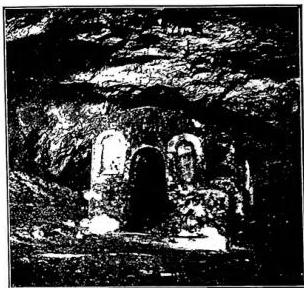
MONACHISM – Eremitic cave – Olevano Tusculum.
Currently, Antoniani (v.)—namely: among the Maronites, the Lebanese monks, the Antoniani of St. Isaiah, and the Aleppine Antoniani; among the Chaldeans, the Antonian monks of St. Hormizd. The Basilians (v.), though they do not all share a common origin or relation of dependence. In Italy, there are the Basilians of Grottaferrata; in Galicia and elsewhere (with foundations also in America), the Basilians of St. Josaphat; in Lebanon and Syria, the Melkite Salvatorians, the Suwajrites, and the Aleppines are called Basilians, the latter two sharing a common origin. Finally, there are the Armenian Mechitarist monks, divided into two branches: those of Venice and those of Vienna.
2. Stages of Monastic Life. — The postulant is unknown in ancient Eastern law. St. Pachomius kept newcomers near the gate for a few days to test their constancy; afterward, they were immediately admitted as monks. In the recent law of Catholics, the postulant was introduced in imitation of Latin discipline. The novitiate, however, is of ancient tradition, though neither Pachomius nor Shenoute knew II. It existed with St. Basil, and civil law regulated it when Justinian prescribed three years (Nov., 5, 2), which superiors could reduce in certain cases (Nov., 123, 35). Most typika also require three years. Current law prescribes a distinctive habit for the novice.
3. Vows. — St. Pachomius did not yet know an explicit profession with vows, whereas Shenoute had his monks compose a written promise to observe the rules. However, this was not a vow made to God but a simple promise or bond toward the monastery. Profession does exist with St. Basil (Reg. fus., 14: PG 31, 950-951), as well as in Syria (John Chrysostom, Exhort. II ad Theodos.: PG 47, 309-21). The Council of Chalcedon (can. 6) declares the marriage of a monk illicit, while St. Theodore the Studite speaks of promise and pact (I, 20: cf. II, Ep., 88, 165, 172: PG 99, 970, 1334, 1523, 1539). It cannot be said that the content of these vows was identical to the current profession, though the three vows of chastity, poverty, and obedience were from the beginning presupposed in a life consecrated to God. Indeed, chastity was always considered one of the foundational points of monastic life, but it does not yet appear that it rendered marriage invalid. Spiritual fathers highly recommend poverty, yet it does not seem that the monk was incapable of possessing. Obedience was certainly a requirement already for Pachomius and constitutes the foundation of religious life for St. Basil and St. Theodore the Studite. Beyond these virtues, others were considered equally necessary for monastic life, such as abstinence, prayer, etc., and the three virtues forming the object of our three vows were not singled out as more essential. Thus, monastic profession was a solemn declaration or promise made to God to fulfill all obligations and endure all that was imposed by monastic life.
As for the formula of profession, at the beginning of monastic life, it was implicitly contained in the ceremony of vestition with the tonsure of hair, the change of name, and the conferral of monastic garments. All this symbolized a new life begun by religious profession, which was considered a new Baptism. Once it became more explicit, profession was not made through the recitation of a formula: such formulas exist, but not for profession, rather for the retraction of an apostate. The Byzantine monk professes through interrogations and responses found already in manuscripts of the 9th and 10th centuries, identical to those in the Euchologion (Euchol. Byzant., Rome 1873, p. 227).
Monastic vows are always perpetual and solemn in ancient Eastern law. Other types of vows, temporary and simple, were recently introduced from Latin law. But a characteristic of monastic profession is the distinction of various degrees. It is true that profession remains unique, in that all monks are bound to observe forever all the precepts of monastic life. In the early centuries of monasticism, that is, in its golden age, degrees are not yet mentioned; this distinction was introduced later due to various circumstances, such as relaxation and the expansion of monastic life. Spiritual fathers, like St. Theodore the Studite, fought against what they considered an abuse (Testamentum, 12: PG 99, 1819). Today, however, monastic practice has admitted them.
With his first profession, that is, after the novitiate, the monk enters the category of rasophores, those who wear the riasson, a black habit with wide sleeves. Much debate has arisen over the profession of rasophores—whether they make a true profession or are rather to be compared to novices. It must be said that, although this profession is not expressed in questions and answers, the entire ceremony has the meaning of a true profession.
Usually, after some years (from 5 to 10), the rasophore may request admission to the second degree, that of the staurofores (those "who bear a cross"), also called the small (angelic) habit, microschema. The monk of this degree is considered on the path to perfection. Most halt their ascent here. There remains, however, a further degree: that of the great angelic habit (megaloschema) or of perfection. Those who, after many years spent as staurofores, request admission to this degree are rather rare. The megaloschema entails more numerous and severe ascetic obligations, including a greater number of daily metanias (profound bows to the ground) and stricter abstinence. Just as one may remain in a given degree without aspiring to a higher one, there is no absolute necessity to pass through lower degrees to reach the higher ones.
Among Catholics, degrees exist but are not infrequently more or less assimilated to the Latin institution—for example, simple profession to the rasophorate, solemn profession to the microschema (Basilians, Melkites, Constit., nn. 31-32), or even the two professions are compared to the small and great schema (Copts, Ethiopians, Armenians, Basilians of Grottaferrata).
4. Superiors. — At the head of the monastery stands the superior, designated by various titles; only the most common are mentioned here.
In antiquity, the words "elder" (γέρων, πρεσβύταρος) or even "abbot" (apa, abba, etc.) were used, though initially, the latter referred to the monk himself, later only to the superior. Common is also the term "prepositus" (προστιώς, nostanate) and derivatives, as well as ἐξάρχος, ἄρχων, or "hegumen." One may distinguish, as in Byzantine law, the superior without sacred orders—the "hegumen"—from the priest or deacon superior—the "kategumen." An honorary title borne especially by superiors of great monasteries is that of "archimandrite." There are still various titles for minor superiors.
5. Enclosure. — Justinian requires that the monastery be surrounded by a high wall, with a single door guarded by elderly and prudent porters (Nov., 133, 1). No woman may enter a men’s convent, nor vice versa, and this prohibition is extended in male monasteries to boys, beardless youths, and married men. Often, it is also explicitly forbidden to bring female animals into the monastery. Monks may not leave the convent without the superior’s permission, and this rule is even stricter for nuns. It must be added, however, that departure is not as absolutely prohibited as in the strict papal enclosure of Latin law; the bishop may permit it for grave reasons.
6. Departure. — By default, the monk must remain in his convent. However, if there are reasons, he may transfer to another convent with the permission of the superiors. A monk may be expelled from his monastery for certain offenses; nevertheless, he remains subject to the obligations of his state. If he abandons the monastic state, he is excommunicated and compelled to return to the monastery, where he is subjected to various penalties. Only from the beginning of the 19th century, in some particular Churches, has laicization begun to be granted, but the practice is contrary to the entire Eastern tradition.
7. Ministries. — Although their life was contemplative, monks had a great influence on the public life of the Church. Alongside the attraction of their virtue, which drew both Christians and pagans to the desert or monasteries, and alongside the numerous houses for hospices, hospitals, orphanages, and schools, the activity of monks extended further. Thus, in the field of theology, monks were often the most ardent defenders of orthodoxy. St. Anthony went to Alexandria to bear witness to his faith, and his example inspired the great majority of hermits, who, with their zeal, effectively defended the faith of Nicaea (St. Athanasius, Vita Antonii, 68-70) and were the allies of St. Athanasius, who also found help and defense in the monasteries of Tabennis in the struggle against Arianism. For this reason, monks suffered persecution from intruded bishops and Emperor Valens.
St. Basil, St. Gregory Nazianzen, and St. Amphilochius fought against the same heresy and against Macedonianism and Manichaeism. Almost all the great names of monks distinguished themselves in the defense of the faith, such as St. Nilus, St. Serapion of Thmuis, St. Meletius, St. Aphraates, St. Sophronius, St. Sabas, St. Maximus the Confessor and his disciples, the two Athanasiuses, who suffered martyrdom for the faith. St. Isidore of Pelusium fought against Nestorianism, St. Marcellus the Acemete and his monks against Monophysitism, St. John Damascene against the iconoclasts, St. Theodore the Studite, and many others were champions of the faith. On the other hand, it is also true that many heresies had fanatical defenders and sometimes even originated among monks: Eutychianism arose in a monastery and found many followers in the monasteries of Constantinople, Egypt, and Thebaid. Origenism also found most of its adherents among the monastic class. Monks were among the most bitter opponents of the Council of Florence (1493).
As ascetic writers, others are notable, including St. Serapion (d. after 362), Evagrius Ponticus (d. after 400), St. Nilus the Elder (d. c. 430), St. Arsenius the Hermit (d. 449), and St. John Climacus (d. c. 649). In the interpretation of Sacred Scripture, St. Basil, St. Gregory Nazianzen, St. Isidore of Pelusium, Eutychius, St. Ephrem, St. Sophronius, and others distinguished themselves. Monks are also found in the fields of letters and secular sciences.
8. Dependence and Exemption. — As a general rule, Eastern monks depend on the bishop. However, from the 8th century, or perhaps even earlier, the custom arose that the patriarch could exempt monasteries, churches, and houses from episcopal jurisdiction and subject them directly to himself, either at the time of their foundation or afterward. This exemption was effected by placing a cross blessed by the patriarch on the exempted site. From that moment, all the rights of the local bishop passed to the patriarch himself. Such exemption is called patriarchal stauropegia. Metropolitans have vainly risen against this right, which has now been greatly reduced, so that in some dissident patriarchal Churches it no longer exists or scarcely exists. Among Catholics, it is restricted to already existing stauropegia and new convents.
In ancient times, until the end of the Byzantine Empire, there were other convents called imperial, directly subject to the Emperor and at least partially withdrawn from ecclesiastical jurisdiction, as well as those independent of all secular and ecclesiastical authority, called "free and autodespotic."
Among Catholics, monks depend, according to ancient law, on the local bishop; the patriarch has over them a mediated jurisdiction, except in stauropegic monasteries and where special law grants greater authority, as among the Maronites, Syrians, and Copts. There also exists the privilege of papal exemption among the Mechitarists of Venice and the Basilians of St. Josaphat; others also appeal to it, but the concession is not certain (Basilians, Melkites, Antonians), although they have some rights proper to the exempt (such as their own jurisdiction).
9. Idiorrhythmia. — Among the Byzantines, probably as a consequence of the unbridled independence of some monasteries and perhaps also due to some relaxation introduced by imperial legislation (Leo VI, Nov., 5), a new, freer form of life called "idiorrhythmia" seems to have formed toward the end of the 14th century.
The idiorrhythmic monastery is composed of a certain number of religious families (10 or more). At the head of each family is a superior, who must care for his monks (usually 6 or 7), whom he has gathered in the monastery or accepted as novices. Idiorrhythmic monks may possess goods, acquire them, sell them, and bequeath them by will; they live by their labor and their goods within the family, where discipline is greatly reduced. They have in common a council that governs the entire monastery; they gather in church for the Divine Office and only a few times a year (3 or 4) do they dine together in the same refectory. The monastery provides the families with bread, wine, firewood, and other necessities; the rest each provides for himself.
(da Skandinavien, Berlino 1891, inv. 11)
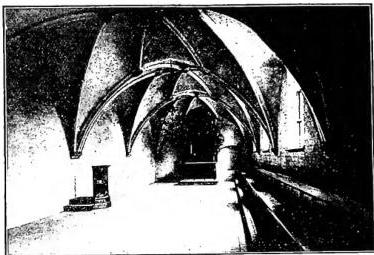
MONACHISM - Chapter Hall of the Ancient Convent of Helsingör (late 14th century).
This abuse has spread widely. On Mount Athos, there are 9 idiorrhythmic monasteries. All protests have failed to suppress the numerous abuses.
11. Statistics
Until the beginning of the 20th century, Russia had the largest number of monks. Some figures for 1914 have already been cited. Currently, it is not possible to complete these statistics. Mount Athos follows with several thousand monks; Greece itself has nearly 2000 (men and women). Other dissident countries count barely a few hundred religious, for a fairly significant number of monasteries. Many of these are practically deserted; one or more monks reside there for the administration of goods.Among Catholics, the Studites numbered more than 100 monks in 1932; among other Eastern Catholics, monks number approximately 2000, excluding nuns.
II. WESTERN MONACHISM.
The communal ascetic life, or cenobitic life, born in the East in the 4th century, spread almost simultaneously in the West as well, in various forms, often poorly and badly organized. The Rule of St. Benedict (d. ca. 547), an incomparable monument of monastic life, quickly imposed itself over almost all other rules, giving unity to Western monachism and contributing to its powerful developments, to the point of making it for centuries a primary institution in the life of the Church.
The complex history of Western monachism is presented in the Enc. Catt. in many detailed entries, extensively developed; the present one has a general and coordinating character and is limited to monachism proper, excluding all other forms of associated ascetic life that arose and developed from the Middle Ages onward (Regular Canons, Mendicant Orders, Religious Congregations), which nevertheless have their complete illustration under their respective headings.
SUMMARY:
I. Pre-Benedictine Monachism
II. St. Benedict and the Diffusion of Benedictine Monachism. -III. Benedictine Reforms
IV. Influence of Monachism in the Western Christian World
V. Monachism.I. PRE-BENEDICTINE MONACHISM
Regarding its genesis, Christian monasticism arises from the Gospel, specifically from the fact that Christ proposes counsels to more easily attain Christian perfection (Mt. 16:21). The various hypotheses advanced to assign monasticism a non-Christian origin, especially since E. Weingarten (Der Ursprung des Mönchtums, Gotha 1877) thoroughly attacked the traditional thesis, are one-sided and unsustainable (cf. U. Berlière, Les origines du monachisme et la critique moderne, in Rev. bénéd., 8 [1891], pp. 1-19, 49-69). As for its evolution, monasticism represents the final stage of Christian asceticism, which, though to varying degrees, develops in both the West and the East in three successive phases: asceticism within the Christian community, asceticism in solitude or anchoritism (v. ANACORETA), and finally ascetic life in common, that is, cenobitism or monasticism. This last phase took root in the West in the second half of the 4th century, under pronounced influences from Eastern monasticism.1. In Italy. - The most comprehensive monograph on pre-Benedictine monasticism in Italy remains that of Ernesto Spreitzenhofer, Die Entwicklung des alten Mönchtums in Italien von seinen ersten Anfängen bis zum Antreten des hl. Benedict, Vienna 1894. Rome is perhaps the oldest center. Communal ascetic life, if not initiated there, certainly received a strong impulse in Rome when St. Athanasius arrived (341), accompanied by two Egyptian monks, Isidore and Ammonius. "Among the noble Roman women, none at that time knew the monks' purpose," states St. Jerome (Ep., 127, c. 5: PL 22, 1080). The noble Marcella was the first to embrace that ideal (ibid., 1089) and turned her palace on the Aventine into a female ascetic community. St. Augustine, during his stay in Rome (387-88), visited plura diversoria sanctorum, both male and female, true monasteries governed by a monk or a nun who presided over all (De mor. eccl. cath., I. I, c. 33: PL 32, 1340). In the 5th and 6th centuries, monastic life flourished widely in Rome, so that before the 7th century, 16 monasteries could be counted there—7 female and, it seems, 9 male. These monks, even before St. Gregory the Great, were entrusted with the official duties of the basilicas of St. Peter and St. Paul; shortly afterward, they were also found in the basilicas of St. John and St. Mary Major.
Meanwhile, monastic life had spread throughout Italy. St. Eusebius of Vercelli (d. 371), formerly a lector in Rome, elected bishop of Vercelli in 345, introduced the common life among his clerics (v. CANONICI REGOLARI DI SANT'AGOSTINO. AGOSTINO). In Aquileia, around 370, there already existed that monastery where Rufinus and Jerome stayed before passing to the East (cf. Vallarsi, Vita Rufini: PL 21, 80). In Milan, St. Ambrose (d. 397) founded a monastery near the city walls, "plenum bonis fratribus," says St. Augustine (Conf., VIII, c. 6: PL 33, 735), "quibus unus presbyter praerat vir optimus et doctissimus" (De mor. eccl. cath., I. I, c. 33: PL 32, 1340).
During the 5th and 6th centuries, monasteries arose everywhere—in Ravenna, Naples, and Sicily. For central Italy alone, St. Gregory, in his Dialogues, commemorates about twenty outside Rome, almost all pre-Benedictine (cf. F. Antonelli, De re monastica in Dialogis s. Gregorii Magni, in Antonianum, 2 [1927], pp. 401-36).
2. In Gaul. - In Gaul, monasticism began with St. Tours (v.). Ordained a priest in 360, he lived as a hermit at Ligugé near Poitiers; consecrated bishop of Tours in 371, without changing his way of life, he established his dwelling in a cell near the city, where, due to the influx of numerous disciples, the famous Marmoutier (maius monasterium) originated, one of the most celebrated centers of monastic life in the West. Another monastic center of great influence was that begun by St. Honoratus in the early 5th century on the island of Lérins, off Cannes—a true school of sanctity and culture; it suffices to mention St. Lérins (v.) and St. Arles (v.), also educated in this monastery. Of great importance for monasticism in Gaul, indeed in the entire West, was John Cassian (v.), founder of two monasteries in Marseille—that of St. Victor for monks (415) and another for nuns—and author of various works on monastic asceticism, widely disseminated throughout the Middle Ages. During the 5th and 6th centuries, monasticism spread extensively in Gaul, and there was no city without one or more monasteries.
3. In Africa. - In Proconsular Africa, the monastic ideal found a strong protector and promoter in St. Augustine. After returning to Tagaste following his baptism (388), he sold his possessions, keeping only his house, where he began monastic life with his friends. Consecrated bishop of Hippo, he introduced the common life among his clerics and promoted monastic life among the faithful of both sexes. His letter 211 (PL 33, 960), written in 423 for the Hippo monastery presided over by his sister, enjoyed wide diffusion and became the basis for the constitutions of numerous religious congregations, which rightly venerate the holy Doctor as their spiritual father. In the 5th and 6th centuries, monastic life flourished throughout Christian Africa, as can also be seen from Victor of Vita’s Hist. persec. Africanae prov. temporibus Vandalorum (PL 58, 179-260), written around 488, and had authoritative representatives, such as St. Fulgentius of Ruspe (d. 533), who, even in exile, founded a monastery in Cagliari. The Vandal persecution first, then the Saracen invasion, put an end to every Christian institution.
4. In the British Isles. - From Gaul, monasticism passed into England, specifically among the Britons who had taken refuge in the west of the island following the Anglo-Saxon invasion (428). St. Germanus of Auxerre, on his second journey to Britain (447), ordained Ilut a priest, who founded the monastery of Llantwit. In the 6th century, St. David, bishop of Menevia, spread monasticism in Wales. In the early 7th century, the most celebrated monastery in Britain was Bangor Iscoed, near Chester, divided, according to Bede (Hist. eccl., I. II, c. 2: PL 95, 83 sg.), into seven sections, each with at least 300 monks.
Monasticism flourished even more in Ireland, where the ecclesiastical organization itself became almost monastic. St. Patrick, apostle of Ireland (d. 461), had visited Marmoutier and Lérins, and several Irish monasteries trace their origins back to him; but the great monastic development occurred in the 6th century. Some of the most important monasteries are: Killeany, on the principal Aran Island in Galway Bay, founded by St. Enda (d. 542); Clonard in Meath, founded around 520 by St. Finnian (v.), to whom up to 3,000 disciples are attributed; Moville in Ulster, founded by another St. Finnian, who came from the monastery of Killeany (d. 590); Clonmacnois, on the left bank of the Shannon, a great center of culture, founded by St. Ciaran around 544; finally, the celebrated Bangor, north of Moville on the southern coast of Belfast Lough, founded around 588 by St. Comgall (d. 601), from which St. Columbanus and St. Gall emerged. Monastic life for women also developed extensively: St. Brigid (d. 524), founder of the monastery of Kildare, exerted great influence.
BIBL.:
E. Spreitzenhofer, Die Entwicklung des alten Mönchtums in Italien, Vienna 1894; U. Berlière, Les origines du monachisme, Maredsous 1927; F. Antonelli, De re monastica in Dialogis s. Gregorii Magni, in Antonianum, 2 (1927), pp. 401-36; E. Vacandard, Vie de S. Victrice, évêque de Rouen, Paris 1917; L. Duchesne, Fastes épiscopaux de l'ancienne Gaule, I, Paris 1907; P. de Labriolle, Histoire de la littérature latine chrétienne, Paris 1924; H. Leclercq, Lérins, in DACL, VIII, coll. 2615-2650; A. Wilmart, Le recueil des lettres de S. Augustin, in Miscellanea Agostiniana, II, Rome 1931, pp. 171-214; G. Morin, Les monuments de la prédication de S. Augustin, in Rev. bénéd., 34 (1922), pp. 257-286; J. Chapman, St. Benedict and the Sixth Century, London 1929; M. Cappuyns, Jean Cassien, Brussels 1949; F. Cabrol, Les origines du monachisme en Afrique, in Rev. bénéd., 15 (1898), pp. 49-63; P. Monceaux, Histoire littéraire de l'Afrique chrétienne, Paris 1901-1923; C. Plummer, Venerabilis Baedae Historiam ecclesiasticam gentis Anglorum, Oxford 1896; L. Gougaud, Les chrétientés celtiques, Paris 1911; Id., Les saints irlandais hors d'Irlande, Louvain 1936.
A. Lentini
One of the most notable characteristics of Irish monasticism was its expansive force. The first example is found in St. Columba (d. 597), educated at Moville and later at Clonard, who around 563 left Ireland and landed, with 12 companions, Iona (v.), west of Scotland and 115 km north of Ireland, where he founded that celebrated monastery, which became a center of culture and evangelization for the northern Picts. A monk of Iona, St. Aidan (v.), bishop and abbot (d. 651), founded in 635 Lindisfarne (v.) that other famous abbey, which became a center of evangelization for Northumbria and may be considered the Iona of the Anglo-Saxons.
The first to inaugurate the series of monastic and apostolic migrations of the Irish toward the European continent was St. Columbanus (v.), who, having departed in 590 from Bangor with 12 companions, founded in the Vosges the monastery of Anegray, then the more celebrated one of Luxeuil, later moved near Lake Constance, and, having left St. Gall here, descended into Italy and founded the monastery of Bobbio, where he died in 615.
But at this juncture, another factor of primary importance for monasticism in the British Isles had come into play: the Roman monks. St. Augustine, with 40 companions, sent by St. Gregory the Great for the conversion of the Anglo-Saxons, had landed in Kent around Easter of 597. Their influence was not limited to the evangelizing mission among the Anglo-Saxons; the subsequent overcoming of the disciplinary and liturgical particularisms of Breton and Irish monasticism, the Romanization of culture in England, the dissemination of the Rule of St. Benedict, and finally the missionary spirit of Anglo-Saxon monasticism, to which the evangelization of Germany and the peoples of the north is largely owed, ultimately stem from the influence of the Roman monks.
II. ST. BENEDICT AND THE DIFFUSION OF BENEDICTINE MONASTICISM. - In pre-Benedictine Western monasticism, alongside examples of holy life and at times great industriousness and learning, there were also abuses and disorders that ecclesiastical and civil authority could not entirely eliminate; suffice it to recall the wandering monks and the sarabaites, the "most wretched kind of monks," mentioned by St. Benedict (Reg., c. 1). Above all, what was lacking was a great common Rule, suited to the nature of religious life and to the Western spirit. The many Rules in use were essentially collections of spiritual maxims, with lists of prohibitions and penances. Preference was given to the Rules of St. Basil, rich in prescriptions poorly attuned to the Western mentality, and to the monastic norms of Cassian; but rather than on the basis of a true Rule (sometimes several Rules were combined for use in the same monastery), the various religious houses were governed by the will of the abbot, which easily led to arbitrariness.
The inestimable merit of St. Benedict is that of having given Western monasticism a practical, reasonable, and moderate legislation for religious life, suited to the conditions and character of the Western spirit—a true fixed Rule, in which arbitrariness is excluded, the best of monastic tradition is preserved, and new elements of primary importance are added, such as stability in the monastery and manual labor; that labor which, through the influence of Cassiodorus, founder of the celebrated monastery of Vivarium, also becomes cultural and scientific work. As for the origin and content of the Benedictine Rule, V. BENEDETTO: IV. La Regola.
The Rule of St. Benedict spread rapidly and extensively, soon prevailing over all other rules. Two factors primarily favored its diffusion: its intrinsic excellence and the support of ecclesiastical authority, especially that of the popes, beginning with St. Gregory the Great. The incomparable praise that the latter bestows upon St. Benedict in his Dialogues, one of the most widely read books of the Middle Ages, was a powerful vehicle for the diffusion of the great Patriarch's Rule.
In Italy, during the 7th century, the spread of the Benedictines was delayed by the Lombards; wherever they passed, monasticism was almost destroyed; they respected only Bobbio, inhabited by Irish and Frankish monks; and it is interesting to note that precisely at Bobbio the Benedictine Rule found acceptance as early as the first half of the 7th century. Outside Lombard domains, in the Du-
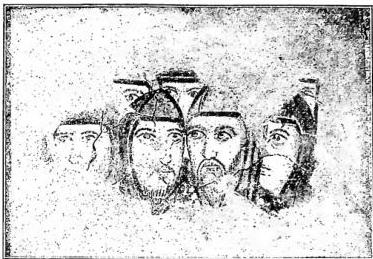
The conversion of the Lombards in the final decades of the 7th century ushered in a period of extraordinary flourishing for the Benedictines in Italy. In 705, the abbey of Farfa in Sabina was founded, rapidly ascending to extraordinary power; monks from Farfa soon established S. Vincenzo al Volturno. From this point onward, Benedictine abbeys multiplied across Lombard territories, with the protection of rulers, as in the case of Nonantola, founded in 752 by St. Anselmo (v.), brother-in-law of King Aistulf. Around 720, Montecassino also rose from its ruins under Abbot Petronax and became a driving center of Benedictine monasticism in Italy and beyond.
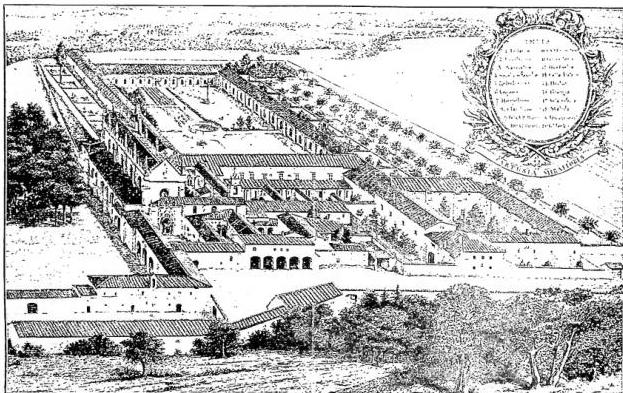
MONACHISM - Panoramic view of the Charterhouse of Miraflores (15th century). Engraving.
it found wide favor, and the Rule of St. Benedict ultimately prevailed. The favor of the Merovingians also contributed to this, particularly that of St. Bathilde (v.), wife of Clovis II, who later retired to religious life (d. 80). Around 660, even Lérins, a stronghold of pre-Benedictine Gallic monasticism, adopted the Rule of St. Benedict. Shortly afterward, St. Leodegar, Bishop of Autun (663-80), speaking at a local Synod about monastic observances, cited only the Rule of St. Benedict (MGH, Concilia, I, Concilia Aevi Merov., Hanover 1893, p. 221).
North of Gaul, in present-day Belgium, monasticism made great progress through the work of St. Amand (v.), apostle of Belgium, in the first half of the 7th century, specifically according to the Columbanian-Benedictine Rule of Luxeuil.
In Frisia and Germany, however, the disseminators of Benedictine monasticism were the Anglo-Saxon monks, great apostles of these regions in the second half of the 7th century and throughout the 8th century: suffice it to recall St. Willibrord (v.), St. Suitbert (v.), and St. Boniface (v.).
III. BENEDICTINE REFORMS
During the 7th century and the early 8th century, Benedictine monasticism reached the apex of its diffusion and vitality in all the countries where it had penetrated; unfortunately, its decline was not long in manifesting itself, first in England and Gaul, somewhat later in Italy and Germany. The principal cause is to be sought in the so-called right of appropriation, a general phenomenon that was not limited to monasteries alone but also affected bishoprics and, in general, ecclesiastical institutions endowed with immovable property, and which could only have disastrous consequences. As regards monasteries, the genesis of this right is easily explained. Few were the monasteries founded and endowed by an abbot; ordinarily, it was kings, princes, bishops, or even wealthy and influential laymen who founded a monastery in territory subject to them or of their property, and endowed it with the immovable goods necessary for its subsistence—fields, vineyards, forests. It was natural that the lord, founder and donor of the goods, should also be the natural protector of the monastery, which in some way belonged to him. But protection opened the way to ever broader interference in the very life of the monastery; thus, a complex of rights of the "proprietor" (as the founding lord was called) was formed, and by the early 8th century these rights were publicly and universally recognized. They concerned above all two things: control over the election of the abbot and broad interference in the administration of goods. It reached the point of seeing abbeys governed by laymen and monasteries burdened with taxes or even stripped of their goods, given as appanages to royal officials or to the prince’s creatures. This was, in essence, the first example of that secularization of ecclesiastical goods which, in different forms, has recurred so many times throughout the centuries. The system of appropriation, Charles Martel (v.), unfortunately continued even under Charlemagne, despite the fact that he meditated upon and desired monastic reform, as is evident from his numerous capitularies on the subject. The monastery was considered and had in reality become a landed power, and, by virtue of the right of appropriation, constituted a cog in the political-social machinery, which it was well-nigh impossible to do without. In this state of affairs, however, monastic discipline could not subsist; indeed, abbeys where regular Benedictine life was still practiced were rare: disorder had taken on more than worrisome proportions.Providential at this moment was the reforming action of St. Benedict of Aniane (v.), who not without reason may be called the second father of Benedictine monasticism. He initiated the reform in 785, with the support of Louis the Pious, then king of Aquitaine, who placed him at the head of the monasteries of his kingdom. With Louis’s ascent to the Empire (814), the influence of St. Benedict of Aniane extended to all of France, and in a short time a great number of monasteries, from the Pyrenees to the Rhine, were brought back by him to regular Benedictine life. Famous was the great assembly of abbots at Aachen in 817, of which Benedict was the soul and which concluded with that Capitulare monasticum (MGH, Legum sect. II, Capitularia regum francorum, I, Hannover 1883, p. 343 ff.), which was to be the basis of the reform and which may be considered the first example of what in religious law were later the Constitutions, that is, declarations of the Rule. Many prescriptions of that Capitulary were useful and opportune; there were, however, also elements that departed from Benedictine tradition, particularly the tendency toward a certain centralization. In any case, Benedict’s reforming action had broad success. By the early 9th century, the Benedictine Rule, reformed by Benedict of Aniane, passed from southern France into Spain as well. The renaissance created by Benedict, however, did not have a long duration. Supported as it was by imperial power, when this collapsed, Benedict’s reform could not sustain itself.
Benedict of Aniane died in 821; the reign of Louis the Pious (d. 840) was very troubled; with the fratricidal wars of his sons, the powerful structure of the Carolingian Empire was shattered. One of the most disastrous consequences of this weakening was that it opened the way to invasions by the Normans from the north, the Saracens from the south, and the Hungarians from the east. For many years, Europe, and especially France, Italy, and Germany, were traversed by bands of pirates and marauders; a great number of abbeys, bishoprics, churches, and villages were sacked and destroyed. Monastic discipline, like the life of the clergy and morals in general, fell profoundly low. Lay abbots multiplied, and abbeys became feudal lordships. The end of the 9th century and the early 10th century mark the lowest point of the decline.
But precisely at this moment, a salutary reaction began to manifest itself almost everywhere, and that period of renaissance commenced which would reach its greatest splendor in the 12th century.
The driving Cluny (v.), an abbey founded in 910 and governed by a series of outstanding abbots, among whom St. Odo (d. 941), St. Majolus (d. 994), St. Odilo (d. 1048), St. Hugh (d. 1109), and Peter the Venerable (d. 1156) stand out, under whom the Cluniac reform reached its apogee and counted monasteries throughout Europe. Of primary importance for the implementation and diffusion of the Cluniac reform was the fact that Cluny obtained, as early as 931, to be immediately subject to the Pope and was thus removed from all influence of local civil and ecclesiastical authority. With Gregory VII (1073-85), formerly a monk of Cluny, the energies of the Cluniac reform were fully placed at the service of the Church. The contributions of the Cluniacs to ecclesiastical reform and the renaissance of culture and Christian life are incalculable.
In addition to Cluny, and not without its more or less direct influence, many other minor centers of monastic reform arose from the first half of the 10th century: Brogne in Flanders (919); GORAZD (v.) in Lorraine (933); St-Bénigne in Dijon (990) and St-Vanne in Verdun (1004) in France; Cava (1011) in Italy; Hirsau (1071) in Germany. Two principal elements characterized these various centers of reform: a certain union among the various abbeys originating from the same center, exemption (v.) that freed monasteries from all external interference.
A century after Cluny, from the old Benedictine trunk other particular reforms arose, generally attuned to criteria of more severe monastic asceticism and greater poverty, in reaction to the growing economic and political power of the great abbeys. The principal of these reforms are: the Camaldolese, founded in 1012 (v. BENEDETTINI CAMALDOLESI), whose diffusion in Italy during the 11th and 12th centuries may be compared to that of the Cluniacs in France; the Vallombrosans, founded in 1036 (v. BENEDETTINI VALLOMBROSANI); Carthusians (v.), founded in 1084; the Cistercians (v.), founded in 1098; and later the Sylvestrines, dating back to 1231 (v. BENEDETTINI SILVESTRINI), and the Olivetans, founded in 1313 (v. BENEDETTINI
MONACHISM - Monastic refectory. St. Francesca Romana multiplies the bread. Fresco by Antoniazzo Romano's school. - Rome, Convent of Tor de' Specchi.
All these various reforms had their own regulations and distinct character, so much so that they appeared as separate corporations, in the manner of religious Orders in the modern sense of the word, and in some way paved the way for the new mendicant Orders of the 13th century.
Parallel to male monasticism, female monasticism developed from the 4th century onward. Beginning in the 7th-8th centuries, the Rule of St. Benedict also prevailed among women: V. BENEDETTINI: IV. Benedettine.
IV. INFLUENCE OF MONASTICISM IN THE WESTERN CHRISTIAN WORLD
It does not seem exaggerated to affirm, with Harnack, that after the papacy, monasticism in the West "has been the strongest influence exerted in all domains of Latin Christianity" (A. Harnack, Il monachesimo, trans. by D. Battaini, Piacenza 1909, p. 90). Indeed, in the great stages of Church history and especially in the most difficult periods, monasticism and religious in general have always been present and active.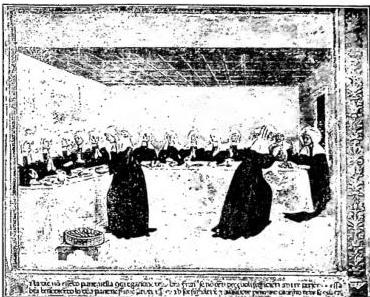
12. Religious Influence
It is certain that from its very appearance, monasticism represented, within the Christian community, the ideal of evangelical perfection, realized in a concrete and visible form of life. Hence its silent but real and continuous function of recalling and stimulating, by the force of example, not only the faithful but also the clergy, to a higher and more coherent Christian life. This is perhaps the least clamorous but deepest and most precious contribution monasticism has uninterruptedly offered to Christendom. In the early Middle Ages, when the Church was called to the formidable task of building a new society and a new Christian civilization, merging barbarians and Romans, monasticism—and particularly Benedictine monasticism, whose origins chronologically straddle antiquity and the Middle Ages—was the most valid providential instrument. Every abbey and monastery, usually erected outside cities, soon became a center of attraction: a population settled there for agricultural work, and a settlement formed (many cities and towns originated thus), amid which the monastery was an ideal oasis of peace and a school of Christian life; the Benedictine "ora et labora" was the simplest and most effective lesson for bending rough barbarian customs to the gentleness of the Gospel.Monasticism also rendered itself meritorious, as is well known, through
a broad activity of active conquest for the faith. St. Gregory the Great may be considered the first missionary pope in the modern sense of the word, and the Roman monks he sent to England constituted the first missionary expedition. They brought with them the Gospel and Virgil, Christian and classical culture; the Anglo-Saxons first, then the Germanic peoples, were won to Christianity and introduced into the world of culture almost exclusively through the work of monks.
Finally, mention must be made of the religious influence exercised by monks through theological and spiritual literature. From the 7th to the 13th century, theological literature—which from the time of Charlemagne onward was quite rich—as well as spiritual literature (Lives of saints, prayer books, ascetical writings) had a predominantly monastic origin. It is superfluous to recall the religious influence exerted by Benedictine monasticism through the liturgy.
2. Socio-economic Influence. — One of the most important and beautiful chapters in the history of Benedictine monasticism concerns the activity of the great medieval abbeys in the agricultural and industrial fields: marshes drained, forests cleared, fields tilled; agricultural cultivation so advanced that it remained substantially unchanged until modern times; consequently, a first-rate contribution to the Christian civilization of barbarian populations, with an improvement in the condition of serfs and peasants, and a charitable and assistential function through the revenues of abbatial estates: V. BENEDETTINI: III. L'opera civilizzazione.
3. Cultural Influence. — The merits of monasticism for culture are well known. During the barbarian darkening, culture survived in monasteries, and even flourished there, first in England, reaching its apogee with Bede, then on the continent, especially when Charlemagne sought to foster a cultural renaissance by every means, which in fact he could arouse by employing the work of learned monks, Alcuin (v.). Many abbeys became true centers of culture at this time, with a literary production then imposing and a consequently very broad influence: it suffices to recall, for example, Corbie, Fulda, St. Gall, Reichenau, without citing more names. Every abbey also had its library, and to supply the library, a scriptorium was necessary. Some of these scriptoria became, so to speak, editorial centers of primary importance, to the point of creating types of script with their own recognizable characteristics. It was in these monastic scriptoria that the treasures of ancient literature, passing from fragile papyrus to parchment, were saved from destruction. It is now universally recognized that what has been preserved of Latin literature was saved in the libraries of churches and especially in those of monasteries: an inestimable service rendered by the Church and monasticism to culture.
Moreover, abbeys and monasteries were not closed fortresses in terms of culture: their cultural wealth was placed at the service of the public through the school, another sector in which Benedictine monasticism of the early Middle Ages rendered itself highly meritorious. From the 7th century onward, no further mention is found of the great public schools where, until the end of the 4th century, classical letters were taught; by necessity, their place was taken by episcopal schools and especially by monastic schools, annexed to monasteries, whose functioning was stimulated and better organized under Charlemagne (cf. S. d'Irsay, Histoire des Universités françaises et étrangères, I, Paris 1933, p. 39 ff.).
Finally, the contribution of Benedictine monasticism to the arts must be remembered. Romanesque art was sometimes called monastic art. "If one considers," writes Berlière, "that monk artists drew the plans of numerous churches, directed their construction, decorated their walls, carved their capitals, that monks are the most celebrated miniaturists, goldsmiths, and glaziers of the time, one will rightly conclude that Romanesque art is monastic art. This is true for England as well as for Germany and France" (U. Berlière, L'Ordine monastico dalle origini al sec. XII, Bari 1928, p. 111).
BIBL.:
A. Harnack, Die Mönchtum, Giessen 1881; U. Berlière, L'Ordre monastique, cit.; S. d'Irsay, Histoire des Universités, cit.; G. Schnürer, Kirche und Kultur im Mittelalter, Paderborn 1924-29; P. Schmitz, Histoire de l'Ordre de Saint-Benoît, Maredsous 1942-49; J. Leclercq, L'amour des lettres et le désir de Dieu, Paris 1957; and the works cited in V. BENEDETTINI.
A. Lentini
PRESENT STATE OF WESTERN MONASTICISM
V. PRESENT STATE OF WESTERN MONASTICISM
In Western monasticism, three types are distinguished today: Benedictine, Cistercian, and Carthusian. Here, some principal data are provided, referring to the individual voci for further statistical information.a) Benedictines: 1. Confederated Benedictines. — The Confederation dates back to 1893 and today comprises 15 Congregations, listed below with their year of foundation: 1) Cassinese (1408); 2) English (1300; reestablished in the 17th century); 3) Hungarian (1500); 4) Swiss (1868); 5) Bavarian (1684; restored in 1858); 6) of Brazil (1828); 7) French or Solesmense (1837); 8) American-Cassinese (1855); 9) Beuronese (1868); 10) Cassinese of the Primitive Observance (1872); 11) Swiss-American (1881); 12) Austrian (1889; reorganized in 1930); 13) of St. Ottilia for foreign missions (1884, approved in 1896); 14) Belgian (1920); 15) Slavic (1945). 2. Camaldolese Benedictines (v.) with two Congregations: that of the Camaldolese Hermit Monks, centered in Camaldoli in Tuscany, and that of the Camaldolese Hermits of Monte Corona (1523). 3. Vallombrosan Benedictines (v.). 4. Silvestrine Benedictines (v.). 5. Olivetan Benedictines (v.).
b) Cistercians (v.): 1. Holy Cistercian Order (1908); 2. Cistercian Congregation of Italy (1479); 3. Congregation of Casamari (1152); 4. Reformed Cistercians (v.) or Trappists (1664).
c) Carthusians (v.).
Finally, it should be noted that the following Eastern monks also currently live in the West: 1. Mechitarists (v.), or Armenian Benedictines; 2. Monks of St. Paul the First Hermit (v.); 3. Antonians (v.); 4. Basilians (v.).
VI. MONASTIC MEDICINE
Its natural beginning lies in the Benedictine cloistered environment, but even before it became established there (it is impossible to determine when this occurred), Cassiodorus, having abandoned the political offices at the court of the Goths and retired to private life in his villa at Vivarium near Squillace in Calabria, had established in that hermitage a small lay community of individuals like himself, desiring peace and recollection after so many turbulent events. Gathered together, Cassiodorus’s companions dedicated themselves to study and philanthropic works, among which the care of the sick was foremost. The villa’s library contained many medical books, and Cassiodorus (De institutione divin. litter., ch. 31: PL 70, 1146) urged his companions to study them, so as to bring relief to the sick. This may be called the "prehistory" of monastic medicine, followed by its proper history.It was written in the Rule of St. Benedict (ch. 36):
« Cura infirmorum ante omnia sit », referring to the sick brethren of the Order. From this arose the necessity of a monacus infirmarius with duties as nurse, pharmacist, and physician; furthermore, that of an infirmary; a hortus simplicium for cultivating medicinal plants; an armarium pigmentariorum, a primitive pharmacy for storing medicines; a kind of school to instruct new monastic infirmarians; while the libraries with which monasteries were equipped preserved medical codices among others, and in the "scriptoria," another glory of the Order, copyists multiplied their copies to transmit them to posterity.
Thus, within the cloistered environment, all the necessary prerequisites for the life of medicine existed, along with excellent conditions for its dignified maintenance and the fulfillment of the charitable mission willed by Christianity. This is all the more valuable when one considers that, outside the cloisters, the healing art, devoid of schools and any means of sustenance, led a wretched and undignified existence. However, monastic medicine, precisely because of the lack of lay physicians, opportunities for study, and adequately equipped places of care, could not long remain within the confines of the cloister. Thus, infirmaries and hospitals began to form outside it to accommodate the poor sick who knocked at the monastery doors and whom Christian charity forbade turning away; while, on the other hand, the wealthy, princes, and powerful summoned to their sickbeds the monaci infirmari of proven medical skill and sometimes considerable renown.
At the same time, lay elements eager to learn the healing art began to infiltrate monastic medical schools. Thus, little by little, monastic medicine became secularized, both through this infiltration and through the departure from the cloister of the monaci infirmari, whose absence sometimes lasted a very long time. This clashed with the principles of monastic life, which could not tolerate such frequent violations of the Rule, often desired by abbots themselves for the profit brought to the community by the generous rewards the infirmari received from their visits. Thus began the first oppositions and prohibitions; among the first to speak out was St. Bernard (Epp. 67-68: PL 182, 175-78), who recounts the case of an infirmarius who fled the monastery to escape the abbot’s orders, which wanted to send him out constantly for visits without allowing him to attend to divine service. Other voices joined in these protests; councils and synods followed, forbidding the practice of monastic medicine (Reims, 1119; Clermont, 1130; II Lateranense, 1139; Montpellier, 1162; etc.). Thus, little by little, such medicine disappeared, though by then it had fulfilled its role as a means of connection between the declining classical world and the emerging medieval one, preserving codices and multiplying them, keeping the idea of the school alive, and nourishing the lay medicine that arose from II. Indeed, from monastic schools, with the contribution of certain particular conditions, the Salernitan school originated (