
BASILIANI D'ITALIA (ITALO-GRECI). — The term “Basilian Order” is of Western origin, having arisen in Italy during the Middle Ages to designate and distinguish the Italo-Greek monks who particularly followed the ascetic precepts of St. Basil the Great.
The present Congregation of Basilian Monks of Italy or of St. Mary of Grottaferrata is the heir and continuator of Italo-Greek monasticism, which was introduced into Italy in the 6th century under Justinian and developed with the progressive Byzantinization of the Italian provinces of the Byzantine Empire, fostered by the influx of refugee monks from Syria and Egypt beginning in the 7th century, owing to the Arab invasion. This influx increased because of the iconoclastic persecution of the 8th century, since the iconoclastic laws never took effect in the Byzantine provinces of southern Italy.
The Arab occupation of Sicily in the 9th century led to the concentration of Italo-Greek monasticism in Calabria, Apulia, and Lucania, but there was a subsequent return to Sicily in the Norman age, when monasteries were restored that brought such renown to the Byzantine Church in Italy.
Remarkable holiness flourished in Italo-Greek monasticism even before the Normans. The most representative figures are: St. Elias the Cave-dweller, St. Christopher of Collesano, St. Saba the Younger, St. Leoluca, St. Nicodemus of Mammola, St. Vitalis of Castronuovo, and St. John Teriste. But the great luminary who, throughout his long life, drew a numerous company of monks into his orbit and transformed them into saints and scholars was St. Nilus of Rossano (910–1004), founder of the monastery of Grottaferrata (q.v.).
It can be asserted with full truth that with St. Nilus and his disciples, Bl. Paul, St. Proclus, and St. Bartholomew of Rossano, Italo-Greek monasticism—when the eremitic system still generally prevailed—achieved a true and perfect cenobitic organization, which had already in some way been realized in the monastic center of the Mercurion, the Athos of Byzantine Calabria, where St. Nilus himself was formed under the guidance of St. Fantinus. The great reorganizers of Italo-Greek monasticism in the Norman period, such as St. Bartholomew of Simeri (q.v.) and St. Luke of Messina, applied the teachings of the great Nilus, which remained ever alive in the monastery of Grottaferrata, which, sheltered by the Apostolic See, flourished and served as a center of attraction for Italo-Greek monks.
The golden age of Italo-Greek monasticism coincided with the Norman domination (1059–1198). The Norman princes were indeed patrons of cenobitism. Thus arose the monasteries of the Patir, near Rossano, and of the Most Holy Saviour in Messina.
From that time onward, part of the monasteries organized themselves into two extensive monastic groups: one, headed by the archimandrite of the Most Holy Saviour of Messina, included most of the monasteries of Sicily and some of Calabria, numbering 49 in all; the second, that of SS. Elias and Anastasius of Carbone, embraced 36 monasteries in Lucania and Calabria.
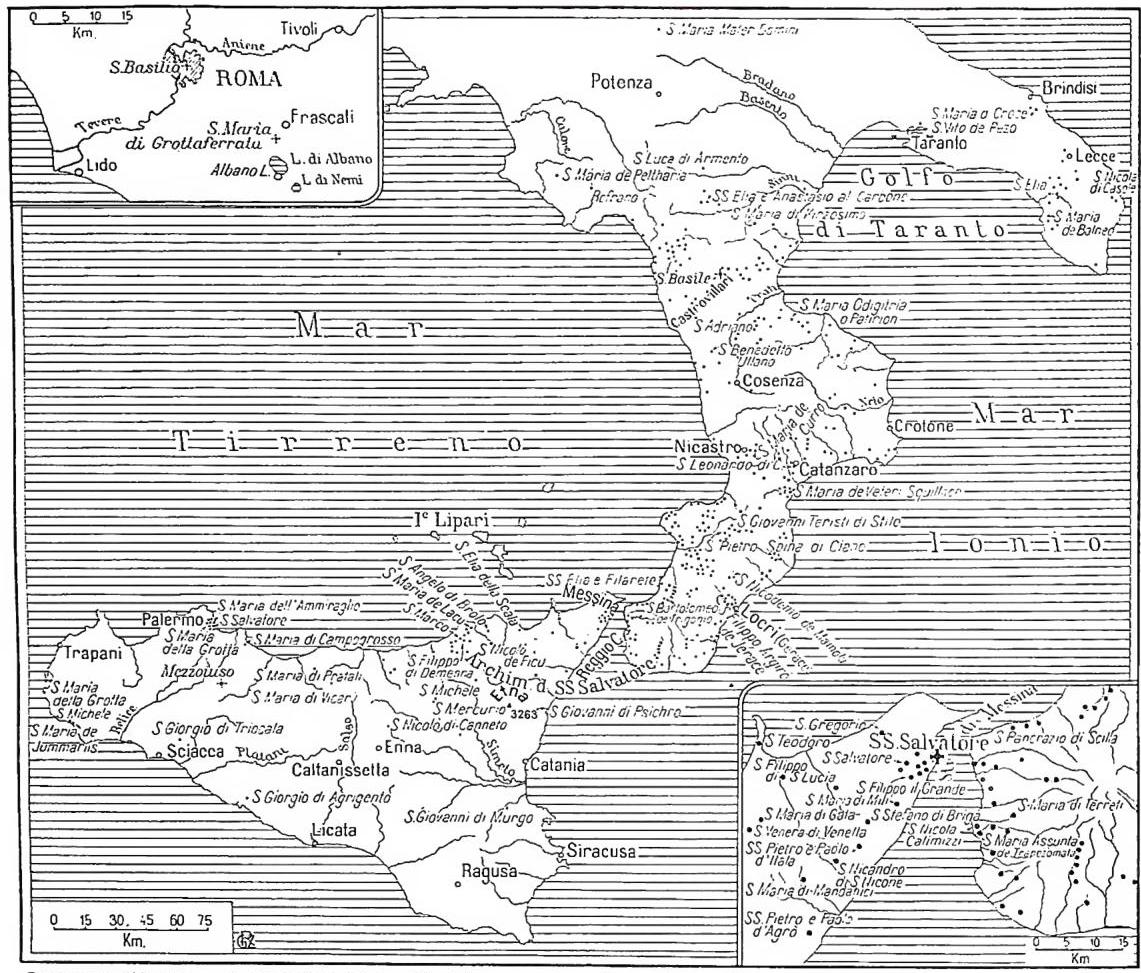
BASILIANS OF ITALY (ITALO-GREEK)
The monasteries of the Basilians of Italy from the 10th to the 20th century. The dots, even when not accompanied by a name, indicate their location; those still in existence are marked with crosses.
The progressive decline in the number of monks, the loss of the Eastern monastic traditions and of the Greek language, led to the transfer of some monasteries to Latin religious Orders and the abandonment of others. The painful decline in religious discipline could not be eliminated or halted by the apostolic visitations that followed, beginning with the first prescribed by Pope Honorius III in 1221. Nor was it able to be remedied by the celebrated Cardinal Bessarion, who strove to reform the Order. Many monasteries were placed under commendatory abbots, and finally it was thought to suppress the Basilian Order in Italy altogether. This danger was averted thanks only to Gregory XIII, assisted by the two illustrious cardinals Guglielmo Sirleto and Giulio Santoro.
On Pentecost Sunday in 1579, the true rebirth of the Order took place with the convocation of the general chapter of the Greek monks of Italy at S. Filarete in Seminara, near Mileto in Calabria, followed, on 1 November of the same year, by the bull Benedictus Dominus of Gregory XIII, which established the Congregation of the Basilians of Italy and that of Spain, conferring upon them an organization similar to that of the Benedictine Congregation of the Cassinese. Attempts were also made to reduce the abuses of commendatory abbots by separating the commendatory abbot’s table from the monastic refectory, as was practiced with the Benedictines. The Order thus reformed resumed its life. The renewed Basilian Congregation was Italo-Spanish, since it also included the Spanish branch of the Basilians of the Latin rite, which, established in Spain around 1556, although dependent on the same superior general, developed and exercised local influence. This branch was suppressed by the minister Espartero in 1855.
In reality, however, the restored Basilian monasticism of Italy lacked the essential character of Byzantine monasticism.
With the exception of the monastery of Mezzoiuso (Palermo), founded in 1609 by the Albanian Andrea Reres, whose monks were Italo-Albanians born and living in the Byzantine rite, in all the other monasteries, including that of Grottaferrata, the Byzantine rite, although preserving some archaic Italo-Greek characteristics, had been seriously altered. Many monasteries adopted the Roman rite in its entirety; the monks could easily change rites. Indeed, in 1709, the abbot general Pietro Menniti asked Clement XI for the complete Latinization of the Order; this request was refused, as was another renewed to Pope Benedict XIV in 1746 by the abbot general Diego Del Pozzo.
In 1784, the minister of the King of Naples, B. Tanucci, suppressed numerous monasteries located in the continental part of the kingdom. Those remaining were in Sicily and at Grottaferrata. Finally, the law of 1866 entirely dissolved the Order, which would have disappeared had not the monks of the monastery of Grottaferrata, which was preserved as a national monument, obtained permission to remain as its custodians. The rite observed in the Abbey, however, was a mixture of the Byzantine and Roman rites.
In order to lay the foundations for a revival of Italo-Greek Byzantine monasticism, a reform was imperative. This was finally decided by the Sacred Congregation for the Propagation of the Faith for Oriental affairs, in the plenary session of 12 July 1880, and, despite the serious difficulties encountered, was confirmed by decree of 12 April 1882. A major role in the preparation and implementation of the reform was played by the learned abbot of Grottaferrata, G. Cozza-Luzi (q.v.), later vice-librarian of the Holy Roman Church. His successor, Abbot Arsenio Pellegrini, completed the reform during his long tenure (1883–1917), thus organizing the present Congregation of the Monks of the Basilians of Italy of S. Maria di Grottaferrata, which received its first constitutions in 1900.
Almost completed the work of reform, a first step toward expansion followed: in 1920 the historic monastery of Mezzoiuso was reopened, where the Congregation has its novitiate. Another foundation was begun in 1932 at S. Basile, in Calabria, in the Italo-Albanian diocese of Lungro; and in 1935 the college of S. Basilio in Rome was reopened, after more than a century, for the philosophical and theological formation of young monks. Finally, in 1938, in response to the wishes of the Holy See, the monks established missions in Albania at Fieri and Argiocastro, from which they were expelled. In 1948 they opened a house at Piana degli Albanesi (Palermo).
Pius XI, with the bull Pervetustum Cryptaferratae coenobium of 26 September 1937, gave the Abbey its definitive juridical status by elevating it to an Exarchic Monastery, i.e., an Abbatia nullius, immediately subject to the Holy See.