Also known as:
Greek: Sabbas;
Sabas of Palestine, Saint Sabas, St. Sabas;
Italian: San Saba
SABA, Saint. - Palestinian monk. In the Constantinopolitan Synaxarion and in the Roman Martyrology he is commemorated on December 5.
According to his biographer Cyril of Scythopolis (Vita, BHG 1608), he was born at Mutalaska, near Caesarea of Cappadocia, in 439, and died on December 5, 512. As an adolescent he entered a monastery of his native province. In 456 or 457 he went to Palestine, where he led the monastic life in various monasteries, until he obtained permission to withdraw to the eremitic life. He lived for five years among the ruins of a tower of Gebel el-Muntar, then went to the valley of the Kidron. But the growing number of disciples forced him to group them together and, against his will, to build little cells and adapt natural caves. Thus began the "great laura," which became the most famous in Palestine (478). Sallustius, patriarch of Jerusalem, conferred the priesthood on St. Saba and also took the opportunity to consecrate the church of the monastery (491). Because of disagreements he went voluntarily into exile (593-598); and during this period he founded the "nea laura" of Thecua (508). As archimandrite of Palestine, twice (512 and 531) he intervened at the imperial court, after one of his letters had proved useless, to have the chrysargyron (a sort of odious tax) abolished and to defend the faith against the Monophysites. Cyril of Scythopolis hails in St. Saba and in his monks "the strongest bulwark of the Catholic faith in Palestine." He died at the age of 93.
Under his name a "typikon" for the whole liturgical year is known (rule, martyrology, and breviary together). However, as it is today, it cannot go back beyond the
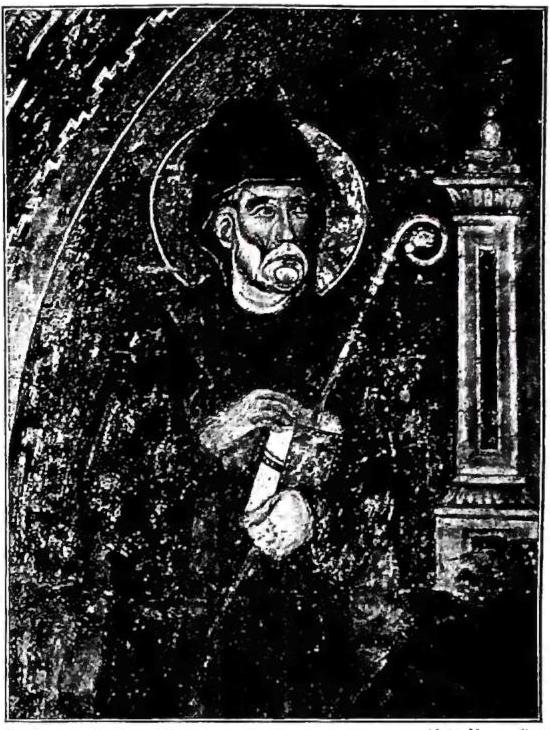
SABA, saint - Fresco of the 13th century - Rome, church of St. Saba, 12th or 13th century. His influence was considerable in the organization of later monasteries. (phot. Mercuri)The burial chapel of St. Saba is found in the monastery of the same name in Palestine, but the relics are in Venice; in Rome in the 9th century a church was erected in his honor.
BIBL.:sources
Ed. Schwartz, Kyrillos von Skythopolis (Texte und Untersuchungen zur Geschichte der altchristlichen Literatur, XLIX, 2), Leipzig 1939, cf. the review by Fr. Doelger, Kyrillos von Skythopolis, in Byzant. Zeitschr., 40 (1940), pp. 474-84, and the severe chronological criticisms of E. Stvin, Cyrille de Scythopolis. A propos d'une nouvelle édition de ses oeuvres, in Anal. Boll., 62 (1944), pp. 169-86; W. Haacke, Die Glaubensformel des Papstes Hormisdas im acaoianischen Schisma (Anal. Gregor., 20), Rome 1939; E. Hoade, Guide to the Holy Land, Jerusalem 1947; L. Abatangelo, Attraverso il deserto di Giuda: La Laura di s. S., ibid. 1929; S. Vailhé, Le monastère de st. S., in Echos d'Orient, 1 (1898-99), p. 337 ff.; P. De Meester, Règlement des b. et six pères Sabas le Grand et Théodose le cénobiaque pour la vie des moines cénobites et celliotes (French trans. of cod. Par. gr. Coulin 295), Lille 1917; id., De monachico statu (S. Concr. per la Chiesa orient., Codificaz. canon. orient., fonti, 2e serie, fasc. x), Vatican City 1942; J. Moschus, Le Pré spirituel, French trans., Paris 1946; E. Cannizzaro, L'antica chiesa di s. S. sull'Aventino, in Atti del II Concr. internaz. di arch. crist., Rome 1902, pp. 241-48; H. Leclercq, s. v. in DACL. XIII, coll. 767-85; XV, coll. 189-211; M. Armellini, Le Chiese di Roma dal sec. IV al sec. XIX, ed. C. Cecchelli, II, Rome 1941, pp. 722-24, 1426-28. Martiniano Roncaglia
Roncaglia, Martiniano. “Saba, santo.” In Enciclopedia Cattolica, vol. X, coll. 1505–1506. Città del Vaticano: Ente per l’Enciclopedia Cattolica e per il Libro Cattolico, 1953. https://azioneromana.com/article/saba-santo.
MLA
Roncaglia, Martiniano. “Saba, santo.” Enciclopedia Cattolica, vol. X, Ente per l’Enciclopedia Cattolica e per il Libro Cattolico, 1953, coll. 1505–1506. Azione Romana, https://azioneromana.com/article/saba-santo.
BibTeX
@incollection{ec10_saba_santo,
  author    = {Roncaglia, Martiniano},
  title     = {Saba, santo},
  booktitle = {Enciclopedia Cattolica},
  volume    = {X},
  pages     = {1505--1506},
  note      = {Cited by column},
  publisher = {Ente per l’Enciclopedia Cattolica e per il Libro Cattolico},
  address   = {Città del Vaticano},
  year      = {1953},
  url       = {https://azioneromana.com/article/saba-santo}
}
Click or scroll to zoom · drag to pan · Esc to close