Machine translation of the 1948–1954 Italian original. The original text is authoritative.
SASSANIDI. - The progenitor of the dynasty of Persia or Īrān is said to have been a certain Sassan, of whom nothing is known with certainty, whereas the true founder may be considered Ardāšir (Artakhashatr) in the year A.D. 208.
I. ORGANIZATION OF THE STATE
The advent of the Sassanids was assessed in different ways. To Roman historians, they represented nothing more than a more powerful enemy of the Romans. In reality, a new spirit emerged in the Iranian polity with the Sassanids. The principal characteristics of the Iranian-Sassanid state system were a strong centralization of power and the creation of a state religion.
Society was divided into four classes: 1) those dedicated to worship (āsračān); 2) the warriors (artēšthārān); 3) the bureaucracy (dibhērān); 4) the people (peasants, eāstryōshān, and artisans, hutukhshān). Each class comprised several subdivisions, each headed by a chief assisted by an official responsible for the census of his class, an inspector to oversee revenues or punish transgressors, and finally an instructor “to instruct each person from childhood in a craft or a science and place him in a position to earn his livelihood peacefully” (Letter of Tansar).
II. STATE RELIGION
The state religion of the Sassanid Empire was Zoroastrianism. Ardāšir I ordered that the scattered remnants of-
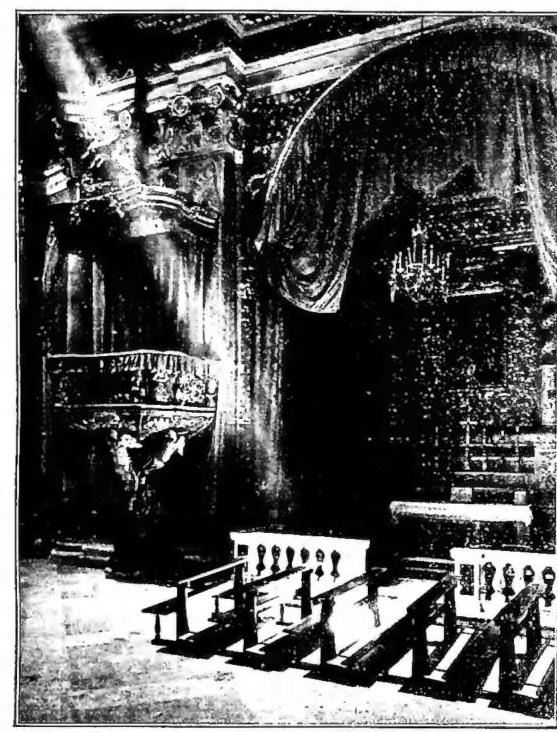
SASSARI, DIOCESE of — Interior of S. Maria — Sassari. (phot. G. Heller)the Avesta from the time of the Arsacids be collected and arranged; they were subsequently made canonical and obligatory. The primitive Sassanid Avesta later underwent various amplifications: the Hellenistic influence, and especially the Indian one, are of recent date. Most of the Avesta disappeared at the time of the Islamic conquest, and only a few fragments remain. Other religions were also found in the Sassanid Empire, such as Judaism, Christianity, and Manichaeism, which underwent, at varying intervals, more or less violent persecutions aimed at reducing them to the state religion. For the anti-Christian persecutions: V. PERSIA.
III. ART
In the architectural field, the S. have left notable traces. The buildings are constructed of bricks covered with sculpted or painted stucco. Sassanid sculpture, like the architecture, glorifies the divine power of royal majesty (“king of kings, companion of the stars, brother of the sun and the moon,” or “immortal man among the gods and a most illustrious god among men”). Bas-reliefs carved into the rocks still remain today. It is enough to recall the bas-reliefs commissioned by King Shapur at Nagshai Rustam, north of Persepolis, beneath one of the tombs of the Achaemenids, to commemorate the victory over the Romans (260). The balance of the composition, the nobility of the poses, and the suppleness of the forms constitute the artistic merit of this strange rock art. The industrial arts, too, are well represented. These include chased vases and plates, painted textiles, and so forth, which reproduce, with refined artistry, scenes of hunting, rural life, and other varied decorative motifs. Numismatics likewise possesses considerable artistic value.
IV. LITERATURE
Sassanid Īrān certainly produced a great deal in the literary field as well, but relatively little has come down to us. Most of it consists of religious treatises and inscriptions, while Persian literature in the Pahlavi or Middle Persian language is less well represented. Of particular interest is a short prose work that recounts the birth and adventures of the hearth of the Sassanid dynasty, Ardashir.
BIBL.: E. W. West, Grundriss der iranisch. Philologie, II, Strasbourg 1904, pp. 1–129; J. Labourt, Le Christianisme dans l'Empire perse sous la Dynastie sassanide (524-635), Paris 1904; E. Herzfeld, Am Tor von Asien, Berlin 1920; id., Psikolism, and inscriptions of the Early Hist. of the Sassanian Empire, I–II, there 1924; V. F. Büchner, Sassanides, in Encyc. de l'Islam, IV, Leiden–Paris 1934, pp. 185–89; A. Christensen, L'Iran sous les Sassanides, Copenhagen 1944; G. Edward Browne, A liter. Hist. of Persia, I, Cambridge 1951; F. M. Paraja, Islamologia, Rome 1951; N. Turchi, Le religioni del mondo, 2nd ed., there 1952, p. 189 ff. Martiniano Roncaglia
Cite this article
“SASSANIDI.” Enciclopedia Cattolica, vol. X (1953), p. 1147. Azione Romana digital edition, https://azioneromana.com/article/sassanidi.