
I. GEOGRAPHY.
After China and India, this is the largest (1.6 million km²) of Asia’s independent states. Its maritime facade faces the Persian Gulf and the Arabian Sea; its borders place it in contact with the U.S.S.R. (to the north), Turkey, Iraq (to the west), Afghanistan, and Pakistan (to the east).
Approximately two-thirds of the territory consists of an arid, steppe-like or desert plateau, bounded on all sides by mountain ranges (Elburz: 5,761 m.), which in turn are isolated from the exterior by more or less extensive depressed areas and shield the country’s interior from the beneficial influence of humid sea winds. The marked continentality of the climate results in brief, harsh winters and long, scorching summers; but even more characteristic is the extreme scarcity of precipitation, which accounts for the presence of vast desert areas (Salt Desert, Lut Desert). Cultivation is possible only on the slopes of the highest mountains, fertilized by rainfall, or in internal oases, where some water table surfaces, yielding, in addition to cereals (primarily wheat), especially cotton, tobacco, and sugar beet. The widespread steppe is linked to nomadic pastoralism, the substantial size of the livestock population (13 million sheep; 7 million goats; 2.5 million cattle, etc.), and the activities connected to it (carpets, handwoven textiles, hides, etc.). Sericulture (Caspian littoral), fishing (Caspian Sea), and oyster farming (Persian Gulf) are also flourishing.
However, the country’s greatest resources lie underground; of its still poorly assessed wealth (fossil coal, metals, and especially copper and lead), only petroleum is exploited. Found in several zones, it is extracted in greater quantities from Khuzestan (from where a pipeline carries it to Abadan on the Persian Gulf), Khorasan, and eastern Mazandaran. Production has roughly quadrupled over the last twenty years (25 million tons in 1948), placing Persia fourth among oil-producing countries. The disputes that have recently arisen with England are essentially economic in nature and stem from Persia’s demand for a higher percentage (royalty) of the profits, with the aim of improving the country’s economy. This had already been favored by the development of transportation routes (2,500 km of railways, among which the Trans-Iranian Railway from Bandar-e Gaz on the Caspian to Bandar-e Shahpur on the Persian Gulf stands out) and by more efficient port organization.
Persia’s population today amounts to no less than 17 million inhabitants (10 per km²), of which 2.3 million are urban; the remainder consists of Turks, Kurds, Arabs, Baluchis, Gypsies, Armenians, and Jews. Europeans number a few thousand, all residing in the major population centers. Fewer than ten of these exceed 100,000 inhabitants. Tehran, the capital, now has more than double the population of twenty years ago (700,000); it is followed by Isfahan (205,000), Tabriz (215,000), and Shiraz (129,000).
Persia is a hereditary constitutional monarchy, with an elective government and bicameral representation.
II. ANCIENT HISTORY AND RELIGION.
The territory of Persia, inhabited since prehistoric times, saw the rise of one of the most ancient civilizations of the Near East. The earliest historical records date back to the Elamites, a people of uncertain origin who established a powerful kingdom in the southwestern region of the plateau (third millennium B.C.). Around 2000 B.C., Indo-European tribes, the Medes and Persians, began to infiltrate the region from the north, gradually imposing their dominance over the indigenous populations. The Medes settled in the northwestern part of the plateau, founding a kingdom that reached its peak in the 7th century B.C. under Cyaxares, who allied with Babylon to overthrow the Assyrian Empire (612 B.C.). Meanwhile, the Persians, settled in the southern region (modern Fars), were initially subject to the Medes but later, under the leadership of Cyrus II the Great (559-530 B.C.), rebelled and founded the Achaemenid Empire, which would become one of the most extensive and powerful empires of antiquity.
Cyrus conquered Media (550 B.C.), Lydia (546 B.C.), and Babylon (539 B.C.), incorporating vast territories into his empire, which stretched from the Aegean Sea to the Indus River. His successors, Cambyses II (530-522 B.C.) and Darius I (522-486 B.C.), further expanded the empire, which reached its maximum extent under Darius, encompassing Egypt, Thrace, and part of the Indus Valley. The Achaemenid Empire was characterized by a highly centralized administration, with a system of satrapies governed by provincial governors (satraps) who answered directly to the king. The empire’s infrastructure was remarkable, with a network of roads (the most famous being the Royal Road, which connected Susa to Sardis) and an efficient postal system. The capital was initially Pasargadae, founded by Cyrus, but later moved to Persepolis, built by Darius I, and Susa.
The religion of ancient Persia was initially polytheistic, with a pantheon of deities linked to natural forces. However, around the 7th century B.C., a religious reformer named Zarathustra (or Zoroaster) introduced a new monotheistic religion, Zoroastrianism, which would become the dominant faith of the Achaemenid Empire. Zoroastrianism is based on the dualism between the god of light and goodness, Ahura Mazda, and the principle of darkness and evil, Angra Mainyu. The religion emphasizes the struggle between these two forces and the importance of human free will in choosing between good and evil. The sacred text of Zoroastrianism is the Avesta, which includes the Gathas, hymns attributed to Zarathustra himself. Zoroastrianism had a profound influence on the culture and ethics of ancient Persia, promoting values such as truth, justice, and charity.
I. THE IRANIAN WORLD
The factor that most contributed to shaping Iranism and ensuring that it constituted a distinct cultural—and indeed political—entity for over a millennium is undoubtedly the religious one. In fact, while the Iranian peoples of the plateau, who adopted the religion of Zarathustra, became a historical people capable of asserting themselves on the margins of the Greco-Roman world, the related tribes of Central Asia, which remained estranged from it, dissolved into the sea of nomadic and barbarian populations that the ancients included under the name of Scythians. It should also be noted that the assertion of Iranism, particularly on the cultural plane, appears in its varied development in close relation to the affirmation of those religious values.Among the Indo-European peoples who, during the course of the second millennium, had settled on the plateau that took its name from them (Irân, Middle Persian ērân from Old Persian aryânân), the first to assert themselves were the Medes, who founded a kingdom that, from the second half of the 8th century B.C., constituted for over a century and a half one of the most powerful political organizations of the Near East. No direct information exists regarding the religion of the Medes, but the very fact that the new message preached by Zarathustra would be adopted and transformed by the Magi—who, according to Herodotus’ testimony, were one of the six tribes of Media—shows that these Aryan peoples, having become sedentary, had elaborated the ancient naturalistic heritage of the common phase into new values.
The legacy of the Median Empire was inherited by the Persian Empire of the Achaemenid dynasty. Founded by Cyrus
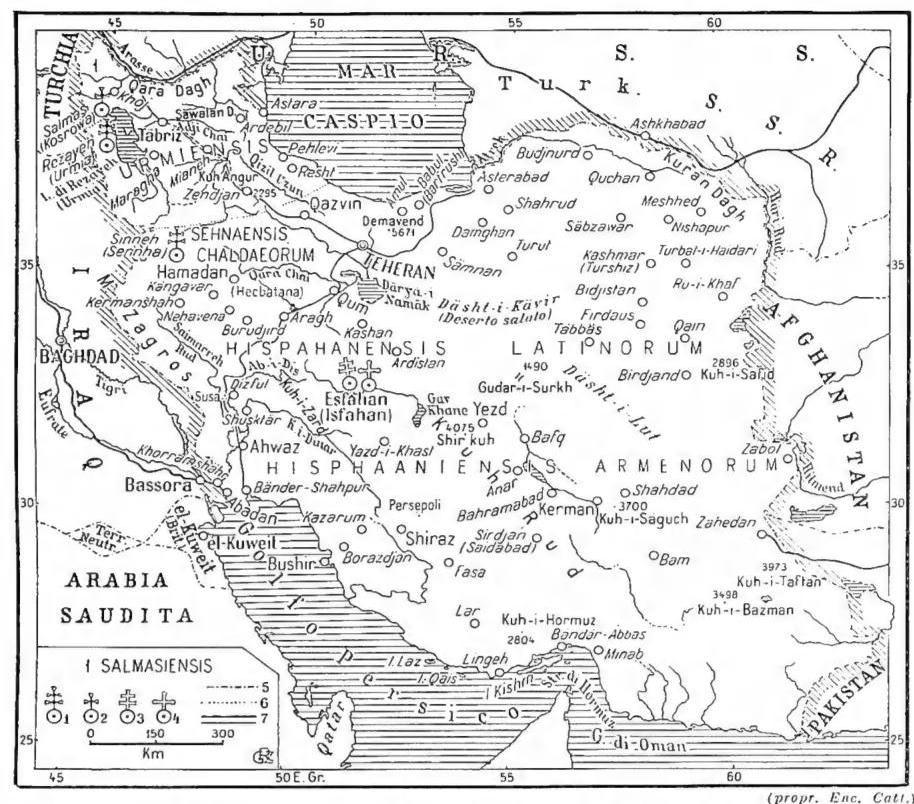
PERSIA - 1) Archdiocese of the Chaldeans; 2) diocese of the Chaldeans; 3) archdiocese of the Latins; 4) diocese of the Armenians; 5) state border; 6) ecclesiastical circumscription border; 7) railways.
founded by Cyrus the Great around the mid-6th century B.C., established a political-administrative organization that was certainly the first and most important of the ancient world. The solidity of the work, created by Cyrus and strengthened by Darius I, was such that Persia, despite its less fortunate campaigns against Greece, was able to maintain a position of preeminence for over two centuries. The decline of the Empire was contributed to by the fact that, after Darius, the dynasty assumed the typical characteristics of Oriental despotism, from which it had initially differed vigorously. Indeed, at the foundation of the Iranian Empire lies a conception of power entirely new in the political tradition of the Near East. Today, there is a tendency to deny that the first Achaemenids were Zoroastrians; however, though the elements emerging from their inscriptions are scarce, it is clear that the character assumed by the imperial function with them cannot be explained except by a religious renewal, which also encompassed the ethical domain. The constantly repeated affirmation of the divine derivation of power, together with the proclaimed moral imperative inherent in it, leads one to attribute to a religious motive—and specifically to Zoroastrianism—the novelty of political action and the consequent success of the first monarchs. Their very attitude of tolerance and respect toward other religions (Darius confirmed the promise made by Cyrus to the Jews immediately after the conquest of Babylon, regarding their return to Jerusalem and the reconstruction of the Temple) must certainly be understood as the reflection, beyond particular political circumstances, of a new recognition of the ethical validity of religious data.
With the Battle of Gaugamela (321) and the death of Darius III, the last of the dynasty, the Achaemenid Empire concluded its cycle. The victorious expedition of Alexander the Great, though his premature death prevented the realization of a political organization that would have fulfilled his universalistic ideal, nevertheless succeeded in breaking the barriers that separated Persia from the West. Under the rule of the Seleucids and then the Arsacids, Iranian identity was profoundly influenced by Hellenistic culture and failed to achieve a distinct cultural physiognomy. This is certainly to be linked to the decline of the national religion. The Iranian elements circulating in the Hellenized world and penetrating even into the Roman sphere had undergone deep elaborations, rendering them estranged from their origins: such is the case, among others, of Mithraism, which, formed in Anatolia and propagated in the West, preserved little or nothing of the motifs tied to the figure of Mithra in Zoroastrian religion.
The Iranian tradition resurged with
the Sassanid Empire, which, succeeding that of the Arsacids in 266 A.D., constituted a solid structure that endured until the Muslim conquest. The struggle against Rome and later against Byzantium was the dominant feature of the entire history of the Sassanid dynasty. Associated with this was the ruthless persecution of Christians, beginning from the moment when Constantine’s conversion made them appear as allies of the secular enemy. The Battle of Nihâwand (642, 21 A.H.), called the "victory of victories" by the Arabs, marked the end of Persia as an independent national state and, at the same time, its entry—though not without the preservation of original traits—into the sphere of Islam.
II. ZARATHUSTRA AND HIS PREACHING
In classical and Iranian religious tradition, the figure of the reformer appears with clearly legendary traits. The legend that formed among the Greeks—that Zarathustra (the Iranian form of the name, as opposed to the Hellenized Zoroaster, which gained currency through its appearance in the title of a work by F. Nietzsche) lived six thousand years before Plato—is certainly the product of Iranian cosmological speculations that found resonance in the circle of the Academy. Within Persian traditions, the accounts regarding his age are not univocal and have a legendary character; however, one contained in the Bundahišn, a relatively recent Pahlavi cosmological treatise but one that reworks ancient material—namely, that he converted King Vištāspa 258 years before Alexander the Great—has been given particular consideration by scholars. Unfortunately, no unanimous interpretation of this datum has been reached; some, wishing to identify the Zarathustrian Vištāspa with Hystaspes, father of Darius I, believe that the advent of Alexander should be understood as the beginning of the Seleucid era, i.e., 312 B.C., and thus place Zarathustra’s life, who according to tradition lived 77 years, between 570 and 500 B.C. (Herzfeld); others, more plausibly, hold that the reference to the reign of Alexander should be understood as coinciding with the end of the Achaemenid Empire, specifically with the death of Darius III (330 B.C.); consequently, the prophet’s birth would be placed around 650 and his death around 533 B.C.This interpretation of the tradition’s datum appears the most plausible.
Against the reliability of this same datum, however, it may be argued that the language of the Avestā, and particularly that of the Gāthās—the oldest hymns, which are certainly the work of Zarathustra himself—presents a markedly archaic character compared to the language of the Achaemenid cuneiform inscriptions. Since there is no continuity of development between the language of the Avestā and that of the inscriptions, the differing archaism may be attributed to dialectal diversity. Moreover, there is the difference between the Gathic linguistic form and that of the remaining Avestā (recent Avestā), which can only partly be explained by a certain dialectal diversity: for the rest, it will be necessary to admit some interval of time, and this is corroborated by the development of the doctrine itself from the Gathic (Zarathustrian) phase to the Avestic (Zoroastrian: the use of the two appellations to distinguish the two phases is due to Lommel), for which a more or less lengthy period of time must also be admitted.
In consideration of this, if one adheres to the date of the Qundahīš that places, it seems, the conversion of Vištāspa in 588 (Zarathustra was then 42 years old according to tradition), it will be necessary to admit that the evolution of the doctrine and the formation of the Avestā (v.) into a canonical corpus must have taken a good portion of the Achaemenid age. This is, moreover, confirmed by the fact that, for example, one Yāšt, that dedicated to Ardvi Sūrā Anāhīta, could not have been composed before 400 B.C., since the description of the goddess clearly refers to a statue: it is known that the female deity Anāhīta and the cult of divine images were introduced by Artaxerxes II Mnemon (404-358).
As for the original cradle of the Mazdean religion, clear geographical references and the historical and doctrinal developments themselves suggest the eastern regions of Iran. Zarathustra must have carried out his preaching between Chorasmia and Margiana; its initial success must, moreover, have occurred in the region of Lake Hamun; subsequently, there was a shift westward, specifically into Media. Certainly, this shift, which is associated with the adoption of the Mazdean doctrine by the Magi, a tribe of Media, accounts for the fact that Zarathustra is said in exegetical literature to have been a native of Ragā, near modern Tehran. The hypothesis that he, a native of Media, may have emigrated to the eastern regions, where his preaching would have met with favor, finds support in the emphasis on persecutions found in the Gāthās (Bartholomae); but such allusions can also be explained within the context of probable displacements that the prophet’s activity was forced to undergo in the same eastern regions, between Chorasmia and Margiana. Moreover, the Avestic language, both in its Gathic and recent aspects, surely occupies a median position between the northwestern dialects of Iran and the more eastern ones (Sogdian and Saka).
In the past, the historical personality of Zarathustra has been doubted, but certainly without any serious reason. His figure emerges vividly from the Gāthās, which certainly go back to him, both in its human and intellectual aspects. His name shows an etymology that refers to an agricultural and pastoral environment: Zarat-uštra- "he whose camels are lean"; the same environment is also indicated by the names of the parents Pourušaspa and Dughdōvā, which tradition attributes to him. He belongs to the family of the Spitamas, probably a clan of a semi-nomadic people. His priestly activity (he attributes to himself the title of zaotar in Yasna 33.6) and his preaching take place within a narrow circle of followers. In the Gāthās, he often laments the difficulties opposing his work, on the part of princes (Kavi, Sāstar) and priests (Karapan, Usig); in Yasna 51.12, there is a reference to the hostile reception he received, during his winter travels, at the court of a prince. His position strengthens when he succeeds in converting to his religion Prince Vištāspa and influential members of his court, such as the brothers Frašāostra and Jāmāspa: he marries the daughter of the former; to the latter, he gives his own daughter, Pouručista, in marriage; one of his Gāthās is, in fact, composed on the occasion of these latter nuptials.
Around the intellectual and social figure of Zarathustra, highly discordant opinions have been put forward in recent times. Some see in him a member of a royal family, related to those of Media and Persia, and discern in his actions the intent to gain a political position by modifying the social structure of the agricultural class, replacing serfdom with a kind of vassalage (Herzfeld, who places Zarathustra’s life in the time of Darius). Others see in him a shaman, a kind of medicine-man presiding over ordeals in a primitive society (Nyberg). As for his doctrine, it could not be considered original, since it would have merely defended pre-existing religious positions against the innovations of others. This concept partially inspires the most recent research, which aims to demonstrate that Zarathustra did not emerge from the sphere of the Indo-Iranian naturalistic religion; if anything, he would have done nothing but strip the inherited elements of their crudely naturalistic character, reviving them in their abstraction. The starting point of such research is the recognition of a presumed affinity between Ahura Mazdāh and his archangels with Varuna and the Ādityas of Indian mythology.
In this direction of studies, the figure of the Eastern sage, which to the philosophers of the Academy seemed so elevated as to place it on the same level as that of Plato (indeed, Zarathustra would have been reborn in Plato), is reduced to modest proportions, with which it will be very difficult to reconcile the evident importance that his creation holds, not only in the formation and development of Iranianism for approximately a millennium, but also in Western thought, whose ties with Zarathustrian idealism appear increasingly certain. In our view, the figure of the Iranian reformer is primarily that of the creator of a cosmogonic-religious doctrine, in which the intellectual moment precedes and prevails over both the ethical and the social. Certainly, he brought into his creation the mental habit proper to the speculative tradition, which can be called Indo-Iranian, given that it also appears in India in the speculative attitudes underlying Brahmanism, along with some traits and exigencies proper to that naturalistic religion. But the originality of his conception is undeniable, as an attempt to bridge the world of spirit and that of matter by grasping them in a unitary genetic moment, unlike Indian thought, which gravitates exclusively on the spirit and denies the visible world any true reality.
III. THE GĀTHIC RELIGION
The question may be posed whether it is legitimate to reconstruct the doctrine of Zarathustra by taking as a foundation only the seventeen Gāthās, which are considered, and are clearly, his work, or whether it is better to use for such reconstruction also the recent Avestā, which constitutes a broader and more complete representation of the Mazdean religion in all its aspects, according to the method followed by authoritative scholars (among whom Lommel). It seems to us that the true nucleus of the Zarathustrian doctrine is more easily recognizable in the Gāthās, since the religious world reflected in the recent Avestā contains developments and superstructures that are the result of a complex syncretistic elaboration. In this syncretism, the genuinely Zarathustrian original nucleus prevails and informs all assumptions and transformations; but there is no doubt that it is therein interwoven with a religious and ritual structure that renders it less recognizable in its most genuine nature.At the basis of Zarathustra’s doctrine lies the intuition of a bond of affinity and even identity between the world of spirit and the world of matter. While in Greece, with Heraclitus, the logos will be rediscovered as the law of the world, and the eternal dynamism of things will be recognized as the same dynamism present in discursive thought (the becoming of the world appears as a projection of the mental process), in the Iranian steppes, in an environment that may be considered median between East and West, a thinking activity is elevated to the source of all creations, which is the projection onto the universal plane of the intuitive creativity of the mind. This is a new cosmogony in which the driving principle is the divinized human mind.
The eminently mental character of the supreme god, from whom creation descends, appears in the very name Ahura Mazdāh, in which the first element ahura, "Lord," was already previously destined to designate the divinity, while the second, in its compound structure, reveals itself as an innovation of Zarathustra, intended to emphasize the creativity, as thinking energy, of the god (the parallel Indian form medha- indicates an "active wisdom" and even "poetry"; in Yasna, 53. 3 and then in Yasna, 45. 1, the elements composing the appellative mazdāh- appear distinct in their components manas "thought" and dhā- "to place" and especially "to create" in a cosmogonic sense; in Yasna, 45. 1, the compound verb maz-dā- is used with evident reference to the name of the god). Therefore, it is to be believed that the name does not signify a generic "wise lord," as is usually understood, but contains a specific reference to the very nature of Ahura Mazdāh, who is the "thinking god," the lord who creates with the spirit, "the Thinking Lord."
Many hypotheses have been made regarding the emergence of this new monotheism; and while on the one hand it has been sought to emphasize how, already in the Indo-Iranian religion, there is among the divine figures one that stands out above the others (Varuna), on the other, a probable derivation from Mesopotamian religions has been considered. In truth, such attempts at explanation, otherwise poorly founded, appear superfluous if one keeps in mind that the doctrine of Zarathustra is above all a cosmogonic doctrine, which necessarily postulates the unique origin of creation. This is a single god, the promoter of creation, and in this creativity, he is a pure force of thought.
The mental character of Ahura Mazdāh is clear not only from the god’s own creation but also from the nature of the divine figures surrounding him. To define the spiritual nature of this creation, which first develops in the world of spirit and then in that of matter, it will suffice to recall Yasna, 31. 6-7: "To Mazdāh belongs the kingdom that is increased for him by the Good Thought. He who at the beginning with thought filled the spaces of light and with the strength of his mind created the Truth (Aša, pron. Arta), by which he sustains the best thought; and this you increase, O Mazdāh, through the spirit."
The divine entities surrounding Ahura Mazdāh are his modalities: Aša "the Truth" (that is, the order of the world, nature in teleological function, and, as such, Truth), Vohu manah "the Good Spirit," Aṣ̌a Vahišta "Devotion" or "Piety," Xšaθra "the Kingdom," Haurvatāt "Integrity," Amərətāt "Immortality." The connection with the supreme god is signified by the fact that their names, even as subject, appear in the instrumental case, because Ahura Mazdāh is the true subject, even when his name is not mentioned. In these divine entities, there are clearly hypostases of abstract concepts in ethical function, as determinations of pure mental activity, whose hypostasis gives figure to the supreme god. This is explicitly declared in the recent Avestā, where the divine entities now constitute, together with Ahura Mazdāh, the seven Holy Immortals (Aməša Spənta). Yasht, 13. 81: "The forms he assumes are the beautiful and great forms of the Aməša Spənta."
Another divinity is inserted into the system, hitherto rigorously monotheistic, and steers it toward a certain dualism. This is Spənta Mainyu "the Holy Spirit," which is the hypostasis of the "impulse to act, vital élan" (this is the value of Old Indic manyu), ethically qualified, and is itself a modality of Ahura Mazdāh as active will. This new divinized notion is the link between the God, pure spirit, and the created universe, as appears in Yasna, 44, where, after listing all aspects of creation, the poet concludes: "Thus I strive to recognize you, O Ahura Mazdāh, creator of all things, as the Holy Spirit."
This modality of the single god clearly expresses both the necessity of the transition from the spiritual phase of creation to the material one and, at the same time, the ethical character of the divine creator. It certainly responds to the need to find a place within the monotheistic conception for a dynamic and ethically active solution to the problem of evil. Once the beneficent character of divine creation is affirmed, the problem of evil arises as a dialectical opposition to such a character. This does not undermine the monotheistic character of the original Zarathustrian conception: in the Gāthā, the Spirit of evil, Angra Mainyu, never opposes Ahura Mazdāh, but only Spənta Mainyu, the beneficent impulse.
The contrast between the two principles awakens with the rise of life (Yasna, 45. 2); and it is announced as a matter of choice, since the Holy Spirit decides for Truth (Arta) and the Evil Spirit decides for the Lie (Drug). Yasna, 30. 4: «E quando questi due Spiriti si incontrarono, allora per prima cosa stabilirono la vita e la non vita e che alla fine l'esistenza peggiore fosse dei seguaci della Menzogna e la migliore realtà spirituale (manah) fosse dei seguaci della Verità. Fra questi due Spiriti i seguaci della Menzogna hanno scelto l'agire del Peggiore, ma lo Spirito santissimo, che ha come veste i solidi cieli, ha scelto la Verità e così coloro che vogliono con giuste opere rendere lieto Ahura Mazdāh».
(from D. Gribnadi, L'Aria anteriore, in Geografia universale, IV, Torino 1936, p. 205)
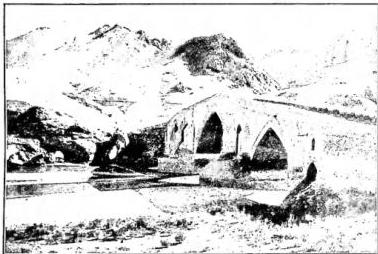
PERSIA - The Kisil-Usum near Mianch. Observe the mountain flanks covered by a thick detrital mantle.
Regarding the position of man in the Gāthic system, the spiritual essence (daēna) holds notable prominence, present in every individual form (gaēba). Though this essence is reflected in individuals, its place resides in the mental life of Ahura Mazdāh, and to it, it returns as an increment after man's death, provided it has been well realized and not deviated from (cf. Yasna, 46, 11; 49. 9). While there is a very explicit hint at the diversity of spiritual essences proper to the two spirits in Yasna, 45. 2 ("The most holy thus speaks to the evil one: neither our thoughts, nor our beliefs, nor our words, nor our deeds, nor our essences [*daēna], nor our souls agree"), it is never explicitly stated that there exists an evil spiritual essence in the follower of the Drug*, which, after death, rejoins the corresponding essence in the spirit of Angra Manyu. Here too, dualism is imperfect, or at least not entirely explicit. Judging from Yasna, 46. 6, the existence of a spiritual essence of demonic derivation and creation of Angra Manyu seems excluded: "For he is a follower of the Lie who is benevolent to a follower of the Lie, he is a follower of the Truth to whom the follower of the Truth is dear, since you created the spiritual essences." The spiritual essences are, therefore, a creation of Ahura Mazdāh, hence an Ahuric creation: deviation from the essence manifests itself only in the fact that one is a follower of the Truth or a follower of the Lie by an act of free choice. It is explicitly stated that he who does not fully realize his spiritual essence and thinks and acts inconsistently, now well, now badly, following his own tendencies and desires, will ultimately be cut off from the mind of Ahura Mazdāh (Yasna, 48. 4).
In Zoroastrian eschatology, the object of reward and punishment is the soul of each individual. Thus, it happens that the follower of the Drug faces a double penalty. One is the loss of the reward that belongs to the essence when the right path—that conforming to it—has been followed; the other is the punishment awaiting the soul after death. "The spiritual essence of the follower of the Lie loses the reward of the right path. His naked soul, before the crossing of the Bridge of the Separator, will tremble with fear" (Yasna, 51. 13); indeed, "the soul of the follower of the Truth will be eternally happy, and eternal will be the torments of the follower of the Lie" (Yasna, 45. 7).
The Zoroastrian doctrine considered thus far is undoubtedly a theological construction; but its polemical stance, documented at every step in the Gāthās, reveals its character as a militant religion. Contributing to this character is, first and foremost, the social intent that emerges within II. The place given to the hypostasis of the ox (the soul of the ox), as a symbol of laborious prosperity, clearly demonstrates that the reformer also pursues a civil aim. It will not be a matter of promoting the transition from nomadic life to settled forms favorable to agriculture, as has been believed, but most likely of defending livestock and establishing a stable regime of pastures, beneficial to an orderly pastoral society.
BIBL.:
A. Christensen, Essai sur la démonologie iranienne, København 1941; H. Lommel, Die Religion Zarathustras, Tübingen 1930; J. Duchesne-Guillemin, Ormazd et Ahriman, Paris 1953; G. Messina, Der Ursprung der Magier und die zarathustrische Religion, Roma 1930; V. ZARATHUSTRA.
G. MESSINA
IV. ZOROASTRIANISM
The process of transformation of the original nucleus of the doctrine, as represented in the Gāthās, certainly began in the eastern provinces of Īrān, that is, in the very places of preaching and contiguous zones. A transitional phase is reflected in the Yasna haptoṇhātī ("Yasna of the seven chapters," from Yasna 35.3 to 41.5), still composed in Gāthic but in which the prophet no longer speaks in the first person; rather, it is the community of the faithful ("we") that speaks. Already here, the cult of naturistic forces re-emerges, and the divine entities appear as a body of archangels, Aməša Spənta (pron. Amurta Spanta). Furthermore, the Fravashi (pron. fravarti), "protective spirit," "genius," appears for the first time, which is ignored in the Gāthās.Subsequently, the religious center of Iranianism was established in the northwestern regions of the plateau by the Magi, who adopted the doctrine of Zarathustra and gave it new doctrinal and ritual developments. It is to be believed that the Magi, in elaborating the material into a canonical body, took into account the religious and mythical poetry already arisen and in the process of formation in the eastern provinces, just as occurred in the formation of the epic tradition, which, having taken shape in Persis, certainly incorporated legends born in other environments.
Much has been discussed about the true nature of the Magi, and opinions differ. On the one hand, it is held that they were a Zoroastrian religious community of Media, formed as such, and that their name should be connected with the term maga- "wealth, gift" (Gabe, Messina), which already appears in the Gāthā (the name maṛu- does not appear in the Avestā except once in the recent Avestā in the compound moṛutbī); on the other hand, it is affirmed that the meaning of moṛu- in the cited compound and in Māṛo, one of the six tribes of Media mentioned by Herodotus (1.100), as well as in magus of the Achaemenid inscriptions (the usurper of the Persian throne at the end of Cambyses' reign was Gaumāta the Magus), reflects a distinction of social order, and therefore the word has nothing to do with maga- and magavan of the Gāthā (Benveniste). We believe that it is not possible to separate the Gāthic forms maga- and magavan- from the identical Vedic forms magha- and maghavan-, whose range of meaning "wealth, gift" and "rich, powerful" allows developments both in a social and in a religious sense. It is probable that Zarathustra adopted the term for "wealth," "common good" (one must consider that it concerns a pastoral society) to denote a spiritual "communion," while elsewhere, among the Medes, it retained its original meaning, so that the adjective simply indicated the member of a tribe of pastoral aristocracy (moṛu- is parallel to aīryaman- "companion"). In other words, the linguistic kinship between maga- and magavan- of the Gāthās and moṛu- of the recent Avestā, Māṛo tribe of the Medes, appears certain, but the semantic substance has developed into different values. Therefore, it is to be excluded that the Magi constituted, from the beginning, a religious community inspired by Zoroastrianism. They became so later, when, that is, they adopted the doctrine of Zarathustra, already more or less elaborated elsewhere, and brought into it their own religious beliefs and ritual practices. The fact that the Avestā never speaks of Magi is precisely the proof that they did not consider themselves a priestly caste, to the point of having to indicate the priest with their tribal name. This was done by others in noting that the priests were always Magi, but certainly not all Magi were priests. In the Avestā, the ancient denomination zaotar for the priest, which is already Gāthic, was maintained, and to it was added that of abaurvan, certainly connected with the renewed affirmation of the cult of fire.
In Zoroastrianism, the dualistic principle, which emerged within Zarathustrian monotheism, asserts itself ever more strongly. The creation of Angra Mainyu is that of the world of the Lie, which opposes the world of Truth; and all existing things are distributed in the domains of the two opposing spirits. The struggle develops perpetually between their respective creatures and will conclude with the definitive victory of the principle of good. Alongside Ahura Mazdāh, who
The Jews, rightly proud of their monotheism, especially after the purification of the exile, must have considered the Persian religion one of polytheists, worshippers of demons, a mixture of superstitions. The returnees refused the collaboration of the Samaritans in Jerusalem; they did not respond to the appeal of the Jews of Elephantine, considered syncretists and schismatics for their sanctuary. "Judaism" is nothing other than the ancient Yahwism of the Sinai covenant, now perfectly realized with the exclusion of every trace of idolatry (I-II Chronicles; Ezra-Nehemiah; Song of Songs).
In a completely new way, R. Reitzenstein has taken up and extended to the New Testament the alleged influence of Iran on Judaism.
His system centers on the mystery of salvation, on the "Son of Man." This man is in Persian the renewer of the world, the depositary of the message and the power of God, the savior for the entire race, but at the same time the saved one, who must ascend to heaven as the first luminous body, a god and at the same time the ideal representative of souls. A conception that, from Iran through Asia Minor and Hellenism, would be at the
basis of the mystery of Redemption (especially in the letters of St. Paul). Despite the philological erudition employed to support it, such a system is a paradoxical misrepresentation (Lagrange): it is founded and reconstructed with Mandean and Manichaean texts, centuries later than Christianity, in which experts find nothing specifically Iranian; it rests on the derivation of Christianity from Hellenism, excluded by literary and historical criticism.
IV. CHRISTIANITY AND ISLAM.
I. EVANGELIZATION OF PERSIA
The oldest ecclesiastical community outside the borders of the Roman Empire is the Church of Persia, where Christianity presumably penetrated as early as the 1st century. Eusebius reports (Hist. eccl., III, 1: CB, II, 1, p. 188) a tradition not to be dismissed, according to which the apostle St. Thomas evangelized the Kingdom of the Parthians. According to the Chronicle of Arbela (v. ARBELA), a disciple of the Lord, Addai, would have brought the glad tidings around the year 100 to Edessa and Adiabene, a region east of the northern Tigris. This chronicle was composed between 550 and 569 by Mēšihāzekā ("Christ conquered"). Its historical value for the earliest times is debated.In any case, during the 2nd century, Christianity spread into Persia. Messengers of the Gospel were likely Jewish Christians, who, through the trade routes leading from the Roman Empire to Mesopotamia, maintained lively contact with the numerous Jewish colonies in that region. The first certain news of the existence of Christianity in Persia dates to the beginning of the 3rd century. In the Liber legum regionum, written by a disciple of the Gnostic Bardesane (d. 222) or by Bardesane himself, there is mention of Christians in Persia (Patr. Syriaca, II, 608). Around the middle of the 3rd century, King Shapur I deported prisoners from Syria to Persia, among whom were the bishop of Antioch, St. Demetrianus, and some priests.
From the very beginning, Christianity in Persia was the religion of an ethnic minority, namely the Syriac population, and found itself in a difficult position vis-à-vis the Mazdean religion of the Magi, which had become the official state religion under the Sassanids (i.e., from 226). Relations between the Church of Persia and that of the Roman Empire were scarce, given the political antagonism between the two empires, and became even more difficult after the Roman Empire, under Constantine, embraced Christianity. Persian Christians were easily suspected of harboring sympathies for the state’s enemy, which, from 340 onward—especially under Shapur II—led to a series of long and bloody persecutions, during which there were countless martyrs (v. XVII DEI MARTIRI): among them, St. Simeon bar Sabbā'ē, bishop of the capital. Connection with the West at that time was naturally almost impossible, so the Church of Persia developed in a highly independent manner. Nevertheless, it seems that Western Fathers, namely the bishops of the Antiochene region, played a part in the development of a central ecclesiastical organization in Persia, supporting the bishop of the Persian capital Seleucia-Ctesiphon, Mār Pāpā, in his hegemonic tendencies. Christian literature in Persia from this early period is very scarce, entirely in the Syriac language. Worthy of note is the "Persian sage" Aphrahat (v. AFRAATE).
After the restoration of religious peace under Yazdegerd I in 399, the Church of Persia had the opportunity to intensify relations with the West. The peace was, it seems, obtained by a delegate of Emperor Arcadius, Bishop Mārūtā of Maiperqat, who returned to Persia in 408 or 409 bearing a letter from the Western Fathers and with the task of establishing unity of faith and discipline between the Persian Church and that of the Empire, which was achieved at the Synod of Seleucia-Ctesiphon in 410. This synod accepted the faith of Nicaea and the discipline of the West. The same synod confirmed the preeminent position already acquired by the bishop of Seleucia-Ctesiphon and the title of katholikós (i.e., universal head of the entire Church of Persia).
However, a new outbreak of persecution soon led to a rupture with the West. The Synod of Markabtā in 424 abolished the right of appeal to the Western Fathers and declared that the katholikós of Seleucia could
(from Eret von Graefe, Iron des arae Persica, Berlin PS, fol. 109)
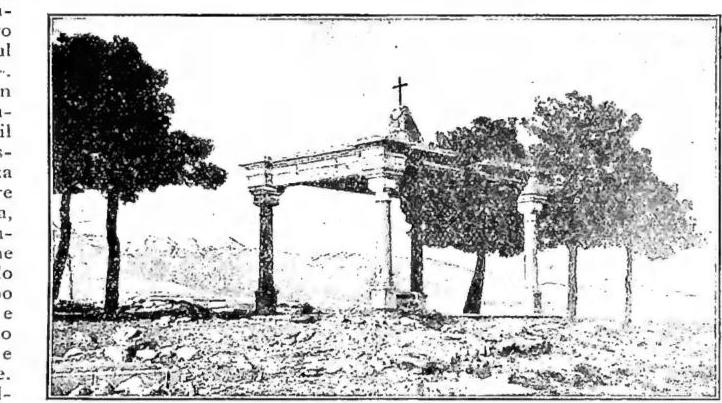
PERSIA - Armenian Cemetery, near Tehran.
With this declaration, the Church of P. effectively separated from the universal Church. This separation deepened with the acceptance of Nestorianism in P. toward the end of the 5th century. For subsequent periods, V. CALDEI; 'IRAQ; NESTORIO E NESTORIANESIMO.
Guglielmo de Vries
II. MUSLIM PERSIA
The history of Muslim Iran begins with the Arab conquest and continues to the present day. For nearly two centuries (637–820), Iran was a province of the caliphate. Subsequently, as the caliphate disintegrated, it fragmented into local autonomous dynasties founded by Arab, Persian, and later also Turkish and Mongol governors or military leaders. These dynasties, often in conflict with one another, were mostly short-lived, tied to the fortunes of their founders or a few successors. Periodic reunifications of Iran were brought about by the great Turkish and Mongol invasions that crossed it from east to west (Seljuqs, Mongols of Chingiz Khan, Mongols of Timur Lang). From 1502 onward, Iran has been ruled by unitary dynasties, which continue to this day. These dynasties established Twelver Shi'ism as the state religion, already widely diffused in Persia.
1. Persia under the Caliphate (637–820). — The Arabs defeated the Sassanid troops at Qadisiyyah in 637, occupying Ctesiphon, and then at Nihawand in 642; King Yazdegerd III, put to flight, was killed by a local governor in Merv in 651. By this period, the conquest of Iran was completed and extended beyond, except for the mountainous region south of the Caspian, where autonomous princes remained for a long time. From a religious standpoint, despite Zoroastrianism being formally tolerated, much of the population rapidly converted to Islam, particularly to avoid the poll tax (jizyah) reserved for infidels. The new converts attached themselves as clients (mawālī) to Arab tribes; however, they were kept in a subordinate position, leading to widespread discontent, which explains the frequent uprisings and the favor shown to the enemies of the Umayyad caliphate, the Alids and the Abbasids. When the latter came to power, Persian elements assumed a position of greater prestige in the state and in Islamic culture.
2. The autonomous dynasties until the Seljuq invasion (820–1037). — On the characteristics of the caliphate’s disintegration, V. ISLAM, historical expansion. The caliph al-Ma'mun, after residing in Khurasan during the first part of his reign (813–19), sent the general Tahir there as governor, who became practically independent, initiating the Tahirid dynasty (820–73). They were supplanted by the Saffarids, originating from Sistan (867–903), who extended their dominion to Kerman and Fars but failed in their attempt to invade Khuzistan. Meanwhile, minor dynasties formed in northwestern Iran: the Dulafids in Kurdistan (ca. 825–97), a branch of Alids in Tabaristan (864–900, and later fragmentarily), and the Sajids in Adharbayjan (899–939). Nearly all of Iran, except the western periphery, was reunited by the Samanids (874–999), originating from Transoxiana, and enjoyed a flourishing culture under their rule.

PERSIA — Catholic Church of Tabriz built in 1900 under the care of the French Lazarist Fathers.
See above. This dynasty, centered in Afghanistan, lasted from 962 to 1186 in total. It reached its peak under the famous Maḥmūd, conqueror of northwestern India (v. INDIA); Iran was lost to the Ghaznavids with the Seljuk invasion.
3. From the Seljuk invasion to the Mongol invasion (1037-1220). — The first of the great Seljuks, Ṭughril Beg, occupied Khurāsān in 1037 and rapidly continued his conquest, entering Baghdad in 1055. All of Iran was once again united, entering a new phase of high culture. The Seljuks, strictly Sunni, had to confront the Ismāʿīlī movement in western Iran (v. ISLĀM, the sects). The last of the great Seljuks was Sanjar (d. 1157), under whom military leaders (atābegs) established autonomous dynasties in Azerbaijan (Ildegizids, 1136-1225), Luristān (Hazāraspids, 1148-1339), and Fārs (Salghurids, 1148-1287). In central-eastern Iran, the Seljuks were defeated by the Khwārazm-Shāhs (fourth dynasty, ca. 1077-1231).
4. From the Mongol invasion to the beginning of the Safavids (1220-1502). — In 1220, the Mongols of Chinggis Khān (Genghis Khan) invaded Iran, conquering its entire center and north; the Qutlugh Khāns (1222-1303) took advantage of the struggle between the Mongols and the Khwārazm-Shāhs to establish themselves in Kirmān. In 1256, a second Mongol invasion occurred, led by Hülegü, who reached Baghdad and killed the last caliph (1258). Hülegü founded the dynasty of the Il-Khāns (1256-1353), under whom all of Iran was once again united. The minor dynasties of the Salghurids, Qutlugh Khāns, and Hazāraspids died out. The country recovered from the severe devastation of the first invasion. Later, even the Il-Khāns underwent fragmentation into smaller states: the Sarbadārids in Khurāsān (1337-81), the Kartids in Herāt (1245-1389), and the Muzaffarids in Fārs and Kirmān (1313-93). The Jalayirids of Mesopotamia (1336-1411) penetrated into Azerbaijan.
Tīmūr Lang (Tamerlane) brought a new invasion to Iran, conquering it entirely between 1380 and 1393. He was succeeded by Shāh Rukh (1405-47), under whom the state enjoyed renewed prosperity; it then declined amid internal struggles, while the Turkish dynasties of the Qara-Qoyunlu (1378-1468) and Āq-Qoyunlu (1378-1502) advanced from Azerbaijan into central Iran.
5. The Safavids (1502-1736). — This is a Shia dynasty, originating in Azerbaijan, with which the modern history of Iran as a unitary state begins. Its founder was Ismāʿīl, who defeated the Āq-Qoyunlu at Sharūr and conquered Tabriz, assuming the title of shāh (1502). By 1510, he had extended his dominion over all of Iran, as well as Mesopotamia and Armenia. His state thus became contiguous with the Ottoman Empire, and the existing religious antagonism (the Ottomans were Sunni and the Safavids Shia) sharpened the rivalry. Ismāʿīl was defeated by Selīm I at Chāldirān and lost much of Armenia and Azerbaijan. The greatest Safavid was Shāh ʿAbbās (1587-1629), whose reign was prosperous and powerful. He reconquered much of the lost territories in the east. Only later was Mesopotamia definitively occupied by the Ottomans (1638). In 1722, a Sunni rebellion
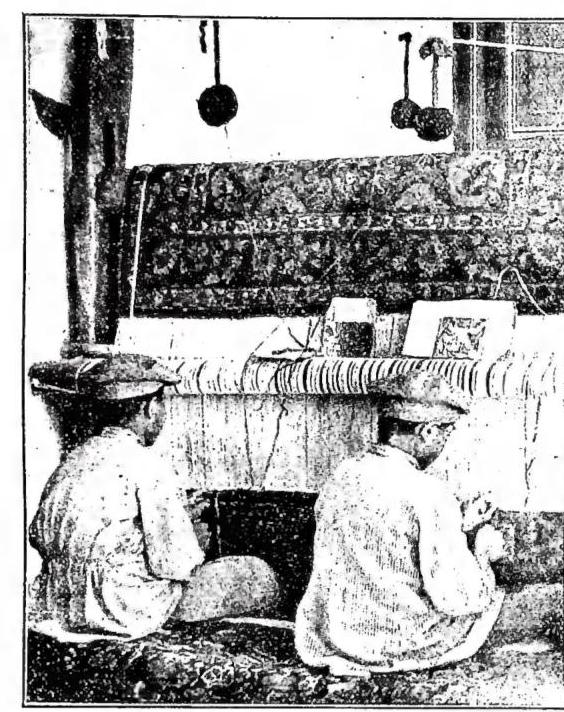
PERSIA - Young carpet weavers at the loom - Tabriz.
6. The Afšarids (1736-96)
Nādir Šāh (1736-47), in addition to reconquering Irān, occupied Afgānistān and invaded India, sacking Delhi (1738). His state lasted only a short time: under Šāh Ruḥ it was reduced to Ḫurāsān, while the Zand dynasty occupied the rest of Irān (1750-96). In 1796, Āṣā Muḥammad Ḫān of the Qāǧār tribe, after lengthy struggles, ascended the throne in Tīherān, once again unifying the region.7. The Qāǧār (1796-1925)
Under them, Russian and English influence (from India) progressively asserted itself. Āṣā Muḥammad Šāh reigned until 1796. His successor Fatḥ 'Alī Šāh (1797-1834) lost territories north of the Aras and some provinces in Armenia in war against Russia. Muḥammad Šāh (1834-38) and Nāṣir ad-dīn Šāh (1848-96) were repelled by the British in their attempts to occupy Afgānistān. Under the reign of Nāṣir ad-dīn, Bābism (v.) was fiercely persecuted. Financial difficulties increased foreign intervention under his successor Muṣaffar ad-dīn (1896-1907); this intervention culminated in the Anglo-Russian Treaty of 1907, which divided Irān into spheres of influence. Internally, the šāh was forced to grant a constitution and open a parliament (1906). His successor Muḥammad 'Alī attempted to retract, but was deposed in 1909. During World War I, Irān, though it had declared neutrality, was invaded by Turks, Russians, and British and became a battleground. At the war's end, it was evacuated. In 1921, a coup d'état brought the nationalist movement of Rīḍā Ḫān to power. He became prime minister in 1923; in 1925, Parliament sanctioned the end of the Qāǧār dynasty, and Rīḍā Ḫān was proclaimed sovereign with the dynastic appellation of Pahlavi.8. The Pahlavi (from 1925 onward)
Riḍā Pahlavi (1925-1941) began a renewal of the country. He ensured internal pacification through the disarmament of tribes; promoted the economy, particularly oil production,whose importance led to struggles for concessions among Russians, British, and Americans; reorganized and modernized the army; concluded a series of friendship and non-aggression treaties with neighboring states; and abolished capitulations for foreigners (1928).
In World War II, Irān again declared neutrality, but was once more occupied by Russians and British (1941). Riḍā Pahlavi abdicated and died in exile in Johannesburg in 1944. He was succeeded by Muḥammad Riḍā (reigning). Russians and British pledged to withdraw six months after the end of hostilities; in the meantime, they would enjoy transit rights, and Irān would sever relations with Germany and its allies. This was followed in 1942 by a declaration of war against Germany. Through Irān, much of the American aid reached Russia. Meanwhile, internally, parliamentarianism developed, and the Tūdeh party, with communist and pro-Russian tendencies, and the Millet party, conservative and pro-British, were formed. Anglo-American troops withdrew in 1945; Russian troops in 1946. A revolt in Āḏarbāyjān (1945), supported by the Russians, was suppressed (1946). The denunciation of the oil concession to Russia and the dissolution of the Tūdeh created tension between the two countries, to which was later added the far more serious conflict with Britain. In 1951, the nationalization of oil was decided; Prime Minister Muḥammad Muṣaddaq led the movement, which culminated in the expulsion of British technicians, the expropriation of the Anglo-Iranian Oil Company, and the closure of British consulates in Persia.
General works: P. M. Sykes, History of P., 2 vols., 3rd ed., London 1930; D. N. Wilber, Iran, past and present, ibid. 1948 (popular, essentially modern). Cf. also the historical sections in the works of E. G. Browne, A literary history of P., 2 vols., ibid. 1902-1906; A history of persian literature under tartar dominion (A. D. 1285-1502), Cambridge 1920; A history of persian literature in modern times (A. D. 1500-1922), ibid. 1924. For the period up to the Mongol invasion, fundamental: W. Barthold, Turkestan down to the mongol invasion, 2nd ed., London 1928.
On individual dynasties and figures, Ghaznavids: M. Nāzim, The life and times of sultan Mahmud of Gazna, Cambridge 1931. Turkish dynasties: W. Barthold, Orta Asya Türk tarihi hakkında dersler, Istanbul 1927; German trans., Berlin 1935; French trans., Paris 1945; V. TURCHI. Mongols: R. Grousset, L'empire des steppes, Paris 1939; id., L'empire mongol, 2ème phase (E. Cavaignac, Histoire du monde, 8, III), ibid. 1941; L. Bouvat, L'empire mongol, 2ème phase (ibid.), ibid. 1927. On Čingiz Ḫān: F. Grenard, Gengis-Khan, ibid. 1935; C. C. Walker, Jenghiz Khan, London 1939. On the Il-Khans: D. Spuler, Die Mongolen in Iran, Politik, Verwaltung und Kultur der Ilchanzeit, Leipzig 1939. On Tīmūr Lang: H. Melzig, Timur, New York 1940. Cf. also MONGOLI. Ṣafawids: W. Hinz, Irans Aufstieg zum Nationalstaat im fünfzehnten Jahrhundert, Berlin 1937; H. R. Römer, Der Niedergang Irans nach dem Tode Ismails des Grausamen, 1577-1581, Würzburg 1939; L.-L. Bellan, Chah-'Abbās Ier: sa vie, son histoire, Paris 1932; V. Minorsky, Tadhīrat al-mulūk: a manual of safawid administration (Gibb Memorial, N. S., 16), London 1943. Afšarids: L. Lockhardt, Nadir Shah, London 1938. Qāǧār: E. G. Browne, The persian revolution of 1905-1909, Cambridge 1910. Pahlavi: H. Melzig, Resa Schah, Der Aufstieg Irans u. die Grossmächte, Stuttgart-Berlin-Leipzig 1936. On recent events: F. Gabrieli, P., Storia, in Enc. Ital., App. II, I-Z, pp. 522-23; cf. also the chronicles and periodic bibliographical notes in the journals Oriente Moderno, Cahiers de l'Orient contemporain, and The Middle East Journal.
Chronology and genealogy: S. Lane Poole, The mohammadan dynasties, Westminster 1894, V. indices; E. de Zambaur, Manuel de généalogie et de chronologie pour l'histoire de l'Islam, Hannover 1937, V. indices (fundamental). Bibliography: A. T. Wilson, A bibliography of P., Oxford 1930; M. Saba, Bibliographie française de l'Iran, Paris 1936. Sabatino Moscati
### III. CURRENT SITUATION.
Present-day Persia covers a portion of the territory of the ancient Persian Empire. Christians in Persia constitute a small minority, reduced to approximately 145,000 faithful in the face of over 14,000,000 Muslims. According to Article 1 of the 1907 Constitution, Islam is the state religion. Article 2 establishes that the shah must be a Muslim; likewise, ministers must be Muslim, as per Article 58. Freedom of education is promised (Article 19), with the limitation that it excludes subjects contrary to the official religion. The freedom of the press guaranteed by Article 20 is similarly restricted by the exclusion of writings against Islam. The freedom of assembly and association guaranteed by Article 21 excludes those from which "any religious or civil disturbance" may arise. Article 1059 of the Civil Code prohibits the marriage of Muslim women to non-Muslims. A law of 22 July 1933 promises respect for the personal statutes of non-Muslim communities.
1) SITUATION OF SCHOOLS. – Foreign schools face significant obstacles. In 1932, the closure of foreign elementary schools was ordered; in 1939, this was extended to secondary schools for Iranian subjects. Only the schools of foreign missionaries for foreign pupils remained open, though these are also attended by Iranian youth. There are schools in Tehran, Isfahan, Tabriz, and Rezaijeh.
2) CATHOLIC HIERARCHY. – Persia has an apostolic delegation, based in Tehran. The most significant community is that of the Chaldeans, with 7,200 faithful distributed across the archdiocese of Ūrmijah (renamed Rezaijah in 1933) and the dioceses of Salmas and Sena. For the Latins, there is the archdiocese of Isfahan with 3,200 faithful. The Armenians have the patriarchal vicariate of Julfa-Isfahan with 1,100 faithful. The secular clergy is assisted by European missionaries: Lazarists, Carmelites, and Discalced Carmelites; as well as by the Daughters of Charity and the Oblates of the Holy Spirit, also known as the Sisters of St. Zita. The Armenian Congregation of the Sisters of the Immaculate Conception also works in Persia.
3) NON-CATHOLIC CHRISTIANS. – The Monophysite Armenians number approximately 120,000 followers. There are also about 9,000 Nestorians, 4,000 Protestants, and 500 "Orthodox." Over 300 Protestant missionaries work in Persia.
For further information