
SAMARITANI (ebr. Sōmrōnīm; gr. οἱ Σαμαρεῖται). - At first this name designated the inhabitants of the SAMALIA (v.),
Meanwhile, in the uncultivated countryside and in the largely deserted land, wild beasts and lions increased in number, having never completely disappeared from the Ephraimite thickets (I Reg. 13, 24; 20, 36); the immigrants attributed these consequences to the vengeance of the local god, no longer worshipped in the national cult. The Assyrian authorities sent back from exile one of the Jewish priests, so that he might "teach the immigrants the worship of the god of the region" (II Reg. 17, 27); the regional cult thus took on a syncretistic character with a certain predominance of the religion of Israel over idolatrous practices (ibid. 17, 40-41). A blow to this religious deviation was dealt by King Josiah, who, crossing the country, destroyed idolatrous images everywhere (II Par. 36, 6, 7), and even more by the teaching of the Judean priests; later, in fact, the S. took care to make pilgrimages for the feasts to the temple of Jerusalem (Ier. 41, 4).
After the return of the Jews from exile, the S. were not permitted to collaborate in the restoration of the Temple (Estd. 4, 2); a refusal that further intensified their mutual aversion (Neh. 4, 1-23). The governor Sanballat the Horonite tried to conciliate the two parties by marrying his daughter to a descendant of the high priest Eliashib; but Nehemiah exiled the governor's son-in-law (ibid. 13, 28), who according to Samaritan chronicles became the high priest of the Samaritan national cult and initiator of the schism. Sanballat, indignant at the treatment inflicted on his son-in-law by the rigorous authorities of Jerusalem, proclaimed the independence of the S., building for them a sumptuous temple, also Yahwistic, on Mount Gerizim (v.) overlooking the city of Shechem (v.), and called to officiate in it members of the family of Aaron, who had also been expelled from Jerusalem along with Manasseh.
However, criticism tends to assign a Hellenistic origin to the temple of Gerizim. It admits a slow evolution for the schism: the initiative for the construction would have come from the refugee priests of Jerusalem, together with Manasseh, because they were intolerant of the rigor instituted by Nehemiah; having concentrated near the S., they would have received permission there from the governors of the Seleucid Kingdom to build the rival temple which was destroyed by John Hyrcanus (Flavius Josephus, Antiq. Iud., XIII, 9, 1). This exacerbated
the rivalry between the two races. The S. suffered no persecutions either from Pompey the Great or from Herod; but by order of Pontius Pilate (v.) many of them were killed on the occasion of a gathering convened by an impostor on Mount Gerizim in 36 A.D. and prohibited by Pilate (ibid., XVIII, 4, 1, 2). The S. took part in the general rebellion of Palestine against the Romans; Cerialis, commander of the 5th Macedonian Legion, besieged them on Mount Gerizim and reportedly killed more than 11,000 of them on July 15, 67 (Fl. Jos., Bell. Iud., XXXVII, 23).
They regained power and spread everywhere throughout Palestine and also in Transjordan; their hatred against the Jews extended to Christians. On several occasions they destroyed churches and killed the faithful, but by the emperors Zeno and Justinian (6th cent.) they were punished so severely that they never rose again. In 1167 the Jewish traveler Benjamin of Tudela found that the Cuthaeans were a small minority scattered among Nâbulus, Ascalon, Caesarea, and Damascus (Nâbulus counted only a hundred families).
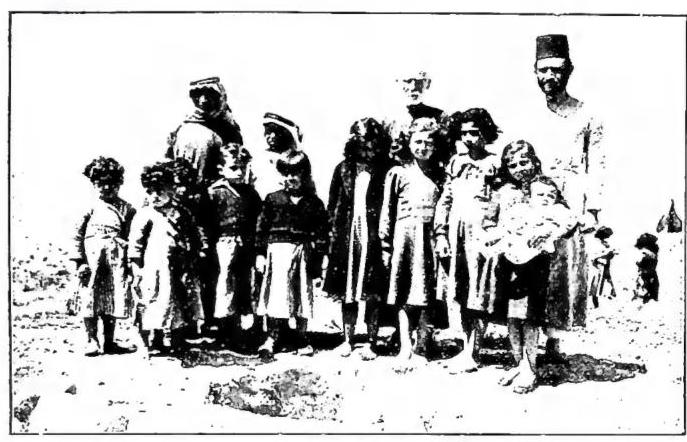
There are presently 260 families of S. gathered around their new synagogue at the foot of Gerizim. Ca. 85 of them are scattered between Tel Aviv and Haifa.
Their doctrines are little known; the basis of their faith is the Mosaic Samaritan Pentateuch (v.), the only collection of the Sacred Books accepted by them; they preserve its text, altered and interpolated, with practical adaptations, from a subsequent legislation, long transmitted orally and then fixed in writing. Thus arose the Tâbah (10th cent. A.D.), a compilation of norms concerning the priesthood and sacrifices, the Hâlih ("path" along the ways of the Law), etc. The S. still await the Taheb, a sort of reforming Messiah of the Moses type, who will restore a kingdom of glory for 1000 years after his death. They exclude any sensible representation and any anthropomorphism when speaking of God. They faithfully observe the Sabbath and circumcision. They still speak a dialect that seems to derive from Palestinian Aramaic and use an archaic alphabet derived from the paleo-Hebrew one.
The power and diffusion of the S., before the revolt of 549, are attested by the remains of their synagogues found in Palestine and Transjordan, with inscriptions; in the excavations of Mount Nebo 8 fragments were found. In 1948 in the village of Salbit, 3 km. east of Qubâb on the Jerusalem-Ramleh road, a synagogue was discovered, facing Mount Gerizim, with an inscription of Ex. 15, 18.