
SAMARIA (Heb. Šōmērōn, Assyrian Samarina, Greek Σαμάρεια). — A city founded in 880 B.C. by Omri (v. AMORI), the sixth king of Israel, in the center of his kingdom, on the summit of a hill (443 m above sea level), purchased for two talents of silver from a certain Somer (I Reg. 16:24); the present-day Arab village of Sebastijjeh, 10 km northwest of Nābulus, occupies its ancient site.
The choice of site was excellent (Is. 28:1), at the intersection of the principal routes of communication, with the possibility of strongly fortifying its sides.
The archaeological excavations, undertaken only partially in 1908–10 and 1931–35, have brought to light the historical vicissitudes of the city under Omri (880–721 B.C.), Sargon (721–331 B.C.), Alexander the Great (331–323 B.C.), and Herod the Great (30 B.C.).
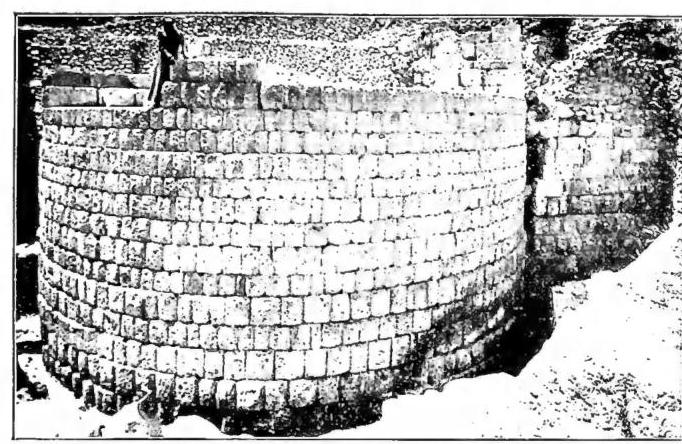
(from J. W. Crawford - K. Keegan-E. L. Lubemb, The Building at S., London 1912, inv. 26, 2)
SAMARIA – Round tower excavated at S.
“the pool of S.” (I Reg. 22:38), in which Ahab’s chariot was washed after the fatal battle of Ramoth-Gilead. In 1932, among the ruins of the citadel, a rich collection of ivories was discovered, approximately 200 pieces, some of them inlaid with lapis lazuli or other colored substances and covered with gold leaf, all delicately decorated with subjects combining Egyptian and oriental motifs, dating from the ninth century (I Reg. 22:39). Amos (3:15) deplored their excessive luxury.
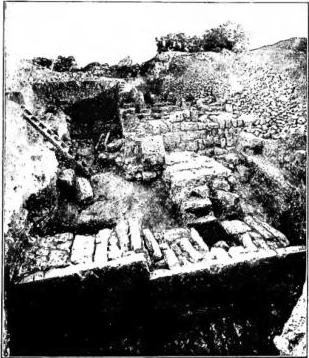
Strongly fortified, the city resisted the serious attacks of the Syrians of Damascus (I Reg. 20:1, 13, 21) and sustained the siege of the Assyrian Salmanasar V for three years, until in 721 Sargon captured it, deported its inhabitants to Assyria, and replaced them with people of a different stock, who mingled with the few Israelites who had remained, forming the hybrid race of the Samaritans (v.). From the destruction of 721 until the time of Alexander the Great, little is known: a Neo-Babylonian letter addressed to Abi-Ahi, governor of Samarina, and many potsherds attributed to the Assyro-Babylonian and Persian periods attest to the two foreign administrations.
In 331 S. initially submitted, but then attempted to rebel against Alexander the Great, who dismantled it and imported a colony of 6,000 Macedonians. Renewed by the Macedonian Perdiccas, again laid waste by Ptolemy I and then by Demetrius Poliorcetes, it enjoyed a period of prosperity; around 108 B.C. it was captured and destroyed, though not annihilated, by Giovanni Hyrcanus. A beautiful round tower with sections of wall, numerous fragments of Rhodian-type jars, coins, and inscriptions—including a votive stele bearing a Greek inscription of Hegesander with his wife Xenachis and children, dedicated to Serapis and Isis—indicate the city’s Hellenistic-pagan revival. In 63 B.C., after being occupied and rebuilt by Pompey the Great, it was fortified still further by the governor Gabinius in 57 B.C., so much so that its citizens were called “Gabiniani.”
In 30 B.C. the emperor Augustus ceded it to Herod the Great, who completely transformed it and in 27 called it Sebaste, after its patron Augustus, repopulating it with Roman colonists and merchants.
A vast circuit of walls, furnished with towers, was built along the sides of the hill, extending northward to the valley floor, where the stadium stood, and northeastward to the site of the present-day village of Sebastijjeh. A monumental gate, flanked by two circular towers, led onto the colonnaded street, approximately 1,700 m. long. Above the ruins of the royal Palace of Achab and Omri and perhaps of the temple of Baal, a solemn staircase led to a large terrace, on which stood the Augusteum, an apsidal building with porticoes, an altar, and a statue of Augustus. Farther north was the temple dedicated to the goddess Kore, whose statue was found in a cistern; in the temple, two stones were discovered bearing in relief the symbols of two oval helmets, interwoven with laurel and surmounted by a star, the symbol of the Dioscuri, venerated in the pan-
theon of S. Even today the ruins of the stadium, theater, forum, basilica, mausoleums, and aqueducts can be recognized. The city supplied Herod and subsequently the Roman governors with five cohorts of Sebastiani, and in the time of Claudius (A.D. 42-54) also with a cavalry squadron.
In S., Christianity was introduced by the deacon Filippo, who encountered Simon Magus there (Act. 8:9-14). During the disturbances of 64, the soldiers severely mistreated the Jews, who took terrible revenge in 66 by burning the city.
After 70 Vespasian removed the troops from II. In 196 Settimio Severo imported a new population and granted it colonial rights, under the title Colonia Lucia Septimia Sebaste, and restored its walls, public buildings, theater, and forum; but the city was losing its importance as the nearby Neapolis grew (v. NA-
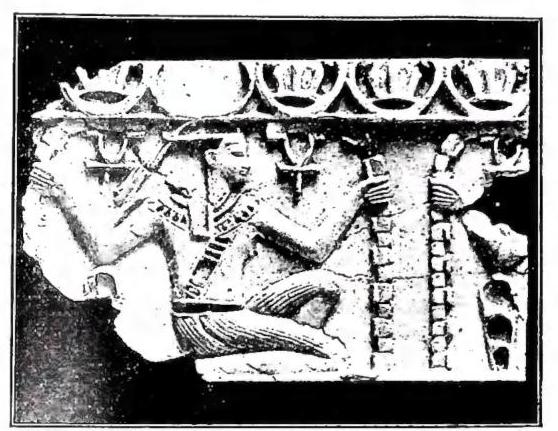
(from J. W. Crowfoot – G. M. Crowfoot, Early Ivories from S., London 1938, pl. 2, 3) SAMARIA – Engraved ivory in Egyptian style found at S.
In 1932, the remains of a church erected at the site where the head of the Baptist was first discovered were found at the summit of the hill; the itineraries of the 13th century mention it; it seems to date from the 5th century. In a lateral grotto, frescoes depicting scenes of the beheading of St. John can still be seen.