
BAAL (ba'al = «lord, master, possessor»). - Divinity worshipped by almost all peoples of the Near East and in Africa. In the Bible it is designated with the article (hab-ba'al), omitted in the documents of Ras
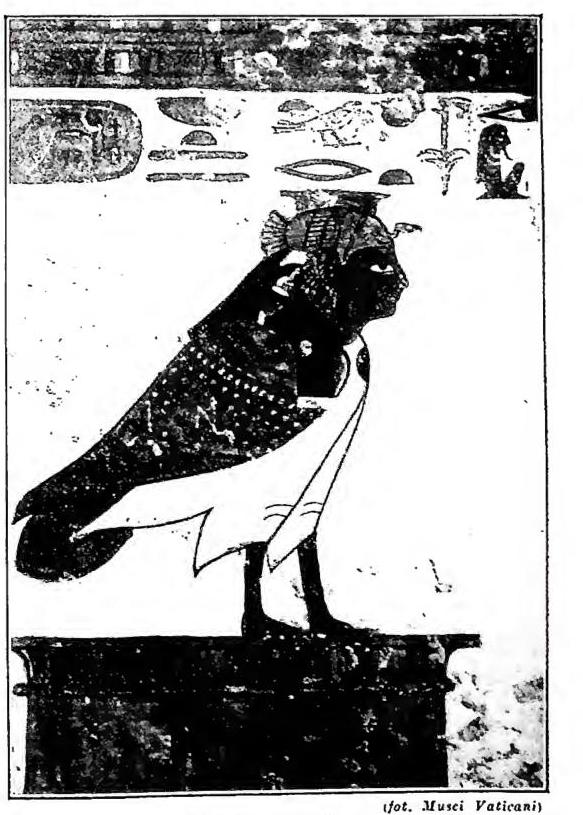
(phot. Musci Vaticani)
From the place where he was worshipped, or toward which he was supposed to have a predilection, or from the functions attributed to him, arose numerous denominations (hypostases) of B. (Baalim): Baalsamin (Balsamen) = B. of heaven, B. of Lebanon, B. Bērīth (of the covenant), B. Markodes (of the dance?), B. Mrp (healer), Beelphegor (v.), Beelsephon (v.), Beelsebub (v.). The Canaanite territory, before the Israelite invasion, was full of Baalim. Among some peoples, B. was worshipped under another name, but with the same prerogatives: Mekal at Beisan, Rešēph-Seth in Egypt, B. Šamin, Malak Bel, Jarchi Bel, Agli Bol at Palmyra, B. Hammōn at Carthage, Tešup among the Hittites and the Hurrians, Melqart (v.) at Tyre, Hadad (v.) among the Canaanites.
E. Dhorme connects the cult of B. with the idea that nomads had of the protective divinity, who, in symbiosis with the members of the tribe, was considered not only father, mother, brother, relative, but also «master» or Baal; with the multiplication of gods, the Baalim multiplied, so that each city had its B. and its Baalat (1 Sam. 7:3 ff.; 12:12); from the Amorite cult of the «B. of the high peaks» arose the B. of heaven, B. Šim, Balsamen. According to F. Cumont, B. is the god of the tribe from whom, in exchange for protection, he demanded worship; his sovereignty extended by considering foreign worshippers as clients, whereby B. became a universal god; «master» of the earth because he fertilizes it, he resides in heaven from where he bestows rain and heat (B. of fertility). According to W. R. Smith, there was a shift from the concept of the land of B. (fertile zone, therefore favored by the god) to that of B. as the owner of that land. As god of fertility, he became the controller of waters and rain, the one who presides over the production of animal life and sexual relations, hence the husband of the earth; the masculine principle. It is considered more probable, with Vigouroux and Lagrange, that the name B. implies an attribute of the divinity, presupposing the existence of a god who is master and lord of the universe.
The documents of Ras Šamrah (v.) illuminate his figure. According to the myth of Baal and Alejan-Baal, B. is one of the 70 sons of Ašerat of the sea and father of Alejan-B. Unlike the other gods, he has no temple until 'Ašērāh obtains the construction of one for him, built with bricks and cedars on the heights of Šaphon (Mt. Casius?) by Košer, Hasis, and Hjōn, who open a skylight in it so that B. «the rider of the clouds» can utter his holy voice through II. The dedication is celebrated with hecatombs of oxen, rams, goats, calves, and lambs. B. (with Alejan-B.), being in conflict with Mōt, the genius of the summer harvests (and therefore of drought), is the god of the beneficial waters that make plants sprout and grow. Eliminating each other in turn, B. (and Alejan-B.) descends into the bowels of the earth at harvest time, and Mōt at the time of the rains. From his dark abode, Mōt sends a message that, to reach B., would have to pierce Līn (the biblical Leviathan?), the twisting seven-headed serpent. To B. (and Alejan-B.) belong the clouds, the wind, the thunderbolt, the rains, the seven youths, the eight swine, the house of light, and the lightning. Resurrected, B., accompanied by his daughters (Pidrija, daughter of light; Talija, daughter of abundance; and Arsija), ascends the heights of Šaphon, where the gold is, casting out its usurper Šaphon. After this, 'Anat slays Mōt, thus restoring to the earth the spirit of vegetation.
B. was worshipped on the rooftops of houses (Jer. 32:29; 2 Kings 23:12), in temples (1 Kings 16:32; 2 Kings 10:21-27; 11:18), and especially on the bāmōth (v. BRAHMÃ); cf. Jer. 19:5; 32:35; 1 Kings 18:20. Around the altars ḥammānīm were erected, and human victims were also offered to B. Such rites, cruel and utterly shameless, are execrated by the Bible (1 Kings 18:19-25; 2 Kings 10:19; Jer. 19:5; 32:35).
The cult of B., despite the strict prohibition of Mosaic legislation, was also dear to the Israelites. In the time of the Judges they worshipped the Baalim and the 'Ašērīm (Judg. 2:11-13). Under Ahab, son-in-law of Ithobaal II of Tyre, there were 450 prophets of B. and 400 of 'Ašērāh in the kingdom of Israel, and only 7,000 men refused his worship. The energetic reaction of Elijah culminated in the contest on Carmel (1 Kings 16; 18:16-40). Promoted again by Ahaziah, it was opposed by Joram and uprooted by Jehu (1 Kings 22:54; 2 Kings 3:2; 10:18-28). Athaliah introduced it into Jerusalem as well, but Joash abolished it (2 Kings 11:18; 2 Chron. 23:17). Restored to honor by Ahaz and Manasseh, it was fought against by Hezekiah and Josiah (2 Kings 18:4; 21:3; 23:4-5). Yet the priests of B. continued to operate until the exile, after which the cult of B. disappears (Jer. 2:8, 23; 7:9; 9:14 ff.). Some biblical names ending in B. were later altered with bōšeth («shame»): Ishbosheth for Ishbaal, Mephibosheth for Mephibaal, etc.