
HITTITI. – A people now well known after the texts from el-‘Amarnah and Boghazkój, often mentioned in the Bible (Hebr. Hēth, plur. Hittim; also bēnē Hēth; Septuagint Xirvāba, Vulg. Hethaei), in the historical books. Some biblical passages refer to a kingdom of the H. and to a Hittite race living outside the land of Canaan; but neither the kingdom nor the land is localized. Recent discoveries vindicated the sacred text and disproved the hasty assertions of the critics of half a century ago, who found in the biblical affirmation of a Hittite empire a gross error.
Explicit references to a “kingdom” of the H. are: I Reg. 10:29: Solomon procured horses for the “kings” of the H. and for those of Damascus; II Reg. 7:6: “Behold, the king of Israel has allied himself against us (the Syrians) with the ‘kings’ of the H. and of the Egyptians, who will fight against us.” Other texts seem to allude to an extra-Canaanite Hittite population. King Solomon had foreign wives: the daughter of the Pharaoh of Egypt, Moabite, Sidonian, and Hittite women (I Reg. 11:1). Many centuries earlier, Esau, son of Jacob, married Judith, daughter of Beeri the Hittite, and Basemath, daughter of Elon the Hittite (Gen. 26:34). Iudc. 1:22 ff. recounts that an anonymous man, driven out of his city Luza, later called Bethel, went to the “land of the H.” in order to found there a city to which the name Luza was given.
Most biblical passages, however, refer to H. living in Canaan. At the time of Abraham, a colony of bēnē Hēth or H. lived in the region of Hebron (between Jerusalem and the Neghebh), and appears to have possessed fairly extensive lands. The patriarch Abraham negotiated with them for the purchase of a field, which became a burial place for Sarah, his wife, for himself, and for his family. In the covenant made with Abraham (Gen. 15:18-21), and in the numerous texts where the inhabitants of the Promised Land are mentioned, the H. are listed alongside the Amorrites and other immigrant or indigenous peoples in Canaan. Num. 13:29 determines the geographical position of the populations that were to be subjected to the chosen people: the H., the Jebusites, and the Amorrites (v.) inhabited the mountains, while the Canaanites dwelt along the sea and near the Jordan. Furthermore, two H. lived at the time of David (ca. 1025): Achimelech (questioned by the persecuted fugitive: “Who will accompany me to Saul?”: I Reg. 26:6) and Uriah, the husband of Bathsheba, victim of the murderous and adulterous King.
In the prophetic books only Ex. 16:3-45 alludes to the H., saying that the mother of Israel (that is, of the Hebrews) was Hittite.
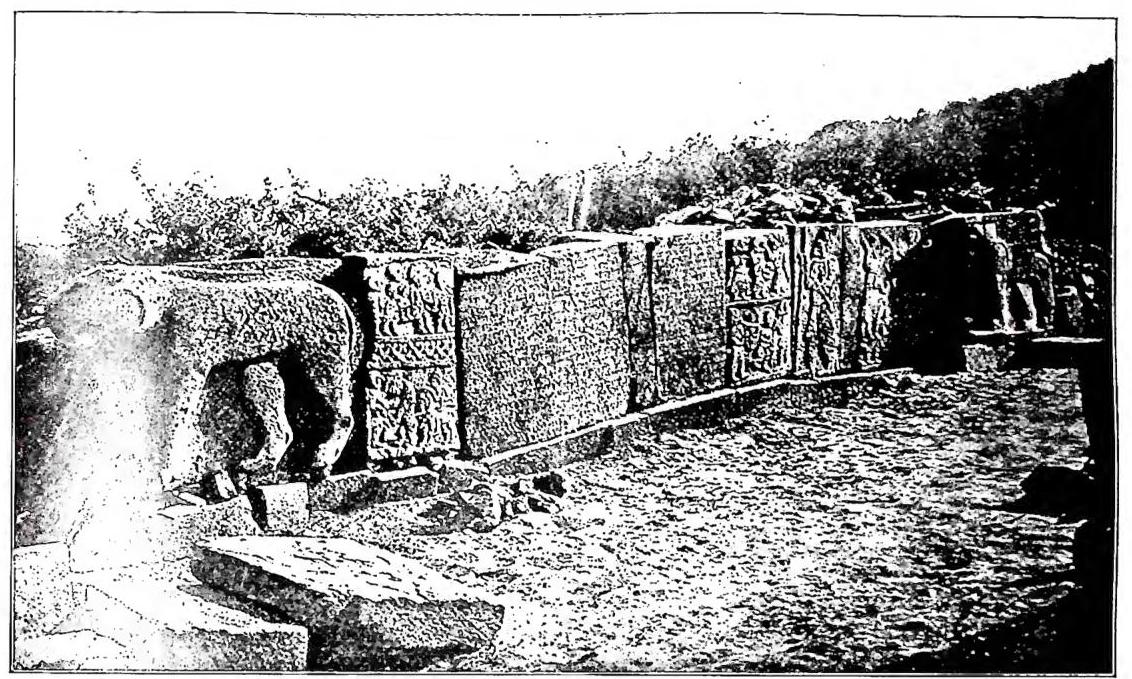
HITTITI — Hittite reliefs and bilingual inscriptions (Phoenician and hieroglyphic Hittite) discovered at Karatepe during the Turkish excavations of 1947–45.
RELIGION OF THE H. — The H. called themselves Hattu, or rather “men of the land of the city of Hattu” or “Hattusas,” the name of the capital. They were Indo-European in language, of mixed race, and superimposed themselves upon Asia Minor populations of a different language and civilization, among whom the city of Hattu already enjoyed great prestige. The H. adopted as their national name that of the conquered people. The inhabitants of Hattusas who preceded the H. are usually called Hattians; they had a language entirely different from that proper to the H., although it continued to be spoken after the Hittite conquest and remained the language of certain religious ceremonies. So far, nothing precise is known about the manner in which the Empire of the H. was founded. It is possible that Anittas of Kussar (approximately contemporary with Hammurabi of Babylon) played a major role in II. It seems that the successors of this king, conqueror of various regions of Asia Minor, including the Kingdom of Hattusas, all belonged to that dynasty which held power in the Empire of the H. until its collapse around 1200. The height of its power came toward the end, from 1400 to 1200, especially under the kings Suppiluliumas and Mursilis II, when the struggle in Syria with the Egyptians made the Empire formidable and a danger to Egypt.
Just as the H. had their own civilization, so too they had a particular religion which, although in its fundamental features it resembled those of the other polytheistic nations of the ancient Near East, and first of all that of the Babylonians and Assyrians, displays several entirely different peculiarities. It was polytheistic, with a very large number of divinities of diverse origin: pre-Hittite Asia Minor divinities, divinities from the pantheons of subject peoples, and finally divine figures proper to the H. and shared with the other Indo-European-speaking peoples. The pantheon of the Hittite Empire was therefore somewhat composite, all the more so because it was also influenced by that of the
Babylonians through the pantheon of the Hurrians, who inhabited the regions between Hittite Asia Minor and Babylonia and Assyria. Hurrian influence is quite strong not only in the pantheon but also in the myths, many of which are of Hurrian origin, although they have come down only in a Hittite version.
The name of the national and principal god is still unknown, but that he was a god of the storm, lightning, rain, and sky is already attested by his ideogram, which shows him to correspond to the Mesopotamian god Adad. Beside the storm god there was, as his wife, a goddess who was foremost in the Hattian pantheon, the solar goddess of Arinna; she does not, however, seem to have been a goddess of the sun, since the H. had a sun god distinct from this goddess, who had her great sanctuary in the city of Arinna. She is called “the queen of the lands,” “the queen of heaven,” “the lady of just judgment.” To her the kings of the H. submitted reports of their military campaigns, and by her they swore in international treaties. Another goddess was also very important, the one whom the Babylonians and Assyrians called Ištar. In addition to the sun, the H. also worshipped the moon: the moon god was Arma. The son of the supreme god was Telipinus, an agrarian deity and god of vegetation and fertility, corresponding to the Mesopotamian god Tamuzu. The name of the god Innaras may perhaps be connected with that of the Indian Indra. The god Hasamilia possessed the power to conceal people. Very ancient was the god Halmasuittis, the deity of Anittas of Kussar. The protective Hittite divinities were called Kulses. The H. also personified certain abstract or moral concepts, such as Sin, Sincerity, Right, Answered Prayer, and others.
Certain important divine figures of the Luvians, such as Santas and Kupapa, and of the inhabitants of the land of Palà, had entered the Hittite pantheon. The Babylonian and Assyrian divinities in the pantheon included Anu together with his wife, Enlil and his wife, Ea and Damkina, Išhara, and quite a few other divine figures. The H. also greatly venerated rivers, mountains, and the sea, images of which they kept in the temples.
They represented their divinities in a wholly anthropomorphic manner, as though they were human in every respect. Indeed, they attributed to their gods all the physical and moral qualities characteristic of human beings.
The H., like their neighbors, also had a rich flowering of myths, partly of Indo-European origin and partly deriving from Mesopotamia through Hurrian mythology. Particularly noteworthy is the Myth of Telipinus, according to which this god disappeared one unfortunate day, whereupon vegetative and generative life ceased on earth. The god is sought, and finally the bee succeeds in finding him. The influence of the myth of Tamdzu on this mythical account of the H. is evident. The account of the storm god and the serpent Illuyankas has also been preserved. Of other myths there are only fragments. The H. had translated the Babylonian myth of Gilgameš into their own language, that is, the Epic of Gilgameš: the Hittite version of this has preserved certain passages not yet found in the Assyrian recension.
Below the gods in the hierarchy of beings stood numerous demons; below them, human beings, among whom the kings occupied a highly prominent position, since they were the vicars of the gods on earth and their representatives, especially of the personal divinities, such as the goddess Ištar, who was the personal deity of King Hattusilis and therefore favored him in all his undertakings.
What would happen and the will of the gods the H. sought to learn through mantic practices, or the art of divination, which was no less important among them than among the ancient Mesopotamians. Very many mantic texts in the Hittite language were translated from Babylonian, while others were based on texts composed in that language. Among the mantic arts, hepatoscopy, extispicy, astrology, and predictions from the flight of birds and from malformed births were prominent. The gods also communicated their will in dreams and sent birds to signify what human beings were to do. The future was also foretold from the fevers that afflicted the Hittite king. Omens were discerned in the changes undergone by the statues of the gods.
The religious literature of the H. was very rich in magical and incantatory writings. Magic and incantations played a very large role in their religion, an aspect of their religious life that brings them close to the Babylonians and primitive peoples. Sympathetic magic in particular was very widespread. The inscribed clay tablets containing Hittite texts have preserved many incantatory writings describing ceremonies of exorcism, all filled with prototypical magical acts.
The H. also knew the practice of evoking divinities from enemy cities in order to bring them over to their own side, as the Romans did, as well as the cursing of conquered cities. Particular interdictions protected the person of the king, who frequently had to submit to purificatory acts in order to make himself immune to harmful contacts. The H. had a highly elaborate doctrine concerning sin, which was believed sometimes to afflict with its consequences only the successors of the actual sinners. Sacrifice was similar to that of the other nations of the ancient Near East: it had the character of a meal and of an offering presented to the god. The composition of the numerous and influential priestly caste did not differ greatly from that of the priests among the Mesopotamians. Religious literature was rich in rituals with detailed descriptions of religious festivals and ceremonies. A number of rites of Hattian origin can still be found among these rituals.