
ABRAMO. – Patriarch of the Old Testament, son of Tare, descendant of Shem. His history, rich in detail, is narrated in Gen. 11:26–25:11.
I. A. IN THE HOLY SCRIPTURES. — To determine the period in which A. lived, it was customary to resort to the synchronism with Hammurabi, the Babylonian king who lived around 2000 B.C. and was identified with ’Amrāphel, king of Shin’ar, against whom A. fought (Gen. 14, 9); but since recent discoveries have made it possible to establish the date of Hammurabi’s reign between 1728 and 1685 B.C., the identification with ’Amrāphel appears increasingly problematic. According to the data of the Bible, A. was born 1200 years before the foundation of the Temple, set at 968 B.C., that is, in 2168 B.C. (cf. Gen. 21, 5; 25, 26; 47, 9; Ex. 12, 40; I Reg., 6, 1). The setting of the biblical account of A. corresponds to and is confirmed by the information we possess concerning the contemporary Mesopotamian East.
A.’s family, Ur (v.), was idolatrous (Ios. 24, 2; Ind. 5, 7-9; cf. Gen. 31, 19, 35), and some descendants of Tare bear in their names traces of the moon god Sin, whose principal center of worship was at Ur. Tare, who belonged to the semi-nomadic Semitic tribes settled in lower Mesopotamia, moved northward, toward Haran or Harran, at the time of the disorders that followed the fall of the IIIᵃ dynasty of Ur in 1940 B.C.; Harran was a transit station on the route to Canaan and, like Ur, a city devoted to the god Sin. Amid the polytheism and immorality of his homeland, A. had remained, not without particular divine assistance, faithful to the Lord Jahweh. After the death of his father, God addressed to him the definitive invitation (he had already spoken to him at Ur, cf. Act. 7, 2) to leave his kindred and his country and go toward the land that He would show him. On this occasion, God blessed A. for the first time, granting him His favor and assistance, and promised him a countless posterity of widespread renown. A. would moreover be a source of blessing for all nations (Gen. 12, 3), since among his descendants would be the Messiah, savior of the world.
At the age of 75, A., with his wife Sara and his nephew Lot, the son of his already deceased brother Aran (Hārān), left Haran, proceeding with his wealth and his servants — several hundred people (cf. Gen. 14, 14) — southwestward into the land of Canaan, which he crossed from north to south, moving in various directions. We find him at Sichem, at the oak grove of Morèh in the heart of the country, in the pass between Mounts Hebal and Garizim; then farther south, at Bethel; and finally in the extreme southern region of the Negheb. At the oak grove of Morèh, the Lord appeared to him and promised to give him and his descendants the land in which he was standing, and A. raised an altar there and at Bethel (Gen. 12, 5-9). On the occasion of a famine, he had to descend into Egypt, which the Nile saved from drought; and, to prevent the king from taking Sara into his harem by disposing of her husband, he advised her to declare herself his sister — as she in fact was on her father’s side only, Gen. 20, 12 — but the Lord saw to it that the woman suffered no outrage and that the incident benefited A.
Having returned to Canaan, in order to avoid disagreements with his nephew Lot on account of their respective herds, which required extensive pastures, he separated from him and left him the territory of the Pentapolis. God then renewed the promises (Gen. 13, 14-17). A. pitched his tents at the oak grove of Mambre near Hebron, where he dedicated an altar to the Lord, sanctifying the place already devoted to Canaanite worship. A military expedition enabled A. to test his strength. After twelve years of tribute to the king of Elam, who at that time held primacy in Mesopotamia and western Asia, the five kings of the Palestinian Pentapolis attempted to shake off his yoke; but four eastern kings marched against them: ’Amrāphel, king of Sennaar (or Sin’ar); Arioch, king of Ellāsār; Chodorlahomor, king of ’Elām; and Thadal, king of Gōim. Among the prisoners they took was also Lot, whom A., after pursuing the victorious troops for a long time, rescued in a lightning-fast nocturnal attack. Many attempts have been made to recover the names of the four eastern kings in contemporary documents, but their scarcity does not permit definitive conclusions.
On his return from the expedition, A. Melchisedec (v.), king of Salem and priest of the « Most High God », who offered the exhausted troops bread and wine and offered them in sacrifice to the Lord, blessing A., who gave him a tenth of the spoils (Gen. 14, 17-24). In a new theophany, A. asked God that His promise might be realized in an heir; he reaffirmed to Him his unlimited faith, « and God counted it to him as justice », confirming His word with a solemn covenant concluded according to Babylonian custom: God, in the symbol of a blazing fire, passed between the sacrificial victims cut in two (Gen. 15). Sara, irretrievably barren, availed herself of the right granted to her by Babylonian law (cf. Codice di Hammurabi, 144-47) and offered A. the slave-girl Agar so that she might give him an heir who would legally be considered the mistress’s son. Thus, at the age of 86, A. had Ismaele (Gen. 16). When he was 99, in an important apparition, God further defined the terms of the covenant established between Him and A. The Lord repeated the promise of a very numerous posterity (Gen. 17, 2, 4-6) and of a land (v. 8), while A. had to commit himself to worship Jahweh as the one true God (v. 7), to remain faithful to the rule of perfection established by Him (v. 1), and to have faith in the steadfastness of the promises (vv. 1, 17-19). This is a conscious adherence to God, toward whom one’s entire life is directed and into whose hands the future is entrusted. The visible sign of the covenant is circumcision (v.) in the male (vv. 11-14), through which A.’s descendants become heirs of the promises made to the patriarch (v. 12). Finally, the Lord announced the imminent birth of a son of Sara, who would be the direct heir of the divine promises. Ismaele too received his share of blessing (vv. 15-22). On that occasion, A. circumcised himself, Ismaele, who was thirteen years old, and all the men of his household, including one hundred foreigners by origin (vv. 25-27).
The new orientation of A.’s life was expressed by the change, willed by God, in the name of the patriarch and his wife. A. would no longer be ’Abhrām (the name is attested in Mesopotamia at the beginning of the second millennium in the forms A-ba-am-ra-ma, A-ba-ra-ma, A-ba-am-ram, and probably means « He is great with regard to the father », that is, of noble birth), but ’Abhrāhām, which the Bible (Gen. 17, 5) interprets as « Father of a multitude of peoples », because of the assonance between the ending -hām and the Hebrew hamōn, « multitude ». Sara, until then called Sarai (Assyr. Sa-ra-ai), had her name changed to the more recent form Sārāh, « princess », corresponding to the Babylonian Sarratu, « queen ». Later, at the oak grove of Mambre, in a mysterious apparition of three men whom A. received as guests, God confirmed to him the promise of an heir despite Sara’s disbelief. On that occasion, God confided to His friend His intention to destroy the sinful Pentapolis. A.’s generous intercession was unable to avert the scourge, from which only Lot escaped (Gen. 19, 29). From Mambre, A. moved to the Negheb, settling in Philistine Gerar, where once again he succeeded in rescuing Sara from the desires of King Abimelech, with whom A. formed a friendship (Gen. 20, 1-18).
When he was 100 years old, A. had the long-awaited heir: Isacco (Gen. 21, 1-7). Properly circumcised, his weaning was celebrated with great magnificence (v. 8). Later, the child aroused Sara’s jealousy, and she demanded that Ismaele be expelled from her household. Obeying the Lord, A. separated from his first son (Gen. 21, 1-21; cf. 25, 12-16). In Philistia, A. was respected and feared, and he was able, through a legal transaction, to secure ownership of the well of
Beersheba, important for the prosperity of his flocks, 40 km as the crow flies from Gerar. But God put A.’s faith to a severe test: he ordered him to go to a mountain in the “land of Moriah” to sacrifice Isaac there. Along the way, the son’s innocent questions tore at his heart, but did not weaken his faith or his spirit of absolute obedience and love. By commanding the killing of the son who was heir to the promises, God demanded of A. an act of heroic faith; by preventing its fulfillment through the intervention of an angel, he condemned the practice of human sacrifice in use among the Canaanites, among whom A. lived (v. ISACCO).
Sara died at the age of 127 in Hebron. To bury her, A. purchased the cave of Machpelah from the Hittites. The transaction is recounted with an abundance of precise details, because this was the first piece of land permanently possessed by Hebrews in Canaan (Gen. 23, 1-20). Another narrative, rich in Eastern folklore, reproduces the negotiations conducted by A.’s faithful servant to choose a wife for Isaac. The chosen woman was a relative: Rebecca, granddaughter of Nachor, A.’s brother, because the patriarch, for ethnic and religious reasons, did not want a foreign woman for his son (Gen. 24). After Sara’s death, A. took another wife named Cetura (Gen. 25, 1-6), from whom were born the ancestors of various tribes inhabiting the regions south and southeast of Palestine, in the steppes. He then provided, according to the law of the time, for securing Isaac’s inheritance by sending his other sons away from him.
At the age of 175, A. “died in a good old age, old and full of days,” and was buried by Isaac and Ismael in the cave of Machpelah, beside Sara (Gen. 25, 7-11). The memory of A. remained alive throughout all the centuries of the history of the chosen people, who inherited from him the messianic promise.
In the New Testament, the Virgin Mary and Zaccariah sing of the promises and covenant of God with A. (Lc. 1, 55-73), which are fulfilled in Jesus, the “son” of the patriarch (Mt. 1, 1; Lc. 3, 34). Jesus himself gives this title, “son of A.,” to a sick woman and to Zacchaeus, of which the Jews were particularly proud (Lc. 13, 16; 10, 9; Mt. 3, 9; Lc. 3, 8; Io. 8, 39), but declares that it is not carnal descent, but rather imitation of A.’s works, that counts (Io. 8, 33-44). A. is in heaven (Lc. 13, 28), and Jews and Gentiles will rest in his “bosom” (Lc. 13, 28; 16, 22-30).
Pietro, Stefano, and Paolo will recall the Abrahamic promises (Act. 3, 25; 7, 2-8, 17; Hebr. 6, 13; II Cor. 11, 22), which have been fulfilled in Christ for all those who, through faith, are children of the great patriarch (Rom. 9, 7-9; Gal. 3, 29; 4, 22-31). A. is the exponent of the economy of the promise (ἐπικτωσία)—opposed to the bilateral Mosaic covenant—which finds full realization in the New Testament (Gal. 3, 16-18). The exaltation of A.’s faith (Rom. chap. 4; Gal. 3, 6-9; Hebr. 11, 8-19; Iac. 4, 21-23), and the demonstration of the superiority of Christ’s priesthood over the Aaronic priesthood on the basis of what occurred between A. and Melchisedec (Hebr. chap. 7), are two classic chapters of Pauline preaching.
In the time of Pope Damaso (366–84), A.’s name was inserted into the canon of the Mass, and his memory has been recorded in the martyrologies since the ninth century on October 9. He is also invoked in the prayers for the dying.
BOSOM OF A. — In the well-known parable of the rich man, the angels carry Lazarus the beggar, after his death, “into the bosom of A.” (Lk. 16:21 ff.). The expression, rare and ancient in rabbinic writings, is frequent in patristic literature, in the liturgies for the dead of all rites, and in Christian inscriptions. With few exceptions, ecclesiastical writers-
(Alinari photograph)
ABRAMO - Sacrifice of A. Master of Isaac (13th century) - Assisi, Upper Church of S. Francesco.
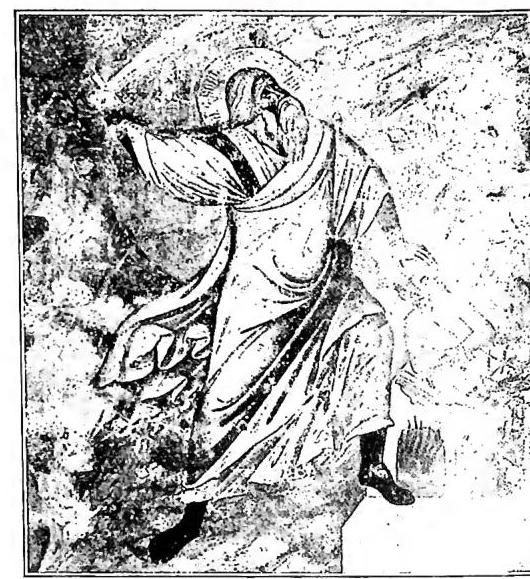
According to modern exegetes, the metaphor may have a twofold meaning. For some, it refers to the heavenly banquet at which A. is the presiding host; whoever sits at his right, reclining on the lower couch and leaning on his left elbow, can easily rest against his breast: in sim (Io. 13, 23; Plinio, Ep. 4, 22, 4). Other authors prefer to see in resting on the bosom of A. the paternal protection and tenderness of the patriarch of believers (Rom. 4, 16 sgg.), who receives his children into eternal happiness, they being intimately united to him (cf. Io. 1, 23; Lc. 13, 28; and the apocryphal IV Mach. 13, 17, where, however, “the bosom” is probably a Christian interpolation).
In this second sense “bosom” is used in the Babylonian language (Cod. di Hammurabi, XL, 49 sgg.: the king carries his subjects in his bosom) and in the Hebrew language (Num. 11, 12; I Reg. 3, 20; 17, 19; Lam. 2, 12).
Salvatore Garofalo
2. A. NELLA LEGGENDA AGGADICA. — A.’s father, according to this legend, was a general in Nimrod’s army, and on his own initiative set out in search of the truth, attaining knowledge of the oneness of God. Nimrod, king and astrologer, convinced that he himself was God and foreseeing the birth of a child destined to dethrone him, summoned seventy thousand pregnant women and had their newborn children killed; but A. remained safe, hidden in a cave. When he grew up, A. became a disciple of Sem, from whom he learned the art of determining the leap year. He did not take part in the sin of the Tower of Babel, but by renouncing the spoils of war after the victory over the kings of the Pentapolis, he sanctified the name of God. Since, according to his astrological predictions, he believed that he would have no descendants, the Lord reproached him for this. He then indicated to him the four empires that in the future would enslave Israel. The blame for this enslavement must be attributed to A., who had presented Sara to the king of Egypt as his sister rather than as his wife. A. loved the land of Canaan because he hoped that his descendants would be a nation of farmers. Lot’s shepherds had no scruples about allowing their flocks to graze in other men’s fields, whereas A.’s shepherds did not. Hence the disagreements and the separation. The change of Abram’s name to Abraham gives rise to various interpretations: father, chosen, beloved, king, powerful, most faithful among the nations. The three angels who were A.’s guests were Micael, Rafael, and Gabriel, who assumed human forms in order to visit A. A. chose the cave of Macpelah as the place of his burial because there the little sheep destined for the banquet of the angels had taken refuge; and Adamo and Eva rested there, with torches burning beside their headboards, while a sweet fragrance filled the entire cave.
Eugenio Zolli
3. ICONOGRAFIA
Funerary art prefers to represent A. in the sacrifice of Isaac, according to various schemes: A. brandishing the knife in his right hand, while his left rests on Isaac’s head or leads him by the hand; Isaac, for his part, is either kneeling beside the altar or carrying the wood. Sporadic examples show father and son praying, or A. pointing to the fire. A ram, the divine hand, or a group of doves completes the scene. Sculpture sometimes represents Isaac in the air together with the angel. The theme already appears in the synagogue of Dura Europos (in the year 245) and in mosaics, glass, lamps, rings, gems, spoons, and medals. If at first it suggested the idea of salvation, Constantinian art later made it a theme parallel to that of the scene of the Lord’s Passion, thus interpreting it in the typological sense, which had long been widespread. Finally, the basilica decoration of Ravenna gave it the well-known Eucharistic meaning. It is plausible that it suggested the same meaning at Milano and Nola, as well as in the first mosaic panel of S. Maria Maggiore in Roma, in which the meeting of A. and Melchisedech is represented, followed by the historical scenes of Lot’s separation from A. and the vision of Mambre.Among the great artists of the Renaissance, the sacrifice of A. was treated, besides by Gozzoli in the Camposanto and Sodoma in the duomo of Pisa, by Tiziano in S. Maria della Salute in Venezia, Tiepolo in the archiepiscopal palace of Udine, and Tintoretto (Galleria degli Uffizi); we should also mention the painting by C. Allori in the Galleria Pitti. The scene of A.’s sacrifice was assigned as the subject for the competition (1402) for the second door of the Florentine Baptistery.
Among the depictions by foreign artists, those of Rembrandt and Rubens are noteworthy. - Vedi Tav. VIII.
(1922), p. 159 sgg.; K. Künstle, Ikonographie der christlichen Kunst, II, Friburgo in Br. 1928; V. Casagrande, L'arte a servizio della Chiesa, II, Torino 1932. Luciano De Bruyne
4. POESIA POPOLARE E TEATRO
The figure of A. inspired a short poem in 30 ottave, of which editions from the early nineteenth century are known. In the theater, mention should be made of a medieval French mystery play and a Rappresentazione di Abram e Isac by Feo Belcari.5. APOCALISSE di A
An apocryphal work from the end of the 1st century A.D., preserved in Slavonic. The first part (chs. 1-8) contains the story of Abramo and his father T'are, in accordance with the Jewish legend (cf. B. Beer, Leben Abrahams nach Auffassung der jüdischen Sage, Lipsie 1859). The second part (chs. 9-32) is an amplification of Gen. 15, 1 sgg.Jewish tradition—perhaps presupposed also in Io. 8, 56—spoke of a revelation to Abramo during his sacrifice (Gen. 15, 9 ff.). The texts have been collected in H. Strack and P. Billerbeck, Das Evangelium nach Markus, Lukas und Johannes und die Apostelgeschichte, II, Munich 1924, p. 525 ff. (cf. also I, 468; IV, 1065, 1115). The Apocalypse of A. is a Jewish writing; for example, the tree of knowledge in paradise is the vine (chap. 23), in accordance with Jewish beliefs (Strack-Billerbeck, op. cit., III, pp. 250, 609, 646); the angel Azazel is a figure of Jewish demonology (Strack-Billerbeck, op. cit., III, p. 781 ff.). The angel Iacel (a kind of predecessor of Metatron) beside Michael (likewise in a tabula devotionis from Pozzuoli dating from the second or third century A.D.) demonstrates a tendency toward Gnostic speculation. Toward the end (chap. 29), certain allusions presuppose the revision of a Christian (Gnostic).
The Slavonic Apocalypse of A. differs from the Book of Abraham, also called the «Apocalypse» among the Gnostic Sethians (Epiphanius, Haer., 39, 5, 1: ed. Holl, II, p. 75, 11 ff.): the quotations from the Apocalypse of A. among the Audians, given by Theodore bar Koni (C. H. Puech in Mélanges Cumont, Brussels 1936, p. 951 ff.), reveal an entirely different character.