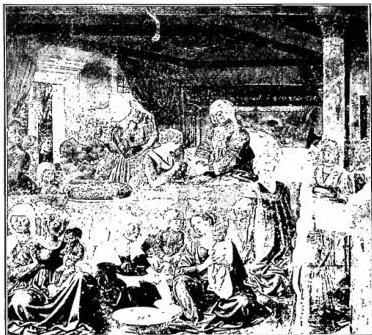
GOZZOLI, BENOZZO. – Painter, born in Florence ca. 1420, died in Pistoia on 4 October 1497. His true name was Benozzo di Lese di Sandro, and the surname G. appears only in the 2nd ed. of Vasari’s Vite. He was a pupil and follower of Angelico; nevertheless, he is first mentioned (January 1444) in a document undertaking to collaborate with Lorenzo and Vittorio Ghiberti on the famous doors of the Florentine Baptistery. In Rome (1447) and Orvieto (1449), however, he worked with Angelico as a painter.
The essential stages of his activity in Umbria and Tuscany may be summarized as follows: painting in Montefalco (1450); in Viterbo (1453; Storie di s. Rosa, lost), in Florence (1459; Corteo dei Magi, Palazzo Riccardi); frescoes in S. Agostino at S. Gimignano (1463–65); from 1467 to 1484 he executed the Storie del Vecchio Testamento (Pisa, Camposanto, almost entirely destroyed); finally, he was in Florence in January 1497.
The extent of his activity as a sculptor alongside the Ghibertis is unknown, but it must in any case have been limited and subordinate. On the other hand, while collaborating in Rome on the pictorial decoration of the Cappella Niccolina, G. remained faithful to Angelico.
The same may be said of Orvieto (Duomo, chapel of S. Brizio, the two sections of the vault), where it is not easy to isolate his artistic individuality.
But at Montefalco (panel of the Assunta, Pinacoteca Vaticana, ca. 1450; church of S. Francesco, Storie del Santo, 1452), G., by then independent, demonstrated a tendency to expand the master’s forms; to suggest a more general plasticism through a heavier color, simplifying the effect of the changing hues; and to complicate the study of perspective and landscape, though without spatial synthesis. The art of B. G. resolves itself into a pleasant, convincing, at times poetic narrative (fresco in Palazzo Riccardi), in a style that does not go beyond the bounds of Angelico’s taste, without, however, understanding its inner and religious significance. G. was not indifferent to the innovative achievements of Florentine painters such as Baldovinetti and Filippo Lippi, but without modifying the formal typology of his own master. Among the most significant works are: the Storie di s. Agostino at S. Gimignano; the Madonna, angeli e santi (1461) in the London Gallery; the Madonna e santi (1466) in the Gallery of S. Gimignano; the other one in the Gal-