
LIPPI, FILIPPO. — Painter, born in Florence ca. 1406, died in Spoleto on 8 or 10 October 1469. He was a Carmelite in Florence, where he remained until 1432, apart from brief journeys to Pistoia, Siena, and Prato. He is referred to as a painter for the first time in a document of 1431.
After 1432 he is found in Padua, where he carried out pictorial work in the church of the Santo, now lost. But on 8 March 1437 he was once again in Florence, where he established himself as an artist, although a letter of 1438 describes him as one of the poorest friars in Florence. From those years date the Madonna of Tarquinia, the Coronation of Mary, now in the Uffizi, and the Annunciation for the church of the Murate, now in Munich. His artistic recognition was accompanied by ecclesiastical appointments: a bull of 23 February 1442 appointed him rector for life of the church of S. Quirico at Legnaia; from 1450 he was chaplain to the nuns of S. Niccolò de Fieri in Florence itself.
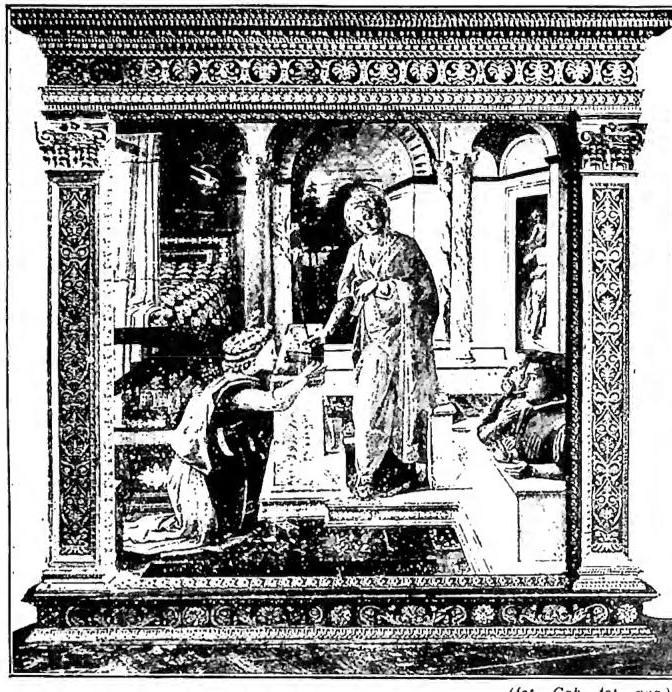
In 1456, after having become chaplain of the convent of S. Margherita in Prato, he was released from his vows; he then married Lucrezia Buti. Meanwhile, work on the choir was proceeding so slowly that in Nov. 1463 the representatives of the city of Prato resolved to compel L. to complete it within a short time; when this proved insufficient, in the following Apr. they considered appealing to Carlo dei Medici so that he might set the month of Aug. as the deadline for L. to finish the work. This is the last information concerning L.’s activity in Prato.
In Feb. 1466 the master was in Spoleto to decorate the apse of the Duomo. There too the painter showed no excessive commitment: the scaffolding was erected only in March of the following year, and frescoing began in Sept. Despite an illness suffered by L., by then an old man, the upper part of the apse, with the Coronation of the Virgin, was completed in the autumn of 1468. The master’s death did not interrupt the work, which, continued by his assistant Fra’ Diamante, who had already worked with L. at Prato, was completed on 23 Dec. 1469.
At that time the tomb commissioned by Lorenzo il Magnifico and designed by his son Filippino was also erected in the Duomo at Spoleto.
Rather than under Lorenzo Monaco, L.’s pictorial education took place in the Carmelite convent itself, where Starnina had worked before Masolino and Masaccio. L.’s earliest works—that is, what remains of the Confirmation of the Rule, frescoed in the church cloister, and the Trivulzio altarpiece, now in the Museo del Castello in Milan, depicting the Madonna of Humility among Angels—show him to have been deeply influenced by Masaccio’s plastic and spatial investigations. This influence is still attested by works subsequent to the Paduan period, which nevertheless are distinguished by a more intense taste for colour and by the new significance assumed by the line, which runs around the masses, flexible and seemingly isolated. A remarkable example from this period, to be placed around 1434, when L. presumably followed his patron Cosimo de’ Medici into exile, is the Madonna and Child, formerly in the Palazzo Vitelleschi at Tarquinia and now in the Galleria del Museo Borghese in Rome. Between 1442 and 1447, however, L.’s style approached that of Angelico (with the Annunciation in the Palazzo Venezia in Rome; the Coronation of Mary in the Pinacoteca Vaticana; and the Annunciation in the Pinacoteca of Munich). This adherence by the forty-year-old painter to the style of his fellow citizen seems to correspond to the need for a more meditated, composed, and reflective form of painting.
L. reached the height of his art in works expressing feelings of affectionate religious and domestic piety simultaneously, such as the Adorations of the Magi in Florence and Berlin, or the innumerable Madonnas and Child, in which the humanization of the sacred figures is combined with a deepening of psychological values, a dynamic and vibrant luminosity, and a delicate colouristic tone. After the “angelic moment,” the images are determined above all by that articulated and slender line, perhaps close to Donatello-like drawing, which would be dear to Botticelli. In the great fresco works (the cathedrals of Prato and Spoleto), L. instead achieves a precise and unified sense of space, and engages in a monumental construction of the figure that would be admired by the sixteenth-century artists, enriched by an easy narrative vein that anticipates the virtuosity of Ghirlandaio, and compensates at least in part for the weakness of the dramatic representations. - Vedi tav. XCV.