MILANO, ARCIDIOCESI di. — It now comprises a territory of 4,850 sq. km and extends over not only the present province of M., but also parts of those of Como, Bergamo, and Pavia.
The boundaries of the diocese varied at different times, nor is it always possible to determine them precisely; more important and better known is the extent of the metropolitan jurisdiction of M., which is already mentioned at the time of the Council of Sardica (343–44); and until the 5th century, in northern Italy, the only bishop appearing as metropolitan is the bishop of M., followed somewhat later also by that of Aquileia. At its greatest extent, the Milanese metropolitan province would have embraced the Vicariate of Italy, that is, Liguria (now Liguria, Piedmont, and Lombardy), Emilia, Venetia and Istria, the Cottian Alps, and also Raetia I, with Chur as its capital; Aquileia, however, and then Ravenna soon removed the eastern part of the territory from Milanese jurisdiction, and in the 9th century, under Angilberto II, Chur was placed under the archbishop of Mainz. In the 12th-century Beroldo (Ecclesiae Ambrosianae Mediolanensis halendarium, ed. M. Magistretti, Milano 1894), 18 episcopal sees of the province of M. are listed; at the end of the 12th century only 15 are listed; between the 15th and 16th centuries M. lost the dioceses of Vercelli and Turin; the dioceses of Bergamo, Brescia, Cremona, Lodi, Crema, Como, Pavia, and Mantua now form part of the Milanese province; nevertheless, 54 parishes in Switzerland, in the Pievi of the Tre Valli, Valle Capriasca, and Brissago; 29 parishes of the diocese of Bergamo (the vicariates of Calolzio, Caprino, S. Brigida, and Sottochiesa); and 7 parishes of the diocese of Novara (the pieve of Cannobbio) still follow the Ambrosian rite (v. AMBROSIANA LITURGIA) today; while 30 parishes of the diocese of M. (Monza, Treviglio, Trezzo d'Adda, Varenna, and Civate) practice the Roman rite.
The present inhabitants dependent on the diocese of M. number approximately 3,500,000; there are 879 parishes, 2,003 churches, 2,100 diocesan priests, 31 male religious orders and congregations, and 119 female ones.
The diocese has a theological seminary at Venegono Inferiore, with a secondary-school seminary; lower-seminary schools are located at S. Pietro Martire (Seveso) and Masnago (Varese); there is a Duomo seminary with the school of S. Arialdo attached, and the Pont. Ist. Ambrosiano di Musica Sacra (for the Beato Angelico School and the University of the S. Cuore: V. SCUOLA SUP. D'ARTE CRIST. B. A. e S. CUORE, UNIV. del). The diocese also has numerous archiepiscopal colleges: in M., the S. Carlo; and others at Gorla minore, Arona, Porlezza, Saronno, Desio, Tradate, Seregno, Monza, Lecco, Cantù, and Vimercate. Colleges and institutes conducted by religious orders include in M. the Gonzaga, the Zaccaria, the Leone XIII, and the Salesian college, in addition to numerous colleges for girls conducted by Sisters.
I. ORIGINS AND EARLY HISTORY OF THE CITY
Perhaps preceded in the central area and at some peripheral sites by Neolithic settlements (Cascina Ranza, Cattabrega di Crescenzago) and by Celtic villages (at S. Antonino and S. Protaso), Mediolanum owed its origin and prosperity to its position (as its Celtic name probably also indicates) at the centre of the Lombard plain and at the crossroads of routes where merchants and soldiers gathered. The Romans occupied it after 222 B.C. and recovered it after the Second Punic War, around 191; in 49 it was recognized as a Roman municipium, in 42 incorporated into Roman Italy; from the time of Augustus onward it was a Roman centre against the Alpine peoples and a temporary residence, then, from the end of the third century A.D., a permanent imperial residence.II. ORIGINS OF MILANESE CHRISTIANITY AND OF THE MILANESE CHURCH
A legendary tradition, which does not date back beyond the eleventh century, attributes the origin of the Milanese Church to the preaching of s. Barnaba, and relates that the Saint stopped in the suburb so as not to pay homage, while passing through the city gates, to the pagan gods with which every gate was adorned; he is therefore said to have begun his apostolate in the suburb, and the place is even specified, a few steps from the present basilica of s. Eustorgio, where the little church of s. Barnaba al fonte had arisen and was destroyed in the seventeenth century. One day, however, having taken up the Cross and caused the pagan idols to fall, the Saint is said to have entered the city through Porta Orientale, now Porta Venezia, and to have taken possession of it, giving the Milanese Church its first apostolic organization and its first bishop, s. Anatalone.Another legend, or at least a narrative extensively embellished with legendary details, speaks of a certain Filippo, “a most illustrious name both among men and before God” (Datiana historia, 5, p. 20, ed. Biraghi, Milano 1848), who is said to have given an orchard to s. Caio, who in turn transformed it into a Christian cemetery. It also speaks of Filippo’s domus, the first seat of worship in the city or suburb, and of Porzio and Fausta, Filippo’s children, who are said in turn to have given two basilicas to the Milanese, called by their names.
In reality, concerning the time and manner of the introduction
(courtesy of Prof. A. Calderini)
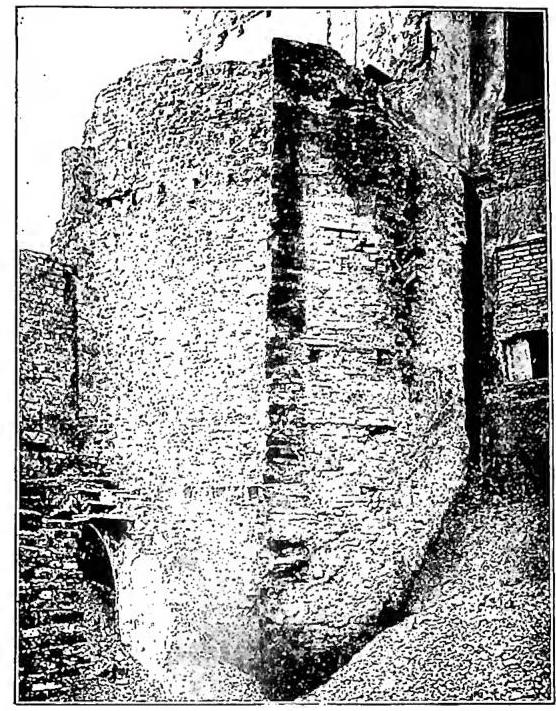
MILANO, ARCIDIOCESI di — Roman tower of the Carrobbio.
of Christianity into M., one can only conjecture that in a place such as M., which became more important year by year, the new faith must, from the first century A.D. onward, have spread rapidly, especially in the silence of the humble, through the work of unknown missionaries, and that the episcopal see was established.
The Milanese martyrology, which may be recognized as authentic, is represented by ss. Vittore, Naborre and Felice, PRIMASIO (v.), Nazario and Celso; concerning whom legend exercised its ingenuity.
Various legends concerning s. Calimero, bishop, describe him as of Greek or Roman origin and have him die a martyr in the place where his basilica arose, drowned in a well. Furthermore, other Passiones connect with M. saints who were not Milanese, for example, s. Alessandro, s. Fedele, s. Carpoforo, s. Exanto, and ss. Fermo and Rustico. The first bishops, s. Anatalone or Anatolio, s. Caio, s. Castriziano, and then, in addition to s. Calimero, s. Mona down to s. Mirocle, are presented as confessors of the faith; they succeeded one another until the time of Constantine, alongside an Aurelio Diogene and a Valeria Felicissima, whose funerary inscription, discovered in 1786 and subsequently lost (CIL, V, 6186) near the cemetery ad martyres, states that they were a Domino coronati e beati confessores, comites martyrorum.
In 313, when the emperors Constantine and Licinius met at M. to establish the directives of their policy, they confirmed there Galerius’s Eastern edict of 311, favorable to the recognition of Christianity; the new recognition, however, not proclaimed in a specific document, took its name from a supposed edict of M. From that time, during the fourth century, M. became an important center for the development of Western Christianity, not without conflicts both with paganism and with heresies, especially the Arian heresy. Around the middle of the century, the latter enjoyed the protection of Constantius II and Justina, who made themselves guardians of Arian bishops, until Aurelio Ambrogio, having become bishop in 373, effectively fought the heresy through a series of providential circumstances and, rising as a vigorous supporter of the Roman Church, succeeded in dominating imperial policy itself in the West. He maintained very close relations with Graziano, Valen-
tiano II, and Teodosio and exercised considerable and frequent influence on their decisions, not only religious but also political.
When the Carolingian Empire disintegrated in 887, only the archbishop of M., as bishop-count, represented the Italian tradition, which would be confirmed by Conrad II the Salian in 1026, when, upon receiving the crown of Italy in the Basilica of St. Ambrose, he granted Bishop
(courtesy of Prof. A. Calderini)
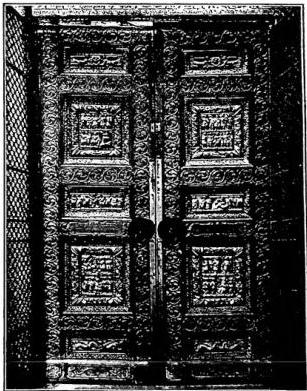
MILANO, ARCIDIOCESI di — Wooden door of the Basilica of St. Ambrose (fifth century) — Milan.
Aribert of Intimiano (v. 1018–45) the title of imperial vicar. Civic life then developed around the bishop, among the captains and major feudal lords and the merchants, who conducted their trade through the Ticino valleys, the temporal domain of the bishops themselves. Once again M. was at the centre of Lombard life, but the temporal authority of the bishops within the feudal order provoked against Aribert the rebellion of the lesser vassals, whose fiefs were not hereditary. After defeating the major feudal lords and the count-bishop at Campomalo, Conrad II the Salian intervened: by the constitutio de feudis of 1037 he granted the lesser feudal lords the right of inheritance as well, had Aribert arrested, and besieged M. But the people rebelled, joining forces with Aribert, who had fled from Piacenza to M.; and it seems that Aribert himself then conceived the Carroccio, drawn by oxen and bearing the Cross with the image of the Redeemer, in order to rally the Milanese people around him, at the sound of the martinella, to defend their freedom. The Emperor withdrew, but not long afterward, in 1042, the wealthy merchants, under the leadership of the judge Lanzone, expelled the nobles and laid the first foundations of the Commune of M. This took shape at the end of the eleventh century through an agreement between the nobility and the bourgeoisie, which allied itself with the so-called pataria to combat the immoral and simoniacal clergy. Among the Arialdo (v.); Anselm of Baggio and Landulf Cotta, canons of the Duomo, stood with him, while Bishop Guido was in opposition. Meanwhile, the civil struggle over the conduct of the clergy grew more acute. St. Peter Damian intervened to restore peace, and Anselm of Baggio, who became pope in 1061 under the name Alexander II, strengthened the patarini party with his new authority. Excommunication was imposed on Guido; the knight Erlembald, brother of Landulf Cotta, intervened; then came the arrest and killing of St. Arialdo; and finally, after further events in which the Milanese episcopate was deeply implicated and in which the Pope’s clarifying and pacifying authority intervened several times, Erlembald was killed (1075). Thereafter, little by little, tranquility returned among the parties in M.
The Commune then developed under the protection of the archbishop’s power and was governed by consuls; then, in order to safeguard its interests, it began its struggle against other Communes—Lodi, Como, Cremona, and Pavia—despite the preaching of Bernard of Clairvaux and of the monks of the Abbeys of Clairvaux and Morimondo, founded by him during his long stay in Milan.
Meanwhile, M. swarmed with Cathar and Waldensian heretics, against whom the Dominicans, established in the convent of St. Eustorgius, now fought; the Order of the Humiliati was also formed, engaging in the wool trade as well as in religious occupations, and the Cistercians likewise took up the reclamation of the countryside around the city. Frederick II defeated M. and the Communes at Cortenova, but was later defeated by the Second Lombard League. The struggles between Ghibellines and Guelphs then also broke out in M.: the nobles, protected by Archbishop Leone da Perago, a great persecutor of heretics as well, sided with the former, while the people sided with the Guelphs and in 1240 chose Pagano Della Torre as their leader. Finally, when the internal struggles of the city were rekindled and became entangled with external struggles involving the parties of neighboring cities, Pope Urban IV appointed Ottone Visconti archbishop of M. (1262). Thus began the rivalry between the Torriani and the Visconti, which in 1310, when Matteo Visconti entered the city as imperial vicar in the entourage of Henry VII, was resolved in favor of the Visconti. As Ghibellines, they incurred the excommunication of John XXII in 1321, while an interdict was proclaimed against M.; at Vaprio in 1322 they defeated the Guelphs allied against the city. The lords of the Visconti family therefore succeeded one another in M. until
1447, and during their rule the Visconti state expanded its territory and its trade. Nor did the Milanese episcopate any longer oppose them; among its bishops was Giovanni Visconti (1342). In 1395 the Emperor Wenceslaus granted Gian Galeazzo Visconti the title of duke; finally, in 1450, after the brief interlude of the Ambrosian Republic (1447–50), Francesco Sforza assumed the lordship. An able politician and at the same time a patron of the arts and letters, he transmitted it to his successors, among whom Ludovico il Moro (1499–1508) brought Leonardo da Vinci and Donato Bramante to M.
IV. FOREIGN DOMINATION AND THE RISORGIMENTO
In 1490, following the struggle waged against the Sforza by the King of France, Luigi XII, the French entered M.; after a brief interlude and following the victory at Marignano (1515), they settled there until 1521, when Carlo V proclaimed the last of the Sforza, Francesco II, Duke of M., and upon his death annexed the Duchy to the Empire. Spanish rule was then established in M., represented by a governor with almost absolute authority over the nobility, clergy, and people, in an environment such as that described in I Promessi Sposi: an atmosphere of despotism combined with indifference to the interests of the citizens, in which, by contrast, the figures of the two cardinal archbishops Borromeo shone forth. s. CARLOW (v.), concerned to apply the reforms of the Council of Trent, sought in the diocese to preserve independence from all lay interference in episcopal jurisdiction, reformed discipline, revived churches and convents and built new ones, and undertook the restoration of the Ambrosian rite and of the dignity and decorum of worship. Federico, in addition to devoting himself to the terrible plague of 1630, demonstrated an exceptional love of culture, founding, among other institutions, the Biblioteca Ambrosiana (1609) and the Pinacoteca (1621).With the Treaty of Rastadt (1714), Lombardy and M. passed to the Austrian Crown, which occupied M. in 1736, implementing under Maria Teresa and Giuseppe II characteristic economic and juridical reforms. This was the period when, after the Jesuits had been expelled from the city, the Società Patriottica was established at Brera (1778) to promote culture; under Giuseppe II, an intrusion into the religious sphere began, leading, among other things, to the suppression of numerous churches and convents and to the secularization of education. It was also the period in which the abbot Giuseppe Parini scourged the world of privilege and the corruption of the Milanese nobility and wealthy classes (Il giorno, 1763).
On 15 May 1796 the French entered M. with Napoleone, unleashing revolutionary frenzy in the city, while French soldiers plundered churches, museums, and public treasuries. M. first became the capital of the Cisalpine Republic and then of the Italian Kingdom, and witnessed Napoleone’s coronation as king in the Duomo (1805), while persecution of the religious Orders intensified. After a brief period of renewed prosperity, the people’s distress increased, culminating in 1814 in the killing of the minister Prina by an enraged mob. Shortly thereafter M. became part of the Kingdom of Lombardy–Venetia within the Austrian Empire, suffering abuses, oppression, and worsening economic conditions, while the patriotic program for revolution was being carried out, associated with the names of Giovanni Berchet, Silvio Pellico, Carlo Cattaneo, Cesare Correnti, and Federico Confalonieri. It was the period of Tommaso Grossi, Alessandro Manzoni, Massimo d’Azeglio, and Antonio Rosmini, and finally of Giuseppe Verdi. The consequence was the Five Days (18–22 March 1848) and, a decade later, the entry into M. (8 June 1859) of Vittorio Emanuele II and Napoleone III.
From then on, M. was at the forefront of the country’s political Risorgimento and economic consolidation, despite alternating fortunes and misfortunes.
V. ARTE
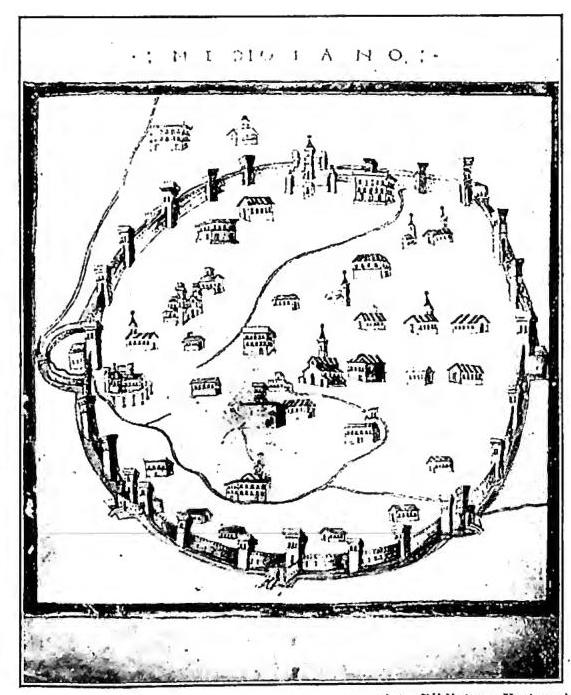
M., built in successive rings of walls and buildings extending ever farther around the center formed by Piazza S. Sepolcro and the nearby Piazza Mercanti and Piazza del Duomo, is rich in memories and monuments from every period, especially those dating from after Barbarossa’s destruction of 1762.For the Roman period, traces remain of the theater, circus, arena, walls, and certain other buildings; the Columns of S. Lorenzo, perhaps taken from a pagan temple, and part of the towers of the Monastero Maggiore are, for now, the only elements of such constructions visible from the outside.
For the early Christian period, the most distinguished monuments, and those best preserved through their successive reconstructions and adaptations, are the Basilica of S. Lorenzo, perhaps dating from the 4th century, with important mosaics; the Basilica of the Apostles, now S. Nazaro; the Ambrosian Basilica, where s. Ambrogio is buried; and the Basilica of S. Simpliciano, conceived and partly built by s. Ambrogio. Also worthy of note in the present Basilica of S. Ambrogio is the ancient chapel of S. Vittore in ciel d’oro, and in that of S. Simpliciano the still-preserved exterior masonry dating from the end of the 4th century.
Of medieval M., the surviving Piazza dei Mercanti had at its center the Broletto Nuovo, or Palazzo della Ragione, built in the 13th century; the church of S. Vincenzo in prato and the Basilica of S. Eustorgio, which now has the appearance acquired in the 8th–9th centuries, with important additions from the 15th century (the Portinari Chapel); the churches of S. Eufemia, S. Celso, and S. Calimero; the Basilica of S. Satiro; and that of S. Babila. The Abbey of Chiaravalle, on the southern boundary of the present city, was founded by s. Bernardo and his monks in the 12th century, while the church of S. Maria la Rossa, dating from the 10th century, lies in the suburbs in the direction of Pavia.
In Visconti-Sforza M., the work of Giovanni Averulino, known as il Filarete, and of Guiniferte Solari developed: the former was the first exponent of early Renaissance Tuscan art, the latter of the style known as Lombard Gothic. Leonardo da Vinci and Bramante worked in M. under the Sforza. In the Visconti-Sforza city there were not only the new walls of Azzone Visconti, of which the pusterla of S. Ambrogio and Porta Nuova remain, but also the Navigli, begun in the 13th century and completed in the 15th (Naviglio grande, di Pavia, della Martesana, and interno). The Ospedale Maggiore, “la Cà Granda,” founded by Francesco Sforza, was severely damaged by the war.
Important are the church of S. Gottardo al Palazzo; the Casa dei Borromeo, now almost entirely destroyed by bombing; the Monastero Maggiore, of which the church of S. Maurizio survives, with distinguished paintings by Bernardino Luini; the cloisters of S. Ambrogio, now the Università Cattolica; the church of the Grazie, a work by Bramante, beside Leonardo’s celebrated Cena; the Castello, begun in 1568; and other suburban buildings, such as the Bicocca degli Arcimboldi, Villa Mirabello, and S. Cristoforo sul Naviglio.
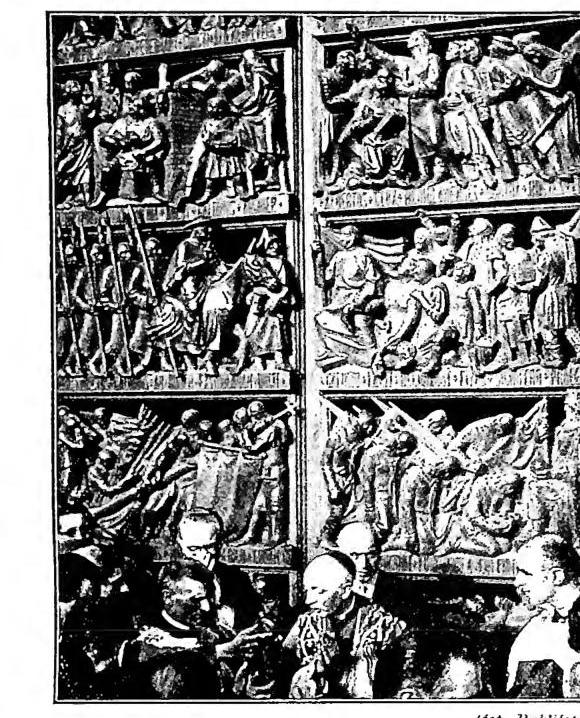
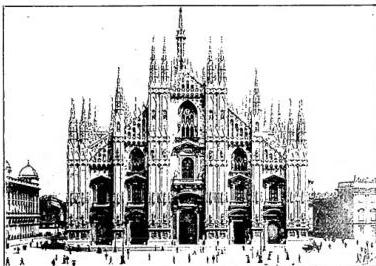
The most distinguished and characteristic monument of M., whose construction began in 1386 under Gian Galeazzo Visconti at the initiative of Archbishop Antonio da Saluzzo, is the Duomo, dedicated to Maria Nascente. It is the largest and most complex example of Gothic architecture in Italy, laboriously built over centuries of work and completed only in Napoleon’s time, with a façade that is not entirely harmonious, while the bronze doors are being installed only in our own day. The entire structure is made of Candoglia marble (Lake Maggiore) and decorated with 3150 statues, most of them on the exterior; the principal spire is 108.50 m high and bears the celebrated “Madonnina”; the interior is rich in works of art, with large stained-glass windows, and contains an important and valuable treasury. Beneath the high altar is the “scurolo,” where s. Carlo is buried.
During the Spanish dominion, as regards monuments, Gaetano Alessi, Vincenzo Seregni, Pellegrino Tibaldi, known as il Pellegrino, Mangone, and Richini were active in M.; Procaccini, Cerano, Morazzone, Crespi, and others gave the city distinguished paintings. A new and more extensive ring of walls is due to Ferrante Gonzaga, governor between 1549 and 1561, the one still called the bastioni. Dating from this period are the lazaretto, the Palazzo del Senato, now the Archivio di Stato, the present Palazzo arcivescovile, the churches of S. Maria della Passione, S. Stefano, S. Antonio abate, S. Paolo e Barnaba, S. Maria presso S. Celso, S. Alessandro, S. Sebastiano, the present church of S. Vittore al corpo, S. Raffaele, and S. Marco; then the Rotonda dell’Ospedale, the palazzi Belgioioso, Marino, and di Brera, the Biblioteca Ambrosiana, and, outside the city, the Simonetta and the Certosa di Caregnano.
During the Austrian dominion, characteristic noble palaces arose, such as the Palazzo Reale; the Palazzi Trivulzio, Serbelloni, Sormani-Andreani, Cusani, Dugnani, Clerici, Crivelli, and Arese-Litta; the Villa Reale; and above all the Teatro della Scala, a work by Piermarini (1779) built on the site of the former church of S. Maria della Scala.
From Napoleonic M. come the Arena and the Arco della Pace; from the period of the Risorgimento, besides certain houses, such as Manzoni’s, the Palazzo Melzi, that of the Borromeo d’Adda, the Palazzo Saporiti, the votive temple to S. Carlo, the modest monument to Leonardo, and the Giardini pubblici. More recently, Piazza del Duomo was redeveloped through the construction of the Galleria Vittorio Emanuele, the arcaded buildings on the northern and southern sides, the equestrian monument to Vittorio Emanuele II, and the monument to the Cinque giornate. The district of Via Dante was then built, with the Foro Bonaparte, and the Castello and subsequently the Parco were redeveloped. The district of Piazza degli Affari, Piazza Diaz, and the Missori district were also established, as were Corso del Littorio, now Matteotti; Via dei Giardini; the district of Piazza Fiume, now Piazza della Repubblica; and, in Piazza S. Ambrogio, the monument to the fallen. Three other buildings stood out for their grandeur, if not always for their artistic merit: the central railway station, the Palazzo di Giustizia, and the new Ospedale del Perdono at Niguarda. A myriad of new constructions, following the destruction caused by the war, have altered, and not always beautified, the city; thus, in many areas, the face of old M. has been irreparably lost.
The city also preserves outstanding artistic works from every century in the great Pinacoteca di Brera, the Ambrosiana, the Museo del Castello, the Poldi Pezzoli, and other smaller collections. The new Museo archeologico, in the cloister of the Monastero Maggiore, and the Museo della Tecnica, which will be housed in the cloister of S. Vittore al corpo, are under construction and preparation. — Vedi tavv. LXIII-LXV.