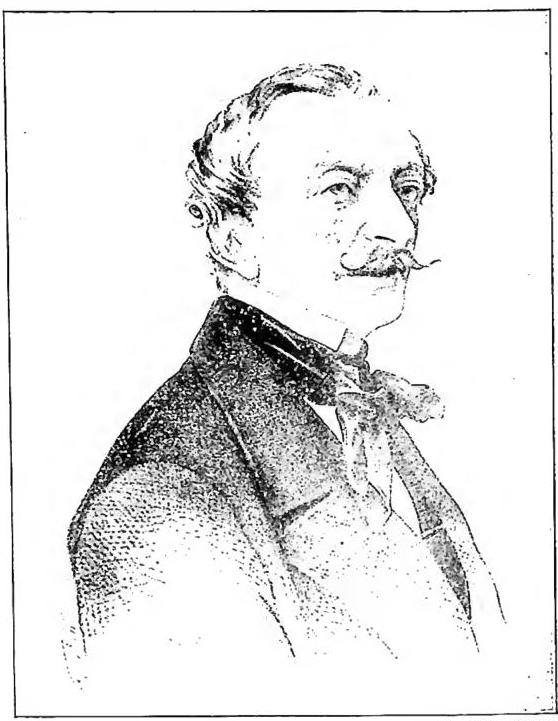
AZEGLIO, MASSIMO TAPARELLI D'

AZEGLIO, MASSIMO TAPARELLI d'. — Statesman and man of letters, born in Turin on 24 Oct. 1798, fourth child of Cesare and Cristina Morozzo di Bianzè, died on 15 Jan. 1866. Of brilliant and independent character, he received a careful and strict family education and soon felt the sharp contrast between the closed, traditionalist environment of the Restoration and the new spirit and ideals of the century. His decision to go to Rome to devote himself to painting and to earn his living by his own work tore him away from the closed Piedmontese environment and helped to make him an Italian. During his Roman period, in fact, d’Azeglio matured into the Italian and the new man, which made him hostile to conspiracies and uprisings and kept him far removed, unlike his brother Roberto, from the Piedmontese revolution of 1821. Yet he did not escape the fascination of the national idea, and he soon began to think of Italy in terms of moderate liberalism.

Painting, though it brought him praise and remuneration, was not enough: from patriotic canvases such as *La disfida di Barletta* and *La battaglia di Legnano*, there arose in him the desire to engage in some other work for the benefit of his country and to “electrify the characters” of Italians. And from the richly coloured canvases and the “stilted” prose of *La Sagra di S. Michele* (drawn and described, Turin 1829), after various attempts at poetry and drama had failed, he turned impetuously, under the evident influence of Manzoni (whose daughter Giulia he married in 1831) and of the Milanese milieu, to *Ettore Fieramosca o la disfida di Barletta* (1833), a novel rich in compelling patriotism that immediately placed its author in the forefront and won the volume true acclaim, even from Mazzini. It was followed, in the same spirit, by *Niccolò de’ Lapi, ovvero i Palleschi e i Piagnoni* (1841), broader in scope and conducted with more thorough research but less successful, and by *La Lega Lombarda*, left unfinished at chap. 8 in 1845 and published posthumously in 1871. As painting had already proved insufficient, so now literature seemed inadequate to him: in him, who had spurred his cousin Balbo to outline *Le Speranze d’Italia*, there arose the desire for more direct action.

Article illustration

Not compromised with sects or movements, he threw himself into a political journey through the Marches, Romagna and Tuscany, and completed it by combating the ideas of uprisings and conspiracies, invoking concord and discipline and, despite the distrust of many, championing the name of Charles Albert (Sept. 1845), with whom, on 12 Oct., he was to have a dramatic, decisive interview in Turin. From the journey and the anticipated failure of the Rimini rising there came into being one of the best-known pamphlets of the Risorgimento, *Degli ultimi casi di Romagna* (March 1846), in which, faithful to his own concept—as he would say six years later—that “the lightning conductors of revolutions are opportune, serious reforms and good liberal laws,” he disapproved both of revolutionary pretensions and of certain deficiencies in government and, convinced that the premise of the national question could not be found outside certain ethical principles equal “for the great as for the small, for the strong as for the weak, for rulers as for the ruled,” he urged Italians to abandon conspiracies in favour of open agreement. The resonance of this work was great, and its fundamental theme, one of the cornerstones of d’Azeglio’s thought, recurred frequently in his writings and speeches, such as that of 12 Feb. 1851: “I believe that there are not two different codes of morality, one for rulers and one for the ruled; I do not believe that raison d’état is a dispensation from common morality.”

D’Azeglio suddenly became one of the most influential leaders of liberal and patriotic opinion, which believed it had found in Pius IX the sign and motive of its faith. The subsequent *Proposta di un programma per l’opinione nazionale* (1847), a “magna carta” of Italian reformism, always based on the concepts of civic education, reaffirmed his ideas, which were given a more decided national stamp by the Austrian occupation of Ferrara. The bloody Milanese incidents of the following January inspired in him a fiery indictment, *I lutti di Lombardia* (1848), which pointed to Austria as the enemy and sounded the clarion call to war, in which he took part with the papal troops of Durando. Wounded on 10 June at Vicenza, he entered into polemics against democrats and republicans, whom he accused of being solely responsible for the defeat. And in *Tinori e speranze* (1848) he reaffirmed another of his fundamental concepts: “the most important political education of any people is that which teaches respect for the law. Without this respect one may change the form of government, find new orders, perfect constitutions as one wishes; all will be in vain: one will achieve only disorder and anarchy.”

Averse to power, he accepted the ministry (7 May 1849–Nov. 1852) only after Novara and the advent of Victor Emmanuel II, out of a sense of patriotic duty. A difficult task it was to govern Piedmont after the defeat and in the ferment of passions. Once again his programme was: order within the law, “neither absolutism, nor republic, and much less anarchy.” And with this concept he negotiated the difficult peace with Austria (Aug. 1849), resisting with dignified firmness its demands and obtaining honourable terms; he concluded useful agreements with France and England, maintained the Statute, welcomed exiles from every part of Italy, and initiated reforms.

Facing a Chamber that refused to accept the peace, painful but inevitable, he did not hesitate to resort to dissolution, and the country understood the warning that sprang from the “Proclama di Moncalieri,” made the king sign it (20 Nov. 1849). In his relations with Rome (Siccardi Laws, 1850), d’Azeglio, driven by the concern to modernize legislation and to liquidate the past in accordance with current ideas, came fatally to infringe the rights of the Church and to diminish the authority of the papacy, thus irreparably inflaming that religious conflict which, above all through misunderstanding, was to divide Italy so painfully for a long time into two opposing camps. The support he received in the parliamentary struggle from Cavour secured Cavour’s entry into the ministry, but prepared the fall of d’Azeglio, who, lazy by nature and too little flexible and quick, was overwhelmed after the crisis of the connubio (21 May 1852) by what he called jokingly “the impious rival,” dynamic, bold and unscrupulous.

Excluded for ever from active politics, he returned to private life and art; but he was occasionally entrusted with missions and was always ready to support his successor with direct interventions before the sovereign, with speeches, with writings (as for the law on civil marriage, for the sequestration of ecclesiastical property and for the Crimean expedition), or by accompanying the king and Cavour to Paris and London (Nov. 1855). But by now the man who could claim political consistency from *Degli ultimi casi* to the most recent manifestations appeared outdated, and his legalism and moralism, which would lead him to refuse to represent Piedmont at the Congress of Paris (1856), confined him to his Cannero in a posture of opposition, while, among his paintings and devoted friends, he began in *Bozzetti della vita italiana* (1858) to evoke part of his picturesque adventurous life. From this retirement he emerged on the eve of the war of 1859 to go to Paris and London to assist in Cavour’s policy. Yet he was never completely convinced by it, distrustful as he was of what seemed to him the unscrupulousness of its methods.

For a brief period commissioner of the government in Bologna (1859) and governor of Milan (1860), his restless puritanism made him suspicious even of the Expedition of the Thousand, fearing that Mazzini might benefit from II. A similar sentiment led him to protest (Il misfatto di Parma, Oct. 1859) against the murder of Auriti, a crime he deemed « a grave betrayal of Italy », whose reputation, honour and independence he feared compromised, and which made him desire a regular trial against Garibaldi after Aspromonte. Though still beloved and esteemed, the consensus of the more active and doctrinaire liberals began to abandon him, especially as he hardened his stance on some of the most heated issues of the day. In La politique et le droit chrétien (Dec. 1859) he advocated Rome as a free city, a first step that led him to deny Rome as capital (Questioni urgenti, 1861) and to advocate as the definitive solution to the Roman Question the provisional arrangement of the September Convention. The letter Agli elettori (1865) was another sign of his going against the current, of his prioritising civic education over immediate action. And to this end he also dedicated his Miei ricordi (1863–65), because « Italy’s first need is to form Italians endowed with strong and noble characters ». His death (1866) cut short the work with which he had hoped to contribute to the making, after Italy, of Italians.

BIBL.: Principal source, up to 1846: I miei ricordi, 2 vols., Florence 1867; many subsequent editions, especially school editions, some with unpublished pages such as the Florence 1920 edition, occasionally revised by editors; cf. A. M. Ghisalberti, Come sono nati « i miei ricordi », in Rass. stor. d. Risorg., 34 (1947), fasc. III–IV. More useful than any biography is the autobiographical epistolary collection, rich, vivid and colourful, though published sporadically without a coherent plan and subject to precautionary mutilations or alterations; cf. A. M. Ghisalberti, Un epistolario da raccogliersi, in Rass. stor. d. Risorg., 33 (1943), fasc. III. His literary and political writings, apart from the two completed novels, were published by his son-in-law M. Ricci in a text not always genuine. Posthumous works by M. d’A.: Scritti postumi di M. d’A., Florence 1871, edited by M. Tabarrini, Scritti politici e letterari, 2 vols., 1872, and more recently by M. De Rubris, to whom we owe many other essays on d’A., in Scritti e discorsi politici di M. d’A., 3 vols., Florence 1931–38. The most effective biographer is N. Vaccaluzzo, M. d’A., Rome 1925; more recent is A. Pompeati, D’A., Milan 1946. A noteworthy collection of documents is held in the Museo Centrale del Risorgimento in Rome; cf. E. Morelli, La raccolta aziendale, in Rass. stor. d. Risorg., 26 (1939), fasc. III. See also, for the author’s ecclesiastical policy, P. Pirri, Pio IX e Vittorio Emanuele II dal loro carteggio privato, I, Rome 1944.