
INGHILTERRA. – A region which, together with Scotland and Wales, constitutes the island of Great Britain, and a place-name used in a general sense as its synonym. Here both the island (Great Britain) and the United Kingdom are considered; the latter is formed, together with the former, by the north-eastern portion of neighboring Ireland (the so-called «Northern Ireland»), along with the smaller islands (Anglesey, Wight) and archipelagos (Shetland, Orkney, Hebrides, Scottish Islands).
SUMMARY:
I. Geography
II. Civil history
III. Ecclesiastical history
IV. Literature
V. Archaeology and art
VI. Educational system.#### I. GEOGRAFIA.
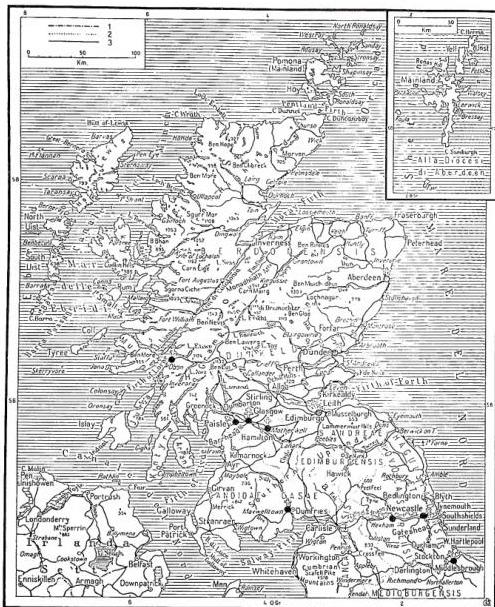
INGHILTERRA - 1) State boundaries; 2) boundaries of ecclesiastical jurisdictions; 3) railways.
Britain, appears less mountainous than Scotland, where long and relatively high mountain summits (Ben Nevis, 1,343 m, in the Grampians) are separated by deep valleys (Glenmore). In England, by contrast, while the northwestern sector gives way to numerous but short mountain ranges (Pennines, Cambrians), in the southeastern sector plains (love lands) predominate, bounded by modest hill ridges (hills, downs), which along the English Channel rise into the white limestone escarpments to which the island owes the classical name of Albion. The two sectors are delimited by a line running from the mouth of the Exe (on the English Channel), along the Severn and the plain of York, to the mouth of the Tees on the North Sea. The characteristic abundance of mineral deposits (especially iron and coal) is related to the prevailing nature of the relief, consisting of very ancient, eroded uplands.
The climate is typically maritime and temperate, with cool summers, mild winters, and moderate temperature ranges. Abundant humidity in every season results in frequent and heavy precipitation (little snow), an almost constantly overcast sky (fewer than 40 clear days a year, on average), and dense fogs. The rivers, generally short, have a considerable flow and a regular regime and constitute excellent waterways, extended and linked by numerous canals. The landscape stands out for the intense green of its vegetation, well preserved in the plains (meadows) but much damaged in the mountains, where woodland has now been reduced to small residual patches in the higher areas.
| Area in sq. km. | Population (1948 estimate in thousands of inhabitants) | Density per sq. km. | |
|---|---|---|---|
| England | 131,748 | 43,380 | 286 |
| Wales | 19,335 | ||
| Scotland | 78,740 | 5,160 | 65 |
| Northern Ireland | 13,566 | 1,348 | 100 |
| United Kingdom | 243,389 | 49,888 | 206 |
| Isle of Man | 572 | 50 | 87 |
| Channel Islands | 194 | 95 | 49 |
| Totals | 244,155 | 50,023 | 205 |
The population of the United Kingdom (50.5 million inhabitants, of whom 43.5 million are in Great Britain, 5.4 million in Scotland, and 1.4 million in Northern Ireland), having almost doubled in number over the last century, is distributed very unevenly. Four-fifths of it live in urban centers, and while population densities are extremely high in the industrial mining districts and near the ports, the countryside is generally sparsely populated, except in some of the most fertile and productive areas. Overall, the density both of the United Kingdom (208 inhabitants per sq. km.) and of Great Britain (194) is the highest in Europe when compared with regions of equal size. Of the 25 cities with (in 1950) more than 100,000 inhabitants, three each exceed one million inhabitants (London and Birmingham in England, Glasgow in Scotland), four exceed 500,000 (Liverpool, Manchester, Sheffield, and Leeds, all in England), and 48 exceed 100,000 (of which 41 are in England, 3 in Scotland, and 1 in Northern Ireland).
The economy of the United Kingdom is distinctly industrial and commercial in character. While more than two-thirds of the British population are engaged in industry, trade, and transport, only a very modest proportion of it (about 4%) is occupied in agriculture.
Cereals (oats, wheat, barley) and food or industrial crops on the one hand, and livestock products (sheep, cattle, horses; meat and dairy products) on the other, testify to the highly advanced level of activity of British rural workers; but without imports the metropolitan territory could perhaps meet domestic needs for no more than three months a year: from one-third to more than two-thirds of imports, in fact, normally consist of food products. Large estates and large-scale farming predominate on agricultural holdings.
Fishing is of considerable importance, favored both by the extensive possibilities offered by the surrounding seas (herring in the North Sea) and by the activity of the island’s sailors (cod from the Newfoundland Banks); forestry is insignificant.
The enormous development attained in the United Kingdom by extractive industries and, consequently, by manufacturing industries at the beginning of the last century is clearly related to the abundance of the resources possessed by Great Britain in hard coal (estimated at 200 billion tons) and iron ores, as well as to the favorable location of these resources and the ease of transport in what is Europe’s only entirely insular region. The coalfields are grouped around the Pennine Mountains and in Wales; production from 1910 to the present has averaged 200–250 million tons annually, of which approximately one-fifth was exported. As for iron, however, despite the considerable quantity of ore extracted (from 7 to 16 million tons annually), it must be imported from abroad to supply the great heavy-industry complex (concentrated chiefly in Sheffield, Birmingham, and Glasgow), which, after the textile industries (with cotton at the head, localized mainly between Manchester and Liverpool and on the Clyde), forms the basis of the British economy. Mechanical industries have also naturally developed considerably and are spread throughout the country, as have shipbuilding (Clyde), metallurgy (South Wales), aluminum processing, the chemical industries, etc. The postwar period is characterized by the rational modernization of all these activities, increasingly oriented toward the production of mass-consumption goods intended to find a large market domestically.
The requirements arising from such an economic structure are met by an adequate development of commerce, which benefits from an excellent banking organization and, above all, from a merchant fleet that, before the Second World War, was the largest in the world (with its 18.5 million tons of tonnage, it is today surpassed by that of the U.S.A.). The United Kingdom has some of the most heavily frequented ports in Europe (London, Liverpool, Burkenhead, Manchester, Glasgow, Cardiff, Newcastle, Hull, etc.), an excellent railway network (32,800 km.), and an air infrastructure ensuring rapid connections with every part of the world. Finally, it should be borne in mind that the United Kingdom forms the center of one of the most extensive and populous political complexes on Earth, the British Commonwealth, distributed as follows:
| Area in millions of sq. km. | Population in millions of inhabitants | |
|---|---|---|
| Africa | 9.7 | 77.1 |
| Asia | 0.5 | 16.7 |
| America | 10.2 | 16.1 |
| Australia | 8.5 | 10.9 |
| Total | 28.9 | 120.8 |
The United Kingdom is a constitutional hereditary monarchy, governed by a democratic government with bicameral representation (the House of Lords, partly elective, and the House of Commons). Northern Ireland (with its own Parliament and autonomous government), the Isle of Man (572 sq. km. and 51,000 inhabitants), and the Channel Islands (194 sq. km., 95,000 inhabitants) likewise have their own institutions. In Europe, Gibraltar and Malta (321 sq. km. with 280,000 inhabitants) depend on the United Kingdom. The capital of the United Kingdom is London, whose metropolitan district has 8.3 million inhabitants, of whom 3.3 million constitute the so-called County of London, the remainder belonging to the Outer Ring.
II. CIVIL HISTORY.
I. MEDIEVAL HISTORY
The abandonment of the island by the Romans marked the beginning of the Teutonic invasions (Jutes, Angles, and Saxons). The Celtic populations withdrew into the western provinces and partly emigrated to Armorica. The Saxon tribes organized themselves into kingdoms: seven (the Heptarchy) in the 7th century, reduced to three in the 8th; and finally they were unified in the 9th century under the supremacy of Wessex. But already in the second half of the 8th century the invasions of the Danes had begun. The Saxon king Alfred halted their advance, leaving them the north-eastern territories but compelling them to recognize the sovereignty of Wessex. At the beginning of the 11th century other Danish invaders penetrated the island, and the conquest was completed by Canute (1016–35). After his death the throne returned to the Saxons with Edward the Confessor (1042–66), who, having been educated in Normandy, filled the higher ranks with Norman elements. In 1066 the Saxon Harold was elected king, but the duke of Normandy, William, declared him a usurper and, having landed in England, defeated the Saxons at Hastings, where Harold fell on the field. William succeeded in consolidating his conquest: although elements of feudalism had existed before the arrival of the Normans, only then did it become established as a political system; but William knew how to found a strong monarchy, limiting the power of the great feudal lords. On the death of his successor Henry I, the throne, after a period of anarchy, passed to the Angevin house of the Plantagenets with Henry II (1154–80). He further strengthened royal power, increasing the authority of the curia regis and instituting itinerant judges, who in the local courts replaced private justice with the king’s justice. From this system arose the formation of common law, in which the various indigenous customs were fused; and for two centuries and more, the essential theme of English politics was the search for a balance between royal power and the rights of the lay and ecclesiastical aristocracy. In 1215 the barons imposed the Magna Charta on John Lackland, which at that time established only the feudal concept of a limitation on monarchical absolutism, but which foreshadowed broader aspirations, as they appeared with ever greater prominence in subsequent revisions. A first indication of these developments came under Edward I (1272–1307), when representatives of the communities were also summoned who later constituted the House of Commons (the lesser nobility and the bourgeoisie). At that time, however, they were summoned separately, and only to decide on the Crown’s financial demands. During these years the conquest of Wales unified southern England, while from 1314 Scotland declared itself independent.In 1328 Edward III (1327–77), claiming the crown of France, initiated the Hundred Years’ War. Despite their military victories, the English ultimately had to abandon France, where from 1453 they retained only Calais. This failure subsequently had fortunate consequences for England because, forcing it to renounce territorial expansion, it directed the country toward a policy of maritime power; but its immediate effect was the disastrous civil war of the Wars of the Roses, caused by the rivalry between the houses of Lancaster and York. After a grim period of violence and usurpations, Henry Tudor, related to the Lancastrians, married Elizabeth of York, reconciling the factions and beginning a new dynasty.