
GREGORIO I, POPE, called MAGNO, saint, Doctor of the Church. — Born in Rome around 540, he ascended to the papacy on 3 September 590 and died on 12 March 604.
SUMMARY:
I. Before the pontificate
II. Pontiff
III. Writer
IV. Conclusion
V. S. G. in art. — VI. S. G. in folklore.1. BEFORE THE PONTIFICATE
2. The family
There is no doubt that G. belonged to a patrician family, which some have sought to identify with the Anicii; but in one of his letters G. speaks of the hospice of the Anicii without saying anything further on the matter (Reg., IX, 8). If G. was an Anicius, he was so through the Petronii, to whom his ancestors belonged, since in the sixth century there were numerous family connections between the two families (cf. G. B. De Rossi, Inscriptiones christianae urbis Romae septimo saeculo antiquiores, I, Rome 1867, p. 371 ff.). Felix III, pope from 483 to 492, was his great-great-grandfather. Two sisters of his father Gordian, Tarsilla and Emiliana, consecrated themselves to God on the same day (Homil. in Evang., XXXVIII, 15) and were honoured as saints, no less than G.’s mother, Silvia. The images of Gordian, Silvia, and G. as they appeared in the painted decoration of the monastery «ad Clivum Scauri» were minutely described by Giovanni Diacono (ninth century) in S. Gregorii Magni vita (IV, 83-84), thus allowing one to imagine an approximate portrait of the Pontiff and his parents (cf. H. Leclercq, s. V. in DACL, VI, cols. 1764-68). G.’s family possessed a large palace on the Caelian, where the church of S. Gregorio now stands.3. Intellectual formation
G.’s contemporary, s. Gregorio di Tours (Hist. Francorum, X, 1), asserts that, at the time of his papal election, G. was «so well versed in letters, grammar, dialectic, and rhetoric that in the eternal city he was second to none». For a writer such as Gregorio di Tours, who encountered difficulties even with the simplest rules of Latin grammar and admitted that he did not know the cases of nouns or the tenses of verbs, the literary culture of his namesake must certainly have been astonishing; without doubt, he had no competitors in this field, though his excellence was entirely relative. It will suffice to recall that G. himself, even if hyperbolically, declares that he did not know Greek, and in Latin admits that he was unable to avoid barbarisms or always to give nouns the case required by each preposition. His Latin was that of the cultivated Roman society of the period, the Latin of conversation, but not a literary Latin.His biblical culture and knowledge of the Fathers, both very extensive and genuinely profound, date from the period of G.’s monastic life; previously, however, he must have learned the jurisprudence and laws governing the administration of Rome, which were absolutely necessary for the career of a high official, the path to which he had initially been directed.
4. Prefect of Rome
G. recalls in a letter (Reg., IV, 2) the time when, in his capacity as prefect (perhaps praetor) of Rome, he signed a solemn document, namely, the declaration of the bishop of Milan, Lorenzo, by which he accepted, before witnesses, the condemnation of the Three Chapters. Such an office generated no small number of disputes, and at the end of his term the officeholder had to go to Ravenna to render an account. G. himself recalls that very few of his successors escaped without harm. Consequently, he retained this burdensome magistracy solely out of duty, all the more since he felt strongly attracted to the monastic life. Indeed, he declared to Leandro di Siviglia (Reg., V, 53 a) that he had been held back for some time from following this vocation not only by the difficulty he experienced in changing his habits, but also because he felt that he still had to render «service» in the world, despite his repugnance.From his years in administration, however, he retained a keen sense of discipline and of the necessity of order; and, as pope, he would readily remind magistrates and ecclesiastical dignitaries to respect the rule governing their profession and to conduct affairs with the regularity traditional among high Roman officials, which remains for all the best guarantee of justice and the public good.
4. Monastic profession. — At a certain point, his vocation to the religious life prevailed. He renounced honours, settled his affairs, and changed his dress and way of life. Whereas previously, says Gregorio di Tours (Hist. Franc., X, 1), he had been seen in the streets of Rome dressed in a purple toga adorned with gems, he was now seen clothed in the humble monastic habit.
His monastery was his paternal home on the «Clivus Scauri», which he dedicated to the apostle Andrew. He subsequently founded six others on his estates in Sicily. G. did not wish to be abbot of the monastery he had founded; he preferred to practise obedience under the guidance of the abbot Valenzione (Dialog., IV, 21). The Rule adopted was that of s. Benedetto, to whom G. devoted the second book of his Dialogues.
The difficulty he encountered in practising fasting proved disastrous to his health, which suffered from it throughout his life (Reg., V, 53a; Hom. in Evang., II, 22).
5. Apocrisarius in Constantinople. — G. was unable to enjoy the peace of monastic life for long. The position of a regionary deacon had become vacant, and the Pontiff chose G., whose merit and aptitude for affairs were known. It is uncertain whether G.’s ordination took place under Benedetto I (574–78) or at the beginning of the pontificate of Pelagio II (579–90). There is no doubt, however, that Pelagio II sent him as apocrisarius, today one would say nuncio, to Constantinople, to the emperor Tiberio II, in 579.
In the Byzantine capital, G. remained until 585, continuing, insofar as possible, to live in community with several monks who had followed him from Rome. Although he did not speak Greek fluently, he entered into relations with eminent figures in Constantinople, and, once elected pope, maintained these friendships. His acquaintance with the emperor Maurizio, who succeeded Tiberio in 582 and whom G. considered enigmatic, as well as his experience of the Byzantine milieu, proved extremely useful to him in governing the Church. His diplomatic activity in Constantinople did not prevent him from beginning his celebrated exposition of the Book of Job, known as the Moralia, which he had been asked to write by his friend s. Leandro di Siviglia.
Returning to Rome in 585, he resumed monastic life at the «Clivus Scauri», meditating on and commenting upon the Holy Scriptures. But Pelagio II, who knew the man’s worth, did not fail to make use of him in the difficulties of his many affairs; and not a few of the Pontiff’s letters, reports Paolo Diacono (Hist. Langobardorum, III, 30), were the work of G., who served as his secretary.
II. POPE
1. Election. — In October 580, no small number of calamities descended upon Rome which, in conclusion, led, in January 590, to the terrible bubonic plague (Gregory of Tours, Hist. Franc., X, 1; G., Dial., III, 19; Paul the Deacon, Hist. Lang., III, 23; id., Vita Greg., 10; John the Deacon, Vita Greg., I, 34-35). Among the first victims was Pope Pelagius II, who died around 15 January; thereafter the dead could no longer be counted. Paul the Deacon (Vita Greg., 10) states that entire districts of the city were left depopulated.In this state of depression and anguish,
(photo Bibi, Montecassino)
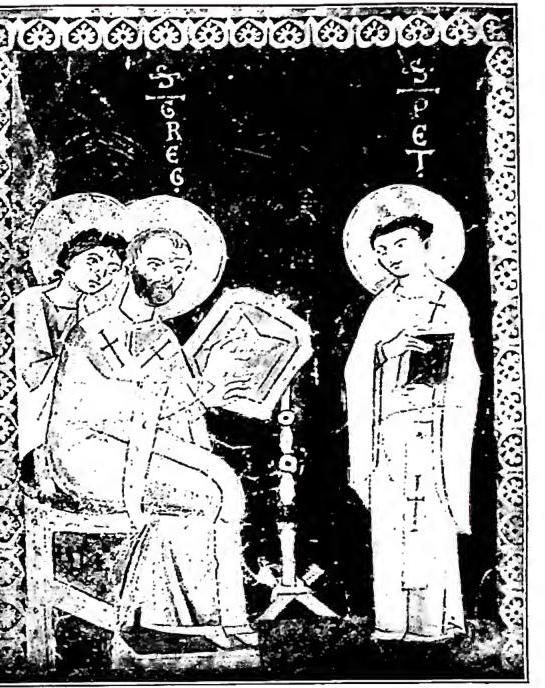
with grave dangers pressing in, it became necessary to provide immediately for the election of the new pope. G. was acclaimed by the entire people, but sought to withdraw from the honor. Even the attempt to petition the Emperor not to confirm the election proved fruitless, since the prefect withheld G.’s letter and sent the petition of the Roman people, asking Maurice to hasten to confirm the designation of his friend. After an unsuccessful attempt to flee, G. was forced to allow himself to be led to S. Peter’s to be consecrated pope. The ceremony took place on 3 October 590 (Lib. Pont., I, p. 312).
2. Pastoral activity: a) in Rome and Italy. — While the imperial confirmation was still awaited, G. left the monastery and immediately set to work organizing relief. He delivered a speech to the people that was at once a cry of anguish and an invitation to hope (John the Deacon, Vita Greg., I, 41); he thus announced for the following day a penitential procession that was to set out from the various churches of Rome toward the Liberian Basilica: the so-called litania septiformis, which was repeated for three consecutive days.
When the plague had ended, Rome was subjected to further calamities: famine, which G. sought to alleviate by urging Justin, praetor of Sicily, to send shipments of grain greater than usual (Reg., I, 2); the danger of Lombard occupation, which remained ever threatening; the garrison, which was in turmoil because it was not being paid (Reg., I, 3); and storms, which uprooted trees and caused houses and churches to collapse (Homil. in Evang., I, 1, 5). Through his letters and homilies, G. encouraged everyone and urged the officials to fulfill their duties exactly.
(fol. Anderson)
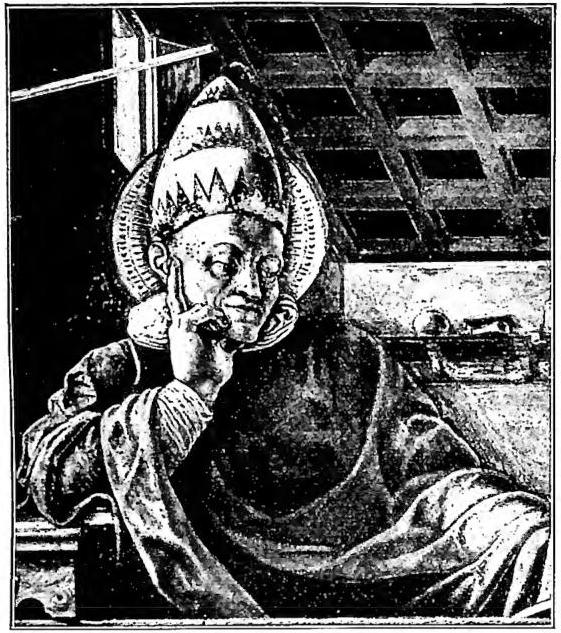
GREGORIO I, PAPA, saint — Painting by Niccolò Pizzolo (ca. 1450) — Padua, church of the Eremitani.
The history of the Church of Naples under G. provides a significant example of such interventions (cf. Reg., III, 15, 58, 60; X, 19; XI, 12, 53; XII, 29). No less resolute were G.’s interventions with the bishops of Amalfi and Taranto. Yet just as G. was determined to require the bishops to fulfill their duties, so was he equally determined to defend their rights: as soon as a “defensor,” entrusted with the patrimony of Sicily, usurped the rights of the bishop, who alone was responsible for guiding his clergy (Reg., XI, 24), or took advantage of the vacancy of the see to compromise the successor’s rights over a monastery in the diocese (Reg., XI, 54), the Pope intervened to prevent abuses that endangered the authority of the episcopate.
Apart from the metropolis of Rome and its territory, Italy was divided into three metropolitan provinces: Milan, Aquileia and Ravenna. For the most part, G., respectful as he was of the rights of others, did not correspond directly with the bishops of these districts, but only with the metropolitans, who were answerable for their suffragans, just as he was for his own. But when the circumstances required action involving individual bishops for the common good of the Church, he did not fail to undertake II. Thus the schism of Aquileia was brought to an end when the metropolitan Severus refused to submit to the Pope’s just admonition (cf. Reg., XII, 13; XIII, 36).
In the province of Milan, G.’s prudence succeeded in overcoming the last resistance to the condemnation of the Three Chapters, due above all to the pressure of Theodelinda,
queen of the Lombards, who, although Catholic, was attached to them at the inspiration of her spiritual director, the monk Secundus (cf. Reg., XIV, 12).
The metropolitans of Ravenna, given the city’s particular situation as the seat of the Byzantine exarch, sometimes seemed genuinely to lose control; consequently, the Pope’s relations with them required special attention, which G. did not fail to exercise. Compelled by his office to make his severity felt, he nevertheless allowed the tenderness of his heart to show through, while always upholding the prestige of the See of Rome (cf. Reg., V, 11, 15; XI, 21; XIII, 30).
b) In Spain. — Among the provinces dependent on the patriarchate of the West, Spain was one of the most peaceful during G.’s pontificate. In 587 the Visigothic king Recared had converted, and in 589 the Third Council of Toledo received official news of the conversion of all the Visigoths. Leander of Seville, who had worked so hard for this conversion, informed the new Pope, who was also his friend. G. expressed his joy in a letter of April 591 (Reg., I, 41). Recared himself then sent G. three abbots to present his homage and gifts, but the sea was so stormy that it prevented them from going beyond Marseille. For his part, G. had sent the priest Probinus to Málaga, and the King invited him to court, although he was unable to go there for reasons of health. There was, however, an exchange of gifts between Recared and G. Through his good offices and with the requisite discretion, G. helped the King ensure that the Byzantines remained on the southeastern coast, along the shoreline. In this territory as well, G. exercised his office as supreme judge in ecclesiastical matters: he intervened with regard to the governor Comitiolus, who had arbitrarily deposed two bishops, sending the “defensor” John to restore order.
c) In Africa. — After Belisarius’s victory over the Vandals, North Africa had passed to the Byzantines and, consequently, the Church had gradually regained its vigor. A sudden revival of Donatism engaged G.’s pastoral activity, and he opposed with all his strength the elimination of the scandals arising from II. After making a fruitless appeal to the civil authorities, he turned to the episcopate alone and, aided by such capable collaborators, obtained what he desired. After 596, no further letter by G. is found that speaks of the Donatists.
d) In France. — Gaul had recently been unified under the Catholic Kingdom of the Franks, but the civil wars that agitated and convulsed the Merovingian Kingdom, and the unheard-of cruelties of its sovereigns and princes, also had a painful effect on the moral and disciplinary condition of the Church. The condition of the Frankish Church, when G. was elected pope, was truly disastrous (cf. Gregory of Tours, Hist. Franc., IV, 12, 43; VII, 20; VIII, 29, 29). At the request of Childebert, king of Austrasia, G. sent the pallium to Virgilius of Arles and appointed him papal vicar of the provinces of Austrasia, Burgundy, and Aquitaine, with authority to resolve questions of lesser importance on his own authority, and more serious ones with the assistance of twelve bishops. Only in extreme cases was he to have recourse to Rome. G. intervened repeatedly and successfully with Queen Brunichilde to put an end to the scandal of simony, the consecration of laymen to the episcopate, and paganizing practices that were still in use, especially in the countryside.
e) In England. — When in 590 G. ascended the papal throne, there was nothing to suggest that England was on the eve of becoming a Christian nation. The invading Angles and Saxons had restored paganism there. The need for the conversion of the Anglo-Saxons arose in G.’s mind as soon as the political conditions of the Frankish Kingdom guaranteed him safe passage for the missionaries he intended to send. In 595 G. ordered the priest Candidus to purchase some young Anglo-Saxon slaves, so that they might be educated in one of the monasteries of Rome; in 596 he attempted the enterprise by sending a group of missionary monks from his monastery «ad Clivum Scauri». In 597, the conversion of King Ethelbert and ten thousand
Anglo-Saxons showed that G.’s plan had fully succeeded (v. saint). G. also outlined the general structure of the Catholic hierarchy in England (Reg., XI, 39), based on the Roman division of the Empire, which, however, St. Augustine of Canterbury, taking account of the current political situation, deemed it wise to modify. G.’s epitaph mentions the conversion of England through his agency (cf. the text in A. Silvagni, Inscriptiones christianae urbis Romae saeculo septimo antiquiores, II, Rome 1935, no. 4156).
f) In the East. — The relations between the Church of Rome and the Churches of the East in G.’s time largely revolve around the vicissitudes of the dispute with the Church of Constantinople, which the Pope’s prudence and perseverance were unable to resolve. At the Council of Constantinople in 587, the patriarch John the Faster, who presided over it, signed the acts with the title of «ecumenical patriarch». Pelagius II refused to recognize as legal this Council, which had assembled without his authorization, and protested against the title of «ecumenical patriarch» assumed by the Faster (cf. Reg., V, 44), in which he rightly saw the very authority of the papacy in the East compromised.
G. waited five years after his election before asking John to renounce the title that did not belong to him. The opportunity was provided by the appeal that two priests from Asia Minor had made to the Holy See (Reg., V, 45). In his letters to the Emperor, the Empress, and the Patriarch (Reg., V, 37, 39, 44) in June 595, he insisted particularly on the proud character of the aforementioned title, «stigmatizing the Faster’s pride in very clear terms» (Reg., V, 37). In the letters sent to the patriarchs of Alexandria and Antioch, which date from the same period, G. retraced the history of the conflict beginning with Pelagius II: he recalled that the Council of Chalcedon had not granted such a title to the Roman pontiffs and urged the patriarchs neither to assume it nor to address him by it in their letters (Reg., V, 41). The Emperor Maurice did nothing to induce the patriarch John to renounce the aforementioned title; indeed, in 597 he made a serious attempt to overcome G.’s intransigence toward the patriarch Cyriacus, who had succeeded John in September 595 (Reg., VII, 30). Cyriacus, who had previously been G.’s friend, retained the detested title. G.’s efforts to resolve the question failed, but the danger he feared ultimately disappeared through the special meaning taken on by the term «ecumenical», which became synonymous with autocephalous.
3. Political action: a) with the Lombards. — On 5 September 590 Autari died, the first of the Lombard kings, whom the dukes had elected to address the danger of their anarchic situation (Paul the Deacon, Hist. Lang., III, 35). Autari had prohibited the baptism of the Lombards according to the Catholic rite. He was succeeded by Agilulf, duke of Turin, who, by marrying the widow, gave rise to great hopes, since Theodelinda, coming from Bavaria, professed not Arianism but Catholicism, and was greatly loved by her people. The present reality, however, offered nothing reassuring, and G. recognized in it the signs heralding the end of the world. He sought in vain to draw the attention of the exarch Romanus and of the Emperor himself to the grave danger. The only action attempted by the exarch was an ill-advised maneuver that induced Agilulf to march on Rome.
Because of the exarch’s indolence, G. undertook negotiations with the Lombard king and, by means of a tribute of 500 pounds of gold, induced Agilulf to withdraw. Paul the Deacon dramatized his account of G.’s meeting with Agilulf so as to make it resemble that of Leo the Great with Attila (Vita Greg., 26); likewise, around 640, the anonymous continuator of Prosper’s Chronicle had gone so far as to assert that G. would not have left Rome to plead with Agilulf, but would have met him on the steps of
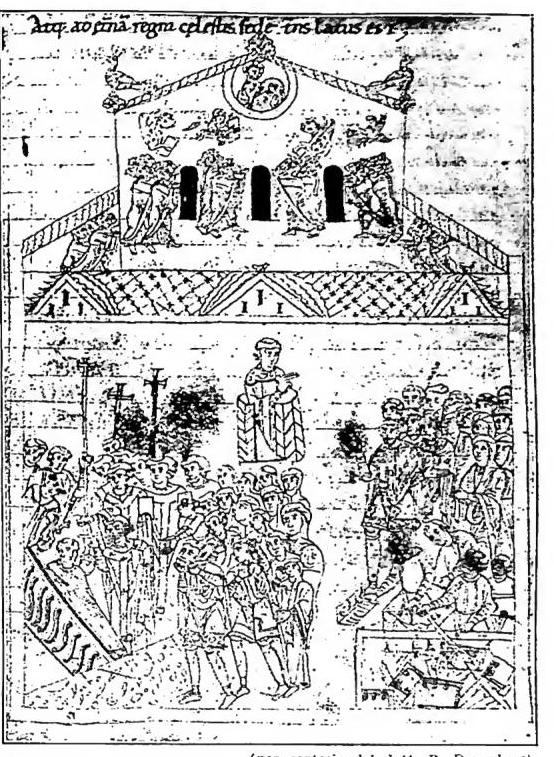
St. Peter (Prosperi auctarii Avicensis novissima, 17). All this, however, serves to reinforce the Gregorian concept of Rome’s protection through the Prince of the Apostles, who acted in the person of his successor (cf. O. Bertolini [V. BIBLICA.], p. 283).
The good relations between the Pope and Queen Theodelinda were frustrated in their peacemaking effects by the obstinacy of the Byzantines, who viewed the Lombard problem differently. In 595 Agilulf was prepared for a general truce with the exarch and, in the absence of such a truce, for another with the Pontiff, but on considerably less advantageous terms. G. informed the imperial representative at Ravenna of this (Reg., V, 34), but without result; indeed, the exarch used it as grounds for accusing the Pope before Constantinople of negotiating separately with the Lombard king. The Emperor had the impudence to rebuke G. with the naiveté of a foolish man, but the Pontiff did not lose his composure: he replied like a man who was deeply wounded, but in no way frightened, steadfast in his patriotism, and confident in his good conscience (Reg., V, 36). The exarch also had an anonymous pamphlet posted in Ravenna in which G.’s work for peace was stigmatized as a crime. The Pope replied with excommunication if the slanderer failed to prove his accusations—an impossible condition, since G. was entirely certain of the justice of his cause (Reg., VII, 42).
The death of the exarch Romanus, which occurred when the Pope had greater reason than ever to complain of the Lombards’ ferocity, brought about a change in the state of affairs.
things. His successor, Callinicus, proved more reasonable and, through the mediation of G., in October 598 the truce was signed which the Pope intended should benefit both peoples, that is, the Lombards and the Romans, and should constitute the foundation of the « Christian republic ».
In this sense the congratulations and thanks expressed by the Pontiff to Agilulf and to Queen Theodelinda are to be understood (Reg., IX, 66-67). G.’s policy had wisely preferred negotiations to the intransigence of the Emperor Maurice, thereby preserving at once the interests of Italy and those of the Church, and drawing the Lombards, still Arians, closer to Catholicism.
The truce of 598 was broken through the imprudence of Callinicus, who took prisoner at Parma the daughter and son-in-law of the Lombard King; but the new Emperor of the East, Phocas, understood that G.’s policy was the only one to be followed in Italy, and accordingly sent the former exarch Smaragdus, a friend of the Pope, to restore the situation. G. made himself guarantor of the thirty-day truce signed in June 603 (Reg., XIII, 36), which could be renewed and which, according to the new agreement, was to last until April 605. A letter written by the Pope in December 603 to Queen Theodelinda (Reg., XIV, 12) asked her to thank the King for the truce granted and expressed G.’s joy at the birth of Prince Adaloald, who received Baptism and was proclaimed king in June 604 (Paul the Deacon, Hist. Lang., IV, 25, 27, 30): he was to be the first Catholic king of the Lombards, but G. was no longer among the living.
b) With the Byzantines. — In his relations with Byzantium, G. always regarded himself as the Emperor’s subordinate, and in his correspondence he did not in the least alter the protocolary formulae of his predecessors. Yet, conscious of his responsibility, he had no fear of opposing the Emperor, even vigorously, whenever the latter infringed upon the authority of the Church and of the Holy See.
He asserted the principle of independence in relation to civil power and resolutely claimed the rights of St Peter, which he repeatedly declared to be founded upon the Holy Gospel (Reg., V, 37; cf. P. Batifol, St Grégoire le Grand, 3ª ed. Parigi 1928, p. 207, note 1). He vigorously opposed anything that might diminish the authority either of the Roman primacy or of the ecumenical primacy; he maintained and extended the right of appeal to the Holy See in all diocesan matters, as well as its right to intervene in the disciplinary affairs of all dioceses.
He held, moreover, that the Emperor had the duty of defending Rome and Italy against the Lombards; but if necessity demanded it, or imperial aid failed to arrive, nothing prevented him from undertaking the defence himself.
Thus G. did not hesitate to voice his remonstrances to the Emperor Maurice when he judged that civil legislation was in conflict with ecclesiastical legislation (cf. Reg., III, 61, 64). He strongly censured Eulogius, Patriarch of Alexandria, for failing to approve the four General Councils and the Tomus ad Flavianum of Leo the Great, for not condemning Eutyches, Dioscorus, and Severus with sufficient clarity, and for failing to define with theological precision the two natures in Christ (cf. O. Bardenhewer, Ungedruckte Exerpte einer Schrift des Patriarchen Eulogius von Alexandrien (580-607) über Trinität und Incarnation, in Theologische Quartalschrift, 78 [1896], pp. 353-401). G. himself, in a letter to the bishop of Syracuse, clearly affirmed that « the Church of Constantinople is subject to the Apostolic See, which the most pious Emperor and our brother, the bishop of the city, never cease to acknowledge » (Reg., IX, 26).
5. Administrative activity
Imperial legislation and the particular conditions produced by the Lombard occupation, the poor government of the Byzantines, and the calamities had gradually imposed upon the bishops of Rome tasks that went beyond the purely religious sphere and entered not only, as has been seen, the political field, but also the administrative and economic spheres. In this field as well, G., despite his profession of complete detachment from earthly affairs, demonstrated that his personal experience in youth and maturity had been truly fruitful.The most substantial part of the administrative and economic activity of the Church of Rome arose from its extensive landed properties, which caused it to be regarded as the largest landowner in Byzantine Italy. The totality of these properties was designated by the name « patrimonium s. Petri », since this affirmed that their owner was the Prince of the Apostles himself.
In G.’s time, the patrimonial groups of the Church of Rome were: the « patrimonium Alpium Cottianum », between the Maritime and Cottian Alps, the Po, the Tuscan-Emilian Apennines, and the sea (John the Deacon, Vita Greg., II, 53); the « patrimonium Ravennate et Histriae » (Reg., XI, 8); the « patrimonium Piceni », between the Adriatic and the Umbrian-Marchigian Apennines (John the Deacon, loc. cit.); the « patrimonium Tusciae », between the Arno, the Tiber, and the Tyrrhenian Sea (Reg., IX, 96); the « patrimonium Sabinum et Carseolanum » (Reg., XIII, 38; III, 21); the « patrimonium Appiae », along the Via Appia and the Via Ostiense (Reg., XIV, 14); the « patrimonium Urbanum », the immovable properties within Rome (John the Deacon, loc. cit.); the « patrimonium Sanniticum » (id., ibid.), which was almost entirely lost with the Lombard occupation; the « patrimonium Apulum », which was seriously damaged (id., ibid.); the « patrimonium Calabrianum » (Reg., IX, 205-206); the « patrimonium Campaniae », which also included properties on the offshore islands (Reg., XIII, 29); and the « patrimonium Lucaniae et Brutiorum » (Reg., IX, 124-27). With the Lombard occupation, one could practically speak only of the « patrimonium Brutiorum », since the Lucanian patrimony had disappeared. The « patrimonium Siciliae », distributed throughout the island (Reg., IX, 29), had instead remained intact; this led G. to facilitate its administration by dividing it into two districts: the « patrimonium Panormitanum » in western Sicily and the « patrimonium Siracusanum » in eastern Sicily (Reg., IX, 38).
There were also the « patrimonium Sardiniae » and the « patrimonium Corsicanum », on the respective islands (John the Deacon, loc. cit.); the « patrimonium Germanicianum », from the city of Germanicia in Numidia (id., ibid.); the « patrimonium Dalmatianum » and the « patrimonium Illyricum », both greatly reduced by the incursions of the Avars and Slavs (Reg., II, 23); and the « patrimonium Galliarum », which was not very extensive (Reg., VI, 6).
Each patrimony constituted a separate administration, managed by a rector appointed by the Pope. For the more important patrimonies, he was usually chosen from among the deacons or subdeacons; for the others, from among the notaries of the Apostolic See and the defenders of the Roman Church. As has been seen, G. granted the rectors such broad powers, including in the spiritual sphere, that they became veritable papal legates.
The rector was assisted by administrative officials known as notarii, chartularii, and defensores, and by other lower-ranking employees known as actionarii.
The link between the rector and the officials of his office on the one hand and the body of rural inhabitants on the other was provided by a class of tenant farmers called conductores: stewards and massarii who managed the agricultural units (condunnae, massae), upon which the elementary units (fundi) depended, together with their respective lesser tenants and agricultural workers in general (coloni, rustici Ecclesiae).
All the various local administrations of the estates reported to Rome, to the central administration of the Church in the Lateran Palace. In G.’s time, the treasury of the central administration was managed by a deacon bearing the title of « dispensator Ecclesiae Romanae ». All revenues and expenditures, the pensiones in silver and gold paid by the tenant farmers and the coloni, were listed in a large register established by Pope Gelasius I, and therefore called the Gelosianum polyptychum (Reg., II, 38; IX, 199; Giovanni Diacono, Vita Greg., II, 24). This entire remarkable organization functioned regularly under G.’s supervision, and the letters in which he issued his directives to the conductores are true models of enlightened administrative wisdom (cf. Reg., I, 39 a, 42; II, 38).
Enormous sums of money and vast quantities of produce flowed into Rome, so that the Holy See could provide not only for the expenses of the Church and of the personnel of the central and provincial offices, but also for the bi-