
ILDEFONSO of TOLEDO, Saint. — Archbishop of Toledo, born in Toledo in 617, died there on 23 January 667. He was called El Capellán de la Virgen in the comedy of that title composed by Lope de Vega about him, and he earned this nickname from his principal work, De virginitate Sanctae Mariae contra tres infideles, which forms the basis of all Marian literature in Spain.
He was a monk and abbot in the monastery of SS. Cosmas and Damian at Agali, near Toledo, renowned for having provided the Spanish Church with a series of bishops and abbots who stand out in history. Towards the end of 657, an order from King Recceswinth came to remove him from this retreat and elevate him to the metropolitan see of Toledo. His episcopal and literary activity lasted a decade. His successor in the see, St Julian of Toledo, lovingly compiled a catalogue of his works: the first is the one already mentioned, the Libellus de virginitate Sanctae Mariae contra tres infideles, a theological controversy directed especially against the Jews. This is followed by the Liber in cognitione Baptismi unus, of exceptional importance for the history of the catechumenate and the liturgy of Baptism in Spain; the De progressi spiritualis deserti, a complement to the previous work, which sets out the progress of the baptised through the spiritual life to the kingdom of God, using the allegory of the Jewish people wandering in the desert until the promised land; and the De viris illustribus, fourteen biographies devoted to Spanish personalities, and in particular Toledan ones. With this work, he continued the work of St Isidore under the same title; it is
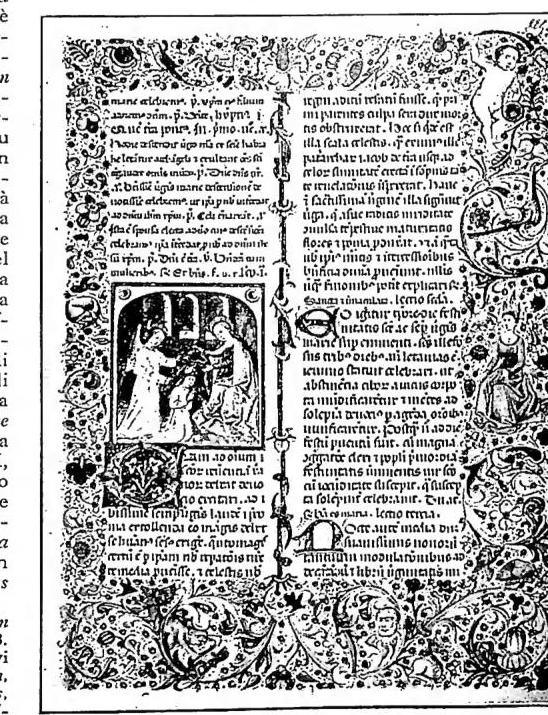
ILDEFONSO OF TOLEDO, Saint — I. of T. vested in pontifical robes by the Virgin assisted by an angel, Spanish Franciscan Breviary (second half of the 15th century) — Paris, Bibliothèque nationale, ms. lat. 1064, f. 285.
important because in several respects it is the only source for the life and ecclesiastical history of Spain. Two letters addressed to Quiricus, bishop of Barcelona, on the occasion of the Libellus de virginitate, are also known.
The theology of Ildefonsus belongs to the traditional patrimony of the great Fathers of the Church, chiefly St Jerome, St Augustine, and St Gregory the Great. Characteristic is the style of synonyms, adopted in the Libellus de virginitate and carried to an extreme: a fervent effusion of overflowing affection. In his other works the exposition is calmer and more balanced.
The Libellus de virginitate was translated into Castilian in the 15th century by Alfonso Martínez of Toledo, archpriest of Talavera.