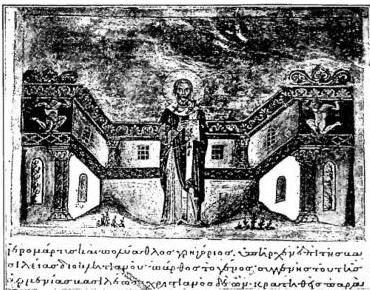
GREGORIO di ELVIRA, saint. – Flourishing in the 4th century, he was a most ardent defender of Nicaea and a bitter opponent of Osio di Cordova on account of the “blasphemy of Sirmium” (357); later a determined partisan of Lucifero di Cagliari, involved in the uncompromising protest against the synodals of Alexandria (362); finally leader of the Luciferians after the death of the bishop of Cagliari (370–71). G. attracted particular attention after the work of P. Batiffol and A. Wilmart reconstructed his important literary corpus.
He is the first known bishop of Elvira (near Granata). A constant defender of the “homousios,” he also became an opponent of Priscillianism. His theology possesses personal and pioneering value in not a few questions.
His works are known: De fide orthodoxa contra Arianos, a powerful defense of the “homousios”; Tractatus de epitalamio, that is, five homilies on the Song of Songs, the oldest Latin commentary in which, for the first time in the West, the nuptials between Christ and the Church are expounded; the so-called Tractatus Origenis de libris S. Scripturae, that is, twenty treatises discovered in 1900 by P. Batiffol and A. Wilmart, which deal with the Old Testament through allegorical exegesis and vivacity of style; De arca Noe, concerning the Church prefigured by it; Expositio in Ps. 92.
G.’s personality looms ever larger in patristics as that of a careful and successful coiner of Trinitarian formulas. He is the first representative of homiletic preaching in the Latin Church; a pioneer in suggestive doctrinal points (such as Christ and the Church, represented by the Song of Songs; the doctrine of the seven capital sins in antithesis to the seven gifts of the Holy Spirit; and the beauty of Christ’s humanity). Important patristic figures such as Apringio di Beja, Isidoro di Siviglia, Beato di Liebana, etc., subsequently drew inspiration from G.