Machine translation of the 1948–1954 Italian original. The original text is authoritative.
BEATO di LIÉBANA. — Born at Liébana in the Asturias, he was tutor and confessor to Queen Adosinda, Benedictine abbot of Valcavado (diocese of León), and died on 19 February 798. He is venerated under the name of St. Biego in Spain. Together with Eterio, bishop of Osma, he opposed adoptionism (v.). The two epistles Contra Elipandum are published, together with a life of him, in PL 96, 890–1030.
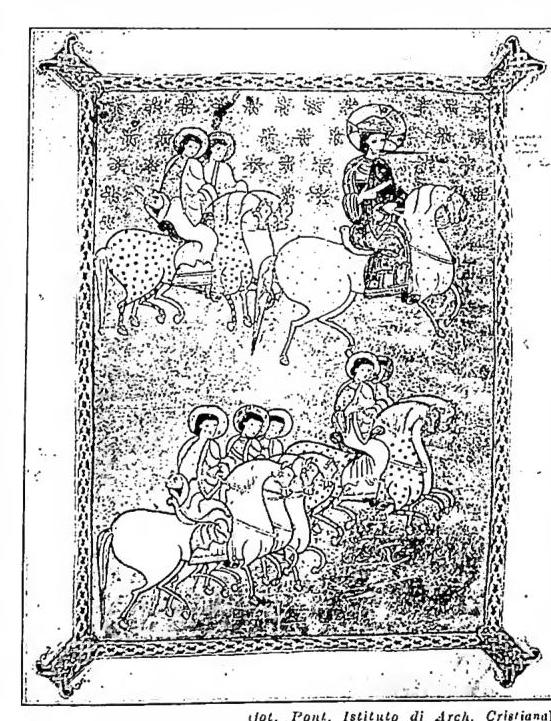
He is known above all for the Commentary on the Apocalypse published by Florez in 1770, in an edition now extremely rare, and republished in 1930 by Henry A. Sanders in vol. VII of the Papers and monographs of the American Academy in Rome. This commentary, very important for the history of the ancient exegesis of the Latins and for the text of the Apocalypse itself, differs from the usual Catenae of patristic citations, because the passages are linked together so ingeniously and harmoniously as to form a single whole without breaks in continuity. B. himself gives the names of nine authors whom he used, but the substance of the work consists of the CommentariesApringius (v.) of Beja, of Tichonius (v.), Afer (v.). B.’s work thus makes it possible to establish, through the transcribed passages, the original text of Victorinus’s commentary and the most important and valuable part of that of the Donatist Tichonius, whose text is lost. B.’s Apocalypse is also important for a map of the terrestrial globe and for its many codices rich in miniatures, which Neuss considered to have derived from a single source of the 5th century from an African milieu; they instead clearly reveal a stylistic affinity with the art of the regions on the two slopes of the Pyrenees in the 10th, 11th, and 12th centuries. Moreover, the architecture adheres to Arab forms and types, while the figures show Celtic and Merovingian influences.
Particularly singular, moreover, is the stylization, and consequently the iconographic consistency, of certain celestial personages (for example, the angels), which contrasts with the realism of other figures. The liveliness of the movement, which connects the representations with Carolingian art, and especially certain bold perspectival compositions, give B.’s codices great importance from the point of view of the history of art.
BIBL.: H. L. Ramsay, Le commentaire de l'Apocalypse par B. de L., in Revue d'histoire et de littérature religieuses, (1902), pp. 419–47; H. A. Sanders, op. cit., 1930. On the manuscripts: H. L. Ramsay, The use of the commentary of B. of L. on the Apocalypse, in Revue des bibliothèques, (1902), pp. 74–104; J. A. Herbert, Illuminated Manuscripts, Londra 1911, pp. 209–11; H. Vogels, Untersuchungen zur Geschichte der lateinischen Apok.-Übersetzungen, Düsseldorf 1920, p. 56 ff.; W. Neuss, Die Apokalypse des hl. Johannes in der altspanischen und altchristlichen Bibelillustration. Das Problem der Beatus-Handschriften, Monaco 1931; A. Ferrua, Le teofanie dell'Apocalisse nell'arte, in La civiltà cattolica, 1938, II, p. 446 ff.; M. Del Alamo, Los Commentarios de B. al Apocalipsis y Elpando, in Miscellanea Mercati, II, Città del Vaticano 1946, pp. 16–33. Noemi Crostarosa Scipioni
Cite this article
“BEATO DI LIÉBANA.” Enciclopedia Cattolica, vol. II (1949), p. 650. Azione Romana digital edition, https://azioneromana.com/article/beato-di-liebana.