
BIBLICAL CATENAE. — A title, neither original nor appropriate, given to commentaries on the Bible composed of excerpts from various authors. The earliest compilers more suitably called them in Greek ἐλλογάς, συναγωγή ἐξέχθασαν, παραγραφαί, and in Latin excerpta or collectanea. This type of writing arose after a period of intense production, when, as though weary of creating, the human mind found an abundant harvest ready for easy collection. The first exegetical c. thus appeared toward the end of the patristic age and reached their greatest flourishing, and acquired particular importance for ecclesiastical literature, among the Greeks.
I. GREEK CATENAS
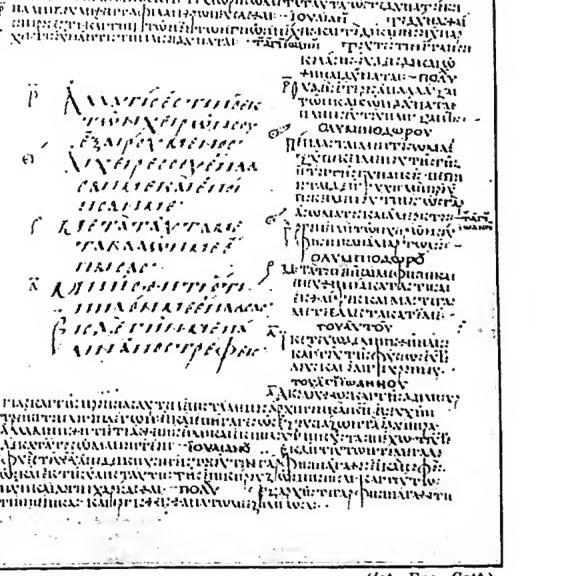
The first and most illustrious author of biblical catenas in the Greek language is the rhetorician Procopio (v.), of Gaza in Palestine (first three decades of the sixth century). In the manner described above, he commented on the Octateuch, the books of Kings and Isaiah, and the three books attributed to Solomon (Proverbs, Ecclesiastes, Song of Songs). Because of its great length, he himself made an abridgment of the Octateuch, thus providing an example of a genre akin to the catenas properly so called (partial ed. in PG 87; his plan ibid., 21). Among those who followed in his footsteps, the most worthy of remembrance for the fruitfulness and extent of his work is Niceta, metropolitan of Heraclea in Thrace (eleventh century), who composed catenas on Job, Psalms, the Major Prophets, the Gospels, and the Epistles of St Paul. Lesser stars are a Philotheus (seventh century?), Andrew the priest (eighth century?), Giovanni Drungario (ninth century), Policronius the deacon (ninth century?), Nicola of Muzalon (twelfth century), and Macarius Chrysocephalus. Most of the manuscripts (numbering in the hundreds) are anonymous; and, in any case, it is more important to know the internal composition than the name of the compiler.According to their material arrangement, biblical catenas fall into four classes: 1° crown-shaped: in the middle of the page (or folio) stands the biblical text, with the commentaries arranged all around it; this is the most grandiose and elegant form; 2° columnar: text and commentary face each other in two symmetrical columns; 3° alternating: the text, divided into short sections and marked by repeated quotation marks in the margin, is followed by the commentary without interruption across the entire width of the page; 4° marginal: on the margins of a codex containing only the text are recorded the Fathers’ explanations of the more difficult or significant passages; this is the lowest class, of little or no use.
With regard to the number of authors excerpted, an evolution can be observed after Procopio: at first only two (three at most) are selected, one from the Antiochene school and the other from the Alexandrian, so as to make the two senses heard, the literal and the mystical; then their number is gradually increased, drawing from every quarter without distinction; finally, the sheer bulk of the work, which has grown in this way like an avalanche, leads to the use of abridgments, not so much of the series of authors as of their excerpts.
Of capital importance, moreover, if we are to derive from the catenas all the benefit we may reasonably expect from them, is their treatment of the names of the authors excerpted and of their texts. The best and most accurate catenas indicate the author at the beginning of each excerpt, usually in red and in large characters, but also by means of abbreviations that may give rise to misunderstandings. As time went on, compilers and copyists became progressively less diligent, until they omitted the names altogether, creating difficulties for scholars in identification and verification. As for the text, in order to insert an excerpt into the series of a catena, some formal adjustment may be necessary at the beginning and the end. But compilers are not always satisfied with this: some patch up the cited author’s words in their own fashion, without need, muddying the pure waters of the tradition.
In short, in order to extract sound and lasting fruits from the immense and confused mass of Greek catenas, they must first be carefully sifted. Above all, the various catenas on the same biblical book must be classified; for this work, G. Karo and J. Lietzmann have already prepared the ground for the whole Bible, M. (now Cardinal) Faulhaber for a large part of the Old Testament, J. Sickenberger and J. Reuss for the Gospels, and K. Staab for the Epistles of St Paul—all Catholics except the first two. Then each class and each type, properly reconstructed by comparison of the copies that have come down to us, must be precisely evaluated as to its competence and fidelity in transmitting both the name and the wording of every author from whom it takes excerpts. Only after such a rigorous examination can the abundant materials preserved in the catenas be safely put to use. It is a long and patient, but rewarding, task; it is estimated that more than half of the rich and varied exegetical literature of the Greek Church has reached us only through the catenas. The method and productivity of this critical work have recently been demonstrated many times over in the Berlin edition of the Greek Fathers of the first three centuries, and in the volumes of K. Staab, Pauluskommentare aus der griech. Kirche, Münster 1933, and of R. Devreesse, Le commentaire de Théodore de Mopsuette sur les Psaumes (I-LXXX) (Studi e Testi, 53), Città del Vaticano 1939.
II. EASTERN C
The Greek ones are often supplemented by the b. c. in the Syriac, Armenian, and Coptic languages, whether translated from the Greek or composed or augmented on the basis of indigenous authors. Particular attention must be given to Syriac literature. The monk Severus (9th century) is the best-known compiler of a c. covering the whole Bible; anonymous are an older one(7th century), of which the Syriac manuscript 853 in the British Museum is a copy, and another known by the title Gannat büssämē, or “Garden of Delights” (12th century), on the liturgical pericopes for the entire year. But the commentaries of Ídā'dād of Merv (9th century) and Dionysius bar Salibi (12th century), as well as the “Treasury of Mysteries” of Gregory Bar Ebroo (13th century), also contain much material from the c. From the Syrians such compilations passed, through translations or adaptations, to the Christian Arabs, and from the Arabs or the Copts to the Abyssinians.
III. LATIN C.: THE GLOSS. — Among the Latins this compilatory genre was less widely used, at least at first. Before the Carolingian renaissance, two pale figures, worn down by time and hidden in the shadows of libraries, appear before us: the Scholia of St. Victor of Capua (d. 553) and the Expositum in Heptateuchum of a Roman deacon named Giovanni, from a slightly later period (cf. Pitra, Spicil. Solesm., I, pp. L–LXV, 265–301). In the Carolingian age it was a generally accepted and sought-after practice for biblical commentaries to be formed from excerpts of the Fathers; but few took the trouble to indicate accurately the author of each excerpt, as Rabano Mauro (d. 856) did, approaching the true type of the c. (PL 107–108; the Glossa ordinaria was wrongly attributed to his disciple Valafrido Strabone, PL 113–14).
(fol. Enc. Catt.)
CATENE BIBLICHE – C. on Job, Cod. Vat. gr. 749, fol. 77 (9th century), in uncial script, consisting of 230 leaves, two columns. This page contains Job 10:7b–9 and is an example of the crown catena (Rabmencatene), in which the biblical text, written in the centre in larger letters, is framed in the three outer margins by the commentary, made up of successive excerpts from well-known exegetes. Each exegetical passage (called a scholion) is preceded by an indication of the author (called the lemma). A series of signs (four here) serves to refer the various scholia to the four biblical stichoi placed in the centre. In this codex, each lemma (the author’s name in the genitive: chiefly Olympiodorus, Julian [of Halicarnassus], St. John [Chrysostom], and Polychronius) is written in red.
CATENE BIBLICHE - CATENE DI S. PIETRO
and others; and his work remained esteemed as the “magna glossatura” or “glossatura magistralis.” But what, because of its widespread diffusion, came to be called the Glossa ordinaria resulted from the assembling of particular glosses on individual books, produced by various compilers. It seems established that the cradle and center of this work was the school of Anselmo, or Anselmo di Laon (d. 1117). In manuscripts and editions (many from the beginnings of printing until well into the seventeenth century), the Glossa generally takes the form of a chain in a crown or column, and is accompanied, as a summary or complement, by the so-called glossa interlinearis, consisting of concise explanations inserted between the lines of the biblical text. But in the immense number of glossed Bibles or parts of the Bible preserved in the great libraries, there is also considerable variety, which still awaits classification and assessment, so that a criticism and history of the Glossa may be undertaken. It is an immense task, begun only in recent years, and far less urgent and fruitful than that concerning the Greek chains, since we possess the complete writings from which the excerpts composing the Glossa are taken. But among its many forms, the Expositio continua of s. Tommaso d'Aquino on the four Gospels deserves mention for the abundance of its texts, the excellence of its doctrines, and the felicity of its exposition; it was soon adorned by posterity with the title of C. aurea, and is still printed (Turin 1938) and read (Italian trans. by P. A. Del Corona, San Miniato 1902–1903).
IV. MODERN TIMES
With the Renaissance and the new paths it opened for scholarship, the production of b. c. did not cease, especially in Italy. After the C. aurea super Psalmos of the French Carthusian Fr. du Puis (de Puteo; Paris 1530) came the C. in Genetim, C. in Exodum, and C. in Psalmos of L. Lippomano (Paris 1546, 1550, and Rome 1585), the Glossae magnae in Genetim of A. Martinengo, superior general of the Lateran Canons (Padua 1597), and the Caeli davidici of the Theatine V. Giliberto (Naples 1639–44), enormous folio volumes that become unwieldy under their own bulk.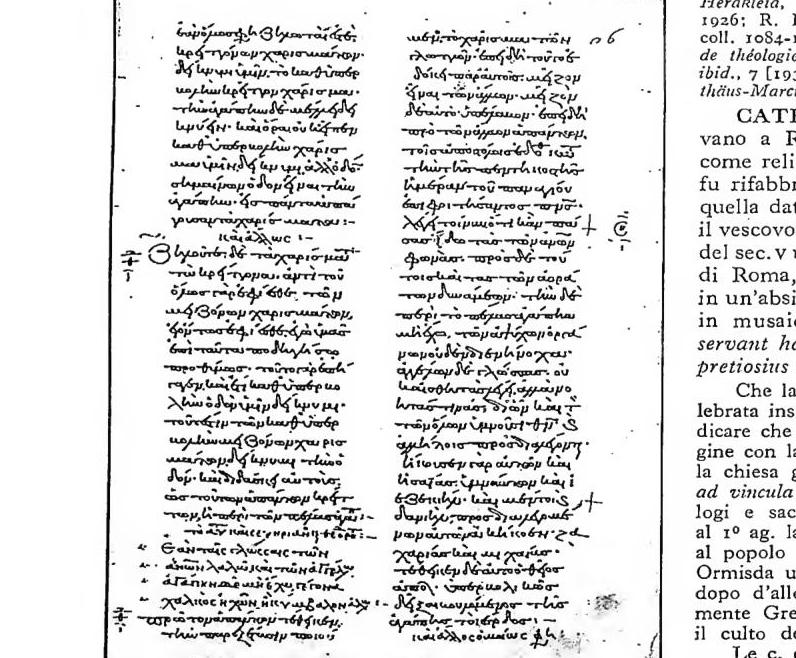
CATENE BIBLICHE - C. on the Epistles of St. Paul. Cod. Vat. 26, 602, f. 26' (11th century). A codex of 97 leaves, mutilated at the beginning and end, now contains the text from I Cor. 6:13–18 to Eph. 5:10–13. It is an example of the two-column catena, which follows the procedure inaugurated by Procopius of Gaza (6th century). The script is minuscule, but the biblical text is written in semi-uncial letters. The passage commented upon here is I Cor. 13:1.
More modest are the C. in Iob of A. Cermelli (Genoa 1636) and Collectanea seu C. SS. Patrum in Acta Apost., by L. Sanseverino (Naples 1665), which nevertheless are also in the old style, that is, based on the ancient Fathers and intended for ascetical and moral purposes. But after the magnificent flowering of commentators, whereby the century following the Council of Trent was called the golden age of Catholic exegesis, work began on c. composed solely of recent authors, and specifically of those who had most painstakingly explained the literal sense of Scripture, such as A. Gagny (Gagnano), E. Sa, St. Menocchio, and G. Tirino. With these, and additionally G. Estius, the Franciscan G. de la Haye compiled his Biblia magna (Paris 1643, 5 vols.). Comprising more than twice as many authors, among them the great Bossuet, is the Biblia sacra... cum selectissimis litteratibus commentariis, published in Venice (1745–57; 28 vols. in large 8vo). On the Protestant side, the Critici sacri (London 1660; 9 vols.) and M. Pole’s Synopsis criticorum (ibid. 1669–74; 5 vols.) may be classed in the genre of c. Meanwhile, the same 17th century saw the publication in print of the largest number of Greek c., chiefly through the work of the Jesuits Cordier and Poussines (Possinus).
For the 19th century, mention should be made, for example, of La chaîne d'or sur les Psalmes by Abbé J.-M. Péronne (Paris 1879; 3 vols.) and the Commentary on the Psalms from primitive and medieval writers by the Anglicans Neale and Littledale (London 1860–1874; 4 vols.). Even in our own times, the imposing work of the priest and professor G. Bellino, Gesù Cristo nelle S. Scritture e nei SS. Padri e Dotsori (Turin 1911–15, 9 vols.), consists of commentaries and homilies on the Gospels, translated from the Greek and Latin texts of the most distinguished writers of Christian antiquity and the Middle Ages.
The seed of the c. b. has not yet died out, and will probably continue to produce new fruits.