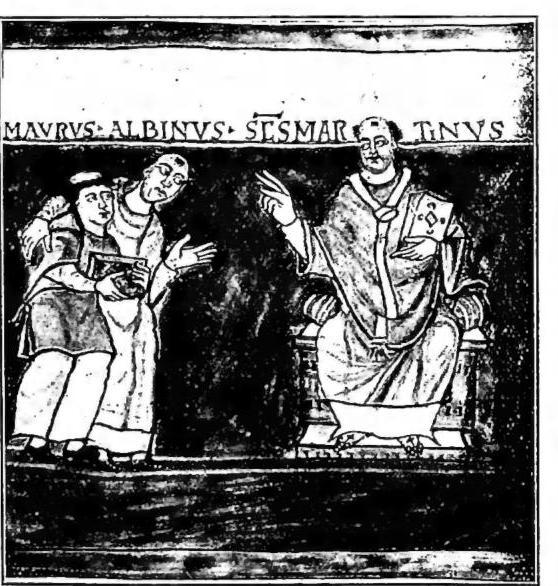
RABANO (Hrabanus, Rhabanus, Ma-
gnentius), MAURO. — Benedictine, b. at Mainz ca. 784, d. there on
4 February 856.
Trained in sacred and profane letters by Aimone at the school of Fulda and then by Alcuin at that of Tours, he was ordained a priest in 814 and from 817 directed the school of the abbey of Fulda. Ordained a priest in 814, elected abbot in 822, he resigned in 842 and retired to Petersberg. On 26 June 847 he was elected archbishop of Mainz.
R. fully deserves the title of praeceptor Ger-
maniae. Thanks to his pedagogical learning, Fulda was
transformed into an intellectual center of the first order, which
fostered the progress of literary and theological knowledge
in a country where such knowledge was almost nonexistent. R. did not cultivate
scholarship except in order to provide the clergy with the equipment necessary
to propagate Christianity in Germany. To this end
he wrote a large number of works sharing the
character of practical manuals, useful for instructing still barbarous populations in the truth
of the faith; for example, the commentaries
on almost all the books of Holy Scripture, in which passages
from the Holy Fathers and allegorical interpretations abound; De institutione
clericorum, R.’s work that exercised the greatest influence;
De universo libri viginti, a broad encyclopedic treatise,
the fruit of assiduous reading, which anticipates the various Summae,
Treasuries, and Mirrors left by the Middle Ages; Homilies for the course
of the ecclesiastical year and on virtuous Christian life;
a historical Martyrologium, dependent on that of
Bede; poems and festal hymns, among which is the
Veni Creator; and a copious and important collection of letters.
R. fought against Godescalco, his former pupil, who
professed dangerous theories concerning double prede-
stination, one to the joys of Paradise, the other to the
pains of Hell. R. distinguished two things that were quite different from
each other: predestination, by virtue of which the good
will be saved, and divine foreknowledge concerning the perdition
of hardened sinners. In October 848 an assembly
of bishops, presided over by R., declared Godescalco guilty
of heresy.