
THEOLOGY. — The science of the divinity in itself and in its relations with creatures.
I. HISTORY OF THE TERM
Transcription of the Greek term ἀγολόγος. Etimologically, it means discourse about God. In Greek antiquity, poets (Homer, Orpheus, Hesiod) were called theologians insofar as they explained the world through the activity of the gods, in opposition to the “physiologists” and “philosophers,” who sought a purely rational and natural interpretation. For Aristotle, t. is the part of metaphysics that deals with the First Cause, with divinity; for the Stoics, it is the way of conceiving the gods, which may be mythical, “physical” (the personification of natural phenomena), or “civil” (cultic practices).Rejecting the pagan conception of divinity, the first ecclesiastical writers also distrusted the term, until a distinction was made between true t. (Christian) and false t. (pagan). Eusebius then wrote De theologia ecclesiastica and, later, Pseudo-Dionysius wrote De mystica theologia. During the Trinitarian controversies (cf. St. Athanasius), t. meant doctrine concerning the Trinity, while the Pauline term “economy” was reserved for Christology. In the sense of doctrine concerning divinity, it was first used by Abelard (Introductio in theologiam, Epitome theologiae). Only in the thirteenth century was it applied to the entire body of revealed truths, gradually supplanting the other terms.
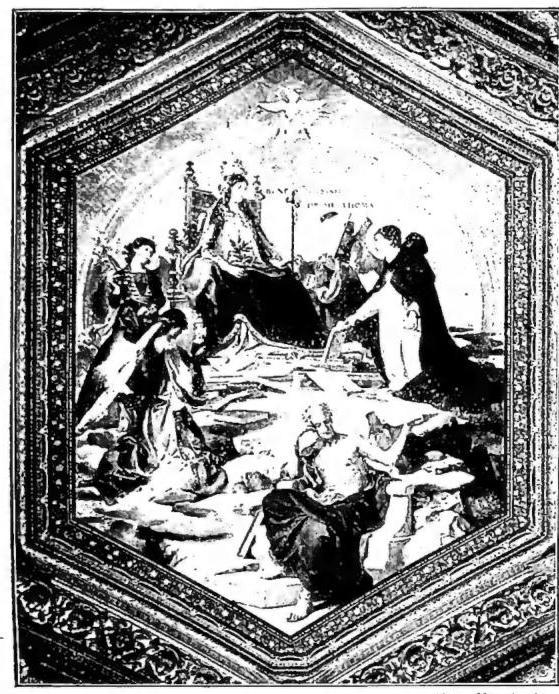
TEOLOGIA — The Church embraces the doctrine of St. Thomas. Fresco by Teodorico Seiz on the vault of the Gallery of the Candelabra, executed during the pontificate of Leone XIII — Vatican Museums.
II. NATURE OF T
It is defined as the science that treats of God and of all things in relation to God, in the light of divine Revelation and human reason. Its object is God in his essence and attributes (primary material object), but it also comprises all things insofar as they have a relation to him (secondary material object). What distinguishes t. from the sciences that have the same subject is the manner of considering God: that is, not as the supreme cause of being, as he appears to rational speculation, but in his intimate life (formal quod object), as manifested by Revelation (formal quo or sub quo object). Knowledge of the intimate nature of God certainly transcends every natural and created capacity. Nevertheless, a science of the divine mysteries founded on Revelation and faith is possible and necessary; s. Tommaso deduces this from the fact of our elevation to the supernatural end, which is the beatific vision (Sum. Theol., 1°, q. 1, a. 1), of which t. is only an obscure anticipation.One may speak of a Christocentrism of t. Christ is in fact included in the material object both as God and as man; indeed, as God he enters into the formal quod object (the second person of the S.ma Trinità), and as Redeemer he is the living synthesis of the entire supernatural economy.
Nevertheless, although Christocentrism is more effective in attracting souls through its vital concreteness, the classical (theocentric) definition remains scientifically preferable.
III. THEOLOGICAL METHOD
Since t. begins from the articles of faith as proposed by the Church’s magisterium, before directly studying the revealed datum the theologian must acquaint himself with the doctrine proposed by that same magisterium, the proximate norm of faith. With this sure guide, he approaches the very sources, direct (Holy Scripture) and indirect (the Fathers), of Revelation; he gathers their doctrine, demonstrating its continuity through the centuries and its homogeneity with dogma. This work constitutes what is known as positive t. At a third stage he elucidates, systematizes, and rationally deepens the revealed datum, developing its virtualities with the aid of dialectic, which is always subordinate to the light of faith. This is the proper task ofspeculative t. Speculative t. and positive t. do not oppose one another but complement each other. Just as theological speculation cannot be carried out apart from the documents of Revelation, so it would not be sufficient to confine oneself to a purely historical inquiry. There are, in fact, truths contained integrally in the sources of Revelation (formal revealed, explicit or implicit) in a more or less clear manner. There are, on the other hand, other truths contained only radically or partially, but which are easily deduced by means of reasoning (virtually revealed, or theological conclusions). It is debated whether the latter retain their homogeneity with the revealed datum and, consequently, whether they can be objects of divine faith should the Church’s magisterium define them. In principle, a clear distinction must be made between formal revealed, even if implicit and obscure, and virtually revealed, which requires a rational element in order to be formulated. The former belongs to divine Revelation; the latter, however, goes beyond it and therefore cannot be an object of properly divine faith. The function of reason in theological elaboration raises the problem of the relations between t. and philosophy.
IV. T. AND PHILOSOPHICAL SYSTEMS. — T., while presupposing certain philosophical truths (the existence of God, the first cause, etc.), makes use of philosophy to elucidate and formulate the datum of Revelation. Historically, various philosophical systems or schools have contributed to the elaboration of theological concepts; but the need for continuity and stability in the official teaching authority imposes the choice of what best suits dogmatic requirements. The Church has expressed her preference for the Aristotelian-Thomistic system, while reserving the freedom to accept whatever good there may be in the others. These are not condemned, although history demonstrates that several have led to untenable positions; but relativism cannot be pushed so far as to place the most contradictory assertions on the same evaluative level on the pretext that reality is elusive, and therefore no system can express it adequately, so that the multiplicity of systems, rather than doing harm, benefits an approximate expression of II. Dogmatic formulas, even when consonant with particular philosophical schools, remain immutable; they may, however, be deepened, specified, and developed «codem sensu eademque sententia» (v. DOGMA).
V. FEDE. — Theology presupposes faith both objectively and subjectively. Objectively, it operates within the sphere of divine Revelation and under the guidance of the Church’s magisterium; subjectively, the theologian must begin from Revelation and proceed in the light of faith, from which he receives that supernatural inspiration that transforms arid science into a flavorful and life-giving wisdom. It is not necessary, however, to say with Stolz that theological science is a charism, at least in the strict sense. On the other hand, faith is strengthened by theology. According to s. Agostino, “truly salvific faith is generated, nourished, defended, and strengthened” by sacred doctrine (De Trin., XIV, 1, 3). The First Vatican Council adds that reason, assisted by faith, can fruitfully deepen revealed truths.
The long-standing disputes concerning the speculative or practical nature of theology also relate to this problem. The Augustinian current demanded an affective theology, engaging mind and heart in the ascent toward the Supreme Good; the Aristotelian current, on the contrary, desired a purely theoretical theology. These extreme positions indicate the difficulty of the problem, but were abandoned because of their exclusiveness, and many sought a middle way. Already s. Bonaventura (IV Sent., Prooemium, q. 3) and s. Tommaso (Sum. Theol., 1°, q. 1, a. 4) resolved it in this manner: the predominance of the theoretical and contemplative element, naturally ordered, however, to influence human action. Nevertheless, the problem has recently been raised again by kerygmatic theology.
VI. KERYGMATIC THEOLOGY
With the intention of making theology more closely consonant with the psychology of concrete man and with the complex life of today, a form of theology called kerygmatic theology, or theology of preaching, has recently developed. Arising through the initiative of the Jesuits of Innsbruck, it was developedabove all by Jungmann, Rahner, Lakner, and Lotz. They reproach classical theology for being too abstract, addressing itself only to the intellect; they therefore prefer a Christocentric theology which, through symbols and images, appeals to all the faculties of man. It has won numerous adherents, especially among the younger clergy; indeed, some have abandoned school theology for II. The misunderstanding must be resolved by considering kerygmatic theology not as a new and distinct theology, or, worse, as opposed to scholastic theology, but as an emanation and an integration of the latter.
Indeed, although theology, for didactic reasons, must proceed in a rigorously logical and systematic manner, the theologian does not forget that the submission of the intellect to the truths of faith is only the first step in a religious homage, which must engage man in all the manifestations of his individual and social life.
VII. HISTORY OF T
Faced with Revelation, every person adopts a personal attitude of his or her own. Here the history of individuals is not being presented; rather, the most characteristic and important movements in Catholic thought as it reflects upon the revealed datum are outlined in broad strokes.1st period: the Fathers. — The Apostolic Fathers adhered to the scriptural datum and to the apostolic catechesis without adding noteworthy developments. In the 2nd century, contact with the pagan world and its culture determined reactions of a philosophical, political, and social order. The apologists then arose, feeling the need for a systematic defense of Christian truths. Two currents soon became manifest among them: one traditionalist (Tatian), which held philosophy in contempt, and the other broader (Justin), which instead made use of all the contributions of Greek speculation. In these sketches of t. there were uncertainties and imprecisions. But there was a more serious danger, that of falling into Gnosticism. This complex philosophical-religious current threatened to absorb Christianity, reducing it to an arbitrary and extravagant gnosis. s. Irenaeus of Lyons reacted forcefully, appealing not to reasoning but to the tradition of the Church, the living and unfailing custodian of the truth. The line of s. Justin was continued in the Didaskaleion of Alexandria. Founded by Pantaenus, it owed its orientation to Clement and then to Origen, the creator of the first great synthesis of scientific t. It was fruitful in theological developments through s. Athanasius, Didymus the Blind, and s. Cyril, and it also influenced the great Cappadocians, s. Basil, s. Gregory of Nyssa, and s. Gregory Nazianzen. The school of Alexandria is characterized by strong Platonic influences, pronounced allegorism in exegesis, and profound mysticism.
With an antithetical character (more positive and Aristotelian), the school of Antioch developed, with s. John Chrysostom, Theodore of Mopsuestia, Theodoret, and others. These currents exerted great influence in the controversies that fostered the evolution of t. from the 3rd to the 6th century, the golden age of patristic t. The stages of this development are marked by the first seven ecumenical Councils. In 325, at Nicaea, the consubstantiality of the Son with the Father was defined against the Arians, and it was s. Athanasius who for half a century championed the Nicene faith. Trinitarian t. was then deepened and systematized by the Cappadocian Fathers, while s. Hilary of Poitiers disseminated in the West the fruits of Eastern speculation. In 431, at Ephesus, one person in Christ was affirmed against the Nestorians: the struggle was again led by an Alexandrian, s. Cyril. But the controversies determined by this Council threatened to end in Monophysitism (v.) initiated by Eutyches. Therefore, in 451 at Chalcedon, the twofold nature of Christ was recognized, with the unanimous approval of Pope Leo the Great’s dogmatic letter to Flavian of Constantinople (the tome of s. Leo).
Christology was subsequently developed by Leontius of Byzantium and then by Maximus the Confessor, under pressure from the Monothelite heresy (one will in Christ), condemned at the Third Council of Constantinople (680–681).
In the West, Trinitarian t. developed, but with a different character. Tertullian, Hippolytus, and later Novatian were engaged in combating the Trinitarian error of the Modalists. Their doctrine was completed in the 4th century by s. Hilary of Poitiers and especially by s. Augustine (De Trinitate libri XV). The influence of the latter on t. of all periods was truly immense, because he summarized the entire preceding tradition, clarified and deepened the most arduous questions, and examined and systematized all sacred knowledge in a work permeated by ardent mysticism (the characteristic of the current that takes its name from him), which became the source and guide of scholastic t., including that of s. Thomas Aquinas. Links between the Fathers and the Scholastics were, in the East, pseudo-Dionysius, a mystic with Neoplatonic motifs, Leontius of Byzantium and s. Maximus the Confessor, and above all s. John Damascene, not a great theologian but a diligent epitomizer; and, in the West, Severinus Boethius, Cassiodorus, s. Isidore of Seville, and s. Bede the Venerable.
2nd period: the Scholastics. — The first center of sacred and profane culture in the Middle Ages was the Carolingian school (8th–9th centuries), begun by Alcuin and continued by Rabanus Maurus. Theodulf of Orléans (v.) dealt chiefly with the Holy Spirit; Paschasius Radbertus (v.) and Ratramnus (v.) of Corbie discussed the Eucharist, an issue raised again a Berengar of Tours (v.). His error was refuted by many, among them Lanfranc (v.) of Pavia, later archbishop of Canterbury. His disciple s. Anselm (v.) of Aosta, who later succeeded him in the same see, was the true initiator of scholastic t.: he was no longer content merely to collect the Fathers’ statements concerning the various truths, but introduced and accentuated dialectics. This tendency was continued by Abelard and, to the point of error, by Gilbert Porretanus, whom s. Bernard opposed and had condemned by the Council of Reims (1148). s. Bernard, like his contemporary s. Peter Damian, followed the line of s. Augustine, who placed faith above dialectics. The same applies to the school of St. Victor (Hugh, Richard).
The time was ripe for the great syntheses that were called Sententiae. The Laon (v.), but the most Peter Lombard (v.), called the Magister Sententiarum. His four books became the text of the theological faculty of Paris, founded in 1215, which soon became the goal and center of theological studies for more than a century. The teaching method consisted precisely in an exposition (lectio) of Scripture and the Fathers followed by a dialectical exercise (disputatio). Teaching remained essentially along the Platonic-Augustinian line, while from Spain came the first objections of the Arab philosophers (Averroes, Avicenna), drawn from the recent translation of Aristotle’s works. At first Aristotelianism was rejected; then, chiefly through the work of s. Thomas and his teacher s. Albert the Great, it was rehabilitated. Representatives of Scholasticism in the first half of the 13Auxerre (v.), Philip the Chancellor (v.), POLITEISMO (v.), William of Auvergne (v.). But s. Thomas unquestionably remains the greatest for the diligence and breadth of his erudition, the clarity and precision of his expression, and above all the depth of his doctrine. Thomism takes its name from him, a current extending well beyond the circle of the Dominican school. The latter was represented by Giles of Rome, Hervaeus Natalis, and later by Capreolus (d. 1444), called the princeps thomistarum. Alongside it flourished the Franciscan school, which was more Platonic-Augustinian. Its first and greatest representative was s. Bonaventure, a disciple of Alexander of Hales and a companion of s. Thomas at the University of Paris. Among his disciples, Cardinal Matteo d’Acquasparta distinguished himself. The controversy with the Dominican school found its leading representative in Duns Scotus, whom Franciscan t. subsequently followed.
There is no doubt that s. Thomas embodies in his spirit and work the highest expression of the philosophy and t. of Scholasticism, not only in content but also in method (v. saint).
3rd period: the moderns. — The 14th and 15th centuries marked a decline of scholasticism and of theology in general, owing to the nominalism of Occam, political revolutions, religious schisms, and the revival of Humanism. The 16th century, however, witnessed a powerful revival, begun at Salamanca Francesco da Vitoria (v.), who introduced into the schools the commentary on the Sum. Theol. of s. Tommaso instead of the books of Pietro Lombardo. He had illustrious disciples: Domenico and Pietro Soto (v.), Carranza (v.), CANTO (v.). In Italy the Dominican school could boast the names of Tommaso De Vio (Cardinal Gaetano) and Francesco Silvestri (the Ferrarese).
At Salamanca the reformed Carmelites competed with the Dominicans, with the celebrated Cursus Salmaticensis in Summam s. Thomae, while a promising theological University was arising at Louvain. The Jesuits soon arrived as well: between them and the Dominicans a dispute broke out that dominated the schools for centuries, down to our own day, concerning Grace and free will. The Dominicans (Domenico Bañez, Alvarez, De Lemos; and, later, the more balanced Giovanni di s. Tommaso) were chiefly concerned with the dominion of God, whereas the Jesuits (Ludovico Molina) began from human freedom in order to defend it against the attacks of the new Lutheran heresy.
The Society of Jesus sent distinguished theologians to the Council of Trent (Lainez, Salmeron), and produced celebrated controversialists, such as Gregorio di Valenza, Pietro Canisio (v.), Roberto Bellarmino, Lessio (v.), Vasquez (v.), Suárez (v.). The Franciscan school too, which was represented at the Council of Trent by Andrea Vega (v.) Medina (v.), recovered through the publication of Scoto’s works, undertaken by Wadding (d. 1657), and through the writings of Francesco de Herrera, Bartolomeo Mastro (v.), etc.
At the same time, theological specialization began. Exegesis took on its own character with the Jesuits Toledo, Maldonato, Cornelio a Lapide (v.), while patrology was inaugurated by another Jesuit, Petavio. The Dominican Melchior Cano founded the new theological methodology, and mystical theology received a great impetus from the Carmelite school. The problem of the relationship between speculative and affective theology was then posed, Contenson (v.) sought to resolve in his Theologia mentis et cordis.
In the 17th and 18th centuries theology withered amid internal and external controversies, and was subsequently corrupted by Cartesian and Leibnizian philosophy. Nevertheless, against the Jansenists and Gallicans there arose extensive works of ecclesiology, major positive studies, and some good speculative theologians (Bilhart, Gotti, the work of the Benedictines of Salzburg and of the Jesuits of Würzburg). Moral theology developed extraordinarily with s. Alfonso de' Liguori (d. 1787), and the theological method, freeing itself from the commitments of particular schools, assumed the modern positive-speculative form.
The 19th century opened Hermes (v.) Günther (v.) and of the French traditionalists, but later witnessed the revival of positive studies (v. MOHLER, LUDWIG; MICHEL; SCHWANE, JOSEPH; HEFELE; HERGENBÖTHER), which brought to light the continuity of traditional doctrine (v. NEWMAN). Speculative theology was reborn with neo-Thomism, especially in Italy (Sanseverino, Liberatore, Cornoldi). Meanwhile, in Germany the Jesuit Kleutgen (d. 1883) reconstructed classical philosophy and theology in two celebrated works. While neo-Thomism found its official sanction in the encyclical Aeterni Patris (1879) of Leo XIII, theology was engaged in defending the supernatural and objective character of revealed doctrine against the naturalism and subjectivism disseminated by contemporary philosophy. Vatican Council (v.) reacted vigorously against them, and an extensive theological literature developed around II. Nevertheless, subjectivism, modernism (v.), reappeared and was definitively crushed by the encyclical Pascenò of Pius X. Contemporary theology has inherited this situation and has sought to improve II. The return to scholasticism and to s. Tommaso has produced eminent theologians (L. Billot), but also fierce opposition from those who slip toward dogmatic relativism, lured by the mirage of a false irenicism; positive studies likewise have numerous and worthy practitioners, but some of them have not entirely avoided the danger of historicism and evolutionary subjectivism, under the influence first of immanentist philosophy and subsequently of existentialism. These unhealthy elements were recently (1950) denounced by the encyclical Humani generis (v.), which delineates the state of contemporary theology and points out the goals of its future course. — See table CXXXIX.
NISL.: J. Bellamy, La théol. cath. au XIXe siècle, Paris 1904; M. Grabmann, Stor. della t. catt., Italian translation, 2nd ed., Milan 1939 (with extensive bibliography); L. Allevi, Disegno di stor. della t., Turin 1939; Y. Congar, Théologie, in DThC, XV, cols. 246–447 (with bibliography); I. De Ghellinck, Le mouvement théologique au XIIe siècle, 2nd ed., Bruges–Paris 1948; E. Hocedes, Hist. de la théol. au XIXe siècle, 3 vols., Brussels–Paris 1948–52; P. Parente, La t., Rome 1952, pp. 9–83; L. Allevi - L. Tondelli - M. Pellegrino - C. Colombo, La t. ital. nella prima metà del sec. XX, in La Scuola catt., 80 (1953), pp. 361–479. Pietro Parente