Machine translation of the 1948–1954 Italian original. The original text is authoritative.
PANTENO. — Eusebio (Hist. eccl., V, 10) relates that, in the time of Commodus, P. was supposedly head of the school for biblical studies in Alexandria and that he had taken Stoic philosophy as his point of departure (according to Filippo di Side, Pythagorean philosophy). This information conflicts with the other account that follows (10, 2): P. was supposedly ordained as a missionary to the peoples of the East and sent as far as India. His mission as an apostolic “evangelist” is narrated according to Eusebio’s general conception of the “evangelists” (v. EUGENIO, op. cit., III, 37, 2). Among other things, their task was to transmit a written Gospel.
P., however, must have realized that the Gospel of Matteo, written in Hebrew letters, had already been disseminated in India by Bartolomeo (10, 3); V. also Efraim, Evangelior. concord., ed. Moessinger, Venezia 1876, p. 286). P. was supposedly to have died as head of the school, where he taught orally but also through his writings (10, 4): thus Eusebio’s account comes to an end. The conflicting tendencies between P. as head of the school, philosopher, and author of books, and P. as evangelist, exegete, and teacher of oral instruction, can perhaps be explained by the fact that the former reflects the later Alexandrian tradition concerning P. It should not be maintained that P. had been head of the famous school, which perhaps did not yet exist in his time (cf. J.
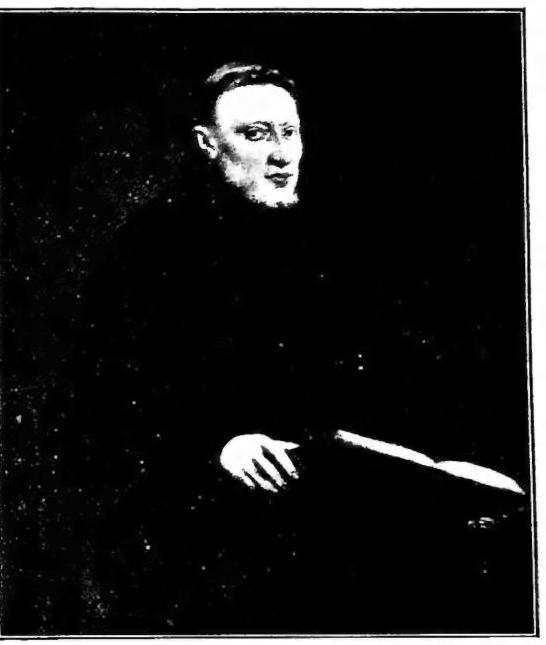
PANVINIO, ONOFRIO — Portrait of O. P. by Titian — Rome, Galleria Colonna.Munck, Untersuchungen über Klemens von Alexandrien, Stuttgart 1933, p. 185). It is generally said—following an indication by Eusebius, Hist. eccl., V, 11, 2, p. 452, 10 ff., ed. Schwartz—that he was mentioned, though without being named, by Clement in Strom., I, 11, 2, and that he is to be identified with the “Sicilian bee,” so that P. would have been Sicilian by origin. But this identification is neither certain nor plausible. If P. the evangelist went to India (perhaps southern Arabia, or Axum; V. HARAN, Mission und Ausbreitung des Christentums, Leipzig 1924, II, p. 698; M. Simon, Verus Israëli, Paris 1948, p. 311), where he found the Gospel of the Hebrews (Hebrew Matthew), it is more likely that he should be identified with the Palestinian Jew whom Clement mentions (Strom., I, 11, 2) among his teachers and who was probably the vehicle for apostolic traditions deriving from James the Just (Strom., I, 11, 3); and thus it may be supposed that P. transmitted local Palestinian traditions, perhaps also with a Judeo-Gnostic tendency, to Clement. The various hypotheses concerning the role P. may have played in Clement’s work (W. Bousset, Jüdisch-christl. Schulbetrieb in Alexandria, Göttingen 1915, and Munck, loc. cit.) cannot be proved. One may only suppose that Clement transmitted many exegetical traditions of P. under a reference to the “presbyters” in his (for the most part lost) Hypotyposeis, whereas P.’s name occurs only once in Eclog. proph., 56, 2. P. was one of these ancient presbyters, transmitters of the apostolic oral tradition: the “presbyters” did not write (Ecl. proph., 27, 7). The attribution of books to P. by Eusebius and others may perhaps be explained by admitting that traditions of P., more or less authentic, were published in book form by P.’s students or by adherents of the Alexandrian school.
BIBL.: Th. Zahn, Forschungen zur Geschichte des neutestam. Kanons, III, Erlangen 1884, p. 136 ff.; A. Harnack, Geschichte der altchristlichen Literatur, I, Leipzig 1893, pp. 291–96.
Erik Peterson
Cite this article
“PANTENO.” Enciclopedia Cattolica, vol. IX (1952), p. 437. Azione Romana digital edition, https://azioneromana.com/article/panteno.