
EUSEBIUS of CAESAREA. - Father of ecclesiastical history.
SUMMARY:
I. Life
II. Historical works
III. Apologetic works
IV. Exegetical works
V. Dogmatic works
VI. Letters.I. LIFE
Born around 265, he died in Caesarea of Palestine in 339 or 340. The particular gratitude he felt toward the martyr Pamphilus, whose name he took as Εὐσέβιος τοῦ Παμφίλου, has led some to believe that Eusebius was his slave; however, it seems more likely that the noble and learned Pamphilus known in Caesarea during the episcopate of Agapius (Hist. eccl., VII, 32, 25) was rather his beneficent friend and teacher, as Jerome attests (De viris illustribus, 81; PL 23, 727). Eusebius studied under the learned Antiochene priest Dorotheus (Hist. eccl., VII, 32, 2-3), but it was primarily in Caesarea, home to the rich library founded by Origen, that he completed his scholarly formation, and where Pamphilus introduced him to the Alexandrian philological method.During the Great Persecution (303-11), which he later described with moving detail, he witnessed the destruction of sacred buildings, the burning of holy books, and savage scenes of martyrdom not only in Palestine but also in Phoenicia and even in distant Thebaid. In Caesarea, he stood by Pamphilus (cf. Photius, Bibliotheca, cod. 118; PG 103, 396-400), who was imprisoned on November 15, 307, and collaborated with him on the Apologia pro Origene, a work interrupted by the martyr’s decapitation (February 16, 310), to which Eusebius later added a sixth book. Spared from persecution (a singular exception that later gave rise to malicious insinuations: cf. the words of Potamon at the Synod of Tyre in 335, in Epiphanius, Panarion, Haeresis, 68, 8; PG 42, 197), he was elected bishop of the important metropolitan see of Caesarea between 313 and 315, in any case before the grand celebrations for the dedication of the church of Tyre (ca. 315-16), at which he delivered a panegyric (Hist. eccl., X, 4). At the Council of Nicaea, entrusted with delivering the official address to Constantine, according to the Vita Constantini (III, 11; Socrates, Hist. eccl., I, 18; though Theodoret, Hist. eccl., I, 7 attributes the speech to Eustathius of Antioch), he contributed his vast and assured erudition to the fixing of the date of Easter, ensuring the triumph of the Alexandrian nineteen-year cycle. With the bishops of the Council of Tyre (335), he traveled to Jerusalem for the solemn dedication of the Basilica of the Holy Sepulchre, then proceeded to Constantinople, where he delivered the ceremonial oration for Constantine’s Tricennalia. In Caesarea, Eusebius continued to enrich the library, a cherished inheritance from the admired Origen and his great teacher Pamphilus. The scriptorium, a necessary complement to the library, also received new impetus from him; suffice it to recall that Constantine turned to Eusebius to obtain fifty copies of Holy Scripture (cf. Vita Constantini, IV, 36-37).
The day of his death is recorded in the Breviarium Syriacum on May 30; in the Martyrologium Hieronymianum on June 21: "In Caesarea Palestinae deposita Eusebi episcopi historiographi" (Martyr. Hieronymianum, p. 328), a notice later included in Usuard’s Martyrology (cf. ed. J.-B. Du Sollier, Acta SS. Juni, VI, Venice 1745, pp. 350-51) and in the Roman Martyrology, until Baronius’ revision. Acacius, Eusebius’ successor in Caesarea, wrote his life (Sozomen, Hist. eccl., I, 4), which has not yet been recovered.
His stance toward Arianism has always been much debated: an enemy of the ἐξοδόξιος, an expression he associated with Sabellianism, he welcomed Arius in Caesarea, defended him, extolled his doctrine, and reinstated him in his functions (323-24). The Council of Antioch (late 324) excommunicated him; at the Council of Nicaea (325), after some hesitation, he signed the creed containing the term "consubstantial," as it was suggested (or more precisely, patronized) by the Emperor, as he artfully explains in his letter of justification to his diocese (Socrates, Hist. eccl., I, 8). After Nicaea, Eusebius continued to support Arius and his faction, working to remove defenders of the "consubstantial" from their sees, such as Asclepiades of Gaza in 326, Eustathius of Antioch in 330 (though he refused to succeed him), and especially Athanasius in 335 and Marcellus of Ancyra in 336. In his writings, Eusebius appears more cautious; his Trinitarian doctrine, and particularly his Christology, is as imprecise as that of Origenism, which, in combating Sabellian modalism, fell into subordinationism. However benevolently one may interpret many of his Christological expressions, the fact remains that, alongside his namesake and friend, the bishop of Nicomedia, he figures among the most formidable opponents of the "consubstantial," given also the prestige he enjoyed as a learned man among Constantine and the Eastern episcopate. This easily explains the epithet δίγλωσσος given to him (Socrates, Hist. eccl., I, 23), and the severe judgments passed on his orthodoxy by St. Athanasius (cf. De decretis Nicaenae Synodi, 3: PG 25, 420), St. Epiphanius (cf. Panarion, haeresis, 68, 8: ibid., 42, 197), St. Jerome (cf. Epist. 133 ad Ctesiphontem, 3: CSEL 56, p. 247; Adversus Rufinum, I, 8 and II, 15: PL 23, 421, 457), the Second Council of Nicaea (Mansi, XIII, 316-37), Photius (cf. Bibliotheca, cod. 13: PG 103, 53; cf. also cod. 127: ibid., 408), and many others.
Eusebius was undoubtedly the most erudite bishop of his time: an orator, exegete, apologist, theologian, historian, topographer, and bibliophile, which is why Constantine held him in such high esteem. Less commendable for his character and his excessively courtly demeanor, he appears as an indefatigable worker endowed with a versatile intelligence and, above all, a tenacious memory. His erudition rivals that of Origen, though as a thinker and writer he does not surpass the common average. Eusebius has been remembered with admiration through the centuries for his numerous works, the fruit of meticulous research and profound reading, especially in the rich collections of the libraries of Caesarea and Jerusalem. To fully appreciate Eusebius’ work and method, it suffices to say that without his research, we would know very little about the first centuries of Christian life. That Eusebius had an apologetic intent in composing his works is evident; nevertheless, neither this purpose nor the various defects found therein are such as to overshadow his scientific probity.
More than a historian in the strict sense of the word, Eusebius was a collector of literary and archival sources—this is his principal merit.
II. HISTORICAL WORKS
Historical writings constitute the finest part of Eusebius’ literary output,| Chronikon-Karno | 153 | ||||||||
|---|---|---|---|---|---|---|---|---|---|
| K | Op. | Abr. | Fig. | Lyd. | Nab. | Inb. | Lst. | Ec. XXV. Dyn. | M. M. |
| Ex- | Alt- | Der- | Stk- | Stk- | Stk- | ||||
| 12 | 12 | 1287 | 12 | 13 | 6 | 4 | 23 | 6 | |
| 1288 | 13 | 14 | 7 | 5 | 24 | 7 | |||
| Idem, Adm 12 | |||||||||
| 1289 | 14 | 1 | 8 | 6 | 25 | 8 | |||
| 1290 | 15 | 2 | 9 | 7 | 26 | 9 | • Synod of Arretica, dogmatic decrees | ||
| 1291 | 16 | 3 | 10 | 8 | 27 | 10 | • S. M. | ||
| 12 | 12 | 1292 | 17 | 4 | 11 | 9 | 28 | 11 | • S. M. |
| 1293 | 18 | 5 | 12 | 10 | 29 | 12 | • S. M. | ||
| 20 | 20 | 1294 | 19 | 6 | 13 | 1 | 30 | 1 | • L. M. |
| 1295 | 20 | 7 | 14 | 2 | 31 | 2 | • L. M. | ||
| 1296 | 21 | 8 | 15 | 3 | 32 | 3 | • L. M. | ||
| 1297 | 22 | 9 | 16 | 4 | 33 | 4 | • L. M. | ||
| 1298 | 23 | 10 | 17 | 5 | 34 | 5 | • L. M. | ||
| • In this year the war of the kings against Sodom and L. M. | 16 | 1299 | 24 | 11 | 18 | 6 | 35 | 6 | • L. M. |
| 1300 | 25 | 12 | 19 | 7 | 36 | 7 | • L. M. | ||
| 1301 | 26 | 1 | 20 | 8 | 37 | 8 | |||
| • In this year the war of the kings against Sodom and L. M. | 16 | 1302 | 27 | 2 | 21 | 9 | 38 | 9 | |
| 1303 | 28 | 3 | 22 | 10 | 1 | 10 | • L. M. | ||
| 1304 | 29 | 4 | 23 | 1 | 2 | 11 | • L. M. | ||
| 17 | 17 | 1305 | 1 | 5 | 24 | 2 | 3 | 12 | • L. M. |
| 1306 | 2 | 6 | 25 | 3 | 4 | 1 | • L. M. | ||
| 1307 | 3 | 7 | 26 | 4 | 5 | 2 | • L. M. | ||
| 1308 | 4 | 8 | 27 | 5 | 6 | 3 | • L. M. | ||
| 1309 | 5 | 9 | 28 | 6 | 7 | 4 | • L. M. |
| Chronikon-Karno | 227 | ||||||||
|---|---|---|---|---|---|---|---|---|---|
| K | Op. | Abr. | Idem | ||||||
| Idem | Lyd. | Nab. | Inb. | Lst. | Ec. XXV. Dyn. | M. M. | |||
| 1000 | • When Ardysus, having attempted a revolt against our knowledge, was prevented by a small force in his early plans and captured by Gyges, he was taken to Nineveh. | 204 | 2292 | 4 | • | • | • | • | • |
| 2293 | 5 | • | • | • | • | • | |||
| 2294 | 6 | • | • | • | • | • | |||
| • | • The Church of Rome receives as its bishop Telesphorus, "a martyr," after the 20th year, for 12 years. | 205 | 2295 | 1 | • | • | • | • | • |
| 2296 | 2 | • | • | • | • | • | • | ||
| 2297 | 3 | • | • | • | • | • | • | ||
| 2298 | 4 | • | • | • | • | • | • | ||
| 2299 | 5 | • | • | • | • | • | • | ||
| 2300 | 6 | • | • | • | • | • | • | ||
| 2301 | 7 | • | • | • | • | • | • | ||
| • | • For the Church of Alexandria, as the 12th episcopal successor, Heraclas is appointed, for 2 years. | 206 | 2302 | 1 | • | • | • | • | • |
| 2303 | 2 | • | • | • | • | • | • |
(from Eusebius Werke, V., in GCS 38, Leipzig 1911, pp. 183, 227)
EUSEBIUS OF CAESAREA – Chronicon of E. of C. in the Armenian version.
Arrangement of dates and text according to the editor J. Karst.
has not been recovered except for a few fragments; a complete Armenian version (ca. 600) and a partial Latin one, executed in 381 at Constantinople by St. Jerome, who enriched the text with information concerning Roman history and extended it to 378 (cf. letter to Vincentius and Gallicanus: PG 19, 315-16), are preserved. A Syriac version must also have existed, used by the author of the Chronicon (775) of pseudo-Dionysius (cf. ed. J. B. Chabot, in Corpus Script. Christ. Orientalium: Scriptores Syri, 3rd series, II, Paris 1923, p. vii).
It is to this work that E. owes his status as the most widely known and utilized ecclesiastical writer of antiquity.
Collectio veterum actuum martyrum (Ἀρχαίων μαρτυρίων [ὡς μαρτύρων] συναγωγή), a work written before 303, now lost, containing Acts of martyrs prior to the Diocletianic persecution. These acts formed part of the material gathered for his History, where they are indeed cited (cf., e.g., IV, 15, 47; V, 4, 3, 21, 5). The author of the Greek Martyrologium (4th century), of which we possess an epitome in the Breviarium Syriacum contained in a manuscript of 411-12, used this collection and refers to it with the expression ἐκ τῶν Ἀρχαίων, appended to a certain number of martyrs (cf. L. Duchesne, in the preface to the diplomatic edition of the Martyrologium Hieronymianum, in Acta SS. Novembris, II, 1, Brussels 1894, pp. L-XVI, especially p. LXVII; A. Ehrhard, Überlieferung und Bestand der hagiographischen u. homiletischen Literatur der griechischen Kirche, I (Texte u. Untersuchungen, 50, 1), Leipzig 1937, pp. 1-17).
Chronicon, in two books, entitled in the Eclogae propheticae: Χρονικοὶ κανόνες καὶ ἐπιτομαὶ παντοδαπῆς ἱστορίας Ἑλλήνων τε καὶ βαρβάρων (I, 1: PG 22, 1024). The Greek text exists in two recensions (the first ca. 303, the second 325).
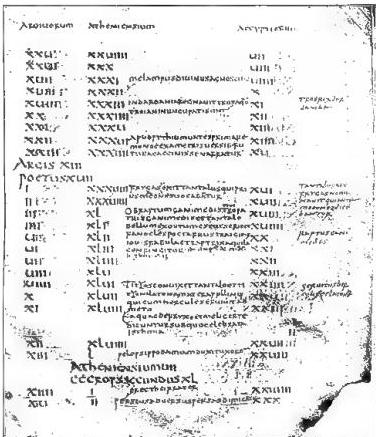
P. Keesling, Die Chronik des Eusebius in syrischer Überlieferung, in Oriens Christianus, 2nd series, 1 [1926], pp. 23-48, 223-41; 2 [1927], pp. 33-56). The versions do not faithfully reproduce the original, as the translators manipulated its content. Book I, or the Chronographia, contains a summary of the history of the most celebrated ancient peoples: Chaldeans, Assyrians, Hebrews, Greeks, and Romans, with corresponding lists of rulers, based on the best ancient historians and the Bible. E. often cited entire passages from his sources (especially noted in ch. 41: PG 19, 267-68; for Babylonian history, cf. P. Dhorme, Les sources de la Chronique d'Eusèbe, in Études bibliques, new series, 7 [1910], pp. 233-37) and discussed their value. Book II, the Chronici canones, contains ingenious synchronic chronological tables for sacred and profane history, the arrangement of which can be grasped from our reproductions. In the original Greek, the dates were arranged in columns and written, depending on the case, in red, red and black, or black, which is why St. Jerome urges the attention of copyists (cf. letter to Vincentius and Gallicanus: PG 19, 313-14). This second book, in St. Jerome’s Latin version, became the most widely known manual of Syriac chronology in the Western Middle Ages. The apologetic intent of the work is evident: Jewish and Christian civilization, by virtue of their divine origin, stand at the summit of history.
Editions: complete Latin text with Greek fragments: PG 19, 99-508; Chronicon in the version of St. Jerome, ed. by R. Helm, Eusebius Werke, VII, 1-2, in GCS 24, 34, Leipzig 1913, 1926; J. K. Fotheringham, The Bodleian Ms. of Jerome's version of the chronicle of Eusebius reproduced in collotype, with an introduction, Oxford 1905; German translation of the Armenian version by J. Karst, Eusebius Werke, V, in GCS 20, Leipzig 1911 (with critical introduction).
Historia ecclesiastica, in 10 books, the tenth dedicated to Paulinus, bishop of Tyre. A truly innovative work in the Church, to which he devoted over twenty-five years of labor. The first seven books cover the history of the Church from its origins to 305; Books VIII and IX deal with the Diocletianic persecution up to the death of Maximinus (313); Book IX describes the vigorous resurgence of the Church during the period of peace up to Constantine’s victory over Licinius and the unification of the Empire (323). The work was written after the compilation of the synchronic chronological tables of the Chronicon, in which E. had established the milestones of his chronology. The various recensions of the Historia date from 305 to ca. 326. Schwartz distinguishes four and assigns them to the following years: the first to 312-13, the second to 315, the third to 317, and the fourth, i.e., the textus receptus, to ca. 323 (cf. R. Laqueur, Eusebius als Historiker seiner Zeit, Berlin 1929, with observations by H. Delehaye, in Anal. Boll. 48 [1930], pp. 100-91, and by H. Janne, in Byzantium 8 [1933], pp. 741-49). Rufinus translated it into Latin in 403 and continued it up to 395; Rufinus’s work sometimes takes the form of a reworking. A good Syriac version from the late 4th century exists, later translated into Armenian.
E. defines the scope of his work and outlines the method he will follow at the beginning of Book I. He will describe, starting from the oikonomia of the Savior—that is, the divine plan concerning Our Lord Jesus Christ—the successions of the Apostles, the great events of ecclesiastical history, the illustrious men who directed the major communities, the heralds of the divine word, whether orators or writers, the propagators of errors, the fate of the Jewish nation after its crime against the Savior, the persecutions endured and the champions of the faith, and finally how the Savior, in His mercy and goodness, undertook the defense of the Church (I, 1, 1-2). As for method, since this was a work never before attempted, he would draw upon earlier writers who had left only partial accounts, borrowing the necessary citations from their writings and blending them into an organic whole (I, 1, 3-4).
Whether E. succeeded in amalgamating into an organic whole, as he intended, the immense literary (in the first seven books) and archival (in the last three books) material he collected and transcribed in his History cannot be affirmed. Nevertheless, despite the serious defects observed—such as ignorance of Western sources, disproportion, flawed criticism, partiality in judgments, and a courtly spirit in the exposition of contemporary history—the author maintained the plan he had set for himself and bequeathed to posterity a historical work worthy of faith and often the sole surviving source of information.
Editions: The editio princeps of the Greek text is due to R. Estienne, Paris 1544; Greek text, Latin version, and learned annotations by H. de Valois (Valesius), Paris 1659, frequently reprinted and reproduced in PG 20; critical edition by E. Schwartz (Eusebius Werke, II, 1-3, in GCS 9, 1-3, Leipzig 1903, 1908, 1909—the third volume contains the critical introduction), with Rufinus’s version edited by Th. Mommsen on facing pages. A manual edition of the Greek text established by E. Schwartz exists: Eusebius Kirchengeschichte, 4th ed., Leipzig 1932. Syriac version ed. by W. Wright and N. Mac Lean, Cambridge 1898; Armenian version, Venice 1877. Modern translations: French by E. Grapin, 3 vols., Paris 1905, 1911, 1915 (the general introduction is prefaced to vol. III); English by H. J. Lawlor and J. E. L. Oulton, 2 vols., London 1927-28 (the introduction is in vol. II); German by Ph. Häuser, Munich 1932, 1938, with an introduction by A. Bigelmair; Italian by G. Del Ton, 2 vols., Florence 1943. For specific bibliography, in addition to that contained in the aforementioned introductions, consult the general works cited below.
A. PIGANIOL
Vita Pamphili (m. nel 310), biografia del celebre suo maestro ed invitto martire scritta ca. il 310-11, oggi perduta. E. vi fa un preciso rimando nella sua Hist. eccl. (VI, 32, 3); vi aveva inserito un catalogo di libri della Biblioteca di Cesarea il cui fondo precipuo era costituito dalle opere di Origene. Non è improbabile che s. Girolamo ne abbia mutuato l'elenco delle opere del grande scrittore (cf. De viris illustribus, 54: PL 23, 698-703).
De martyribus Palestinae, opera scritta ca. il 313, vi racconta le gloriose gesta dei martiri palestinesi durante la grande persecuzione (303-11); l'autore è stato spesso testimone dei fatti che racconta. Nel manoscritti conterrini la Storia è frequentemente inserita tra il I. VIII e il IX talvolta anche dopo il X. Se ne conoscono due redazioni: una breve, ed è quella comune (ed. E. Schwartz, in CB, 9, 2, pp. 907-50); vers. II. di A. Soldatelli, in C. Gallina, I martiri dei primi secoli, Firenze 1939, pp. 345-390) e una lunga, conservata in una versione siriaca, contenuta in un manoscritto del 411-12 (ed. W. Cureton, Londra 1861) e in alcuni frammenti in greco, pubblicati dal p. H. Delehaye (cf. Eusebiis Caesariensis de martyribus Palestinae lungioris libelli fragmenta, in Analecta Bollandiana, 16 [1867], pp. 11-39; lo stesso autore, tratta di quest'opera in St Romain martyr d'Antioche, ibid., 50 [1932], pp. 241-83). L'operetta, benché di carattere locale, completa il II. VIII e IX della Storia dedicati, come si è detto, alla grande persecuzione.
Vita Constantini, in 4 libri, non ricordata da s. Girolamo nell'elenco delle opere di E. (cf. De viris illustribus, 8: PL 23, 726-27). Tradizionalmente la si credeva scritta da E. subito dopo la morte dell'Imperatore (22 maggio 337). Si tratta di un panegirico in cui sono entusiasticamente esposti i lati commendevoli e abilmente taciuti i lati oscuri e riprovevoli dell'eroe, il che ha fatto dire al Duchesne: «C'est le triomphe de la réticence et de la circonsolition» (Histoire ancienne de l'Eglise, II, 4ª ed., Parigi 1910, p. 191). Costantino figura come l'autentico servitore di Dio, il θεοπαβής (I, 3), il novello Mosè (I, 21) e l'autore si complice di mettersi spesso in primo piano.
E l'opera più discussa di E. e la critica storica moderna si è sbizzarrita nel giudicarsi: da uno scritto autenticamente eusebiano, pur reticente ed encomiastico, si è giunti a scorgervi rimaneggiamenti arianeggianti del tempo di Costante e perfino a farne un'opera apocrita che sarebbe dovuta (ca. 400) al successore di E. sulla cattedra di Cesarea, Euzio, ariano (H. Grégoire). La polemica si è acuita in particolar modo sui 15 documenti che l'autore vi ha inserito: qui pure dall'autenticità più assoluta, si passa al rimaneggiamento per giungere addirittura al falso. Qualunque sia l'autore dell'attuale «textus receptus» della Vita, i dubbi affacciati su taluni documenti e punti del suo contenuto sono tali da consigliarne un uso prudente.
L'autore vi ha aggiunto (figura spesso come l. V) il discorso di Costantino Ad coetum Sanctorum, ricordato nel l. IV, 32 e tenuto ad un'assemblea di clero nel 323, che alcuni critici rigettano fra gli apocrifi (cf. bibl. in Norman H. Baynes, Constantine the Great and the Christian Church, Londra 1930, pp. 50-56). Segue poi il De laudibus Imperatoris Constantini, oratio in Tricennibus habita. La trasmissione del testo è assai difettosa. I capp. 1-10 costituiscono il discorso propriamente detto tenuto nel 335, del tipo del λόγος βασιλικῶ, mentre i capp. 11-18 contengono probabilmente il discorso tenuto da E. per la dedicazione del S. Sepolcro (cf. Vita Constantini, IV, 46): E. spiega ai pagani palestinesi perché Costantino ha edificato una sontuosa basilica sul sepolcro di Cristo, unigenito di Dio (cf. cap. 11); la parte dottrinaria ha evidenti rapporti con i primi libri della Theophania. L'unione dei due pezzi è probabilmente opera di E. stesso.
Edd. di H. de Valois, in PG 20; di J. A. Heikel, Eusebius Werke, I, in CB. 7, Lipsia 1903. Alla bibl. «pro e contrala Vita Constantini, contenuta in Norman H. Baynes, op. cit., pp. 40-50 e in I. Daniele, I documenti costantiniani della «Vita Constantini» di E. di Cesarea (Analecta Gregoriana, 13), Roma 1938, si aggiunga: H. Grégoire, Eusebe n'est pas l'auteur de la «Vita Constantini» dans la forme actuelle et Constantin ne s'est pas converti en 312, in Byzantion, 13 (1938), pp. 561-83; id., La vision de Constantin «liquide», ibid., 14 (1939), pp. 341-51; la stroncatura dello studio di I. Daniele,
p. 357, risente troppo la polemica; più equanime la recensione di J. Zeiller, Revue d'hist. ecclés., 36 (1940), pp. 406-408; J. Zeiller, Remarques sur la «vision de Constantin», in Byzantion, 14 (1939), pp. 331-39; A. Alföldi, The conversion of Constantine and pagan Rome, Oxford 1948; J. Vogt, Berichte über Kreuzeserscheinungen aus dem 4. Jahrhundert n. Chr., in Mélanges H. Grégoire, I, Bruxelles 1949, pp. 593-606.
III. APOLOGETIC WORKS
As has already been said, Eusebius’s entire literary output has an apologetic character; nevertheless, some of his writings belong more strictly to apologetics, of which he left a complete course, one might say, partly directed at pagans and partly at Jews. Even in these works, Eusebius followed his usual method of placing before readers abundant and carefully selected excerpts from sacred and profane authors.Generalis elementaris introductio (Καθόλου στοιχειώδης εἰσαγωγή) in ten books, of which four complete books remain, titled: Προφητικῶν ἐκλογῶν (ed. Th. Gaisford, Oxford 1842, reproduced in PG 22, 1021-1262), and fragments of Books I, IV, and X. The four surviving books contain a collection of messianic prophecies, accompanied by a commentary. Book IV is dedicated to the prophet Isaiah. The work may date to around 310, and Eusebius declares that these four books should be considered a corollary to his Chronicon (PG 22, 1023).
Preparatio evangelica, in fifteen books, written between 315 and 320 and dedicated to his friend Theodotus of Laodicea, to justify Christians against the accusation of having abandoned their ancestral religion to adopt Judaism. Books I-VI deal with polytheistic religions; the rest of the work is particularly devoted to Greek philosophy, which Eusebius demonstrates, with chronological data (X, 14; PG 21, 838), to be later than the Jewish "theologians and prophets," and thus indebted to the "barbarians," highlighting its points of contact and contrast with Christianity. In this way, Eusebius shows pagans that Jewish monotheism, and even more so Christian monotheism, is superior to their polytheism. The entire work is interspersed with excerpts from earlier authors, making it a veritable archive for the study of ancient religions.
(from The Bodleian manuscript of Joram's version of the Chronicle of Eusebius, by John Knight Fotheringham, Oxford 1883, p. 57)
EUSEBIUS OF CAESAREA - Chronicon in the Latin version by St. Jerome. Arrangement of dates and text according to the Oconianus Bodleianus codex (5th-6th century), Oxford, University Library.
which, in particular, addresses their cosmogony. Notable also is the spirit of tolerance toward his pagan adversaries. It seems that Eusebius intended primarily to refute Porphyry.
Editions: PG 21; by E. H. Gifford, Oxford 1903, with English translation; H. Doergens, Eusebius als Darsteller der phönizischen Religion, Paderborn 1915; id., Eusebius als Darsteller der griechischen Religion, ibid. 1922; P. Henry, Recherches sur la préparation évangélique d'Eusebe et l'éd. perdue des oeuvres de Plotin publiée par Eusebius, Paris 1935; id., Les états du texte de Plotin, ibid. 1938.
Demonstratio evangelica, in 20 books, of which the first ten and fragments of the fifteenth remain, written between 315 and 320 and dedicated to Theodotus of Laodicea, like the previous work. Eusebius responds to the Jews—not writing against them, but for them—who accused Christians of having altered their religion and corrupted it as well. He demonstrates with great serenity that Judaism prepared the way for Christianity, its natural culmination, and is therefore superior to II. In book IV, he treats the two natures of Christ. From book VI onward, he discusses the earthly life of Christ, reviewing the many biblical texts that refer to II. The numerous biblical quotations contained in the work are particularly useful for reconstructing the Septuagint text.
Editions: PG 22; I. A. Heikel, Eusebius Werke, VI, in GCS 23, Leipzig 1913.
Theophania, in 3 books, rediscovered in a Syriac version contained in a codex from 411 preserved in the British Museum (ed. H. Gressmann, Eusebius Werke, III, in GCS 11, 2, Leipzig 1904). A popular apologetic treatise on the Incarnation, with references to the Demonstratio evangelica; the second part of the De laudibus Constantini shows points of contact with the Theophania, written, it seems, in the last decade of his life. The Greek text, fragmentary, is preserved in passages of the Catena on Luke by Nicetas of Heraclea (PG 24, 609-89), some of which also mention a second Theophania, which, according to Schwartz (Pauly-Wissowa, VI, 1, cols. 1431-32), would have treated the second coming of Christ.
Some apologetic writings by Eusebius are now lost: Contra Porphyrium, in 25 books; Reputatio et Apologia, of which Photius (cf. Bibliotheca, cod. 13; PG 103, 53) knew two versions; these addressed pagan objections to Christianity. Photius (op. cit., cod. 11, 12) speaks of a Praeparatio ecclesiastica and a Demonstratio ecclesiastica, which may be identified either with the Introductio or with the Praeparatio and Demonstratio.
Special mention is deserved by the Apologia pro Origene, in 6 books, completed together with Pamphilus, to which Eusebius later added book VI after the death of the glorious martyr. "The purpose—he writes in the Hist. eccl. (VI, 33, 4)—of this Apologia, which we two have composed with care, was precisely to refute judgments of sheer malevolence," to vindicate his much-maligned memory. Only the first book of this work remains, in Rufinus' translation (PG 17, 541-616), and an analysis by Photius (cf. op. cit., cod. 118; PG 103, 396-400). It was a filial homage to the great writer.
Della prima categoria ora si possiede gran parte del commento ai Salmi (PG 25, 65-1206; G. Mercati, Opere minori, II [Studi e Testi, 77], Città del Vaticano 1937, pp. 58-66); id., Osservazione e premi del Sal-
terio di Origene, Ippolito, Eusebio, Cirillo Aless, e altri [Studi e Testi, 142]. Città del Vaticano 1948) e quello, molto più frammentario, ad Isaia. Già s. Girolamo rilevava la mole immensa del commento al Salterio. Eusebio di Vercelli (v.) ne fece una traduzione latina, libera da ogni espressione araneggiante (cf. Girolamo, Epist., 61, 2: CSEL 54, p. 377; Epist., 112, 20: ibid., 55, p. 390). Non si hanno più tracce del rifacimento latino, mentre si conserva il testo greco completo per i Salmi 50-95, desunto da un unico manoscritto, e quello frammentario, ma di umpietzza notevole specialmente dopo le identificazioni del Mai e del Mercati, per i Salmi 96-150. Per i primi Salmi, invece, i frammenti sono piuttosto modesti. In genere, poi, sussistono dubbi su quanto proviene dalle Catene circa la sua autenticità (cf. R. Decreesse, Chaines exégétiques grecques, in DBs, I, coll. 1122-24). Meno prolisso appare il commento In Ieniam (PG 24, 89-526). Circa la sua divisione in libri, s. Girolamo si contraddice, parlando ora di 15 libri (In Ieniam prologus: PL 24, 21) ed ora di 10
(De viris ill., 81: ibid., 23, 727). Il medesimo giudica severamente tale opera, che pure utilizzò largamente nel suo commento. E. allegorizzerebbe troppo, pur avendo promesso di far procedere parallele le due esegesi, storica ed allegorica (cf. Girolamo, In Iesium liber V, prologus, 18, 2: ibid., 24, 136, 184). Tale critica, però, si spiega con il carattere particolare del libro che fu contiene. Altrove, infatti, lo Stridoneuse si mostra grande ammiratore di E. non solo come storico, ma anche come esegeto (cf. De viris ill., 81:
ibid., 23, 727). Di un commento sul Vangelo di Luca, non conosciuto da Girolamo, sono stati stampati solo brani desunti dalle Catene (PG 24, 529-606). Le brevi note provengono piuttosto da altri libri di E. (cf. R. Devreese, op. cit., col. 1187; V. anche: I. Sickenberger, Die Lukas-Katene des Niketas, Lipsia 1902, p. 86sg.).
È innegabile che i commenti di E. denotano una grande dipendenza da Origene; ma ogni tanto affiora anche lo spirito positivo dell'autore che conosceva bene la storia, oltre alla vita palestinese, ed aveva anche un'infarinatura di ebraico. E. di solito parla del senso letterale (Πρὸς λέξιν-Κατ' ἱστορίαν-Κατὰ τὴν πρόχειρον διάνοιαν) come di qualche cosa imperfetta, che spesso deve cedere il posto ad un senso più recondito, capace di percepire la vera idea del libro sacro. Egli generalmente chiama tale senso superiore διάνοια oppure θεωρία. E. afferma
che l'uso dell'una o dell'altra esegesi è determinato dai singoli casi (cf. Demonstratio evang., VII, 1, 113: CB 23, p. 320). Spesso una pericope biblica è suscettibile di tutte e due le esegesi (καὶ πρὸς λέξιν καὶ πρὸς διάνοιαν: ibid., V, proemium 35: CB 23, p. 209). Rarissimamente E. afferma che l'esegesi letterale esaurisce il significato di un testo biblico (cf. Demonstratio evang., VII, 1, 120 sgg.: CB 23, p. 321); mentre con una certa frequenza propone l'interpretazione spirituale come l'unica possibile (cf. op. cit., IV, 33: ibid., p. 181). La posizione di E. sembra ben delineata dal testo di Demonstratio evang., IX, 1, 12 (ibid., pp. 403-406), ove egli afferma scopo principale (ὁ προηγούμενος... σκοπός) dell'esegesi biblica essere quello di insegnare «cose mistiche e divine», ma, contro un allegorismo esagerato aggiunge anche che bisogna mantenere il senso letterale (καὶ τὴν πρόχειρον διάνοιαν σώζεσθαι) nelle narrazioni storiche.
L'Onomasticon. Molto più utile dei vari commenti biblici è un'altra opera di E., ossia l'Onomasticon o libro «dei luoghi» (Περὶ τῶν τοπικῶν ὀνομάτων) menzionati nella S. Scrittura. Esso è un comodo repertorio di geografia e di topografia biblica. Data la sua conoscenza della Palestina, E. costituisce un'autorità di primo ordine
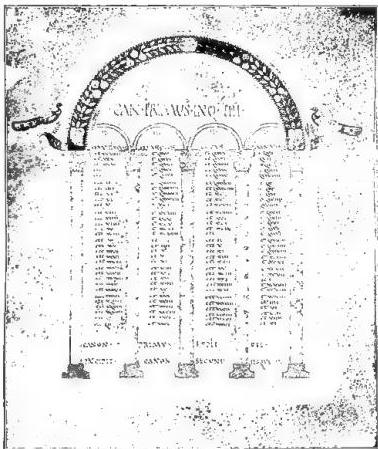
(fot. Biblioteca Vaticana)
EUSEBIO DI CESAREA - Canones Evangeliorum - First Canon - in which the parallel passages of the four Gospels are indicated - Vatican Library, cod. Vat. lat. 3806, f. 2° (6th century).
and four evangelists (canon I), to three (canons II-IV), and to two of them (canons V-IX) were indicated by the corresponding numbers in the various vertical columns. Finally, in four subdivisions of canon X, E. indicated the passages proper to each evangelist.
In practice, this is a Gospel synopsis without text, but with all the necessary references to understand the reciprocal relationship of the various Gospels and their peculiarities. A marginal note (number of the pericope and of the canon) allows one to identify, while reading a Gospel, the various parallel passages. These canons still appear in the critical edition of Nestle (cf. 10th ed., Stuttgart 1930, pp. 28-33). In manuscripts, they are often adorned with beautiful miniatures.
The De quaestionibus et solutionibus in Evangelii (Greek title: Περὶ τῶν ἐν Εὐαγγελίois ζητημάτων καὶ λύσεων or Περὶ διαφωνίας Εὐαγγελίων; cf. Jerome, De viris illustribus, 81: PL 23, 727; In Matthaeum, 1, 16: ibid., 26, 24) is preserved only in very extensive fragments (PG 22, 879-1016). The work in two books is a kind of Consensus evangelistarum, intended to resolve some apparent contradictions and difficulties. The preserved texts concern in particular the period of infancy, the
Passion, and the Resurrection of Christ. Some excellent observations and ingenious solutions are not lacking.
The De solemnitate paschali (PG 24, 693-706) is a treatise of greater liturgical and dogmatic importance (texts concerning the Eucharist and the sacrifice of the Mass) than exegetical. The work was occasioned by the discussion of the Paschal question at the Council of Nicaea and is dedicated to Constantine; it was composed in 332.
DOGMATIC WORKS
Although he played a significant role in the complex Arian controversy, Eusebius cannot be called a theologian. With vague and sometimes captious formulas, he always declared himself a fervent orthodox; yet no one can deny his Arian-leaning hesitation. He wrote only two polemical-theological works, which do not always shine for clarity and precision of terminology. Marcellus of Ancyra (v.), condemned by the Arian Synod of Constantinople (336), Eusebius composed a work in two books (Against Marcellus: PG 24, 707-824; ed. E. Klostermann, Eusebius Werke, IV, in GCS 14, Leipzig 1906, pp. 1-58). This is a refutation of an untitled work by the bishop of Ancyra. In practice, Eusebius, with a great display of biblical quotations, combats Sabellianism (v.). Without doubt, the refutation is tight and effective, even if modern criticism remains uncertain about the doctrinal position of Marcellus, who always showed himself deeply attached to the formula of the Council of Nicaea. Eusebius’s stance, however, appears less clear, as he seems to reproduce, in generic terms, a subordinationism based on certain original texts. In practice, the work is more an expression of the animosity of the Eusebians (v. NICOMEDIA), who used the pen of the influential bishop of Caesarea against Marcellus, than a serene theological dispute.
Eusebius expanded and completed this work with three additional books titled De ecclesiastica theologia (Greek: Περὶ τῆς ἐκκλησιαστικῆς θεολογίας; PG 24, 825-1046; ed. E. Klostermann, Eusebius Werke, IV, in GCS 14, pp. 60-182). His aim is to demonstrate the legitimacy of the accusation against Marcellus, whose theological doctrine is defined as Judaic (=Ebionite) and Sabellian (v. SABELLIO), since at times he denies the existence of the Word before creation and at others reduces the Word to a mere "modality" of the Father (cf. De eccl. theologia, II, 1, 2: ed. cit., pp. 99, 101). The work further clarifies Sabellianism, showing its heretical character, but does little to elucidate Eusebius’s own doctrine.
VI. LETTERS
Of Eusebius’s vast correspondence, only four letters are known. One — that to Carpianus on the Gospel Canons — deals with biblical matters; the others address dogmatic questions. The letter to Flacillus,Bishop of Antioch, is more of a dedication than a letter (PG 24, 823-26; CB 14, p. 60). Eusebius briefly explains his polemic against Marcellus and presents the three books of De ecclesiastica theologia.
Far more interesting is the letter to the Caesarienses (PG 20, 1535-44), preserved by St. Athanasius in the De decretis Nicaenae synodi. In it, Eusebius recalls his prominent position at the Council of Nicaea and explains to his faithful how he was induced to subscribe to the long-avoided and suspect homoousion. He then asserts that the much-debated adjective was intended solely to clarify the lack of similarity between the Word and created things, since the Word is similar (homoiousios) only to the Father, from whose hypostasis and substance (homoousion, interpreted as ek tēs ousias) his being derives. This interpretation is the clearest proof that Eusebius was a supporter of the homoiousion (v. ARIANESIMO) without denying the divinity of Christ.
Of another letter addressed to Constantia, sister of Constantine, only excerpts remain. To this illustrious figure, who had inquired about an image of the Saviour, Eusebius responds decisively, declaring idolatrous the practice of sculpting statues and painting images of the Divinity and the saints (PG 20, 1545-50). The writing, as was natural, became the subject of lively
discussions during the iconoclastic period (v.). It is mentioned in the Second Council of Nicaea (cf. Mansi, XIII, pp. 313-17). St. Constantinople (v.) wrote an extensive refutation of it (cf. Antirheticus, in J.-B. Pitra, Spicilegium Solesmense, I, Paris 1852, pp. 371-503).
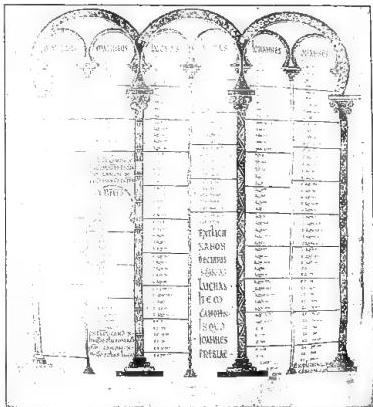
EUSEBIO DI CESAREA - Canones Evangeliorum, - Canon decimus - in cui sono indicati i passi peculiari ai singoli Vangeli. Bibbia sacra (sec. 13) - Cava dei Tirreni, Abbazia, Cod. I (già XIV).