
LIBRARY. - From the Greek βιβλιοθήκη, a repository of books. It is a collection of books selected according to organic criteria of subject matter, arranged and preserved for use in study and leisure. The term denotes not only the book material and furnishings but also the room or building. Alongside library, the term libreria (from the Latin libraria) is also found with a similar and sometimes identical meaning. According to Tommaseo, it is preferably attributed to private collections. It seems, however, that it more properly designated the cabinet or shelf, and should therefore be considered synonymous with the German Bücher-schrank and the English book-shelf or book-case, or rather small collections. In any case, in Italian nomenclature, this term has lost vitality and currency. In Anglophone countries, the word library is used with the meaning of biblioteca.
SUMMARY:
I. Ancient period
II. Middle Ages
III. Modern age
IV. State of libraries in Italy
V. The principal foreign libraries.I. ANCIENT PERIOD
1. The East
The earliest history of libraries among Eastern civilizations is intertwined with that of religious rites.The Assyrian tradition is of sacred origin. A deposit of clay tablets with texts in cuneiform characters, dating back to the third millennium B.C., was discovered at Nippur within the precinct of a temple during excavations carried out between 1890 and 1900. Even earlier, in 1850, Layard and Rassam, on the hill of Qujingk near Nineveh, uncovered a deposit of as many as 22,000 tablets, now preserved in the British Museum. These belonged to the library of King Assurbanipal (7th century B.C.) and preserve for us the majority of Babylonian literature, ritual and magical texts, history, science, and technical and administrative didactic books. Each tablet bears a mark for page numbering and a note of ownership ("property of Assurbanipal, king of the world"), which may be considered the oldest example of an ex libris. There is also evidence of libraries annexed to sanctuaries in Babylon, Assur, Küthâh (II Reg. 17:24), Agade, and Nippur.
In Egypt, libraries already existed in the pre-Ptolemaic period, according to epigraphic evidence. However, it is not known to which period the oldest ones belonged. Some scholars believe they date back to the early use of papyrus, that is, to the fourth millennium B.C. Their hypothesis is not supported by any certain proof or evidence. Instead, the era of Amenophis I of the Eighteenth Dynasty is considered more probable, though without any secure documentation. We owe to Diodorus (I, 49, 3) the legendary account of a library that a king, Odymandyas—unknown to all other sources—would have placed in a large building constructed for this purpose, naming it ψυχῆς ἰατρεῖον ("clinic or medicine of the soul"). Perhaps Diodorus refers to the library that King Ramses Miamun (14th century B.C.) had arranged in a hall of the Ramesseum near Thebes, placing it under the patronage of the gods Thoth and Seša. Lepsius discovered among the ruins of the building the tombs of two librarians. Remains of libraries also came to light in Memphis, at el-'Amârnah between Hermopolis and Siût, among the ruins of ancient Akhetaten, and at Oxyrhynchus. The large quantity of fragments found in the vicinity of major Egyptian cities demonstrates that books were widely circulated even in the homes of private individuals from various social classes. There are signs of a book circulation not unlike that of our own time and of a multifaceted production addressing every branch of knowledge: theology, magic, poetry, novels, fables, and even true encyclopedias, referred to as the Books of Thoth and disseminated in thousands of copies throughout Egypt. In major cultural centers, an entire organization of scribes must have attended to the work of transcription and the commerce of texts. The collections formed everywhere were dispersed or suffered damage during the Persian domination and later with the advent of the Macedonian conquest.
Among the Hebrews, there is mention (II Mach. 2:13) of
(photo: Selavanna)
LIBRARY – Sixtus IV visiting the Vatican Library. School of Antoniazzo Romano (late 15th century) – Rome, Hospital of Santo Spirito.
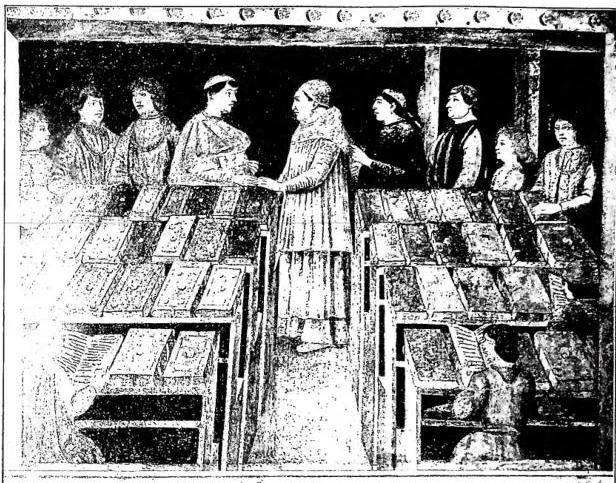
2. Greece. – According to a legend reported by Athenaeus (I, 3a) and other classical writers, the founding of the oldest libraries in Greece is attributed to Polycrates of Samos and Pisistratus. However, many elements suggest this tradition is scarcely reliable.
The first mention of bibliographic collections is found in Aristophanes' Frogs (943, 1409) and thus dates to the end of the 5th century. Euripides is also said to have been a collector of books (Athenaeus, loc. cit.), as inferred from certain allusions in the Alcestis (962) and the Hippolytus (451, 954). Such uncertain and indirect references cannot be considered sufficient to document the existence of true libraries in Greece. Indeed, Socrates (Xenophon, Memorabilia, IV, 2, 1; 8, 10) considers exceptional the case of Euthydemus, son of Diocles—a wealthy young man fond of studies—who had gathered literary and philosophical works, including complete copies of Homeric poems. Athenaeus (loc. cit.) also speaks of the library of the Athenian Euclid.
In the 4th century, the flourishing of philosophical schools had fostered and spread a love of learning, creating a new and unprecedented need for texts required by
teachers and disciples. Thus, scriptoria and numerous libraries arose, among which those of Clearchus of Heraclea on the Pontus (Mem., Fragm., I, 2, in C. Müller, Fragmenta historicorum Graecorum, III, Paris 1883, 527) and Nicocles, son of Evagoras, king of Cyprus (Athenaeus, loc. cit.) are remembered. One cannot imagine the Academy without a sufficient collection of texts. Strabo (XIII, 608 ff.) states that Aristotle was the first collector of books (πρῶτος ὢν ἴσμεν συναγαγῶν βιβλία). Upon his death, the library passed successively to Theophrastus and to Neleus of Scepsis, who transferred it to Mysia, where it was acquired by Apellicon of Teos, who found it largely incomplete. The Roman dictator Sulla later found it in Athens and took possession of it, bringing it to Rome. All these events are recounted by Diogenes Laertius (V, 62).
The greatest Hellenic library arose in Alexandria. Its original plan was conceived by Ptolemy I (323–280), but its execution was realized by Ptolemy II (280–246). It consisted of two sections: the more important, named the Brucheion, was located near the museum in the royal palace, while the smaller was housed in the Serapeum, outside the royal quarter. It contained works in Greek. Texts in Assyrian, Phoenician, Hebrew, Aramaic, and Egyptian were translated into Greek. It is possible to reconstruct the topographical distribution of its book furnishings and their content from the catalogues (πίνακες), the most complete of which is that
of Callimachus. From the information provided by the historian Tzetzes and the Oxyrhynchus Papyrus 1241, as well as from numerous other catalogues (laterculi), a list of some of its librarians can be compiled. The Alexandrian library was enriched with volumes not only through purchases but also, and above all, through the daily work of its scribes, who transcribed texts while emending and recensioning them. Thus, the tradition of the scriptorium, governed by strict rules, was consolidated. The division of material in the volumes was regulated by norms establishing when works should be contained in a single scroll (ἀμιγείς βίβλοι) and when multiple treatises should form a miscellany (συμμιγείς βίβλοι), as well as how the various parts of a single work should be grouped. It also determined the length of each volume according to the number and type of verses it contained (stichometry). The Alexandrians also used diacritical marks, punctuation, and other conventional indications.
Another tradition, which enjoyed long but uncertain fortune (Seneca, De tranquillitate animi, IX, 5; Dio Cassius, XIII, 38, 2; Gellius, Noctes atticae, VII, 17; Plutarch, Caesar, 49), holds that the library was destroyed by the fire set by Caesar’s fleet in the port of Alexandria (47 B.C.). Shortly thereafter, however, it still appears to have existed, as Antony enriched it with 200,000 volumes taken from the library of Pergamum and donated to Cleopatra. Yet its decline had certainly begun by then. By the time of Aurelian (270), the collection of the Brucheion would have definitively perished; in 391, the fanatical mobs of Patriarch Theophilus would have devastated and burned those of the Serapeum.
The Byzantine Tzetzes states that in Callimachus’ time, the Brucheion contained 400,000 συμμιγείς βίβλοι and 90,000 ἀμιγείς, while the Serapeum held 42,800 volumes. These numbers would later have risen to 700,000 volumes by the time Caesar caused the fire.
Another distinguished library was that of Pergamum. According to an ancient legend, the learned king Attalus I (241–197) would have assembled a number of works that formed the initial nucleus around which the substantial collections, ordered and systematized in the time of Eumenes II (Strabo, XIII, 624), were later developed. Excavations conducted in 1874 by the German mission of Humann uncovered the remains of the library’s sumptuous building. It consisted of three adjoining rooms, with a portico in front adorned by a statue of Athena, who, according to Juvenal, was considered the patroness of libraries. Some holes found in the inner walls, according to archaeologists, should be regarded as
traces of the supports that held the shelving. Other statues, of which only the inscribed bases remain, also adorned the portico. The names of Homer, Alcaeus, Herodotus, Timotheus, and other writers can be read there. Eumenes would have founded the library out of rivalry with Egypt, whose king, Ptolemy Physcon (146–117 B.C.), is said to have even forbidden the export of papyrus. The legend is scarcely credible, as Eumenes had already been dead for twelve years (158 B.C.) when Ptolemy Physcon ascended the throne. The organization and functioning of the library of Pergamum reflect Alexandrian influences. It, too, was not merely a book repository but a museum rich in
works of art and a gathering place for scholars. It had catalogues reminiscent of Callimachus’ πίνακες and a flourishing scriptorium. Plutarch (Antonius, 58, 59) recounts that Antony donated the library collections of Pergamum to Cleopatra.
Other libraries arose and flourished in Antioch and near the Pyramid of Cheops at the initiative of King Antiochus III. Mithridates, king of Pontus, is said to have founded one that later fell into the hands of Lucullus. An older, though smaller, library would have been
that of Hiero II (270–215 B.C.), tyrant of Syracuse. In Athens, next to the palaestra, a library called the Πτολεμαῖον was founded by Ptolemy Philadelphus, enriched by the book contributions of the young men who frequented II. Considerable bibliographic collections were formed in Smyrna, Chios, Delphi, Halicarnassus, Corinth, Milasa, and Teos, almost always adjacent to palaestras. They are also found in the service of temples, as at Cos, or in private homes, such as that of Dio Chrysostom in Prusa or of T. Julius Aquila Polemaeanus in Ephesus.
V. ALESSANDRO; PERGAMO; PTOLEMEI
E. F.3. Rome
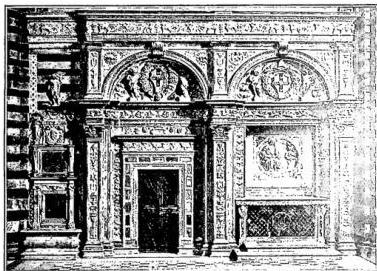
Victorious Roman generals took with them the libraries seized from the vanquished, considering them personal war spoils. The triumphant general of Pydna (168 B.C.), L. Aemilius Paullus, gave his sons the books that had belonged to Perseus, king of Macedonia (Plutarch, Aemilius Paulus, 28). In 146 B.C., C. Scipio Africanus distributed the Phoenician books found in Carthage to the princes of Numidia, Rome’s allies, bringing back in his trophy only twenty-eight scrolls containing the agricultural works of Mago (Pliny, Nat. Hist., XVIII, 22). Andronicus of Rhodes reorganized and enriched the rich library of Apellicon, housed in his villa. Cicero was an avid bibliophile. He owned numerous libraries in his various residences: at Cumae, Tusculum, Antium, Formiae, and on the Aventine (Epist. ad Attic., I, 4, 3; 10, 4; 11, 3; 20, 7; II, 1, 12; 6, 1; IV, 4, 1; 5, 3; 8, 2). His friend T. Pomponius Atticus spent vast wealth to enrich the great library he had in his house on the Quirinal, whose organization was overseen by learned slaves. In addition to BIBLIOTECA - View of the Piccolomini Library. Sculptures by Lorenzo di Mariano, known as il Marrina (1497). Siena, cathedral.The texts he acquired were joined by those produced in the attached scriptorium. Q. Tullius Cicero and M. Terentius Varro also possessed libraries in Rome. The greatest bibliophile of the Republican period, however, was M. Licinius Lucullus, a man of broad and varied culture who owned two libraries: one in Rome, formed around the large collection he had brought from Greece, and another in Tusculum, which he opened to the public with great liberality.
In the Imperial period, the library became increasingly integrated into the necessities of social and private life. Vitruvius, in his work, repeatedly felt the need to assign it a suitable place in the architectural design of houses and public buildings. Book collections were scattered everywhere in the residences of wealthy lords. Latin works were kept separate from Greek ones, and in larger libraries, they were grouped into two sections housed in different rooms. Libraries were also found in suburban villas and even in the modest homes of scholars. A particular character was assumed by the numerous libraries formed in the late imperial period under the influence of Christian religious currents. The noble Gallienus left his to the Church; Tonantius Ferreolus, Consen-
(courtesy of Mons. Frutaz)
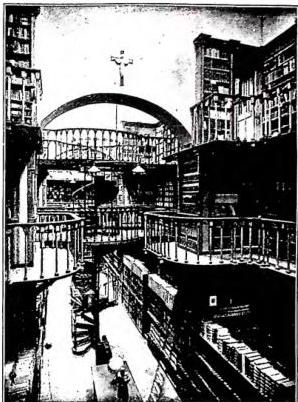
The interior of the library of the Abbey of Maria Laach.
Among Roman public collections, the first to be recalled is the one that Caesar was forming with the help of M. Terentius Varro, which remained unfinished at his death. The first of these opened for public use was due to the patronage of C. Asinius Pollio (76 B.C.-5 A.D.), who placed it on the Aventine, where the Atrium Libertatis stood. In 28 A.D., at the behest of Augustus, a rich library arose in the imperial palace on the Palatine, which, after various events, survived until the second half of the 4th century. It had been severely damaged during Nero's fire of 64 and later transferred to the palace of the Flavians, where it was twice burned again (in the years 161 and 363). Octavia, Augustus's sister, founded the library that bore her name, located in the portico adjacent to the temples of Jupiter Stator and Juno. It fell victim to a fire in 363.
Vespasian gathered in the temple of Peace, along with the books he had brought to Rome as spoils of the Jewish war, others he had acquired (Pliny, Nat. Hist., XXXVI). The most important in terms of size and value of texts was the Ulpian Library, which Trajan had built in the forum bearing his name, near the column. It was preceded by a por-
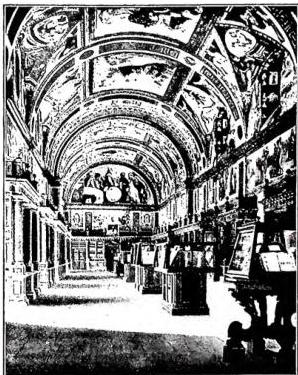
LIBRARY - Hall of the library of the Escorial (16th century).
portico, of which remnants can still be seen. In almost all thermal buildings, public libraries were found, for example, in the Baths of Caracalla, the Trajanic, Diocletian, and Neronian-Alexandrian Baths.
Outside Rome, in nearly all cities of some importance, collections intended for public reading were formed, for example, at Tivoli in the Temple of Jupiter, at Como in the villa of Pliny the Younger, at Tortona, and at Suessa. Following the transfer of the capital to the East, libraries in Constantinople received considerable impetus, especially through the work of Constantius, who established another in the basileuon, later becoming the object of particular provisions by his successors. By the time of Theodosius II, it possessed as many as 120,000 volumes.
4. Christian libraries
Christians, continuing the Jewish tradition, maintained the habit of assiduously reading Holy Scripture, of which the early communities of the faithful must have possessed multiple copies, along with the books indispensable for liturgical practices and the instruction of catechumens. The preparation of texts was attended to by Christian scribes, whose work became increasingly active and appreciated. Culture intensified in Rome and the Western countries in the 4th century, receiving notable impetus, especially through the work of St. Jerome, who, with St. Augustine, embodied the great doctrinal and philological movement of his time.The early collections also contained books of more modest content: lists of bishops, registers of the poor, calendars, acts of martyrs, synodal decisions, etc.
The greatest center of theological studies at the end of the 2nd century was Alexandria, where a school flourished, having two great masters, Clement of Alexandria and Origen, along with a library and a scriptorium. The culture of those scholars, to which the later work of Ambrose and Athanasius is connected, was notably influenced by the Hellenistic tradition. Origen had probably frequented the libraries of the Brucheion and the Serapeum in his native city, and when, as a fugitive, he took refuge in Caesarea, he founded a great school to which he dedicated all his activity. He attached to it a library, reminiscent of that of the Peripatos, and a scriptorium of Alexandrian inspiration. The continuator and follower of his work was Bishop Alexander, who had also founded a rich library in Jerusalem as early as 212. After Origen’s death, the priest Pamphilus, his disciple, kept the school and library alive, which St. Jerome (De vir. ill., 113) recalls as bibliotheca Origenis et Pamphili. According to Isidore of Seville (Etymologiae, VI, 6, 1), it contained as many as 30,000 volumes. Eusebius made use of it for the composition of his Historia ecclesiastica, and it was later cared for and expanded with numerous books.
Notable for the quantity and quality of its texts was the library of St. Augustine, later bequeathed by him to the city of Hippo. It was later dispersed during a sack by the Vandals.
In Rome, information about the origins of ecclesiastical libraries is quite scarce. The Liber Pontificalis assures us only that in the time of Pope Anterus (235-36), the acts of the martyrs were preserved in churches. It can be assumed that these were kept together with sacred books and documents concerning the life of the Church.
Pope Damasus (366-84), who had long worked with his father in the scrinium of the Roman Church, founded the Basilica of St. Lawrence near the Theater of Pompey, designating some rooms facing the portico for the archiva, in which he also placed books. Other certain references to an archive (archivum or scrinium) date back to Innocent I (407-17). This reference recurs frequently thereafter, sometimes together with that of bibliotheca Romanae ecclesiae or Apostolicae Sedis. Pope Hilarius (461-68) had a library of the Roman type built next to the cloister of St. Lawrence Outside the Walls, that is, having a Greek and a Latin section. St. Paulinus urges the faithful (Epist., 32, 16) to read and meditate on the sacred texts preserved in a room to the left of the apse of the church of Nola.
Numerous collections were formed almost everywhere during the 4th and 5th centuries. George of Cappadocia possessed philosophical and literary books; St. Jerome had one in Rome and another in his monastery at Bethlehem. In Palestine, libraries were scattered, sometimes of modest size, in various religious communities.
The Rule of St. Pachomius prescribed that the cenobites of the monastery founded at Tabennisi in 322 should preserve and use the library, which contained, among other things, Holy Scripture and the Fathers. St. Ammon would have read as many as six million lines of patristic works. He exhorted his disciples to exercise themselves in the meditation of sacred texts. Shenoute (d. 451), the eloquent and austere founder of the monastery of Atripe, obliged the cenobites to read and transcribe books.
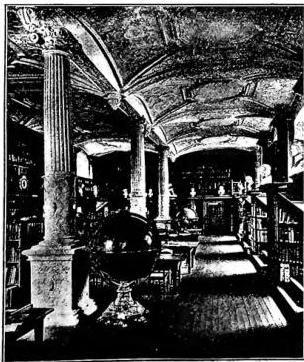
In some pre-Benedictine monasteries of the West, a similar scholastic and bibliographic organization is not lacking. At Marmoutier, the religious community founded by St. Martin of Tours in 372 certainly had a scriptorium and perhaps a library—"Ars ibi, exceptis scriptoribus, nulla habetur" says Sulpicius Severus (Vita s. Martini, ch. 10). Also at Lérins, on the coast of Provence, the religious had a library, the books of which
G. FERRUA S.I.
Library - Reading room of the civic library of Trier, formerly the library of the Jesuits (1611-14).
they were allowed only to use, never to own any books of their own. A similar organization is found in the two monasteries founded in Marseille by Cassian (414). St. Patrick (372-461), the apostle of Ireland, having studied at the continental school of St. Germanus in Auxerre, became acquainted with the monastic regulations of Tours and Lerins, which inspired him in the foundation of the first insular schools. When he went to Rome, Pope Sixtus III entrusted him with a large number of books, which he brought with him to Ireland.
5. Technical characteristics of libraries in the ancient period. - The library initially had, as seen, a sacred character or served to complement the practices of ancient cults, forming part of the temple and arising alongside II. Only later did it gain structural and functional autonomy. For its construction in public buildings and private homes, a whole set of canons developed, reflecting the tradition of a type we might call Hellenistic, as it originated from the Athenian Peripatos and established itself with distinct characteristics in Alexandria and Pergamum. Two Roman texts, Varro’s De bibliothecis (Gramm. rom. fragmenta, ed. Funaioli, Leipzig 1907) and Vitruvius’ De Architectura (I, 2; VI, 4, 7), provide information on this.
The library was to face east and was almost always preceded by a portico. Pliny (Nat. Hist., XXX, 10) states that it was customary to adorn it with statues, a claim confirmed by epigraphic evidence containing dedicatory inscriptions related to busts of great writers. Sometimes portraits were painted in medallions arranged on the shelves. The room’s floor plan, typically rectangular, featured at the far end, opposite the entrance, a niche in which the statue of Athena, goddess of wisdom, was prominently displayed, symbolizing her patronage.
Books were placed on wooden shelves at various levels within perimeter niches, often, as in Ephesus and the Ulpian Library, in multiple tiers, so that access to those placed higher up required a landing or gallery running along the walls of the room. Sometimes the scrolls did not rest directly on the shelves but were stored in capsae with lids.
The cabinets were closed with wooden or metal doors and harmonized with the room’s architecture. In the libraries of the wealthy, precious aromatic woods were used, which also served to keep insects away, or ivory.
In the earliest period, the management of the library was entrusted to ministers of worship, as, for example, among the Egyptians and Assyrians, or to teachers, as in Greece. Only under Alexandrian regulations did a body of precepts develop, through the work of specialists—namely, scribes and librarians—on how to transcribe texts, preserve them, organize them, and make them accessible for research and consultation. In Roman libraries, the role of those assigned to them changed, some of whom were also responsible for their administration. Slaves organized into collegia were also employed, but primarily for executive tasks. The custom of entrusting technical and administrative direction to scholars was never abandoned.
In the imperial household, staff organization was regulated according to the number and abilities of each member, though no distinction was made between the duties of the bibliothecarius and those of the procurator rationum summarum privatarum bibliothecarum. Early Christian book collections appear to have been managed by ecclesiastics and, exceptionally, by lay faithful. These accounts, however, refer particularly to small collections of liturgical texts, not to true libraries.
The librarian was responsible for cataloging and shelving volumes according to criteria and rules definitively established by the Alexandrians. Among their collaborators were scribes,
II. MIDDLE AGES
Odoacer brought the monk Eugippius from Noricum to Naples, where he founded a scriptorium and a library in the Lucullan castle. These had relations with many scholars, including Cassiodorus and the exiled African bishop Fulgentius, who in Sardinia—specifically in Cagliari—had established a monastery whose scriptorium produced the famous text of Hilary of Poitiers' De Trinitate. A few years later, during the reign of Theodoric, numerous libraries began to form, particularly through the efforts of scholars such as Symmachus, Boethius, Mavorzio, and Ennodius. Among these, the library of the cathedral of Verona deserves special mention, adjacent to the school where the renowned Ursicinus flourished.In Rome, the archivum or scrinium Apostolicae Sedis was organized during the time of Gelasius I (492-96), where books also appear to have been kept. There were also active scribes who produced numerous codices. The decree De libris recipiendis et non recipiendis is attributed to this pope or, as others contend, to Hormisdas (514-523). Studies received notable impetus during the brief pontificate of Agapitus I (535-36), to whom is owed the foundation of the library ad Clivum Scauri, on the Caelian Hill, and of a theological school. Gregory the Great would later transfer the pontifical book collections to the Lateran Palace, in that wing of the Patriarchium now part of the Sancta sanctorum building, distinguishing them from his private collections, which remained in the cloister built next to the church of S. Andrea ad Clivum Scauri. This library, therefore, is identified with the Agapetian one.
Western monasticism, which continued and revived older ascetic traditions, created a new cultural tradition in which the book played a preponderant role. In the Rule of St. Benedict,
(Int. historichii d. G. Nationalbibliothek)
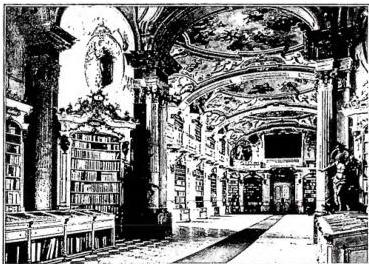
BIBLIOTECA - Hall of the library of the Austrian abbey of Admont (18th century). Sculptures by J. T. Stammel, frescoes by B. Altomonte.
the obligation of reading is prescribed for the various contingencies of claustral life. The cenobite had the book in hand in the choir, on the altar, in the refectory, in the cell, a faithful companion of his day. Many of those readings were done in common (fratres sedentes omnes in unum). Some of them, entrusted to one alone, had to be listened to and meditated upon in silence by the others. The selection of passages was provided for by whoever had the mandate. And the reader had to perform his task "cum humilitate et gravitate et tremore" (ch. 47). Individual reading was considered an antidote to otiositas. For a certain number of hours, the religious had to dedicate themselves to labor manuum and for another period of time to lectio divina. Two among the eldest (seniores) had to ensure that no frater acaediosus, abandoning himself to otio aut fabulis, was not intent on reading and thus distracted the others (ch. 48). For Lent, the hours to be devoted to reading are also indicated. The library possessed not only the codices necessary for liturgical practices and the daily needs of the monks but also the works indispensable for their studies. It was located in the cloister and was united with the school and the scriptorium, with which it had a continuous and intimate connection.
A great friend of St. Benedict was Cassiodorus, the founder of the monastery of Vivarium, near Squillace, in Calabria. A Christian and theologian, he had wished to create in Rome a school like those of Caesarea and Jerusalem, but the onset of new political events and especially the death of Theodoric, of whom he had been a collaborator, did not allow him to realize his plan. He subordinated his attachment to classicism to the principles and ends of religious doctrine. In the Vivarian cloister, he realized an educational organization in which Christianity and paganism (understood as Romanity), monastic discipline, and intellectual work seemed to be reconciled. The labor of writing allows the scribe to resist diaboli subreptiones illicitae, and study opens the mind to the paths of eternal salvation. From his Institutiones divinarum litterarum, one can reconstruct the life of the library and the scriptorium. We thus know what kind of texts he collected, the sources from which he drew, the works he selected, and the norms followed in the reproduction of texts. In the treatise De orthographia, he gives particular precepts for obtaining correctness in dictation. After his death, the library dispersed, it seems, into various nuclei that nourished new book collections in Verona, Bobbio, and insular monasteries.
Many libraries were formed simultaneously outside Italy, especially in France. But a more direct connection with Roman culture was preserved by the insular cultural currents, especially Irish ones. In the three hundred cenobitic communities founded especially in Scotland by Columba, monasteriorum pater et fundator, libraries and schools were formed in which continental influences were evident. From then on, libraries and schools multiplied in the cloisters that arose wherever evangelization reached.
In the 7th century, information regarding the vicissitudes of the book collections of the Apostolic See is uncertain. It is known with certainty, however, that Rome had become a destination for young people who attended its schools, for scholars and bibliophiles from every place who came to acquire or donate books. A Greek colony that had settled between the Palatine and the Aventine established schools, libraries, and monasteries of the Greek language. The insular monastic colonization also spread on the continent, where numerous libraries, schools, and scriptoria arose
that maintained lively relationships among themselves. In 612, the Irish monk Columbanus arrived in Milan, a refugee with some companions from Burgundy, and found a benevolent welcome at the Lombard court. He was also given the locality of Bobbio, near Piacenza, where he soon founded (614) an abbey that quickly became a luminous center of studies and the seat of a library and a scriptorium. The original book collection, which must have contained Irish manuscripts, rapidly grew through accessions from the local scriptorium or from purchases and donations.
The history of the libraries that arose in Frankish territory is the history of the insular cloisters founded there, at Luxeuil, Corbie, Péronne, St-Riquier (Centula). In Scotland, the most important book collection was established in the cloister of Iona; in Northumberland, at Lindisfarne; in the Anglo-Saxon regions, at Canterbury, Wearmouth, and Jarrow. Among the insular centers that moved into Germanic territory, we recall Mainz, Fulda, Echternach, and St. Gall.
Around the middle of the 8th century, in Rome, Pope Zachary (751-52), the last Greek to assume the pontificate, belonged to those bilingual scholars who elaborated texts in the city's scriptoria. He himself had translated works from Greek into Latin and vice versa. Until that time, the vicissitudes of the bibliographic collections remain obscure. It was due to his patronage that the scrinium at the Lateran was organized, in which he seems to have distinguished the section containing books from that of documents. He gave a new arrangement to the building, having a portico constructed before it in the Hellenistic manner, a tower, and a triclinium. Only later, however (781), is a bibliothecarius first mentioned, by the name of Theophylact. The library of St. Peter also had a slow but incessant development. In the city, the production of books destined for export to even the most distant lands continued. Numerous libraries, some of which were distinguished for the number and importance of their codices, arose or flourished in the cathedrals of Verona, Milan, Vercelli, Pavia, Modena, Lucca, Arezzo, in the monasteries of Nonantola, Novalesa, and especially Montecassino, which experienced a period of great splendor through the work of Paul the Deacon and his school.
A new direction was given to studies by the Carolingian Renaissance, which also exerted its influence on libraries, the greatest of which arose alongside the famous Palatine School on an original nucleus consisting almost exclusively of codices that had come from Rome to Pepin. It had the character of imperial magnificence insofar as it reflected the multifarious cultural currents that converged at the imperial court.
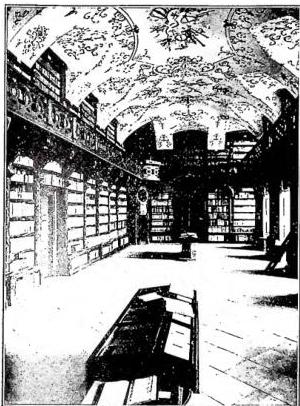
BIBLIOTECA - Interior of the library of the Austrian abbey of Göttweig, by J. L. V. Hildebrand, stuccoes by F. Amon (1778).
Christ states that Charlemagne was "the first crowned bibliophile of the Middle Ages," to whom we owe the first courtly and state library. We are outside the cloisters and churches, before the oldest example of secularization carried out largely by ecclesiastical masters, such as Alcuin of York, Paul the Deacon, and Theodulf. The fortunes of the library were uncertain and confused, eventually leading to its decline and extinction; yet the new spiritual orientation given to it had profound and lasting repercussions on the subsequent developments of studies and culture.
In the 9th century, the flourishing of libraries, schools, and ecclesiastical writers continued, especially in Verona, through the work of the archdeacon Pacificus and Bishop Ratherius, as well as in Vercelli, Turin, Pavia, Cremona, Modena, Lucca, and Arezzo. A rich collection of codices was owned by Eberhard, Margrave of Friuli, who had at his court, in the Eastern March, Rabanus Maurus, Hincmar, and Gottschalk. Montecassino still dominated studies throughout the South, exerting a strong influence on Benedictine monasteries. Bobbio also maintained the ancient primacy of its greater library, to which it added the new one "ad Speluncam." During this period, the bibliographic heritage was systematically organized, and around the 10th century, a catalogue was compiled, edited by Muratori (Ant. Ital. M. E., III, Milan 1740, p. 818). The monasteries of Nonantola and Novalesa were also active, though of lesser importance. This glorious path was halted by the incursions of Saracen and Hungarian violence, which devastated the life of the cloisters. Outside Italy, too, barbarian violence was felt, contributing to or accelerating the decline of studies in Spain and the British Isles.
The Cluniac and Cistercian reforms, while steering culture more decisively toward sacred disciplines and resisting classical and paganizing influences, recalled schools and scholars to the strict observance of primitive monastic rules. The Church was undergoing one of its most difficult crises due to adversities that, though they did not weaken its authority, exerted a noticeable influence on the culture of ecclesiastics. Men of profound learning reacted to the spread of heretical currents by drawing from the pure scriptural and patristic sources and tradition. Monastic and ecclesiastical libraries increasingly emphasized their sacred character in opposition to that of lay schools. Montecassino regained its former splendor when Abbot Theobald (1023-35) reconstituted the library; it reached its apogee under Abbot Desiderius (1056-1086), who later became Pope Victor III (1086-87). The scriptorium was highly active, and the school was much celebrated, where the greatest scholars of the time, Amatus, Alfanus, Alberic, Constantine the African, and Leo of Ostia, exercised their magisterium.
The contribution of other monasteries' libraries to studies, though less vibrant, was still significant: Farfa, Nonantola, Pomposa, Fonte Avellana, and especially those of the cathedrals of Vercelli, Novara, Ivrea, and Verona.
The new mendicant Orders infused their spirit and aspirations into collections. Thus were formed those of the Franciscans in Assisi, Siena, Padua (Antoniana), Florence (S. Croce), Todi, and of the Dominicans in Bologna, Pisa, Florence (S. Marco and S. Maria Novella), Venice (SS. Giovanni e Paolo), Turin, and Naples.
The rise of universities and the flourishing of legal studies, especially in Bologna, Padua, and Naples, coincided with the new fortunes of the Italian vernacular and the secularizing and Ghibelline orientation of the courts. A profound change occurred in the very conception of the book, produced no longer as a duty of inner discipline but for profit (scriptores qui pro pretio scribunt), and in that of the library, understood as a means of information and lay studies, sometimes even opposed to the medieval sacred tradition. The distinctly hostile tendency of the schools created by Frederick II and Manfredi later softened, tempered by the broader and more serene work of the Angevins. The collections of texts formed in Naples under Charles I of Anjou, and especially under his grandson Robert, reflected the spiritual stance of the princes and the culture of their time, as well as the ideal ties linking Naples with Perugia, Florence, and Avignon.
Among the most glorious libraries assembled by the early humanists, those of Francesco Petrarca (1304-1374), Giovanni Boccaccio (1313-75), Coluccio Salutati (1331-1406), and Poggio Bracciolini (1380-1459) will be recalled here. Numerous were those founded by princely patrons, some of which were distinguished for the quantity and importance of their texts. Worthy of mention are the valuable collections of the Princes of Achaia, the Sforza library of Pavia, the Malatestiana of Cesena, the Estense of Ferrara, the Urbinate of Federico da Montefeltro, and the Gonzaga library of Mantua. In Florence, the initial nuclei assembled by Cosimo and Piero de' Medici were enlarged and completed by Lorenzo the Magnificent with numerous codices purchased from private individuals and others transcribed by scribes he employed and sent even to distant lands. He is therefore considered the founder of the Medicea Laurenziana, which was also enriched by his son Piero and the later heirs of his house. The Aragonese library of Naples, founded by Alfonso I and expanded by Ferdinand I and Alfonso II, was also highly valuable. It was plundered by the French king Charles VIII, who transported its most notable part to Paris, where some manuscripts are still preserved. In this period, the Marciana library also arose around the original substantial nucleus of Petrarch's works and the codices bequeathed to the republic by Cardinal Bessarione.
The ancient monastic foundations still survived, continuing a venerable tradition while maintaining modest limits in their orientation and size, whereas the new princely collections reflected the new directions of studies and had assumed unprecedented dimensions. Library (v.) represents the noblest and most significant link between ancient and new institutions, between the Middle Ages and the modern era, between ecclesiastical erudition and humanism.
BIBL.:
- Christ, Die Bibliothek des Klosters Fulda im 16. Jahrhundert, Leipzig 1898.
- Muratori, Antiquitates Italicae Medii Aevi, Milano 1740.
- Storia della cultura veneta, a cura di G. Arnaldi e M. Pastore Stocchi, Vicenza 1976-1987.
- Le biblioteche nel mondo antico e medievale, a cura di G. Cavallo, Roma-Bari 1988.
- La biblioteca di Montecassino, a cura di F. Avagliano, Montecassino 1994.
- Le biblioteche nel Medioevo, Atti del Convegno (Cassino 1997), a cura di G. Cavallo, Roma 2000.
A. P.
III. MODERN AGE
The invention of printing accelerated the shift in the direction of studies, facilitating the diffusion of books and intensifying the growth rate of libraries. It thus also influenced their structures and cataloguing systems.
In 1609, Cardinal Federico Borromeo opened AMBROSIA (v.), founded by him, an illustrious institution in which a noble tradition of studies was perpetuated. After the Vatican, it is the richest collection of manuscripts, notable for their antiquity, provenance, and content. Thereafter, many other libraries arose throughout Italy. In Rome, the Angelica, formed around the nucleus of the Augustinian Angelo Rocca, was opened to the public in 1614, and was later enriched by the books of Cardinal Passionei, Olstenio, and Cardinal Noris. The Alessandrina, established in 1666 by Pope Alessandro VII Chigi, opened its doors to readers in 1670. In the last years of the century, specifically in 1698, Cardinal Girolamo Casanate left by will a fund of 160,000 scudi for the creation of a public library in the convent of the Minerva. The building was constructed in a short time (1700), and the first 20,000 volumes already collected by the munificent cardinal were placed there, followed by subsequent acquisitions.
No less vigorous was the work carried out to increase the book patrimony of universities and municipalities in Bologna (1605), Perugia (1623), Padua (1629), and Fermo (1688).
The 18th century is considered the century particularly favorable to the fortune of erudite studies and the formation of libraries of a modern type. Spacious and luminous halls, sumptuous Baroque shelving, lavish furnishings, an abundance of well-bound books, a livelier and more intense movement of readers, a grander vision of erudite research. A
(from M. Burton, Famous Libraries of the world, London 1937)
READING ROOM - Library of the University of Cambridge.
Upon his death in 1714, Antonio Magliabechi bequeathed his 30,000 volumes to the poor, with the stipulation that they be made available to all citizens. Thus was born the Magliabechiana, which grew rapidly thanks to the munificence of princes and private individuals and formed the original core of the Biblioteca Nazionale Centrale. Among the most notable acquisitions, the following deserve mention: the Marini library (1736), the Gaddi (1755), the Biscioni (1756), the Mediceo-Palatina and the Lorraine (1771), the Lami (1775), the Strozziana (1786), the Palatina (1861), and many others. In Lombardy, Maria Theresa gave considerable impetus to studies by founding numerous libraries, some of notable importance. She conceived one for the Archiginnasio of Pavia when she reformed it in 1757. However, its actual inception dates to a few years later (1763) and to the work of Gregorio Fontana, who gathered the first nucleus of academic proceedings. In Milan, the Pertusati library, acquired by the Congregazione di Stato and donated to Archduke Ferdinand, contained 24,000 volumes. By Maria Theresa’s rescript of 1770, it was immediately opened to the public, and shortly thereafter, following the suppression of the Society of Jesus, it was established in the Palazzo di Brera and enriched with numerous collections of various origins.
Among the others, the libraries of the Universities of Pisa, Genoa, Turin, and Cagliari,
the Corsiniana in Rome, the Classense in Ravenna, the Federiciana in Fano, and those of Bergamo, Brescia, Lucca, Mantua, and Palermo achieved considerable development.
The history of libraries in the nineteenth century can be divided into two periods: the first preceding unification, the second following II. In the major centers of study, they reflected the influences of Enlightenment thought and the erudite reaction. In Parma, the books collected and organized by Filippo di Borbone as early as 1769 passed to the State during the Restoration (1818) and were housed in the Palazzo della Pilotta. Duchess Maria Luigia showed great generosity toward the new institution, enriching it, among other things, with precious Oriental manuscripts. The Borbonica in Naples, which had already been established in the time of Charles III, was only in 1804 placed in the Palazzo di Capodimonte and opened to the public. It already included the distinguished library of San Giovanni a Carbonara, the collections of the Jesuits, the Farnesiana, and the Officina dei Papiri Ercolanesi.
The suppression of religious congregations during the period of French domination paralyzed scholarly life in many monastic centers and led to the confiscation of substantial book collections, which were either dispersed and dismantled or overwhelmed public libraries with material of little or no use to them. These drawbacks recurred and worsened after national unification,
when the laws of suppression imposed on municipalities and the State the obligation to preserve vast quantities of works that, due to their content and monotonous uniformity, could not benefit public reading. Each library inherited multiple copies of patristic, ascetic, and theological works, which represented a dead weight yet had deprived communities and schools of the resources necessary for their work.
Alfonso Gallo
IV. STATE OF LIBRARIES IN ITALY
In terms of their organization and purpose, Italian libraries can today be divided into state, provincial, and municipal libraries, those of ecclesiastical institutions, popular libraries, and private libraries.17. State Libraries
State libraries are in turn distinguished into: central national libraries, national libraries, university libraries, and government libraries without further specification.a) The central national libraries are two: that of Florence, developed around the nucleus of Antonio Magliabechi’s bequest (v. above), today holds 22,000 manuscripts, 400,000 autographs, 2 million printed works, and several valuable collections. That of Rome results from the merger of approximately 60 monastic libraries incorporated by the State following the suppression of religious Orders and Congregations (1873), among which particularly rich were those of the Jesuits of the Gregorian University and the Gesù. It possesses approximately 5,670 manuscripts (notably the Sessorian collection, formerly in the Sessorian Library of S. Croce in Gerusalemme in Rome), 704,000 volumes and 660,000 pamphlets, a rich collection of journals, and special collections. The "National Center for Bibliographic Information" depends on II. Both these libraries enjoy the so-called "printing right" or "mandatory deposit," by which every Italian publication must be sent to them free of charge.
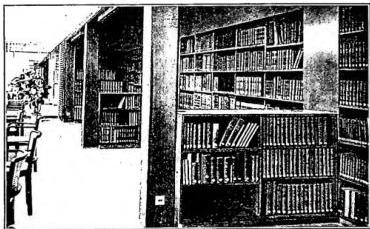
READING ROOM of the new National Library of Bern.
it suffered no immediate losses despite the building's collapse during the Second World War, and now holds approximately 4,600 manuscripts and 1,100,000 volumes. The National Library of Palermo is the continuation of the Jesuit library of the Collegio Massimo, seized and opened to the public by Ferdinando I in 1778; after the losses caused by the Second World War, it now holds approximately 360,000 volumes and valuable collections of autographs.
c) University government libraries also benefit from provincial legal deposit. Originating for university studies, they have almost all developed in a humanistic direction and, with the exception of Pavia, lack scientific publications. There are twelve in total: Pavia (founded by Empress Maria Theresa in 1757, with a detached collection from the library of the Collegio Ghislieri; it holds 350,000 volumes); Padua (founded by the Venetian government in 1621; it holds 330,000 volumes); Genoa (founded with the holdings of the Jesuit library in 1773; it has various valuable collections); Bologna (established in 1742 from the merger of the collections of Ulisse Aldrovandi and L. Ferdinando Marsili; it holds approximately 480,000 volumes); Modena (founded in 1772 and annexed to the Estense Library; it possesses 62,000 volumes); Pisa (formed from the bequests of two professors of the Athenaeum in 1742; it has approximately 240,000 volumes); Rome (known as the Alessandrina [V. above], formerly at the Palazzo della Sapienza; today it holds approximately 332,000 volumes and 258,000 pamphlets); Naples (originating from the nucleus of the Gioacchina Library, founded by G. Murat and opened to the public in 1827; it holds 630,000 volumes); Messina (derived from the suppressed Jesuit library, becoming municipal in 1778 and later university in 1838; it possesses approximately 100,000 volumes); Catania (established in 1755 with the nucleus of the private collection sold by the historian G. Caruso; administratively united with the Ventimiliana Library, derived in 1873 from the collection of Bishop S. Ventimiglia; together they hold 150,000 volumes); Cagliari (derived from the original nucleus donated by Carlo Emanuele III in 1792; collapsed during the Second World War, it still holds 225,000 volumes); Sassari (possibly initiated as early as the late 16th century; today it holds 90,000 volumes).
d) The other government libraries number fifteen: seven in Rome, three in Florence, and one each in Parma, Modena, Cremona, Gorizia, and Lucca. Among those in Rome, special mention is deserved by: the Casanatense (v. above), rich in precious collections of Roman diaries and edicts and prints, with a book collection of approximately 230,000 volumes; the Angelica (v. above), notable for its collection of Romance philology, with 130,000 volumes; the Vallicelliana (v. above), which today holds approximately 40,000 volumes and has in deposit one of the richest collections of historical journals, owned by the Deputazione di storia patria. The others are the library of the Istituto di Archeologia e Storia dell'arte, the Medica, the library of Modern and Contemporary History, and the Musical Library of S. Cecilia. Among the Florentine libraries, the Mediceo-Laurenziana is deservedly famous, begun as a private collection by Cosimo the Elder de' Medici (1389-1464) and continued by his successors until Cardinal Giulio (Pope Clement VII), who wished it housed in a magnificent building designed by Michelangelo in the cloister of S. Lorenzo: the new site was opened to the public in 1571. With a philological-classical character, it possesses more than 10,000 manuscripts, some of which are extremely precious (suffice it to mention the Medicean Virgil of the 5th century and the Horace that belonged to Petrarch), and approximately 34,000 volumes. Also in Florence are the Marucelliana (approximately 270,000 volumes) and the Riccardiana (40,000). The other five are the Palatina of Parma (founded in 1769 by Duke Filippo of Bourbon; destroyed during the Second World War, it holds approximately 410,000 volumes), the Estense of Modena (derived from the private collection of the Este family, it possesses approximately 235,000 volumes and many illuminated manuscripts of great value), those of Cremona (founded by Empress Maria Theresa of Habsburg in 1774, it holds approximately 200,000 volumes), Gorizia (established in 1919 from the merger of the "Studien Bibliothek" with the municipal and provincial libraries; it has approximately 110,000 volumes), and Lucca (opened to the public in 1794 with the nucleus of the library of the Lateran Canons of S. Frediano; today it holds approximately 330,000 volumes).
State property today also includes the libraries of the former royal house, among which the two in Turin deserve particular mention: the king's library (150,000 volumes and 4,000 manuscripts) and that of the Prince of Piedmont (approximately 10,000 volumes; specialized in the history of the House of Savoy).
2. Provincial and municipal libraries. These are very numerous, mostly dating back to foundations of the 17th-18th centuries, and are of particular importance for local historical bibliographic material. The most famous of all is the Bolognese library, known as the Archiginnasio, opened to the public in 1801 and resulting from the merger of various suppressed libraries; it suffered various damages during the 1940-45 war but preserved its holdings: it possesses very notable collections of portolans and geographical maps and approximately 450,000 volumes.
3. Libraries of institutes. Among the libraries of public bodies and institutes, all specialized, it suffices to mention those of the various regional Deputazioni di storia patria, of the many national and city academies, of the numerous Italian and foreign cultural institutions, and in particular the Roman libraries of the Deutsches Archäologisches Institut (56,000 volumes), of the British School (approximately 30,000 volumes), of the École française (40,000 volumes), of the American Academy (approximately 48,000 volumes); those of the Senate (approximately 140,000 volumes), of the Chamber of Deputies (approximately 180,000 volumes), of the various Ministries, that of the Consiglio Nazionale delle Ricerche (approximately 150,000 volumes); and finally the Corsiniana Library in Rome, which has retained the holdings it had in 1754 when it was opened to the public by Cardinal Neri Maria Corsini (35,000 volumes), now united with the library of the Accademia dei Lincei (approximately 150,000 volumes), famous for its collection of Atti of all academies.
4. Ecclesiastical libraries. These are many and notable, often constituting a unicum for their specialized collections. Apart from the Vatican and Ambrosian libraries (for which V. the individual entries), the remaining ones can be distinguished into capitular libraries, libraries of seminaries, archiepiscopal and episcopal libraries, libraries of religious Orders and parishes, and libraries of universities and religious cultural institutes.
a) Capitular libraries are almost all of primary historical importance, having been linked to scriptoria of particular activity throughout the Middle Ages: suffice it to mention those of Vercelli (dating back to the ancient Libraria s. Eusebi; it possesses 218 codices, some of which are extremely important, and over 4,000 parchments), Verona (founded in the 9th century; collapsed during the 1940-45 war and now rebuilt; cf. Ecclesia, 9 [1949], pp. 33-34; however, the 1,084 manuscripts were saved, including precious palimpsests from the 4th and 5th centuries, illuminated codices, the manuscripts that served Scipione Maffei's investigations, and also 165 incunabula and approximately 30,000 volumes), Padua (established in 1482; it possesses 322 manuscripts, among which the precious "Evangelario di Isidoro" of 1170, 405 incunabula, 8,000 volumes), Modena (rich in important manuscripts from the 7th to the 19th century and ancient parchments), Treviso (founded in the 15th century, it previously held, before the severe losses suffered in the Second World War, 120 manuscripts, 6 incunabula, and over 33,000 volumes), Bergamo (of fairly recent foundation [late 18th century], it nevertheless has, alongside its 15,000 volumes and 100 manuscripts, a nucleus of 1,500 parchments, many of which are important for their antiquity), Ferrara (established by the will of Cardinal Roverella and the munificence of Ercole I d'Este, it is famous for its 22 illuminated choir books), Benevento (rich in extremely precious codices, it suffered severe damage in the Second World War), etc.
b) Seminary libraries are mostly reserved for professors and clerics of diocesan or regional seminaries; some, however, are also accessible to the public. Alongside those of modest size, there are others rich in either the number of volumes or the value of manuscript codices. Worthy of mention are the libraries of Aosta (containing 250 manuscripts, 150 incunabula, and approximately 25,000 volumes), Arezzo (founded in 1640; possessing 800 manuscripts, 50 incunabula, and approximately 16,000 volumes), Casale Monferrato (established in 1738; with 220 manuscripts, 160 incunabula, and approximately 30,000 volumes), Cremona (created in 1592; holding 200 manuscripts and 200 original parchments, 38 incunabula, and 20,000 volumes), Gorizia (founded in the second half of the 18th century; possessing 5 manuscripts, 10 incunabula, and approximately 30,000 volumes, including some extremely rare Slavic editions), Mondovì (founded in the 16th century, with 150 manuscripts, 70 incunabula, and 60,000 volumes), Piacenza (two seminary libraries: the episcopal one, with approximately 40,000 volumes, and that of the famous Collegio Alberoni, which serves as a major seminary, with 20 incunabula and approximately 80,000 volumes), Pisa (called "Cateriniana," founded in 1452; containing approximately 200 manuscripts, Greek and Latin, of the greatest interest, many incunabula, and over 30,000 volumes), Turin (created in 1752; possessing 70 manuscripts, 35 incunabula, and 60,000 volumes), Treviso (dedicated to Pope Pius X; though dating only to the 19th century, it already holds 60,000 volumes), Venegono (the library of the Milan seminary, to which that of Monza has been joined; in addition to some manuscripts, it has approximately 40,000 volumes), Vicenza (founded around 1740; containing 150 manuscripts, 37 incunabula, and 30,000 volumes), etc.
c) Archiepiscopal and episcopal libraries generally do not hold great importance, also because the most substantial ones have enriched the collections of other libraries, especially those of seminaries. Examples include those of Benevento (approximately 15,000 volumes), Bologna (124 manuscripts and 13,000 volumes), Brindisi (83 manuscripts, 132 incunabula, and approximately 10,000 volumes; famous for its collection of geographical atlases), Taranto (2 incunabula and approximately 12,000 volumes), Trento (2 manuscripts and 19,000 volumes; of very ancient origin), Udine (628 manuscripts, 139 incunabula, and 22,000 volumes), etc.
d) Equally limited is the value of parochial libraries and those of modern religious congregations: however, they are sometimes notable for some precious relics, and, since they are almost all constituted ex novo, they abound in recent publications. A separate category is represented by those libraries that, although absorbed by the State at the time of the suppression of monastic Orders and thus not properly ecclesiastical libraries, are nevertheless entrusted to various religious congregations for the management and custody of the book material. Such are the libraries of the great abbeys, now erected as national monuments (for these, see the individual entries or those of the respective dioceses, V. DIOCESI).
e) Of great importance, both in terms of the number of volumes and the selection of material, are the libraries of universities or religious cultural institutes. Only a few are mentioned here for brevity: the library of the Gregorian University, reconstituted ex novo after the State’s confiscation of the ancient one, which since 1928 has already acquired 200,000 volumes; the library of the Catholic University of the Sacred Heart in Milan, belonging to the Institute of Higher Studies "G. Toniolo" and deposited at the University: founded in 1921, it holds 460,484 volumes and 1,785 periodicals; the library of the Pontifical Biblical Institute, begun in 1909, rich in 100,000 volumes concerning Oriental studies in general and Sacred Scripture in particular; the libraries of the Pontifical Oriental Institute (60,000 volumes), the Pontifical Lateran Athenaeum (90,000 volumes, in addition to manuscripts and incunabula), the Pontifical Athenaeum "Angelicum" of the Order of Preachers (over 60,000 volumes), the Pontifical Athenaeum "Antonianum" of the Friars Minor (approximately 30,000 volumes), the Institute of Christian Archaeology (15,000 volumes), the Congregation and Athenaeum "De propaganda fide," divided into two sections, one dogmatic-historical, located on the Janiculum (25,000 volumes), and one missiological, at the Sacred Congregation (15,000 volumes), that of "Civiltà Cattolica" (over 200,000 volumes, 45,000 pamphlets, and more than 1,000 periodicals), etc.
5. Popular and private libraries. - Popular libraries are characterized by broad dissemination and are continually increasing; private libraries, on the other hand, sometimes attain great importance due to the preciousness of the relics they contain: one may think, for example, of the collections of the private library of the Marquises Malvezzi de' Medici of Bologna; the illuminated codices and 30,000 valuable volumes of the Olechki library in Florence; the 230 incunabula, rare editions, and 30,000 volumes of the Melzi library, now belonging to the Marquises Meli Lupi of Soragna, in Milan; the 25,000 volumes and priceless relics of the library of the Counts Leopardi in Recanati, etc.
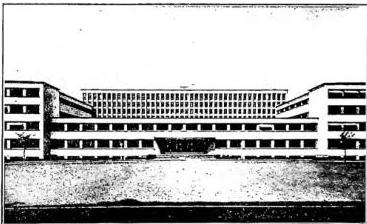
BIBLIOTECA - South façade with the main entrance of the new National Library of Bern.
T. M. Guarnaschelli and E. Valenziani (Indici e cataloghi, new series, I), of which 2 vols. have been published so far (I: A-B, Rome 1943; II: C-F, ibid. 1948).
V. THE PRINCIPAL FOREIGN LIBRARIES
For libraries outside the Italian national territory, a systematic overview cannot be offered, as their organization varies from country to country, and the importance of major collections, closely tied to the cultural history of peoples, is not uniform across regions. Nevertheless, almost all states today boast their own national library, not only in Europe but also in the Americas and Asia. These represent the most significant collections of bibliographic material related to the history, geography, and economy of individual countries. The principal ones are:The Bibliothèque Nationale of Paris, the oldest in Europe to have acquired such a character. Its origins trace back to the private libraries of the Carolingian kings, though it did not maintain continuity until the 14th century, when Jean II le Bon bequeathed his collection to Charles V (1364), who placed it in the Louvre. Significant acquisitions occurred under Louis IX, Charles VIII, Louis XII (during whose reign some precious relics from Petrarch’s library entered the collection), and Francis I (who appointed the humanist G. Budé to direct the library, merging it with the new collection at Fontainebleau, where the library remained until the second half of the 17th century, when it was transferred to Paris), and Louis XIV. In 1736, Louis XV opened it to the public; in 1763, the valuable holdings of the suppressed Jesuit libraries were incorporated; in 1789, as a result of the French Revolution, it acquired the status of a "national library." In 1810, Napoleon I, who had brought numerous relics by plundering Europe’s principal libraries (much of the loot was reclaimed after Waterloo), consolidated its holdings with appropriate legislative measures. In 1930, the Bibliothèque Mazarine (founded by Cardinal Mazarin in 1643, which at the time of its incorporation held 250,000 volumes, 1,900 incunabula, and 5,800 manuscripts) was annexed. Before the last world war, its holdings consisted of 125,000 manuscripts, over 4 million printed works, and 500,000 volumes of periodicals. Its printed catalogue is of paramount importance, constituting one of the most valuable reference works for any field of study.
The British Museum Library in London, whose core is formed by the extremely rich private collection of Sir Hans Sloane (3,516 manuscripts, 50,000 volumes), acquired by the Crown in 1753. On this occasion, which marked the birth of the British Museum, the collections of Robert Cotton and of Robert and Edward Harley, already state property since 1700, were added. Expanded through subsequent acquisitions, the library received great impetus under the direction of an Italian-born librarian, Antonio Panizzi (1797–1879), who devoted his efforts to it from 1856 to 1866, laying the foundations for the scientific classification of its materials. Despite the damage suffered during the Second World War (approximately 250,000 volumes were destroyed by fire), the British Museum Library holds over 4 million printed works (with shelving extending 118 km), approximately 10,000 incunabula, over 54,000 manuscripts, and 2,400 papyri. Its Oriental collection is particularly important, comprising 16,000 manuscripts and over 120,000 printed works. World-renowned is the Index of incunabula published by R. Proctor in London in four volumes between 1898 and 1899.
The Gosudarstvennaja publičnaja biblioteka (State Public Library) of Leningrad, formerly the Imperial Library of St. Petersburg, initiated by Catherine the Great with the acquisition of the collections of Counts Załuski and Minister Dubrovskij. From 1918, the year of the Russian Revolution, its holdings nearly doubled, and before the last world war, it comprised approximately 5 million volumes and 331,100 manuscripts.
The Preussische Staatsbibliothek, formerly the Kaiserlich-königliche Bibliothek, of Berlin. It originated from the private collection of Elector Frederick William, who opened it to the public in 1661. In 1782, it was transferred to a new building specially erected by Frederick the Great. Enriched by subsequent acquisitions, in 1914, under the direction of the great historian Adolf von Harnack, it was moved to the grand edifice that housed it until the beginning of the last world war. At that time, it held approximately 3 million volumes and nearly 63,000 manuscripts.
The Nationalbibliothek of Vienna (formerly the Kaiserlich-königliche Hofbibliothek), founded by Maximilian I in 1493. In the 18th century, it incorporated religious libraries, as well as the ancient university and civic libraries of Vienna, and was further enriched over the centuries by various private collections of the Habsburgs. In 1919, passing under the control of the Ministry of Public Education, it lost its royal title and assumed that of a national library. In 1940, its holdings amounted to approximately 1,500,000 volumes, 9,000 incunabula, over 30,000 manuscripts, and approximately 60,000 autographs.
The Verejná a univerzitní Knihovna (Public and University Library) of Prague, whose foundation is linked to that of the University in 1348. Before the Second World War, it held approximately 900,000 volumes.
The Bibliothèque nationale suisse (Schweizerische Landesbibliothek) of Bern, opened in 1895; it possesses approximately 700,000 volumes and 1,200 periodicals.
The Biblioteca nacional of Madrid, opened by Philip V in 1712 under the title of "royal library," which it retained until 1836. Enriched by various acquisitions, particularly following the suppression of monasteries, before the Civil War it held 30,172 manuscripts, 101,200 prints, 2,412 incunabula, 1,400,000 volumes, and 30,000 periodicals.
The Bibliothèque royale de Belgique of Brussels, established by royal decree on June 19, 1837, and formed by the union of three notable collections: the collection of Charles van Hulthem of Ghent, the so-called Burgundian library (1843), which had already absorbed the famous manuscripts of the Bollandists' library, and the civic library of Brussels. In 1940, its holdings amounted to approximately 850,000 volumes, 500,000 periodicals, and 31,421 manuscripts.
The Koninklijke bibliotheek (Royal Library) of The Hague, founded in 1798. Before the Second World War, its holdings consisted of approximately 1 million volumes, including manuscripts and printed works.
The Kongelige bibliotek (Royal Library) of Copenhagen, founded by Frederick III of Denmark and enriched by subsequent acquisitions, particularly in the 18th century under the reign of Christian VII. In 1940, it held approximately 900,000 volumes, 4,000 incunabula, and 30,000 manuscripts.
The Kungliga biblioteket (Royal Library) of Stockholm, whose original nucleus dates back to King Gustav Vasa (1523–60). It boasts several precious manuscript relics (a Silver Gospel containing a pre-Jerome Latin version, a French translation of Marco Polo’s Milione, a collection of Chinese manuscripts, etc.) and printed works (an almost complete collection of Elzevir editions). Before the Second World War, it held 12,000 manuscripts and over 600,000 volumes.
The Kongelige Universitetsbiblioteket (Royal University Library) of Oslo, founded simultaneously with the University in 1811 by Frederick VI of Norway and Denmark. Before the Second World War, it held over 5,000 manuscripts, 271 incunabula, and approximately 600,000 volumes.
The library of the University of Helsinki, founded in 1640. In 1940, it held over 600,000 volumes and collections of manuscripts, maps, and musical works.
Outside Europe, the most important library is undoubtedly the Library of Congress in Washington, founded in 1800 as the library of the two chambers of the United States. In 1897, upon moving from the Capitol to its current location, it began the organization and publication of its vast catalogue, which constitutes one of the highest achievements in bibliographic science (v. CLASSIFICAZIONE, sistemi di). Its holdings amount to approximately 5 million volumes.
A. M. R.
Worthy of mention are also the Biblioteca Nacional de México (approx. 300,000 volumes and some precious manuscripts), the Biblioteca Nacional of Buenos Aires (approx. 90,000 manuscripts and 200,000 volumes), the Biblioteca Nacional do Rio de Janeiro (120,000 manuscripts and approx. 500,000 volumes), and, in Asia, the national libraries of Beijing (8,000 manuscript scrolls, 30,000 Chinese incunabula, 85,000 volumes in European languages, and 500,000 in Chinese) and Tokyo (approx. 700,000 volumes in Chinese and Japanese, 130,000 in European languages, and various manuscripts, before the Second World War).
Beyond these, which have the character of national libraries, other libraries deserve special mention for the extent of their collections or the tradition to which they belong, such as in England the libraries of the University of Oxford (Bodleian Library, established in 1410 with the collection of Thomas de Cobham, Bishop of Worcester, d. 1327; nearly disappeared in 1550, it was reconstituted by Thomas Bodley in 1602. Before the last conflict, it counted approx. 40,000 manuscripts and 1,500,000 volumes), of the University of Cambridge (founded in 1424; its substantial collections boast some pieces of great value, such as the Codex Bezae of the Gospels and Acts, a manuscript of Bede’s Historia ecclesiastica from the first half of the 8th century, etc.); in Ireland the library of Trinity College (founded by Queen Elizabeth in 1591; it holds approx. 500,000 volumes, 548 incunabula, 2,190 manuscripts); in France the library of the Arsenal in Paris (formerly the private library of A.R. de Voyer d’Argenson, Marquis of Paulmy; in 1934, it held 840,000 volumes, 2,800 incunabula, 11,639 manuscripts, 6,745 periodicals) and the university library of Strasbourg (founded in 1531, completely destroyed in the fire of 24 August 1870 and subsequently rebuilt ex novo; before the 1939–45 war, it possessed 4,759 manuscripts, 5,000 papyri and Ostraca, 1,900 incunabula, and over 1,700,000 volumes); in Germany the Bayerische Staatsbibliothek in Munich (founded by Albert V of Bavaria in the second half of the 16th century; in 1939, it held a collection of approx. 50,000 manuscripts and over 1,800,000 volumes), the library of the University of Göttingen (opened in 1737; before the Second World War, its holdings amounted to approx. 9,000 manuscripts, 5,000 incunabula, 900,000 volumes), that of the University of Leipzig (founded in 1543 with the collection confiscated from the Dominican library of Pauliner Kloster; in 1939, it held approx. 950,000 volumes, 3,000 incunabula, 6,000 manuscripts); in Greece the library known as the Gennadiou (after its founder Giovanni Gennadius), in Athens (opened to the public in 1926; before the last conflict, it held 200 manuscripts and approx. 30,000 volumes); in Poland the Jagiellonian Library in Kraków (founded in 1400; the latest data before the Second World War are 570,000 volumes, 3,020 incunabula, 8,600 manuscripts); in Russia the Odeska tsentralna naukova biblioteka (government library of Odessa, founded in 1829; before 1940, it held approx. 2,500,000 volumes), and the Publichnaya biblioteka Soyuza S.S.R. imeni V. I. Lenina (Lenin Public Library of Moscow, with approx. 5 million volumes and over 41,000 manuscripts); in Spain the library of the Escorial (v.) and in Portugal that of the University of Coimbra (first mentioned in 1541; its holdings consist of approx. 2,500 manuscripts and 500,000 volumes); in Sweden the library of the University of Uppsala (founded by King Gustavus Adolphus in 1620; it holds 17,000 manuscripts and approx. 700,000 volumes); in the United States the Boston Public Library (founded in 1852 by Prof. G. Ticknor, moved to its current location in 1895, expanded in 1918; it oversees about thirty affiliated libraries, bringing the total holdings to approx. 1,700,000 volumes), the Harvard University Library (established in 1858; it holds approx. 2 million volumes; with affiliated libraries, the collection rises to 3,700,000 volumes), the New York Public Library (formally founded in 1895, it holds over 3,500,000 volumes), the Columbia University Library (established in 1754, it holds 1,300,000 volumes), the Yale University Library (founded in 1701; with its dependent libraries, it holds approx. 2,500,000 volumes), etc.
For libraries attached to major abbeys or dependent on religious Orders,