
AUGUSTO, GAIO GIULIO CESARE OTTAVIANO (Gaius Iulius Caesar Octavianus Augustus). – Son of Gaio Ottavio and Azia (daughter of Giulia, the younger sister of Giulio Cesare), born on 23 September 63 B.C. (691 of Rome), he was adopted and educated by his great-uncle G. Cesare. While pursuing studies in rhetoric at Apollonia, in Greece, he learned of his great-uncle’s tragic death (44 B.C.) and hastened to Rome to claim his inheritance and punish the assassins.
Having defeated Antonio in 43 B.C., he formed with him and Lepido the second triumvirate, to ratify which the contracting parties sacrificed to one another their relatives and closest friends. The triumvirs defeated the republicans commanded by Bruto and Cassio at Filippi (42). In 40, Ottaviano, through the treaty of Brindisi, became master of the West; in 36 he defeated Sesto Pompeo and left Lepido only the office of pontifex maximus, an office which he assumed after Lepido’s death. With his victory at Azio over Antonio (2 September 31 B.C.), he remained in practice master of the entire State. To preserve appearances, he successively had the most important public offices conferred upon him, and in 27 B.C. obtained the title of « Augustus » (in Greek Σεβαστός), together with that of prefect of morals and consul for life. He promoted the material and cultural prosperity of the empire by securing peace and fostering literature and the arts. He successively married Clodia, Scribonia, and Livia. He died at Nola in 14 of the Christian era (767 of Rome), on the 19th day of the month sestile, which in his honor was called augustus (August).
Lc. 2, 1-2, as he undertakes to describe the birth of the Savior, relates: « In those days a decree went out from Caesar Augustus to register the whole (inhabited) earth. This first registration took place when Quirinio was governing Syria ». Since the secular sources have yielded no explicit evidence of a universal census ordered by A., certain critics (with E. Schürer) have called Luke’s veracity into question (v. QUIRINO). But
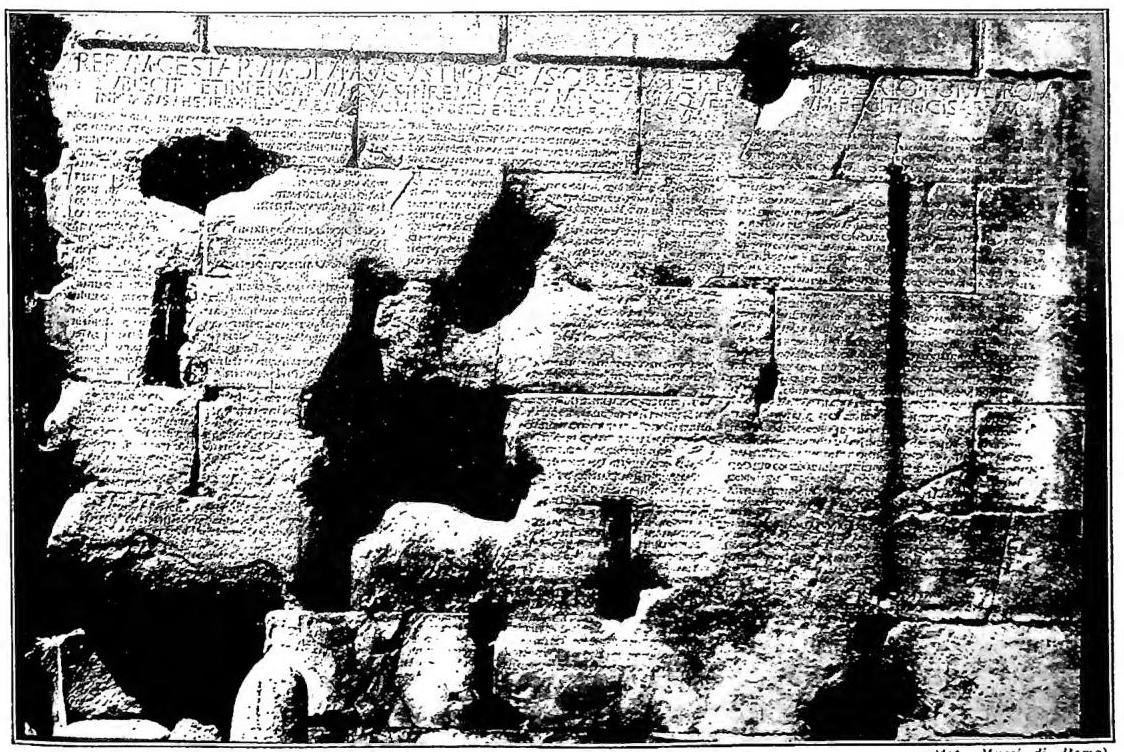
there are indications that confirm the Gospel. Tacitus (Ann., I, 2) informs us that after A.’s death a Breviarium imperii compiled in the emperor’s own hand was read in the senate, «in which were indicated all public revenues, the number of citizens (Roman), and of allies under arms, the condition of the fleet, of the kingdoms (subject or allied), of the provinces, of taxes, of tributes, of needs and of distributions». To possess this information, A. must necessarily have ordered censuses and statistical surveys throughout the empire. In the monument of Ancira (Ankara), which contains his Res gestae, A. states that he carried out the census of Roman citizens three times (in the years 28 and 8 B.C. and in A.D. 14).
Even before this period A. intervened in the affairs of Palestine, and especially in those concerning Erode. After the victory at Azio (31 B.C.), A. had granted pardon to Erode, who had sided with Antonio and was now striving, through idolatrous adulation, to make the powerful Roman forget his political offense: he multiplied his honors, naming cities after the divine A. and erecting temples to him (v. ERODE MACNO). Without allowing himself to be blinded by the adulation, A. treated Erode benevolently; he granted him autonomy in the administration of justice and finance, exemption from tribute to the empire and from the obligation to quarter Roman troops and garrisons; he granted him his own army, composed for the most part of mercenaries (Syrians, Thracians, Germans, Gauls), but demanded absolute dependence in political, military, and dynastic matters; in practice, he regarded him as a ad mutum fiduciary. When, in 8 B.C., Erode, without Rome’s permission, used his army for a punitive expedition against the Nabateans who favored the marauding Bedouins, A., indignant, wrote to him that from then on he would regard him no longer as a friend but as a subject (Flavio Giuseppe, Ant. Iud., XVI, 290). At Erode’s death (4 B.C.), A. partially confirmed his will, denying Archelao the title of king of Judea (with Idumea and Samaria) and granting him only that of ethnarch. He accepted, however, the deceased man’s designations for his other surviving sons, assigning Antipa the tetrarchy of Galilee and Perea, and Filippo that of Batanea and Traconitide (Lc. 3, 1). A. intervened once more in Palestinian affairs by deposing Archelao (A.D. 6) and entrusting Judea to the Roman procurators.
AUGUSTO - Res gestae of A. From a cast of the 'Monumentum Ancyranum', preserved in the Museum of Rome.
From the 12th to the 15th century, the Mirabilia enjoyed very wide circulation throughout the West, but they were not chiefly responsible for keeping alive the memory of the first emperor in the Middle Ages.
A. had been the founder of the empire which, after Charlemagne and Otto I, was again to become a living reality. Although it differed profoundly from the ancient one, it presented itself as its legitimate continuation, and the emperors of the Middle Ages styled themselves Caesars and Augusti, thus harking back to the distant predecessors from whom they claimed to derive their rights and powers, and especially invoking the name of A.
In tracing back from their own times to the origins of the empire and of the world—one need only recall the universal chronicles—historians assigned A. a pre-eminent place. By emphasizing the unequalled power, wealth, happiness, and prosperity of his reign, they fostered the belief that the age of A. had been a kind of golden age, willingly evoked as a contrast to and consolation amid present miseries. Men of letters and poets encouraged this view, seeking to awaken in contemporary sovereigns some feeling of emulation for the generosity of A., who had protected Virgil and Horace. Thus Anselm of Besate promises Henry III to sing his deeds if he receives from him the protection which A. granted to Virgil (cf. E. Dümmler, Anselm der Peripotetiker, Halle 1872, p. 16).
The strongest reason why the memory of A. remained alive among Christian peoples in the Middle Ages was the fact that Jesus Christ had been born during his reign. No one could believe that God, in becoming man, had chosen without profound reason that time in which, after the unity of the world had been achieved and peace established, one prince had gathered into himself all the powers of the ruling city and had founded the empire for the ages. On the contrary, all believed that God had entrusted to that prince a great and decisive mission: namely, to offer to the redemptive work of the Saviour a world made one and pacified. The idea of this, albeit unconsciously Christian, mission of A. is already clearly expressed at the beginning of the 5th century in the Historiae adversus paganos (VI, 1) of Paolo Orosio. Toward the end of the 6th century, the famous legend of the Capitoline vision, attesting A.'s awareness of the birth of Christ, appears in the Chronicle of a Byzantine writer of Syrian origin, Giovanni Malala (ed. L. Dindorf, Bonn 1831, pp. 231-32). Malala had drawn the account from the now lost work of a somewhat earlier chronicler, Timoteo. The legend was long handed down among Eastern Christians; in the 8th century it also received a Latin translation in Rome (cod. Vat. Pal. 277, fol. 63), and in the 12th century a new version appeared in the Mirabilia urbis Romae. This legend is connected with the origins of the church of S. Maria in Aracoeli, which most probably date from the 6th century.
Whereas the Eastern version of the legend reaffirmed an idea common among Christians of the 6th century—that, once Jesus Christ had been born, false oracles fell silent—and thus asserted the victory of Christianity over paganism, the Western version returned to the thought of Orosio that Christ was born under A., when the whole world was at peace, and added that A. did not wish to continue to be called lord of men, because among men the Lord of the world had been born. - Vedi Tav. XXIX.