
NOLA, DIOCESE of. – City and diocese of Campania, in the province of Naples.
It has an area of 200 sq. km, with a population of 260,000 inhabitants, of whom 250,000 are Catholics; it has 111 parishes with 265 diocesan and 100 regular priests; 17 male and 55 female religious communities (Ann. Pont., 1951, p. 291).
I. HISTORY
Ancient N. (Ναόλα, in Oscan Novia, “new city”) was, after Capua, the most important and wealthiest city of the Campanian hinterland. According to Hecataeus (500 B.C.), it belonged to the Ausones or Aurunci; around 600 it became a center of Etruscan expansion, and at the end of the 5th century fell into the possession of the Samnites. In 327 it sent a force of 2,000 men to aid Naples, engaged in the Second Samnite War; but after the alliance between Rome and Naples had been concluded, it was attacked and devastated by Quintus Fabius in 313; in 311 it formed an alliance with Rome. During the Hannibalic War, the Senate and the aristocratic party succeeded in keeping N. loyal to Rome. Sulla besieged it twice: in 89, after defeating the Samnites at Pompeii, and in 80, when he succeeded in capturing II. Shortly afterward Spartacus sowed destruction there. The name of Augustus is particularly associated with N.; he constructed there a magnificent aqueduct from the springs of Serino to the principal centers of Campania. At N., the «gens Octavia» owned large estates, and Augustus died there in 14 A.D.Among the ancient monuments, the necropolis, the amphitheater, the theater, and the temple that Tiberius is said to have erected in memory of Augustus should be mentioned. Particular mention should be made of the Abellan Cippus, which contains in the Oscan language the treaty regulating the administration and property rights of the area of the sanctuary of Hercules, situated on the border between N. and Abella (first half of the 2nd century B.C.). In 410 N. was taken by the Goths of Alaric; in 155 it was destroyed by the Vandals of Genseric. Incorporated in 647 into the Lombard Duchy of Benevento, it passed in 849 to the Principality of Salerno. Charles I of Anjou granted it as a fief. In 1528 it returned to the royal domain.
II. THE ORIGINS OF THE NOLAN CHURCH
The earliest information is preserved in Carmina natalizia IV and V, composed in the years 398 and 399 for the feast of St. Felice the priest. In them St. Paolino recounts the experiences of Bishop Massimo and his presbyter Felice during the persecution, highlighting in particular the work of the latter, who is the saint(from G. Chierici, in Ambrosiano, ..., pl. 51)
Quinto is the second bishop of N. of whom we have any knowledge, likewise supplied by St. Paolino in his V Natale. The third bishop is Paolo, who consecrated in 403 or 404 the monumental Basilica erected by St. Paolino in honor of St. Felice (cf. Ep., XXXII). The episcopate of St. Paolino (v.), who succeeded Paolo, began only between 408 and 416. They were followed by: Paolino iuniore, d. 11 Sept. 442 (epitaph); Felice, d. 9 Feb. 484 (epitaph). Excluding a bishop Deodato, who never existed but was confused with an archipresbyter of the same name, there followed Giovanni Talaia (484), who, forced by the Monophysites to leave the see of Alexandria and take refuge in Rome, received from Felice III the Church of
N.
(Liberato, Breviarium, 18); Teodosio, d. 7 Dec. 490 (epitaph); Sereno, mentioned in several letters of Pope Gelasius (492–96) and present at the Roman Synod of 449; Prisco, 25 Feb. 523 (epitaph); Leone I, of that name (536), present at the Synod held in that year under the patriarch Mena; Giovanni (555–60), mentioned in two letters of Pelagius I (overlooked by Lanzoni); Gaudenzio, mentioned in two letters of St. Gregory the Great (594, 595). Aureliano and Senato, known from their epitaphs, belong to an uncertain year of the seventh century. Later came Leone III, Lupino, Sisto, another Leone, and Giovanni around 940. The bishop Guglielmo was a contemporary of Urban II (1088–99) and Paschal II (1099–1118). When Salerno was made a metropolitan see around 983, apparently, Giovanni XV on 12 July 989 placed N. under it; and after the principality fell through the action of Roberto il Guiscardo, Napoli asserted its rights over the diocese of N., but Paschal II (1100–1106) again declared N. subject to the archbishop of Salerno, Alfano. Only in 1179 is N. found clearly dependent on Napoli; at the Lateran Council of that year the Nolan bishop Bernardo is recorded among the suffragans of the Church of Napoli, of which it remains a suffragan today.
III. THE NEW PAOLINIAN CONSTRUCTIONS. THE SURVIVING MONUMENTS OF CIMITILE. — When Paolino arrived at N. for the second time (394 and 395), he found other basilicas around the tomb of his patron: according to the natal carmen VI (400), five; according to Letter XXXII, to Severo (403 and 404), four.
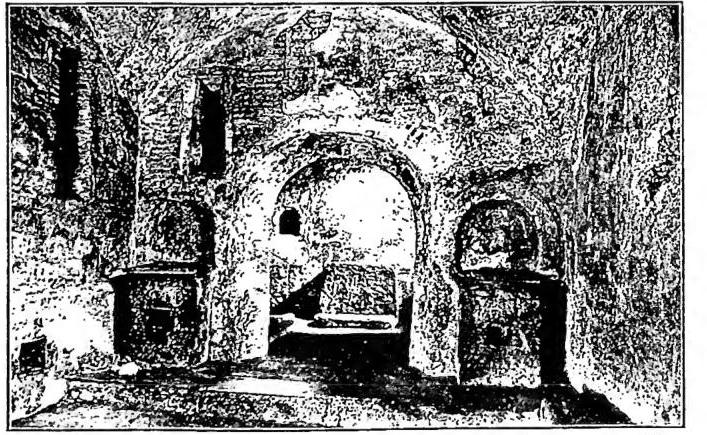
S. Felice had been buried outside the walls, in the open countryside; his remains had been enclosed in a modest tomb, covered by a marble slab overlaid with silver; two openings made in the marble allowed perfumes to reach the interior of the tomb, which was protected by a wooden aedicule. Later, a three-aisled basilica had been built there, its vault resting on rough masonry pillars, with the aedicule occupying the western end of the central nave. Paolino enlarged the Basilica, replacing the pillars with marble columns supporting semicircular arches, upon which rested a vault, perhaps decorated with stucco, now destroyed. In the intrados of the arches and on the frieze above them was rich mosaic decoration on a blue ground, with vine-scrolls; on the frieze, an inscription of eight hexameters, in letters of gold, running in two rows around the four walls. It is the carmen that begins: Parvus erat locus, ante sacris augustus agendis. On the frieze of this same peristyle, but on the outer side, was another carmen in letters of gold, of which only miserable traces remain. Behind the altar stand two columns, with two saints carved in high relief on the front face of the capitals: « Sanctus Faustillus », « Sanctus Felix ». Faustillus is unknown. To the left are the tombs of the successor of s. Paolino,
Paolino iuniore, who died in the year 444, and of Bishop Felice, who died in 484. On the wall against which these lean, a fresco represented what seems to have been a city enclosed by walls furnished with towers, perhaps a representation of Jerusalem, showing a strong analogy with the mosaic of Madaba. Behind the northern side of the peristyle rises a wall pierced by arches, having the appearance of an iconostasis; on the side facing the apse it is decorated with a series of paintings dating from the 7th to the 14th century. The wall is cut
by two arched passageways; and in the section between them are three images representing the Virgin flanked by s. Paolino and s. Felice.
On leaving the Basilica through the southern door, one finds the so-called Basilica of the Martyrs. In essence, it consists of three square rooms with frescoes from the 12th–13th centuries, with two small altars in the middle room and frescoes representing s. Eusebio at the left altar and s. Maria Maddalena at the right. In the room furthest to the left, the excavations of 1935 brought to light a series of earth graves, oriented from east to west, with semicircular heads in section. In one of these headpieces, a painting was discovered depicting the scene of Jonah being disgorged by the monster. Of particular importance is the prothesis of this basilica, supported by two pillars covered with ornament on all four faces; on the shelf resting on the capital is the inscription LEO TERTIVE EPISCOPUS FECIT. This bishop has been assigned to the 8th century on the authority of N. writers, but without secure foundation. Also noteworthy are two fragments (now at the Superintendency for Monuments) that formed a triangular slab intended to serve as a ramp for an ambo; they represent part of the scene of Jonah (the tail of the monster surrounded by fish remains), and along the lower edge one reads: HOC OPVS LUPINVS EPE RENO (varit). Two other slabs, of different period and style, represent, respectively, the calf and the lion, symbols of the evangelists Luca and Marco, and the eagle and the lion, likewise symbols, with the divine Lamb between them, holding a cross with its right paw.
The new great Paolinian Basilica, begun in 401 and consecrated in 403, faces sideways toward the ancient Basilica in which the martyr rested. The three entrance doors to the south correspond to three entrances set in the side of the ancient Basilica, through which the tomb of s. Felice could be seen. It had three aisles, with a double row of columns surmounted by arches; the apse was triconch. Of the two minor apses, the one on the left was intended for meditation and prayer, and the sacred books were preserved there, as in a model ecclesiastical library; the one on the right housed the sacred vessels.
From several fragments it may be inferred that the walls were faced with polychrome marble slabs, forming ge-
This distinguished Sanctuary, one of the most celebrated pilgrimage sites in the 4th and 5th centuries, experienced the worst ravages of the barbarians at the end of the ancient world, of the Lombards and the Saracens, as well as the plundering and neglect of the men of the 9th century. Research and excavations resumed only from 1931 to 1935.
Early Christian monument of N. — In the crypt of the cathedral of N. there is preserved a marble slab whose central panel represents a jewelled cross, with the apocalyptic letters suspended from the transverse arm; the four symbolic rivers flow from the foot of the cross. Slightly above the transverse arm are two stars beneath rays; at the sides of the cross are two pomegranate plants, and around it five doves. The entire scene is framed by a border decorated with vine branches which, beginning at a vase at the foot of the cross, join again at its summit. At the sides of the central panel are two smaller lateral panels, on which two burning candelabra are represented. The dominant idea of this precious monument is the cross, that is, Christ triumphant. The symbolism becomes more pronounced when one considers that it is an altar frontal. It is assigned to the end of the 5th century, or at the latest to the beginning of the 6th.
N. and the Bells. — The first to use the word « N. » to indicate a small bell is said to have been the fabulist Avienus (4th–5th century?). To find « N. » with the meaning of bells, one must reach Viodoardo (10th century). The first testimony to the connection between the bell and N. is found in Walfrido Strabone (9th century); but the connection between bells and s. Paolino, in the sense that s. Paolino was supposed to have been the inventor of bells, is quite recent, dating from the 16th century. Yet if s. Paolino had no role in the invention of bells, nor the city of N. in their origins, Campania has a very important place in their history, because the earliest testimony to the use of bells to summon monks to prayer refers precisely to Campania, and specifically to Eugippus, the celebrated abbot of the Lucullanum, which stood in Naples on the hill now called Pizzofalcone.
IV. GIGLI DI N
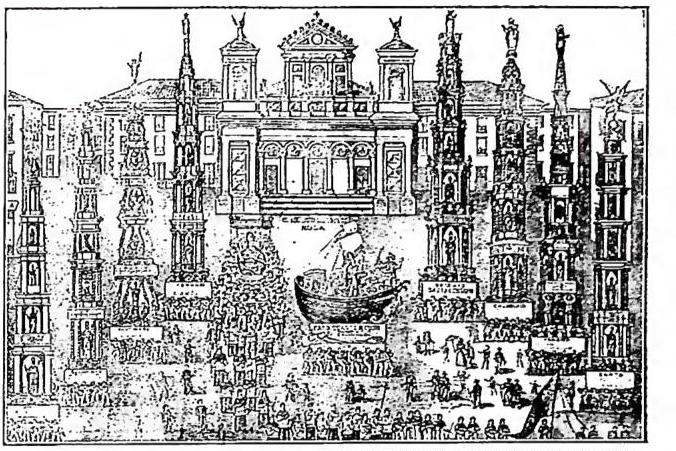
This is the name given to eight very tall wooden “structures,” in the form of obelisks or bell towers, which are carried in procession at N. for the feast of s. Paolino. They are constructed by local artisans under the direction of the “masters of the feast.” The designs vary from year to year and reflect motifs drawn from Renaissance, Baroque, Oriental, or modern architecture, adapted to local tastes.In 1931, the fifteenth centenary of the Saint’s death, the decorations followed a single theme: an apologetic commentary on the life and works of the Saint. Each “giglio” is constructed with a wooden framework in the shape of a quadrangular pyramid at the base, and then triangular, closely joined together so as to give solidity to the whole; this skeleton is covered with the “decoration,” composed of five sections. The giglio generally terminates in a sacred statue, and in the third section, which is the central one, there is always a figure of s. Paolino. The procession is intended to recall the welcome given by the people of Nola to their bishop when he returned from captivity. The feast lasts three days, namely Saturday, Sunday, and Monday following 22 June (the dies natalis of the Saint). On Saturday evening the gigli are “dressed” in front of the houses of the “masters of the feast”; on Sunday morning they are carried to Piazza del Duomo and blessed by the bishop amid the rejoicing of the crowd, the sound of music, and the throwing of confetti and sugared almonds onto the Saint’s silver bust. The heavy structures are carried at a run by teams of approximately forty bearers, called “paranze,” who proceed dancing, competing with one another in agility. Among the gigli stands the boat, recalling the Saint’s arrival by sea, and there is invariably a “Moor,” to recall that it came from the black continent. The procession takes place according to a traditional order which, in the popular interpretation, is intended to reproduce the sequence in which the various tradesmen and the different crafts went to meet the Saint to welcome him; presumably, it is an order of precedence among ancient craft guilds. It is as follows: market gardener, tavern keeper, pork butcher, baker, butcher, shoemaker, blacksmith, and tailor. On Monday the “undressing” of the gigli takes place, and amid music, illuminations, and songs the feast comes to an end. The origin of the name lies in the fact that, at first, real flowers were used; these were soon attached to clubs and later to interwoven reeds, until, through a spirit of competition, the present “structures,” approximately 30 metres high, were reached. The traditional flower-decked club, or, as it is called, the flower-decked torch, has not entirely disappeared: two of them are still preserved and are carried in front of the first two gigl