
BENEVENTO, ARCHDIOCESE OF. — An archdiocese among the largest in southern Italy, with its see in a city rich in history that was once the capital first of a duchy and then of a principality, later placed directly under the authority of the Holy See. Its suffragan dioceses are those of Sant’Agata dei Goti, Alife, Ariano, Ascoli Satriano and Cerignola, Avellino, Bojano, Bovino, Larino, Lucera, San Severo, Telese, Cerreto, and Termoli, situated in Campania, Apulia, and Molise. The archdiocese of Benevento, covering an area of 2,500 sq. km. in the province of the same name (and to a lesser extent in that of Avellino), borders on the dioceses of Avellino, Ariano, and Cerreto and on the territory of the archdiocese of Conza. It has 160 parishes, 268 diocesan priests, and 105 regular clergy, and a population of about 335,000 (1948). Its patron saint is St Bartholomew the Apostle.
OUTLINE:
I. History
II. Events from the late 18th century to 1860
III. Art
IV. Abbey of St Sophia
V. Beneventan conciliar region.I. HISTORY
On the slope of a hill called della Guardia (135 m.), at the confluence of the Calore and the Sabato, there arose Malventum, the Samnite city that long waged war with Rome. Before becoming a Roman colony, it witnessed the victory of Curius Dentatus over Pyrrhus; the bonus eventus was handed down in the very name of the city, which from then on became Beneventum.The first historically attested bishop is St. Januarius (v.), a victim of Diocletian’s persecution. The second, Theophilus, was present at the Roman Council of 313. A second Januarius is mentioned as a legate of the Pope at the Council of Sardica in 341. In 404 another bishop of Beneventum carried a letter from Pope Innocent I to Constantinople in favor of St. John Chrysostom, addressed to Emperor Arcadius. The second half of the 5th century saw the episcopate of St. Tammaro; Epiphanius held office from 494 to 499 (cf. Jaffé-Wattenbach, 657, 736-37). In 545 the city was taken by Totila, who razed its walls to the ground. The Byzantine general Narses rebuilt it from its ruins, reducing it to a small village.
Better times awaited Beneventum with the Lombard invasion: a column of the new occupiers advanced into Samnium and, under the leadership of a first duke, Zotto, around the year 571, gave rise to a Lombard duchy that soon extended over much of southern Italy, later divided into twenty-four counties. Like Alboin, Zotto was a barbarian; and before Roman civilization and the Church could exert their influence upon him and his people, the violence of barbarism was unleashed upon sacred places and priests. Around 589 the abbey of Montecassino was destroyed, and in those same years Zotto is said to have had eighty Christians put to death for refusing to engage in pagan practices.
The Beneventan Lombards abandoned Arianism under Duke Arechis, who became the great reorganizer of the duchy. Shortly before the year 600, through his own baptism, he opened the way to the mass conversion of his people, and on 15 December 600 he had the restored and enlarged cathedral, dedicated to the Virgin, consecrated. Both he and the bishop of Beneventum were in contact with Pope Gregory I. In 662 Emperor Constans II besieged Beneventum; the legend, incorporated into the Beneventan liturgy, tells that a Lombard priest named Barbatus secured the lifting of the siege on condition that Duke Romuald put an end to the remaining pagan practices. Constans II was soon forced to raise the siege; and Barbatus was then able to put an end to the cult of the sacred oak and the golden viper, which the duke, now a Christian, had secretly venerated in his palace. From 663 Barbatus was bishop and united the see of Beneventum with that of Siponto (a union that would last four centuries), with oversight of the famous sanctuary of St. Michael on Mount Gargano. Arechis had set the duchy on the path toward quasi-independence from the Lombard crown; during the 7th and 8th centuries the prestige of the dukes and the power of the state grew even greater. Animated by the zeal of neophytes, Romuald and his wife, Theodora, founded churches and convents. For a brief time King Liutprand managed to assert his authority, but soon Beneventum regained its autonomy; this was sealed by the construction of the cloister of St. Sophia, begun in the mid-8th century by Duke Gisulf and completed, together with the adjacent church, by Arechis II in 760.
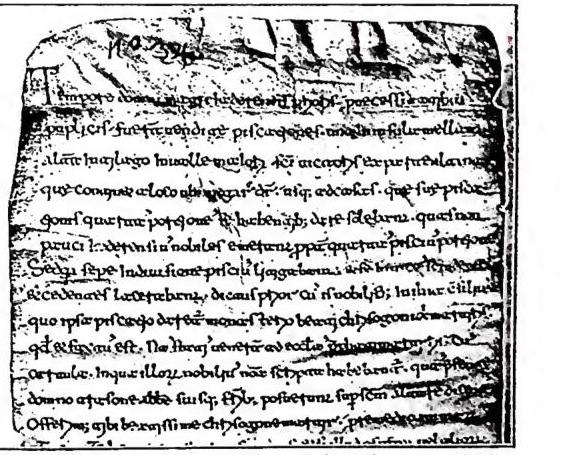
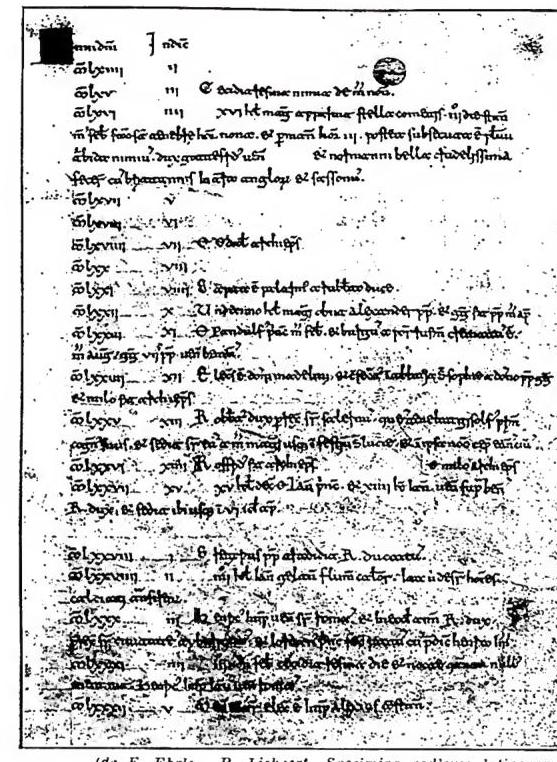
BENEVENTO — Annales Beneventani (1064–82) — Biblioteca Vaticana, cod. Vat. lat. 4928, fol. 6 (a. 1113–20).
Pope John XIII, in 969, elevated B. and Siponto to metropolitan sees, and thus Landolfo I assumed the dignity of archbishop. During the 11th century the jurisdiction expanded to include twenty-five suffragan churches, as illustrated by the reliefs on the famous bronze doors of the 13th-century Cathedral, which depict the twenty-five bishops. The archbishop of B. enjoyed singular privileges, gradually eroded by time: a tiara and pallium in the form of an omophorion, like the archbishop of Ravenna; a leaden seal for diplomas, like papal acts, and the custom of being preceded in public liturgical ceremonies by the Most Holy Eucharist.
A new period in Beneventan history opened in the mid-11th century under Leo IX. In 1050 the Pope excommunicated the Beneventans, whose fierce spirit of autonomy had made them turbulent and rebellious against the imperial authority of Henry III. The following year, however, when Leo came among them and was enthusiastically received, he conceived the plan to unite the principality to the Church not only spiritually but also temporally. He reached an agreement with Henry III, whereby the Holy See’s rights over Bamberg were exchanged for the retrocession of imperial rights over B. In 1053, at the head of an army, the Pope made his entry into the city, expelled Prince Landolfo III, and left a governor in his name. The capture of B. was a prelude to the new policy of direct papal intervention in the South; confronted by the new Norman power, Leo IX was defeated and taken prisoner at the battle of Civitate by Robert Guiscard, allied with the Lombard princes. The Pope’s imprisonment in Benevento brought about a reversal of relations; the Church recognized the Normans’ dominion over the conquered lands as its own vassals, making them its closest defenders. In 1077, however, in place of the last Lombard prince, Landolfo VI, the Church consolidated its dominion over B. Indeed, in the time of Gregory VII, the city and territory were governed by rectors, and in 1059 Nicholas II had held a notable council in B.; from that year onward, papal visits and councils were frequent. Gregory VII came to B. in 1073, first once, and then a second time in 1080, when he received Robert Guiscard in penance and confirmed his investiture over the South; Victor III and Urban II visited at the end of the 11th century; Paschal II at the beginning of the 12th.
Between 1130 and 1139, B. was the stronghold of Anacletus II against Innocent II; but anti-Norman sentiment drove part of the citizenry into the arms of Innocent. Soon after, the archbishop, Peter II, was killed by the rebellious Beneventans on suspicion of maintaining relations with William of Sicily, who had recently besieged Adrian IV and devastated the territory. Shortly thereafter B. again gave refuge to the Popes to protect them from the violence of Barbarossa. Alexander III stayed there for three years (1167–70). In the following century, Frederick II, at war with the Holy See, destroyed much of the city, beginning its decline. Nevertheless, considered the ward of the Church, which restored its wounds, B. was preserved to the Holy See in the treaty for the cession of the kingdom to Charles of Anjou; and beneath its walls, in 1266, the decisive battle for the fate of the South was fought between Charles and Manfred, son of Frederick II. In 1378, during the Western Schism, which saw two rival archbishops acting in the city, Joanna I seized B. From 1429 to 1436 the archbishop was Gaspare Colonna, a zealous and munificent pastor who, though not implicated in the revolt of the Colonna against Eugenius IV, was summoned to Rome, imprisoned in Castel Sant’Angelo, and, restored to his see, died prematurely of grief. Alfonso V of Aragon also attempted in 1440 to encroach upon the papal sovereignty over the city; and so did King Ferdinand in 1482. In turn, Alexander VI temporarily alienated the principality in favor of his own son, Giovanni, Duke of Gandia. Again, in 1528, imperial troops occupied B. by order of Charles V, though it was restored the following year.
At the end of the 17th century, just when a terrible earthquake was about to devastate it, as indeed happened in 1702, B. had as its shepherd one of the most distinguished figures of the age, Cardinal Vincenzo Maria Orsini, a Dominican, who renewed the religious life of the diocese and knew how to lift the city from the damage of two earthquakes before being elected pope under the name of Benedict XIII (v.). Even afterward, he refused to abandon the direct care of the diocese so dear to him, so that only after his death did B. have its own archbishop, Sinibaldo Doria.
Natives of B. were the popes Felix IV, Victor III, and Gregory VIII; among the cardinals BORGHESIA (v.) and Bartolomeo Pacca (v.).
Numerous since ancient times are the male and female religious orders established in the Beneventan diocese. The archives of B. are rich in documents: the capitular archive and that of Santa Sofia, near which the museum and the provincial library have been organized. The local educational institutions have a good tradition of studies.
II. EVENTS FROM THE END OF THE 1700S TO 1860
After having been part of the Papal States since the 12th century, and after having been subjected to arbitrary occupation by the Neapolitans—also due to Bourbon family solidarity—in 1750 and 1768, Benevento was forcibly removed from ecclesiastical rule in January 1799 by a force of 3,000 Frenchmen under General Brusier, who, among other things, seized the famous treasure of the Cathedral and the funds of the Mount of Piety. The republicans, attacked by the local people and fleeing to Capua with their rich spoils, soon returned to attack, and the commissioner Carlo Pop raised the tree of liberty there. With the fall of the Parthenopean Republic, Benevento first returned to Bourbon rule, and then, on 5 October 1800, to Papal government.Later, by a Napoleonic decree dated Saint-Cloud, 5 June 1806, it was granted as a ducal fief to Talleyrand and his descendants; on 21 July following, possession was taken on behalf of the feudal lord by Alessandro Dufresne de St-Léon, soon replaced as governor by the Alsatian Luigi de Beer. The civil administration was partly beneficial, though it was followed by brief Murattian and Austrian interludes (1814) until, by decision of the Congress of Vienna (1815), Benevento was restored to its former sovereign.
Soon after, a period of unrest followed due to secret societies, particularly the Carbonari; so that at the outbreak of the 1820 revolts, after repressive measures and a serious clash near the Cathedral, the apostolic delegate Monsignor Olivieri had to leave, and on 16 July a provisional government was established, which, among other things, sought—though in vain—to bring about the annexation of Benevento and its surrounding territories to the neighboring Kingdom of Naples. Nine months later, however, due to the defeat of the constitutionalists and the Austrian intervention, Papal rule returned.
The attachment of most of the inhabitants and the prudent governance of the delegate Monsignor Gioacchino Pecci (later Leo XIII) ensured that further attempts at union with Naples came to nothing. In December 1848, a deputation of Beneventans went to pay homage to Pius IX in exile at Gaeta, and, given the complete tranquility, on 12 October 1849 Pius IX was able to visit that farthest outpost of his territories.
Some disturbances that occurred in 1855 due to poor municipal management prompted the government to take exemplary justice by dissolving the relevant council and adopting appropriate remedial measures. But plots hatched since May 1860, and more especially the irresistible advance of Garibaldi’s forces and the collapse of the Bourbon regime, led on 3 September to the sudden departure of the delegate Monsignor Agnelli, and then to Garibaldi’s decree of 25 October that put an end to Papal rule.
III. ART
The oldest ruins, the inscriptions found in excavations, and the coins bearing Greek inscriptions show the imprint of Hellenic art and the relations with the Greek colonies of Campania and Magna Graecia. The grandest monument of the Roman period is the Arch of Trajan, also called the Porta Aurea because of the excellence of the sculptures that depict the most salient events in the emperor’s life. Other remains from the Roman period include: the theatre with three tiers of arcades and a nearly intact stage, the ruins of a vast Roman emporium, stretches of the Appian Way still well paved, the Egyptian obelisk, and the statue of the god Apis. To the Lombard period belong the walls and fortresses near Ponte Arsa, a necropolis with tombs from the 7th and 8th centuries, and the church of S. Sofia.The Cathedral, with the adjoining archiepiscopal palace, was built in the 7th century by Bishop David, then rebuilt into a three-aisled structure in the 9th century by Prince Sicone, and into a five-aisled one by Ruggiero, Archbishop of Benevento (1179–1221), who also completed the façade, similar to those of the Apulian cathedrals, constructed with remnants of Roman buildings and tombs of Lombard princes (it remains unfinished). Notable on it are the central rose window with six colonnettes interspersed with mosaics and the bronze doors (late 12th–early 13th century), considered by some critics to be the work of a local master, by others of Byzantine provenance, depicting scenes from the life of Christ. Inside, the columns of the central nave come from a Roman building; the others were placed there by Pope Benedict XIII after those of Ruggiero collapsed due to earthquakes. The paintings above the arcades depicting Prophets and Apostles date to the mid-18th century; those with Elijah and Daniel are by the Beneventan artist Albano. Worthy of note are the finely crafted ambons of the high altar, the work of Nicola da Monteforte (1311), the same high altar by Meomartini (first half of the 19th century), and the metropolitan treasury, which includes the wrought-iron episcopal chair (11th century), known as that of St Barbatus, damaged during the French occupation. The bell tower, in which a curious Roman-era bas-relief is embedded—from which the coat of arms of Benevento is derived—dates to 1273 through the efforts of Archbishop Romano Capo di Ferro. Following the most recent wartime events, the Cathedral has suffered considerable damage; only the façade, the bell tower, and some columns remain intact. The work of reconstruction and restoration is still ongoing.
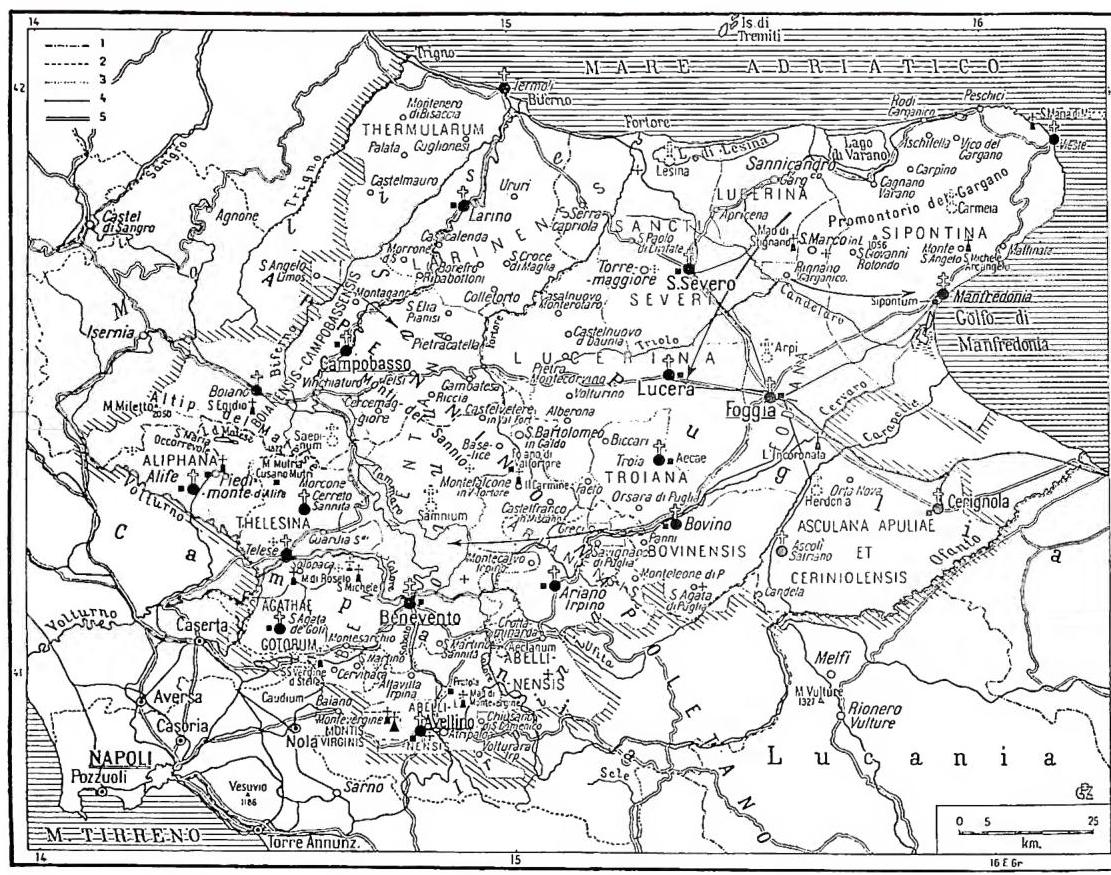
BENEVENTO – Map of the conciliar region of Benevento.
IV. ABBEY OF S. SOFIA. — Unlike the other abbey dedicated to the martyr Sophia in the locality “ad ponticellum,” this one, which was the most important among the many in the ancient capital of the Lombard duchy, took its name from Divine Wisdom, just like the famous basilica of Byzantium. Its origins are linked to the name of Prince Arechi II (758–88), who, near the church already existing around 706 and rebuilt by him, established a monastery of nuns, the first abbess of which was his sister Gorimberga. It later became dependent on Montecassino, and the nuns were succeeded by monks. The Cassinese abbot St. Bertarius (d. 883) completed and consecrated an oratory of St. Benedict, whose construction had been begun by his predecessor Bassacius. The man who later became the renowned abbot Desiderius and Pope Victor III made his profession there and lived there for some time at the beginning of his monastic life.
Arechi had already endowed it with very substantial revenues, but its possessions grew even further in subsequent years. The commendation marked its end. With the consent of the commendatory cardinal Ascanio Colonna, it passed in 1590 to the Canons Regular of the Savior of Bologna; since 1834 the Brothers of the Christian Schools have been there. The archive is scattered in various places in Benevento. The manuscript of the famous Chronicle of the monastery is now in the Vatican Library.
Of the basilica that Arechi had rebuilt in imitation of Hagia Sophia in Constantinople, nothing remains except a small, mutilated portal with a lunette containing a bas-relief depicting Arechi kneeling before St. Mercurius, who recommends him to the Redeemer and the Virgin. A commendatory cardinal added his own coat of arms to II.
Nor is the cloister adjacent to the modest present-day church the original one: it dates in part to the 12th century and has in its center an ancient capital adapted to serve as a well-head. — See Pl. LXXXI.
V. REGIONE CONCILIARE BENEVENTANA
It is one of the regions into which Italy was divided, for the purpose of holding regional councils in place of provincial councils (v. IV), by provisions of the Sacred Consistorial Congregation of 15 Feb. and 22 Mar. 1919 and 29 Sept. 1933 (AAS, 11 [1919], pp. 72-74, 176; ibid., 25 [1933], p. 466). It comprises the territories of the ecclesiastical provinces of Benevento and of Manfredonia, and also the dioceses of Foggia and of Troja, and the nullius abbey of Montevergine.In Benevento, the capital of the region, is seated the regional ecclesiastical tribunal for marriage nullity cases; it judges, in addition to first instance, also on appeal for cases that in first instance have been judged by the regional tribunals of Abruzzo (Chieti) or Apulia (Bari). Appeal against the sentences of the Beneventan regional tribunal must be made either to the Campanian regional tribunal (Naples) or to the Sacred Roman Rota (cf. Pius XI, motu proprio Qua cura, 8 Dec. 1938, in AAS, 30 [1938], pp. 410-13).