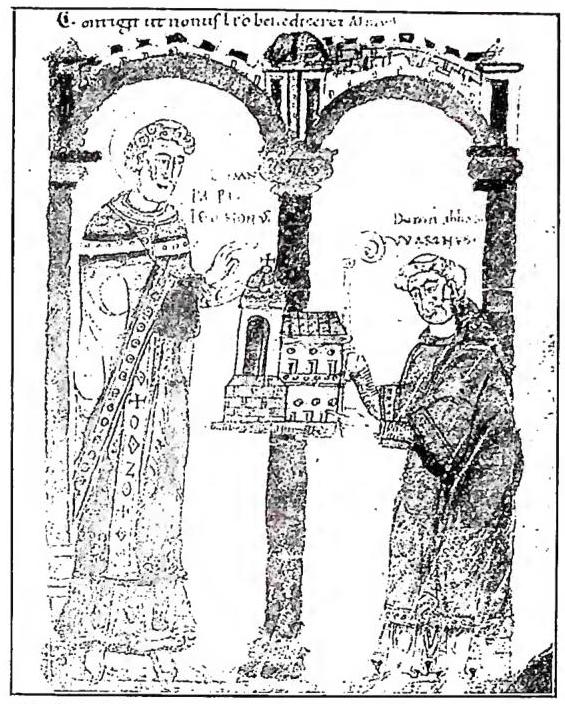
LEO IX, POPE, saint. — Bruno, bishop of Toul, was born on 21 June 1002 at Egisheim from the family of the counts of Dagsburg in Alsace, and died on 19 April 1054 at Rome. Educated in the Cluniac monastery of St-Evre near Toul, he entered the imperial court. In 1026 he was elected bishop of Toul and consecrated on 9 September 1027. He worked assiduously for the spread of the Cluniac monastic reform, especially in the three monasteries of his diocese, namely St-Evre, St Mansuy and St Hidulphe of Moyenmoutier in the Vosges (cf. R. Bloch, Die Klosterpolitik Leos IX. in Deutschland, Burgund und Italien, in Archiv für Urkundenforschung, 11 [1930], especially pp. 190-94).
As a prince of the Empire, he was most faithful to Emperor Conrad II and his son Henry III, of whom he was a cousin. Henry III designated him pope at the Diet of Worms in December 1048, but Bruno accepted the tiara only on condition that the clergy and people of Rome should choose him canonically. After donning the pilgrim’s habit rather than pontifical insignia, he began his journey to Rome (according to Wibert, Vita of Leo IX). Bruno of Segni recounts the meeting of Bruno of Toul with the monk Hildebrand, later Gregory VII, near Besançon. At Rome he was elected unanimously by the clergy and people and crowned in the Lateran on 12 February 1049. Soon afterwards he energetically began the reform of the clergy and Church at a Lateran synod.
Leo summoned from abroad excellent collaborators such as Hildebrand, Humbert of Silva Candida, Hugh of Remiremont, Frederick of Lorraine (later Stephen IX) and others to the Roman Curia. The Pope himself made numerous journeys through Italy, France and Germany, where at the synods of Pavia, Reims and Mainz he issued ordinances against simony, lay investiture and clerical marriage. At the Synod of Vercelli (1050) he condemned Berengar of Tours for his erroneous theories on the Eucharist. He also went to Toul and Germany, where he met Emperor Henry III. On returning to Italy, he found the Normans threatening southern Italy. Leo himself marched against them, but the papal army was defeated on 18 June 1053 near Civitate and the Pope taken prisoner. He returned to Rome on 12 March 1054, ill unto death. During Leo’s pontificate the long-prepared schism between the Eastern and Western Churches was finally consummated; the Pope no longer received the legates from Constantinople who had excommunicated Patriarch Michael Cerularius.
Leo was the best of the German popes of the Middle Ages. His pontificate, which manifested a harmonious cooperation between papacy and Empire, represents the beginning of the medieval ecclesiastical reform. Soon after his death he was venerated as a saint. Feast, 19 April.