
VERCELLI, ARCIDIOCESI of. — It has an area of 1,658 sq km and a population of 198,500 inhabitants, distributed among 139 parishes, of which 119 are in the province of V., 10 in that of Novara, 9 in that of Pavia, and 1 in that of Alessandria. The diocesan clergy consists of 299 resident priests; there are 2 seminaries: the major seminary in the city, and the minor seminary at Moncrivello. It also has 7 male religious orders and congregations with 12 houses, 49 priests, and 32 lay brothers; and 126 convents for women, with 955 religious. The capital has 42,930 inhabitants (1951). Patron: St. Eusebius, bishop, whose feast is celebrated on 1 August. An archiepiscopal see since 1817, it has as suffragans the dioceses of Alessandria, Biella, Casale, Novara, and Vigevano. Its territory consists three-quarters of plains, cultivated chiefly with rice (approximately half of the national area and production), hence a particular social problem arising from the seasonal immigration of more than 27,000 migrant rice weeders, mostly women, during the weeding season (May–July), and of 16,000 outside harvest workers for the reaping.
I. CIVIL HISTORY
The city is the ancient Vercellae, situated near the Sesia River, almost at the junction of the Roman roads that led from Pavia and Milan to the passes of the Pennine Alps; it was founded by the Salluvii among the Libui or Libici (Pliny, Nat. hist., III, 21). Entering Rome’s sphere of influence perhaps at the beginning of the 2nd century B.C., V. became strong and powerful. Not far from it, at the Campi Raudii, Marius defeated the Cimbri in 101 B.C. About thirty kilometres to the northwest, near Vittimulo, were the Vercellese gold mines mentioned by Strabo (V, 218, 12) and by Pliny (Nat. hist., XXXIII, 21). Included in the eleventh Augustan region (Transpadana), V., called «apollinea» by Martial (Epigr., X, 12) because of the pagan cult prevalent there, was already in Vitellius’s time a «firmissimum municipium» (Tacitus, Hist., I, 70), assigned to the Aniensian tribe. But it subsequently declined so greatly that to St Jerome it appeared by then «raro... habitatore semiruta» (PL 22, 327).Capital of a duchy in the Lombard period and of a county under the Franks, it passed under the jurisdiction of the bishops toward the end of the 10th century. Gradually becoming autonomous in the 11th and 12th centuries and organized as a free commune, it dominated an extensive territory, bending even powerful feudal lords to its authority; in 1228 it established a Studium generale, which continued for more than a century, and in 1243 proclaimed the freedom of serfs. In 1335 it fell under the lordship of the Visconti; Filippo Maria ceded it in 1427 to Duke Amedeo VIII of Savoy: Amedeo IX and Carlo II resided there and died there. It endured ruinous sieges by the Spaniards in 1617 and 1638, and they occupied it until 1659; in 1704 it was besieged by the French, who dismantled its fortifications.
II. RELIGIOUS HISTORY
Created as a diocese around 345, Vercelli had as its first bishop St. Eusebius (v.) and apparently then comprised all of Piedmont. But the address of the letter that Eusebius wrote from exile (ca. 356) to the clergy “et sanctis... plebibus Vercellensibus, Novariensibus, Hipporegiensibus, Augustanis, Industriensibus et Agaminis ad Palatium necnon etiam Derthonensibus” (according to the best reading: cf. BHL, 2748) seems to presuppose an already different situation for Turin and the other regions of Piedmont. The presence of Christian communities in minor localities far from the centre, such as Industria (Monteu da Po) and Palatium (near Crescentino, on the Roman road which, along the Po, linked Taurinum to Ticciuum), the establishment of communal life among the clergy (St. Ambrose, Epist., I, 63, 56), and the existence of a monastery of virgins at Vercelli are indications of the rapid organization of the diocese by Eusebius, aided by the strength of pre-existing groups of the faithful. The apostolate carried out by his successors, St. Limenius, present at the Council of Aquileia in 381, and St. Honoratus (CIL, V, 6722), elected after internal disputes through the intervention of St. Ambrose (Epist., I, 63: cf. Paulinus, Vita, 47), as well as by St. NAVARRA (v.), produced tangible results: around 389 the dioceses of Novara and Turin were separated from Vercelli, if Turin had not already been so separated earlier, and shortly thereafter those of Ivrea and Aosta.The catalogue of the 40 pastors from Eusebius to Nottingus (ca. 1830), known from their portraits formerly painted in the old Cathedral, is now fragmentary. Among them, 12 of whom were accorded the title of saint, the following stand out: St. Aemilianus I, around 501, who, besides an altar in the Cathedral, where his body is venerated, had several churches dedicated to him; St. Flavianus (d. 541), presumed author of the Vercelli metrical inscriptions, whose epitaph is preserved (CIL, V, 6728); and Aemilianus II, to whom King Aripert II confirmed in 707 the recently founded monastery of S. Michele di Lucedio and the earlier donations. Under Liutward, archchancellor of Charles the Fat, the temporal power of the bishops took shape, if it did not begin, both by virtue of the disputed diploma of 16 March 882 and through another similar act. The massacre of the city clergy perpetrated by the Hungarians on 13 December 899, to whom Liutward too fell victim (cf. MGH, Script., I, p. 609),
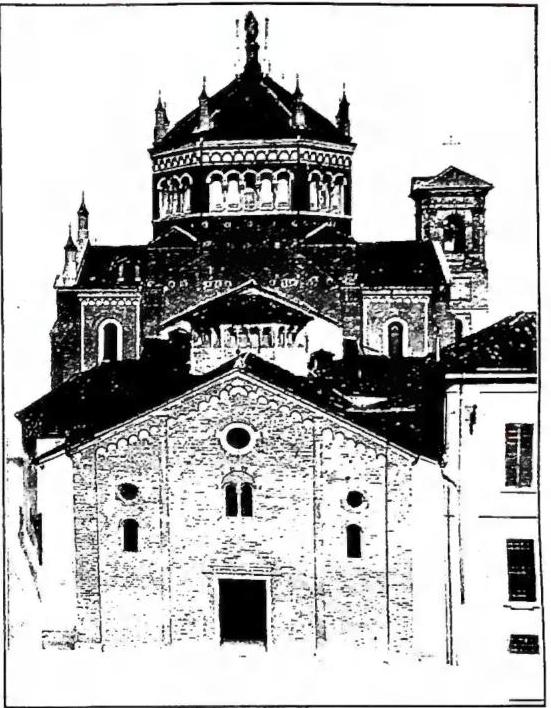
(courtesy of Mons. G. Ferreri)
Ivrea (v.) waged a fierce struggle against the bishops St. Peter (d. 997) and Leo: the corpse of the former, who became his victim, was burned, for which he was excommunicated, while Otto III stripped him of his possessions, which he assigned, together with the counties of Vercelli and Santhià, to Leo by two diplomas dated 7 May 999. Although these donations remained partly ineffective, together with those of 1000–1001 they mark the high point of episcopal feudalism. Soon thereafter, perhaps from the middle of the 11th century, the commune began increasingly to oppose its exercise in the city and county. These struggles provide the context for the construction of boroughs and castles by bishops such as Uguccione (d. 1170), who founded the Piazzo of Biella and Ronsecco—precursors of the free boroughs (v.), about thirty of which were later created by the Commune for other purposes in the 12th and 13th centuries. In 1243 the Commune attempted to seize the remaining episcopal dominion, by then reduced to the places alone listed (after the pievi) in the bull of 1 June 1187, sent by Urban III, formerly bishop of Vercelli (1182–84), to St. Albert (v.); the prelate Martino Avogadro (1244–68) resisted. The matter was brought to an end instead by the cession of Biella to the Savoyard duke Amadeus VI (1379) and the investiture of the papal fief of Masserano and Crevacuore to the Fieschi (1394). In the 15th and 16th centuries, bishops of the Fieschi family of Lavagna governed the Church of Vercelli for about 90 years, followed family (v.), from 1499 to 1572, when Cardinal Guido Ferrero exchanged it for G. Francesco Bonomi (v. EUNOMIANI), abbot of Nonantola. Bonomi implemented the Tridentine reform there: he held 11 synods, consolidated the urban Seminary, established the minor seminary, abolished the Eusebian rite, and left detailed reports of his pastoral visitations in the diocese, in Maurienne, and in the Aosta Valley (1576).
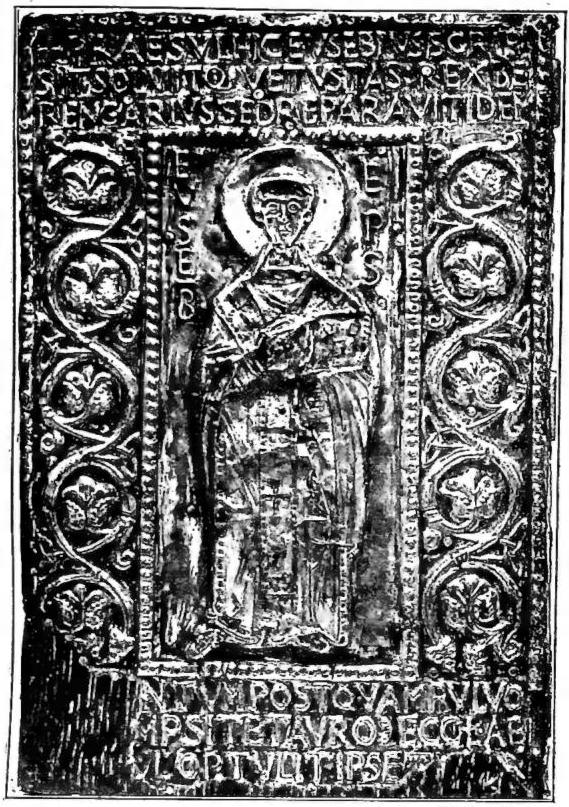
(photo by D. Vittorio Viale)
VERCELLI, ARCIDIOCESI di — Covering of repoussé silver plates, offered by King Berengar I for the Gospel codex of St. Eusebius (9th century).
III. RURAL PARISHES, CHAPTERS, MONASTERIES
In the 10th century the diocese was divided into 36 rural parishes (catalogues in Cod. Vat. lat. 4322, fols. 34r and 108), almost all situated along ancient Roman roads and in archaeological areas. In addition to the two urban Chapters of S. Maria and S. Eusebio, which the bishops Norgaudo (ca. 844) and Alderico in 1040 restored to the practice of common life, seven others already existed from the 11th century onward, including those of Biella and Casale. There were nine historic abbeys: SS. Michele and Genuario of Lucedio, made famous by s. Bononio (v.); S. Stefano di V.; SS. Vittore and Corona of Grazzano (Casale), endowed in 961; SS. Salvatore and Giacomo della Bessa (Biella); Sannazzaro (ca. 1040); Muleggio (11th century?), Benedictine; S. Maria di Lucedio, Cistercian, founded in 1123 and flourishing under the abbots Pietro (1184–1205) Oglerio (v.), whose extensive territory acquired from the monks who GRANGIA (v.); S. Maria di Vezzolano ([v.] now Asti); S. Andrea di V., founded in 1224 BICCHIERI, GUALA (v.), Tommaso Gallo (v.) to head II.IV. ILLUSTRIOUS PERSONAGES
The following were born in the diocese: s. Guglielmo (v.); b. Varmondo (v.); b. Giovanni da V. (v.); b. Emilia Bicchieri, Dominican, foundress of the monastery of S. Margherita (d. in 1314); b. Antonio della chiesa di S. Germano, Dominican (d. in 1459); b. Arcangela Girlani of Trino, Carmelite (d. in 1494); b. Panattieri (v.); b. Giacobino Canepaccio, Carmelite (d. in 1508): all with cult approved in the diocese; Rainero Avogadro, the bishop who carried fra' Dolcino (v.); Antonio da V. (v.); M. Gattinara (v.); R. BAZZANO (v.); O. FERRARIENSIS (v.); Raimondo Recrosio, bishop of Nice (d. in 1732); G. Fr. Marchini, blista (d. in 1774); E. Avogadro Della Motta (v.).V. ARCHIVI
Little information is available about the ancient Schola S. Eusebii, attached to the Cathedral; its importance, however, can be perceived indirectly from the precious collection of 220 codices in the Chapter Archive (many of them illuminated, several dating from the 9th–11th centuries, about fifty liturgical, some of which contain ancient musical notation; the celebrated codices include: Vercellensis a of the Vetus Latina, from the 4th century; the Anglo-Saxon Vercelli Book, from the 10th century; De advocatis of the Imitation of Christ ([v.] from the 13th–14th century; no. 39, containing the works of Atto, from the 10th century, etc., together with documents from 707 onward). Also noteworthy are the following archives: the archiepiscopal archive (documents from 1145 onward); the civic archive, for the Biscioni collection (records from 882 onward); the hospital archive (with documents from the 12th century to 1500 inventoried); and the Archive of the Archbishop’s Curia (records of pastoral visitations from 1553 onward). The records of the ancient suppressed monasteries have partly been scattered and partly transferred to the State Archive of Turin. The libraries of the Seminary, the Agnesiana (ecclesiastical), and the civic library are good.VI. MONUMENTI
Appartengono al periodo romanico il campanile (del 1152 ca.) della Cattedrale, ricostruita in varie riprese dal 1572 al 1860 su disegno di P. Tibaldi e, per la facciata e l'atrio, di B. ALTIERI (v.), che conserva un Crocifisso di lamina d'argento sbalzata (sec. XI) e un tesoro di grande pregio artistico, comprendente tra l'altro una copertura a lamina d'argento con sbalzi (sec. IX), donata da re Berengario I per il codice dei Vangeli di s. Eusebio, e un'altra d'oro con ornati a smalti e pietre dure per un evangelario (sec. XI: V. tav. 89 del vol. IX); il portale ed i musaici pavimentali di S. Maria Maggiore (ora al Museo Leone con il materiale epigrafico ricuperato nella demolizione della stessa e del Duomo), chiesa matrice di V., riedificata nel sec. XII e consacrata da Eugenio III il 17 giugno 1148, abbattuta nel 1777; la parte anteriore di S. Bernardo; i campanili di S. Michele e di S. Vittore. Il fervore architettonico del secc. XI-XII è confermato dalle superstiti chiese romaniche sparse in diocesi, quali le antiche pievi di S. Michele di Balocco; S. Michele di Clivolo a Borgo d'Ale; Lenta; S. Maria di Rado a Gattinara; l'abbaziale di S. Genuario, del sec. XI; le chiese di Naula a Piane Sesia (ivi epitaffio di prete Candidiano: sec. VII); S. Michele di Trino (importante centro religioso, patria dei Giolito e di altri celebri tipografi che stamparono a Venezia dal 1480 e in loco dal 1508); S. Pietro di Robbio; S. Lorenzo di Oldenico; S. Pietro di Tronzano, ecc. del sec. XII.Il più insigne monumento cittadino è la basilica di
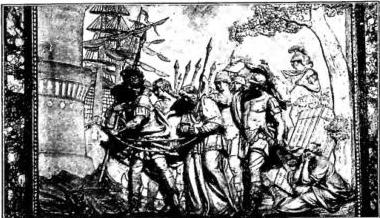
(per cortesia di mons. A. P. Frutua)
VERCELLI, ARCIDIOCESI di - S. Eusebio parte per l'esilio. Particolare dei rilievi del coro del Duomo, opera di G. B. Bernero su disegno di F. A. Meyer (sec. XVIII).
S. Andrea in stile gotico con elementi antelamici, costruita negli anni 1219-27 a cura del card. Gualà Bicchieri; tipiche espressioni del gotico sono pure le chiese di S. Francesco, di S. Marco (ridotta a mercato pubblico), di Sennazzaro e le costruzioni monastiche di S. Maria di Lucedio. Del '700 notevoli il 2° cortile del Seminario ultimato su disegno del Juvarà e la chiesa parrocchiale di Borgo d'Ale (1770) di ispirazione vittoniana.
Sulla fine del '400 e nel '500 tenne un posto preminente nel movimento artistico del Piemonte la scuola pittorica vercellese, resa illustre dai nomi dello Spanzotti, del Sodoma (v.), che passò presto a Siena, FERRARIENSIS (v.), degli Oldoni, dei Giovenone e di Bernardino Lanino; le molte tavole e gli affreschi esistenti nel Museo Borgogna, in episcopio e in varie chiese cittadine (S. Cristoforo, S. Paolo, S. Francesco, S. Giuliano, ecc.) e della diocesi ne documentano la feconda attività. Ricchi ed apprezzati i Musei cittadini: Leone (archeologia) e Borgogna (pinacoteca). Un privato conserva il cofano del card. Bicchieri con smalti limosini del sec. XIII. - Vedi tav. CXXX.
BIBLI: fonti: molti documenti in Monum. hist. patriae, 20 voll., Torino 1836-99; S. Caccianotti, Summ. monum. omnium quae in Tabulario municipii Vercelli, continentur..., Vercelli 1868; L. Bruzza, Inacriz. ant. vercell. (le cristiane 2 pp. 25-362), Roma 1874; E. Ferrero, Iscriz. ant. vercell., Torino 1891; G. Colombo-R. Pastè, I necrol. eusebiani, in Boll. st. bibl. subalp., 2-7 (1897-1902), 25 (1923); indici di G. Borghesio, ibid., 31 (1929), pp. 147-250; D. Arnoldi - F. Gabotto, Le carte dell'Arch. capitol. di V. (Bibliot. Soc. st. subalp., 70-71), 2 voll., Pinerolo 1912-14; P. Fr. Kehr, Italia pontif., VI, II, Berlino 1914, pp. 26-54; G. Sella, Cartario del monast. di Muleggio, e D. Arnoldi, Le carte dell'Arch. arcto. di V. (Bibliot. Soc. st. subalp., 83), Pinerolo 1917; R. Pastè, Invent. dei mst. delle Bibl. capit. di V. (Invent. dei mst. delle Bibl. d'Italia, a cura di A. Sorbelli, XXXI), Firenze 1924; D. Arnoldi, Il «Libro delle investiture», del vesc. di V. Giop. Fieschi (Bibliot. Soc. st. subalp., 83, II), Torino 1934; G. C. Faccio-M. Ranno, I Bisciani (ibid., 145-46), 2 voll. (su 7 previsti), ivi 1934-39; Acta Reginae Montis Orqpae, 2 voll., Biella 1945-48 (vol. I, 4 pp. 23-47; 78-124; 224-40 i registri delle decime e notizie sui monast.; vol. II, pp. 37-45 note stor. sulle chiese del Biellese e dell'alto Vercellese, a cura di G. Ferraris); Eubel, I, pp. 220-21; II, pp. 290-91; III, pp. 331-52; IV, p. 364; V, pp. 410-11; Storia: M. A. Cusano, Discorsi historiali, Vercelli 1676; V. Mandelli, Il Comune di V. medioevo, 4 voll., ivi 1857; C. Dionisotti, Memor. stor. della città di V., 2 voll., Biella 1861; id., Notizie biogr. dei vercell. illustri, ivi 1862; F. Savio, Gli antichi vesc. d'Ital. delle orig. al 1300. Il Piemonte, Torino 1868, pp. 1-8, 403-94; F. Gabotto, Ricerche intorno all'invas. degli Unghuri in V. ed al tempo della morte del vesc. Liutowardo, Vercelli 1899; R. Gresnigo, V. SACRO, Como 1909; Arch. della Soc. vercell. di stor. e d'arte, 3 voll., Vercelli 1910-21; Medioevo vercell., ivi 1926; Lanzoni, pp. 1036-44; G. C. Faccio - G. Chicco, Vecchia V., 7 voll., Vercelli 1931-51; R. Ordano, Un vesc. ital. del secolo di ferro (Attone di V.), ivi 1948. Per l'arte: G. Colombo, Docum. e notizie intorno agli artisti vercellesi, Vercelli 1885; P. Verzeone, L'architet. romanica nel Vercellese, ivi 1934; A. M. Brizio, Catal. delle cose d'arte e di antichità d'Ital., V., Roma 1935; V. Viale, Guida ai Musei di V., ivi 1935; id., V. e la sua provincia dalla romanità al fascismo, ivi 1939; G. Chicco, Mem. del vecchio duomo di V., ivi 1943 (con bibl.); N. Gabrielli, Le pitture romaniche, Torino 1944, pp. 11-13, 70-72; L. Mallé, Antichi smalti cloisonnés e champlevés dei secc. XI-XIII in raccolte e musei del Piemonte, in Bollet. Soc. Piemontese d'arch. e di Belle Arti, 3 (1949), pp. 38-79; 4 (1950), pp. 54-136. Giuseppe Ferraris