
NOVARA, DIOCESE of. — City, capital of the province of the same name and a diocese. The diocese extends from the lower Novarese to the main chain of the Alps. To the east, its boundary is formed by Lago Maggiore and the Ticino; to the west, by the Sesia and a spur of Monte Rosa; to the south, by the boundary of the province together with the territory of Gravellona Lomellina; to the north, by the arc of mountains that rises from Rosa to the Gries and descends from the Gries to Lago Maggiore above Cannobio.
Its area is approximately 4,400 sq. km. The inhabitants number 420,000, of whom 419,500 are Catholics. In addition to the urban centre, the ecclesiastical district comprises 43 vicariates forane, 13 collegiate churches, 381 parishes served by 578 secular priests and 215 religious priests, 4 seminaries, and 33 male and 46 female religious communities.
The episcopal see, established in the 4th century and suffragan to the diocese of Milan, has, since 26 September 1817, by decree of Pius VII, formed part of the ecclesiastical province of Vercelli.
I. HISTORY
Ancient Novaria, a city of the eleventh Augustan region (Transpadana), had a pre-Roman origin, perhaps more Gallic than Ligurian. It was traversed by the great road indicated in the itineraries of the late Empire, which linked Milan with Vercelli. Destroyed by Maximus in his struggle with Valentinian II, it was rebuilt by Theodosius the Great at the request of Bishop Gaudentius. It also suffered serious damage in the wars between Theoderic and Odoacer, so much so that Bishop Honoratus, according to Ennodius, built a castle there for its defense. Under the Carolingians it was the seat of a count, but power gradually passed from the counts to the bishops, who were confirmed by Otto I (969) in the person of Bishop Aupaldo. From the time of Henry III, N. was a Commune, governed by two consuls and a chief consul. Frequently at war with Vercelli and Milan, it joined Frederick Barbarossa against the latter city, but in 1168 it was compelled to enter the Lombard League. After the Peace of Constance, it fought with the counts of Biandrate, with Vercelli, and with its bishops, who did not wish to be deprived of their sovereign rights, in which they had again been confirmed by Frederick Barbarossa. Following the expulsion of the bishop in 1200, Innocent III threatened to suppress the diocese. Then, when Martino della Torre became lord of Milan, N. paid him homage, as it did to the Visconti, and from that time formed part of the Duchy of Milan, with rare interruptions: in 1536–38 it belonged to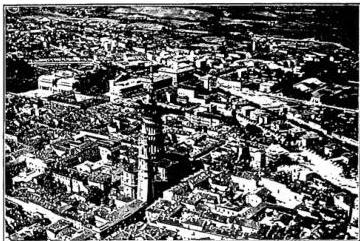
(photo Enit)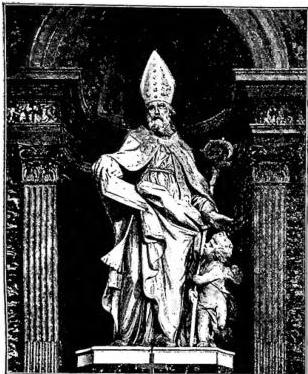
Monferrato; from 1556 to 1602 to the Farnese of Parma, and with the Treaty of Vienna of 1738 it passed to the House of Savoy.
Because of its position, N. was the scene of important battles. In April 1500, Ludovico il Moro, Duke of Milan, was preparing to besiege Trivulzi, appointed governor by the king of France; but, abandoned by his Swiss troops, he was taken prisoner. On 6 June 1513, the Swiss in the service of the king of Spain drove out the French; on 10 April 1812, the troops that had rebelled against King Carlo Felice were dispersed there; on 23 March 1849, Radetzky inflicted a defeat on the Piedmontese that compelled King Carlo Alberto to abdicate.
II. MONUMENTS
Of the ancient monuments with which the city was once rich, little now remains. Among them, the Baptistery should be mentioned; it has an octagonal plan and was probably rebuilt in the 10th century according to the plan of the 5th-century structure.The old Romanesque Cathedral, consecrated in 1132 by Innocent II, had already been restored, enlarged, and patched up in such a way that it retained little of its original lines. It was demolished in 1865 to make way for the Antonellian Temple, opened to the public and consecrated by the bishop, Monsignor Gentile, on 2 October 1869. The building is striking for the grand porticoes rising beside and in front of it, for its various superimposed colonnades, for the vastness of its proportions, and for the beauty of its classical forms. The interior is basilical in form, with three naves divided by Corinthian columns 19 metres high. It contains nine altars: the high altar and eight lateral ones, on which canvases and altarpieces from the old Cathedral may be admired, including The Marriage of s. Catherine by G. Ferrari, Our Lord on the Cross with s. Gaudenzio, s. Benedict, and the Magdalene by Bernardino Lanino, and the fresco of the Madonna delle Grazie by Bernardino Campi. Other precious remains of the ancient Basilica are the mosaic pavement of the presbytery, thought to date from the 9th century; the oratory of S. Siro, with 12th-century frescoes; and Lanino’s frescoes transferred to the walls of the lower sacristy. The chapter library should be counted, on account of its manuscripts, among the richest in Piedmont: it possesses 144 codices, a collection of sacred canons by the grammarian Stefano, a guide to Rome from 1399, and precious incunabula.
The basilica of S. Gaudenzio, rebuilt in stages between 1577 and 1659 according to a design by Pellegrini, is flanked by the fine bell tower erected in 1753–86 by Benedetto Alfieri and surmounted by the exceptionally daring dome of Antonelli, constructed between 1844 and 1888, which provides a distinctive element in the appearance of the city. Inside, the Baroque altars display a polyptych by G. Ferrari from 1514, the Deposition from the Cross by Moncalvo, and frescoes by Morazzone and Stefano Legnani. Splendid and exceptionally rich in marble and valuable works is the «scurolo», begun in 1674, where s. AUDENZIO (v.), patron of the city and the diocese, rests in an octagonal urn of worked silver and Venetian crystal.
Among the other churches of N. should be mentioned that of Ognissanti, with Romanesque remains; the fifteenth-century churches of S. Martino and S. Nazzaro, the latter restored in 1929–32 and containing fifteenth-century frescoes; and the Baroque churches of S. Marco (1607), with frescoes by Moncalvo and a canvas (Martyrdom of s. Mark) by Crespi, and S. Pietro al Rosario, with a Madonna by Procaccini and frescoes by the Fiammenghini.
III. SHRINES
The Sacred Mount of Varallo is the most distinguished of the Novarese shrines; it was founded in 1491 by the noble Milanese b. Bernardino Caimo of the Friars Minor Observants. The complex of architectural buildings, designed by Pellegrino Tibaldi and Galeazzo Alessi, comprises 46 chapels, a basilica, a secondary church, four grand buildings (one used as a hotel and three as hospices for pilgrims), and a cloister for the Oblate fathers engaged in spiritual care. The chapels reproduce, in statues and paintings, the most important events in the life of Jesus Christ. The finest artists of the period worked there: suffice it to recall maestro Frate Francesco, G. Ferrari, F. Stella, G. Wespin, and the Valsesian artists G. D'Enrico, G. Ferro, B. Ravelli, G. Bargnola, D. Bussola, G. Volpini, C. Tandardini, L. Marchesi, A. D'Enrico, Gianoli, Orgiazzi, Avondo, Borsetti, Gilardi, Reffo, etc.The shrine of the Most Holy Crucifix of Boca owes its origin to a fresco painted above a crude wayside pillar, depicting a Crucifix flanked by an angel collecting in a chalice the blood flowing from the side; it had been venerated since the middle of the seventeenth century. The wayfarer G. B. Curioni of Gallarate, delivered from an ambush in that vicinity, attributed his salvation to invoking the Crucifix and made the first substantial offering, which gave rise to the Shrine. The present grandiose temple is by the architect A. Antonelli.
The church of the Most Holy Pietà of Cannobio is a national monument and was designed, by order of s. Carlo Borromeo, by Pellegrino Pellegrini. The façade is in red granite from Baveno; the interior is exceedingly rich in gold and stuccoes, with paintings by good seventeenth-century artists. In place of the tabernacle, in the position where it stood in 1522, one sees the miraculous little picture depicting the Pietà. S. Carlo Borromeo enriched this Shrine with many privileges, visited it several times, and on 31 October 1584 celebrated there his penultimate Mass.
The shrine of the Madonna del Sangue at Re, in Val Vigezzo, likewise originated in a miraculous event, namely the blood that flowed from the forehead of the Madonna, depicted with the Child in her arms on the façade of the church of S. Maurizio, after a stone had been hurled at her forehead on the evening of 29 April 1500 by one Giovanni Zuccone, who had angrily left a tavern because he had lost at gambling. The event was repeated on the night of 1 May in the presence of a large number of people who were praying by the light of numerous burning candles; the blood began to flow in such abundance that it ran down to the ground, soaking several small cloths, which are carefully preserved in the shrine, as is shown by the testimonies written by the valley’s podestàs Daniele De Crispi and the noble Angelo Romano. An altar of wood was immediately built before the miraculous image; then the old church of S. Maurizio was lengthened so that the portico came to lie at the centre of the new structure (1595). But as the Shrine’s fame and the number of Italian and Swiss pilgrimages grew, the need was felt to erect a new temple, whose construction is under way. The design, in the Gothic style, is by the architect Edoardo Collamarini.
The shrine of the Sacred Mount of Orta was conceived by the community of the village to commemorate the principal events in the life of s. Francis of Assisi; but it began in 1591, when the abbot Amico Canobio undertook the erection of what later became the twentieth chapel. The bishop of N., ven. Bascapé, promoted the work on the Sacred Mount, himself ordering a chapel at his own expense; other benefactors followed his example. In 1630 ten chapels had been completed, and in 1770 the twentieth was also inaugurated. They stand in the most varied architectural forms of the sixteenth and seventeenth centuries among the pine woods of the enchanting mountain that dominates the lake of the same name on three sides; they contain a considerable number of terracotta statues, and their walls are frescoed by various painters, among whom are G. C. Procaccini, Cantalupi, Nuvolone, Crespi, the Fiammenghini, and Morazzone.
La Madonna del Boden: on the mountain overlooking the village of Ornavasso, at the beginning of the sixteenth century, an image of the Virgin painted on the wall of a small chapel was venerated; the chapel was later transformed into a small church and enlarged in 1761; in 1825 the side aisles were built. The Shrine is now connected with the town by a good carriage road and is visited by numerous pilgrims.
Minor shrines. - The diocese is rich in other shrines, most of them dedicated to the Madonna. The following may be mentioned: the Madonna del Varallino at Galliate, the Madonna di S. Cassiano at Cameri, the Madonna di Loreto at Oleggio in the lower Novarese area; the Madonna del Sasso at Boletto and the Madonna della Bocciola at Vaciago on Lake Orta; the Madonna delle Grazie at Montrigone near Borgosesia and the Madonna del Callone at Campertogno in Valsesia; S. Fermo at Crusinallo, the Madonna della Neve at Bannio, the Madonna della Vita at Mozzio in Ossola; S. Carlo, on the mountain of the same name, at Arona, and the Madonna delle Grazie at Suna on Lago Maggiore.
IV. THE SAINTS
The first apostle of N. was St. Lorenzo, priest and martyr, mentioned in the Cathedral diptychs after St. Gaudenzio and St. Agabio (vistorum magister et doctor egregius, sed non episcopus), who probably came from Vercelli, preached and baptized outside the city, and was killed by the pagans together with some children who followed him. — The first bishop of N. was St. AUDENZIO (v.), succeeded by St. Agabio (d. in 438?), who continued his work with great zeal and is buried in the Cathedral beneath the altar dedicated to him. Saints Giulio and Giuliano, apostles of upper Novara and the Cusio, are said to have been two brothers, one a priest and the other a deacon, who destroyed many pagan altars and temples and erected many churches. The 99th of these was the church erected at Gozzano, in honor of St. Lorenzo, by Giuliano, who was buried there; and the 100th was that erected on the island in Lake Orta by Giulio, who was buried there together with the bodies of St. Elia, bishop of Sion, St. Audenzio, the martyr Demetrio, St. Filiberto the abbot, and St. Adalgiso (v.), the 32nd bishop of N. Blessed Panacea, a fifteen-year-old girl killed by her stepmother (1 May 1383), is honored at Ghemme; Blessed Pacifico of Cerano, of the Friars Minor of the Observance (d. at Sassari in 1482), at Cerano. Also worthy of mention is the blessed Caterina of Pallanza (1437–38), who led an eremitical life on the Sacro Monte at Varese; her body rests beside that of Blessed Giuliana in the small chapel adjoining the Basilica.V. I VESCOVI
The diocese of N., Father Savio asserts, is the only one among all those of Piedmont to possess a precise list of its bishops, recorded in the precious ivory diptychs of the Cathedral and the Basilica of S. Gaudenzio. The Cathedral diptych, 33 cm high and 27 cm wide, was written by a certain Airaldo, a subdeacon, and lists the bishops of Novara from S. Gaudenzio to Bonifacio (1172). That of S. Gaudenzio measures 32 cm in height and 22 cm in width and contains the list of the bishops of Novara up to Guglielmo Amidano (1343).From S. Gaudenzio to the present day, 117 bishops have governed the diocese of N.: three of them—Gaudenzio, Agabio, and Adalgiso—bear the aureole of the saints; two, Pietro Filargo (Alessandro V) and Benedetto Odescalchi (Innocenzo XI), rose to the honors of the Roman pontificate, and fourteen were raised to the cardinalate.
VI. SCHOLARS
Pietro Lombardo (v.), Cardinals Ardicio I (d. in 1434) and Ardicio II (d. in 1483); the BlessedFr. Tornielli of the Reformati Minors, an eminent preacher (d. in 1589), St. Carlo Borromeo (v.), the Venerable C. Bascapé (v.); the Venerable Fr. Quagliotti, preacher (d. in 1617), the Venerable L. Giacobini, popularly called the 4 blessed holy parish priest of Cressa and Varallo Sesia (d. in 1732); Canon P. Scavini (v.), an eminent moral theologian.