
PIETRO, APOSTLE, saint. — First of the Apostles, constituted by Jesus as head of His Church.
SUMMARY:
I. Life
II. St. P. in Rome. —III. Martyrdom
IV. Tomb
V. Letters
VI. Liturgy
VII. Iconography
VIII. Apocrypha
IX. Legends.I. LIFE — His name appears in the New Testament in four forms: Σιμεών (Simeon, from Sim'ōn, a Semitic form: Acts 15:14; 2 Pet 1:1), Σιμιών (Simon, the more common form, a Hellenized abbreviation of the preceding), Κηφᾶς (Lat. Cephas, a transcription of the Aramaic Kēphá', meaning “rock”), Πέτρος (Lat. Petrus, the Greek translation of the same Aramaic nickname, given to Simon by Jesus [John 1:42]). His father was called John ('Ιωάν[ν]ης: John 1:42; 21:15–17) or Jonah. In Matt 16:17 Simon is called “son of Jonah” (Βαριωνά; cf. BAR IONA), but it is possible that the name Jonah, attributed to Peter’s father (also in the Vulgate at John 1:42), is an abbreviation of John (perhaps due to a slip by the Greek translator of Matt 16:17: U. Holzmeister [cf. bibliography], p. 6).
Peter was born at Bethsaida (cf.) near the Lake of Gennesaret, where he worked as a fisherman with his brother Andrew (cf.), who was also called to the apostolate, and with the sons of Zebedee (cf.), James the Greater (cf.) and John (cf.), who later also became apostles.
The fact that Peter had a mother-in-law at Capernaum, healed by Jesus (Matt 8:14; Mark 1:30–31; Luke 4:38), shows that Peter was married; the name of his wife is not known with certainty—she is called Joanna by the Easterners and Perpetua by the Westerners—and it is not known whether his wife was still alive at the time of Peter’s call. Some exegetes have sought to identify Peter’s wife with the “sister-woman” whom Cephas is said to have taken with him on his apostolic journeys (1 Cor 9:5), but this is far from proven. It was probably a Christian woman (a household servant or deaconess) who followed Peter and the other missionaries mentioned there, in line with the tradition that attributes a daughter, Petronilla (cf.), to Peter.
Peter and John are described by the Sanhedrin as “uneducated and ordinary men” (Acts 4:13), a sign that they had not attended the rabbinic schools of learning. They had, however, followed the instruction of John the Baptist (cf.). This is certain for the sons of Zebedee and for Andrew; it is probable for Simon-Peter. Peter’s call to the apostolate took place gradually. When his brother Andrew presented him to Jesus with the words “We have found the Messiah,” he received the nickname Cephas (John 1:42). He was present at the miracle at Cana (John 2:2–11) and then settled with Jesus in Capernaum (John 2:12). He was definitively called to the apostolate after the first miraculous catch of fish (Luke 5:11; Mark 1:18; Matt 4:22), thus becoming a “fisher of men.”
Pietro De Ambroggi
II. ST. PETER IN ROME. — Pope Clement, in his Letter to the Corinthians, written between 18 Sept. 96 and 25 Jan. 98 (A. Casamassa, I Padri Apostolici, Roma 1938, p. 49), recalls the martyrdom of the holy founders Peter and Paul, attesting that to these men of holy life was added a multitude of the elect who, amid so many torments, set before us a magnificent example (1 ad Cor.: PG 1, 217-21). Ignatius of Antioch, martyred in Rome under Trajan, writing in transit to the faithful of the Urbe, entreats them that he cannot give them orders as Peter and Paul did (Ad Rom., IV, 3). Bishop Dionysius of Corinth, addressing between 165-70 the bishop of Rome, Soter, explicitly testifies that Rome and Corinth had as founders of their respective Churches the same Apostles Peter and Paul (Ad Rom., in Eusebius, Hist. eccl., II, 25, 8). The same testimony is given a few years later by St. Irenaeus, bishop of Lyons (Contra haeres., III, 3, 3) and later by Tertullian (Adversus Marcionem, IV, 5, 2: CSEL, 47, 430). He moreover calls the Church of Rome “blessed” because the Apostles poured out their blood there, where Peter conformed himself to the Lord’s Passion (De praescr., 36, 2). Commodian attests that Nero “first punished Peter and Paul in the city” (Carmen Apologet., 828: CSEL, 15, 169). Peter of Alexandria and Athanasius indicate Rome as the place of martyrdom of the two Princes of the Apostles (Epist. canon., 9, 9: PG 18, 484; Apol. de fuga sua: PG 25, 668); the same is affirmed twice by Gregory of Nyssa (In s. Stephanum, 2: PG 46, 729; Epist., 17: PG 46, 1061). St. John Chrysostom repeatedly states that St. Peter died in Rome (Contra Iudaeos et Gentiles, 9: PG 48, 825; In s. Ignatium, 4: PG 50, 593; In Psalm., 48, 6: PG 55, 232; In Rom., 32, 2 sg.: PG 60, 678). Whatever interpretation one may give to some expression in the context of the poem placed by Damasus (366-84) “in catacumbas,” it is undisputed that he claims Peter and Paul as Roman citizens for their martyrdom: “Rome rather deserved to defend her own citizens” (A. Ferrua, Epigramm. Damasiana, Città del Vaticano 1942, pp. 139-44). While the year of St. Peter’s arrival in Rome cannot be fixed with certainty, there is instead a series of indubitable testimonies that he suffered martyrdom in Rome and was buried there. If many have tried to deny St. Peter’s coming to Rome, beginning with the heretics of the 13th century, just as many times it has been confirmed even by learned Protestants, such as A. Harnack and above all H. Lietzmann (Petrus und Paulus in Rom, 2nd ed., Berlin-Leipzig 1927; id., Gesch. der alten Kirche, I, ibid. 1932, p. 20) and especially Petrus römische Martyrer, in Sitzungsbericht der Preuss. Akad. der Wissenschaft, Philolog.-Hist. Klasse, 29 [1936], pp. 1-21), in which he refutes Daunzenbauer (1932) and K. Heuss (1936).
III. MARTYRDOM
1. The Year
The sources and interpreters are not in agreement regarding the year of St Peter’s martyrdom. In the so-called Liberian Catalogue it is stated that the Apostle Peter “passus est autem cum Paulo die III Kal(endas) Iulias, consulibus suprascriptis,” that is, on 29 June in the year when Nero and Vetus were consuls, namely 55. This year for the Apostle’s death was accepted by Th. Mommsen (Über den Chronographen des Jahres 354, in Abhandlungen der Königl. Sächsisch. Gesellsch. der Wissenschaftl., 1 [1850], pp. 634-37) and later by H. Kellner (Jesus von Nazareth und seine Apostel, Regensburg 1908, pp. 216-43). The death of Peter is assigned to the year 57 in the “Fasti Vindobonenses priores” and in the “Consularia Ravennatia,” while the “Consularia Constantinopolitana” place the martyrdom in the year 58 (ed. Th. Mommsen, in MGH, Auct. antiquis., IX, pp. 283, 194, 220). Not a few authors place the death of St Peter in the year 64, coinciding with that of the burning of Rome, which occurred in the month of July. Such is the opinion, among Protestants, of C. Erbes (Die Todsstage der Aposteln Petrus und Paulus, Berlin 1899, pp. 1-138); A. Harnack (Chronologie, I, Leipzig 1897, p. 242); T. Zahn (Grundriss der Gesch. des apostol. Zeitalters, 2nd ed., ibid. 1927, p. 68); and, among Catholics, of L. Duchesne (Hist. ancienne de l'Église, I, Paris 1906, p. 64); P. Franchi de’ Cavalieri (in N. Bull. di arch. crist., 13 [1907], p. 113); M. Lagrange (Evang. selon s. Luc, Paris 1921, p. XXXI). Other authors, however, prefer the following year, 65. Indeed, the text of Tacitus’ Annals interposes a certain interval between the fire and the persecution, which arose when “non ope humana, non largitionibus principis aut deum placamentis decedebat infamia, quin iussum incendium crederetur. Ergo abolendo rumori Nero subdidit reos” (XV, 44). This was already the opinion of D. Papebroch (Acta SS. Iunii [Paris 1867], § 2, 17-25, pp. 367 B-369 B) and, more recently, of O. Marucchi (La crocifissione di s. P. in Vatic., in N. Bull. arch. crist., 11 [1905], pp. 137-53); A. Profumo (Le fonti ed i tempi dell’incendio neroniano, Rome 1906, pp. 306-15, 320-27). St Epiphanius placed the death of St Peter and St Paul in the twelfth year of Nero’s reign (Hom., 27, 6, 6: PG 41, 373 B); this opinion was followed by L. Tillemont (I, p. 179). But in the Armenian version of Eusebius’ Chronicle (v.), in the Chronicon Gallicum (ed. Th. Mommsen, in MGH, Auct. antiquis., IX, p. 639) and in Agapius (PO 7, 478) Peter’s martyrdom is indicated in the thirteenth year of Nero’s reign, which runs from 3 Oct. 66 to 12 Oct. 67, unless this year is to be reckoned from Nero’s second tribunician power, namely from 10 Dec. 54. Clement of Rome places the martyrdom of St Paul (1 Cor 5:7) ἐπὶ τῶν ἠγαμένων, that is, in 67, when Nero, having departed for Greece, left the government of Rome to Sabinus, Tigellinus and Helius Caesarinus (Dio Cassius, 63, 12, 19); but the term “egumeni” can also mean ordinary judges, and the contemporaneity of Paul’s martyrdom with that of Peter is not certain. St Jerome places the year of St Peter’s death in the last year of Nero (“...Romae... cathedram sacerdotalem tenuit ad ultimum annum Neronis, id est decimum quartum” [De viris illustr., 1: PL 23, 638]) and repeats the same date for St Paul (De viris illustr., 5: PL 23, 647) as well as in the version of Eusebius’ Chronicle (ed. R. Helm, in CB, XXIV, Leipzig 1913, p. 185). Jerome also wrote that the Apostle Peter was martyred two years after the death of Seneca, which occurred in 65, and therefore in 67, a date chosen by C. Baronio (Annales, I, nn. 1-4).2. Manner
The first Christian writer to attest Peter’s crucifixion is Tertullian, both in referring to the prediction made by Christ Himself (John 21:18-19) regarding the Apostle’s martyrdom (Scorpiace, 15: CSEL, 20, p. 178) and in declaring that Peter, by his martyrdom, conformed himself to the Lord’s Passion (De praescr., 36, 2). Lactantius distinguishes the manner of martyrdom inflicted by Nero upon the two Apostles and indicates that Peter was crucified (De mortibus persecutorum, II, 6: CSEL, 27, p. 175); as does Eusebius (Hist. eccl., II, 25, 5). Peter, bishop and martyr of Alexandria (300-11), likewise recalls that Peter, first of the Apostles, was imprisoned several times and finally crucified in Rome. St John Chrysostom repeatedly affirms that he was crucified (In Gen., 66: PG 54, 657; In II Tim., 5, 2: PG 62, 626; In Pent. et initium Act., 8: PG 51, 109), while Jerome states that Peter was crucified head downwards, at his own request, feeling himself unworthy to be martyred in the same manner as his Lord (De viris illustr., 1: PL 23, 639). This manner of martyrdom was customary at the time of Nero, since the contemporary philosopher Seneca affirms that he had seen crosses of various kinds, to which some slaves were suspended head downwards (Consol. ad Marc., 20). Origen writes that St Peter was crucified head downwards, at his express request to the executioner (Euseb., Hist. eccl., III, 1, 2). Moreover, six Christian sarcophagi (four Roman and two from Galilee), all of the fourth century, depict the scene of the Apostle Peter being led to martyrdom by a soldier, preceded by the executioner carrying the instrument of martyrdom: the cross (Wilpert, Sarcofagi, pp. 168-69; figs. 99 and 100; pls. 121, 4; 146, 1; 145, 1; 16, 1-2).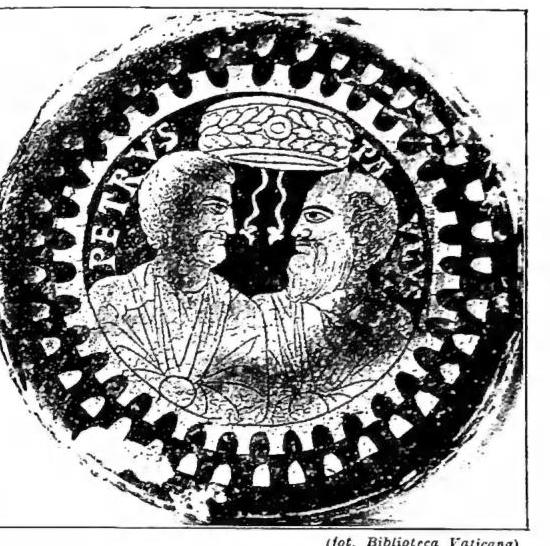
3. Place
As for the place of martyrdom, it is indicated in the Martyrium Petri of the Pseudo-Linus “ad locum qui vocatur Naumachiae, iuxta obeliscum Neronis, in montem” (in R. A. Lipsius, Acta Apostol. apocr., Leipzig 1891, pp. 11-22). In the later account of the Pseudo-Marcellus it is Nero himself who orders that Peter and Paul be put to death “in the naumachia.” The Liber Pontificalis indicates the place of martyrdom as near that of the tomb, placing it “in templum Apollinis iuxta locum ubi crucifixus est, iuxta palatium Neronianum in Vaticanum, in territorio Triumphali Via Aurelia,” as stated in the biography of St Peter (I, p. 52); this topographical indication is repeated for the translation of his relics from the place “in catacumbas,” which is attributed to Pope Cornelius, who would have deposited them “iuxta locum ubi crucifixus est, inter corpora sanctorum episcoporum, in templum Apollinis in monte Aureum, in Vaticanum, palatii Neroniani, III Kal. Iul.” (I, p. 150).IV. TOMB
The earliest testimony regarding the place of burial of the Apostle is the well-known passage of the “vir ecclesiasticus Gaius,” who, in his polemical writing against Proclus, head of the sect of the Cataphrygians (Montanists), wrote: “If you go to the Vatican or along the road to Ostia, I can show you the trophies (τράπευα) of the founders of this church,” in Eusebius, Hist. eccl., II, 25. Jerome writes that Peter was buried at Rome in the Vatican, near the Via Triumphalis, where he is venerated by the whole world (De vir. ill., 1: PL 23, 639). The place is indicated in the second redaction of the Liber Pontificalis in the biography of Peter in the following manner: “Peter was buried on the Via Aurelia, in the temple of Apollo, near the place where he was crucified, near the Palatium Neronianum, in the Vatican, near the territory of the Triumphalis, on the III Kalends of July” (I, 118). In the biography of Cornelius the Pope it would be reported “from the Catacombs near the place where he was crucified, among the bodies of the holy bishops, in the temple of Apollo, on the Monte Aureo in the Vatican, near the Palatium Neronianum, on the III Kalends of July” (ibid., p. 150). According to the biography of Sylvester, Constantine built the basilica of St. Peter “in the temple of Apollo, whose little shrine he thus enclosed with the body of St. Peter” (I, p. 176). That the Constantinian Basilica arose “in the temple of Apollo” is affirmed, as has been seen, three times in the Liber Pontificalis. But in recent excavations, throughout the entire area of the confessio, no other remains have been found except those of tombs; nothing that would authorize the search for the “temple of Apollo” mentioned above. The information published about the nature of the tomb of St. Peter was very summary and contradictory. Previously it can be said that the excavations and archaeological discoveries had always been occasional, and only as much was known as had been transmitted by Pietro Mallio, by Maffeo Vegio, and by the finds of 1594 and 1626, within the area of the confessio. G. Settele, commissioned together with E. Sarti to append to the work of F. L. Dionisi on the Vatican Grottoes, published in 1846, carried out some research in the niche of the pallia. It results from his diary that he brought to light again the gate of Innocent III, removed the metal slab of Innocent X, recognizing that it “rested upon a wall that has a square hole, beneath which is a space, as described by Borgia in the Vatican Confessio (p. LXIX). But when a light was lowered down, it was seen that at the depth of five palms there were cements and among these a bone of a rib and a piece of wood” (R. Cugnoni, Giuseppe Settele e il suo diario, Rome 1888). On the basis of the Vita Silvestri in the Liber Pontificalis, archaeologists believed that the tomb of the Apostle was underground, and G. Wilpert even attempted a reconstruction of it, although Duchesne had warned not to consider reliable the data provided by the biographer of the 6th century (Liber Pontificalis, I, p. 194, n. 61; L. Duchesne, Notes sur la topographie de Rome au moyen âge, Vaticana, XII, in Mélanges d'arch. et d'hist., 35 [1915], p. 67).Now, for the first time in the annals of history, from 1939 to 1949, through the personal initiative of the Supreme Pontiff Pius XII, explorations could be carried out within the confessio of the Vatican Basilica, thus crowning his personal aspiration, formulated even before his elevation to the Chair of St. Peter.
In 1939, when it was necessary to provide a tomb for Pius XI in the Vatican Grottoes, the same Pope Pius XII wished that the level of the floor of these grottoes be lowered and that a more worthy arrangement be given to the tombs of his predecessors existing there. Thus the explorations in the confessio were begun. The progress of the excavations was always conditioned by the static requirements of the Basilica, especially in the two most delicate parts, such as the area of the piers of the dome, the foundations of the medieval confessio and of Clement VIII, of the main altar of the same Pope and of Bernini’s baldachin. The report of the excavations carried out has been published by B. M. Apollonj-Ghetti, A. Ferrua S. J., E. Josi, E. Kirschbaum S. J., Esplorazioni sotto la Confessione di S. Pietro in Vaticano eseguite negli anni 1940-49, with a numismatic appendix by C. Serafini (2 vols., Vatican City 1951). If one descends today into the confessio, where there is the statue of Pius VI in prayer (executed by Canova), one sees before one the splendid polychrome marble decoration of Paul V, directly beneath the papal altar. In the center stands a rich gate of gilded bronze; behind this there is another high gate, also of gilded bronze, on which is inscribed a metrical inscription of Innocent III (1198–1216). Behind this grating is fixed an oak table, about 2.35 m long and 36.5 cm high, to which are affixed two small columns and a fragment of a crenellated tower in Limoges enamel. The original decoration can be reconstructed, as Stohlman has done, by means of the examples of antependia offered to the cathedrals of Orense and of Santo Domingo de Silos, especially since the small statues that belonged to it are now in the Museo Sacro of the Vatican Library.
In the center was Jesus Christ enthroned between the symbols of the four Evangelists and the twelve Apostles, divided into two groups of six, beneath the arches of the walled city of turretted Jerusalem; in other words, it is the same representation that about eight centuries earlier had been placed there by the Emperor Valentinian III at the time of Sixtus III (432–40). In the plane of the niche is situated a silver casket offered by Benedict XIV to contain the sacred pallia which are blessed by the Pope every year on the eve of the feast of St. Peter. At the back opens an irregular apsidal niche with, to the right and left in mosaic, the Apostles Peter and Paul, from the time of Urban VIII, but restored under Pius IX. In the depths of the apse stands out the mosaic with the image of Christ, bearded, with long hair, with a cruciform nimbus; with His right hand He makes the oratorical gesture, in His left He holds the open book on whose pages is read: “Ego sum via, veritas et vita; qui credit in me vivet.” The mosaic, however, has undergone many and not always fortunate restorations.
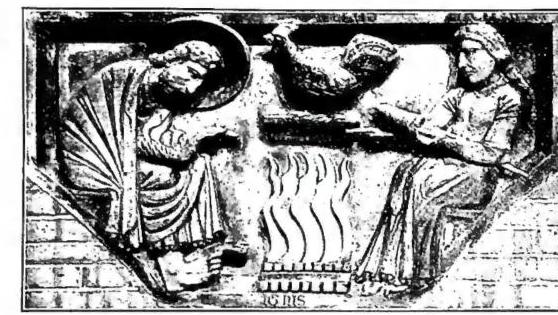
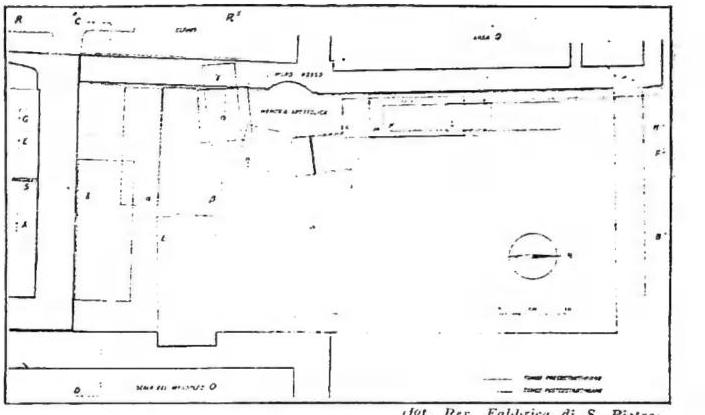
The relics of the Apostle were deposited at the very place of his martyrdom on the slope of the Vatican hill, in a simple trench in bare earth, covered by a few roof-tiles—precisely one of those graves which the historian Tacitus describes as “humili sepultura” (Hist., I, 49). The four Gospels relate that the body of the Redeemer was requested by Joseph of Arimathea from the same Roman authority that had pronounced the sentence of crucifixion, and that Pilate “gave up the body.” Indeed Roman law laid down that “corpora damnatorum quibuslibet petentibus ad sepulturam danda sunt.” Moreover this “ius sepulchri” was later granted to all the other Roman martyrs, even to Sixtus II and his four deacon-martyrs who were “incontinenter animadversi” because they were caught on 6 August 258 in the cemetery of Callistus itself. The same procedure was followed for the body of the disciple Peter as for the divine Master. His burial took place in an area of the Vatican hill where there seem already to have been other tombs, such as the one marked γ, even deeper, consisting of a terracotta sarcophagus protected by a wall containing a terracotta pipe for libations, rising above the ground surface, as has been found in other Roman tombs and elsewhere. Another trench to the east, θ, contained another corpse likewise laid in bare earth; it was covered by roof-tiles, one of which bears the maker’s stamp of “Stat. Marcius Demetrius” (CIL, XV, 1273 a), dated by E. Dressel to the time of Vespasian (69–79); but stamps from the same workshop were also found in Caligula’s ships at Nemi (G. Gatti, in G. Ucelli, Le navi di Nemi, Rome 1938, pp. 337 ff.). It should be noted that both γ and θ have the same east–west orientation, slanting toward the south-west, in the same way as the Apostle’s tomb was arranged.
To the south-east of this field of Peter, after AD 123 but not later than the mid-second century, the Matucci mausoleum (O) was erected, as attested by the still-in-place titulus on its façade, in front of which is an ambitus bounded by a wall in opus reticulatum leading to a staircase built at the western end of the mausoleum itself, of which it is contemporary. Behind the Matucci mausoleum and to its west was erected mausoleum S, largely destroyed in 1626 by the foundations of the south-east pier supporting Gian Lorenzo Bernini’s baldacchino over the high altar of Clement VIII. Uphill, bounded by walls, was field Q, entirely occupied by open-air inhumation graves covered by a mosaic pavement of basalt tesserae; access to this area was from the south by means of a clivus and a staircase; beneath the clivus, at a depth of 2.30 m, a drain was laid to carry off rainwater descending from the hill; its floor is made of bricks laid in courses, four of which bear the maker’s stamp “Aurelii Caesaria et Faustinae Augustae,” giving a date between AD 147–161, a date shared by the large protective wall recognized for a height of at least 2.50 m, a length of 7 m from north to south, about 0.50 m thick, revetted with coccio pesto and red plaster and therefore distinguished by the label
(photo: Fabbrica di S. Pietro)
of the “red wall.” All this was executed when the steep clivus running north–south was fitted with a staircase to give access to field Q and to the solarium of mausoleum R¹ which meanwhile had been built. The workman who built the red wall crossed over the western part of the Apostle’s tomb, which had already received a small protective wall m¹, plastered inside, suggesting another m²; at this point a rough irregular niche N¹ was made, 21 cm deep, 72 cm wide and about 1.40 m high; above it was placed a broken marble slab, previously used in a mausoleum because it contains the inscription of an “Aelius Isidorus.” Higher up in the thickness of the red wall a second niche N² was made, 0.72 m wide, lined with grey marble slabs and covered by a travertine slab supported by two Corinthian columns of white marble 1.40 m high; their bases, showing the rebate for a gate also on the east side, rested on a travertine threshold belonging to a square battentato. The southern column was still in place, the base and a fragment of the shaft of the northern one were later moved. Above this opens a third niche N³, 1.12 m wide and 0.92 m high. Yet this embellishment of the tomb shows that it was already at that time frequented and venerated by the Christian community of Rome; Eusebius indeed declares that “myriads” of visitors came from every part of the Roman Empire (Theophania Syriaca, IV, 7: ed. H. Gressmann, in CB, XI, 2, Leipzig 1904), a statement confirmed even by Julian the Apostate (Cyril of Alexandria, Contra Iulianum: PG 76, 1004 sqq.).
Excavation has brought to light precisely what, from the second century onward, was pointed out, venerated and recognized as the trophy of Peter. The space beneath niche N³, glimpsed by Settele and Grisar, was found to be filled with debris of walls and human bones of an elderly person; among the earth was collected a gold lamina on which is represented in the centre a jeweled cross between two eyes, of seventh-century workmanship, evidently an ex-voto for a healing obtained. The earth also yielded precious evidence of offerings left by unknown pilgrims of every age and country who left their alms at the tomb (see below). Meanwhile other graves, likewise only inhumations, had been dug all around; very ancient is tomb γ; not much later is tomb ζ; whereas tomb ι may have come into being together with the red wall, while κ and λ are later; post-Constantinian are α, β, δ, ε.
Further reinforcement was later required on the north side, where the red wall showed a crack, so that the northern colonnette was moved and the monument received a reinforcing wall about 50 cm thick and about 90 cm long, revetted on the north by a layer of decorated plaster which immediately received the graffiti of visitors who scratched their names on it
altars. “Simplici vivite in ♣ Nicasi vibas in ♣; Victor cum suis Gaudentia vibatis in ♣, etc. Paulina vivas, Prima vivas; in ♣ Venerosa Vea, Verus, Bonifatia, Venerosa, Vea,” etc. At a certain point, however, an opening was made in this graffiti-covered wall to install within the wall itself a small marble-slab chest, probably intended to hold relics. Everything was then sealed with a layer of lime that covered the graffiti. This must have occurred before the Constantinian works that definitively concealed the wall. After the publication of the excavation report, Fr. A. Ferrua identified, on the red wall behind the chest, a Greek-letter graffito invoking ΠΕΤΡ(Ε), and announced this in Cte. Catt., 1952, I, pp. 15-29, fig. 3.
In 1908, Gnirs published a precious ivory casket found near the confessio of the church of Samagher (Istria: see pl. 99 of vol. VI). The decoration on the back represents the presbytery of a basilica with an architrave supported by six vitrine columns and, in the center, a tabernacle or small edifice surmounted by a crown. These typical vitrine columns immediately led Gnirs himself, and later M. Cerrati, G. Wilpert, and P. Toesca, to believe that the presbytery of the Vatican basilica with the Apostle’s monument had been reproduced. The Constantinian architects were forced to construct an enormous platform against the hill rising to the north and west. The Roman necropolis (see VATICAN) was buried beneath this platform; the two steep slopes, east-west and south-north, were leveled not only by demolishing anything that might obstruct the foundations of the new building but also by removing whatever parts of the mausolea above the chosen level—about 1.30 meters from the Apostle’s tomb. All voids were filled with rubble, a veritable “congestio terrarum,” after numerous sarcophagi had been filled with bones from the smaller tombs found on the hillside; the same rubble was contained by masonry.
The floor of the Constantinian presbytery consists of thick marble slabs; remains of its enclosures survive to the north and south, where the setting for two of the six vitrine columns is still visible. The subsoil suffered further damage from the creation of a veritable Christian cemetery beneath the floor of the Constantinian Basilica, with formae and sarcophagi, as were found in the basilica “Apostolorum in catacumbas,” sarcophagi being especially frequent in the area of the apse and presbytery.
Gregory of Tours reports what he had learned from his deacon, Agisifus, who had visited the Apostolic Sanctuary in 589-90. He indicates the “sepulchrum sub altari collocatum” and difficult of access, “valde rarum habetur.” To approach it, the gates surrounding it had to be opened—“reseratis cancellis, quibus ille ambitur”—and then one reached the tomb itself—“accedit super sepulchrum.” One then had to open a small window—“et sic fenestella parvula patefacta”—through which one could insert one’s head and implore the graces needed—“immissio introrsum capite, quae necessitas promit efflagitat” (De gloria martyrum, 27: PL 71, 728).
There were thus two closures protecting the tomb: an outer gate and a “fenestella parvula” that could be opened. The imperial legates refer to these two closures in their petition to Pope Hormisdas. Between 514 and 523, they had come to Rome sent by Emperor Justinian, asking the Pope for relics that had been near the tombs of St. Peter and St. Paul, if possible “usque ad secundam cataractam”; hitherto “catartha” has been understood to mean a vertical shaft at the tomb where objects could be lowered.
Gregory of Tours also reports that many pilgrims had golden keys made identical to those that locked the gates of the Apostle’s tomb and substituted them, once blessed, as remedies against illness. The custom of these golden keys is confirmed by a letter of Gregory the Great, in which he writes of sending to John, former consul, patrician, and quaestor, one of the keys used to lock the gates of St. Peter’s tomb; he calls it “sacratissima” because it contains filings from the Apostle’s chains. It seems such keys were also worn around the neck as devotional objects.
The mosaic decoration of the niche of the pallia, preserved to us with repeated and not always successful restorations, is certainly no earlier than Leo IV (847-55). Many works were carried out by Leo IV “post depredationem Saracenorum” in the Vatican Basilica. The biographer records three “imagines argenteas totasque exauratas” placed “in corpus beati Petri” (Lib. pont., II, p. 111); shortly afterward, however, he describes the Pope’s anguish “cum cotidie beatissimi apostolorum principis Petri sacratissimum altare cerneret violatum,” whereupon he clad in gold and silver “non tantum confessionem sacram, verum etiam frontem sepediciti altaris” (ibid., p. 113); a little later, mention is made of an altar “quod supra sanctissimum beati Petri apostoli corpus consistit” (ibid., p. 133). The Liber Pontificalis states that the basilicas of St. Peter and St. Paul were “funditus depredatione sunt” by the Saracens (II, p. 106). The Annales Bertiniani declare that the Saracens took away “cum ipso altari, quod tumbae memorati Apost. principis superpositum fuerat, omnibus ornamentis atque thesauris.” Clear traces of the depredations were found beneath the shutter of Innocent X, where a triple lead lining was found broken and violently twisted at its edges, and likewise a very thin silver lamina, the only metallic remains found on the tomb itself.
The presbytery altar above the tomb was in ruins in the 12th century, and Callixtus II enclosed it within his own altar, which he consecrated on March 25, 1123; upon it, in 1594, Clement VIII erected the present high altar. Of the many tombs discovered, the humble burial of the Apostle is the only one that shows unmistakable signs of later embellishment and uninterrupted veneration from the time of Gaius’s presbytery—that is, from the late 2nd century. The 1,900 coins, the gold ex-voto, the triple lead lining, and the thin silver lamina constitute evident proof of its veneration, which has always remained localized where the sumptuous Constantinian revetment arose, where altars were superimposed one upon another—that of the elevated presbytery, of Callixtus II, of Clement VIII—remaining throughout the centuries the center of veneration and cult.
Indeed, from the Liber Diurnus it appears that the indictulum written by every newly elected Lombard bishop was addressed to the same Apostle P. and deposited on the body of the Apostle “supra sacratissimum corpus tuum beate Petre”; likewise, the new pope, on the day of his election, addressed to the Apostle his “promissio fidei,” which was presented together with the oath at the Confession of the Apostle, while on the day of consecration the “cautio” addressed to the Church of Rome was offered to the Confession and preserved “in venerabile corpus tuum beate Petre apostole” (formula 76: ed. Th. V. Sickel, Vienna 1889, pp. 80–81). The biographer of Hadrian I attests that Charlemagne, on 6 April 774, deposited the text of his donation, signed by himself and his dignitaries, first on the altar of the Apostle and then in the Confession “intus super corpus beati Petri...”