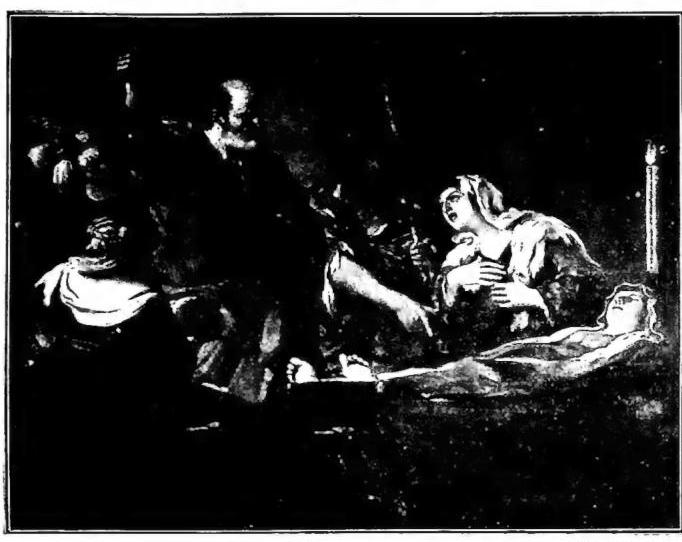
With her means she assisted the needy and was "rich in good works." It is possible that she belonged to the group of "widows" (codex Sessorianus 82 calls her a "widow"), already organized from the time of the ordination of the seven Deacons (Acts 6:1), though perhaps not yet in the form that appears in 1 Tim. 5:9 ff. Having died while St. Peter was at Lydda, three hours from Joppa, she was raised by him under circumstances that in part recall the raising of Jairus's daughter (Mark 5:35-43), which St. Peter had in fact witnessed and which St. Luke could also have known from the Gospel of St. Mark. The non-Catholics Baur, Holtzmann, Pfleiderer and Knopf wrongly regard this miracle as a "doublet" in order to deny its historicity.
T. is a transcription of the Aramaic ρῥῖτι (Hebrew ʾebhijjāh, Greek δαραάς), "gazelle" (regarded by the Semites and by the Bible as a type of beauty; cf. the Hebrew ʾebhī, "ornament"); it was widely used as a woman's name, like other animal names (Rachel, Deborah, Jemima).
Bibliography4 worksE. Jacquier, Les Actes des Apôtres, Paris 1926, pp. 307-10; J. Viteau, L'institution des diacres et des veuves, in Revue d'histoire ecclésia
BIBL.: E. Jacquier, Les Actes des Apôtres, Paris 1926, pp. 307-10; J. Viteau, L'institution des diacres et des veuves, in Revue d'histoire ecclésiastique, 22 (1926), pp. 521-26, 528-34; A. Steinmann, Die Apostelgeschichte, Bonn 1934, p. 101 f. (with bibliography); G. Ricciotti, Gli Atti degli Apostoli tradotti e commentati, Rome 1951, p. 179 f.
ARCHAEOLOGY
In a fragment of a sarcophagus from Arles, the scene of the miracle of the resurrection of T. is represented, according to the narrative of Acts 9:36-42: the Apostle approaches the bed where the deceased T. is laid, takes her by the arm and she rises; in the foreground are two veiled widows, before the Apostle two other kneeling female figures. The same subject was identified by G. Wilpert in a sarcophagus of St-Maximin; it is then reproduced in an ivory of the British Museum.
Bibliography2 worksO. M. Dalton, Catalogue of the ivories of the British Museum, London 1909, pl. 7, no. 292; Wilpert, Sarcofagi, I, pl. 145, 6-5.
BIBL.: O. M. Dalton, Catalogue of the ivories of the British Museum, London 1909, pl. 7, no. 292; Wilpert, Sarcofagi, I, pl. 145, 6-5.
Josi, Enrico, and Luigi Vagaggini. “Tabitha (ΤΑΒΙΔΆ).” In Enciclopedia Cattolica, vol. XI, col. 1684. Città del Vaticano: Ente per l’Enciclopedia Cattolica e per il Libro Cattolico, 1953. https://azioneromana.com/article/tabitha-tabida.
MLA
Josi, Enrico, and Luigi Vagaggini. “Tabitha (ΤΑΒΙΔΆ).” Enciclopedia Cattolica, vol. XI, Ente per l’Enciclopedia Cattolica e per il Libro Cattolico, 1953, col. 1684. Azione Romana, https://azioneromana.com/article/tabitha-tabida.
BibTeX
@incollection{ec11_tabitha_tabida,
  author    = {Josi, Enrico and Vagaggini, Luigi},
  title     = {Tabitha (ΤΑΒΙΔΆ)},
  booktitle = {Enciclopedia Cattolica},
  volume    = {XI},
  pages     = {1684},
  note      = {Cited by column},
  publisher = {Ente per l’Enciclopedia Cattolica e per il Libro Cattolico},
  address   = {Città del Vaticano},
  year      = {1953},
  url       = {https://azioneromana.com/article/tabitha-tabida}
}
One of some 20,000 entries brought back from the twelve printed volumes (1948–54). Spotted something? Help us improve it.
Click or scroll to zoom · drag to pan · Esc to close